From Derek Watt:
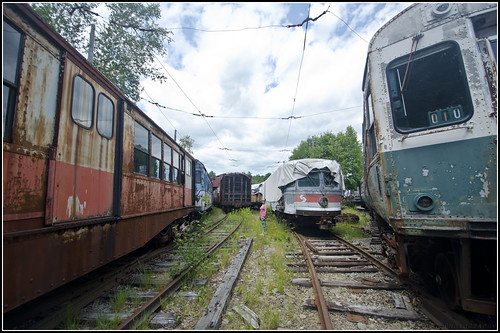
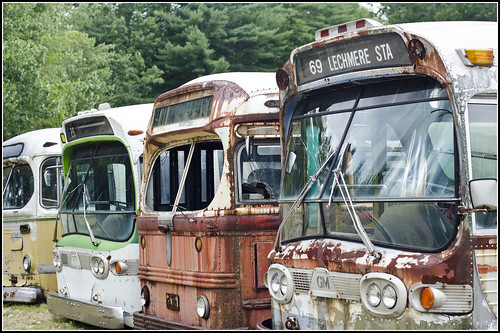
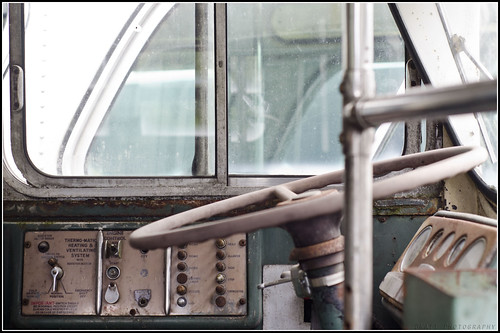
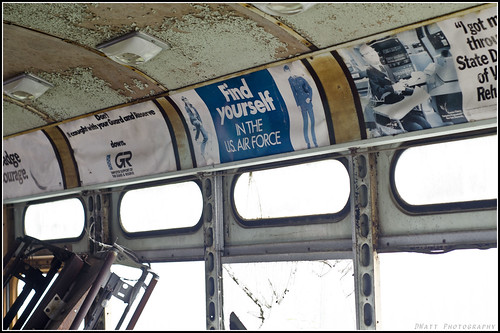
(Derek Watt took these great photos of a transportation graveyard somewhere in New England -- D.B.)
From Derek Watt:
(Derek Watt took these great photos of a transportation graveyard somewhere in New England -- D.B.)
From Dave Brigham:
I don't have much to say about this place. It's been torn down since this Google Maps image was made. Located along Route 9 in Brookline, Mass., it was just a gas station, and not even a historic one (for some cool old gas Midwest gas stations, see June 6, 2012, "Fill 'er Up").
This is what it looks like now:


I haven't been able to find out what's going to be built here. Five years ago, the Chestnut Hill Neighborhood Association posted on its web site the following:
There is a "proposal to demolish the US Petroleum gas station on the northwest corner of Route 9 and Reservoir Road and replace it with a five-story masonry and glass medical/office use structure with retail space on the ground floor....Parking would be provided on three below-ground levels."
Stay tuned.
From Dave Brigham:
As a kid in the '70s tearing around my neighborhood and through the woods, I figured the bike I rode was an invention as old as time itself. There were no mountain bikes in those days, kids, just cruisers, three-speeds, five-speeds and ten-speeds that you rode anywhere and everywhere, treating them alternately like motorcycles, horses, moving trucks and, well, bicycles.
The history of two-wheeled transport goes back centuries, but the advent of what we recognize today as a bicycle began in the 19th century. For a time in the late 1800s and early 1900s, bicycle racing captivated America the way that NASCAR does today. And the fastest dirt bicycle racing track in the country was located in good ol' Waltham, Mass., the city I've written about more than any other on this blog.
Opened in 1893, Waltham Bicycle Park was the first track in Massachusetts built specifically for bike racing (others were also used for horse racing), according to this article on HubTrotter. Numerous world records fell at the park during its heyday.
The park had a grandstand and bleachers that could hold as many as 9,000 spectators. On opening day, more than 15,000 bike racing enthusiasts crammed the park, according to the HubTrotter article. According to a Boston Globe article, on opening day (and probably other days), people sat on the roofs of nearby buildings, as well as hills adjacent to the park.
Here's an illustration from the article:

Racing was very popular at this park, as at many others, but a serious accident, in which two racers were killed, in June 1900 put a damper on the enthusiasm. Two years later, the city of Waltham purchased the park and turned it into a football field. Nowadays, the site, known as Nipper Maher Park, includes Little League fields, tennis courts and a playground.
Here's what the park looks like now:

Here's a current shot of the hospital where some spectators may have watched races:

Here's a current shot of a hill behind where the grandstand once stood. Paths lead up to a neighborhood.

I just recently learned about the history of this park, so I set out to see what, if anything, remained from the bicycle racing facility that had so captured the attention of locals more than 100 years ago. When I saw some stone pieces in the woods and on the perimeter of the park, I thought perhaps they had been part of the grandstand.


It's hard to know what sort of structure these stones were part of. Are they simply leftovers from a more recent set of bleachers or small buildings. Anybody know, or have any guesses?
From Dave Brigham:

Is the word "teardown" in your town's lexicon? No? Well, then let me define it for you: "the process of buying an older, sometimes rundown house, knocking it flat to the ground and building an often oversized house in its place." What ever happened to renovation? My wife and I watch TV shows all the time where builders buy a house, take it down to the studs and turn it into a beautiful new place without the need to rip up a piece of a neighborhood's history.
Unbeknownst to me at the time, I lived in a future teardown in Newton, Mass., several years ago. Called La Casita Flatita (roughly translated as "the little flat house") by our landlord, a 70-something Italian-American guy who grew up in the house, the place was small, of course, but it was cute.
Our landlord's father built the house on a decent-sized lot that was cursed by a giant rock ledge that extended into the basement. He chipped away at the stone in there, our landlord said, to make the basement bigger. In the furthest part of the basement, where you had to duck your head, there was an old wine barrel. Our landlord's father grew his own grapes and made his own vino.
That's a great piece of history that I'll never forget. My wife, Beth, and I lived in the house for about two and a half years until our landlord told us he was going to put his childhood home on the market. Beth and I went back and forth about whether to make an offer. There were only two bedrooms and one bathroom, but it was on a quiet street that was walking distance to Newton Center, where there were stores, restaurants, banks and a trolley line. We were also right around the corner from two malls.
We decided to go for it, but our landlord rejected our offer. We decided to look elsewhere, and found a place not too far away, in the West Roxbury neighborhood of Boston.
We were sad to find out a few months later that the house had been sold to a developer, for not much more than we had offered. Before long, the house was leveled, the ledge blown up and two townhouses went up in its place. La Casita Flatita was gone, and so was its history.
Developers in Newton and surrounding towns have been mad for teardowns for years. I understand the economics: buy an out-of-fashion Cape or ranch house for $600,00-$700,000 (real estate around here is kinda crazy)....

...bulldoze the offending property and replace it with a much larger house that will sell for $1 million or more.***

Often times, the smaller homes are replaced with two or even three town houses, because the lots are decent sized and the zoning laws allow for this. Read this February 2015 Boston Globe Magazine article for more on teardowns in Newton and surrounding communities.
Also see our March 18, 2011, post, "Anatomy of a Teardown."
I'm not saying every old Cape, ranch or bungalow needs to be saved. I know that some places are simply beyond restoration, although Nicole Curtis might beg to differ with me on that. But when developers scoop up a house, erase the memories and history of that place, erect a bland structure with little architectural detail or sense of scale, and sell it to people who want a move-in ready home rather than being willing to put a bit of themselves into a place, it can be easy for neighbors to take offense.
The house at the top of this post was right around the corner from mine until about a year and a half ago. A nondescript brick ranch house, it was leveled, with the exception of one wall, and a new, multi-gabled house went up in its place. Eventually that one wall was torn down -- I imagine this had something to do with zoning/teardown regulations in Newton.
Within the last year or so, several other houses in the vicinity have been knocked down, along with dozens across the city of Newton.

The house that once stood here was featured in a John Travolta movie, "The Forger." Here's a brief article about the shoot, featuring a photo of the place.
Any smart developer/realtor could have squeezed some extra cash out of a potential buyer if they mentioned this fact. But no, somebody tore the damn thing down and put up a house that wasn't in a movie, and most likely won't ever be.
The place below was built in 1920, and purchased for $500,000 in May of this year.

When I saw this piece of heavy machinery parked in the yard, I knew the house's days were limited, despite my wife's insistence that somebody might just be planning a renovation.

The house was emptied first, and the prior owner's belongings were plowed into a big, dirty mess.

Still, amid the rubble there was life, personality, a sense of who the former owner was.

In November 2014, the Newton Board of Aldermen voted to reject a proposed moratorium on teardowns involving homes greater than 120% of the original structure’s floor area.
The primary argument against teardowns comes down to economics: by taking potential starter homes (albeit fairly expensive ones compared to towns a bit further out from Boston) off the market, these developers are catering to a certain class of folks -- rich ones.
As a liberal and someone who loves old homes (mine is from the early '20s), I agree with these arguments against allowing one home to be demolished and replaced with a McMansion or two or more expensive townhouses. At the same time, I don't think you can legislate against developers trying to maximize their profits. I hope there's a meeting place for the two sides in this argument, but rezoning neighborhoods and reworking the details of a replacement house's footprint are big issues that few in Newton's government want to take on.
***These houses are both currently in Newton's Oak Park neighborhood; I offer these photos as an example of the types of houses being torn down, and what replaces them.
From Kris Smith:
Wisconsin isn’t an old state, relatively speaking; it’s only been one since 1848. To this native New Englander, the Badger State is pretty new, and the differences between regions are interesting. New Hampshire has way more old cemeteries, but a lot fewer abandoned buildings. With this find, I got both. Kind of.
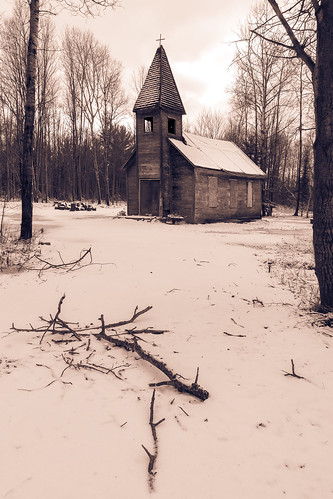
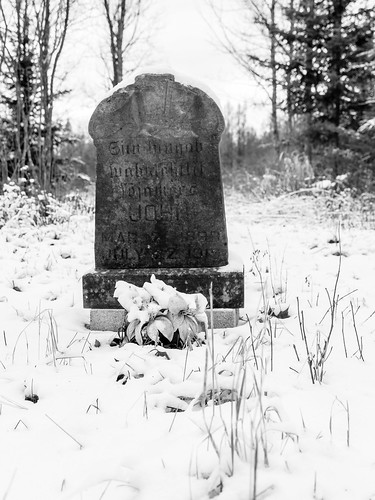
This is the country’s first and oldest Estonian Lutheran church. It was built in Gleason around 1914 or 15 by immigrants fleeing Russian oppression, who decided the Wisconsin River Valley would remind them of their lost homeland and provide plenty of farm and timber land. The congregation was only about 30, but the church, once they built it, became their community center. The cemetery was consecrated before the church went up. Eleven of the original 14 interments remain and many have new markers, although I preferred to photograph one of the originals.
They had an altar, pews and a lectern; all made with rough-hewn planks. Women sat on one side of the aisle, men on the other. Decoration came from their own hands or gardens. What they didn’t have was a bell. Bell-lessness didn’t last long; soon Sears & Roebuck sent “one of their smallest bells” as a result of a donation request from church elders, who stated that Estonians were good customers and the company should give them a bell.
The church saw sporadic, but consistent use by the Estonian immigrants for the next half-century, but tragedy struck soon after the 50th Anniversary celebration. Vandals began to desecrate and destroy the tiny building. Everything was smashed or stolen, including the much-loved bell. In 1970 the people decided to board up their church and leave it alone, figuring that if something looked unloved and useless the vandals would leave it alone. They were right.
Today the church stands alone in its clearing. Some renovation has been done over the years with efforts to preserve the rustic little building. It’s charming and sad and once again has no bell.
From Mick Melvin:
I was driving in New Britain, CT, one day and I did a double take.
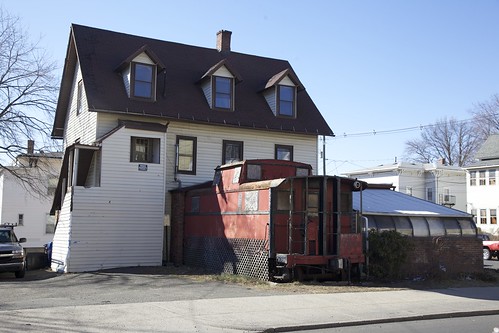
I couldn’t believe my eyes when I saw a train sticking out of a house. It was actually a big red caboose, which is in fact, attached to the house. Well, it's actually attached to the house and another room is attached to the side of the train.
Some folks from New Britain told me the place was called Reno's Cafe. The records show it was established in 1990 and incorporated in Connecticut. I searched reviews for the place, and the last mention of the restaurant was in 2013. The review said the place was nice and it was more of a bar than a café. They actually applied for a liquor license in 2013-2014, but I could find no other mention of the place.
From Dave Brigham:
It's always better to get out and walk. Seems obvious, no? Driving is faster, sure, but you miss so much. People sometimes ask me, "How do you find all these places to write about and take pictures of?" All you gotta do, I say, is walk around a bit.
After driving through the intersection of Main Street/Rte. 20, Weston Street/Rte. 117 and South Street in Waltham, Mass., numerous times, I found myself focusing on two stone monuments on the grounds of the former Banks School. So one day when I had a few minutes, I parked in the school lot and walked up to see what these big slabs are all about.

This one commemorates the so-called Henry Knox Trail, the path that the general took in late 1775/early 1776 from Fort Ticonderoga in New York to Boston to deliver 59 cannons to Gen. George Washington. Other markers along the trail are located in New York towns and cities including Glens Falls, Hudson Falls, Schuylerville and Albany, and Massachusetts towns and cities including Palmer, Marlborough, Framingham and Cambridge.
Here's a detail from the marker.

This marker is for the George Washington Memorial Highway.

The highway -- aka Route 20 -- was created in 1932 to celebrate the bicentennial of Washington's birth, and the route that he took on his way to Boston to assume command of the Continental Army. "There were parades from Agawam to Cambridge," at the time, according to Bryan Farr, founder of The Historic U.S. Route 20 Association, quoted in the MetroWest Daily News in June 2014. "They had a guy dressed up like Washington ride a horse along the route. The streets were lined with people."
The state, however, declined to officially name Route 20 after Washington.

Here's a detail of the marker.
You never know what you'll learn when you go for a little jaunt.
From Dave Brigham:
It's ironic that Anthony's Pier 4, the venerable waterfront restaurant in Boston that was once the place to see and be seen, is being torn down as the neighborhood around it has risen to become the hottest spot in the city.
I went to Anthony's once, to celebrate when my girlfriend (now wife), Beth, graduated from law school. I'd heard of the place from Beth's family, and knew somewhat of its reputation as a special occasion destination and place where celebrities hung out when they were in town.
We took pictures on the back deck, which overlooked Boston Harbor and had great views of the city and the airport. The food was good, not great, but I reveled in looking over the dozens of photos in the hallway leading from the front door into the restaurant: owner Anthony Athanas with Liz Taylor, Judy Garland, Merv Griffin, Johnny Carson and many other A-listers.
Athanas opened his restaurant in 1963. He died in 2005 but the restaurant lived on for eight more years. In its later years, Anthony's Pier 4 fought for customers with a crowd of high-end restaurants in downtown Boston, as well as more options along the waterfront, which was christened the Seaport District in recent years.
I wish I'd taken some photos of the place in its heyday and in more recent years as it sat waiting for its fate. I didn't, but the Boston Globe recently ran some photos from the salad days of Anthony's Pier 4 -- including one of the former passenger liner that was used as a cocktail lounge until it sunk during the blizzard of '78 -- as well as images of the place stripped, unfortunately, of its glory. You can see them here.
Demolition crews began ripping the restaurant down yesterday.
Here are three previous nods to ones that got away:
May 2, 2010, about the former Metz Automobile Factory in Waltham, Mass.
June 1, 2010, about the former Whalom Park in Leominster, Mass.
June 5, 2015, about Veronica's Spa in Waltham, Mass.
From Dave Brigham:
Somerville, Mass., was once the car-theft capital of America, according to Wikipedia, and, more importantly, my friend Jim who grew up there in the 1960s and '70s. The city was much grittier back then, with the Winter Hill Gang in cahoots with the infamous Whitey Bulger, and factories and small industry dominating much of the business landscape. In more recent years, the city, a tightly packed mixture of blue collar workers, hipsters, college students and professionals tucked between Cambridge, Medford, Boston and Arlington, has become a mecca for bars, restaurants, clubs and funky shops and start-up companies.
It was while checking out one of these newer companies -- Taza Chocolate -- a while back that I stumbled across a part of the old Somerville that I suspect not many of the newer residents know about.
Located in a large factory building that once housed companies including Consolidated Bag & Foil Corp. and Sugarman Brothers, according to the Somerville Historic Preservation Commission, Taza offers regular tours of its operations -- and free samples! As my kids and I drove down Windsor Street toward the factory, we passed by a junkyard, with stacks of cars and trucks on both sides of the roadway looming behind corrugated metal fences.
We enjoyed learning how the confections are made, as well as eating the free samples of dark chocolate mixed with all sorts of fruits, peppers, nuts and other ingredients. Well, I liked them anyway.
I made a mental note to visit the area again to take photos of the junkyard, and finally got around to it a few months ago.


The place -- Nissenbaum's Quality Used Auto Parts -- made an even bigger impression on me the second time. Around since 1910, the company is operated by fourth and fifth generations of the founding family, in the same location, I believe.

This gives you a sense for the history of the place, which is the favorite junkyard of the "Car Talk" guys.

And this gives you a sense of how tight things are in this neighborhood, which is very close to a set of train tracks, and which formerly hosted slaughterhouses and meat packing companies.
But this being Somerville, a community increasingly filled with eco-conscious folks, the junkyard backs up to a community garden.

Below are views of the front and back of the junkyard.


In addition to at least one other junkyard in this area, there are auto parts stores and repair shops. Here are two shots of Columbia Auto Parts.


I highly recommend checking out both the chocolate factory and the junkyard. And there are countless great bars, restaurants and shops a short distance away, as well as the Slumbrew tap room.
From Dave Brigham:
It's hard to capture the history and feel of a town simply by spending a few hours there, snapping away while (mostly) following a pre-established route designed to hit the highlights. But that's all I can do, except in my adopted hometown of Newton, Mass. (see May 21, 2015, "I Seek Newton, Part I: Lower Falls," and September 20, 2015, "I Seek Newton, Part II: Auburndale," and March 23, 2016, "I Seek Newton, Part III: Highlands").
Littleton, Mass., was settled by colonists in 1686. A small farming community back then, and even somewhat to this day, the town nonetheless has played a part in the state's digital economy, hosting large complexes first for Digital Equipment Corp., and then IBM, according to Wikipedia.
When visiting a town I know little or nothing about, I make no pretense of covering everything, or even most things, that are historically significant. While I love the beautiful old farm houses and Victorians I see in every town in Massachusetts, I'm more interested in the industries of old -- railroads, factories, mills. I take great pleasure in the hunt for the obscure location, the forgotten place.
I've done numerous drive-by photo shoots of communities in the area near Routes 2, 495, 117, 190, 20 and 62 (see February 17, 2016, "Bunker Buster," December 29, 2015, "Gravity Can Lift You Up," December 17, 2015, "Bring Out Your Dead," December 9, 2015, "Scenes From An Old Shoe Town," November 30, 2015, "Walking Dead Tracks" and November 8, 2015, "This Town Ain't Big Enough....").
All I knew about Littleton before visiting was a) I drove through there to get to Kimball Farm in Westford, and b) a client of the accounting firm where I worked 20 years ago owned Nagog Hill Orchard. As always, I did some research online ahead of time to find a handful of sites to check out.
Here's what I found....

(The Littleton Depot, built in 1879, is home to Erickson's Antique Stoves.)

(Boston & Maine caboose, which sits next to a few rusty freight cars, behind the depot.)

(Littleton Depot guard shanty.)
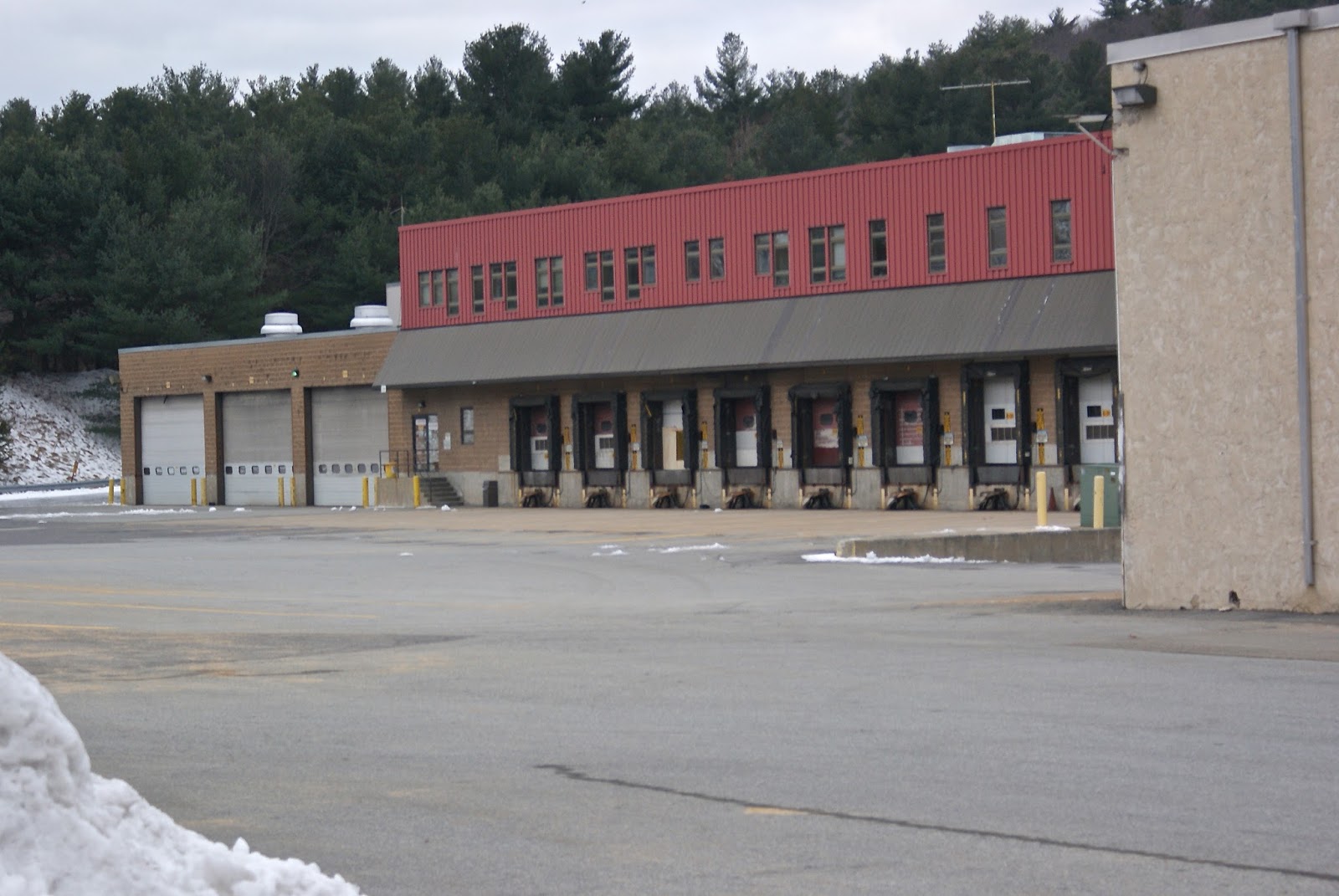
(Inactive loading docks at bottling plant that was most recently for Sunny Delight. That company bought Veryfine, a successor company to a cider mill begun in 1865, according to Wikipedia. Veryfine was an integral part of Littleton until it closed last fall.)

(Covered walkway at Sunny Delight/Veryfine plant, which is just down the street from the old depot.)
(Administrative building at former Sunny Delight plant.)
The road off Route 2A that would have taken me to my next stop, a cemetery, was closed. So I drove a bit more until I hit the town of Groton. Just over the border, I saw this church.


After a bit of research, I learned that the pastor has moved to an Emmanuel Church in Ayer. Not sure what will become of this place.
The next spot on my list was the Hartwell Family Memorial Preserve. I had two goals at this conservation area: get a bit of exercise and seek out the old stone slab bridge indicated on the Littleton Conservation Trust web site.
I was planning on walking most of the way, but the snow pack on the trails was so severely iced over that I ended up slip sliding/ice skating my way much of the time. Thankfully I didn't fall or strain any muscles. I found the bridge, which isn't all that impressive, except for the fact that it's about 150 years old.

The site includes wooded areas, a brook/swamp, small meadows and a field where crops were formerly planted.

Next I headed east on Route 2A toward the busier areas of town. Next to the Masonic Hall (Tahattawan Lodge) is a scuffed up sign for the former Central Hall. Built in the early 1800's, the hall hosted town meetings and dances, as well as grange and church meetings. The building also served as the town's post office and telephone office, as well a gas station, bakery and grocery store over the years. It was abandoned in 1979 and fell victim to fire two years later and eventually torn down.

Where 2A meets Route 119, there is action, and history.
Conant's Store has been around since 1840, and has served mostly as a general store, but also as a post office, barber shop, grocery store, department store, cobbler's shop and an automobile agency. As you can see in my picture, currently it is splitting its time as the Massachusetts headquarters of Donald Trump's presidential campaign. They opened up just a week before I happened by.

Just around the corner is the former Littleton Mill. The building houses a fantastic variety of small businesses, including a theater, a music shop, a realtor, an electrician and a custom clothing shop specializing in cloaks and medieval attire.

And whatever this business is.

On a side street off Rte. 119, I spied this car out of the corner of my eye.

As I was snapping pictures, a gruff older dude emerged from the door in the background. He asked if he could help me. I told him I was just taking a few pictures and I'd be on my way.
"Why you doin' that?"
"It's a cool car," I said.
"Wanna buy it?" he asked.
He said he pulled it out of a local barn and it was in pretty bad shape.
"How long's it gonna take you to finish it?" I asked.
"Coupla years."
"Good luck."
Just a little up the road apiece I found this old greenhouse.

A place called Colonial Gardens was here once; most recently the attached building was a consignment shop. Across the street sits this beautiful home from 1673, known as the Baker House. To see more pictures, click here.

On the way to the next destination on my list, I passed a place that looked like something out of a movie about the Dust Bowl.

I believe this house, or at least some part of it, dates to the 1700's. Immediately to the west sits an access road to a new housing development. Just to the east sits the Nashoba Valley Tubing Park, part of the Nashoba Valley Ski Area. This house and much of the land surrounding it were once prime farmland. As small farmers have struggled and gone out of business, developers have come into the area. These sites are sure to be developed at some point.


Finally I made it to the last place on my list: Sarah Doublet Forest, named for the last Indian to hold title to a 500-acre Indian Reservation in Littleton, according to this article.
Here once again I encountered incredibly slippery ice packed on top of the snow. I skated along and thankfully found my quarry in short order.

Not sure what the story is with this chimney. I spied something just a short skate away....

There are benches nearby as well, all the structures dedicated to Ray Grande, a longtime volunteer for the town's conservation trust and other organizations.
So there you go -- a little bit of Littleton. There's plenty more to explore, so get there, get out of your car, and check it out.
From Dave Brigham: I apologize in advance for this, but I often feel the need to explain my headline choices: I'll admit that befo...


