From Dave Brigham:
Over the last two decades or so, local and national media outlets have published articles about Davis Square in Somerville, Mass., that use the word "hip." In a January 2012 Boston magazine article about the evolution of Davis Square from a working-class neighborhood to a "hip 'hood," the writer lists some of the old guard establishments (many of which still are in business today) alongside more recent bars, restaurants and stores (not all of which are still there).
A BU Today guide for Boston University students cites a 1997 Utne Reader article that "anoint[ed] Davis Square as one of the 10 hippest places in America," and says "[s]ome residents trace (or lament) the transformation" of the square from somewhat of a backwater to the destination zone it has become.
And Coastal Neighborhoods, which seemingly shouldn't give two clams about a non-seaside city such as Somerville, says that Davis Square is "certainly one of the hippest neighborhoods in Boston, but some might argue it’s actually one of the hippest places in America. That’s illustrated by some of the unique offerings of this northwest Somerville neighborhood. Vibrant Davis Square is made up of plenty of trendy bars and hip restaurants. Instead of chain stores, the neighborhood attracts a mix of mom-and-pop stores, public arts and one of the oldest movie theaters in the area."
Considering the fact that I lived outside Davis Square, and hung out there quite a bit, back in the mid- to late-'90s, a reader might wonder what took me so long to explore the area and write about it here. I have written about other parts of Somerville (see links at the bottom of this post), so I'm not sure why I waited more than 14 years into the blog's life before getting to the hippest of squares. Maybe I thought it was too obvious...or I was turned off by the hype. Doesn't matter.
Located in northwest-ish Somerville, bordering North Cambridge, Davis Square became a booming commercial center in the late 19th century. By the late 1920s, trains that had served the area were rerouted, and the square fell into decline, according to Wikipedia. When the MBTA extended its Red Line subway past Harvard and into Davis Square in 1984, the neighborhood's fortunes began to change.
Alright, enough of all that - let's get to the photos...and the memories!

I had to start my tour at the most iconic site in Davis Square, the Rosebud Bar + Kitchen (aka the Rosebud Diner). I ate breakfast and lunch here several times over the nearly three years I lived about 15 minutes away by foot along Highland Avenue. The diner was built in 1941 by the Worcester Lunch Car company, and was originally about 400 square feet, according to Wikipedia. The owners expanded the eatery by more than 3,000 square feet at some point, with a back room and a full kitchen. I recall looking back there once, and being surprised by how large and un-dinerly the addition looked. But from the outside, the place looked the same.
"In 2013, after 40 years of the family's ownership, Evangelos Nichols sold the Rosebud to Martin Bloom," Wikipedia continues. "Bloom, the founder of a chain of Italian restaurants called Vinny Testa's and owner of the Mission Oak Grill, promised to leave the exterior untouched. [H]owever the original interior was completely removed and the business name changed to 'Rosebud American Kitchen and Bar,' reflecting the shift from a diner-style business model to a mid-tier table service restaurant."
The restaurant now serves modern Indian fare. I haven't been inside in a few decades, but evidently the changes are drastic and no longer hold any of the old diner charm. That's too bad.

The outside, though, still looks good enough to eat.
Heading southeast on Elm Street, I recalled the delectable muffins I used to eat at the late, great Carberry's bakery. I walked past the space, which has been occupied by wood-fired pizza joint Posto for a while now, and was pleasantly surprised to see a physical remnant of Carberry's on a back exterior wall.

These lovely bricks were cast by artist Joshua Winer.
Somewhere nearby -- I don't recall where, but that's not important -- I spied what I dubbed Christian Prince Under Glass.

Somerville is known for its Bathtub Marys, small statues of the Virgin Mother in rounded shrines, but a visitor will also spot other religious icons. I wrote about some Marys in my post about East Somerville, which is linked below.
Back on Highland Avenue, I made a photo of the Tenoch Mexican restaurant.

I've never eaten at this place and probably never will. Why did I feel the need to document this rather plain building? Because I went to the bathroom here in a prior eatery, and it was unlike any such experience I've had.
The oddly named Dolly's at Kay and Chip's was a late-night joint that was open from 11:30 p.m. to 5 a.m. The original place was just called Kay and Chip's, and it was evidently a legendary place frequented by night owls looking to sober up after a night of drinking, dancing and whatnot in bars in Somerville, Cambridge, Medford and beyond, according to this column from The Somerville Times. By the time I moved to the area in 1995, Chip had passed away and the family sold the restaurant to a new owner.
My girlfriend (now wife) and I probably only ate at Dolly's once or twice, likely after hanging out at The Burren, an Irish pub that moved in while we were living there. After ordering food to sop up the beer, I asked the waitress where the bathroom was. She pointed me toward the kitchen, and said to ask somebody once I got in there.
I felt like I was being set up for something, but I really needed to pee, so I walked into the kitchen and asked for the bathroom. Somebody motioned toward a hatch in the floor with a handle on it and told me, "It's down there." This to me was further evidence that I was about to be murdered or laughed at by everyone at Dolly's, but again, I really needed to go, so I opened the hatch and walked down the short set of steps into the basement. And sure enough, not far away were the bathrooms. So I tapped my kidney, walked back upstairs, ate my food and that was that.
I will tell a story later about another Davis Square bathroom, believe it or not. I don't think Dolly's lasted very long.
Walking back toward the main part of the square, I detoured down Grove Street, through the CVS parking lot, across a heavily used bike path and stopped in front of a lovely old industrial building that's been nicely restored.

Built around 1924, 48-50 Grove Street was home to a number of manufacturing companies over the years. Its location was good, situated along the Lexington and Arlington Branch of the Boston & Maine Railroad (now the bike path). "It was first occupied by three companies - the Arthur Harding Company, manufacturers of oil cans, the Hamilton and Parker Company, machinists and inventors, and The American Optical Company," according to MACRIS. Other businesses that called this building home included the AmRad Corporation, which manufactured radios, and a clothing manufacturer and a frozen-food operation.
In 1986, the building was renovated. Current tenants include NGP Van, which calls itself "the leading technology provider to Democratic and progressive political campaigns and organizations, nonprofits, municipalities, and other groups; DDS Lab, which fabricates dental implants, orthodontic appliances, retainers and other products; and ChemoMetec, a company providing automated cell counters and cell analysers to the biotech, pharma and academic segments, per its web site.
I walked north through the square, past a Red Line subway entrance and through Statue Park, a lovely green oasis with some odd sculptures in front of J.P. Licks, Boston Burger Company and other stores. Along Holland Street, I paid my respects to a long-gone, much-loved nightclub that still has a sign hanging.

Johnny D's Uptown Restaurant & Music Club -- known as Johnny D's to locals -- was a 300-capacity room where you could sit at the bar or in a booth enjoying dinner and drinks while seeing local, national and international acts. Opened in 1969, the joint's roster of acts over the years included the likes of Alison Krauss & Union Station, the Avett Brothers, Bobby "Blue" Bland, EmmyLou Harris, the English Beat, Hugh Masakela, Marshall Crenshaw, NRBQ, Townes van Zandt, Wanda Jackson and hundreds more, according to the club's legacy site.
The club shuttered after 46 years in 2015, due to personal choice, not financial reasons, according to this NECN article.
During the '90s, I visited the club many times, and saw acts including Sleepy LaBeef, Susan Tedeschi (before she was famous) and Junior Brown.
Just a few doors down is a shuttered music shop where I once got some work done on my electric-blue Telecaster.

Rockin' Bob's Guitars closed up shop in 2020 after 38 years in business.
My next stop was Dover Street, where I made a photo of the building where Candlewick Press and Bright Horizons preschool are located.

The one-story commercial building dates to 1928, according to the Somerville assessor's database. The building is nothing special, but I like the publisher's logo and name. Founded in 1992, Candlewick started as a children's book publisher, but has expanded in the ensuing decades into the young adult and non-fiction markets.
I believe I applied for a job at Candlewick about a thousand years ago, and I think I sent the manuscript for my children's book, A Wicked Good Trip!, to the company many years back. The book is out of print.
I cut across a parking lot, heading south, to make photos of Somerville stalwart Sacco's Bowl Haven.

Opened in Davis Square in 1939, the bowling alley was part of a chain that the Sacco family had been operating since 1895. I'm not sure where the other locations were, but this is the last one. In 2009, the family agreed to let the American Flatbread Company take over the lanes, and add their food to the mix. It's a great place for family fun or a date night or a hangout with friends.

I doubled back to check out the Somerville Theatre, the oldest of the "old guard" mentioned in the Boston magazine article referenced above (others include McKinnon's Meat Market and Mike’s Food & Spirits, which are both still in business). Of the other businesses cited in the article, most of the "pioneers," which came to the square between 1985 and 1999, are still in business, with the exception of a bar called Joshua Tree. As for the "settlers," places that opened between 2000 and 2009, more of them are gone (Diva Indian Bistro, Kickass Cupcakes, Snappy Sushi and Artifaktori). Of the "newbies" that debuted in the area since 2010, two of the five listed are also out of business: consignment shop Found and The Boston Shaker, a home goods store.


The Hobbs Building, which includes the theater, as well as ground-floor retail space, was built in 1914. Upon its opening, the building included a bowling alley, a billiard and pool room, a cafe and a 750-seat meeting hall. "This sole survivor of the vaudeville era in Somerville is also the oldest theater built for the purpose of showing silent movies and vaudeville acts in the Boston area and was a possible prototype for the Strand Theatre in Dorchester designed by the same architects," Funk and Wilcox, according to MACRIS.
In the ensuing decades, plays were also performed here, and eventually "talkies" took over and vaudeville fell away. There have been numerous owners over the years, and renovations aplenty. "In 1996, construction began: the bowling alleys in the basement and a portion of the first floor retail space were gutted to create modern bathrooms and two new cinemas," per the theater's web site. "Two more screens were built in the former ballroom space on the second floor. An elevator was installed, new windows and a bright stylish marquee were added, and the third and second floors were re-modeled as attractive office space. The theatre lobby was expanded by incorporating an adjacent storefront, and new seats were installed in the orchestra portion of the original auditorium."
"In 2006, further renovations restored the original auditorium interior to its original color scheme; and the stage was restored to its original size and upgraded with new curtains, rigging, and movie screen. In 2007, the Somerville Theatre became one of the first venues in New England to offer beer and wine to film and event patrons. In the summer of 2009, more renovations took place. The ageing balcony was repaired and all new seating replaced the originals still there from 1914. Dolby Digital Sound and 24 surround speakers were installed throughout the original auditorium. And a revamped projection booth containing two Norelco DP-70 projectors was installed, enabling the Somerville to be one of the few movie theatres in New England that can run 70mm film."
During the time I lived outside Davis Square, I saw several movies here, and one band: Morphine. Among the acts to play the theater are a few you may have heard of: U2, Bruce Springsteen, Cheap Trick, Phish, Tracey Chapman and Joan Baez.
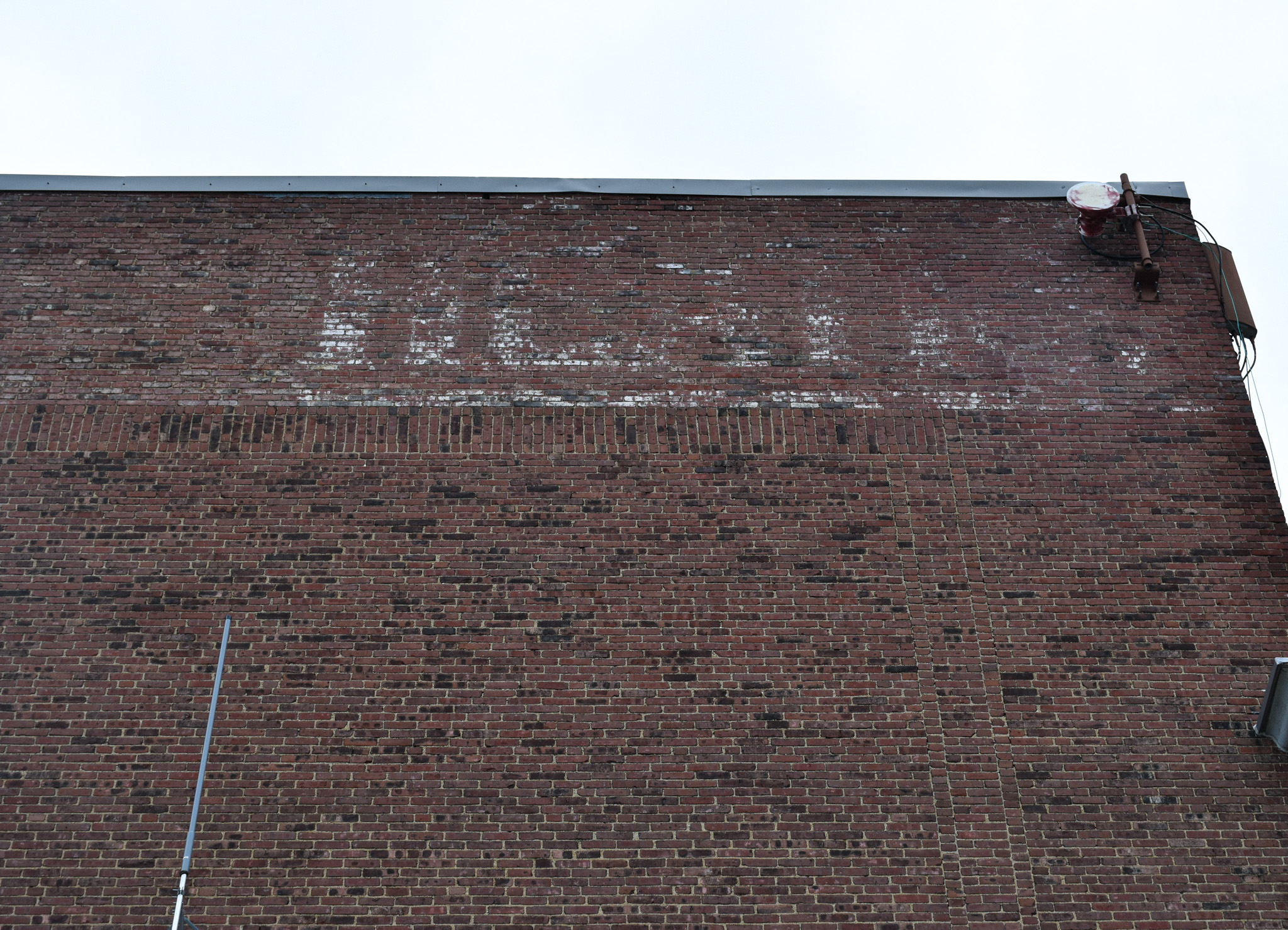
(Ghost sign on the rear of the theater.)

(Back door of the theater.)
Next I checked out Davis Plaza, a strip of concrete running between Elm and Herbert streets, between two old brick buildings. Many years ago, I hung out here with hundreds of folks enjoying Somerville's annual HONK! Festival.
I was drawn in by the array of artwork I spotted on the lower part of one of the buildings.

I was pleasantly surprised by the ghost sign haunting the art display.

The Sprague & Hathaway Company was located in the building that fronts Day Street and backs up to the plaza. Founded in 1874 in what is now Boston's Chinatown, the company originally produced and enlarged portraits "in oil, ink, crayon, water color, and pastel, as well as 'solar and bromide prints, by the sun or electric light,'" according to MACRIS.
Over time, Sprague & Hathaway moved into manufacturing picture frames, easels and mouldings (and later albums, adhesives and a variety of other photo mounting equipment), according to this post on the Bouse Blog. In 1887, the company, which had moved from Boston to West Somerville, constructed a new home at the corner of Day and Elm streets in Davis Square. The company claimed that building was the largest portrait studio in the world at the time.
The building with the art and ghost sign dates to 1890, and was built behind the company's initial Davis Square site. The company faded to black in 1958.
Across the plaza, at 256-260 Elm Street, is a building that dates to 1920, according to the assessor's database. Tenants include Boston Tattoo. That's all I've been able to find out.

A block away, on Chester Street, is the well-known Redbones, a barbecue joint that opened in 1987.


I've eaten here several times, and always filled myself with beer, beef and beans until I'm ready to barf. The place was always packed when I was there, with people squeezing into the bar and getting excited anytime someone would ask the bartender to "spin the wheel" to see what random beer they should drink. There is crazy artwork all over the place and great music pumping through the sound system.
And the bathroom -- my God!
Located in the basement, where there's another bar and more seating, the men's room is unlike any latrine I've ever seen. You walk through a well-decorated door and you look up - up three steps to a toilet on a...what? Stage? Pedestal? Throne? At first it feels wrong to be walking upstairs to stand (or sit) so exposed while doing one's business. But this is a one-holer, so you can relax and just let it flow.
I've heard from a friend that in recent years, things somehow just aren't the same at Redbones, but the last time I was there a while back, I had a great time.
I never made it to the legendary Sligo Pub, which was located on Elm Street until it closed in June 2023 after 75 years, but I'm guessing its bathroom didn't compete with the Redbones one. Below you can see there's still some flair left in the window of the old joint.

A few doors down, heading north, I was pleasantly surprised by the beautiful HIGHLAND SHOES tile entryway for a long-gone store.

Over on Highland Avenue, I found myself thinking of the time I spent flipping through CDs and albums at Disc Diggers. It was a great shop, very casual, great selection, nice people. I don't know how long it was in business, or when it went under. Along the strip of stores where the music store was located, I made a photo of the sign and storefront for Davis Squared. The shop features tons of clothes and other gifts touting Davis Square and Somerville.

The sign predates the store. I'd love to know what store it was created for.
From there I made my back to Grove Street and walked east along the bike path. I knew from a friend's Instagram posting that there were some works of art along this stretch. I wasn't disappointed.

A nod to Woody Guthrie's guitar, which proclaimed "This machine kills fascists."

WANTED: DEAD OR ALIVE CORPORATE LOOTERS of the UNITED STATES this one reads in part.


A train table for the kids.
There was more of that sort of stuff, but through a fence and some overgrown trees to my right, I spied something that demanded my attention.


I don't remember being aware of this property on Willow Avenue and Whipple Street when I was living here. But I became interested very quickly. This, my friends, is the former Somerville Electric Light Generating Station, which was built in 1887. "In 1904, the company was acquired by the Edison Electric Illuminating Co. of Boston and the plant became the new utility's principal substation for the Somerville area," per MACRIS.


I'm not sure how long the plant was in operation or when it shut down. This is prime real estate, but I imagine the clean-up would be pretty onerous.
Across Willow Avenue, at #115, is Charles Rose Architects.

Located in a circa-1900 stucco building that may have been a warehouse or light industrial building at its origin, the architecture firm designs residential, institutional, arts and office spaces around the world.
I circled back toward the Rosebud, and remembered a nearby and very cool building, currently housing a Domino's Pizza franchise, that I figured must have been a service station at one point, so I made a photo.

Sure enough: "No. 360-366 Summer Street is one of the numerous automobile related businesses which thrived in Somerville between 1915 and 1940," according to MACRIS. "The original complex consisted initially of the Texas Company Oils, an oil company located at 366 Summer Street. By 1927 a Willy's car dealership had opened at 201-203 Elm Street and the company maintained a 100 car garage at 360-362 Summer Street." 201-203 Elm Street is the address of the Domino's.
"By 1933 the car dealership had closed as well as the oil company," MACRIS continues. "After 1933 the building was used as a garage and filling station. The building [was] rehabilitated, ca. 1985, by the Dole Publishing Company for offices for the Somerville Journal."
Pretty cool history!
My last shot in Davis Square features the side wall of Dragon Pizza, at the corner of Elm and Grove streets.

I love the simplicity and whimsy of that installation. I believe it lights up at night.
Well, this turned into more of a trip down Memory Lane than I'd anticipated. Brought back some great memories!
Below are links to a bunch of other Somerville posts from over the years.
April 15, 2023, "East Somerville, Part II: The Other Stuff"
April 8, 2023, "East Somerville, Part I: The Main Drag"
March 25, 2023, "Square Dancing Around Somerville"
March 11, 2023, "The Pros and Cons of Winter Hill and Gilman Square"
July 7, 2020, "Union Square, Somerville, Part V: The Future?"
May 29, 2020, "Union Square, Somerville, Part IV: Holy"
December 6, 2019, "Union Square, Somerville, Part III: Retail and Hangouts"
November 7, 2019, "Union Square, Somerville, Part II: Factories and Housing"
August 25, 2019, "Union Square, Somerville, Part I: New Purposes & Grease Monkeys"
And here's the inspiration behind my headline:


