Showing posts with label music hall. Show all posts

Saturday, January 15, 2022

There's Always More Waltham

From Dave Brigham:

First off, let me say that if you're reading this post because you are a fan of the band Waltham, you may not want to venture any further than this video:

Actually, if you're a fan of Waltham, then you may be from Waltham, so you should DEFINITELY check out my latest post about Waltham. The city, that is. I've written quite a bit about this former mill town abutting my adopted hometown of Newton, Mass. (see the bottom of this post for proof).

All of the traipsing I've done through Waltham, however, hasn't resulted in my taking photos of the places I feature below.

OK, I lied. I have taken pictures of the old Music Hall on Elm Street, but not since it was restored so nicely. Built in 1879-80 from a design by Henry Hartwell (who designed numerous buildings in Waltham) this Victorian Eclectic building is called the Music Hall, but the auditorium where audiences once enjoyed entertainment in luxurious surroundings was torn down long ago after a fire.

"The Music Hall...was the most modern theatre in the Boston area; a marble staircase led up to the auditorium and the rear of the auditorium floor was motorized for higher or lower levels," according to MACRIS. "Four crystal chandeliers illuminated the 83' x 60' hall." The building that remains was the entrance to the theater. According to MACRIS, the theater had at least six other names during its tenture as an entertainment destination.

Nowadays there are stores on the ground floor and apartments on the upper floors.

Here's what the Music Hall looked like in 2016:
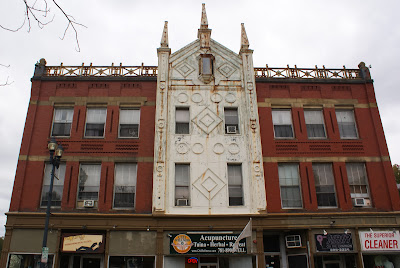
Steps away, at the corner of Main and Lexington streets, is a nice old building that's home to an Armed Forces Career & Recruiting Center.

Known as the Collins Block, this Colonial Revival commercial building rose in 1903. MACRIS doesn't offer much on this place, preferring to spill more ink about its predecessor. "The G.H. Rogers Building was an old, residential structure with a pitched roof and an overhang over the sidewalk to form an arcade." Current tenants in the Collins Building include the U.S. Navy, Marines and Army. There was once a bank here, as evidenced by the night deposit box by the front door.

Moving west along Main Street, we come to the Whitford Building.

Home to, among other businesses, Leo's Place Diner, an eatery founded in Harvard Square that moved to Waltham in 2015, the Whitford Building (or Block) dates to 1877. Its architect, George F. Meacham, also designed the Boston Public Garden, as well as numerous homes and monuments and commercial buildings in Greater Boston. In its heyday, the Whitford contained two "large elegant stores...on the first floor, with a flight of marble steps leading to the upper stories. Interiors were modern and spacious," according to MACRIS.

"Originally owned by G. H. Whitford, the block contained shops on the 1st floor, offices on the second, and the Odd Fellows Hall on the third," MACRIS continues. "Though ownership of the building has changed several times over the past century, the block remains in a fine state of preservation and continues its original uses, save for the third floor which has been converted to a ping pong game room."

Wait...what?! That report dates to 1984, so I doubt there's a ping pong room up there anymore. And the condition of this High Victorian Gothic building seems pretty good...except maybe for one spot.

Actually, I'm sure that's fine. What we're seeing here is an outline of the original gable on the Eagle-Mansfield Building in the forefront. That building dates to 1854, although it was remodeled in 1948. There was some wooden bracing up there at one point.

Next, on the corner of Main and Common streets, is the Lawrence Block.

Known in recent years as the home of video production for local TV personality Rex Trailer (please click this link; Trailer was a one-of-a-kind entertainer), this Colonial Revival building dates to 1900. When it was built, the Lawrence building "had stores on the street level, and offices, social rooms, and apartments on the second floor," according to MACRIS. "The Mass. Telephone & Telegraph Co. originally leased the entire third floor of the building for their exchange." Current ground-floor tenants include David Hawthorne, a violin bowmaker; Cafe on the Common; and Sebastian & Alexander's Ice Cream and Sorbet. There are offices on the upper floors.

(Side entrance to the Lawrence Building.)

My strategy when shooting buildings like this is to get a photo of the entire building, or as much of it as I can, and then some cool details. I lucked out with this place, as I spied tenant directories on either side of the main entrance.

I have no idea whether any of these businesses -- lawyers, dentists, watch repairmen, civil engineers, architects -- are still located here.

The final stop along Main Street is the distinctive building that now houses Main Street Music on the ground floor and basement, and offices on the upper floors.

Built around 1872 and remodeled in 1936, this place is known historically as the Knights of Columbus Building. "The Knights of Columbus (KOC) Building at 719-723 Main Street, corner Spring Street, is dated 1872-1874 by deed and atlas research to Martin Greely as the original owner, later purchased by the KOC in 1917 and subsequently remodeled in 1936," according to MACRIS. "The upper floors of the KOC Building held offices of related social organizations, including Ancient Order of Hibernians, and the Mass Catholic Women's Guild."

The building is a little rough looking as you get close to it. There is even graffiti on the side of the roof. According to MACRIS, the building is an unusual Mansard commercial block "with Tudor-like pseudo half-timber effect. One of few wood-frame, three-story buildings in downtown Waltham."

In business since 1993, Main Street Music specializes in piano sales, service and restoration, according to its web site. The store is a bit cluttered and seems to operate best through customer appointments. I dropped in once to buy a music stand and cord for my guitar, and the salesman took a long time to find those items, although he was friendly and entertaining the entire time.

Lastly, a small brick building that is one of my favorites in Waltham.

Located at 94 School Street, this place is, according to MACRIS, "The only brick (quasi) row-house in Waltham." As the writer indicates, this circa-1860 residential building would look more at home in Baltimore than in Greater Boston. It was added on to the rear of 16 Park Place, which dates to 1850, according to the Waltham assessor's office.

Fun fact/rumor about this quaint little abode, per MACRIS: "Reported to have a brick vault in the basement and to have served as a courthouse."

OK, that wraps up this quick jaunt through downtown Waltham.

Below is a less-than-exhaustive list of previous Waltham posts.

August 25, 2011, "Goodbye Reef, So Long Bill"

February 27, 2011, "UPDATE: What a Dump"

May 12, 2010, "Dead-End Tracks, Part I"

March 20, 2017, "Brigham in Waltham, Part III"

January 5, 2017, "Brigham in Waltham, Part II"

November 9, 2016, "Brigham in Waltham, Part I"

Wednesday, November 9, 2016

Brigham in Waltham, Part I

From Dave Brigham:

I've written about two dozen posts here over the years about, at least in part, Waltham, Mass. (check out these search results). Just next door from my adopted hometown of Newton, Waltham is a former mill city of just over 63,000 residents. Known as the Watch City, Waltham was home to the Waltham Watch Company, the first company to make watches on an assembly line. The city was also home to textile factories in the 19th century. There are plenty of old buildings downtown, in addition to former factory worker housing, churches, old and current railroad tracks and related facilities, diners and plenty of other sites that we here on the Backside love to check out.

Just as when the mills were humming thanks to immigrant workers, Waltham is still a city that welcomes those from other lands. As of the 2010 census, nearly a quarter of the city's residents were foreign-born, many from India and Guatemala, according to Wikipedia. I can tell you from casual observation that six years later, that percentage has surely risen.

This is the first of a three-part series about the city. You will see a few dozen photos and learn about abandoned buildings and repurposed structures alike. You will gain knowledge about classic churches and long-neglected railroad right-of-ways, as well as see ghost signs and out-of-the-way monuments and murals.

As with other town and city surveys I've conducted (see list at the bottom of this post), this post is by no means an exhaustive tally of all of the cool and historical aspects of Waltham.

OK, let's get started.

According to the Waltham Land Trust, this little building holds electrical controls for Waltham Common, the park behind city hall bounded by Main, Moody, Carter and Elm streets. I love how it's styled like a classic New England church, with white clapboard siding and a steeple.

Just to the left of this quaint building sits a memorial to a man who had no connection whatsoever to Waltham or, for that matter, Massachusetts. Dag Hammarskjöld was a Swedish diplomat and the second secretary-general of the United Nations, serving in that role from April 1953 until his death in a plane crash in September 1961, according to Wikipedia.

Just a month after Hammarskjöld's death, the Waltham Junior Chamber of Commerce installed this plaque. Although the diplomat had no ties to the Watch City, the CofC members obviously felt it necessary to honor the man who had sought to bring peace to the world for eight years. He was en route to Congo to negotiate a cease fire when his plane crashed under mysterious circumstances, according to Wikipedia.

Turn east from the little house and the Dag plaque and you'll see this Queen Anne-style building, which is stunning now even its decline.

Built in 1880, this building was once known as the Elm Street Music Hall. The theater's occupancy was more than 1,000 people, and they saw speakers including Mark Twain, Oliver Wendell Holmes and Ward Beecher, according to this article, which is about the building owner's plan to restore the facade. The theater burned down in 1932 after hosting music and vaudeville performances, as well as movies, leaving the facade, which houses retail stores on the first floor and apartments above.

When I checked it out recently, there was work being done on the roof, so I believe the restoration mentioned in the article is under way. Can't wait to see what it looks like when the project is completed.

We skip now just a short distance to the place known by my wife and her family as the Superdome church. Or is it the UFO church?

Dedicated in 1964, Sacred Heart Church is unlike any church I've seen. "The style was not to be bound by popular tradition, not to be merely modern - it was to be a glimpse into the future," according to the church's web site. I was in the wedding of my good friends Jim and Nikki here several years ago.

We're looking here at, of course, the backside of the church, which is the second structure to stand on this property. The original church, built in 1924 for a largely Italian immigrant parish, now houses CCD classrooms and the church hall.

About a half mile away is an imposing brick mastodon of a building, St. Charles Borromeo Catholic Church. Built in 1922, technically the building is an example of Italian Renaissance Revival architecture.

(By User:Magicpiano, Wikimedia)

Listed since 1989 on the National Register of Historic Places, the church has no steeple or stained glass windows, but it has one architectural feature that caught my eye.

At Main Street's Christ Church Episcopal, which opened in 1898 and is also on the National Register, I saw this proud, yet forlorn, detail.

Waltham is filled with congregations, including one whose church has an interesting past.

Ministerio Evangelico Rios de Agua Viva (Evangelical Ministry Rivers of Living Water) is located in the former Hamblin L. Hovey Memorial Building. Outfitted with a 1,300-seat auditorium when it was constructed in 1935, the Hovey building had a fully functional stage and an orchestra area that could accommodate 500 seats, according to the web site for Hovey Players community theater group, which at its inception performed in the building. In 1952, the International Brotherhood of Electrical Workers bought the building. In 1998 a Buddhist group, SGI International, acquired the building and walled off the balcony while converting the auditorium to a temple, according to the Hovey Players web site.

I'm not sure whether SGI still owns the building.

Across the street from the Hovey/church building sits the Jonas Willis Parmenter Home.

This building in and of itself is nothing all that interesting, but history doesn't always come in beautifully decaying packages or awe-inspiring architecture. History is each and every person living their lives, making decisions, going to work, honoring their loved ones. Parmenter was a coal, wood and brick dealer, according to the Hovey Players web site. He was also the father-in-law and employer of Hamblin Hovey, namesake of the memorial building talked about above.

In 1889 Hovey built the Parmenter Block not too far from the site of the Hovey Memorial Building and the Parmenter Home. Named in honor of his father-in-law, the building had retail space on the ground floor and an auditorium and banquet hall on the two floors above, according to Melissa Mannon's "Images of America: Waltham," from Acadia Publishing, excerpts of which I found via Google Books.

Hovey died suddenly in 1904, according to the Players web site. In 1935, the Parmenter family commissioned several buildings, two of which were named in Hovey's memory: the memorial building and a dance hall that's been gone for some time. This is the kind of stuff I find increasingly fascinating, the forgotten history of cities and towns, the people behind named buildings, the citizens who built a place and left behind legacies that benefit future generations.

Every city and town has hidden history, of course, but in old mill towns like Waltham it's easier to find. One day, driving through the city on a route I had done dozen of times, I just happened to look to my left and see this place, as if for the first time.

What caught my eye was the sign across the front of the porch: Gilbrae Inn. I knew there was no way this was an active hotel, so I took to the Internet. Listed on the National Register of Historic Places, the inn was built by the Boston Manufacturing Company, which built the world's first spinning and weaving factory in Waltham. The inn was a rooming house for BMC employees, and was built sometime between 1827 and 1854, according to Wikipedia (not sure why a specific date is so hard to pin down). It is the only surviving boarding house built by the company, according to Wikipedia.

I've located one other 19th century building that took in guests.

Known as the Prospect House, this former hotel and tavern is now an apartment house, according to Wikipedia. Built in 1839, it too is on the National Register.

The penultimate stop on this first part of a three-part installation is a cozy little social club. Maybe they'll invite us in for a drink....

Founded in 1886, the Piety Corner Club is Waltham's oldest neighborhood association, according to Waltham-Community.com. The neighborhood is so named because it was home to several ministers at some point, most likely in the 19th century.

Finally, a rather new-looking sign commemorating a historic event.

Located at the corner of Route 20/Weston Street and the very short Tavern Road, this marker speaks of an event I've written about before, Gen. George Washington's march from Virginia (I think) to Cambridge, Mass. (see April 20, 2016, "Washington Walked Here"). Research online didn't bear any fruit, but I'm guessing there was a tavern near this location and maybe the good general popped in for a quaff or two.

In the next two installments of this series, I will cover railroad, diner and oddball house/retail stuff, as well as ghost signs, murals and a few other things.

As I mentioned at the top, I've also written and taken photos covering other towns in eastern Massachusetts:

December 9, 2015, "Scenes From an Old Shoe Town," about Hudson, Mass.

January 27, 2016, "Finding Hope, But Losing a Mainstay, in Clinton," about Clinton, Mass.

March 30, 2016, "Big Walk in Littleton," about Littleton, Mass.

Meandering in Milford

From Dave Brigham: In April, I ventured to the Grafton Flea Market , searching for vintage wooden boxes I could use to showcase prints of ...