From Dave Brigham:
I am forever indebted to my friend Lee for hipping me to the term "L.A." when referring to Lower Allston, the Boston neighborhood that is bounded by the Mass. Pike to the south, the Charles River on the east and north and Watertown to the west. I have never been to the Pine Tree State's version of L.A., and my two visits to California's City of Angels were largely confined to hotel ballrooms, so I'm going to say that Boston's L.A. is my favorite.
Here's a video about it:
I recently drove through L.A. and realized that a diner where I'd spent many a weekend morning in the '90s eating French toast and home fries was no longer in business. Not only that, but the property and others adjacent on each side were fenced off, which means redevelopment is on the way. So I decided to make photos of those places, as well as other sites of interest in the area.
Let's start with the diner and surrounding sites, learn a little about them, and find out what's going to replace them.

Most recently, this was The Breakfast Club, located on Western Avenue, between Riverdale and Everett streets. As you can see, the restaurant has been fenced off and, unfortunately, tagged with graffiti. The eatery closed earlier this year, but I'm happy to report that the business found a new home in Malden. The Breakfast Club was located in Allston for more than 20 years. When my girlfriend (now wife) and I lived in Brighton, we used to eat at this place, when it was known as Henry's Diner. The structure is a 1954 Worcester Lunch Car Company product, according to the Roadside Architecture blog. The diner was originally known as Fahey's Diner, according to the blog. Prior to becoming Henry's, it was Ted's Diner. It was renovated in 2002; in 2011, an addition was built.

I reached out via Instagram to Richard Gutman, the Dean of the Diner World, about whether this 68-year-old diner might be saved. The news isn't good. "There appears to be no interest in saving the diner," he said. "Much easier to just demolish it." He said he reached out to the Boston Landmarks Commission but was rebuffed. He tried contacting the developer, King Street Properties, but again he reached a quick dead end.


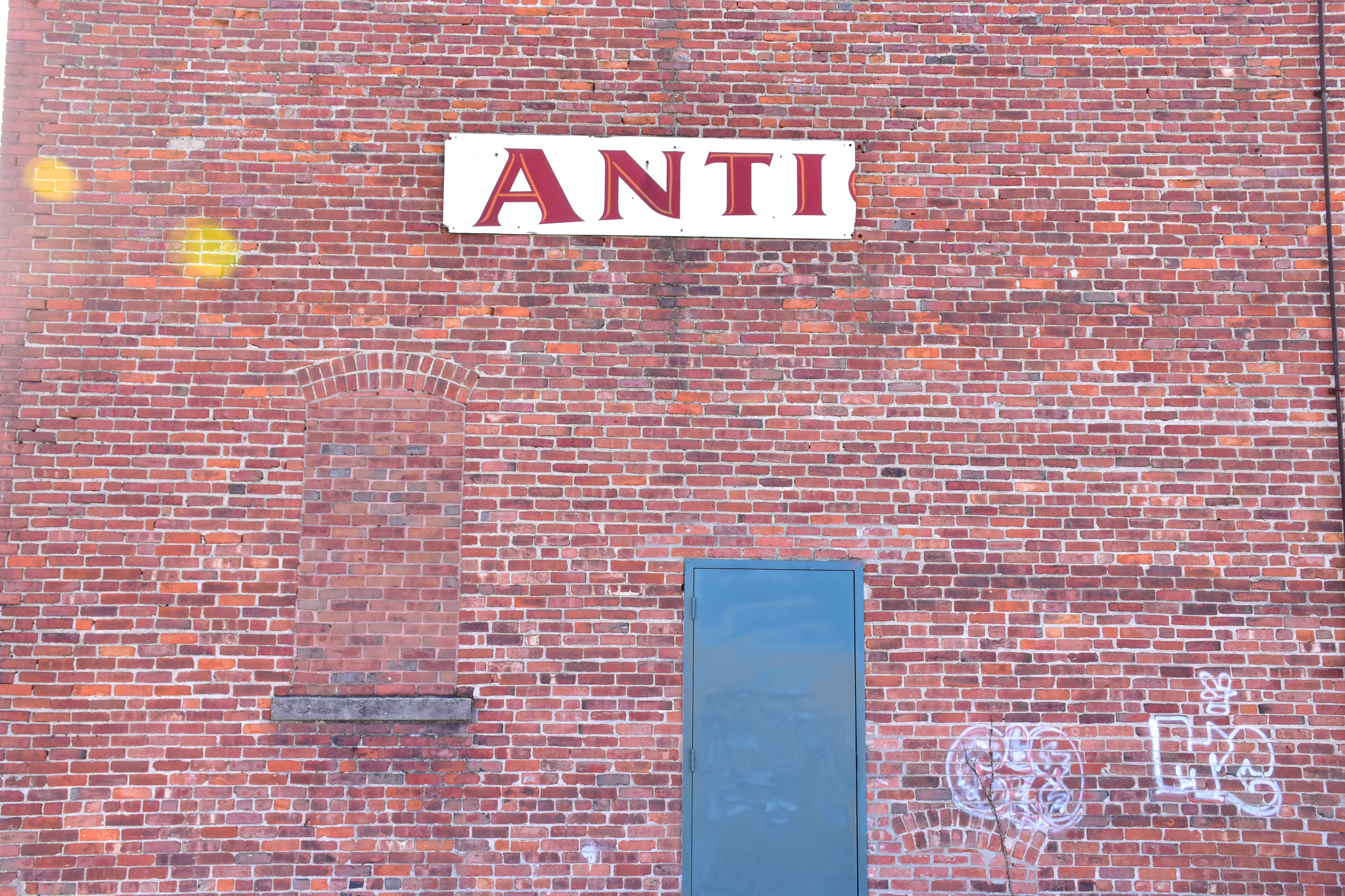
To the east of the old diner are several more properties that will be leveled as part of the redevelopment: a Subway shop, the former Bus Stop Pub, a multifamily home and garage, and other houses and small buildings.

(Old sign on the side of Bus Stop Pub; the Budweiser part has since fallen off/been stolen.)

(Front of the former Bus Stop Pub.)

(Old house at the rear of a commercial property along Western Avenue.)

(Multifamily house slated for demolition.)

(Message of support *cough cough* for the redevelopment on the side of the multifamily house.)
There are properties to the west of the old diner that will be transformed, as well, including the former Stadium Gas Station (so named because of its proximity to Harvard Stadium).

The auto body shop, like the pub, diner and housing sites (and others I haven't included here), are owned by the DiStefano family, who founded Stadium Auto Body, on the opposite side of Western Avenue, in 1968.


A few years ago, Joseph DiStefano, president and CEO of Stadium Auto Body, decided he wanted to transform this somewhat gritty stretch of L.A. "After years of dreaming about what he could do with his family’s land along Western Avenue, DiStefano set out to find a partner," according to this WGBH news article. "Rejecting overtures from Harvard, he eventually brought in the Mugar Family, of Star Market fortune. Together, they plan to turn DiStefano’s auto body shop and his family’s other nearby real estate holdings into a biotechnology hub."


And so, L.A. becomes like the rest of this Boston neighborhood (see April 2, 2022, "Jamming Through Allston, Part II: The Future," in which I discuss redevelopment of Allston Rock City).
"...Mugar Enterprises bought up buildings around DiStefano’s land, including local institutions like the Breakfast Club restaurant and the Bus Stop Pub," the WGBH article continues. "They drew up plans to knock down the current buildings and construct three big new buildings that will include lab space, ground-floor retail, 40 apartments and 800-plus parking spots. They gave the project a grand-sounding name: NEXUS at The Allston Innovation Corridor."
"'We like to draw parallels to Kendall Square,” said Michael DiMinico of King Street Properties, which is developing the site. 'This is a place where companies will be able to grow.'"
"Overall, the Project will include approximately 539,400 square feet (sf) of laboratory/research and development/office space, 40 residential units, 21,100 sf of retail/restaurant space, and 1,900 sf of civic space," according to the plan that King Street Properties filed with the City of Boston. Other Boston-area King Street developments include Allston Labworks, which I mentioned in the above-linked post about redevelopment in Allston; 101 Cambridge Park in Cambridge; and Pathway Devens on the former Fort Devens site.
The current Stadium Auto Body property, at 305 Western Avenue, "will be an approximately six-story laboratory/research and development/office building with ground floor retail/restaurant space along Western Avenue," per the proposed plan.
I won't lament the loss of any of these buildings, except the old diner. Maybe there's still a way it can be saved.
Two lots east of the auto body shop is the site where, until recently, Hondaa (yes) King did business.

The service business closed up shop and sits waiting for...what? I haven't found any indication online that a developer has plans for this site, but I don't doubt that something will happen here soon.


Hondaa King isn't to be confused with Hondar House, a former auto service business that was located in Cambridge (see April 3, 2020, "Walking Through a Waterless Port").
Just a few steps further east on Western Avenue is one of the most stunning public art projects I've seen: Allumination.
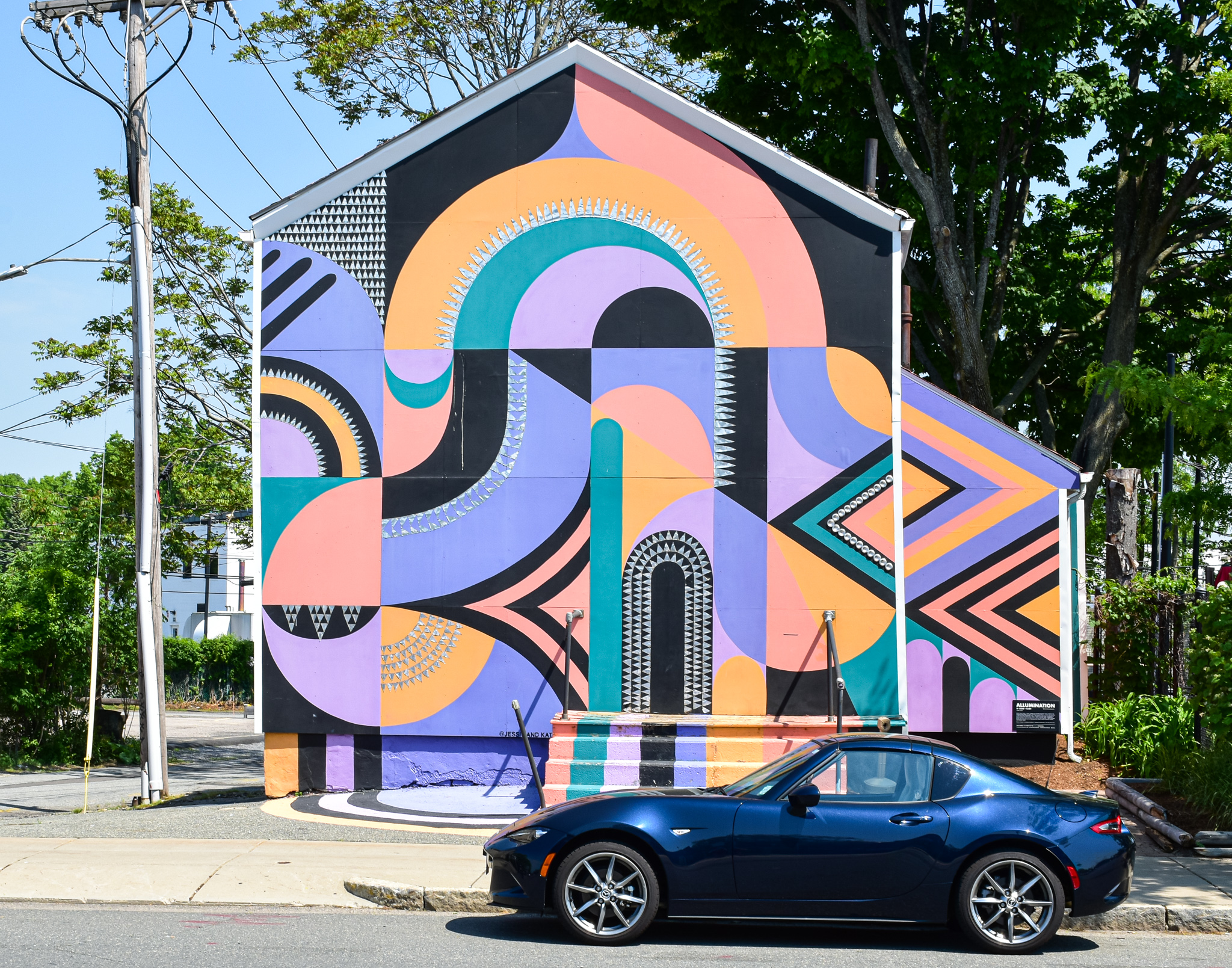

Created by the Baltimore-based artist duo Jessie + Katey in 2017, Allumination transformed an apparently vacant home (most likely owned by Harvard, which owns just about everything in this part of the world) into a psychedelic cornucopia for the eyes.


"Our mission is to transform public spaces into vibrant, playful experiences, and use a highly geometric, abstract language to engage with the history, architecture and culture of a place," Jessie Unterhalter and Katey Truhn say on their web site. "We believe that the aesthetics of one's environments can influence their emotions and state of mind. With a passion for people and design, we bring life to unsung spaces through abstract painting."
The artists, who have created public projects in Washington, D.C., Greensboro, North Carolina, Virginia and other places, were commissioned for the Allston art by Zone 3, a "Harvard-sparked initiativee to further activate and energize Western Ave. with creative programs, events, retail experiments, and public art," per the organization's web site.
Below is a video of the artists at work on Allumination:
Jessie + Katey at Zone 3 from Zone 3 on Vimeo.
Abutting the Allumination house is Aeronaut Allston, a beer garden/food/truck/live music space.


Once again, great art work makes this formerly boring space come to life.


Behind the beer garden is PRX Podcast Garage, which is currently closed due to the coronavirus.
I need to carve out time this summer to hit Aeronaut and other local outdoor beer gardens.
Continuing on the public art tip, the Zone 3 folks are selling limited-edition posters by local artists via old newspaper vending machines.

This bin is located in front of the Harvard Ed Portal on Spurr Street. Check out the featured artists.
In front of the Ed Portal you will also find the fantastic and inspiring work of art pictured beleow.

"In the lore of the Wampanoag," the text underneath begins, "there is a hero by the name of MoShup who helped form the very land you stand upon today. A kind and powerful giant, MoShup helped the indigenous peoples of Massachusetts by teaching them to thrive by the sea. He eventually transformed into a whale to leave them to grow and prosper on their own."
Created by Cambridge-based artist Andromeda Lisle, this work reflects two key concepts that drive most of her work: "the beliefs, stories, and legends that shaped the human race for millennia, and her own eclectic identity as a multi-racial and disabled woman growing and learning through her connection to her diverse heritage."
Standing in front of the Ed Portal and looking due north, one would likely notice the giant naked guy posing at the entrance to Smith Playground.

Known as Quest Eternal, this 27-foot-high statue stood outside the Boylston Street entrance to downtown Boston's Prudential Center for 47 years, before it was taken down in advance of construction of a new entrance. Sculpted by Boston-born artist Donald De Lue, Quest Eternal "brings to mind ancient Greek and Roman sculpture, as well as the work of Renaissance-era artists, who often looked to classical art to inspire their choice of subject matter and style," according to the Boston Art Comission.
The statue was moved to the playground, which features a skateboard park, playing fields, a skating rink and more, sometime in 2019 or 2020, I believe.
There is still more art on our tour.

(Detail of David Teng-Olsen's Evo mural.)
Back in 2017, artist David Teng-Olsen, an associate professor of art at Wellesley College, created the 170-foot-long mural titled Evo on the rear of a building that faces Soldiers Field Road. "Comprised of bright geometric shapes and hand painted illustrations, Evo was inspired by the history of Allston and the people that spoke with Olsen while painting the mural," according to -- you guessed it -- Zone 3. "'I named it 'Evo' because I could tell the neighborhood was changing and growing,'" said Olsen. "'The people that stopped to talk and tell their stories and the history of the neighborhood were all translated into the expressive lines speckled about the composition.'”
After shooting Teng-Olsen's mural, I was struck by the rear of the building below, which faces Soldiers Field Road.

Built in 1940, this (mid-century modern?) property is yet another owned by Harvard University's real-estate arm. Current tenants include Modulus Studios and Bagamor Media.
On the southern side of Western Ave, just a little ways to the west, is Engine House Studios, home to Linda Clave Arts and Daniel Kurganov and perhaps other creative types.

Built in 1887, the Richardsonian Romanesque former Engine House #34 was designed by Charles J. Bateman, who was also the architect of the Bigelow School in South Boston and the Corcoran School in Clinton, Mass., among other buildings.

(Nice mural on the front of Engine House Studios.)
From firefighters, we move on to things that are often the cause of conflagrations.

I am drawn to old, well-worn things with patinas, as regular readers know. I also like the handmade, be it a sign on a Mom-and-Pop shop or a beautiful mural or well-crafted graffiti or the name of a company or person chiseled into a brick or stone building. And I love stumbling across the little things that make each city, town, neighborhood or street individual: storefront churches, memorials to local heroes, little oases where residents can relax under a few trees. This butt can, as I've dubbed it, fits right in with my aesthetic.
Using a tin that appears to have once held holiday cookies and other treats, someone figured that the folks outside the Hill Memorial Baptist Church needed a place to toss their coffin nails before they headed back into the sanctuary.

While the building itself is a little rough around the edges, from what I've gathered from the church's web site, they are an active and engaged congregation. The Shingle style church, which is located at the corner of North Harvard and Easton streets, was built in 1903. From MACRIS: "The church's land was donated...by George A. Hill and his sister Miss Georgia A. Hill. The Hills had farmed a long rectangular tract of land on the west side of North Beacon Street since at least the mid-1870s.
"Hills figured prominently in the events leading up to Little Cambridge's (Brighton) independence from Cambridge in 1807. In 1806, Aaron Hill was part of a committee appointed by the Cambridge town meeting 'to confer with such persons as may be appointed by the Legislature that the South Parish in this town be set off as a separate town.'
"The Hills donated 13,000 square feet to the Baptists on the condition that they erect a chapel called the Hill Chapel in memory of their father, Deacon Samuel Hill. The events which followed the Hill's offer of free land unfolded in a rather peculiar manner. The Baptists of Allston refused to accept the donated land but the Baptist Sunday School Association accepting (sic) the generosity of the Hill family. In 1897, the Baptists purchased the Sunday school of the Congregationalists on Western Avenue for $2,000.00, moving it to the Hill land. The Sunday school building was remodeled and its first classes were held in April, 1898 with 40 students in attendance.
"The Hill Memorial Baptist church's corner stone was laid in July, 1903. It is not clear if the Sunday school structure was incorporated into the church's structure."
One person who might not be welcome in the church is the person who wrote the words below on somebody's house.

Anyway...steps away from the church is the former home of City Tails dog grooming and Bicycle Bill's, which was open for more than three decades.


There was a sign in the window advertising for barbers, so perhaps a haircuttery is slated to open.
Around the corner on Western Avenue is Flint Cleaners, which has been in business for at least 40 years, I believe.

I love the simple sign.
Finally, we come to yet another milestone, the latest of many that I've stumbled across in and around Boston over the years.

Located in a front yard along North Harvard Avenue, this one is engraved, ""BOSTON 7 MILES 1729 PD." This is one of several mile marker stones that Paul Dudley, an attorney general for the Province of Massachusetts and chief justice of the Superior Court, erected (or, more likely, had someone do for him) along various routes back in the Colonial days. I have seen other ones in Newton, Brookline and Boston's Jamaica Plain neighborhood over the years. I always love stumbling across them (not literally, of course).
I hope you enjoyed this first tour of sun-splashed L.A.! Don't worry, I'll return with another post soon. Will there be any movie stars? You'll have to wait and see.