Showing posts with label gravestone. Show all posts

Saturday, July 30, 2022

Finding Color Amid the Gray at Holyhood Cemetery

From Dave Brigham:

A graveyard, for me, is a crap shoot.

I find a cemetery, especially an old one with plenty of shade trees, lichen-covered headstones and obscure Biblical names, to be quite peaceful. I am respectful, treading away from where I believe the coffins are interred, and apologizing if I mistakenly misstep.

I didn't spend time in graveyards as a kid. My ancestors were buried in places far flung from my small Connecticut town -- Springfield, Massachusetts; Worcester, Vermont; Brooklyn, New York. As an adult, I walk through cemeteries with some regularity, but not to spend time with long-gone relatives. No, I walk past tombs, vaults, statues and busted headstones seeking out photo opportunities.

With many of these oases of the dead, I find that the grave markers look quite similar: two to three feet tall, made of dark stone, carved with a religious symbol (a finger pointing to Heaven) or message ("SAFE IN JESUS FOLD") or indication of military service.

I recently ventured to Holyhood Cemetery in Brookline, Mass., mainly because it was close to where I'd dropped my son off for a hike. I figured I'd check out the chapel there, and maybe spy a few cool gravestones to make photos of.

I found quite a bit more than I'd expected, thankfully, and plan to return to take in more.

The Fitzpatrick Chapel was erected in 1862, just five years after the cemetery was laid out. "The stone building was designed by Patrick Keeley, the noted architect who designed many mid-19th century Catholic churches including the Cathedral of the Holy Cross in Boston," per Holyhood's web site. "It is Gothic Revival style derived from an English Gothic country church."

It's quite lovely. Holyhood's layout "reflected the mid-19th century influence of romantic landscape cemetery planning begun at Cambridge's Mt. Auburn Cemetery in the 1830's," according to the web site. "It was the first such cemetery in Brookline. The name Holyhood was derived from the term used to designate the winding sheet in which the body of our Saviour was surrounded before interment."

Many of the graves I walked past and photographed during my short visit are for Irish Americans, many of them, I suspect, immigrants or first-generation citizens. Among the famous folks buried here are Joseph P. and Rose Kennedy, patriarch and matriarch of America's royal family; Massachusetts Governors Maurice Tobin, Foster Furcolo and Edward King; and George Wright, Baseball Hall of Fame inductee and golf course designer.

I set out to find contrast, and I found plenty of that.

(I love the green door set against the gray mausoleum.)

Most of the colors (besides gray) that I focused on were the result of oxidizing metal. I don't know enough about metals to know which type is used for gravestone plaques. I know that copper, iron, brass and bronze are among the metals that turn a greenish color with long-term exposure to the elements.

(Man, that star.)

(I'm not at all religious, but I appreciate a nice icon.)

Not only am I an atheist, I'm also a heretic, because when I see Jesus on the cross, all I can think about is the scene below from Monty Python's "Life of Brian""

More lovely contrasts....

In just about every old cemetery I visit, I find busted gravestones.
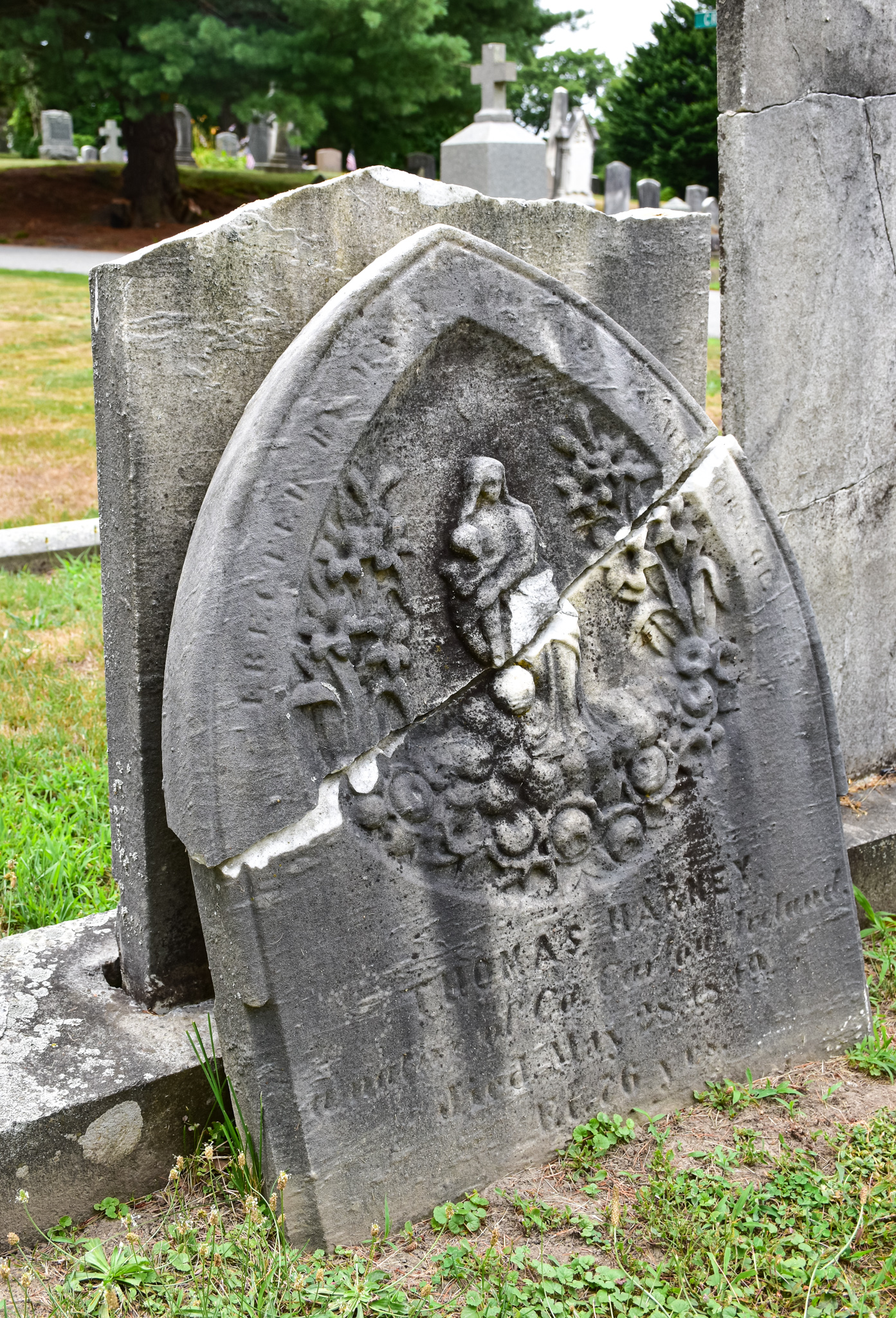
I've walked through plenty of graveyards, but I've never seen a grave with the name below.

The name is apparently more common than I realized. It's used for a line of menswear, grocery store components and by a woodcut printmaker.

I think it also represents the value expressed when people say, "His number was up. Yup, he reached one killion."

A few more stones of note....
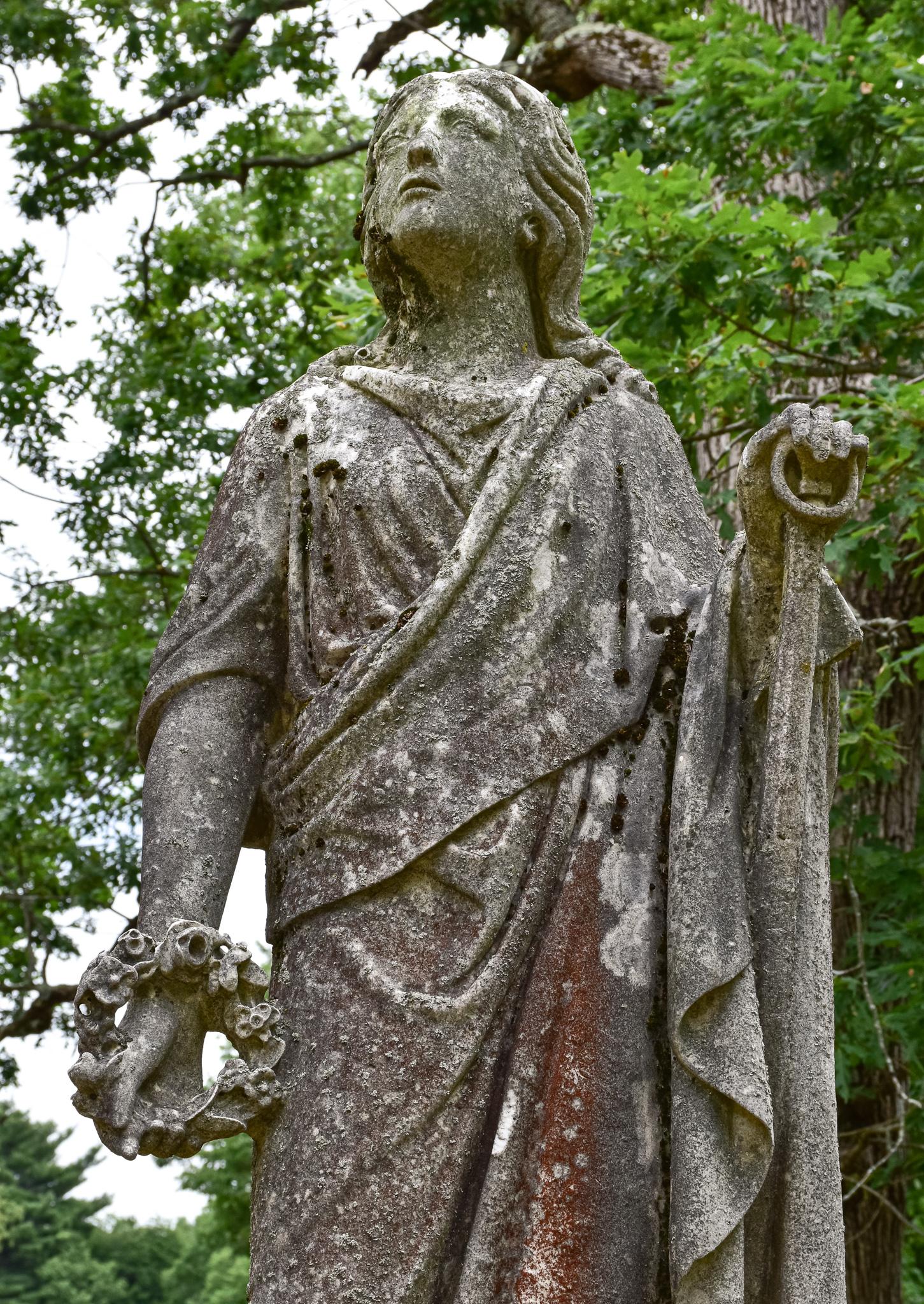
A woman with a sword.

This was the first crypt I saw. I'm not sure whether someone broke in...or out.

This slab is for a family named Amrhein. Until writing this post, I assumed the name was Irish, since there is a well-known restaurant and bar by that name in South Boston, and one of my wife's law school friends, who is very Irish American, once worked there. The eatery was established in 1890, and has the oldest hand carved bar in America and the first draft beer pump in Boston, per its web site. Since Southie used to be an Irish stronghold, I made an assumption. Turns out the name is German and Alsatian, according to Ancestry.com

I don't know if the folks buried here are from the family that started the restaurant. I wrote about Amrhein's in November 2018, when there were fears the restaurant would be shuttered (see November 17, 2018, "Southie to Lose An Institution"). The latest news comes from June, when the building was sold -- yet again -- to a group that plans a multi-use project that will keep part of the Amrhein's building, and erect a five-story building comprising office/lab space, as well as restaurant and retail footage, according to this article from The Real Reporter.

There are a lot of Mark Twain-looking busts and plaques in Holyhood.

Every tomb I saw was a traditional stone crypt, fashioned in the 19th or early 20th century, either built into a hillside or hulking on the ground, looking like something out of a Gothic tale of woe. Except one.

This vault for the Stewart family is the most modern one I've seen in any cemetery.

(Detail from the Stewart crypt.)

I'm going to wrap up with two graves of note.

James Jeffrey Roche was an Irish-American poet, journalist and diplomat, born in Ireland in 1847. He and his family emigrated to Prince Edward Island, Canada, when he was young. By age 19, he'd moved to Boston, where he found a job with the Boston Pilot, an Irish newspaper at which he eventually rose to editor-in-chief. Towards the end of his life he served his government in the diplomatic service as American consul to Switzerland, according to that linked article.

My favorite grave marker is for John Boyle O'Reilly, another Samuel Clemens look-alike, and one with quite a back story.

This plaque is located on a boulder under some shade trees. Quite nice. "Born in Dowth [in 1844], O'Reilly moved to his aunt's residence in England as a teenager and became involved in journalism and shortly after became involved in the military," per Wikipedia. "He left the military however in 1863 after becoming angry with the army's treatment of the Irish, and returned to Ireland the same year. In 1864 he joined the Irish Republican Brotherhood under an assumed name and was part of the group for two years until he and many others were arrested by authorities in early 1866. After a trial the same year he was sentenced to death which was later commuted to 20 years' penal servitude. In 1867 O'Reilly was transported to Western Australia and moved to the town of Bunbury where he escaped two years later."

OK, that's a whole life already by age 24. But O'Reilly was just getting started. He made it to the U.S. and soon moved to Boston. "It was in the US, during a time of intense economic and social turmoil, where O’Reilly’s brilliance flourished. As editor of The Pilot, a Boston newspaper, he became a powerful advocate of the rights of workers and African-Americans. He retained a strong commitment to Ireland and was an important part of the Land League and Home Rule movements," according to JohnBoyleOreilly.com.

"O'Reilly was one of the most famous literary figures of his day, publishing four volumes of poetry and two novels," including Moondyne, a novel; poems "The Cry of the Dreamer" and "The White Rose"; and a collection, "Songs from the Southern Seas."

He has been recognized in modern pop culture. On its Rattle and Hum album, U2 performs a song, "Van Diemen's Land," which references and is dedicated to O'Reilly. The county Clare folk singer Sean Tyrrell has set a number of O'Reilly's poems to music, according to Wikipedia. His mugshot is included among other infamous criminals featured on wine bottles produced by 19 Crimes.

Friday, July 23, 2021

In Sandwich, No Bread, Just Dead

From Dave Brigham:

I recently spent a few days at our house in Sandwich, and took a little time to cruise around looking for the backside of the oldest town on Cape Cod. I ended up amid a lot of dead people and places.

I had a short agenda for my tour, but the "site of the ancient homestead" of one of the 10 founding families of Sandwich wasn't on my list. I just happened across it, which is my favorite way of finding stuff for this blog.

Thomas and Anne Tupper received their allotment of land in 1637, as did the nine other families who had relocated from Saugus, which is on the coast north of Boston. The house they built on this site stood until 1921, when it was destroyed by fire, according to the Tupper Family Association of America web site. I have no idea whether this family is the same one that eventually birthed Tupperware.

The Tupper Family Association maintains the site as a public park.

Tupper was a ship's carpenter, trader and land dealer, according to this genealogy account of his life. Anne was his third wife.

I stumbled across the Tupper homestead site after visiting the Saddle and Pillion Graves site. Yes, I will explain, as I had no idea what to expect when I spied that term hovering on Google Maps over a small wooded area on Tupper Road, near Route 6A.

Well, I'm not going to explain, the Sandwich Historical Commission is: "Edmond Freeman, one of the Ten Men from Saugus and the founder of Sandwich is buried here with his wife Elizabeth....They lived out their lives here and when Elizabeth passed away on February 14, 1676, Edmond buried her on a hill on their farm. He marked her grave with a large stone likening to a pillion (a British term for the seat behind the saddle on a horse). With foresight, Edmond also positioned a large stone that resembled a saddle to be used as a monument for his own grave. Family tradition tells us that the headstones reminded Edmond of the early years in Sandwich when he and Elizabeth traveled by horseback over the fields of their farm. Edmond Freeman died in 1682 and was buried beside Elizabeth, the longer stone, 'the saddle,' was placed over his grave."

(Entrance to the Saddle and Pillion Graves.)

(Edmond Freeman's grave.)

(Elizabeth Freeman's grave.)

I don't want to get too deep into the idea of Europeans founding towns in the colonies, but increasingly when I wander around in service of this blog, I find myself thinking about the native population that was here when white folks arrived. I'm ashamed to admit that this is a relatively recent awakening for me. I grew up in a Connecticut town whose legend includes the fact that King Philip -- aka Wampanoag chief Metacom -- burned the town and watched from an overlooking cave during the war between colonists and indigeneous inhabitants that bears his name. The story is almost assuredly untrue, but for years I believed it without thinking too hard about the natives' point of view of the invading forces.

Sandwich and other towns on the Cape and the islands of Martha's Vineyard and Nantucket were spared attacks by Native Americans during the war, according to the Sandwich Historical Commmission. In addition to their isolation from the mainland of Massachusetts, the fortunes of these areas were helped, according to the commission, by "the laymen missionary efforts of two Sandwich men, Thomas Tupper and Richard Bourne, and the loyalty of the friendly Native American population. Tupper and Bourne had learned the Algonquin Indian language and had helped to build Indian churches, and Bourne had been essential in establishing Mashpee and its Meeting House on the border of Sandwich as a legal tract owned by the Native Americans themselves and recognized under Colony law."

I'm always wary when I read how friendly native populations were to the European colonists. Anyway, let's move on.

I also visited the Spring Hill Cemetery along Route 6A, where I found some cool old stones, many of them bearing surnames that adorn street signs across Sandwich.

(I've never seen a grave marker quite like this. The fact that it's in a little shady glen makes it a little spooky.)

Even creepier, though, was this possibly fresh grave I saw.

Established in 1813, the cemetery has stones with great patinas, and nice overgrown nooks.

Just a bit west on Route 6A is the Crow Farm stand.

Founded more than 100 years ago, the farm offers pick-your-own fruits and vegetables throughout the year, as well as tractor rides and special events. The stand wasn't open when I stopped by; I hope it will be open on other visits.

Below is a place that wasn't on my agenda, but when I drove by, I knew I had to swing back around and take a look. It was worth it for the photos, but I also had to endure getting yelled at.

The sign says, "Marise Fawsett's 'Christmas Shop' / Cranberry Shed c. 1850." Opened in 1944, The Christmas Shop closed sometime in the past several years. From the article linked in the previous sentence, the store sounds like it was a magical place to shop and hang out, soaking up the holiday atmosphere.

There's a fairly large parking lot next to the building, so I parked and strolled along Route 6A to take the shots you see above. As I was looking at the side of the building, a woman came out the door and asked, "Can I help you?" I said I was just taking some pictures, as I'd seen the historical marker sign on the front of the place. " Well, this is a private residence," she said in a less than kind manner. "OK," I said. " I didn't know. I was just curious." She reiterated that it was a private home, and I went on my way.

I totally understand that she wasn't happy that I was shooting pictures of her home. But I can't be the first person who saw the sign and the large parking lot and confused the place for a historical site or active retail operation. Maybe she should put up a "Private Property" sign.

Friday, July 16, 2021

Steps Away from An Eyesore, a Quaint Town Common

From Dave Brigham:

I recently spent a little bit of time in Troy, NH, something I'd wanted to do for a while. I pass through that town a few times a year on my way to play music with friends in the Granite State, and stumbled across an old mill complex a while back. That place, the abandoned Troy Mills, proved to be a fantastic photo opportunity (see June 21, 2021, "Covering a New Hampshire Blanket Mill"). Unfortunately for the people of Troy, it has been an eyesore for nearly 20 years.

After checking out the mill, I strolled through the quaint area around the town common. Here's what I found in Troy, which was incorporated in 1815, made up of parts of the towns of Marlborough, Fitzwilliam, Swanzey and Richmond.

Troy's town hall stands at the head of the common, which is an island in the middle of the bisected Route 12. Completed in 1815, this quintessential New England building was originally a meetinghouse, as I'm sure you guessed, where religious services and town meetings were held, according to this excellent Living Places article.

During those early years, both a local branch of the Congregational Church, as well as the First Congregational Society of Troy, used the meetinghouse. I'm not sure when the building became town hall.

I love the contrast of the red-brick house with the bright-white town hall. According to the Living Places article linked above, the house, at 12 Central Square, is known as a side-hall home. It was built by Stephen Wheeler, who operated a store and staging business. In later years, James Stanley, the cemetery sexton, ran a barbershop and later an undertakers' shop behind this house.

In the background of the photo above you can see an old barn. Below are close-ups of the one you can see, as well as a second one behind it.

Those buildings were built by Troy Mills for storage in 1901.

In the middle of the aforementioned common is a lovely little bandstand.

The bandstand is a newer addition to the common, although there was one located here previously. There was once a Troy Brass Band, which likely played at the old bandstand.

Just off the southern end of the common, behind Troy Deli & Marketplace and the Thai Bamboo restaurant, sits the wonderful Kimball Hall.

Originally home to the Odd Fellows fraternal club when it was built in 1901, Kimball Hall is currently home to the Troy Historical Society. I'm guessing that in the heyday of the mill, this place was jumping with dances, weddings, social club meetings and other events. From the historical society's Facebook page: "Folks who would like to tour the Cheshire Railroad Depot may stop at Kimball Hall to request it be opened."

I love that. Speaking of the depot....

Located just steps away from Kimball Hall, the station is known officially as the Troy Cheshire R.R. Depot. This fantastically restored place dates to 1847. During the latter half of the 19th century and well into the 20th, the station was kept busy by deliveries for Troy Mills and a nearby quarry, as well as by visitors to Mount Monadnock, located a few miles away in neighboring Jaffrey.

Passenger service along the rail line ended in 1958, freight service in the late 1960s, according to the web site above. Eventually the station was converted to a private home; the abandoned rail bed was maintained by the New Hampshire Department of Transportation for recreational purposes, and is now part of the Cheshire Recreational Rail Trail.

In 1998, the Town of Troy acquired the station and in 2002, restoration began. Check this photo gallery of the restoration.

Across the former rail bed from the station is an old barn/storage building that I'm guessing was once part of the railroad.

Folks visiting Troy via train might've stayed at the Kimball Hotel and Residence, below, which was built in the 1870s.

The former hotel is Troy's only example of a mansard-roof structure, according to this walking tour document.

I'm going to wrap up with a few shots from the Village Cemetery (formerly known as the Old Cemetery), which dates to 1785.

(I've never seen a gravestone age to this color.)

Former Rock Club in the Fenway Slated for Redevelopment

From Dave Brigham: Sometime in the late '90s/early aughts, I saw one of the greatest Boston bands of all time, the Upper Crust , in a ...