Showing posts with label Odd Fellows. Show all posts

Saturday, December 6, 2025

In the Valley of Belmont, Part II: Waverley Square

From Dave Brigham:

Belmont's Waverley Square is named for the Waverley Oaks, a well-known -- and long-gone -- famous stand of trees in what is now Beaver Brook Reservation, on the border with Waltham. The grove of trees -- somewhere between one and two dozen -- were "very large and ancient," according to the web site for The Waverley Trail.

The Oaks "inspired the creation of the world’s first regional land trust," according to the Trail's site. Said land trust, The Trustees of Reservations, was formed in 1891 by the Massachusetts Legislature "for the purposes of acquiring, holding, maintaining and opening to the public...beautiful and historic places...within the Commonwealth," per the Trustees' web site.

By the late 19th century, these trees were already older than the nation, according to various online accounts, with estimates of their ages ranging from 100 to 1,000 years old. Unfortunately, none of those mighty oaks are still standing, although the Waverley Trail site tells us that descendants of those mighty trees stand today.

But I'm not here to bum you out about dead timber - I'm here to celebrate yet another Belmont commercial destination (for my first Belmont post, see November 22, 2025, "In the Valley of Belmont, Part I: The Center").

Located in the south-centralish area of the town, Waverley Square is roughly bounded by Trapelo Road, Lexington Street, Pleasant Street and, oh let's say Bartlett Avenue. Amid the residential streets flanking Trapelo Road there are stores, restaurants, churches, historic signs and other points of interest.

I made a few visits to this area. From Beaver Brook Reservation, an area I wrote about once before (see November 25, 2012, "Crouching Barn, Hidden Mill"), head east along Trapelo Road to get to the square. Right where Trapelo meets Pleasant Street stands a small brick building that marks the southern tip of the expansive and well-known McLean Hospital facility and grounds.

Known as the Pleasant Street Lodge, the building once served as an entry gate to the grounds, I believe. These days, it serves as a meeting space for members of the residential community on the grounds. I haven't been able to track down information about its age, prior usage or architect.

At the corner of Church and Lexington streets is a fantastic architectural two-fer.

Occupied by Best Cleaners, on the left, and a Dunkin' franchise, on the right, these two nicely maintained buildings date to different decades of the 1800s. The Dunkin' building was likely built in the 1880s, per MACRIS. It "has most likely always been used for a commercial business on the ground floor and residential space above, as it is today," MACRIS continues. "It may have functioned as hotel space for immigrant workers who came to Boston in the 1890s to help construct the McLean Hospital complex."

Its similarly styled neighbor dates to the early 1850s and is known historically as Waverley Hall. One of the oldest buildings in this area of Belmont, it was originally located across from its current site, according to MACRIS. "[T]he structure was built to provide a meeting place and general store for the emerging population. The first floor was probably used commercially and the second floor served as a hall. The building may have also been used as the railroad depot for the Waverley stop [of the Fitchburg Railroad]. The hall was used as a location for public meetings and as the home of the First Congregational Church of Waverley, organized in 1861."

A few doors down, heading north on Church Street, is one of two storefronts for Wheelworks, a bike shop that was founded in 1977.

There's nothing particularly amazing architecturally about this place, but in doing some pre-search before heading out for second pass through Waverley Square, I learned that this Art Deco building served as a First National grocery store when it was built in 1931. First National Stores (later known as Finast) formed in 1925 from a merger of three grocery store operators, per Wikipedia. The company was eventually acquired and the stores were rebranded in various ways.

The main entrance to Wheelworks is located at 480 Trapelo Road, in what is known historically as the Leonardi-Maynard Block.

"This block was one of many such single-story 'taxpayer' commercial structures which sprung up along streetcar routes and commercial centers in the Boston area in the early 20th century," MACRIS indicates. "Charles E. Leonardi, a Boston attorney, was issued a building permit for the seven unit building in 1914. In 1915 the tenants included Charles E. Scott, insurance agent at #472; the Waverley Square Provision Co. at #476; Isaac Silver’s dry goods store at #482; Pannanchio & Albany’s fruit store at #486 and the Waverley Square Bowling Alley in the basement."

I wonder if remnants of the bowling alley exist. Over the years, I've learned about numerous buildings in Greater Boston that once had thriving bowling alleys in their basements. Sadly, many of those businesses ended up in the gutter.

On the north side of Trapelo Road, a short walk from the commuter train stop, where Waverley Street meets the main drag, stands a beautiful former municipal building that is now surely a great place to live.

This gorgeous place was built in 1873 as a school. In 1895 it was named the Rev. Daniel Butler Grammar School. "It is the oldest surviving schoolhouse in Belmont," according to MACRIS. "After a new Butler school opened in 1900, the second story of this lovely old pile was occupied by the Waverley Society of Odd Fellows. The first floor was vacant until 1906 when it became temporary quarters for the Fire Department and Electric Light Department.

"The Odd Fellows moved out in 1926 and the second story was remodeled to provide sleeping quarters for the firemen. In 1930 an addition was made and the building was converted to a two-door station, with the current Art Deco entry added. A third and final addition was made in 1933 when a branch library wing was constructed."

This building was converted to condos in 2007.

Walking east on Trapelo Road, I looked south down Maple Street and thought I spied something worth checking out in the middle distance. That turned out to be a backside mirage, but on my trek along Maple, I found something real...if a little odd.

Home to Friendship Lodge #20, the Oddfellows Hall is...uh, I got nothing. MACRIS has no details, neither does the Belmont assessor's database.

Back out on Trapelo is a place that I was hoping was still an active theater. But alas....

Now occupied by Beacon Community Church, the former Strand Theater opened in 1921 from a design by Funk and Wilcox. The firm was "primarily known for designing apartment houses and commercial dwellings," according to this Back Bay Houses article. "They designed the Boston Arena (1910) on St. Botolph [Street] and a number of theaters, including (in 1918) the Strand Theatre at Upham’s Corner" in Boston.

The architects also designed the Cabot Theater in Beverly, Mass., which I mentioned in my write-up about that North Shore town (see September 16, 2023, "Downtown Beverly, Part I: Cabot Street + Environs").

The Belmont theater operated under a few names over the decades, including the Studio. In 1976, the owners installed new seats, reducing the total number to just over 400. The moviehouse was renovated again in 1998. According to Cinema Treasures, the theater "was closed in January 2015, but reopened July 2015. On September 9, 2020 it was sold to a church."

On the side of the adjacent Lisa's Family Pizzeria is a great mural.

Across from the pizza joint is Art's Specialties, part of a small local chain of specialty gourmet shops selling cheese, wine, beer, chocolate, dried meat, teas and much more. I dug the poster in the window, as well as the beer selection.

The image is a famous one. From the Library of Congress: "Marching under banners emblazoned 'We Want Beer,' and to the tune of 36 bands, more than 1500 union men paraded through Broad Street, Newark, N. J., on October 30th. [1931], in spectacular anti-prohibition demonstration. Over 20 labor unions and 800 musicians took part in the huge demonstration which is said to be one of the largest and most impressive of any staged in the country."

Side note about Trapelo Road: for a few years after I moved to Greater Boston in 1990 I thought the road was pronounced "TRAP-e-lo," rhyming with Tupelo, the Mississippi birthplace of Elvis Presley. I called information [look it up, kids] one day in the early '90s while I was at work, trying to find some company's phone number, and was corrected by the operator: "It's pronouned "Tra-PELL-o."

I crossed the street, and on the south side of Trapelo, as I was heading west, I spied L.C.'s Variety, about which I know two things: it has a pleasant sign, and it is located in a building that dates to 1927.

Continuing west, I had to make a photo of the automaton cobbler in the window of Peter's Shoe Repair.

This place looks like it's been in business for quite a few decades. As for the somewhat creepy dude who looks like a ventriloquist's dummy, he's part of a culture that I'm hoping to learn more about. In my travels over the years in service of this blog, I've come across a few such automatons, including one at The Cobbler Shop in Newton Corner; one at Eagle Shoe Repair in Norwood; and let's not forget this variation from David's Instant Shoe Repair in Boston, which is now out of business:

I wrapped up my Waverley Square-ish tour at the Pleasant Street Garage, which is north of the Star Market and the Belmont Car Wash. According to MACRIS, the complex "was constructed as an automobile sales and service facility in multiple stages between 1912 and 1949. The complex includes an automotive showroom at its west end and a long narrow section extending to the northeast formerly used for service and storage."

That western end is now occupied by Artefact, a home and garden store.

"The Pleasant Street Garage was initially operated by Cheney J. Holton and George Williams about 1912," MACRIS continues. "The garage consisted of a small building and offered supplies, accessories and storage with all makes of cars bought, sold and exchanged. Holton sold his share of the business to Williams and in 1928 George Williams sold to Amedio (Joseph) DeMelia.

"Amedio Joseph DeMelia was born in Verona, Italy, and upon arriving in the U.S. settled initially in New York City before arriving in Belmont. Under his ownership, the Pleasant Street Garage was continually expanded over the next fifty years and became one of the largest Dodge dealerships in New England.

"The complex was sold by Joseph DeMelia’s daughters, Claire and Lorraine DeMelia, in 2010 to Paul Tocci."

I really like the look of these buildings, and love that they have been repurposed for a variety of uses, including several related to automobiles, including Boston Motor Werks and Coachworks

I love that the owner of this property left an old sign intact.

I hope you enjoyed this tour of Waverley Square. Make sure to check back for the final installment in this series, in which I will cover Cushing Square. In the meantime, check out the links below for older posts about Belmont.

November 21, 2017, "Punk Farm?"

July 2, 2013, "Ped Xing"

May 28, 2013, "Small, But Useful"

Saturday, January 25, 2025

I Knew Nothing About Stoughton, So I Went There

From Dave Brigham:

Stoughton, Mass., located about 20 miles south of Boston, has a mid-sized downtown with some great old buildings. So one recent day, I went there.

The first thing that caught my eye was the sign for a Portuguese social club.

Clube Luis de Camoes is named for Portugal's greatest poet, per Wikipedia. "His mastery of verse has been compared to that of Shakespeare, Milton, Vondel, Homer, Virgil and Dante," Wikipedia indicates. "He wrote a considerable amount of lyrical poetry and drama but is best remembered for his epic work "Os Lusíadas (The Lusiads)."

Gotta love an organization dedicated to a poet.

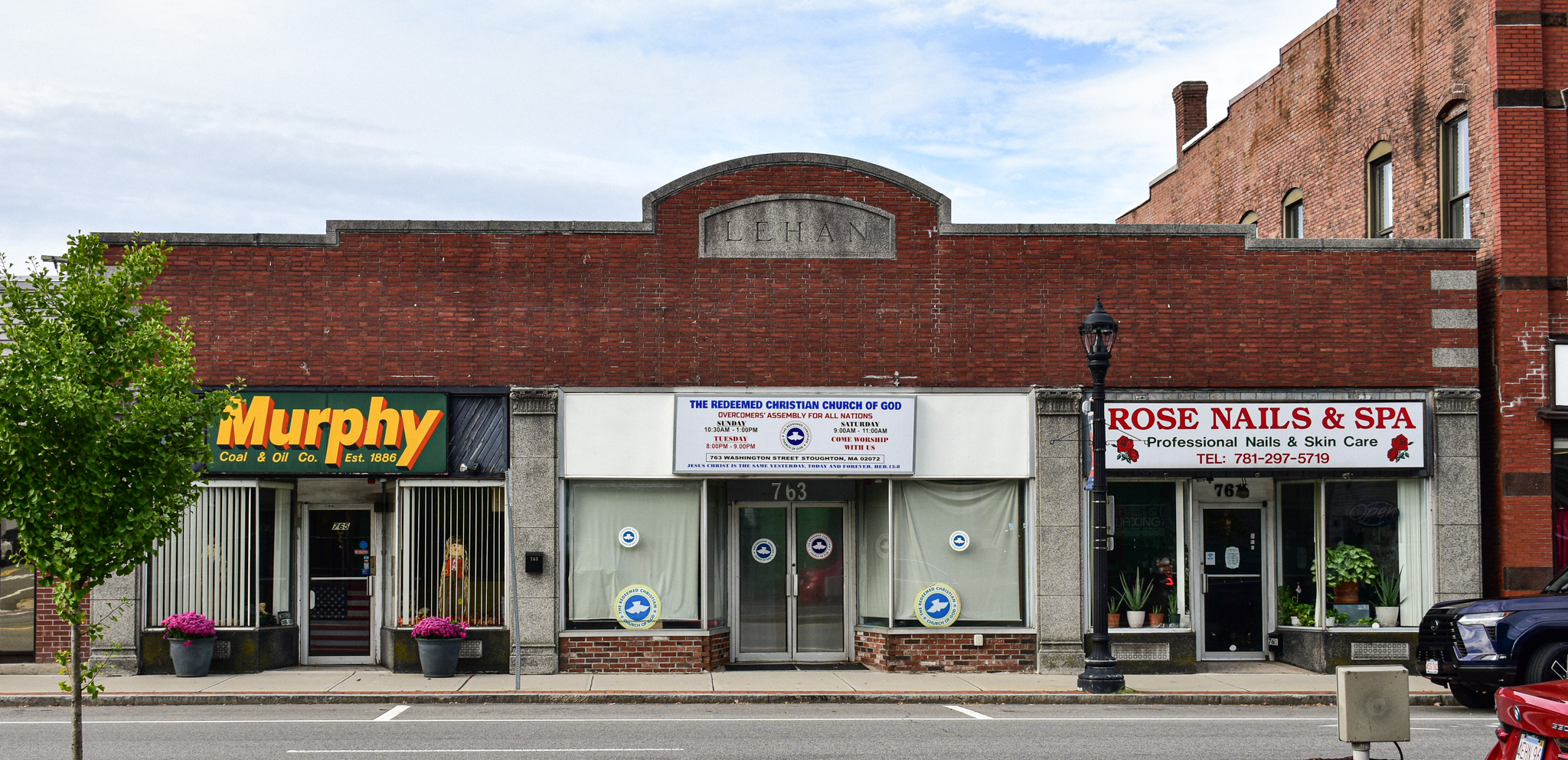
Along Washington Street there are several single-story retail buildings. One that I liked is the Classical Revival Lehan Block, which was built in 1920.

(Zoom in to see the name carved in stone.)

Across the street, on the corner of Washington and Freeman streets, is one place that I found in my pre-visit research.

Currently home to a salon and other small businesses, this Queen Anne-style building dates to 1892 and was built for the local chapter of the Independent Order of Odd Fellows (IOOF), per MACRIS. The town's IOOF was organized in 1845; this building was its fifth meeting place. In 2005, the Stoughton lodge merged with the Braintree one.

Incorporated in 1726, Stoughton was for many decades a farming town. In the 19th century, the shoe-making industry began to take hold, leading to the development of many of the great old builings I saw on my trek. Anchoring the southern end of the main downtown area is the Stoughton Trust Company building at 810 Washington Street.

"Incorporated by 18 business and professional men the Stoughton Trust Company opened for business on July 15, 1911," according to MACRIS. "The bank grew and prospered and in 1916 larger accomodations were necessary. The board voted to build and the new structure opened on February 10, 1917 with deposits of more than $1,000,000. In 1934 the bank merged with 5 other banks to form the Norfolk County Trust Co. In 1935 deposits were in excess of $14,000,000. The bank was of sufficient size to serve the largest industries while also assisting the small businessman and individual."

The building is currently home to some non-banking businesses.

A little further south along Washington Street is a former VFW hall.

Built in the early 1960s, this function hall seems to have closed fairly recently. As you can see, the sign indicates that it will become home to Sully Adult Day Health and Lo's Lounge. Or perhaps those businesses are already in place by now.

Directly across the street is Banh Mi Boba & Me, a Vietnamese restaurant located in an adorable little building.

Prior establishments located here include Comfort Grill and Ronnie's Fine Food & Drink. The building dates to 1930. I'd love to know its original purpose. I'm guessing it was a store of some sort.

Besides the old Odd Fellows hall, I was aware of the State Theatre (sometimes listed as "Theater") before I visited Stoughton.

Opened in December 1927, the theater was designed by the firm of Funk and Wilcox, which was also behind theaters in Beverly, Leominster and the Dorchester neighborhood of Boston, among others. For many years the State hosted vaudeville acts and silent movies. "By 1940, the theater was renamed the Interstate State Theatre, and had been converted into a talking motion picture house," according to the After the Final Curtain blog. "The nearby Stoughton High School held class plays and graduations at the State. The theater was modernized in 1970 — the box seats and some of the atmospheric ornamentation in the auditorium were removed and covered with red drapes, and modern seats were installed on the orchestra level. The theater then became the Stoughton Cinema."

In subsequent years the theater was known as the Stoughton Cinema Pub and the South Shore Performing Arts Center, featuring second-run movies and local theater productions. It closed in early December 2007, just a few weeks shy of its 80th birthday.

Shortly thereafter, local citizens founded the Friends of the State Theatre, a non-profit organization dedicated to bring the "majestic" theater back to life. The group intends "to restore and reopen the theater as a performing arts center," per the After the Final Curtain article. "To that end, they have signed a 20-year lease and were awarded non-profit status in February 2013. They have received grants from the town of Stoughton and the state of Massachusetts, and around $700,000 in donations from private donors and businesses. The Friends aim to raise between $2.5 and $3 million to restore the theater."

As of early 2024, the group indicated on its Facebook page that "we are in need of someone that can help us with raising the funds needed to make the purchase and then rehab. We are in discussion with such a person, but if we can find others would make the lift a little easier."

Here's hoping that the Friends raise the money soon and put this theater back to good use.

(The theater's rear exit.)

(Avocados Mexican Restaurant is located in the space next to the theater's former box office.)

The final building that I knew about before exploring is the stunning Stoughton Railroad Station.

Opened in 1888 on Wyman Street, this Romanesque Revival beauty was designed by, ahem, Charles Brigham, who is probably, like, my 17th cousin 58 times removed. For more on this architect, see February 20, 2021, "Making Things Right in Watertown Square, Part II," in which I feature a church and a bank that he designed.

The station was built from granite quarried in Stoughton, according to MACRIS. The depot is believed to be the only stone station with a tower still standing in the state. "Train and particularly freight service made transportation available to the expanding boot industry opening a national and international market that flourished until the Civil War," according to MACRIS. "Other industries using the railroad included the rubber factories, shoe manufacturers and cotton and elastic webbing businesses."

Before I get to a former rubber factory, I want to feature a sign hung outside Dykeman Electrical.

This sign for Westinghouse Electrical Apparatus, is something I've never seen before. I love how the company's logo looks like electrical circuits and is so simple and yet immediately identifiable. Westinghouse was founded in 1886 in Pittsburgh and manufactured consumer electronics, home appliances, generators, steam turbines and other products well into the 1970s. Since the company turned to the financial services and media businesses in the 1980s and 1990s, I assume this sign goes back to the '70s if not earlier.

Looking east down Summer Street, I saw the only industrial property that I checked out that day.

As I mentioned above, Stoughton was once a shoe-making town. "The shoe industry reached its peak about 1865 in Stoughton and rapidly declined after the end of the Civil War," according to MACRIS. One of the industries that grew during the latter half of the 19th century was rubber-making. "[A]t the corner of Summer and Canton streets, the Mystic Rubber Company was established in 1877 for the production of rubberized cloth and merged with the Hall Rubber Company of Boston in 1889 to form the Stoughton Rubber Company," MACRIS continues.

"The Mystic and Stoughton rubber companies were two of several industries that made an important contribution to Stoughton’s manufacturing economy between ca. 1880 and World War II," MACRIS elaborates. "Another substantial company in the Downtown Stoughton area is the Meade Rubber Company at 25 Brock Street, which was established by Stoughton native James Meade in 1916 for the manufacturing of rubber products. The Meade Rubber Company was closed by 1949." I did not check out the Meade complex.

The former Mystic Rubber property is now known as Trackside Plaza, and houses several small businesses, as well as Sha'ar Hashamayim Messianic Congregation.

Next I headed west along Canton Street for a few minutes. At the intersection with School Street, there stands a lovely little brick building that is currently home to a restaurant, Prato Fino do Brazil.

I believe the building dates to around 1930. Several years ago it was home to Best Pals Diner.

I doubled back on Canton Street, headed east on Porter Street until I saw a nice old building and sign on Pearl Street.

Fernandes Insurance has been in business since 1992. As for the building, it dates to around 1920.

The final shot of the day is of 753-759 Washington Street, which abuts the previously mentioned Lehan Block.

Known as Monks Block, this Romanesque Revival commercial block was built in 1886 and served as a temporary town hall in the 1980s when the actual town hall underwent renovations. Stoughton's town hall is located across Pearl Street from Monks Block.

Saturday, September 7, 2024

Floating Through Fall River, Part III*

From Dave Brigham:

* No actual floating was undertaken in pursuit of this and other posts about Fall River.

Rather than The Backside of America, I could easily have called this blog Ghosts of Times Past or Relics of Places Located Largely in the Eastern Third of Massachusetts (and Sometimes Elsewhere). I am drawn to the old mill towns of New England, and sometimes feel as though I spend too much time hunting down the old, the forgotten, the rusty, the broken-down.

But I find beauty everywhere I explore, in the patina, the hidden history, the faded glory, the hope, the rebirth. I try to find places that people overlook, buildings with stories to tell, sites that contrast original, anachronistic uses with new ways of thinking about the world. I admire the craftsmanship of the buildings, the boldness of chiseling a company or a person's name into the facade. I think of the talent that went into creating a painted advertisement on the side of a building, that 100 years later is still speaking, albeit in fading whispers, to passersby.

I love diners, old movie theaters and kitsch-filled bowling alleys, and I often research these types of places before exploring a given town or city. They make for great photography subjects, and they make me nostalgic for the times I spent in similar places when I was growing up in Connecticut in the 1970s and '80s.

Wow...what a long introduction to the third and final installment in my series about Fall River, Mass. (for the first two, check out this link and this one, too). This one spans some geographic distance, and featues several great old buildings in Fall River's downtown, among other sites.

Let's start at 1144 Pleasant Street, the former American Bakery Company building.

Built in 1934, this building appeared during my visit in February of this year to have been recently fixed up, with new windows at the very least. I believe the place was empty, although a contractor named True Brother, Inc., is listed at that address currently. As for American Bakery, I think it was a Missouri-based conglomerate that formed around the turn of last century.

Heading south-southeast along Pleasant Street, I felt obligated to chronicle another storefront church.

Iglesia Pentecostal Luz en Medio de Tinieblas (Pentecostal Church Light in the Midst of Darkness) is located in the Greany Building, which dates to 1891. Situated in the heart of the neighborhood known to old-timers as The Flint, the Greany Building has always contained a mix of ground-floor retail/business and upper-floor apartments.

At my furthest southeast point of this tour, I reached a diner that looks pretty good on the outside - with a rooftop display that will have sign enthusiasts hooting with pleasure - but one that unfortunately has been closed for some time.

Located on a triangular lot where Pleasant Street crosses Eastern Avenue, C.C.'s Nite Owl Diner is a circa-1956 DeRaffele Manufacturing model that replaced the truck-mounted Worcester Lunch Car No. 786, according to this Fall River Reporter article.

The Fall River landmark has been closed for years, but it may get reheated and brought back to life. "Antone Dias, representing owner Joseph Nasrallah, went in front of the Historical Commission Tuesday stating that Nasrallah is looking to sell or renovate the former Nite Owl Restaurant and get it on the Fall River Register as a significant and historic place before hopefully getting on the National Register," according to a March 20, 2024, Fall River Reporter article.

Fingers crossed.

Now we're heading back toward downtown. At the corner of Bedford and High streets is a former police station, the likes of which I haven't seen in this condition on my backside adventures.

Vacated in 1997, the building was acquired for $1.28 million in 2008, according to this Wicked Local article. The station was built in 1915; I'm assuming at some point it will be demolished and something shiny as a police badge will rise in its place.

Just before Bedford Street hits South Main Street, I spied a lovely old bank building.

Built in 1929, the Fall River Cooperative Bank rose the year after a devastating fire destroyed many buildings in the downtown area. MACRIS calls this building a "good example of the newly emerging Art Deco style," with "characteristic flat wall surfaces and low relief ornamentation." As you can see, this beauty is currently occupied by United Way of Greater Fall River.

On the corner of Bedford and North Main streets is the Classical Revival Burke Building.

Built in 1928, the building is currently home to two restaurants: breakfast joint Sheri's Place, and Dunny's BBQ.

A few doors down, heading north on North Main Street, is The Globe Building.

Dating to 1906, this Classical Revival building was originally home to Fall River Daily Globe Publishing Company. Subsequently, it housed Fall River Herald News Publishing. Currently, the site is occupied by a variety of small businesses.

Next is a much older building, the Italianate Old Red Bank, aka Fall River Savings Bank Building.

Built in 1869, the bank has a "boldly detailed facade with round-arched windows, cornice lintels, and name panel within the pediment" and "is typical of the best institutional building of its period," per MACRIS. The current tenant is a branch of Santander Bank.

Immediately to the north of Old Red Bank is the former Fall River Gas Works Company building.

Built in 1911, this Renaissance Revival building "has perhaps the best-articulated and best-preserved classical revival facade," in the downtown area, according to MACRIS. It is currently occupied by RDA Insurance, which traces its roots to 1908.

Across a parking lot is 177 North Main Street, aka the Peirce Building.

I haven't found out much about this place, other than it was built around 1925 and is currently owned by the Fall River Community Housing Resource Board.

Continuing on the east side of North Main Street, I was happy to see a beautiful church break up the row of commercial buildings.

Completed in 1954 after years of planning and fundraising, the St. Demetrios Greek Orthodox Church was built in the Byzantine basilica style, per MACRIS.

Across North Main Street is the Quequechan Club.

Quequechan -- named for the nearby river -- was chartered in 1894 as a gentlemen's club, and members renovated an existing home for their playhouse. The twenty-five "prominent residents who formed the club represented the city's business and professional elite and included six chief executives of mills, six men otherwise engaged in the textile industry, three investment brokers, two lawyers, one physician and other community leaders," per MACRIS. The club didn't welcome unescorted women into the dining room until the 1970s, per Wikipedia.

The club, as you can imagine, was one of Fall River's most prestigious social clubs for more than 100 years. The club closed in 2012, but according to Wikipedia, the "club remains private and allows members to smoke inside the pub. The club has been reported to be haunted, and mediums and ghost hunters have visited the premises."

Zoinks!

Turning south along the west side of North Main (got that?), I had to make a photo of the Masonic Temple.

The Classical Revival building dates to 1922. A short walk south is the Durfee Block, which dates to 1887.

I like the suspended roof over the entryway, which I'm guessing used to be fancier. "The building was erected in 1887 for the B.M.C..Durfee Trust Co. (originally the B.M.C. Durfee & Co.), chartered in 1870," according to MACRIS. "This firm was organized by John S. Brayton and his sister, Mary Brayton Young, the remarried widow of Fall River Iron Works founder Major Bradford Durfee. The bank was named for their son, B.M.C. Durfee, who was never involved in its operations. Historically, the bank was closely allied to the textile industry in financing the importation of cotton for thriving mills."

I was quite charmed by the ivy-covered building at 44-46 North Main Street.

This small Neoclassical building dates to 1915. I haven't found out much about its history, but MACRIS provides some architectural detail: "whiite glazed brick, cast stone trim...ground floor front is nearly original. There are slender corner columns with spiral neckbanding and Art Nouveau-inspired caps. Metal lintel, opaque glass transom." A separate MACRIS file dates this building to 1928. You choose....

Along South Main Street I got caught up in a conversation with a very nice but extremely talkative woman about what I was doing. I missed a few cool buildings as I tried to get ahead of her, but I didn't miss the Waldorf Building.

Built in 1922, it is "in harmony with the post-1916-fire character of the South Main Street shopping district," according to MACRIS. While the building was known at some point as the Nobby Building, it was built specifically for something called the Waldorf System, Inc.

So what is this system that echoes, but has no relation to, the Waldorf-Astoria? "Waldorf System, Inc., is a somewhat different chain of restaurants. Its 83 cafeterias, drive-ins and pancake houses in eight states lean heavily on self-service eateries in poor locations, offer such dishes as hash and an egg for 65¢," according to this May 21, 1965 Time magazine article. The company merged with a competitor named Restaurant Associates. That company still exists, and functions as an "on-site dining management company."

That's all pretty cool. I've never come across a former self-service cafeteria before.

My final stop in Fall River was Rock-n-Roll Avenue.

Located on Rodman Street, PearTree Studios is obviously operated by a Beatles fan, as evidenced by the tribute to the band's Abbey Road album cover seen below.

(Likenesses of Paul McCartney and Ringo Starr outside the studio. George and John are also featured, of course.)

Whereas the Fab Four had/have Apple Corps. as their corporate entity, the folks behind this studio went with a different fruit. Artists that have recorded at PearTree include The Buggies, Sionide and The Craft.

I hope to return to Fall River soon to check out other parts of the city.

UPDATE: Guido's Court

From Dave Brigham: Longtime readers of this blog might recall that every once in a while I check in on a quaint campo di bocce in Brighto...