Showing posts with label New Mexico. Show all posts

Saturday, March 4, 2023

Happy 13th Anniversary to the Blog!

From Dave Brigham:

(The future's so bright, I gotta wear 3-D glasses.)

On March 1, 2010, I launched this blog with a terrible photo and a reminiscence of how I first got interested in what, as a young man, I dubbed the backside (see "Take Me to the River").

Thirteen years is a long time in anybody's life, and an eternity for a blog. I'm proud that I've kept this online journal of my journeys going for that long. For several years, I had collaborators who brought fresh perspectives, and great photos, to readers of The Backside of America. As each of them dropped away for various reasons, I worried about my ability to keep this thing going by myself. But, to paraphrase George W. Bush, I misunderestimated myself.

I didn't realize how obsessed I could become about this project. I mean that in the best possible way. I took comfort in knowing that I had help here for the first half-dozen years or so. Sure, I had to bug people and edit their words and seek them out on Flickr and bug them some more to publish stuff on the blog. But I was ok with that. Once I stood on my own, I realized that there is no end to the backside of America, and that as long as I can walk, I can fill these pages with photos and fascinating history of all sorts of places.

My mantra is, "I have no ulterior motives in life...except when it comes to exploring the backside." I concoct side trips, annoy my family on vacations and go into withdrawal if a weekend goes by and I haven't ventured out with my camera.

Over the last several years, I have become quite enamored of documenting neighborhoods, villages, towns and the main commercial/industrial areas of cities. I get into a zone when I'm doing this, talking to myself as I roam around, vibrating with excitement when I see ghost signs or named buildings or diners or abandoned (or renovated) factory and mill buildings. I am dedicated to chronicling the past. This is crucial in Greater Boston, as so many towns and cities in the area have changed so drastically in the last 10 years with the booming economy.

Is it strange that I sometimes wish things weren't humming along so well, so I could find all of the backside stuff before it gets bulldozed or painted over or modernized?

So while I'd love to have company on the blog, I long ago stopped worrying about how to fill this space. To the best of my 'ciphering, the last time someone whose initials aren't "DJB" posted on this blog was on January 12, 2018, when Joe Viger shared a photo of a religious-themed sign in Chichester, New Hampshire.

Lately, I have had discussions with a few folks about contributing, and in the case of Mick Melvin, rejoining the squad so he can continue posting great stuff. If you or someone you know is interested in sharing photos with the blog, drop a message at the bottom of this post. I'm happy to do research and writing to support your photos if you're not into doing that part yourself.

In the meantime, though, I will continue exploring whenever and wherever I can, happy to fulfill what I've come to think of as one of my life missions. Below are some of my favorite posts from 2017-2022.

February 1, 2017, "Bon Voyage, Lady," in which I write about a church built in 1952 to meet the needs of Boston's longshoremen and their families. The Chapel of Our Lady of Good Voyage was torn down and a new sanctuary was built nearby in the booming Seaport District. There aren't any longshoremen (or women) left in this part of town, so I'm not sure who worships and prays here.

May 25, 2017, "Duke City Downtown," in which I prove that I don't only write about Greater Boston by featuring photos of Albuquerque, New Mexico, a city where I lived for a short time in the late '80s.

(Albuquerque's El Rey Theater.)

September 13, 2017, "Hub Holdout," in which I write about the MidTown Hotel, a circa-1962 spot located in Boston's Back Bay neighborhood that has somehow managed to avoid the wrecking ball.

January 20, 2018, "The Fabulous Baker Estate," in which I detail my looooooooong pursuit of Ridge Hill Farms, "an 800-acre amusement park/fantastic folly built by industrialist William Baker in the late 1800's in Needham, Mass."

(Remnant of Baker Estate train station.)

March 29, 2018, "Udderly Monstrous," in which I wonder why a mastodon of a building that looks like a Victorian penal institution or something out of a late '70s Pink Floyd video sits on the campus of UMass Boston.

April 8, 2018, "Tom Cruise Slept Here...Well, Maybe," in which I name-check the World's Favorite Scientologist while discussing a historic hotel that's been in disrepair for way too long. The old Hotel Alexandra was built in 1875; the Boston Planning & Development Agency in 2021 approved a redevelopment project that will "retain and restore the façade...and construct a new, approximately 150 room, thirteen story residential building with ground floor restaurant and café space, and a rooftop level bar/restaurant."

(The former Hotel Alexandra.)

August 26, 2018, "You Have Been Un-Matriculated," in which I stumbled across an abandoned college campus in Lancaster, Mass. This type of thing is happening around the country more since the pandemic. The town of Lancaster has been in talks with the Atlantic Union Conference of the Seventh-Day Adventist Church about using part of the old campus for affordable housing.

October 6, 2018, "Scratching Around the Flea Market," in which I feature photos from a bazaar on Cape Cod. Hey, as the only guy on the masthead at this blog, I had to find new stuff to profile!

(Pop-up record players from the Sandwich Flea Market.)

February 23, 2019, "Exchanging Flowers for Life Science," in which I talk about something that's become a regular occurrence in and around Boston: the sale of a property that for decades was used for one purpose (in this case, a flower wholesaler cooperative) leading to a total demolition in favor of life science and technology purposes.

May 4, 2019, "Roll the Dicee: Encore!" in which I visited Everett, Mass., to see how things had changed in the four-plus years since I'd visited the neighborhood where Wynn Resorts was building the first Boston-area casino. The gambling mecca opened in June 2019.

(The Encore Boston Harbor casino under construction.)

June 29, 2019, "Back Streets, Oh Boy," in which I explore an area of Boston's South End I never knew existed, a neighborhood filled with a mix of great old buildings and new development.

July 7, 2019, "A Shrine Lost as Development Looms," in which I wrote about the loss of a religious shrine as a proposed development seemed likely to rise. Unlike so many other skyscraper projects in the city, however, 1000 Boylston has yet to materialize, more than three-and-a-half years after I wrote this post. I do a lot of research for my blog, and I have to say, trying to figure out what used to be on this lonely patch of dirt and grass behind Bukowski Tavern in Boston's Back Bay took a LOT of toil.

(Shrine of Our Lady of the Miraculous Medal, in ruins.)

September 25, 2019, "Seattle, Part IV: Pioneer Square," in which I once again prove that I know where places outside of New England are, by visiting an area of the Emerald City teeming with great old buildings, statues, ghost signs and neon.

October 20, 2019, "Hyde-in In Plain Sight," in which I profile a historic home in Newton, Mass., that was listed on the National Register of Historic Places and designated as a Newton Landmark Preservation Site. That latter designation provides the highest level of protection for properties deemed to be architecturally or historically significant. Alas, after I published this post, a builder tore the damn house down without city approval.

(The Gershom Hyde House, which was razed by an idiot.)

November 13, 2019, "A Tale of Brahmins, Terriers, Murder, Clever Inventions and, Perhaps, Tom Cruise," in which I prove that I may be a bit obsessed with the World's Favorite Scientologist. I also learned about the patriarch of Boston Terriers, as well as a Back Bay mansion's history as a dining club, a secretarial school, the home of some wealthy Brahmins and the Church of Scientology's regional base.

January 14, 2020, "Of Pests, Pestilence & Death," in which I explored the exterior of a long-abandoned house in Concord, Mass., as well as a tiny cemetery, and learned about pest houses.

(Condemned house along Route 2 in Concord that has since been torn down.)

February 27, 2020, "Shoot It If You Got It," in which I put into practice something I'd learned during a camera club presentation: "If you find something you like, shoot the hell out of it." In this case, it's a barn in Windsor, Connecticut.

August 19, 2020, "Nailing a Great Find in Wareham," in which I present two of the best freeform finds I've had for this blog: the Mill Pond Diner and the old Tremont Nail Company complex, both in Wareham, Mass.

(Mill Pond Diner.)

(Tremont Nail Company.)

April 24, 2021, "Zooming Through Loom City, Part I: The Mills," in which for the first time I put into action a plan whereby I visit my mother in Connecticut for the day, and find some backside destinations either before or after (or occasionally both) seeing her.

September 3, 2021, "Many Barns, Two Minds," in which I make photos of barns in my hometown of Simsbury, Connecticut, and learn that the tobacco industry still has a hold in that area.

(Two barns [also known as sheds] in West Simsbury, Conn.)

January, 22, 2022, "Jamaica Plain, Part I: Shopping & Snapping," in which I test out a novel concept: simultaneously Christmas shopping and photographing the backside of a Boston neighborhood. It worked out quite well.

February 12, 2022, "New York City Flashback: Views from the High Line," in which I find a clever way to create content by using photos taken years prior in New York City.

(Airstream trailer in front of The Standard High Line hotel. One of my favorite photos.)

April 23, 2022, "A Wonderful Walk in Wellesley Hills," in which I wake up and smell the coffee, realizing that the backside of America isn't only in gritty old mill towns, but also in tony Boston suburbs.

May 15, 2022, "Busting Ghosts in Boston's Newmarket Square," in which I go hog-wild chasing down ghost signs in an industrial neighborhood.

(Newmarket Square ghost sign.)

September 16, 2022, "Free-forming in Ashland," in which I explore Ashland, Mass., on a whim and discover a great Masonic Temple, a few old factories and an abandoned Dairy Queen.

October 8, 2022, "Learning Things About My Hometown," in which I, well, read the headline.

(Former Probate Court building in downtown Simsbury, Conn.)

Thanks for checking out some of my favorites from the past six years. Looking ahead, expect a lot more of the same type of quality posts you've come to expect; perhaps some input from other folks (fingers crossed!); and field trip opportunities for Backside enthusiasts to places I've been before, as well as some new and exciting locations.

To see my favorite posts from the early years of the blog, check out the post below, in which I write about my top stuff from the year 2016, and feature links to the prior years.

June 9, 2017, "Anniversary Post #7: My Favorites from 2016."

Wednesday, June 14, 2017

The Road to Ruins

From Dave Brigham:

If I'd had more time in New Mexico, I would have visited a pueblo on feast day, when food is offered and religious ceremonies are held. I know next to nothing about Native American cultures, but being in the Land of Enchantment, and seeing Indian artwork, clothing, jewelry and people made me want to learn a little something about the place I was visiting.

Welcome to the third and final installment in my New Mexico series. Previously I wrote about the place I lived with friends back in 1988, and some of our hangouts (see May 24, 2017, "The Land of Enchantment"); and shared photos and a brief write-up about an early morning walkabout in downtown Albuquerque (see May 25, 2017, "Duke City Downtown").

This post is about the Jemez National Historic Landmark (also known as the Jemez Ruins, which is how I will refer to the site). In planning my two-day visit to New Mexico with my friends Andy and Pete, with whom I'd lived in Albuquerque for a short time in 1988 after a road trip, I added a few potential historic ruins to my list. I zeroed in on Jemez because it was closest to Albuquerque. I would love to return to the beautiful deserts of New Mexico to see other ruins, and to witness some native ceremonies.

The drive from Albuquerque to Jemez was stunningly beautiful. The majestic Sandia Range was off to our east, its green peaks set off nicely against the brown earth all around. Once we got off the interstate, our views changed to red rock cliffs, miniature canyons and a mesa off in the distance. There were cacti here and there, along with the odd horse farm and broken-down service station.

The scenery was otherworldly for this boy, raised in the green forests, quaint towns and urban sprawl of New England. Here's an idea of what we felt like:

During the three months I lived in Albuquerque in 1988, I went up the Sandias once, with Andy and Pete, and visited Petroglyph National Monument with Pete and another road trip buddy, John. Those were the only sights we saw. So I was determined to get out of the city on my return trip, and get a better feel for the culture of New Mexico.

A few miles short of the Jemez ruins, we stopped at a camping and cookout area with amazing red sandstone cliffs as a backdrop. We walked around a bit, marveling at the ease with which you could write your name on the rocks. The trails beyond the cliffs were off limits to tourists, as they are sacred to the people of the Pueblo of Jemez.

The road to the ruins...hold on. I need to do this:

OK, thanks for indulging me. On either side of the road to the Jemez ruins we saw glimpses of the pueblo: small adobe houses, a fry bread/burger joint that unfortunately wasn't open; a few dogs lazing in dusty front yards; a school and some businesses; and two men ascending a small hill, one of whom was carrying a small flaming torch.

This sign served as quite a greeting to the ruins, and the Southwest in general. The Jemez site includes a former village, church and convent.

The above photo shows the ruins of a home, which was later used as a Spanish inn, according to a web site run by the New Mexico Department of Cultural Affairs. The former mission church, below, must have been an amazingly imposing sight in its time.

(View through a window of the old church to a small ridge on the opposite side of the road.)

I expected the ruins to be larger, but nevertheless I was humbled. I was so out of my element among the remnants of cultures I know nothing about, out there in a desert landscape that just blows my mind. The terrain was familiar from old Westerns, but yet I felt like I was in an alien world. I felt good slowing down from my East Coast pace, the heat sizzling on my skin as we strolled through the ruins.

Directly across the street from the ruins stands the beautiful Mary, Mother of Priests Catholic Church.

Part of the Congregation of the Servants of the Paraclete, the church was built in 1962. Read more about the history of the church and the congregation here.

On our drive back to Albuquerque, I had to stop at the former Big Chief Service Station on Route 550.

Here again, looking at this sign, and at the abandoned adobe station, I felt like I was on a movie set. There just is nothing that looks like this place in New England, with its hand-painted sign and big skies everywhere.

(The cover art for Pete's first solo album, perhaps?)

(Andy goofing around with Big Chief.)

Over the years of exploring on behalf of this blog, I've learned to check out things from as many angles as possible. I knew I had to take a look at the backside of the backside. Boy am I glad I did.

Isn't he perfect?

Thursday, May 25, 2017

Duke City Downtown

From Dave Brigham:

In the first post about my recent trip to Albuquerque, New Mexico, I wrote about the place where I lived with some friends 29 years ago, and some of our hangout spots (see May 24, 2017, "The Land of Enchantment"). In this installment in my three-part series, I'll cover some cool things I saw downtown on an early-morning walk.

I was happy to see that El Rey Theater is not only still standing, but also active. My friends and I saw the Rollins Band here back in 1988 during our three-month stay in the Duke City. Built in 1941, the theater closed for a time in 2014 after the owner had money problems, according to reports I read online. For a little history of El Rey, check this link on the theater's web site.

Albuquerque is known for its murals.

This set is located on the patio of a former Studebaker Automotive Company dealership and garage, now home to Boese Brothers Brewery. Our visit was too quick. Next time I'll hit this place.

"The City of Albuquerque's Public Art Program, one of the oldest in the country, began in 1978, with the passage of the Art in Municipal Places Ordinance. This bold initiative set aside 1% of city construction funds derived from the general obligation bond program and certain revenue bonds for the purchase or commission of works of art." -- from VisitAlbuquerque.com.

Murals feature Native American images, train conductors, old cars and historic buildings, trees, peace signs, traffic jams, street scenes, civic celebrations, hallucinations, classic motel signs, and much, much more. Below is one of many that caught my eye, and one of the few in decent light at that early hour.

The mural, in part, depicts the Alvarado Hotel, which was torn down by the Santa Fe Railway in the 1960’s. The mural also shows how some, probably most, people felt about that demolition. For more on the once-grand hotel, read this Santa Fe New Mexican article.

For more on the city's murals, read this article and also this one.

The Century Theatre sign isn't historic or even made of neon (I don't think) but it looks really cool, especially at sunrise. The complex was constructed as the first phase of the Downtown Revitalization plan led by Hartman + Majewski and the Historic District Improvement Company. Century traces its history to 1940; the company was acquired by Cinemark in 2006.

I would have loved to have spent much more time wandering through Albuquerque's downtown. The architecture is quite different from what I see around Boston, more colorful and constructed with different materials and with much better signage. I was a bit concerned being in a strange environment so early in the morning -- just me, the birds and the bums, I told myself. Also, I needed to get back to my hotel to start waking up my traveling buddies for that day's adventure, which I'll chronicle in the final post of this three-part series.

Rosenwald Brothers department store was built in 1910 and added to the National Register of Historic Places in 1978, per Wikipedia. It is now office and municipal space.

The Yrisarri Block was erected in 1909, and sits across the street from the Rosenwald building. I love the colors and architectural details on this place, which houses several small businesses, including a bar called Downtown Distillery. The block was formerly home to Maisel's Indian Trading Post. For more details about the Rosenwald and Yrisarri buildings, check this link.

Finally, the Telephone Museum of New Mexico, a place that surely would've been worth a visit. I dig the sign, and its juxtaposition with the "Big Brother" video camera.

The last installment of this mini-series will focus on my visit to some historic ruins an hour north of the city.

Wednesday, May 24, 2017

The Land of Enchantment

From Dave Brigham:

I lived here 29 years ago. No, I wasn't homeless, although there was a Salvation Army shelter just up the street all those years ago. And no, I wasn't squatting in a tent on the property, at 314 Broadway SE in Albuquerque, New Mexico. There was a small house, with a few attached apartments, here three decades ago. I lived there with friends for three months, following a three-week road trip.

I've been writing a memoir covering the trip and my time spent in the Land of Enchantment. I decided a while back I would write the last chapter only after returning to the city. I tried to convince my wife and kids to take a family vacation in New Mexico, but they wouldn't go for it. Then I realized that the better idea was to hang out in Albuquerque with the guys who I traveled and lived with in 1988.

So in early May my college buddy Pete and I flew out of Boston and met our fellow road-tripper, my high school friend and Seattle resident Andy, in the Duke City. Primary on my agenda for our quick two-day visit was to check out a few old haunts. That's what this post is about. I will also write two other posts, one featuring shots I took on an early-morning walk through downtown Albuquerque, the other, photos of Native American and Spanish ruins in the desert north of the city.

I like the look of the Broadway Market Building, which was just a few blocks from our house. I don't have any idea if there was a market in this building 29 years ago. We never shopped at markets or grocery stores back then; we ate out once in a while, or bought ramen noodles, soup, bread, mayo, tuna, cereal and beer at places like the Circle K or 7-Eleven. We also bought more than our share of chili-and-cheese hot dogs at the latter joint. The building was converted to apartments at some point.

One place we ate is the Frontier Restaurant, an institution for students at the University of New Mexico. Located on Central Avenue (aka Route 66), the restaurant served as a hangout for Pete and me, as well as another guy on our trip, John. Andy left our road trip, which started in New England, part way through in order to return to Connecticut for a family party. He joined us in Albuquerque after we'd already been there for at least a month.

I have a thing for clever hair salon names, which started when I was living in Albuquerque. On the 1.5-mile walk from our rental house to the Frontier, I passed a place called Hairforce One, which to this day is my favorite salon name. I didn't see it on my return trip, but Hair We Are is a pretty good name, and I just love the colors and the artwork on their shop.

We didn't have a lot of money when we lived in the Duke City, but luckily drinks and cover charges were pretty low, so we managed to get out with some regularity to see local and national bands. We spent plenty of nights at the Fat Chance Saloon, which no longer exists. We asked the owner of a bar on Central Ave. where we were tipping a pint, "Where was the Fat Chance?" He told us it was in the space where Brickyard Pizza is now, so we popped in for a quick look.

There was a much closer bar that we also visited on occasion. El Madrid (or, as we gringoes called it, The El Madrid), was a short walk from our house, across a bridge over some railroad tracks. We drank cheap beer out of mismatched mugs -- Black Label beer, Mason jars, cartoon characters -- and watched local bands and performance artists.

(Pete in the doorway of El Madrid.)

The place has obviously been shuttered for a while. I was saddened but not completely shocked to see that the awesome Elvis mural on the outside of the bar has been defaced. That's just tragic. It was painted by Kenneth Wolverton.

Here's a photo of the full mural -- on each side of the front door, and above as well -- in all its glory.

I want this sign and light from outside El Madrid. Now, look in the background of this photo, to the right of the "BAR" sign. It's a turret.

And here's that turret from the front.

Built in 2006, this mansion belonged to the late local jewelry and antique seller Gertrude Zachary. Her store is located next to the house, in a neighborhood that various publications I found online refer to as "skid row," "a battlefield of failed homes [and] empty parking lots" and "a barren industrial neighborhood." Those terms may still apply somewhat, but when we walked through the 'hood we spied a brew pub, an artists' collective called Sanitary Tortilla Factory, several funky new apartment buildings and a Fast Signs franchise.

I'm not sure why this poster of Martin Luther King, Jr. and Coretta Scott King was plastered on this building, but I like it.

Just two blocks from the mansion and antique/jewelry store, you get a sense of why folks refer to this area as skid row. The building above until recently was the Albuquerque Rescue Mission. The mission changed its name to Steelbridge and houses nearly 100 men and women on a daily basis and offers "faith-based" programs. I spied at least one building with the Steelbridge name on it, and saw a handful of apparently homeless men lolling about nearby.

After walking through some of our old neighborhood in the midday sun, we drove up Central Ave. to the Route 66 Diner, where Pete worked when we lived there.

Pete had the Pile Up, a "pile of pan fried potatoes, chopped bacon, chopped green chile, two eggs any style, cheddar cheese & red or green chile sauce on top," per the restaurant's menu. I had the 66 Burger, topped with New Mexico Green Chile. Andy had 66 Chicken Fried Steak. They were all terrific.

The next installment in this mini-series will focus on photos I took early one morning in the downtown Albuquerque area.

Tuesday, November 13, 2012

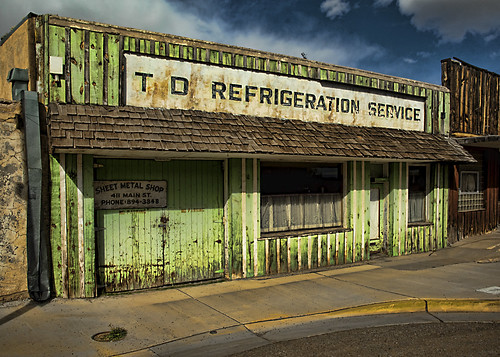
Walk-in Cooler

From Pete Zarria:

TD Refrigeration

I just liked the look of this place in Truth or Consequences, New Mexico. I walked in to a chilly reception....

Former Rock Club in the Fenway Slated for Redevelopment

From Dave Brigham: Sometime in the late '90s/early aughts, I saw one of the greatest Boston bands of all time, the Upper Crust , in a ...