Showing posts with label Seattle. Show all posts

Saturday, March 4, 2023

Happy 13th Anniversary to the Blog!

From Dave Brigham:

(The future's so bright, I gotta wear 3-D glasses.)

On March 1, 2010, I launched this blog with a terrible photo and a reminiscence of how I first got interested in what, as a young man, I dubbed the backside (see "Take Me to the River").

Thirteen years is a long time in anybody's life, and an eternity for a blog. I'm proud that I've kept this online journal of my journeys going for that long. For several years, I had collaborators who brought fresh perspectives, and great photos, to readers of The Backside of America. As each of them dropped away for various reasons, I worried about my ability to keep this thing going by myself. But, to paraphrase George W. Bush, I misunderestimated myself.

I didn't realize how obsessed I could become about this project. I mean that in the best possible way. I took comfort in knowing that I had help here for the first half-dozen years or so. Sure, I had to bug people and edit their words and seek them out on Flickr and bug them some more to publish stuff on the blog. But I was ok with that. Once I stood on my own, I realized that there is no end to the backside of America, and that as long as I can walk, I can fill these pages with photos and fascinating history of all sorts of places.

My mantra is, "I have no ulterior motives in life...except when it comes to exploring the backside." I concoct side trips, annoy my family on vacations and go into withdrawal if a weekend goes by and I haven't ventured out with my camera.

Over the last several years, I have become quite enamored of documenting neighborhoods, villages, towns and the main commercial/industrial areas of cities. I get into a zone when I'm doing this, talking to myself as I roam around, vibrating with excitement when I see ghost signs or named buildings or diners or abandoned (or renovated) factory and mill buildings. I am dedicated to chronicling the past. This is crucial in Greater Boston, as so many towns and cities in the area have changed so drastically in the last 10 years with the booming economy.

Is it strange that I sometimes wish things weren't humming along so well, so I could find all of the backside stuff before it gets bulldozed or painted over or modernized?

So while I'd love to have company on the blog, I long ago stopped worrying about how to fill this space. To the best of my 'ciphering, the last time someone whose initials aren't "DJB" posted on this blog was on January 12, 2018, when Joe Viger shared a photo of a religious-themed sign in Chichester, New Hampshire.

Lately, I have had discussions with a few folks about contributing, and in the case of Mick Melvin, rejoining the squad so he can continue posting great stuff. If you or someone you know is interested in sharing photos with the blog, drop a message at the bottom of this post. I'm happy to do research and writing to support your photos if you're not into doing that part yourself.

In the meantime, though, I will continue exploring whenever and wherever I can, happy to fulfill what I've come to think of as one of my life missions. Below are some of my favorite posts from 2017-2022.

February 1, 2017, "Bon Voyage, Lady," in which I write about a church built in 1952 to meet the needs of Boston's longshoremen and their families. The Chapel of Our Lady of Good Voyage was torn down and a new sanctuary was built nearby in the booming Seaport District. There aren't any longshoremen (or women) left in this part of town, so I'm not sure who worships and prays here.

May 25, 2017, "Duke City Downtown," in which I prove that I don't only write about Greater Boston by featuring photos of Albuquerque, New Mexico, a city where I lived for a short time in the late '80s.

(Albuquerque's El Rey Theater.)

September 13, 2017, "Hub Holdout," in which I write about the MidTown Hotel, a circa-1962 spot located in Boston's Back Bay neighborhood that has somehow managed to avoid the wrecking ball.

January 20, 2018, "The Fabulous Baker Estate," in which I detail my looooooooong pursuit of Ridge Hill Farms, "an 800-acre amusement park/fantastic folly built by industrialist William Baker in the late 1800's in Needham, Mass."

(Remnant of Baker Estate train station.)

March 29, 2018, "Udderly Monstrous," in which I wonder why a mastodon of a building that looks like a Victorian penal institution or something out of a late '70s Pink Floyd video sits on the campus of UMass Boston.

April 8, 2018, "Tom Cruise Slept Here...Well, Maybe," in which I name-check the World's Favorite Scientologist while discussing a historic hotel that's been in disrepair for way too long. The old Hotel Alexandra was built in 1875; the Boston Planning & Development Agency in 2021 approved a redevelopment project that will "retain and restore the façade...and construct a new, approximately 150 room, thirteen story residential building with ground floor restaurant and café space, and a rooftop level bar/restaurant."

(The former Hotel Alexandra.)

August 26, 2018, "You Have Been Un-Matriculated," in which I stumbled across an abandoned college campus in Lancaster, Mass. This type of thing is happening around the country more since the pandemic. The town of Lancaster has been in talks with the Atlantic Union Conference of the Seventh-Day Adventist Church about using part of the old campus for affordable housing.

October 6, 2018, "Scratching Around the Flea Market," in which I feature photos from a bazaar on Cape Cod. Hey, as the only guy on the masthead at this blog, I had to find new stuff to profile!

(Pop-up record players from the Sandwich Flea Market.)

February 23, 2019, "Exchanging Flowers for Life Science," in which I talk about something that's become a regular occurrence in and around Boston: the sale of a property that for decades was used for one purpose (in this case, a flower wholesaler cooperative) leading to a total demolition in favor of life science and technology purposes.

May 4, 2019, "Roll the Dicee: Encore!" in which I visited Everett, Mass., to see how things had changed in the four-plus years since I'd visited the neighborhood where Wynn Resorts was building the first Boston-area casino. The gambling mecca opened in June 2019.

(The Encore Boston Harbor casino under construction.)

June 29, 2019, "Back Streets, Oh Boy," in which I explore an area of Boston's South End I never knew existed, a neighborhood filled with a mix of great old buildings and new development.

July 7, 2019, "A Shrine Lost as Development Looms," in which I wrote about the loss of a religious shrine as a proposed development seemed likely to rise. Unlike so many other skyscraper projects in the city, however, 1000 Boylston has yet to materialize, more than three-and-a-half years after I wrote this post. I do a lot of research for my blog, and I have to say, trying to figure out what used to be on this lonely patch of dirt and grass behind Bukowski Tavern in Boston's Back Bay took a LOT of toil.

(Shrine of Our Lady of the Miraculous Medal, in ruins.)

September 25, 2019, "Seattle, Part IV: Pioneer Square," in which I once again prove that I know where places outside of New England are, by visiting an area of the Emerald City teeming with great old buildings, statues, ghost signs and neon.

October 20, 2019, "Hyde-in In Plain Sight," in which I profile a historic home in Newton, Mass., that was listed on the National Register of Historic Places and designated as a Newton Landmark Preservation Site. That latter designation provides the highest level of protection for properties deemed to be architecturally or historically significant. Alas, after I published this post, a builder tore the damn house down without city approval.

(The Gershom Hyde House, which was razed by an idiot.)

November 13, 2019, "A Tale of Brahmins, Terriers, Murder, Clever Inventions and, Perhaps, Tom Cruise," in which I prove that I may be a bit obsessed with the World's Favorite Scientologist. I also learned about the patriarch of Boston Terriers, as well as a Back Bay mansion's history as a dining club, a secretarial school, the home of some wealthy Brahmins and the Church of Scientology's regional base.

January 14, 2020, "Of Pests, Pestilence & Death," in which I explored the exterior of a long-abandoned house in Concord, Mass., as well as a tiny cemetery, and learned about pest houses.

(Condemned house along Route 2 in Concord that has since been torn down.)

February 27, 2020, "Shoot It If You Got It," in which I put into practice something I'd learned during a camera club presentation: "If you find something you like, shoot the hell out of it." In this case, it's a barn in Windsor, Connecticut.

August 19, 2020, "Nailing a Great Find in Wareham," in which I present two of the best freeform finds I've had for this blog: the Mill Pond Diner and the old Tremont Nail Company complex, both in Wareham, Mass.

(Mill Pond Diner.)

(Tremont Nail Company.)

April 24, 2021, "Zooming Through Loom City, Part I: The Mills," in which for the first time I put into action a plan whereby I visit my mother in Connecticut for the day, and find some backside destinations either before or after (or occasionally both) seeing her.

September 3, 2021, "Many Barns, Two Minds," in which I make photos of barns in my hometown of Simsbury, Connecticut, and learn that the tobacco industry still has a hold in that area.

(Two barns [also known as sheds] in West Simsbury, Conn.)

January, 22, 2022, "Jamaica Plain, Part I: Shopping & Snapping," in which I test out a novel concept: simultaneously Christmas shopping and photographing the backside of a Boston neighborhood. It worked out quite well.

February 12, 2022, "New York City Flashback: Views from the High Line," in which I find a clever way to create content by using photos taken years prior in New York City.

(Airstream trailer in front of The Standard High Line hotel. One of my favorite photos.)

April 23, 2022, "A Wonderful Walk in Wellesley Hills," in which I wake up and smell the coffee, realizing that the backside of America isn't only in gritty old mill towns, but also in tony Boston suburbs.

May 15, 2022, "Busting Ghosts in Boston's Newmarket Square," in which I go hog-wild chasing down ghost signs in an industrial neighborhood.

(Newmarket Square ghost sign.)

September 16, 2022, "Free-forming in Ashland," in which I explore Ashland, Mass., on a whim and discover a great Masonic Temple, a few old factories and an abandoned Dairy Queen.

October 8, 2022, "Learning Things About My Hometown," in which I, well, read the headline.

(Former Probate Court building in downtown Simsbury, Conn.)

Thanks for checking out some of my favorites from the past six years. Looking ahead, expect a lot more of the same type of quality posts you've come to expect; perhaps some input from other folks (fingers crossed!); and field trip opportunities for Backside enthusiasts to places I've been before, as well as some new and exciting locations.

To see my favorite posts from the early years of the blog, check out the post below, in which I write about my top stuff from the year 2016, and feature links to the prior years.

June 9, 2017, "Anniversary Post #7: My Favorites from 2016."

Wednesday, September 25, 2019

Seattle, Part IV: Pioneer Square

From Dave "Proto Grunge Rocker" Brigham:

This is the fourth post in a five-part series about Seattle, a beautiful and fun city I visited with my wife and kids back in April. This series is by no means meant to be an exhaustive survey of the Emerald City. It just features a lot of the stuff I saw while annoying my family by taking so many pictures. For links to the three previous installments, see the bottom of this post.

I saw this ghost sign on a building abutting the parking garage where I put our rental car, and I knew our tour of Pioneer Square was going to be a good one. I had only a rough idea what to expect in the square, which dates to 1852 and calls itself "Seattle’s original neighborhood." There are some Native Americans who might disagree on that title. We went to the square for Bill Speidel's Underground Tour, which was cool, but we had time to kick around the historic district, so we did and boy am I glad.

The Bank of California sign above was a gigantic advertisement for the Seattle outpost of the financial institution that was the first commercial bank in the Western United States. In 1996, the Bank of California merged with Union Bank; in 2008 it became a wholly owned subsidiary of Mitsubishi UFJ Financial Group, per Wikipedia.

Alright, I'm gonna run through the Square more or less in the order my family and I did it before we went underground. You might want to go to the bathroom before starting on this journey; it's gonna be a long one.

This stunner is known as the Good Arts Building. Situated on the corner of First Avenue and Cherry Street, this place was completed in 1890 and was known as the Scheuerman Block, per the building's web site. "It has been the home to department stores, a two-story diner ('Good Eats,' from which our name derives), a cigar store, a jazz club, a boxing gym, brothels, speakeasies, and the original office of Washington Mutual Savings Bank," per the web site. "In the nineteen-seventies the basement housed the first gay and lesbian community center in Seattle, followed by the Skid Road Theatre....In 2015, Good Arts LLC purchased the building with the mission of preserving its artistic heritage and affordability to creative enterprises."
This totem pole is so cool, and the kind of thing I just don't ever get to photograph around New England. In addition to being a stunning work of art, the Tlingit Indian Totem Pole has an interesting back story. "The Totem Pole first appeared in 1899, after members of the Chamber of Commerce, vacationing in Alaska, stole it from Tlingit Indians," per the PioneerSquare.org web site.

Wow, I wasn't expecting that bit of racist history. How the hell did they travel with that thing? Boat? Train?

What happened next, oh great and wonderful Internet?

"The men gave the object to the city as a gift, but the tribe justly sued for its return and $20,000 in damages. The courts found the men guilty of theft, but fined them only $500 and allowed the city to retain ownership. In 1938, the pieces that remained after vandals set the Totem Pole on fire were sent back to Alaska, where Tlingit craftsmen graciously carved a reproduction."

Why am I not surprised that the Native Americans were bigger men than the idiots from Seattle's Chamber of Commerce?

(Detail of the totem pole.)

Steps away from the totem pole is a statue of Chief Seattle.

A Native American, Seattle (or Sealth) was born in 1786 and died in 1866. "While known as 'Chief Seattle, there were in fact no hereditary chiefs among the Puget Sound tribes," according to this biography. "From time to time leaders arose who distinguished themselves by their actions or particular skills, and were respected and followed." Seattle, per the biography, wanted the natives and the white settlers to live in peace and harmony. As such, he worked with David Maynard, who is considered one of the founders of what became Seattle, to realize that goal. Obviously, some Native Americans at the time rejected this accommodation; others went along. Chief Seattle's legacy is therefore a bit complicated.

"Though many people see this cooperation as a lesser of two evils, some individuals have a different opinion," per this post on Indians.org. "Some have criticized Chief Seattle claiming he was cowardly and it cost the tribe their land and their way of life. However, the other Native Americans who chose to fight for their lands eventually lost."

A few more steps away from Chief Seattle's statue and the totem pole is the Iron Pergola, which sounds like a heavy metal band or a medieval torture device but it's actually neither.

Erected in 1909 as a stop for the Yesler and James Street Cable Car Company, the fancy shelter was "the most lavish of its kind west of the Mississippi with ornamental iron columns, wrought iron ornamentation and a large underground restroom," per the PioneerSquare.org web site. It was restored in 1972 and today serves as a place for tourists to hang out, and for homeless people to gather, as you can in the above photo.

The Lippy Building went up in 1902, built for T.S. Lippy, who made a fortune in the Klondike gold rush. I'm guessing the mosaic entryway below had been touched up more than once in the ensuing 117 years.

Too bad this building wasn't named for Zippy the Pinhead's square brother, Lippy.

The State Hotel doesn't exist anymore at this spot along 1st Avenue South, but somebody was smart enough to save and restore this fantastic neon sign. Not sure the history of the hotel.

You may be starting to understand just how excited I was for Pioneer Square, what with the beautifully restored old buildings, the funky statues, the neon signs and the ghost signs. Well, when I saw the building below, I about crapped my pants.

I've shot ghost signs all around Greater Boston (and will even be featured in an upcoming Boston Globe article about these advertising relics), but I've never seen anything as amazing as the Buttnick Building. I thought I was looking at a movie set. I'd never seen ghost signs that were so easy to read, and that featured multiple commercial products: Buttnick Manufacturing, Driftwood Sportswear and Paul Bunyon (not sure why the spelling is different than the lumberjack of folklore) Outerwear. The building dates to 1908 for the Brunswick Balke Collendar Company, which made billiard equipment.

By this point in our walk, I was lagging well behind my wife and kids. Often I wasn't even on the same side of the street as them as they wandered along, chatting, looking at their phones, whatever. But there was no way I was going to miss the opportunity to snap photos of as many of these fabulous places as I could.

The J&M Cafe & Cardroom dates to 1889 as a hotel, and as a bar to 1892, when it served the men of the Gold Rush. The ceiling is tin and the bar-back is made of Austrian mahogany, per the web site.

Walking through Pioneer Square, I felt like I was on a movie set. No more so than when I saw the Bread of Life Mission building.

Founded in 1939, the mission has been in this building since 1942. The charity offers "a bed, food clothing, and a safe environment for those who are in need. Bread of Life reaches beyond the physical needs by offering an opportunity to make a life-changing decision to accept Jesus Christ. Bread of Life is interdenominational and is supported entirely by individuals, churches, businesses, and foundations that believe in giving hope to Seattle’s homeless."

Built as a hotel in 1890, the building was once home to a brothel; the name "Matilda Winehill" just under the cross at the top of building refers to a former madam or prostitute, according to the mission's web site.

Built as a warehouse between 1903 and 1905, the Schwabacher Hardware Building is now home to, among other businesses, Flora and Henri, which offers bespoke products for children, women and home, per its web site.

The red brick building was once home to the Seattle Quilt Manufacturing Company, which was founded in 1915. The company was bought and sold a few times over the decades, and I believe its brands are now dead.

The Washington Shoe Building was built 1892 as the Washington Iron Works Building. It was remodeled, with the addition of two floors, in 1912. I'm not sure if the ghost sign across the top reads "DAGG DURNEDEN" OR "DAGO DURNEDEN." I've seen both interpretations online. Whatever it was called, the company manufactured "green hood shirts," which I assume are the same as hooded sweatshirts.

When I saw this, I assumed this was where our underground tour would begin or end, but I was wrong. I'm sure this stairway leads to something cool.

This is the former Occidental Park station for the George Benson Waterfront Streetcar Line. To answer your questions: no, not that George Benson; the line operated from 1982 to 2005 using vintage streetcars.

Located in Occidental Square, this sculpture depicts Tsonqua, a mythical giant from Northwest Indian lore. Created by Duane Pasco, the statue was displayed at the Kiana Lodge restaurant until 1985, per this Waymarking web page. In 1985 restaurant owner Richard White donated the totem to the City of Seattle. Pasco refinished the totems and they were placed in Occidental Square in 1987.

Located on the back of the previously mentioned Buttnick Manufacturing Building is this ghost sign for local favorite Rainier Beer.

A city has really made it when it has not one, but two (and possibly more) Schwabacher buildings. This one dates to 1884 and is just down the street from the previously mentioned one.

Upon its opening in 1914, Smith Tower featured 540 offices, six retail stores, two telegraph offices, and a public telephone station in the building, in addition to a thirty-fifth-floor observatory, per the building's web site. Today, Smith Tower is home to the famous observatory, thirty-fifth-floor bar, Legends of Smith Tower exhibits, ground-floor retail store, special events space, and office leasing.

Merchants Cafe calls itself Seattle's oldest bar. Established in 1890, the saloon also for a time featured a brothel upstairs for the local loggers and Gold Rush maniacs heading to and from Alaska.

With Merchants Cafe, we completed our circle and were back in front of the Pioneer Building, where we would shortly do our underground tour. While we waited, I noticed this amazing building, which served as a nice backdrop for an oversize chess set.

Now home to Magic Mouse Toys, this stunner of a building rose in 1891 as the Mutual Life Building.

The amazing Barney McCoy sign I saw as we left the underground tour stopped me in my tracks.

Located in the former Elgin Hotel/Traveler's Hotel building (circa 1913), McCoy's was a pre-Prohibition bar, according to this account I found online. The bar offered lunch, cigars and Olympia beer "in cartons."

Continuing our way toward the waterfront, I spied this cool pair of neon signs.

The Pioneer Square Hotel (a Best Western facility) dates to 1914; it was formerly the Hotel Yesler. I'm not sure if the signs are vintage.

Last, but not least, is this impressive old heap.

At its construction in 1893, this power plant was owned by the Seattle Steam Heat & Power Company. "The company was granted a franchise to lay pipes under city streets to provide steam and hot water for various uses," per this web site. Since 2014 the facility has been owned by Enwave Seattle, which uses renewable biomass as its primary fuel, per the company's web site.

OK, so that's (most of) Pioneer Square. Make sure to come back for the fifth and final installment of this Seattle series, which will cover the Lower Queen Anne neighborhood where my family and I stayed during our visit.

Here are links to the previous three installments:

Part III: Underground Tour

Part II: Discovery Park

Part I: Pike Place Market

Tuesday, September 17, 2019

Seattle, Part III: Underground Tour

From Dave Brigham:

This is the third post in a five-part series about Seattle, a beautiful and fun city I visited with my wife and kids back in April. This series is by no means meant to be an exhaustive survey of the Emerald City. It just features a lot of the stuff I saw while annoying my family by taking so many pictures. For links to the two previous installments, see the bottom of this post.

You don't wanna know how many times I sang this song to myself during the course of my 75-minute subterranean jaunt in Seattle. While researching our family trip, I stumbled across Bill Speidel's Underground Tour and I was sold instantly by the web site's tag line: "It’s the only way to tour the interconnecting tunnels of the world-famous Seattle Underground - don't be fooled by impostors!"

I managed to convince my wife and kids to go on this tour, which was a victory in and of itself. We arrived in Pioneer Square a bit early (part four of this series will cover the amazing architecture, ghost signs and restored neon from this old section of the city), so we walked around for a while. I spied this staircase and hoped it would figure into our tour.

Spoiler alert: it didn't.

At the appointed time we gathered inside the amazing Pioneer Building, a "Richardsonian Romanesque stone, red brick, terra cotta, and cast iron building" that was completed in 1892, per Wikipedia.

This fantastic building, like so many others in Pioneer Square, was built after the Great Seattle Fire of 1889. The fire was started due to "an accidentally overturned glue pot in a carpentry shop," per Wikipedia, eventually torching 25 city blocks, including four wharves, the entire business district and its railroad terminals, sez Wikipedia.

While rebuilding the district, the city erected "retaining walls, eight feet or higher, on either side of the old streets, filled in the space between the walls, and paved over the fill to effectively raise the streets, making them one story higher than the old sidewalks that still ran alongside them," per the Underground Tour web site. Building owners, "eager to capitalize on an 1890s economic boom, quickly rebuilt on the old, low, muddy ground where they had been before, unmindful of the fact that their first floor display windows and lobbies soon would become basements. Eventually, sidewalks bridged the gap between the new streets and the second story of buildings, leaving hollow tunnels (as high as 35 feet in some places) between the old and new sidewalks, and creating the passageways of today’s Underground."

So after getting the tour spiel about how we should really, really, really go to the bathroom before going underground, these tunnels are where we started our exploration.

Our tour guide was a short fellow with a booming voice, a corny sense of humor and a great storytelling style. Unfortunately, all these months later I can't remember any of his best lines (or even his worst ones) but trust me he was a master of bad puns, exaggerated tales of woe and actual history (such as the story about how "seamstresses" -- aka working girls -- helped bring in enough money from loggers, sailors and other laborers that their madame was able to finance significant infrastructure that helped the city grow).

Unfortunately, I didn't get enough specific information about some of the things we saw. Or maybe I have just forgotten.

(Is this sign for the Northern Hotel vintage? Is this the original location of the sign?)

(Obviously, this sign for the South End Steam Baths wasn't around in the 1890s, or any time prior to the 1950s, I'm guessing. From what little I've found online, the steam baths were a gay hangout. Why is this sign just randomly placed along the underground tour?)

(This sign for "Sam's" looks like it was pretty cool in its heyday, which, again was probably in the latter half of the 20th century. Why is it down here? What was it for? A restaurant? Nightclub? Ice cream parlor?)

(This is a teller's cage. I assume this sign was from a bank, but again I wonder: is this vintage? It just looks like something some guy made back in the 1970s in high school shop class.)

(The Oriental Hotel was evidently popular with the above-referenced "seamstresses" of Pioneer Square, according to this post from The Ghost in My Machine blog. I'll assume the sign is real, although the paneling on the walls looks suspiciously like my family's rec room from the 1970s.)

(These pavement lights are real. We walked over them on the sidewalk above before and during the tour and I wondered what the heck they were. As our wacky guide explained, these glass tiles were one way of bringing light into the underground when businesses were active under there.)

(I don't recall what our guide said this massive wooden case was used for. Storing food or beer or whips & chains for the seamstresses, I suppose.)

(Where did this plush circular banquette come from? Why has it been thrown randomly into the underground? Did any famous people ever sit on it? Did the seamstresses do some of their "work" here?)

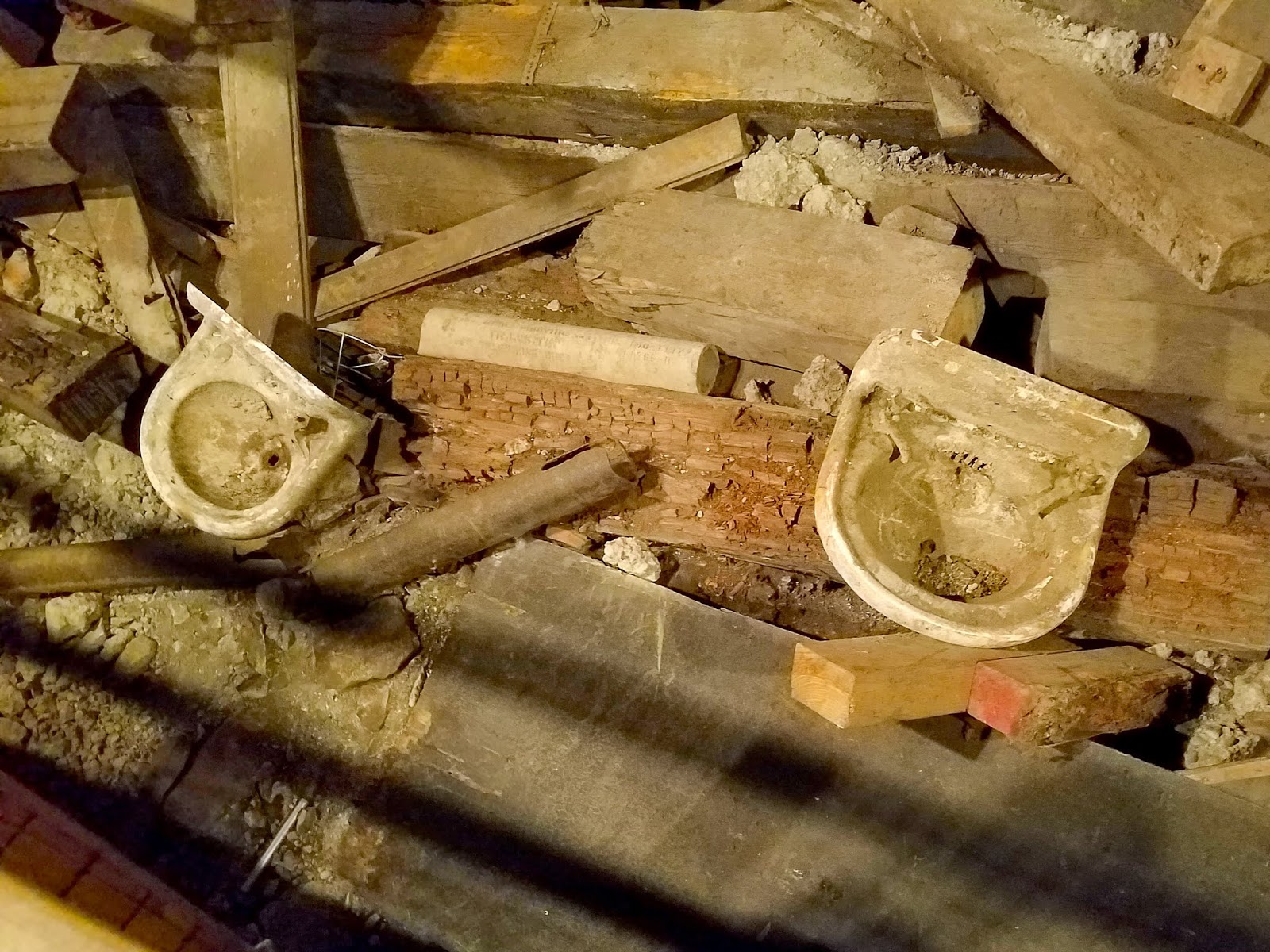
(I hate to keep harping on this, but what's the story with these sinks? How old are they? Where did they come from? Does Restoration Hardware sell reproductions?)

Here are the links to the previous two posts: September 10, 2019, "Seattle, Part II: Discovery Park," and September 1, 2019, "Seattle, Part I: Pike Place Market."

Make sure to come back soon for the fourth part of this series, which will cover the aboveground portion of Pioneer Square.

Former Rock Club in the Fenway Slated for Redevelopment

From Dave Brigham: Sometime in the late '90s/early aughts, I saw one of the greatest Boston bands of all time, the Upper Crust , in a ...