Showing posts with label hospital. Show all posts

Friday, June 9, 2017

Anniversary Post #7: My Favorites from 2016

From Dave Brigham:

This is the seventh installment celebrating the 7th anniversary of The Backside of America. This post covers my favorites from 2016; there will be an eighth post in which I will ramble on about the joys and frustrations of maintaining this blog, and yell at the children to get off my lawn. For links to the previous six installments, see the bottom of this post.

I need to mention that Joe Viger has contributed some amazing photos and fantastic write-ups over the years, but I'll be linking to very few of them in this series. Why? Because Joe -- an amazing photographer who has served as a mentor of sorts to me in that regard, and a great friend I've known for nearly 30 years -- has changed the security settings on his Flickr account so that many of his photos that have run on this blog show up as broken links now. I will instead direct you to his wonderful online portfolio.

This blog focuses a lot on the broken, the rusty, the abandoned and the forgotten. But there is always room for the resurrected, the renovated, the repurposed and the refurbished. On January 14, 2016, Mick Melvin shared a nice story about a traffic control tower in Meriden, Connecticut. "Traffic Stop" taught me, and probably many readers, about an old-school traffic management system.
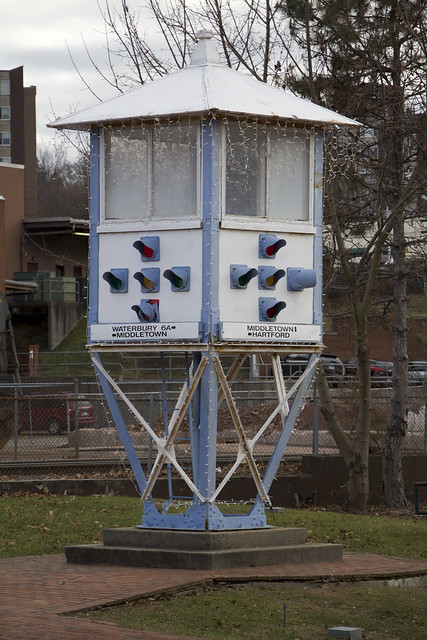
Untitled

(Traffic control tower in Meriden, CT.)

I love old mill towns, with their massive factory complexes, surplus of railroad tracks and bridges, practical homes and churches catering to immigrants. On January 27, 2016, I posted about the few hours I spent in Clinton, Massachusetts. In "Finding Hope, But Losing a Mainstay, in Clinton," I walked through an 1,100-foot, graffiti-covered former Central Mass. Railroad tunnel; snapped photos of ticket booths outside what locals claim is the oldest continuously used baseball field in the world; and captured the wonderful neon sign of a restaurant that closed not long after I visited the city.
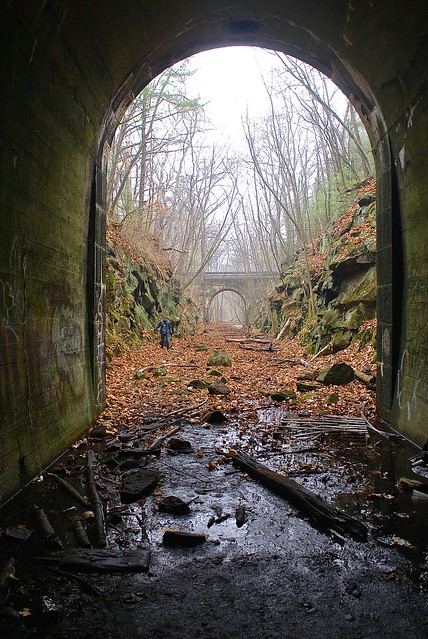
Into the light

(Exiting the abandoned tunnel in Clinton, Mass.)

On February 4, 2016, I posted about an adventure in my hometown of Simsbury, Connecticut. With some family members, I explored the remnants of a once-thriving village along an old stagecoach route, a place I'd never heard of growing up. "Stealing Back Into the Past of My Hometown" features photos of old wells, cellar holes and stone walls.

In "Bunker Buster" from February 17, 2016, I chronicled one of the coolest places I've ever explored: the Assabet River National Wildlife Refuge. I've got two words for you: ammunition bunkers.

(World War II-era bunker at Assabet River National Wildlife Refuge.)

On February 23, 2016, in "A Slice of Heaven," Mick Melvin told the story of a park in Hartford that once featured b-ball courts and chess tables, and which now is called Heaven Skateboard Park.

On February 29, 2016, the blog took a leap into one of the most iconic Massachusetts suburbex locations: Medfield State Hospital. Courtesy of Derek Watts's "Shuttered Asylum," we got to see beautiful photos of the asylum, which was open from 1896-2003.

The year was front loaded with some great posts, including "Shakin' All Over," my account from March 5, 2016, about a former Shaker village in Harvard, Mass., and its unusual cemetery.

Wrapping up the first quarter of 2016 was "Big Walk in Littleton," one of several posts around this time in which I attempted to profile an entire town. In this March 30, 2016, post, I took on the former farming town of Littleton, Mass., and featured an old train station, an abandoned juice plant, a cool house built in 1673 and a chimney in the middle of the woods.

(Abandoned farm house in Littleton, Mass.)

The hit parade continued on April 7, 2016, with "Sweet and Junky," my chronicle of a visit to a chocolate factory cheek-by-jowl with a junkyard in Somerville, Mass.

In "No More Bell to Toll," from May 3, 2016, Kristen Smith shared gorgeous photos and the story behind the first Estonian Lutheran Church in the country, located in Wisconsin.

On May 7, 2016, in "Last Stop," Derek Watt shared some beautiful shots from a transportation graveyard in New England.

(Trains in the graveyard.)

We focus quite a bit on railroads here at the blog. I find it hard to believe how an industry that once was so vital and omnipresent across our country has become an afterthought in so many places. In "Station In Need of Preservation," from June 21, 2016, Mick Melvin told us about a train station in Windsor Locks, Conn., that may one day be preserved.

On July 19, 2016, I posted "Tobacco Road," about an adventure I enjoyed on many levels: I had my mother with me; I saw some cool old tobacco barns and a decrepit church; I did a bunch of research online and learned about this little plantation not far from where I grew up.

(Church in the Floydville section of East Granby, Conn.)

July 26, 2016, was a great day on the blog, as we featured Derek Watts's fantastic shots of the inside of the old Victory Theatre in Holyoke, Mass. In "V for Victory," he posted photos of the theater's interior, taken with permission.

My post from August 1, 2016, found me alternately paranoid and ecstatic to be walking along some long-abandoned railroad tracks. "I Rail Against Trails (Not Really, But I Don't Want Every Abandoned Set of Train Tracks Converted for Cyclists and Roller Bladers)" is not only the longest headline the blog has ever published, but also a fantastic adventure, with a side trip to a graffiti-covered snack truck.

As regular readers of this blog know, I have a thing for churches and religious icons, even though I'm not at all a spiritual guy. On September 16, 2016, in "Like a Virgin," I wrote about and posted photos of the amazing Madonna, Queen of the Universe Shrine in East Boston, Mass.

Every so often I get one or both of my kids to accompany me a on a Backside jaunt. In "Rockin' in the Dungeon" from October 21, 2016, I chronicled a trip the three of us took to Dungeon Rock in Lynn, Mass.

Water towers in New York City caught Mick Melvin's eye in his November 15, 2016, post, "Water You Talking About."

(NYC water tower.)

On December 22, 2016, Derek Watt shared gorgeous photos of a historic home under renovation in Hudson, New York.

(Door detail from Dr. Oliver Bronson House, Hudson, NY.)

We wrapped up the year with "What's Auers is Yours" on December 29, 2016. I'm highlighting this post because it features an adventure that somebody else took me on, which is rare. My buddy Gary and his family hosted my family and me as we walked through the historic Auerfarm property in Bloomfield, Conn.

(Window from old apple barn at Auerfarm.)

Here are the previous six installments in this anniversary series:

"Anniversary Post #6: My Favorites from 2015"

"Anniversary Post #5: My Favorites from 2014"

"Anniversary Post #4: My Favorites from 2013"

"Anniversary Post #3: My Favorites from 2012"

"Anniversary Post #2: My Favorites from 2011"

"Anniversary Post #1: My Favorites from 2010"

Monday, March 20, 2017

Brigham in Waltham, Part III

From Dave Brigham:

Damn, Waltham, you ain't got no end!

This is the third and final installment of my review of the backside of Waltham, Mass. (see January 5, 2017, "Brigham in Waltham, Part II," and November 9, 2016, "Brigham in Waltham, Part I").

I've written plenty of times about single features of the former mill city, and surely will again. Because I live in the town next to Waltham, and pass through several times a week, I figured I'd gather as many photos and do as much research as I could on the things that interest me. But there's so much!

I thought I was done with this post, but then I thought, "Hey, why don't I give a quick look at the old Metropolitan Parkway site, and the conservation area not too far away on Trapelo Road?

That resulted in many great finds, so that's where I'll start. I'll let you know upfront: there are LOTS of pictures in this post.

I drive by the Metropolitan Parkway every weekday, on the way home from my son's school in Sudbury. The road now leads to an apartment complex, but once was the way in and out of Metropolitan State Hospital, a mental hospital built in 1927 and closed in 1992. I did some mountain biking in the area in the mid-'90s, when most, if not all, of the buildings were still standing. I was dumbfounded and fascinated by the abandonment of so many identical brick structures, but didn't own a camera at the time and wasn't as much into the backside of the world then as I've become in more recent years.

To read about Met State and see some photos of the site, check out this Opacity post. Be sure to scroll to the bottom of the post and click on the links for additional photos, which document both inside and out.

After parking my car, I walked along a path with a stone wall on one side and overgrown brush on the other, and before long I was staring at this building.

I've featured this building before on the blog (see August 23, 2010, "You Don't Have to Be Crazy to Live Here, But It Helps," the most insensitive headline I've ever written....). It was the administration building for the hospital, and sits just steps away from an apartment complex. I figured after six years this place would have been gone.

I have no idea why it hasn't been torn down, although it probably has something to do with asbestos and money. I don't know if there is a plan to demolish it.

As I was working on the research for Met State after taking these photos, I realized that I wasn't quite done with this final installment. You see, I discovered that not too far away from this building sits the cemetery that was used jointly by Met State and the nearby Fernald School. So I had to go back....

Just steps from the parking lot abutting the old admin building, I found this site. It stands just off a side path on the way to the main trail toward the cemetery. These steps don't seem to have been part of the old hospital grounds. There are other older features in this area; not sure what their stories are.

The cemetery features approximately 310 burials from 1947 to 1979, per the sign at the front of the graveyard. The site is split between Protestant and Catholic burials.

In the middle of the cemetery is this altar/shrine.

I found just one grave with a name on it.

After reflecting on the sorrow so many families must have felt knowing that their loved ones not only died at Met State but also were buried in such a way that nobody would know who they were, I set to wandering. I found some remnants of the old hospital's infrastructure.

I also stumbled across this:

This sofa bed must have been pulled out of one of the old hospital buildings. This whole area has a lot of paths, some of which are obviously frequented by mountain bikers. I suppose those who hang out in this area might have chilled on this couch at one point. I didn't see evidence of partying in the woods, but I'm sure it goes down.

With so many paths to choose from, I selected one that I knew would take me toward the site of the former Gaebler Children's Center, a facility that once stood on the other side of a hill from Met State. I direct you again to my August 23, 2010, post "You Don't Have to Be Crazy to Live Here, But It Helps," which is about both the Met State admin building and the former psychiatric institution for adolescents. Read the comments under the post; they are heartbreaking.

There are no more buildings on the Gaebler site, which may get developed at some point. I did find these old wagons, which may have been used for hay rides.

I then made my way up the hill toward the water tower, which I recalled from my mountain biking days.

Finally, on my way back to the car, I stumbled across what appears to be an old chimney or outdoor cooking area, near the stone steps I'd seen on my way in.

This area of Waltham was once quite different. Rural and remote but not too far from Boston, the sites along Trapelo Road -- Met State, Gaebler Children's Center and the Fernald School, which I mentioned in part two of this series -- housed the mentally ill and other children and adults who society deemed unfit to live in their own communities. Now these sites have been commercially developed or turned into conservation land.

A little further west along Trapelo Road once stood Middlesex County Hospital, which operated from the 1930's to 2001. This site, too, was developed into condominiums. I didn't get a chance to check out that area before the hospital was torn down, but I recently explored a great wooded area just down the hill that was an unexpected suburbex goldmine.

James Falzone Park is a soccer field with a secret. After driving by this recreation area dozens of times, I realized there was a path leading into a large wooded area that surrounds this place on Trapelo Road. Research ahead of time yielded no clues as to what lay in this conservation area, but I had a hunch. That suspicion paid off bigly, as Donald Trump would say.

If an old pump house and yet another stone wall were all I found in the Falzone conservation area, I would've considered this little jaunt a success. A mild success, but still something worth doing. But then I saw this.

God that's a beautiful site, isn't it? While many people walk past these steps and wall and think little or nothing of them, this is the kind of ruin that sets my heart racing. I have so many questions: How old is this ruin? What did the house look like? Was it a farm house? Who lived here? How long has this place been abandoned?

The front yard of what I'm assuming was a farm house is now a soccer field. A few steps west down the path is another remnant.

There was a community of sorts here. There may be more evidence of homes and other buildings on this section of land on the Waltham/Lexington line. I plan to get back and explore some more.

While nobody lives in the houses I stumbled across, I did find evidence that people are living or at least hanging out here.

The remainder of this last installment will focus on ghost signs, a mural, some old commercial properties and a cool map.

This great map is located at the corner of Harvard and Main streets, on the outside of the former Waltham Super Market, which is now Hannaford Supermarket. Landmarks on the map are Waltham City Hall (c. 1926), Waltham Super Market, Waltham Hospital (c. 1887), a sanatorium (which must be Met State), roadways, rivers and ponds, wooded areas (including a Girl Scout camp that still exists), Brandeis University (c. 1948) and the Boys Club of America (c. 1937).

The artist is the late Leon Nigrosh, who grew up close to Waltham, in Cambridge and Belmont. Nigrosh published ceramics textbooks as well as art reviews for numerous publications.

Located a short distance from the Hannaford, Bubbles Laundromat has replaced its sign since I snapped this picture.

Quick Stop Variety is located on Main Street, not too far from Hannaford, in a cool old building that also houses The Common Cafe.

Further east on Main Street, on the corner of Newton Street, sits the shuttered A to Z Auto Service station, next to an empty lot where Stephen's Liquors once stood. This corner has been neglected for quite some time now but I assume something will get developed here before too long.

Located on the back wall of Michael J's Pub ("Waltham's Best Dive Bar"), this Coca-Cola ghost sign may at one time have been larger. I'm happy the building's owner kept it. Side note: I once drove past this bar and laughed my ass off at the sandwich board sign out front that read, "Soup of the Day -- whiskey!" I haven't seen the sign since, so perhaps the city told Michael J's to take it down.

For the final segment, I move on to Moody Street. Known in recent years for its wide variety of restaurants, Moody Street was once home to department stores, shoe stores, bakeries, hardware stores and some adult bookstores. For a look at the street's past, check out this Brand New Watch blog post.

The sign for Amelia Upholstery Shop caught my eye because that's my daughter's name. I then spotted the faded sign for Spencer Shoes, which is name-checked in the Brand New Watch blog post. Spencer is no longer open, and I don't believe the upholstery shop is either, since the longtime owner, Joseph Amelia, died last year.

I also spied the name "Amelia" on this building on Moody Street. A little research online brought this article to light. This building is owned by Ralph Amelia, brother of the late Joseph. This building once housed a beauty school upstairs, but now comprises seven apartments.

When walking through a parking lot on the backside of Moody Street, I hardly expected to find this amazing painting along the driveway back out to the shopping and restaurant area.

This girl is just one of the beautiful faces depicted by artists Caleb Neelon and Katie Yamasaki. For more on the mural, which was completed in September 2011, see this Brand New Watch article.

See, not everything on the backside is rusty and falling apart.

Along another side street I found this ghost sign for a fountain shop. You can make out part of the Coca-Cola logo.

Finally, the backside of a building on Felton Street, which is just off Moody.

A post-and-beam warehouse/industrial space, 22 Felton Street was home way back when to J. Cushing Company, a grain distributor. You can see the letters "AIN" up there.

Well, that's it for now. I'm sure to post more about Waltham in the future, but this should hold you over for now.

Monday, August 23, 2010

You Don't Have to Be Crazy to Live Here, But It Helps

From Dave Brigham:

In 1995, when I turned 30, my girlfriend (now wife), Beth, joined members of my family in buying me my first mountain bike. She'd bought one in college, and wanted to share her passion for trail riding with me. She still cracks herself up talking about how the first time I rode in the woods, I wore jeans, instead of bike shorts.

We rode a lot initially at the Middlesex Fells, a large (more than 2,000 acres) reserve that spans the towns of Malden, Medford, Melrose, Stoneham and Winchester, just north of Boston. I had a great time exploring hills, meadows, and old fire roads. Over the next 2 1/2 years we rode in a lot of places in New England, but none more intriguing than the grounds of the old Metropolitan State Hospital straddling Belmont, Waltham and Lexington, Mass.

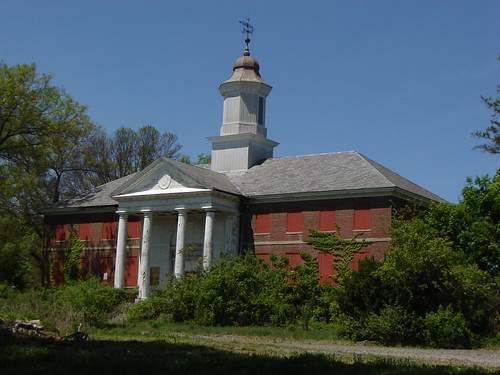
Opened in 1930, the hospital housed mentally ill patients in at least a dozen large, red-brick buildings. The facility closed in 1992 as part of the national movement to deinstitutionalize such patients and move them into smaller hospitals and group homes. For 15 years, the site sat shuttered and deteriorating, a magnet for urban explorers, adventurous partiers and hikers and mountain bikers. In 2007, most of the buildings were torn down to make room for a 387-unit apartment development. Some of the old buildings were renovated and used within the new community.

Part of old Met State Hospital, Waltham MA

Above is the administration building, the last structure awaiting renovation or demolition. I remember touring past this building and several others just like it, only larger, with Beth and our friend Mike. We didn't go in any of the buildings, but spent a fair amount of time on a few occasions marveling at the buildings and wondering just what sort of things went on behind the closed doors.

For great photos of the inside of some of the Met State buildings, check this out. To read more about the conversion of the site to luxury apartments, read this.

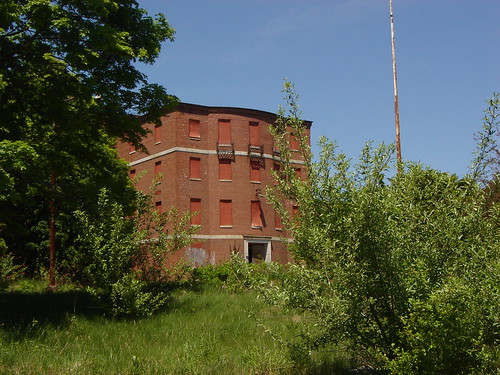
The photo below is from the Gaebler Children's Center, which opened in 1955 on the state hospital's property. This picture is the only one I've taken while knowingly trespassing. I drove right past the "No Trespassing: Police Take Notice" sign, figuring no cop would arrest me as long as I had my two-year-old daughter with me. The folks at Opacity report that in the time since I took this picture, the site "appears to be under development by Testa Construction and Site Dismantlement; demolition or renovation seems imminent."

Abandoned state hospital bldg., Waltham MA

For some cool inside and outside pics of the children's center, check this out.

Checking Out Dudley Street in Roxbury...and a Historic, Pre-Civil War House

From Dave Brigham: As part of a series of quick-hit jaunts through Boston this spring, I checked out the outer reaches of Nubian Square, m...