Sunday, September 20, 2015

I Seek Newton, Part II: Auburndale

From Dave Brigham:

This is the second installment of an occasional series about my adopted hometown, Newton, Mass. The first post covered Lower Falls, one of 13 villages in Newton (see May 21, 2015, "I Seek Newton, Part I: Lower Falls"). In this post, I wander through Auburndale, which lies on the city's western edge, bordering Weston and Waltham. Split by the Massachusetts Turnpike, the village is home to Lasell College, as well as numerous beautiful old homes and a small commercial district.

One hundred years ago Auburndale was arguably Newton's hottest recreation spot. I'm sure that on more than one occasion it was referred to as the bee's knees.

Opened in 1897 along the banks of the Charles River, Norumbega Park featured canoeing, picnic areas, an outdoor theater, a penny arcade, a restaurant, a zoo, a carousel and an electric fountain, according to NorumbegaPark.com. Built by the Commonwealth Avenue Street Railway, the park was incredibly successful for decades before declining and closing in 1963. Norumbega and other nearby boathouses played host to thousands of canoeists in what was called the Lakes District of the Charles River.

Here's a Digital Commonwealth photo of the Norumbega Park restaurant. The awkwardly named Boston Marriott Newton now stands on much of the former amusement park site. There is also conservation land east of the former Norumbega Park.

Here's a picture I took a few years ago of an old light fixture that I presume once lit the walkways at the park.

Here's a shot of the conservation land. I have no idea if this rock wall and stairs were once part of the park, or if they are remnants of an estate.

A short distance up the Charles River once stood Partelow's boat house on the Newton side, and Riverside Recreation Grounds on the Weston side.

Here's a Digital Commonwealth photo of Partelow's boat house. The Riverside train station is in the background.

Here's the boat house site now, with the train bridge from the Digital Commonwealth photo in the background:

Here's the foundation of the train station, which was closed in the late 1950's:

The Riverside Recreation Grounds in Weston opened in the late 19th century and featured athletic fields, a swimming pool, tennis courts, a boat house and other facilities. In 1930 part of the grounds were turned into a golf course (now known as Leo J. Martin). Eventually other Riverside acreage was taken by the state for the building of Route 128.

My deeper appreciation for Newton was triggered by what was supposed to be a short excursion to Auburndale's portion of the Charles River Reservation. I'd been there once before to take some shots of the river and the train bridge. I wanted a closer look at the building that houses Newtron Inc., which for more than 50 years has manufactured high-tech machined parts.

Turns out this building is related to the one-time boating industry of Newton. According to Charles River Canoe & Kayak, a tenant in the building, this historic building "was once used to build Robertson Boats and Canoes. Robertson later merged with Old Town Canoe and for a short time the company was known as Robertson - Old Town Canoe."

In order to deliver canoes to the Partelow and Riverside boat houses, all employees had to do was walk through this tunnel under the railroad tracks.

After snapping a different shot of the Newtron building, I was shocked to see an entrance to this tunnel. Covered in graffiti and open for one and all to walk through, the tunnel leads to the former platform for the old Riverside train station. Back in the late '50s Riverside was moved to a different location, which I'll get to in a minute.

Off the back edge of the old platform I spied a path into the woods. This took me down along the river, where I founnd a restored foot bridge leading to the Weston side of the Charles.

This bridge was a lot rustier the first time I saw it, in 2011 (see October 12, 2011, "Troubled Bridges Over Water").

Ambling along the path I soon realized where I would end up, and I felt like Roald Amundsen discovering the long-elusive Northwest Passage. Honestly, although I knew people had obviously walked this path for decades -- who am I kidding? Centuries! -- I tingled with excitement as if I were the first to realize that there was a path leading under the (very active) railroad tracks, along the river and on to the new Riverside station, and from there, out to an access road along Route 128. If conservationists have their way, eventually old tracks crossing that bridge over the highway will be converted to a walking path leading to, wait for it, Lower Falls (see "I Seek Newton, Part I: Lower Falls").

My son was excited when I told him about this path, although for different reasons than I was. He knew at the far end of Riverside station, far from the public's prying eyes, there were wrecked Green Line trolleys. I took him there.

While there are no longer any boat houses or amusement parks, there is still at least one place where locals can be entertained. Well, there was, and depending on a developer's plans, may yet be again.

This is the former Turtle Lane Playhouse. Built in 1890 as a private residence, the building served as a boarding house and then the Auburndale Club took over in 1920. There was reportedly a bowling alley in the basement at one point. Turtle Lane took over in 1978.

In 2013, however, the playhouse closed. A developer acquired the property and has announced plans to revive the theater and add housing to the site. Stay tuned....

One of the first elements of the backside of Auburndale I noticed is this mural along the Massachusetts Turnpike:

When it was painted in the late '60s or early '70s, some people were concerned drivers on the Pike would get distracted and crash (see December 26, 2010, "Where the Sun Never Sets"). The building once housed a store that sold "hippy stuff," according to one Backside reader.

There are numerous other spots around this village, and perhaps I'll get to more of them some time in the future. The last two places I want to mention hint at somewhat of a new direction for me on this blog, and beyond. In recent months, as I pondered this project, I pored over old maps of Newton and reviewed other historical documents on the city's web site, and got a feel for what my adopted hometown was like 100 years ago. I envisioned covering the backside and the history of each of Newton's 13 villages, which is what I'm doing here. But I also decided to expand that vision and write a book incorporating historic photos and information about historical sites in Newton that still stand, as well as buildings and locations that have changed use over the years, or no longer exist.

Directly across from the Turtle Lane Playhouse is The Melrose.

I believe it's just an apartment house, but I suspect this place has some interesting history. I've been unable to find anything so far. Stay tuned....

Finally, there's this wonderful house:

Currently housing condos, this building was once known as the Nye Park Inn. I believe it was popular with students at and visitors to nearby Lasell College, which was founded in 1851 as Auburndale Female Seminary.

Monday, September 7, 2015

T and Symphony

From Dave Brigham:

I was walking down Mass. Ave. in Boston with my son, Owen recently when I noticed a small construction site right outside the Symphony subway station. We've ridden the subway a LOT over the years, but this was the first time I'd been to this stop. I realized right away that this must be a former entrance to the station; the current head house is about 30 feet away.

Owen and I went down into the station and he used his phone to look up the history of the station. He told me, thanks to Wikipedia, that there used to be a "sub passageway" connecting the inbound and outbound sides, but that it was sealed off in the 1960's. I looked at the Wikipedia entry as well, and learned that the MBTA did moderate renovations to Symphony in the 1990's.

Searching online, I found a random guy's photos posted on Facebook and Twitter of the same construction, and he indicated that there is some sort of utility replacement going on. He said the original Symphony station entrances were covered over when two large apartment buildings, Symphony Plazas east and west, were built, I'm guessing in the 1960's.

Here's a capture from Google Maps before the construction began, showing no sign of the old station entrances:

The current utility work, or whatever it is, is taking place right behind where the person is walking in this photo.

I can't find any old photos online of the original station head houses, but I'll keep looking.

Saturday, September 5, 2015

Bigelow's Little Office

From Dave Brigham:

I've lost track of the number of times I've said, "Thank God for the Internet!" while working on this blog over the past 5+ years. I can't always find answers to my questions about out-of-the-way relics and long-forgotten buildings, but my success rate is pretty good.

Sometimes I think I've found what I'm looking for, but there's a nagging feeling that I'm not quite on the right trail. This happened recently after I took some photos of a small building along Route 20 on the Weston/Wayland border outside Boston.

I've driven by here numerous times over the years and long wondered what this place used to be, and what it was in the process of becoming. My search online started with something like, "Route 20 Wayland Weston old building" and before too long I found information at the Weston Historical Society's web site about a place called the Fiske Law Office.

So I saved the link and then, after I got around to snapping a few photos, went back to the site and read it more thoroughly. And something just wasn't right. I dug a little deeper and realized that the Fiske Law Office was close by, but was in much better condition.

So what the heck was this little place?

I searched on Google Maps and wrote down the address of the house directly behind this small building. Then I conducted a new search and found what I was looking for on the Weston Historical Commission web site:

"The Alpheus Bigelow Jr. House [863 Boston Post Rd], 1827, is a large Federal style building. A graduate of Harvard, Bigelow later studied law with Isaac Fiske and Tyler Bigelow. The Bigelow Law Office [3 Applecrest Rd] was built across the road and has been recorded by [the Historic American Building Survey]."

This building is similar in style to the Fiske Law Office, and obviously the two men knew each other, as Alpheus Bigelow studied law with Isaac Fiske. I may make another visit to try and speak with the guy whose house abuts this property, as it appears he's involved in the renovation.

Here's a peek into his backyard.

Here's what the building looked like a long time ago. The HABS indicates it was erected prior to 1800.

There's a nearly 8-year-old building permit taped in the window of this historic law office. Not sure if the owner plans to convert it to something private or public. I looked through the window and could see some old furniture and drapes and boxes, etc., so maybe he's just using it for storage.

The building is in a really tough spot for any use, public or private, as it sits right next to busy Route 20. I'll keep tabs on it....

Wednesday, August 19, 2015

Misfit Garage

From Dave Brigham:

Beautiful, isn't it?

Known as the Winthrop Square Garage, this squat little parking facility, which is owned by the City of Boston, has been vacant for quite some time. For years I've been reading stories in the Boston Globe about how developers are salivating over the prospect of blowing this eyesore up and replacing it with a gleaming office/condo/hotel/retail palace.

The latest Globe article points out that, while still likely to get done, a deal to buy or lease the land from the city has hit a few snags. Make no mistake, though, this place will fall under the wrecking ball, and yet another awesome monument to the upper middle class will rise in its place.

Don't get me wrong: I agree that this building is ugly and beyond its usefulness. But, although I've only lived in the Boston area for half of my 50 years, I have memories of how things were when I arrived here, fresh-faced and empty-pocketed, in 1990.

My first job in Boston was through a temp agency located just down the street from the Winthrop Square Garage. In subsequent employment I worked in mailrooms, and as part of those jobs, I delivered and picked up packages around the Financial District and Downtown Crossing, passing this site quite often.

I have no sentimentality around this building, but it's nice, on my occasional visits to my old work grounds, to notice things that haven't changed, because so many things around the city have been altered. It would be nice if the developer enlisted an architect who doesn't simply want to put up another glass box that looks like all the other glass boxes going up these days in the Hub of the Universe.

I'll keep y'all up to date as a project gets selected and gets under way.

Monday, August 10, 2015

UPDATE: Goodbye Reef, So Long Bill

From Dave Brigham:

We received more comments on a post I wrote about a former dive bar in Waltham, MA, than on any other piece we've done over the last 5+ years (see August 25, 2011, "Goodbye Reef, So Long Bill", and please scroll down and read the comments). Today I've got an update on the building, which also housed a few other small businesses.

First, some background. I'd driven by The Reef numerous times but never stopped in. In my biased view, I figured the place was kind of crappy and populated by old men in sleeveless t-shirts drinking Bud Light and eating pickled eggs out of a jar on the top of the bar. Not that there's anything wrong with that.

Ignorant of the deeper history of The Reef, and so many other places in Greater Boston that I've photographed and written about here, I find it easy to forget that these places were once people's hangouts, homes, places of business. So I was more than happy when comments from former Reef regulars clued me in to what a great place the bar was.

The building sat empty for a few years, but I knew it was just a matter of time before the site would be redeveloped. Literally steps from a commuter train line and right around the corner from the dozens of restaurants and shops on Waltham's Moody Street, this site was ripe for change.

Sure enough, over the last several months it's been knocked down and built up. To be known as Waltham Landing, the building will feature 34 apartments and 8,000 square feet of retail space on the ground level.

I like that the architecture echoes some nearby homes, including a historic inn that was converted to apartments.

Here's what the place used to look like, from the opposite direction:

To Be Demolished?

Redevelopment is what this country is all about, so it's no surprise when a run-down building with a few small businesses gets torn down in favor of sleek apartments and shiny new stores. But it's unfortunate when working class gathering spots are sacrificed in favor of generic smoothie joints, frozen yogurt stores and coffee shops. There are still dive bars in Waltham, but with demographics changing more of them are sure to shutter.

Monday, August 3, 2015

Steak In the Future?

From Dave Brigham:

I am rarely a man of ulterior motives. Except when it comes to taking pictures of the backside.

On our recent vacation, my son mentioned wanting to check out Barnstable Airport in Hyannis. While his love of aviation is fading somewhat, he knew there was a chance to see some commercial flights at the small airfield. I agreed because I genuinely enjoy plane spotting with him, as we've done in various spots around Boston's Logan Airport and Connecticut's Bradley International.

But, and as Pee-wee Herman says, "Everyone I know has a big but," I knew that if I took Owen to check out the airport, I'd have a chance to take pictures of the long-abandoned restaurant directly across the street from the runway.

On a somewhat aimless drive earlier in the week, I'd driven past the airport after documenting some abandoned motels in Yarmouth (see July 26, 2015, "Cavalier Attitude About Motels"; also see July 21, 2015, "Bikes, Blessings & Buzzards," my first post about our vacation). I had been out a long time and didn't want to take the time to snap pictures of the eatery so I cruised on by.

Plane spotting was a bust -- one or two small, private aircraft. Owen checked the flight schedules on his phone and knew a JetBlue plane was slated to land in the not too distant future, but he didn't want to wait. Well, since we parked in the lot for the dilapidated restaurant....

Mitchell's Steak and Rib House hit the skids at least nine years ago, according to this March 2012 article in the Cape Cod Times. Fifteen months ago a developer bought the property. That developer, Stuart Bornstein, said at that time that he had “nothing concrete” in terms of a new use for the prominent properties along Route 28 across from the airport, according to a Barnstable Patriot article. “I’ve had half a dozen people express interest. I’m sure there will always be traffic issues. Whatever’s there will generate traffic. We don’t want to be held hostage [over that].”

I have no idea what will come of this property. For now, the seagulls seem to be the only ones interested in tenancy.

Sunday, July 26, 2015

Cavalier Attitude About Motels

From Dave Brigham:

I have a weird relationship with motels. I love them but wouldn't want to stay in one. Like many Americans, I've gotten spoiled by hotels and resorts and so I'm partly to blame for the demise of "motor hotels." For that I apologize.

I stayed in motels on occasion as a kid, from the Moon Motel in Howell, NJ, while visiting my grandparents, to an establishment in Salt Lake City during a family vacation when I was 12 years old. There was nothing particularly awesome about these motels (well, other than the Moon's sign), but I liked that they had pools and were situated in the middle of the action. You're not sealed off in a high-rise surrounded by other tall buildings; you're at ground level among the El Caminos, street walkers and Chevy Chase swimming in the pool in the cool night air (WARNING: NOT ENTIRELY SAFE FOR WORK).

Also, Magic Fingers beds.

As a teen, I spent a vacation in a motel on Cape Cod, possibly Yarmouth. I don't remember much about the place except witnessing a car crash and collecting a bucket of smelly shells. Several years later, during college, I spent time with some high school buddies in a motel that I believe was also in Yarmouth. We downed shots of tequila in the room before heading out to carouse.

So it's fitting that on my recent annual vacation to the Cape, I found myself in Yarmouth. We were staying in Pocasset, a village of Bourne where we stay for a week every summer. I took an aimless road trip by myself one day while Beth and the kids were at the beach. I didn't know what I was looking for, and got frustrated as I drove along Route 6A and found nothing but beautiful homes and quaint villages. I was hoping to find something like I did five years ago on a trip to Pocasset (see August 5, 2010, "Dark Side of the Motel").

Turning south from 6A, I made my way to Route 28 in Yarmouth. I'd misunderstood something I'd read about Route 6A. I thought that "seeing what Cape Cod looked like before tourists discovered it, and visit[ing] some of the best quaint, little shops in New England," was what I wanted. But as I drove through Yarmouth, I realized I'd found what I was looking for. The place is much more honky-tonk, with garish mini golf courses, tons of restaurants and hotels and arcades and other amusements.

And of course there were motels.

Many of them are still open, from the Beach 'N Towne to Hunters Green, the Dunes Motor Inn to Castle Dawn. The Bass River Motel was right next to the first shuttered place I saw.

There was no sign, but an online search later on told me this used to be the Cavalier Motor Lodge. This site comprises more than 4 acres and numerous buildings and indoor and outdoor pools.

Abandoned for quite some time, the Cavalier suffered a fire earlier this summer. Read about the blaze here and here.

Eighteen months ago a developer proposed to build affordable housing and commercial establishments on the site, but there are no signs of anything happening any time soon.

Next door to the Cavalier is another abandoned motel that originally I thought was part of the same complex. I haven't been able to find out anything about this place.

Not too far north on Route 28 I drove past another shuttered motor hotel.

This place seems to be in pretty good shape, but it's harder and harder for smaller, locally owned places to compete with the hotel chains on the Cape.

I guess what it comes down to for me is an appreciation for the little guy, the kitschiness of neon and the smaller scale of motels. But as I said, I also really like air conditioning, indoor pools and sleeping on beds with clean sheets. There are plenty of motels that have been redecorated and freshened up, without losing their old-school charm.

For another recent motel-related post, see April 15, 2015, "From Motel to Mall".

To see my previous post about this year's trip to the Cape, see July 21, 2015, "Bikes, Buzzards & Blessings."

Stay tuned for the third and final installment of this year's trip to the Cape....

Tuesday, July 21, 2015

Bikes, Buzzards & Blessings

From Dave Brigham:

Longtime blog readers will recall that I date my discovery of the concept of "the backside" to a canoe trip down the Farmington River I took with my dad when I was 12 years old or so (see this blog's inaugural post, March 2, 2010, "Take Me to the River"). Like rivers, railroad tracks provide a great view of the oft-hidden side of cities and towns. We've posted countless times about abandoned tracks, trestles and trains. Here are a few links:

In this age of railroad downsizing, many former track beds have been turned into bike paths. While I love stumbling across abandoned train tracks, I also love riding my bike, and if I can do it on the backside of America, all the better.

Vacationing on Cape Cod recently, my wife, kids and I took to the Shining Sea Bikeway. Constructed along the former Penn Central Railroad right-of-way (and, before that, ancient Native American trails), the bike path stretches nearly 11 miles from North Falmouth to Woods Hole.

We rode about three miles south from the northern terminus, and then u-turned and headed back. Along the way we passed houses, restaurants (including the Silver Lounge, which features an old caboose), cranberry bogs, small farms and conservation land.

We also came across the Buzzard's Nest, sort of a poor man's Paradise Garden, the folk-art world of wonders in Georgia erected by Rev. Howard Finster.

There was nobody around, and an Internet search turned up nothing. I have no idea who set this place up or for what reason. A deep dive into Google Maps reveals a few tantalizing clues: the words "TAX IT ALL DEVAL PATRICK" written in chalk at the end of the driveway leading to the property, a reference to the former Massachusetts governor; a hand-painted sign at the end of the driveway that says, "NO BAG AT DUMP TAX"; another sign for ABC Services offering "DUMP RUNS." A flagpole with the Stars & Stripes and an anchor sit on opposite sides of the dirt driveway, which disappears into the woods.

Just north of the Buzzard's Nest is an overpass with some cool graffiti.

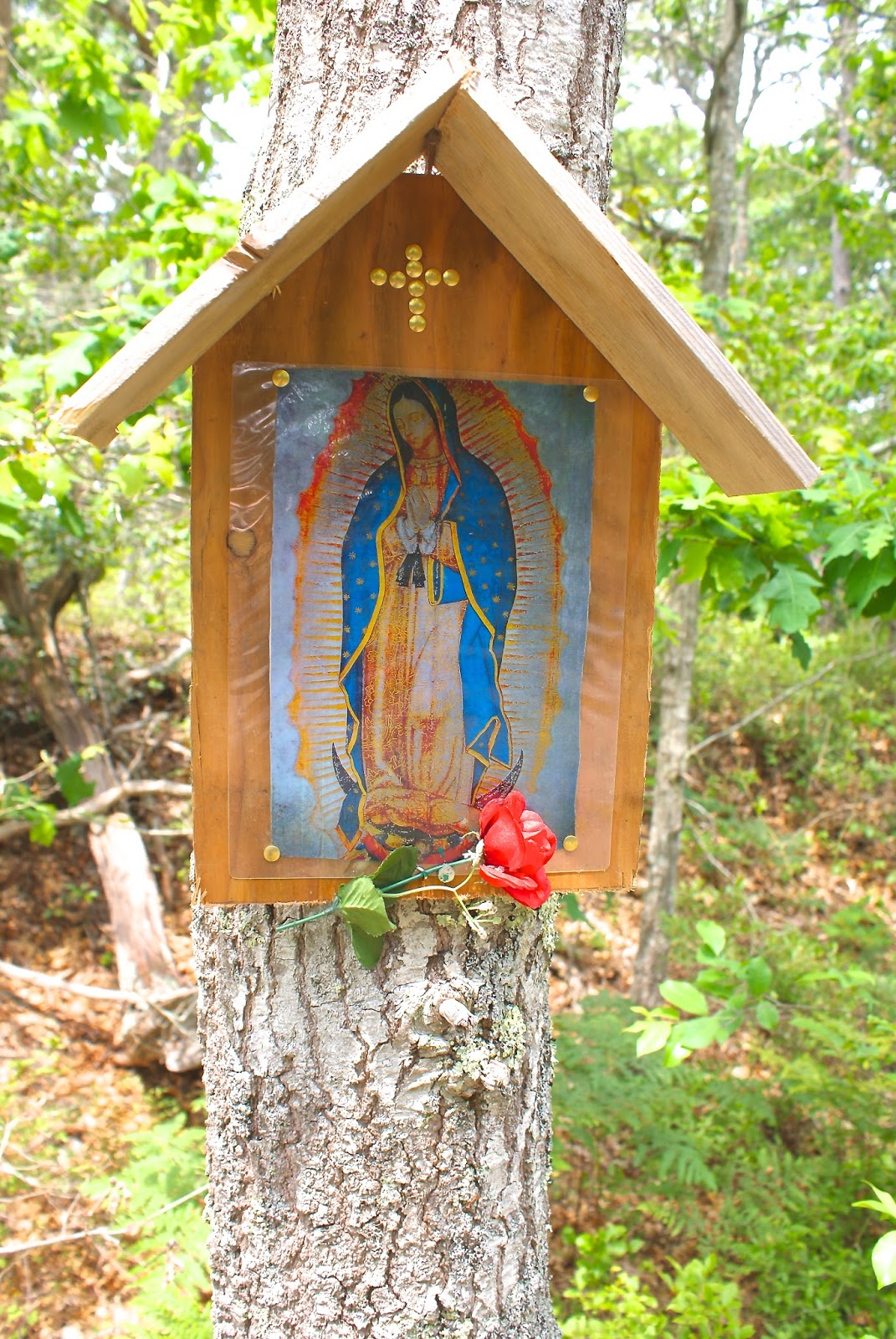
Finally, as we were just about back to where we'd started, I noticed this lovely little memorial.

Tuesday, June 30, 2015

Hartford Arming for New National Park

From Mick Melvin:

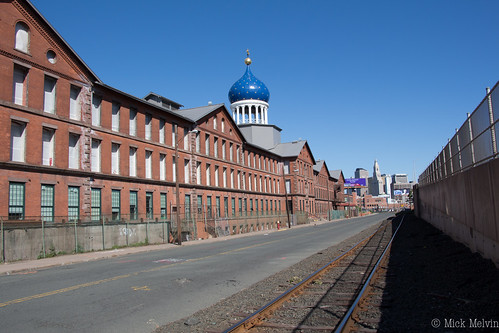
IMG_3376

I have long been curious about this distinctive building in Hartford, CT. I used to think the building was a religious structure because of the blue onion dome with gold stars (Growing up in the Hartford area, I found the building exotic and mysterious -- DB). But no, this is the Colt Armory, one-time headquarters of one of the world's most well-known gun manufacturers.

The dome, which can easily be viewed from route I-91 going through Hartford, was company founder Samuel Colt's idea. Some say that the dome is a tribute to Colt's early work with Russian businessmen. Others say it was just a dramatic marketing tool. Either way, it is a distinctive piece of architecture. The original armory burned down in 1864, three years after Colt's death. The new building was rebuilt by his widow, Elizabeth Colt, and was made to be fireproof and larger than the original. The design is said to be based on the styles of the Italian Renaissance.

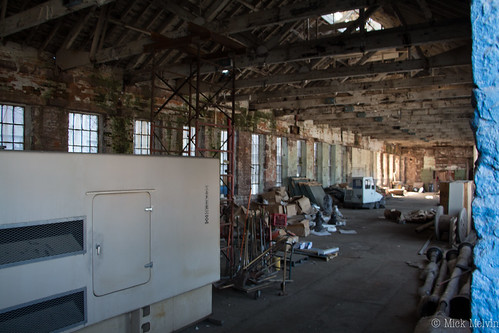
IMG_3406

(Inside the armory.)

IMG_3385

(Rear of armory.)

The building and the surrounding area are being transformed into Coltsville National Park, after receiving congressional approval late last year. The park will honor the accomplishments of Samuel Colt. Plans for the park include a visitors center, an observation platform from which visitors can view the factory floor, and an elevator to the dome.

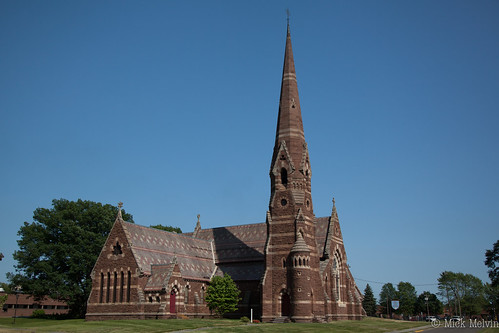
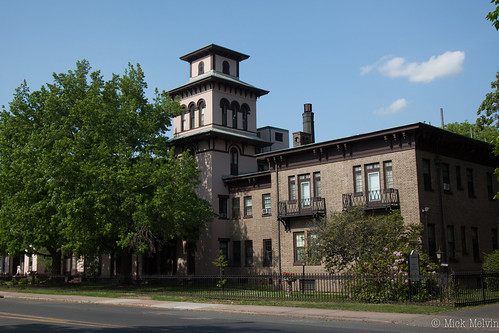
Plans are also in place to transform adjacent Colts Park, Armsmear (the residence of Samuel and Elizabeth Colt), and the Church of the Good Shepherd. It is the hope of Connecticut officials that the area become an educational center emphasizing Colt's contribution to firearms and the industrial revolution. The 260-acre Coltsville National Park is a work in progress, but we will be sure to keep you all posted.

Church of the Good Shepherd #1

(Church of the Good Shepherd.)

Armsmear#2

(Armsmear, one-time residence of Samuel and Elizabeth Colt. Now an apartment building.)

For more, read this article about the approval of the national park.

Thursday, June 18, 2015

UPDATE: Get Thee to a Nunnery

From Dave Brigham:

As promised, I'm back with an update on the former Sisters of St. Joseph convent property in Newton, Mass. (see January 31, 2015, "Get Thee to a Nunnery").

The 5.7-acre site, which has been on the market for years, includes the convent and a school building with a combined total of roughly 95,000 square feet. The convent includes 34 dormitory-style rooms, a chapel and covered parking, according to a real estate listing I dug up online.

The Sisters have rejected many offers from developers, because they wanted to see the site be used for community purposes. Well, thank you, Sisters, for holding out. This week, the City of Newton's board of aldermen approved the $17.3 million purchase of the property as part of a complicated, but much needed, upgrade to schools on the north side of the city.

The buildings will require some environmental remediation, and the addition of a gymnasium before becoming the new home of the Lincoln-Eliot School, one of many old and overcrowded schools in Newton. The current Lincoln-Eliot building would then become "swing space" to be used while the city renovates or replaces other schools.

The Carr School (which is across the street from where I live), a former elementary school that recently became the swing space to house elementary students while their schools are under construction, will eventually become the new home of the Horace Mann School, where my son went and which my daughter currently attends. The Mann school will function as a community center at some point down the road.

While all of these moves won't affect my daughter (she'll be in middle school by the time this plan plays out), it's a victory for younger kids in my neighborhood and surrounding areas. Too many of Newton's schools are overcrowded -- Horace Mann was built for no more than 300 students, I believe, and it currently educates in excess of 400.

I'm always happy to report good news, and especially when it doesn't involve a long-abandoned property getting turned into yet another upscale housing project.

Friday, June 5, 2015

The Ones That Got Away, Part III

From Dave Brigham:

(Photo from Citysearch.com)

I just noticed Veronica's Spa in Waltham, Mass., a few months ago. Located on a somewhat ugly stretch of Main Street, the convenience store (many older such stores adopted the term "spa" because they sold "healthy" soda-fountain drinks, or so the Internet told me) was opened some time in the 1920's or '30s, I believe.

As I often do with places that catch my eye driving around Greater Boston, I put this on my list of places to take some pictures of. Well, I drove by yesterday and recoiled in disappointment: the portico and cool sign on top have been razed. A guy on a ladder appeared to be replastering the building, which is no longer a vibrant red.

Before I got home, I knew I would post a little something about yet another "one that got away" (for more of these, see May 2, 2010, "The Ones That Got Away, Part I" and June 1, 2010, "The Ones That Got Away, Part II"). I wasn't, however, expecting to find out much about Veronica's Spa.

I didn't find a lot, but I did discover that the store was opened by a Turkish immigrant of Armenian descent named Veronica Sarmanian, nee Engelan. She came to this country after escaping the Armenian genocide, went through Ellis Island and then got married. She and her husband, Stephen, "pursued their career goals working long and hard hours until they could fund their own business, Veronica’s Spa," according to Veronica's obituary. She passed away in 2009 at age 103.

"Recognized as a pioneer in the burgeoning Rt. 117 corridor, Veronica is highlighted in Waltham’s history, called 'Waltham Rediscovered,'" the obituary continues. "Veronica was a feminist long before women’s rights were popular, pursuing a business life as well as a family."

I love digging up history like this. On my drives past the spa, I figured it was just another of countless convenience stores that are instantly forgettable the minute you walk out the door. I'll keep an eye on the place and see if they put the sign back up at least.

Here's another cool shot of the place from Flickr.

Meandering in Milford

From Dave Brigham: In April, I ventured to the Grafton Flea Market , searching for vintage wooden boxes I could use to showcase prints of ...