Showing posts with label new york city. Show all posts

Saturday, March 22, 2025

Fanelli Cafe: In Business for 178 Years!

From Dave Brigham:

Located at 94 Prince Street in New York City's SoHo neighborhood, Fanelli Cafe has been in business since 1847 (!). I knew nothing about this historic eatery when I walked by, trailing my wife and daughter as they window-shopped. I saw the sign, pointed my camera up because I liked the looks of it, made a photo and moved on.

This is the final post in my series of quick hits about a trip to NYC last fall. Links to the previous six are at the bottom of this post.

"Herman Gerken leased the wooden building at 94 Prince Street in 1847 and became the proprietor of a grocery on the site," per the cafe's web site. "In 1853 [John] Hance’s heirs, Edna Brown, Mary Sarles, and Sara McIntosh, sold the lots to Herman Gerken. In 1857 Gerken built the present day (sic) handsome five story (sic) brick building that still carries the 94 Prince Street address. This corner building was interconnected with his adjourning (sic) building at 135 Mercer Street by at least 1891."

To read the history of this property, starting with a Dutch farm in the 1640s to its status during Prohibition as a speakeasy, check out this page on the cafe's web site, which quotes from an article originally published by New York Art World.

Here are links to the previous six posts:

March 15, 2025, "Globe Slicers May Rip You to Shreds"

March 8, 2025, "House in Flux in SoHo"

March 1, 2025, "Hoofin' It to the Bowery Ballroom"

February 22, 2025, "Shoot Your Shot at Amsterdam Billiards"

February 15, 2025, "Webster Hall Was Right Across from My Hotel"

February 8, 2025, "The Carl Fischer"

Saturday, March 15, 2025

Globe Slicers May Rip You to Shreds

From Dave Brigham:

I love it when I make a photo of a place simply because I'm captivated by its grittiness, and the subject of the image turns out to have played a significant role in music history.

Located at 266 Bowery in Lower Manhattan, Globe Slicers has served the restaurant industry since 1947. What, you may be wondering, does a 78-year-old company that sells and repairs slicing machines, mixers and meat grinders have to do with music?

Does that name Blondie mean anything to you? No, not the 95-year-old comic strip featuring the titular character and her bumbling husband, Dagwood, master of the massive eponymous sandwich. Neither am I referring to the delicious dessert confection.

This Blondie:

When I posted the photo above to Instagram, one of my followers clued me in that "Debbie Harry and Chris Stein lived above Globe Slicers and their apartment was Blondie's practice space." Thank you, Joe Schumacher!

The apartment was just down the street from the late, lamented CBGB, the club where Blondie and other artists such as the Ramones, Television, Talking Heads and Patti Smith created a seminal punk rock and New Wave scene.

Here's the thing, though: Globe Slicers wasn't located at 266 Bowery back in the Blondie days. There was a liquor store in this space at that time, according to Stein, who was Blondie's co-founder and guitarist. Stein, who turned 75 in early January, is also an accomplished photographer.

To read a full history of 266 Bowery, check out this excellent post from the Daytonian in Manhattan blog.

This is the sixth in a series of short posts about my trip to New York City last fall. Long after my trip, and subsequent to writing this post, I began reading Debbie Harry's autobiography, Face It. I'm thoroughly enjoying it! Links to the other posts in this series are below:

March 8, 2025, "House in Flux in SoHo"

March 1, 2025, "Hoofin' It to the Bowery Ballroom"

February 22, 2025, "Shoot Your Shot at Amsterdam Billiards"

February 15, 2025, "Webster Hall Was Right Across from My Hotel"

February 8, 2025, "The Carl Fischer"

Saturday, March 8, 2025

House in Flux in SoHo

From Dave Brigham:

This plaque is located outside a Guess store at 538 Broadway in New York City's SoHo district, marking the former location of a Fluxhouse artist cooperative live-work space. These are the kinds of things I make photos of while all around me people are window-shopping, taking selfies in front of a Brandy Melville store and generally not taking photos of things like this.

If, like me before October 13, 2024, you have no idea what a Fluxhouse is, let me tell you all about it...in the words of web sites that know what they're talking about. I made this photo because I was somewhat familiar with the Fluxus art movement. What did I know about it? Well, that the musician Beck's grandfather, Al Hansen was a member of the movement.

"Founded in 1960 by the Lithuanian/American artist George Maciunas, Fluxus began as a small but international network of artists and composers, and was characterised as a shared attitude rather than a movement," according to this article from London's Tate galleries. "Rooted in experimental music, it was named after a magazine which featured the work of musicians and artists centred around avant-garde composer John Cage."

"Drawn together by their disenchantment with the elitist attitudes that they perceived in the art world at the time, they looked to the Futurists and Dadaists for inspiration, especially focusing on the performance aspects of these movements," per this article from The Art Story. "The two most dominant forces, however, were Marcel Duchamp and John Cage, who championed the use of everyday objects and the element of chance in art, both of which became fundamental to Fluxus practices. Whilst Cage was part of the Fluxus movement, Duchamp was never directly involved."

"From 1966 to 1975, George Maciunas realized the social objectives of Fluxus towards a pragmatic and non-elitist conception of art in his work as an urban planner in the Fluxhouse Cooperatives," according to the George Maciunas Foundation web site. Over that decade, he livened the SoHo and Lower East Side neighborhoods by creating Fluxhouse cooperatives in 17 buildings.

This is the fifth in a series of short posts about my trip to New York City last fall. Links to the others are below:

March 1, 2025, "Hoofin' It to the Bowery Ballroom"

February 22, 2025, "Shoot Your Shot at Amsterdam Billiards"

February 15, 2025, "Webster Hall Was Right Across from My Hotel"

February 8, 2025, "The Carl Fischer"

Saturday, March 1, 2025

Hoofin' It to the Bowery Ballroom

From Dave Brigham:

This is the fourth short post about my trip to New York City in October (the first one is here; the second one is here; the third one is here). You can't throw a rock in the Big Apple without hitting a famous restaurant, park, store, art gallery, person, movie setting or nightclub. As I was walking through the Bowery in Lower Manhattan, I stumbled across an example of the latter.

The Bowery Ballroom opened on Delancey Street in 1998, in a building that's nearly 100 years old. It is considered one of the best music clubs in the country, per Wikipedia. As with Webster Hall that was featured in my second NYC post, I'd heard of this place but haven't been there.

I became more interested in this well-known spot after looking up and seeing "TREE-MARK SHOES" chiseled into the facade.

Wikipedia says this store never opened, because its planned debut came just before the Wall Street crash of 1929. "It stood vacant until the end of World War II, when it housed a series of shops." Ephemeral New York, however, says Tree-Mark moved in after the big war and was there for the next 30 years.

Whatever.

When I think of the Bowery, which over decades of decline became shorthand for down-and-out, I think of the Bowery Boys, probably thanks to my Dad mentioning the fictional New York City characters from a series of movies made from 1946 to 1958. The Boys were successors to the East Side Kids, who were an imitation of the Dead End Kids.

Got all that?

Here's a sample of the Boys in action:

Saturday, February 22, 2025

Shoot Your Shot at Amsterdam Billiards

From Dave Brigham:

I did not enter Amsterdam Billiards but I slept next to it on my recent trip to New York City (see my two previous posts about this short vist: February 15, 2025, "Webster Hall Was Right Across from My Hotel," and February 8, 2025, "The Carl Fischer"). Apolgies if that sounded a tad unseemly.

Located at 110 East 11th Street in Greenwich Village, the billiards joint (also a cafe and bar) was founded in 1989 by comedian David Brenner and brothers Greg and Ethan Hunt, per the joint's web site. I have fond memories of seeing Brenner on late-night talk shows and elsewhere on TV when I was a kid.

While the billiards place is 35 years old, evidently "this venue has a rich history that dates back to the charming Greenwich Village in 1940," according to this Billiard Bay article. I'm not sure if it was a pool hall back in those days, or what it was. I made the photo above because I dig the sign.

This building stands today, but a handful of buildngs of the same generation weren't so lucky, as they were torn down to make way for, ugh, the hotel where we stayed.

Saturday, February 15, 2025

Webster Hall Was Right Across from My Hotel

From Dave Brigham:

As I exited the Uber that my wife, daughter and I took from the train station, I said to myself, "Whoa! We're right across from Webster Hall!"

I'm not sure why I said this, as I have no connection nor much knowledge of the historic New York City concert venue. I think I first heard of Webster Hall back in the late '90s when I worked for an Internet company and we paid attention to bands webcasting live performances from there. Anyway, let's use my lack of familiarity about this place on East 11th Street to learn something.

"Webster Hall was built in 1886 by architect Charles Rentz in the Queen Anne style and topped with an elaborate mansard roof," according to Wikipedia. "Six years later in 1892, Rentz was hired to design an addition to the building, occupying the site of 125 East 11th Street and designed in the Renaissance Revival style using the same materials as the original building. Throughout the early twentieth century the building was plagued by fires, which occurred in 1902, 1911, 1930, 1938, and 1949. The original mansard roof was likely lost in one of these fires."

Damn, did they hire an arsonist act as part of the vaudeville nights? Yeesh.

A little more from Wikipedia: "The first decade or so of Webster Hall's existence saw it host countless labor union rallies, weddings, meetings, lectures, dances, military functions, concerts, fundraisers and other events, particularly those focused on the working-class and immigrant population of the surrounding Lower East Side neighborhood. Although it also hosted many high-society functions catering to the uppertens (new word for me - DB) of the city, the hall earned a reputation as a gathering place for leftist, socialist, Anarchist and labor union activity very early on."

Since 1992, the hall has been operated by the Ballinger brothers as a place for concerts and corporate events, and includes a recording studio. The night we stayed across the street, actor and comedian John Early, who I've never heard of, was on stage.

This is the second of several quick-hit posts about some of the things I saw during a brief visit to New York City in October. The first one is available here.

Saturday, February 8, 2025

The Carl Fischer

From Dave Brigham:

In mid-October my wife and I traveled with our daughter to take a tour of New York University. I had time the morning before our walkabout to check out the neighborhood, camera in hand. I headed south on 4th Avenue in Greenwich Village and within a short time found myself looking up at this amazing sign.

First, I'm happy to report that the clock inside the eighth note on the former Carl Fischer Music Building is accurate, although it appears some sort of renovation of the massive timepiece was going on. I'm also thrilled that when this music publisher's home was converted to condos, the developer kept the eye-grabbing sign. I mean, it's worth it to attract eyeballs and for giving directions, right?!

As for the building: "For over seventy-five years it housed the printery and a retail store for the Carl Fischer Music company," per this Off the Grid blog post from the Greenwich Village Society for Historic Preservation. "The company’s founder, Carl Fischer, was born in Germany and immigrated to New York in 1872. He opened a musical instrument store on East 4th Street between First and Second Avenues, and soon expanded into sheet music publishing. By 1880 the company expanded to a larger space on Cooper Square, but it wasn’t until 1922 that the building we see today was built."

The company is still in business today, albeit in a different location since 1999: Wall Street in Manhattan's Financial District. The company's "publications span multiple genres, ranging from concert music to jazz, classics, popular and choral works while representing the major instrumental groups, including woodwinds, strings, brass, percussion, voice, keyboard, and fretted instruments," per its web site. "Carl Fischer Music publications are available for purchase at over 2,000 retailers worldwide."

This is the first of several quick-hit posts about some of the things I saw during my brief visit to New York City.

Saturday, February 12, 2022

New York City Flashback: Views from the High Line

From Dave Brigham:

Recently this thought struck me like a runaway freight train: I visited New York City three times between 2010 and 2016 and I didn't post anything about my trips!!!

Granted, it's only in more recent years that I've become obsessive about chronicling places in Greater Boston and cities that I visit on vacation (Seattle, Chicago, Panama City). As well, I've gotten much better at editing my photos in that time. What that means is a) there aren't as many photos in this post as you might expect and b) those photos aren't always as good as I'd like them to be.

Anyway, I dug through my archives, found a bunch of useable photos, and decided to post whatever the blog equivalent of latergrams is. This is the third of four posts.

Two of the three times that my family and I vacationed in New York City earlier this century, I checked out the world-famous High Line, the "public park built on a historic freight rail line elevated above the streets on Manhattan’s West Side," according to the project's web site. "Saved from demolition by neighborhood residents and the City of New York, the High Line opened in 2009 as a hybrid public space where visitors experience nature, art, and design."

I first became aware of the High Line in 2008, before it opened, during a visit to NYC with my wife and a good friend of mine and his wife. We stayed at the Hotel Chelsea and hosted some friends (and, I think, one of my wife's cousins) for drinks and snacks. Afterwards, a smaller group of us walked the city in search of a place to eat dinner. My college friend, Mark, who lives in Greenwich Village, led the way. At some point we passed an elevated railroad right-of-way, and I found myself wondering about it. It was dark, and I was hungry and we were on the move, so I didn't think too much about it. That was the High Line before it was the High Line.

The High Line really is an amazing space, one that gives you a vantage point unlike any other in New York. Honestly, it's the perfect tourist trap for someone like me: I get to walk along an abandoned railbed, where some tracks are preserved; I get to see cool old buildings, some of which have been restored, some of which haven't; I get to look down on traffic and pedestrians like I'm a bird; I get to learn about the history of the city.

I plan to walk along the High Line again whenever I visit the city next. The first time I walked on it, I started from the southern entry point in Chelsea. Here are a few shots from that walk, which was in April 2011.

Now home to Manhattan Mini Storage, this building was once a warehouse for Merchant Refrigeration Co. I love how the tracks heading toward the building were kept intact. Funny to think they used to go right through the old warehouse.

I have so much respect for the people who had the vision to turn this old freight train thruway into a public park. The route was overgrown, obviously, and the tracks were still there, so people had to figure out how to transform an eyesore into an eye-catching walking trail/performance space. And I love how the tracks were kept intact at many points along the path.

The coolest feature I saw on this initial visit was The Standard High Line hotel.

The line cuts under several buildings, providing an opportunity to get out of the rain or heat, or check out how strong the building's superstructure is. The Standard is a chain with hotels in the East Village, as well as Bangkok, Ibiza, London and other cities. Below is an entrance on West 13th Street.

I'd love to know the story behind the Airstream trailer. Perhaps someone was filming a movie.

The last picture from my first High Line tour was taken looking east on West 15th Street.

I'm a big fan of skywalks, especially old industrial ones. This pedestrian bridge connects a former Nabisco building (on the right) and Chelsea Market (another former Nabisco building) on the left.

In 2016, my wife, kids and I checked out a more northerly section of the High Line. We rode the subway and walked south on 11th Avenue, past construction for what is now known as the Hudson Yards development. Filled with hotels, apartments, stores and restaurants, Hudson Yards may be best known for Vessel, an interactive artwork that spirals upward and, unfortunately, became a popular spot for committing suicide. The attraction is currently closed.

(Hudson Yards construction.)
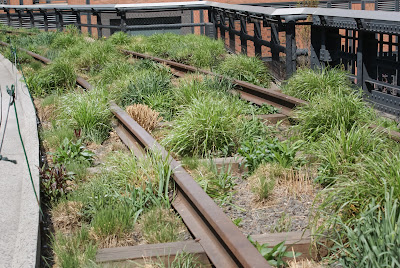
(More of those tracks I love.)

I love the juxtaposition of new and old architecture along the High Line.

I believe the new building is the parking garage for Soori High Line, an apartment tower "where West Chelsea meets Hudson Yards," as the high-end apartment building's web site indicates. The old building in its shadow has been restored, as you can see in the Google Map capture below.

Below is another great example of the blending of rough, old bricks with shiny new glass.

This is the rear (or backside, if you prefer) of The Emerson NYC, which is located at 500 West 25th Street in the West Chelsea neighborhood.

In closing, I'd like to show you the best thing about the High Line:

You can't beat the people-watching along this path.

Make sure to check back for the final post in this New York City flashback series, which features photos taken from the top of a double-decker tour bus.

If you missed the first two posts in this series, fear not; here are the links: "New York City Flashback: Views from the High Line" and "New York City Flashback: The Transit Museum."

Monday, November 18, 2013

Tuesday, May 29, 2012

Graffiti Week, Part VI

Here's the final installment of Graffiti Week. On a recent trip to Manhattan, Chris St. Cyr made some sharp observations about tagged, and often empty, newspaper boxes -- Ed.

Free Voice AM NY

The side effects of the declining print publication industry are not only out-of-work writers or editors or art directors. Another tragedy of this once vibrant medium is the neglect of the iconic publication boxes that line the streets and populate bus stops of our great cities.

Chelsea Now Dhint

They’ve become the burnt-out cars and vacant buildings of the print publication world. These empty vessels are the latest blank canvases of the Backside of America’s favorite artists -- taggers.

Daint Voice The Onion

In the hands of these visionary artists the publication box is reinvented into a kind of box-like Christmas tree that’s been decorated with United States Postal stickers, tags, and images. So the next time you see one of these empty boxes celebrate the Backside of America and tag it!

Kosbe Empty Onion

To see the rest of the posts from Graffiti Week, check out:

Part I, which features shots taken at the snack shack on an old ski hill in Weston, MA

Part II, which features some tagged barns in Connecticut and Massachusetts.

Part III, in which contributor lostlosangeles features wonderful images from L.A., New Orleans and Detroit.

Part IV features three shots by Joe Viger from the West Coast, and three by Mick Melvin from the East Coast, all of buildings that seem beyond recovery.

Part V, in which we feature shots of trains and train tracks.

Friday, July 1, 2011

This Ain't No Mudd Club

From Dave Brigham:

Thanks to my buddy Jay Kumar for pointing me toward this photo exhibit by Blondie guitarist Chris Stein of New York City's infamous, but unfortunately now-defunct, punk rock club CBGB's.

I never made it to CBGB's. I walked past the club several years ago, before it was turned into a John Varvatos shoe store, but it was the middle of the day and although I was well aware of what I was walking past, I didn't take much note of it.

Despite that, as far as I'm concerned, CBGB's should have been placed on the National Register of Historic Places, because it holds a unique place in this nation. For those of you who aren't aware, the club opened in December 1973, with the goal of featuring "country, bluegrass and blues" (hence the name of the club). Rather than becoming a showcase venue for those types of music, however, the club was the place where punk bands such as The Ramones, Patti Smith, Blondie, Talking Heads and Television got their starts. Smith, in fact, closed out the club on October 16, 2006.

I could go on and on about punk rock and how much I love it, but I won't. Just check out these pics and if you don't know much about the above-mentioned bands, check out the videos below:


Monday, January 17, 2011

Undercity

From Dave Brigham:

Self-described urban historian and photographer Steve Duncan made a 28-minute documentary with filmmaker Andrew Wonder (real name: certainly not Andrew Wonder) in which they explore abandoned subway stations, forgotten sewer tunnels and the tops of bridges in New York City. Very cool -- made we wish I were younger or at least more adventurous, or had more time on my hands, or wasn't concerned about hurting myself or leaving my kids without a father.

Thanks to my buddy David Belson for tipping me off to this video.


Check out more of Duncan's exploration photos from around the globe here.

Thursday, October 21, 2010

These Boots Were Made for Explorin'

From Dave Brigham:

Because their sensibility about America's rump is right in line with The Backside, the folks at Palladium Boots have almost convinced me to buy some quality French footwear. Recently, I highlighted the documentary about Detroit that the company made with Johnny Knoxville of "Jackass" fame (see October 10, 2010: Reppin' for the Motor City). Today I'm pimpin' three more of the company's short films about hidden and dilapidated parts of the country, as well as one coal mine that's been burning since 1962.

In the first doc, a pleasant young woman and her crew go in search of abandoned missile silos in Washington and Kansas that have been left for graffiti artists, amateur spelunkers, UFO researchers, and real estate prospectors, among others. Stick around 'til the end for a tour of a silo property that's been converted into a hippy haven.


In the second film, a pleasant young man takes a tour of a slew of New York City's ruins, including a power station in Yonkers, a subway tunnel in Harlem, and a grain terminal in Brooklyn.


In the third documentary, another fine, upstanding young man tours Centralia, PA, home to a labyrinth of coal mines that caught fire in 1962, and is still burning.

Way Down Yonder in Pawtucket, Part I

From Dave Brigham: I apologize in advance for this, but I often feel the need to explain my headline choices: I'll admit that befo...