Showing posts with label American Legion. Show all posts

Saturday, May 25, 2024

Top Champagne House Inspired This Part of Millis, Mass.

From Dave Brigham:

My expedition to Millis, Mass., bubbled up in a roundabout way. There I was, minding my own business, watching the local TV weather report, when the meteorologist zoomed into an area on the map where rain was particularly heavy. In between Medfield and Medway, two towns I'd certainly heard of, was listed "Clicquot."

"What the heck is Clicquot?" I asked myself. Soon enough, I learned that it's a section of the town of Millis, and that the name has an interesting history.

If you're a champagne afficionado like me -- *cough cough* -- you might recognize the name Veuve Clicquot. From Wikipedia: "Veuve Clicquot Ponsardin...is a Champagne house founded in 1772 and based in Reims [France]. It is one of the largest Champagne houses. Madame Clicquot is credited with major breakthroughs, creating the first known vintage champagne in 1810, and inventing the riddling table process to clarify champagne in 1816. In 1818, she invented the first known blended rosé champagne by blending still red and white wines, a process still used by the majority of champagne producers."

So why is a village in this small Norfolk County town named for the bubbly name-checked by rapper Benny Mayne?

If this smokestack ghost sign with missing letters could talk, it would tell you that for most of the 20th century, the Millis-based Clicquot Club Company was one of the nation's largest beverage companies. "[T]he Clicquot Club Co., known initially as the Aqua Rex Bottling Works company, was established on Curve Street in 1881 by Henry Millis and Charles LaCroix using money Millis received from his father, Lansing Millis. In 1885, the town of Millis was named after Lansing, a retired railroad man of considerable means," according to this Milford Daily News article, citing several sources. "The company took its name, which is pronounced 'kleeko,' from a French champagne, according to Hindy Rosenfeld, a collector of Clicquot Club memorabilia who donated her collection to the town shortly before her death in 1996."

From Wikipedia: "In 1881...Henry Millis...made a suggestion to Charles LaCroix, of the LaCroix Fruit Farm, that he call his sparkling cider 'Clicquot' - after the famous French champagne, Veuve Clicquot - and start selling it....The company produced mainly sparkling cider for the first few years but later on Millis would experiment in other flavors as well. The sparkling cider was soon dropped and the company began focusing mainly on ginger ale. During this time the soda company hired a significant amount of the town's residents and would continue to do so for years to come."

For more than 40 years, Clicquot Club was the largest manufacturer of ginger ale in the world. The Millis plant grew to be quite large, and the company ran other operations across the country. I suspect you know what's coming for the company, which was obviously a major employer in town. "When [the company] was purchased by Cott Beverages in 1971, 500 employees produced 240 million cans and 84 million bottles a year," according to the Milford Daily News article. "In 1980, Cott Beverages closed its doors for good."

The plant is used by a variety of companies these days.

Directly behind the old Clicquot Club site is a large, mostly vacant former industrial site.

"In 1889 the town voted to buy a strip of land from Henry L. Millis located at the south side of Curve street," according to MACRIS. "Four stone buildings were built to house the Steel Edge Stamping and Retinning Plant. These buildings were made of stones gathered from the stone walls on the surrounding farms, the largest portion coming from Oak Grove Farm. For many years the plant had a busy life and its products were sent all over the U.S."

In the ensuing decades, a number of manufacturers called the plant home, including Central Stamping Co., American Flax Fibre, Puritan Carbonating Co., United Cork and Seal, Safepack Mills, the Rubberoid Company and lastly, GAF, which manufactured roofing materials here.

These days, all that's left of the once-massive plant is the stone tower seen below.

You can see the Clicquot smokestack from the old plant entrance on Curve Street.

I'm not aware of any redevelopment plans for this site. The town has been studying and surveying residents and looking into options, which would likely include a mix of residential, commercial and office space.

A little west of the old GAF plant is the local American Legion hall, located in a circa-1925 Craftsman-style Bungalow.

"The Millis Post # 208 of the American Legion was organized in 1920," according to MACRIS. "The Post is active in erecting memorials to veterans of foreign wars in Millis."

Close by, on Plain Street, the Millis Wishing Bridge crosses an old railroad right-of-way.

The bridge is fairly new, replacing a span from 1947. The petition to name it the Millis Wishing Bridge was made a few years ago by the Life Experience School, an "alternative day program for individuals with special needs who are dedicating their lives to provide humanitarian services to their community." Unfortunately, the program is no longer in business.

Along Exchange Street, near the intersection with Main Street, I was over the falls about Niagara Hall.

"Niagara Hall was erected in 1879 for the purpose of housing the 'Niagara' fire engine, which remains a cherished relic today," per MACRIS (see photo below for a glimpse of the engine).

I believe this beauty has also served as a police station and town hall down through the years. The Niagara Coffee Haus, located on the second floor, hosts regular folk, rock, blues, jazz and Americana music acts.

I continued west on Main Street, and after passing the town police station, I looked north on Auburn Road, and could tell there were abandoned railroad tracks up ahead. So I ventured forth.

When walking on tracks like these, I always look behind me every few minutes to a) make sure no punks are following me, and b) to keep one step ahead of zombies. These tracks were owned by the New York, New Haven and Hartford Railroad for a long time. Most recently, they were used by the Bay Colony Railroad. There was also commuter train service through Millis until 1967. I believe there was an old train car along a side track here until fairly recently.

Before too long, I ended up at an abandoned manufacturing facility that I figured dated from the 1960s.

And, according to LoopNet, it was built in 1960. Damn, I'm good. I'm not sure what company most recently occupied the site. An application was filed two years ago to construct a solar array here. I'm not sure of the status of that application.

I really wanted to follow the curve of the tracks into the woods, but I headed back toward the center of town.

Along Main Street, I saw St. Thomas Hall.

Built in 1957, the parish hall is affiliated with the St. Thomas the Apostle Parish, which holds worship services a short walk away, on Exchange Street.

Along Exchange Street, I enjoyed the contrast between the sign for a hair salon and the name WINIKER BLOCK carved into the building.

The building dates to the late 1930s or early 1940s.

Continuing north-northeast along Exchange Street, I was rewarded with a building that, while not as photogenic as Niagara Hall, was my favorite of the day.

(The bell seen in the foreground is believed to have been cast in 1845 by George Holbrook, according to this web site.)

Known as the Lansing Millis Memorial Building, after the founding father, this unique, Richardsonian Romanesque building rose in 1886. "At a special town meeting held Oct. 18, 1885, the heirs of Lansing Millis requested permission to erect a building to be known as a memorial to Lansing Millis," according to MACRIS. "A railroad station was to occupy the first story and the second story was to be devoted for the use of a public library and town offices. This received unanimous approval."

I love the combination of stones and shingles, which gives this municipal building a cozy feel. But the perfect touch is the collection of decorative stones around the front and sides of the building. Again, from MACRIS: "In the erection of this building, the outside walls were made of stones and the citizens were invited to contribute unusual stones that they could gather. Many of Mr. Millis's business friends contributed stones as memorials. These stones were marked with the initials of the corporation donating the stone. In the upper half of the tower there are eighteen such stones and in the lower half, nine."

The town offices remained in the Lansing Millis Building until 1998. The building was leased to a private school at some point. In February 2021, the town received a conditions assessment and feasibility study it had commissioned from Spencer, Sullivan & Vogt. The report acknowledged "the Town’s willingness – and in fact, enthusiasm – to revitalize this building, especially given its current state of disrepair."

In the fall of 2022, the Milford Town Meeting considered, among other warrants, one to provide "$2.9 mil or any other amount" to design, upgrade, construct and renovate the building. I'm not sure of the status of that project.

On the grounds of the old train station is a plaque, the likes of which I'd not seen before.

"MILLIS BROTHERS OF THE BRUSH BELLES AND BEAUX RAZOR BURIAL SITE CENTENNIAL CELEBRATION 1985"

I believe this memorial honors those who went without shaving for some period of time in recognition of the town's 100th birthday. When I was growing up in Simsbury, Connecticut, there was a similar effort whereby men didn't shave leading up to the town's 300th anniversary in 1970. My dad grew a pretty good beard.

Following my trek through Clicquot, I did some MACRIS research and discovered a few other places I wanted to check out. So I returned.

On Myrtle Street, in the Rockville section of town, is yet another fantastic old fire house.

Built in 1924, the station has what MACRIS calls a Folk Victorian look. While there is fire equipment inside, I'm not sure whether it's an active house. It has some cool details.

Along Farm Street, near the intersection with Cedar Street, is the old town pound.

From MACRIS: "The Town Warrant authorized Michael Metcalf's construction on the Town Pound on Farm Street in 1734. The Pound was a holding area for stray animals. Owners paid a fine to the pound keeper when they claimed their animals." I have featured a few other town pounds on the blog, which can be found here and here.

Lastly, I checked out an old railroad trestle spanning the Charles River, connecting Millis and Medfield.

Known as the Charles River Railroad Bridge, this feature dates to 1925.

Saturday, May 4, 2024

Seeking Out Hyde Park

From Dave Brigham:

In what seems another lifetime, I played in an over-40 men's baseball league. I played many games in Hyde Park, and enjoyed my drive through Cleary Square on my way to or from games. Recently I realized a years-long goal: I returned to that Boston neighborhood to make photos.

My first stop was a place I'd been to in more recent years, for my son's friend's birthday party, Ron's Gourmet Ice Cream and Bowling, in the heart of the square.

From the establishment's web site: "Ron Covitz is the patriarch of Ron’s Gourmet Ice Cream. The business was started as the Twentieth Century Bowling Alleys by Ron’s father, Julius. A family recreational facility, it housed 10 lanes of candlepin bowling and an 18-table pool hall....A 'foodie' before the term was popular, Ron knew he would not be happy making just average ice cream. He knew then as we know now that the best way to be successful is make it better and fresher than all of the competition."

It's a true family operation, with various members of the Covitz clan working there over the years.

Just south of Ron's along Hyde Park Ave., I couldn't resist making a photo of ODB Liquors.

"Why?" you may ask, if you aren't familiar with the Grammy-nominated, and possibly greatest rap collective of all time, Wu-Tang Clan. One of the Clan's members was Ol' Dirty Bastard, otherwise known as ODB. I'm not a Wu-Tang fan, but I do like the explicit "Shimmy Shimmy Ya" that ODB issued on his own.

As for the building housing ODB Liquors, it's known as the Thomas F. Fallon Block. Built in 1916, its tenants include retail stores on the ground floor, and small businesses located in office space above. Below are a few more retailers (and a possible ghost sign) located along the River Street-facing side of the block.

Back on Hyde Park Avenue, I found myself wanting to go back in time when the New England Baptist medical office building was in its prime.

The bones of this building seem solid, but it needs a refresh. I wonder if there was a clock in that empty circular spot.

Heading east on River Street, I liked the building housing Mr. G's Laundromat and Delicias Columbianas restaurant.

As with too many towns and cities I explore, I saw plenty of empty storefronts in Hyde Park....

...but I also saw two theaters, a storefront church and much more.

Located on Farimount Avenue, the Everett Square Theatre opened in 1915, hosting moving pictures, vaudeville shows and live music in its early years. "In 1933, Everett Square, where the theater was located, was renamed Logan Square, and the following year the theater was renamed the Fairmount Theatre," according to this article at After the Final Curtain (there are some great photos at that link as well). "By the mid-1940s the theater had discontinued the live performances and only showed motion pictures."

In the 1960s, the theater was renamed the Nu Pixie Cinema; in the 1980s the name was changed yet again, to Premiere Performances, as live acts returned to the space. Later on that decade, the old theater was used as an auction house before shuttering, according to After the Final Curtain.

In more recent years, Historic Boston, Inc. and Hyde Park Main Streets worked with the building's owner to re-create and install a new sign out front, and to restore the theater's foyer. In 2018, the owner was able to install a new roof.

I'm not sure of the status of further renovations. I hope someday that the Everett Square Theatre will reopen.

Adjacent to the old theater is a nice old building whose current tenant is the Bethesda Haitian Baptist Church.

As regular readers of this blog know, I have a thing for houses of worship, including ones located in non-traditional spaces. While things seemed pretty quiet at the Baptist church, I did hear music and preaching coming from other small churches along Fairmount Avenue and other locations during my expedition.

I was pleasantly surprised to see another theater marquee just two doors down from the Everett Square joint.

Riverside Theatre Works is located in the circa-1897 French's Opera House/Masonic Temple/Odd Fellows Hall. "French's block was originally constructed in 1897 but was ruined by fire 15 rronths after its opening," according to MACRIS. "Immediately rebuilt, the block was conpleted in 1899 and retained parts of the earlier facade. A more ambitious building than its predecessor, the 1899 block included an opera House (sic) with a 700 seat auditorium and, on the third floor, and odd fellows Hall (sic). In 1915, as the plaque on the building suggests, the interior of the block was renodelled for use as a masonic hall (sic)."

As for Riverside, it is a "rare community theater with a proscenium stage – and the only live theater venue in Hyde Park," per the troupe's web site. The 14,000 square foot facility "features a 156-seat opera house, a spacious dance studio and rehearsal space, a scene shop, a lounge, and several meeting and rehearsal rooms."

There's also a sweet ghost sign on the southeast-facing wall.

At the intersection of Fairmount Avenue and Davison Street there is a banner, installed by Hyde Park Main Streets, recognizing the 54th Regiment, the first military unit consisting of Black soldiers to be raised in the North during the Civil War.

From the Massachusetts Historical Society: "By the middle of February 1863, recruiting for the Fifty-fourth Massachusetts Regiment was underway. Newspaper advertisements and recruiting posters...encouraged Black men to enlist. Twenty-five men responded promptly, and by the end of the first week of enlistments seventy-two recruits were present at Camp Meigs in Readville (now Hyde Park), Massachusetts. However, more soldiers were needed and recruiters turned their attention to states throughout the North and South and into Canada to locate enough eligible Black men to fill the regiment. By 14 May 1863, the regiment was comprised of 1000 enlisted men, and a full complement of white officers."

I knew that the 54th Regiment was raised in Massachusetts, but I had no idea before wandering around Hyde Park that this neighborhood was the epicenter of that effort.

Laly's Market, which took over for Andrea Mini Market in recent years, is located in the Way Building, a circa-1903 Georgian Revival commercial block that rounds the corner from Fairmount Avenue to River Street.

Continuing northeast on River Street, I liked the sign for Kenney Cleaners, which looks like it's been there a while.

In the other end of the low-slung commercial block is Master McGrath's, an Irish bar.

From there I made my way west to the Hyde Park branch of the Boston Public Library. While both the old and new parts of the library are quite attractive, I was more interested in the slabs of stone parked in the north lawn.

This is a granite foundation stone from the former St. Catherine's School in Hyde Park. The foundation was built by Thomas Corrigan in 1895. The church was demolished in 1966.

Nearby are two architectural fragments from the cornice of the former Hyde Park Railroad Station, which was built in 1914 and torn down in 1964. One of them is pictured below.

Across the street from the library lawn is the former Hyde Park High School, which is being converted to studio, 1- and 2-bedroom rentals for the 62+, mixed-income, LGBTQ-friendly community.

Known as The Pryde (see what they did there?), the complex is a renovation partnership between Pennrose and LGBTQ Senior Housing, Inc.

As for the building, it was built in 1902 and was "originally known as the Hyde Park High School...[and] was constructed...as the first purpose-built public high school for the Town of Hyde Park, which was incorporated in 1868 and annexed to the City of Boston in 1912," according to MACRIS. "The 1902 building served as Hyde Park High School until 1929, when the Boston School Department completed construction of a new Hyde Park High School at 655 Metropolitan Avenue. From 1929 through 2015, the building was used as a public intermediate school known as the Rogers School."

Just around the corner, at the intersection of Everett Street and Central Avenue, is the Menino Arts Center, named after former longtime Boston Mayor Thomas Menino, who grew up in Hyde Park.

The building, which dates to 1899, is also home to George Robert White Trust, which owns the stadium in Boston's Franklin Park, about which I will post in the coming weeks.

In between the arts center and the library, across from the old high school, is a building that looks as though it could've been an academic administration building. On the day I visited, it was listed for sale. It's most recent tenant was New Beginnings Academy.

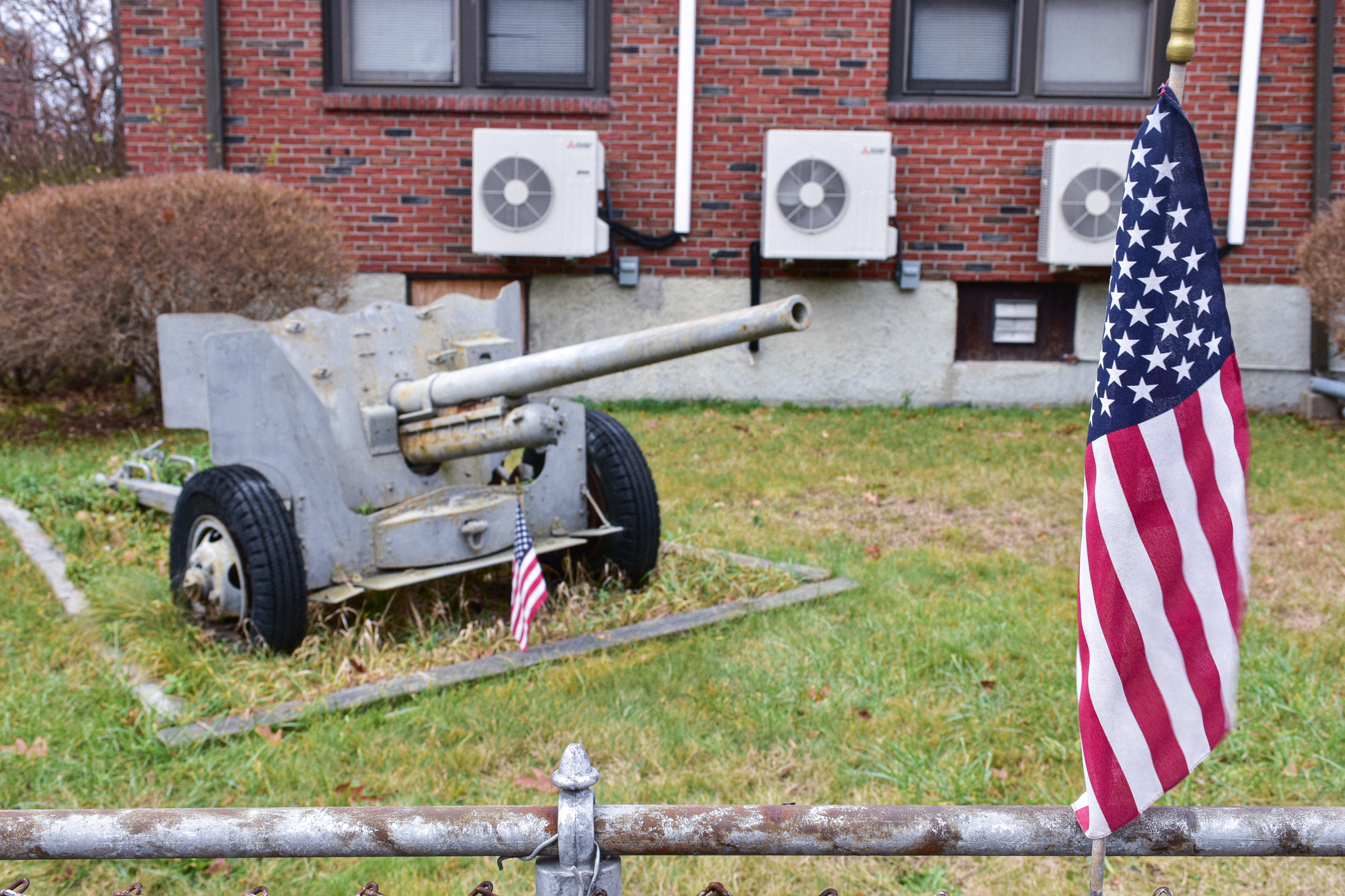
Along Harvard Avenue is the Cecil W. Fogg/Thomas J. Roberts Post #78 of the American Legion.

I ducked back down Everett Street, heading west, to check out a church located in a non-traditional space.

The somewhat ominous sounding Pentecostal Church of the Last Hour was in the middle of a service on the day I walked by. I could hear preaching and music. The congregation is located in an industrial building that several years ago was home to a dry cleaning service.

I doubled-back to Harvard Avenue, and saw two nice little buildings near the intersection with River Street.

Fan Fan Bakery is located in a late-19th century commercial building, and has been in business more than a decade. Prior tenants included Las Vegas Seafood Restaurant (!?!).

Across the street is a building and company that really intrigue me.

Built in 1924, this building is home to Klein Post Card Service, which sells calendars, logo apparel and Boston and Cape Cod souvenirs. In business since 1974, Klein is a family owned business. I thought this company was a relic of another age, but I'm happy to see it's still active.

Back on River Street, I spied a great mural on the side of New York Fried Chicken.

Featuring Mayor Menino and a cast of dozens, this artwork depicts, I believe, a Hyde Park parade from the 1990s.

Last but not least, a shuttered dive bar, located just north of our starting point, Ron's Gourment Ice Cream.

The Cottage Cafe closed in late 2017 after what I'm assuming was decades in business. The building dates to 1940.

Checking Out Dudley Street in Roxbury...and a Historic, Pre-Civil War House

From Dave Brigham: As part of a series of quick-hit jaunts through Boston this spring, I checked out the outer reaches of Nubian Square, m...