Showing posts with label out of business. Show all posts

Saturday, March 28, 2026

Booze + Broads

From Dave Brigham:

In early February , I picked up a framed print I had on display as part of the Small Stones Festival of the Arts in Grafton, Mass. Before swinging by the Brigham Hill Community Barn to retrieve my work, I drove somewhat aimlessly through the neighboring towns of Worcester and Auburn, looking for things to shoot with my camera.

OK, my drive wasn't completely haphazard; I've had Lamplighter II, a shuttered strip club in Worcester, on my radar ever since I began compiling potential sites for my series on New England's second-largest city (see this post from last September, which includes links to eight prior installments about Worcester).

Along with diners, movie theaters and bowling alleys, gentlemen's clubs are vestiges of a dingier past, and that's the sort of stuff I find image-worthy. I've featured strip clubs before on the blog - see this post about the vestiges of Boston's Combat Zone; this post about a former club in Chelsea, Mass.; check out this installment of my Worcester series, which leads off with mention of Hurricane Betty's; and this post about Springfield, Mass.

After circling around for a while, I came upon Chieftain Liquors along Route 12 in Auburn, and slammed on the brakes in a way that I absolutely do not recommend.

I'm not sure how long Chieftain has been in business, but it's long enough that the store once had a neon sign. According to Roadside Architecture, the neon was replaced with backlit plastic several years ago.

There you go - booze + broads, in reverse order.

As a friend said when I posted these photos on Facebook, "You go to all the best places!"

Saturday, January 11, 2025

Oak Square is OK

From Dave Brigham:

I have driven through Boston's Oak Square approximately countless times in my life, and have wondered about one specific property on just about each of those infinity occasions. I'll get to that shortly, after I discuss a family-owned laundry and dry cleaning outfit that closed up shop about five years ago in the Brighton neighborhood.

(I hope somebody saves that sign.)

Swan Cleaners was in business for more than 70 years. I don't know if the business took a dive because fewer people need office outfits dry-cleaned, or if there was another reason it shut down.

(The swan on the side exterior wall is a nice touch.)

In November 2022, the Boston Zoning Board of Appeal approved a pot shop to take over the Swan space. I saw no sign that Pure Oasis, which has stores on Blue Hill Avenue in Dorchester and Devonshire Street in downtown Boston, is preparing to open in Oak Square.

Across the way, elevated above the hustle and bustle of Washington Street, is the specific property I've pondered over for years. Vacant for a long time, this place at one point had what appeared to be contractor trucks parked around it, as if perhaps it was a builder's office. And a search of the address brings up Daley Construction Company as a prior tenant or owner. Turns out, this place has "a long association with members of Brighton's building trades," according to MACRIS.

"This unusual, towered Mansard/Queen Anne house...[s]ituated on a triangular lot formed by the intersection of Washington Street and Langley Road...was built c. 1870-1875 by and for John H. McCausland, carpenter," MACRIS continues. "By 1885, Granville A. Fuller owned this property. Granville A. Fuller resided at 15 Sparhawk Street, Brighton. His father, Granville Fuller was a talented architect/builder responsible for the design and construction of the Greek Revival Brighton Town Hall in 1841. Granville A. Fuller was a partner in his father's lumber company and was also a civil engineer. From the 1890s until at least the 1930s, this house was owned by Walter L. Maguire, roofer with an office at 46 Cornhill Street, Boston."

In late 2018, a developer filed plans with the city for a five-story, 37-unit condo building with ground-floor retail space. I'm not sure of the status of that proposal.

I just have two more sites I want to discuss. The first is the Faneuil Branch of the Boston Public Library, named after the street where it is located. The street is named after Benjamin Faneuil, brother of Peter, who is the namesake of the well-known hall in downtown Boston.

"The Faneuil branch...was built in 1931 and is a relatively rare example of the Art Deco style in Brighton," according to MACRIS. "It was designed by the architectural firm of Kilham, Hopkins and Greeley of Boston, who also designed Waltham City Hall, Dedham High School, and Barnard Hall at Radcliffe."

Last, but certainly not least, is my favorite building in the square.

Located adjacent to the library branch, the circa-1912 Oak Square Fire Station is an English Revival gem. It was designed by the firm of Timothy Francis Walsh and Charles Maginnis, known for designing Roman Catholic churches and institutional buildings around the country, including Holy Cross College in Worcester, Mass., the National Shrine of the Immaculate Conception in Washington, D.C., and Trinity College Chapel in the capital city, per MACRIS.

Here's your headline explainer.

Saturday, September 14, 2024

Is There Hope for an Old Diner in Salisbury, Mass.?

From Mick Melvin:

My wife, Amy, and I were going to a wedding in Amesbury, Mass., and came across Pat's Diner in neighborhing Salisbury. After doing a little research, I found out that it was a great place to stop. The owner, Patricia Poulakos Archambault, was the beloved owner of Pat's Diner. She was proud of her Greek heritage and loved serving her Greek specialties.

From Wikipedia: "The diner was built in 1950 as #824 by the Worcester Lunch Car Company, as a custom job for James and Ann Evans. They had opened their first diner in Haverhill, also called Ann's Diner, in 1948, and moved it to the present site later that year. The business was successful enough that they ordered the present diner as a replacement. It was specifically designed to accommodate a separate dining room, and was opened in April 1950. The Evanses owned the business until 1960, after which it went through a succession of owners. From 1976 to 1987 it was owned by Norman Brockelbank and known as Norm's Place. The diner was closed between 1997 and 1999. In 1999 it was acquired by...Archambault, who restored it and reopened it...."

The diner struggled through the pandemic, and when Pat passed away in 2021, the diner closed.

From reading online comments about Pat's Diner, it was a great place to eat and Pat treated her customers like family. It would have been a great place to experience.

Not sure whether the diner can be saved or if it will be demolished.

Saturday, July 13, 2024

Changes Coming to Former HoJo's Site Near Concord Rotary

From Dave Brigham:

I had several really good meals at the Papa Razzi along Route 2 in Concord, Mass. The Italian restaurant closed in the summer of 2023, so I'll have to get my delicious pasta and lasagna elsewhere. While there, I never thought about the history of the restaurant building, assuming it was just your run-of-the-mill joint that had hosted several eateries over the years. It has, but it's also got a pedigree right out of the annals of legendary roadside America.

And so does the former hotel located across the parking lot.

This pair of buildings, you see, was once part of the vaunted Howard Johnson's dining and hospitality universe. I realize my pictures are sub-optimal, but when I took them I didn't realize the history of this site. I will make up for that with plenty of background information and personal reflections!

Although it's difficult to tell by the looks of the place now, the old Papa Razzi space opened as a Howard Johnsons's restaurant in 1938, according to MACRIS (another source says 1937). The motor lodge (aka motel) opened in 1964 (or perhaps earlier) as the 199th in the chain, according to information at this Flickr post (which also features a nice historical photo). You can see hints of the famous Howard Johnson's pitched roof in the second photo above.

The restaurant operated as a HoJo's until 1991 (or perhaps 1992...sigh); the motor lodge was a Howard Johnson's until the mid-1990s. According to MACRIS, before the restaurant closed, it was "the last operating of all the pre-war Colonial Revival Howard Johnson's in the United States."

During its tenure in Concord, the HoJo's "acquired about two dozen of the original captain's (sic) chairs from the 1935-36 Howard Johnson's in Portsmouth, NH, which burned in 1983," according to MACRIS. Before its closure, the Papa Razzi had approximately 60 full- and part-time employees.

The former motor lodge operated as a Best Western and the Inn @ Historic Concord before being converted to a homeless shelter.

As for the Howard Johnson's chain, known across the country for its bright orange roofs, it was founded by its namesake in 1925 as a restaurant specializing in ice cream in Quincy, Mass. When the company went public in 1961, "there were 605 restaurants, 265 company-owned and 340 franchised, as well as 88 franchised Howard Johnson's motor lodges in 32 states and The Bahamas," per Wikipedia.

The chain continued to grow over the ensuing years...until it began to decline. Eventually, the restaurants all closed and the motels were acquired by Wyndham Hotels.

I used to eat at the HoJo's in Avon, Conn., a neighboring town to where I grew up. It was a great late-night spot after the movies or mini golf or just cruising around town to parties with my high school friends. One time a friend and I got kicked out, along with two slightly older co-workers, because one of us -- I forget who after all these years -- jokingly pretended he was going to lift a chair onto the table. I may also have chewed and screwed once or twice.

We split our time along Route 44 between that restaurant, McDonald's and an Abdow's Big Boy. Good times. A few years ago, I wrote about another former Howard Johnson's located on Cape Cod (see July 16, 2022, "Hyannis Revisited: A Little Something About the Kennedy Clan Here").

Because the former Concord HoJo's buildings are located in prime locations along Route 2 (along with an adjacent shuttered Chinese restaurant), they are likely to increase in value in the near future once the nearby MCI Concord prison is shuttered and the site potentially opens up for redevelopment (for more on this, see June 2, 2024, "Doing Time on the Reformatory Branch Trail").

In May 2023 the owner of the restaurant site, Elm Street Realty Trust, filed a demolition review application with the town. In late May of this year, the Boston Globe reported that in 2025, the site would become home to three eateries: Starbucks, Chipotle and Sally's Apizza, the latter a New Haven-based chain that is expanding into the Bay State.

Saturday, October 14, 2023

I Went to West Medford Square by Mistake...But That's OK

From Dave Brigham:

I'm gonna be straight up with y'all. After walking around West Medford Square for a short while, I realized that I'd meant to go to Medford Square. Regardless, I found some interesting stuff in this neighborhood before making my way to the more hip and happening heart of the city of roughly 60,000 residents.

I wrote about the coolest building in West Medford Square many years ago (see December 26, 2018, "Rise of the House of Usher"), although honestly I don't remember why I didn't explore the area more. No matter.

Let's start with that building, since I now can offer more, and more accurate, information about it, thanks to my pal MACRIS.

When I wrote about the Usher Block in late 2018, I speculated that the building was named for Henry Usher, a Medford resident who served in the Civil War. I believe I based that guess solely on a Google search for "Usher Block" and "Medford Ma" that brought up an article from the Medford Historical Society about Usher's unit, the Lawrence Light Guard.

It turns out that my speculation was wrong. "By 1893 the Usher Block was situated in its current location and ostensibly owned by James Usher," according to MACRIS. "By 1898 the property remained in the Usher family but was under the ownership of Elizabeth A. Usher....This building, visually prominent to rail passengers, is considered to be the 'most notable building' in West Medford and it is credited with stimulating an era of commercial development in the neighborhood....The Usher Block was designed by architect Edward P. Morse and built by James Usher....Morse was an architect of at least regional note. Between 1893 and 1900 Morse designed at least 17 buildings, 11 in Boston, five in Brookline and one, the Usher Block, in Medford."

Perhaps Henry was related to James and Elizabeth.

Looking southwest from the Usher Block, beyond the commuter rail tracks, you will see two nice old buildings along Harvard Avenue.

On the left is the Holton Block, which was built in 1875; on the right is the Independent Order of Odd Fellows (I.O.O.F.) Building, which dates to 1897. The former is named for Samuel S. Holton, "a proprietor of the land company selling lots and constructing dwellings in the Smith Estate subdivision between High Street and Mystic River," according to MACRIS. The building is the oldest surviving commercial building in the area.

As for the I.O.O.F. Building, it was also built by Holton's outfit for the local chapter of the fraternal organization. "Its yellow brick façade is textured and decorated in a highly stylish manner with an arcade of windows on the top story representing the location of the lodge hall," according to MACRIS. "There were three stores on the first floor along with a distinctive arched entry at the south end of the façade that provided access to the stairs leading up to the lodge. Apparently meeting halls were in great demand for lyceums, church services, fraternal organizations, and entertainment."

The Holton Block appears to be apartments now, while the Odd Fellows building is home to Medford Shoe Repair, Serenity Spa and, presumably, other small businesses.

Back on the north side of the railroad tracks, at 17 Playstead Road, is Lola's Coffee and More, situated in an adorable little building.

Medford's assessor's database indicates this building, which is an outbuilding of the home at 1 Irving Street, dates to 1975, but I'm dubious. The home was built in 1900, supposedly. The Lola's spot has been home to a juice bar and a laundry service in recent years. I'd like to think it was a bus shelter or small train station at some point.

Along High Street, just to the east of the Usher Block, is the former home of West Medford Auto & Hardware.

I'm not sure how long the place was in business, but I'm guessing quite a long time. I don't know when it closed.

The building dates to 1928, and is still home to the Goulding School of Irish Dance.

A few doors down, at the corner of High and Warren streets, is Paul Revere Restaurant.

The one-story building, which includes several other storefronts, dates to 1916, according to MACRIS. As for the eatery, as of 2012 it retained "interior fixtures that appear consistent with the construction period," per MACRIS. I hope that's still true.

Across High Street I spied one of my favorite things - a semi-clever salon name: Hair's Karen.

The hair cuttery is located in what's known as the Lieberman Block, which either dates to 1925 (MACRIS) or 1945 (assessor).

Heading south from Karen's place on Canal Street, I spied a cool building at #18.

This cinder block building started life in 1929 as dwelling, according to MACRIS. It was "adapted and enlarged for a small manufacturing facility identified in 1936 as Hydraulic Development Corp., makers of pipe joint filling for clay sewer pipe lines."

I'm not sure what goes on here these days. The building is owned by an outfit named Mass-Flex Research, Inc., which was founded in 1972, and manufactures "helically wound monocoil sheathings that are rugged, flexible, protective casings fabricated with application-specific preferred combinations of materials."

If you can explain that to me, I will pay you one American dollar.

Make sure to check back for my review of Medford Square!

Saturday, October 7, 2023

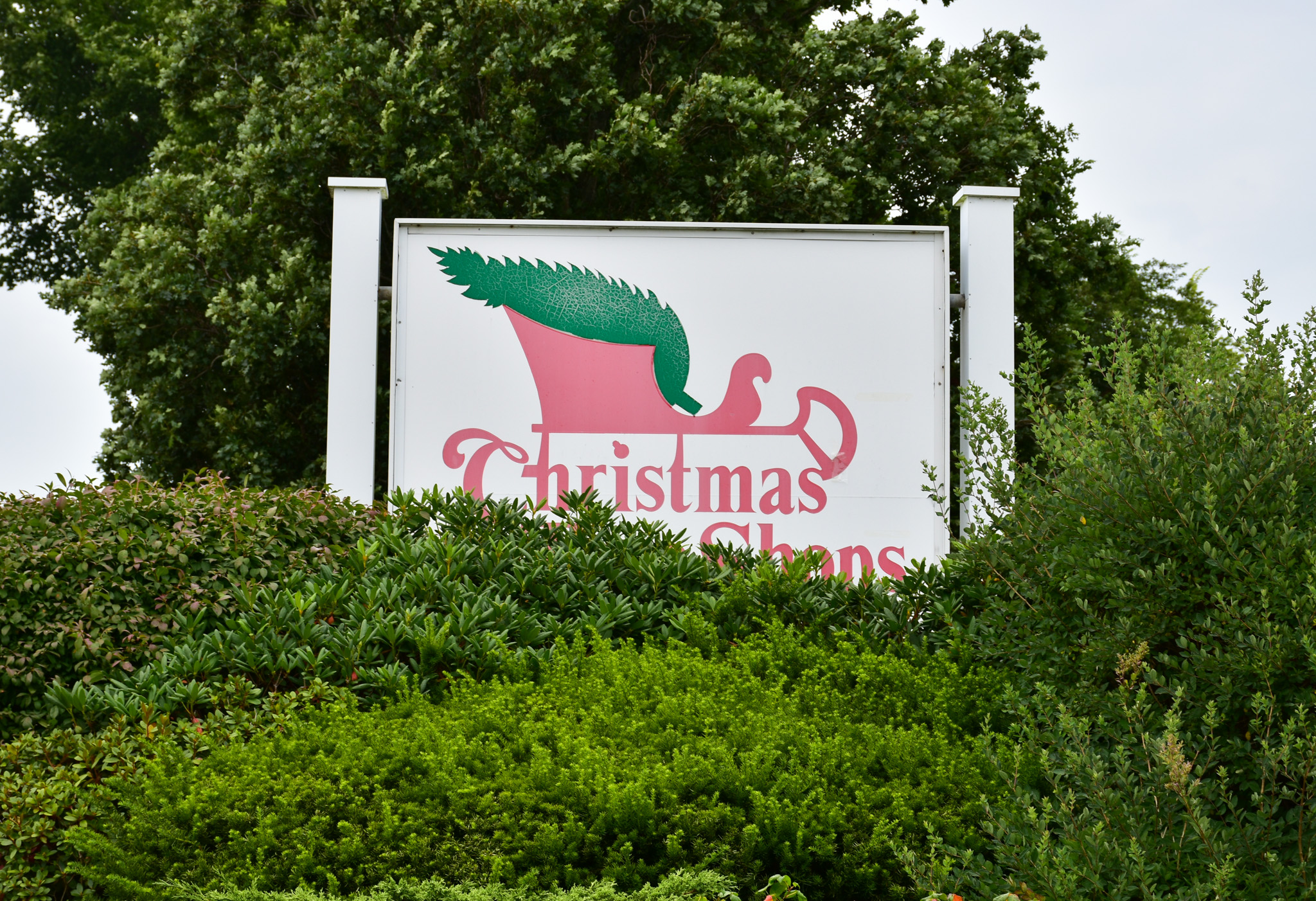
Wrapping Up the Christmas Tree Shops

From Dave Brigham:

Alternatve headlines:

The Year Without a Christmas Tree Shop

Do They Know the Christmas Tree Shops Are Closed?

It's the Least Wonderful Time of the Year

Happy Xmas (The Christmas Tree Shops is Over)

Run Rudolph Run (Oh, Nevermind, the Christmas Tree Shops Are Closed)

Maybe there was a labor dispute with the toymakers of the North Pole. Or a rift between executives about whether to expand their market to include items celebrating Krampus. Maybe it was all due to a Festivus celebration that got out of hand. Whatever the reason, the Christmas Tree Shops retail chain closed all of its outlets earlier this year.

I never set foot in one of the company's stores -- there were 72 at the peak of success, located in 20 states, mostly in the Northeast. In addition to the expected Christmas-y crap, the store sold bargain items such as food, household furnishings and toys. I drove past perhaps the most iconic of the shops, just over the Sagamore Bridge in Bourne, Mass., many times. I got a kick out of the faux-European barn/chalet architecture, which looked so out of place along Cape Cod Route 6.

Built in 1984 (a big part of me wishes it was 1894), the store wasn't the flagship of the retail chain, but its design set the tone for how some future outlets would look. The store in Pembroke, Mass., for instance, looks like a fraternal twin to the Bourne outlet. Wikipedia indicates that "[m]ost stores typically resembled older buildings (Colonial, Victorian, or even Old English barn styles, such as in Sagamore and Pembroke, Massachusetts; and Warwick, Rhode Island). Some, such as the Lynnfield, Massachusetts store, were even more conceptualized; that store was known for its lighthouse and fishing village motif."

The Bourne property -- 4.2 acres and including a large parking lot and a windmill (!) -- was assessed at $3.5 million this year.

The windmill added to the rustic European charm, and is remembered fondly by folks at this Reddit thread. "As far as I know, it's always been a Christmas Tree Shop and built that way to fit in with the location. I'm now in my 30's and remember watching the windmill turning from the inside when my mom took me shopping there as a kid," recalled moosetopenguin.

At one time, and perhaps still, the topper on the main buildng was the largest thatched roof in the world. The store's owners hired craftsmen from Ireland to do the job, from accounts I've seen online.

The roots of the Christmas Tree Shops are on Cape Cod. "What became known as Christmas Tree Shop began as an idea of Charles and Alyce Matthews of Yarmouth Port," according to the In My Footsteps blog. "In July 1946 33-year-old Charles and 37-year-old Alyce came to the Cape from New York. They purchased a home and a small store at the corner of Willow Street and Route 6A in Yarmouth Port that had previously been a grocery store owned by Harry Davidson."

(I found another write-up about the history of the company, in which the couple is referred to as "Mark and Alice Mathews." Sigh....a quick search turned up a few sources using either set of names, but clearly originating from these stories I've linked above. The In My Footsteps article seems to be more well-researched than the other.)

Regardless, here's the quick story after those two people started the business: The husband and wife team expanded the Yarmouth site by taking over some other space, and renaming the new store The Christmas Tree Shop. In 1961 the couple lost the store through a bankruptcy proceeding. In 1970, Charles and Doreen Bilezikian purchased the store, and within a few years had opened other outlets on the Cape. At one point, the company purchased the Cape Cod Coliseum to use as a warehouse (!).

In 2003, the Bilezikians sold out to Bed Bath & Beyond. "Under Bed Bath & Beyond, the chain began to expand beyond New England, arriving in Bed Bath & Beyond's native New Jersey, followed by Delaware and Pennsylvania," according to Wikipedia. "The chain entered the Midwest, with stores in Michigan and Ohio."

In late 2020, BB&B sold Christmas Tree Shops to Handil Holdings, a private company. Wikipedia brings us to the sad ending, the coal in the stocking if you will:

"On May 4, 2023...Christmas Tree Shops announced that it was preparing to file for Chapter 11 bankruptcy protection; the chain and its parent company, Handil Holdings, filed for Chapter 11 bankruptcy the next day....Ten underperforming stores were closed following the filing, in hopes of allowing the company to restructure operations and emerge from bankruptcy by August. However, after the company defaulted on a loan used for its restructuring, it was eventually announced that unless a buyer could be found for the chain by July 5, the chain would liquidate and close all remaining stores. With no buyer found, liquidation sales began at all stores nationwide on July 7, with gift cards and coupons being honored through July 21."

So what has become of this building since it was abandoned by Santa Claus? As Boston.com put it in its headline for a story about the new tenant, "Iconic Christmas Tree Shops location will become...Exactly what you probably think it will: Christmas is out, Halloween is in."

Yes, Spirit Halloween has replaced wreaths and bows and stockings and non-holiday junk with fake blood, sexy nun costumes and decorations designed to scare the crap out of you.

For more about the town of Bourne, see:

July 23, 2022, "Bourne On the 7th of July"

August 11, 2020, "What You Find When You Go Down Depot Road"

July 19, 2020, "Kickin' It Old School-house"

July 20, 2017, "Circling Buzzards Bay"

October 3, 2016, "Bourne Identity."

August 5, 2010, "Dark Side of the Motel"

July 28, 2010, "Two Hearts Beat As One"

Saturday, June 3, 2023

Change is Coming to Charlestown's Northwest Corner

From Dave Brigham:

Walking in the shadow of the Encore Boston Harbor Casino, in the industrial northwest corner of Charlestown, I am in my comfort zone. Odd for a guy who grew up in a fairly rural town, and who lives in a suburb now, I know. There's just something about the grit and the grime and the patinas and the history and, well, the opportunities to make great photos in places like this that really appeal to me. Obviously.

Also, I feel an obligation to document old buildings and signs and industries and neighborhoods before they get erased. But you already know that.

I've explored Charlestown quite a bit over the years - check out Part I, Part II and Part III of my series on Boston's oldest neighborhood. But in any city or town I trek through, I miss things or I run out of time. This return trip to Charlestown was triggered by looking at Google Street View for another post I was writing, and seeing a ghost sign that had me jumping out of my skin. I'm saving that site for the bottom of this post.

Let's start this short tour with the former home of Flynn's Auto Salvage, located at the corner of Dorrance Street and Mystic Avenue.

I don't know anything about the old junkyard -- when it opened, when it got scrapped. Prior to the junkyard, according to MACRIS, this was the site (under the address of 3 Sherman Street) of the Osgood and Hart Iron Foundry. Founded just after the Civil War, the foundry was in operation until at least 1916.

The Boston assessor's office says the property is owned by One Mystic Owner LLC (catchy name, eh?). That company also owns several adjoining properties in what is known as Sherman Square. And you won't be surprised to learn that there is a redevelopment plan in the works.

Known as One Mystic Avenue, the proposed residential tower will rise to 25 stories and include underground car and bike parking, as well as a restaurant or retail space on the ground floor. This is the kind of thing that's happening all across Greater Boston - old industrial sites being snapped up and turned into gleaming office/lab/residential/hotel projects.

Despite the gritty nature of this neighborhood, its location is pretty prime: steps away from the Orange Line Sullivan Square subway stop, right off the highway, a quick walk to the casino and a short distance from the Assembly Square development. The project has been in the works since December 2020; it is currently under review by the Boston Planning & Development Agency.

The next two properties are also included in the redevelopment footprint. At the corner of Dorrance and Temple streets is the abandoned Bell/Simons Company building.

Founded in 1940 as The Bell Pump Company in Hartford, Connecticut, the HVAC, refrigeration and plumbing outfit acquired The Joseph Simons company 17 years later. Today, The Bell/Simons Company operates out of more than 30 locations all across New England.

I'm not sure when the company vacated this property. The nearest Bell/Simons location is in Malden.

While I was excited to make photos of the old junkyard and HVAC joints, the next site literally had me saying, out loud, to myself, "What the hell is THAT place?!"
The Cronin Club on Temple Street was founded 1981, according to some of the limited information I found online. Located behind the Bell/Simons property, the club seems to be a private clubhouse of sorts, perhaps patronized by people who work in the area. I believe it's connected to the family that ran Flynn's auto salvage. It will be gone before too long.

Now to the place I stumbled across on Google Street View.

I assumed that the Whittemore-Wright Company was, to paraphrase Monty Python, a late company, but I was wrong. Founded in 1908, the company proclaims itself to be "one of the top manufactures of tanning oils in the global market today," on its web site. It manufactures anionic oils, bisulfited oils, cationic oils and other things that I know nothing about.

So do the signs painted all over the building count as ghost signs if the place is still in business?

As for the building, located on the corner of Alford Street and Arlington Avenue, next to an MBTA bus garage, it was built in 1880 for Silas Burbank & Son Varnish, according to MACRIS. "This building ranks among the oldest buildings representative of the paint and varnish industry in the Boston area," MACRIS continues.

"This building has historical associations with Silas Burbank (1800-1874)," according to MACRIS. "He had been a varnish maker in Salem before the Civil War, as his father had done before him in Newburyport. In 1864, Burbank and his son Charles purchased the land on Alford St. After his father's death, Charles Burbank operated the factory alone, but in 1877, Nathaniel F. Ryder joined the firm, which later became Burbank and Ryder. The company marketed varnish under the trade name Bunker Hill, and for a number of years did a successful business."

In 1913, the varnish maker moved to a new plant in Everett, and leased this building to Whittemore-Wright.

Checking Out Dudley Street in Roxbury...and a Historic, Pre-Civil War House

From Dave Brigham: As part of a series of quick-hit jaunts through Boston this spring, I checked out the outer reaches of Nubian Square, m...