Showing posts with label armory. Show all posts

Saturday, May 3, 2025

Kicking Around Downtown Everett

From Dave Brigham:

I take pride in coming up with clever headlines for my posts. I often rely on song titles or lyrics or other music-related terms ("Sneakin' Sally Through Boston's Alleys" came from a Robert Palmer song; "Things Are Poppin' in Windsor Locks" derived from two styles of street dancing). Other times I riff on the name of the town or city ("The Shire of Worcester, Part the Fifth,").

I came up empty while brainstorming about the downtown area of Everett, Mass., a city of nearly 50,000 residents just north of Boston. I tried to work something using former big-league baseball player Carl Everett, known by some as Jurassic Carl for his, shall we say, far out views on the world (denying the existence of dinosaurs, disputing that man has ever landed on the moon). In prior posts about the city, I had better luck (see September 30, 2023, "A Nutty Trip to See Some Signs in Everett" played off the Teddie Peanut Butter factory; May 4, 2019, "Roll the Dice: Encore!"; and June 25, 2013, "Roll the Dice") dealt with the city's casino. But those headlines had little to do with the city of Everett proper.

No matter. Lame headline aside, I've come up with another fantastic post (#906!) featuring a beautiful library, a gorgeous church, a nicely maintained armory and much more. Let's get to it!

The Palestine Masonic Lodge caught my eye first.

It looks practically brand new, all spiffed up and ready to greet the day. Often, when I see a Masonic building, it's closed up or in somewhat rough shape. Built in 1910 along Broadway, just south of the old high school, the lodge was erected to replace a previous building that burned down in a different location.

From MACRIS: "Like Masonic lodges across the country, the Palestine Lodge grew in membership in the first decades of the 20th century. In 1910, the lodge reported 465 members. By 1918 membership had grown to seven hundred and sixty-five and by 1926 the lodge had the third largest membership in the state with 1200 members. Interest in freemasonry and fraternal societies declined after 1930. This trend was evident at the Palestine Lodge, where membership declined to 825 by 1943. The Palestine Lodge continued to own and occupy the building at 536 Broadway until the early 1980s, when it was sold due to lack of funds to maintain the property. From the mid-1990s to 2019 the building was owned by the Islamic Association of Massachusetts."

The building sat vacant for a while before being redeveloped into apartments. "It houses 15 apartments consisting of a mix of studio, 1-bedroom, and 2-bedroom units. 3 units are designated as income-restricted and will be rented to households earning at or below 80% AMI (Area Median Income)," per this Maloney Real Estate listing.

Continuing north-northeast on Broadway, I liked the look of the sign outside McKinnon's Supermarket.

A five-store chain of stores in Massachusetts and New Hampshire, McKinnon's has been in business since the 1940s.

I continued all the way to Ferry Street, and then turned around. I didn't see much of note until I'd gone past the Masonic Lodge again and into the heart of Everett Square.

Dempsey's Breakfast & Lunch has been operated by the same family for years. I'm a little unclear on just how long the eatery has been in business. From the restaurant's web site: "From the original Donut Villa that opened in 1976 to Dempsey’s today, The Nentis Family has provided excellence in food service for over 39 years to Everett and the surrounding cities."

The MACRIS file on this building shows an old photo of Donut Villa. There are Donut Villa locations in Arlington, Cambridge and Malden. Their eatery in Newton didn't last very long. The building dates to 1940; previous tenants included Oliver's Stationery Store and S.K. Ames, which sold butter, cheese and eggs, per MACRIS.

Across the square from the diner is a rounded, two-story office building painted a distinctive shade of green.

The Everett Trust Company Building opened in 1919. The bank was establshed elsewhere in 1910. An addition on Chelsea Street, below, was built in 1921.

Now home to Iglesia Pentecostal Unida Hispana (United Hispanic Pentecostal Church), the addition was home to a post office for a number of years. Subsequent to that, the space was occupied by a Waldorf Restaurant, per MACRIS. I wrote about another old Waldorf Restaurant, this one located in Fall River, last September. Waldorf was a cafeteria-style restaurant popular in the middle part of last century in various locations across several states.

I continued east-southeast along Chelsea Street for a little bit until I saw a side-by-side clash of colors and histories.

On the right is Zeke's Pub, which I'll discuss in a minute. On the left is Super JC Market, which sells groceries and includes a pharmacy and a cafe.

The market is located in a circa-1925 building that was originally the Melanson Brothers Chevrolet dealership. A photo in the MACRIS file shows that this was also a BMW dealership in more recent years.

As for Zeke's, it has been slinging drinks since 1940, according to its sign.

This joint has a 3.8-star average on Yelp, based on four reviews.

A few steps further east brought me to the front of the Edward G. Connolly Center.

Like me, you may have guessed that this building's original purpose was as an armory. Built in 1902 in the English Revival style, the Everett Armory "was the home of Company B, 8th Regiment Infantry, Massachusetts Volunteer Militia," according to MACRIS. "In its early years the company provided assistance after the Chelsea Fire of 1908 and during the Lawrence Mills labor strike of 1912. The Armory building was taken over by the State in 1910 and was completely renovated for use by the company."

The renovation included a rifle range and two bowling alleys in the basement. "The building was used for military activities through the Vietnam War era but was also the site for various community functions including banquets, exhibitions and social events including military balls," MACRIS continues. "The City of Everett received the building from the National Guard in the 1970s and it received additional renovations in 1989. In October 2006 the building was renamed the Edward G. Connolly Center in honor of longtime state representative and former mayor, Edward G. Connolly."

At this point, I doubled back to Everett Square.

On the left in the photo above is La Hacienda, a Mexican/Salvadoran restaurant located in a circa-1926 building that was originally home to a Kresge department store. I've written about Kresge stores before, in Waltham and New Bedford.

The middle building is the aforementioned Dempsey's Breakfast & Lunch. The third building, the old Everett Savings Bank, I will discuss below.

I headed south on Broadway and was stopped in my tracks by the Frederick E. Parlin Memorial Library.

The main part of the Richardsonian Romanesque library opened in 1894. The addition, seen in the two photos above, dates to 1912, and was designed by the same architect, John C. Spofford, and matches the design of the original building.

Next door is the Central Fire Station, which dates to 1908 and looks to be in fabulous shape.

Renovations were completed in 2020.

Just a little further south is the shuttered Sal's Dry Cleaning.
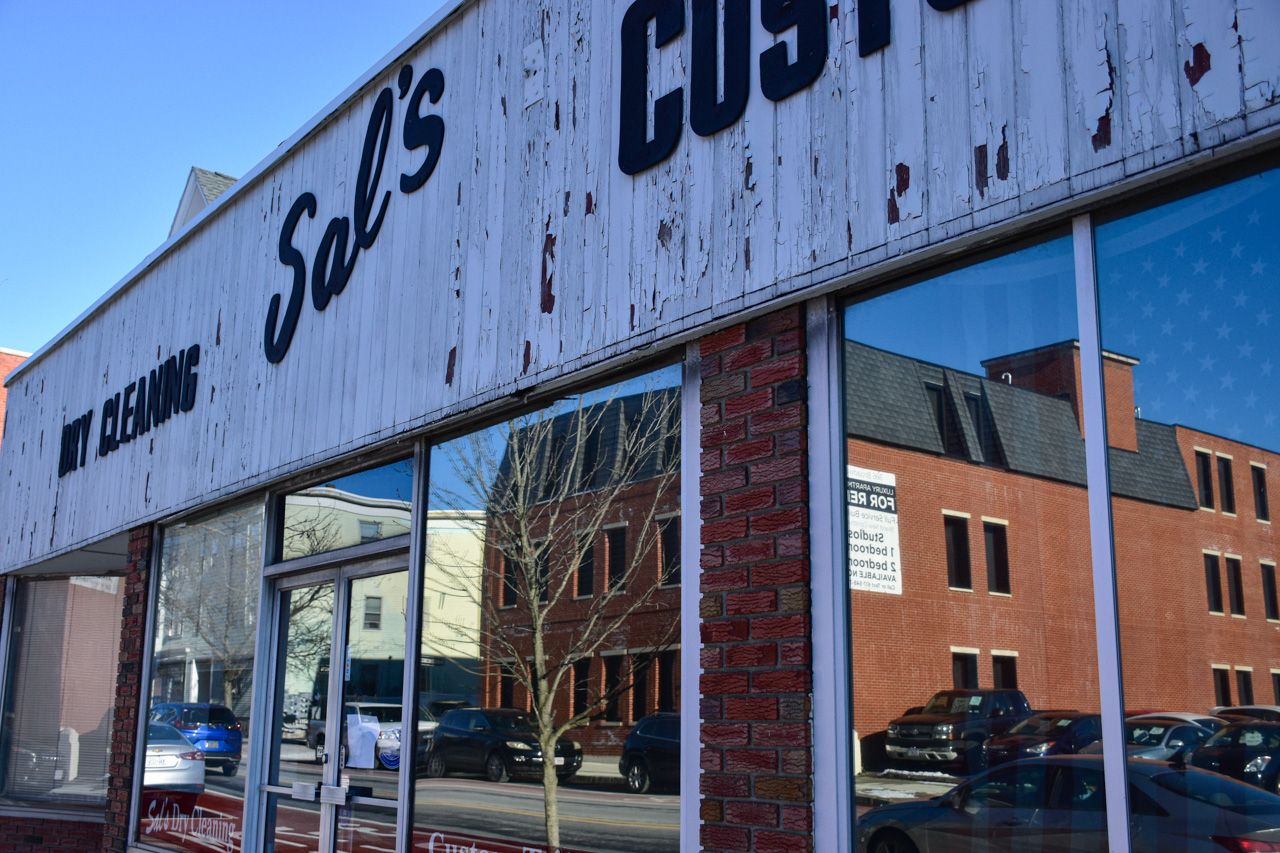
At this point, I turned around and headed back toward Everett Square. There, I spied two great old buildings abutting the previously mentioned Everett Trust Company Building.

Completed in 1896, the Evans Building was built by Alonzo Evans, who served as the city's first mayor and was the president of the Boston Five Cents Savings Bank, per MACRIS. "The Evans Building contained two stores on the ground story and offices above," MACRIS continues. "The third story, known as Arcanum Hall, was used as meeting space by various clubs and civic organizations and for special functions."

Current tentants include a deli, a smoke shop and an insurance agency.

Next door is the imposing and beautiful Arthur H. Whittier Building.

Built in 1900, the Renaissance Revival building was originally occupied by Arthur H. Whittier & Company, a grocery store. Subsequently, F.W. Woolworth opened a store on the first floor. Current tenants include a T-Mobile store, a Brazilian market and the Skyplex function hall.

From there I headed west on Norwood Street. On the side of Angelo's Touch Hairstyling, I found this amusing mural/ad.

Yes, artist Juleen Jones has turned Vito Corleone's threat against a Hollywood big shot in "The Godfather" into a tagline for a hair salon.

Across Norwood Street, I dug the sign for Taco El Paso.

At the intersection of Norwood Street and Broadway is another in a long line of buildings I've documented here with an "X" on it, which indicates to firefighters that the building is not safe to enter in case there's a conflagration.

Built in 1877, this Second Empire brick building holds a few important places in Everett's history. First, per the photo on the MACRIS file, the building once housed a Brigham's Ice Cream restaurant. Second, it was the first masonry block to be erected in Everett Square, according to MACRIS, and "is also the second oldest (sic) building in the square, pre-dated only by the First Congregational Church." I will discuss that church below.

MACRIS continues: "Originally known as the Whittier & Dearborn Building, the block was soon renamed the Library Building. The city's first public library, organized in 1878, was located here until the Parlin Library was constructed in 1894-95. The other tenant and later owner of note was the Odd Fellows Association, organized locally in 1875."

I hope someone can turn this place around, given its illustrious past.

Just north of the previously mentioned Dempsey's is a great little building, the former Everett Savings Bank.

Currently home to Regal Mexican Grill, this Classical Revival gem dates to 1885. Although built as office space, it was converted to use as a bank in 1889. Everett Savings remained in this location until 1930, per MACRIS, when it moved to a newer building that will be featured below. Since that time, a variety of small businesses and retailers have operated here.

A few buildings away is the gorgeous Everett First Congregational Church.

Now home to Igreja Universal, this Italianate stunner dates to 1852 and is oldest surviving structure in Everett Square, according to MACRIS. "The first Everett town meeting was held here on March 21, 1870. The church was incorporated in 1891 and a year later remodeled and rededicated."

The final stop on my downtown Everett tour was the newer Everett Savings Bank building. The sun was tough, so I apologize for the photo.

You can't tell from my photo, but this building is fairly impressive. "This sandstone building, designed in the Spanish Colonial Revival style (infrequently seen on the east coast (sic)) is one of the most distinguished in Everett Square," according to MACRIS. "The exterior walls are decorated with figured panels; multi-pane windows are outlined with rope molding and the arched heads terminate in panels filled with animal and foliate ornament. An arcaded frieze and Moorish cornice finish the major elevations."

Opened in 1930, the building is now home to the Pioneer Charter School...I think.

OK, that's all folks!

Saturday, June 8, 2024

Having a Whale of a Time in New Bedford, Part I

From Dave Brigham:

New Bedford, a former whaling industry powerhouse located on the south coast of Massachusetts, wasn't really on my backside radar - until it was. Don't get me wrong: I was well aware of the city on Buzzards Bay, and figured it would be a cool spot to check out, along with Fall River (stay tuned...). But I knew it would be a long slog from my house outside Boston, so I never considered going there. But then one day, I was on the Cape with my son, realized I had a morning to kill, and well, the rest is history.

I will break down my visit into three installments, divided into relatively equal parts of about two dozen places each, posted in the order in which I visited them. I started my adventure at a great old theater, which I'd found while doing some online research.

The Zeiterion Performing Arts Center was opened by the Zeitz family in April 1923 as the last new theater in the city's downtown. "Designed by Frank Leary and Frank Walker, the two-story tapestry brick building is an adaption of the Georgian Revival style," per the theater's web site. "Inside, décor included marble-columned walls, the Zeitz family 'Z' shield accentuating the proscenium, silk tapestry on the walls, a frieze of gold leaf Grecian dancing muses, a large oval sunset scene on the ceiling, an orchestra rail of solid gum wood, and a $7,000 cut glass Czechoslovakian chandelier. The total project cost more than $12 million in today’s dollars."

The Zeiterion is the only vaudeville theater remaining in the city, according to MACRIS.

The new theater didn't thrive at first, so later during its first year, it reopened as a silent movie house, The State. As time went on the theater showed "talkies" and occasionally featured live performances. In the early 1970s, the owners renovated and updated the theater. By the end of that decade, per MACRIS, the theater had been abandoned and was "in a state of deterioration and disrepair. Paragon Travel, the building owner, planned to demolish the theatre portion of the building to make a parking lot. The Waterfront Historic Area League (W.H.A.Le.) convinced the owners to donate the theatre portion of the building, to W.H.A.Le., under a condominium arrangement, which allowed the travel agency to retain ownership of their space and maintain their operations. W.H.A.Le. began planning for the restoration and operation of this last downtown New Bedford theatre as a full performing arts center."

"Thanks to the dedication of many, the Zeiterion was ultimately restored to its original grandeur," per the theater's web site. "Its original Mighty Wurlitzer Organ was discovered in a private residence, rehabilitated, and returned. Each frieze repaired so the muses could dance around the ceiling once again. The project was a challenge to complete, and some corners were cut, including second-hand seats in three different sizes."

W.H.A.L.e transferred the building's title to the City of New Bedford, and the theater was reopened in 1982. Renovations have continued at various points across the ensuing four decades.

On the corner of School and Purchase streets, behind the Zeiterion, I was entranced by what I dubbed the Peace Building (zoom in to see why).

Looking like something Charles Dickens would write about in a novel, 636 Purchase Street is currently used by the Pilgrim United Church of Christ located across the street. Built in 1883 as a public school (I think), it was used by the Trinitarian Church before the UCC took over the space.

I headed north on Purchase Street, then went west on Spring Street, where I was rewarded almost immediately with a ghost sign.

The sign is for the long-gone A.E. Coffin Press, which was located, oddly enough, in the A.E. Coffin Building. Founded in 1890, the company's "main income was derived from business advertising and calenders," according to MACRIS. "It also had modern linotype presses and bookbinding equipment. It was known all over New England and the Mid Atlantic States for its fine work," MACRIS continues. A.E. Coffin's wife, Carrie, was a direct descendent of Myles and Barbara Standish - he being one of the original signers of the Mayflower Pact, per MACRIS.

Below is the main entrance to the Coffin Building, which dates to 1911. Zoom in to check out the sidewalk detail.

More than a decade ago, this building and others in the area were rehabbed and turned into studios, apartments and retail space as part of a project to create a 24/7 neighborhood.

On South 6th Street, near the intersection with Union Street, I spied a very charming building housing Sixes & Sevens, a "bar and food joint."

"The stone building, as it is presently known, is the only building in the Center District with this particular type of granite facade with its round headed door and windows," according to MACRIS. "John F. Vinal built the structure in 1852 as a stable and woodworking shop. It was later used soley (sic) as a shop."

The building dates to 1852.

Right next door, at the corner of South 6th and Union streets, I was captured by the look of Cottage Antiques, which is located in a circa-1891 building known alternately as the George Emerson Building, the Dartmouth Club and American Legion Post #1.

I shoot a lot signs of all sorts when I'm out and about. Below are two that caught my eye, right across Union Street from each other.

(Downtown Smoke Shop.)

(Minerva Pizza.)

After Minerva Pizza, I continued walking west along Union Street, past numerous beautiful, old homes. I spied a smokestack in the distance and, figuring it marked an old mill, continued walking in that direction. Before long, I realized that the stack didn't signify a factory of any sort, but rather a prison. I wasn't expecting that.

I have stumbled across a few former jails and prisons in my years of wandering the backside, but nothing like the Bristol County House of Correction. The oldest part of this big house dates to 1829. The most recent additions date to 1895. Known today as the Ash Street Jail and Regional Lock-Up, the facility "holds over 200 prisoners who are awaiting trial," according to the Bristol County Sheriff's Office web site. "Approximately a dozen sentenced inmate workers are also housed at the facility."

Directly across Court Street from the prison is Union Baptist Church.

Built in 1899, the Shingle Style church is located in a neighborhood once known as New Guinea, an area populated by African-Americans in the 19th century. "The Union Baptist Church was organized on April 18, 1895 as a result of the union between members from the Second Baptist Church and the Salem Baptist Church," according to MACRIS, naming two primarily (or perhaps exclusively) African-American congregations.

Just up the street, at the corner of Cottage and Court streets, is one example of the many great old houses in New Bedford.

Built in 1856, this three-family home is located in the County Street Historic District. From MACRIS: "The residential area reflects the historical and architectural growth of New Bedford from the years 1780-1890. The oldest homes remaining in this area were the residences of the city's wealthy men from 1780-1820."

Next, I headed north on County Street, where I saw a somewhat dilapidated church.

The church dates to 1858, according to the City of New Bedford Department of Planning, Housing & Community Development, and was known most recently as the Centre Trinity United Methodist Church. A brick exterior was added in 1924 covering the original facade.

The church sold the building in August 2018 to Southcoast Grecian Marketplace. That organization applied for rezoning from residential to business, and indicated potential uses included a performing arts/convention/events center, offices and/or apartments. I'm not sure of the status of any of those proposals.

A little north on County Street is the Bethel African Methodist Episcopal (AME) Church.

Built in 1915 as the First Christian Science Church of New Bedford, this building is the only stucco-covered, Romanesque church in the city, according to MACRIS. I'm not surprised by that, because I can't say I've ever seen a church anywhere that looks like this one. Bethel AME took over the church in the 1970s. The congregation traces its roots in New Bedford to 1822.

Continuing in a religious vein, I scooted west down North Street to make a photo of the former Holy Family School.

Not a great photo, but I wanted to chronicle the fact that this circa-1914 Catholic high school has been redeveloped into apartments.

At the corner of County and Hillman streets, I was enchanted by the small commercial building housing a florist shop, Bloomtopia.

This place dates to 1930. Nearby is a less-than-enchanting former civil defense building.

Constructed in 1892 as a fire station, this place was decommissioned and became a civil defense center in the 1950s, according to this November 2019 SouthCoast Today article. At the time that article was published, the building was in pretty rough shape -- "rotting wood, holes in the roof, drooping ceilings, and a mismatched array of vintage furniture and dusty arcade games with an unknown history," per the article -- and it doesn't look like much has changed, except perhaps for the worse.

The aforementioned W.H.A.Le purchased the building and plans to renovate it. I'm not sure of the status of that project.

OK, back to enchanting.

Dillon's Restaurant has been in business for more than 30 years, in a building that dates to 1920.

Below are two more great old homes. Located along County Street they are situated in what's known as the North Bedford Historic District.

At the intersection of County and Smith streets is a fantastic mixed residential-commercial building.

This big blue building looks well taken care of. It dates to 1896.

Across County Street is Mark's Beverage, which didn't appear to me to be open.

The building dates to 1920. I don't know anything about the store.

(Rear of Mark's Beverage.)

Heading east on Sycamore Street, I came across the New Bedford Army National Guard Armory, at the corner with Pleasant Street.

"The New Bedford Armory was constructed in 1904 to serve as a training, meeting, administrative and equipment storage and maintenance facility for the Massachusetts Army National Guard," according to MACRIS. "The New Bedford Armory is...typical of the medieval-influenced armory architecture first developed in the 1880s, which was also prevalent in armories constructed in New York, Rhode Island, Connecticut and other states."

At the corner of Willis and Pleasant streets I made a photo of yet another great house.

Just steps away on Willis Street is a simple old building with a cool history.

Built in 1850, the building served as a watch house for the New Bedford Police Department, according to a plaque on the facade. I believe the building functioned as a neighborhood station. Perhaps prisoners were kept here on a short-term basis.

This place is currently home to Dr. C.E. Burt Chapter 7 of the Disabled American Veterans.

At the eastern end of Willis Street, I began heading south on Purchase Street. I was tempted to make my way to the waterfront (along the Acushnet River), but decided to save that for a future visit. The first place I saw was the former Glaser Auto Glass complex.

The family-run glass operation was founded in 1921; the company merged with JN Phillips Auto Glass in 2019. The building dates to 1949, and is (or will be) the home of New Bedford Research & Robotics, a non-profit organization that hosts entrepreneurs, businesses, students, researchers, creatives and community members, per its web site.

The final stop for this installment is the former New Bedford Textile School.

The school was established on August 1, 1895, according to MACRIS. The first building was constructed starting in 1898, and the first classes began in October the following year. "During 1918 New Bedford Textile became a state institution by an act amending the State Constitution, and became financially supported by the City of New Bedford and the State of Massachusetts," MACRIS continues. "In 1947 the name of the school was changed to the New Bedford Textile Institute.

"From the 1950's to the 1970's the school went through many changes. In 1953 the school purchased property located on the east side of Purchase Street, directly across from the existing facilities. The purchase came about due to the rapid increase in the student enrollment year after year. Later in the fifties the name of the school was once again changed to Southeastern Massachusetts Technological Institute (SMTI). The name change came about with the combining of Fall River Textile School with New Bedford Textile Institute."

The old school is owned by the City of New Bedford, which operates the Quest Center. The center provides "entrepreneurial training and a supportive environment for startup activity," per its web site.

Make sure to check back next week for part two of this three-part series, in which I will feature a landlocked lighthouse, two funky little art galleries, ghost signs, murals and much more.

Committing Myself to the City of Sin

From Dave Brigham: Lynn, Lynn the city of sin You never come out, the way you came in You ask for water, but they give you gin The gir...