Showing posts with label stained glass. Show all posts

Saturday, September 11, 2021

Stafford Springs, Part II: Other Than the Mills

From Dave Brigham:

I decided to explore Stafford Springs, Conn., because it's a mill town (see August 27, 2021, "Stafford Springs, Part I: The Mills"). I love shooting photos of old factories and mills, as I think is evident if you've spent more than two minutes reading this blog. But I also love the homes, municipal buildings, commercial architecture and churches that were built around these manufacturing facilities during their heydays. So in this post, I will look at those types of buildings in this village that serves as the downtown for the town of Stafford.

The first place that caught my eye -- and did so like no other commercial building in town -- was Full Sail Tattoo on East Main Street.

Established in 1994, the inking business appears to have run dry, unfortunately. This beautiful painted lady (not in the traditional sense of a Victorian home, but still...) dates to, well, I'm not sure. I found the year 1900 online, but I don't believe it. I'm guessing this place was erected at least 10 years prior.

Steps away is the Paradiso Building, which dates to 1930.

The building is home to Paradiso Insurance. It is located across from the American Woolen mill complex, so I'm guessing there may have been related offices here, or retail outfits, back in the day.

Just up Furnace Avenue is what I believe is the former home of the Stafford Springs Press newspaper.

The newspaper was in operation from 1883 to 1935. This building appears to be a private home, or apartments.

Next door to the old Press office is a little building that rivals the tattoo shop for ornate beauty.

Home to Orchardworks, a hand-carved magic wand maker (!), this gem dates to 1900 allegedly, but again, I believe it's older. The shop is run by what I assume is a husband-and-wife team. "Ed is an aerospace engineer by day, moonlighting in the workshop handling wand design, custom shaping work, and overseeing all of the woods and tools that we use. Janet works full time shaping, finishing, & delivering our wands to delighted customers all over the world," per the web site.

How enchanting!

Heading south on River Road, I spied Hyde Autoworks, located in what appears to be a nicely restored building.

The company, which specializes in "wild custom hot rod restorations," per its web site, has been in business since 1996. I like that they kept a few old automotive signs (photo below) on the outside of the building, which dates to 1930.

Doubling back toward the main drag, I walked past Shamrock Laundry, which is unfortunately out of business.

Then I looked west, up Highland Terrace, and saw the gorgeous church pictured below.

Grace Episcopal Church dates to 1876. I love the red clapboard, the bell tower, the fact that this house of worship is built into the hill. And right next to the church is an equally fantastic building.

The Stafford Historical Society building dates to 1885. It was built as the town library, and has also servede as a judge's office, office for a woolen company and the bottling house of the Stafford Mineral Waters Company, according to this post from the CTMQ blog.

Behind the historical society building is a mineral spring house, a remnant of a once wildly popular business offering allegedly curative waters, and the inspiration for the village's name.

The mineral spring -- thought by some to have therapeutic value due to the existence of minerals or other dissolved substances -- was discovered by the Nipmuck tribe that preceded European colonists. Among the colonists who availed themselves of the spring water was John Adams, who later in life, of course, went on to become the second president of the United States.

Naturally, businesses grew up around the spring. "In 1767 a direct stage route was established from Boston to Stafford Springs to capitalize on this budding resort’s popularity and make it more easily accessible," according to this Connecticut Explored article. "Through the early 1800s, visitors to the springs would stay at small hotels such as Child’s, Colburn’s, and the Green. In 1802, Dr. Samuel Willard bought the property and built the Stafford Springs House to accommodate patrons of the miracle water. His clientele grew as the springs’ reputation continued to spread, enabling Willard to expand the hotel."

The whole affair began to go downhill as the Saratoga Springs area in New York began to grow in the late 19th century. I'm not sure when Stafford Springs mineral water dried up as a business venture.

Moving on....

Beyond the mineral house is Hyde Park, where I saw the impressive memorial below.

The Warren Soldiers Monument was dedicated in 1924, and honors those who, like the sculpture's donor, Col. Charles Warren, fought in the U.S. Civil War. Warren was born and died in Stafford. He "had a distinguished military career that extended for the entire four years of," the Civil War, according to this web site. "He enlisted as a private in October 1861, soon became a sergeant, and rose through the ranks of commissioned officers as he served in a continuous series of campaigns. He led his regiment into Richmond in April 1865. After the war, Warren opened a general store in Stafford...and engaged in other successful business activities. He was president of the Stafford Savings Bank, built the Warren Block downtown, and gave to the town Warren Memorial Hall, which was dedicated January 31, 1924."

The sculptor was Frederick Ruckstull, who created many similar monuments around the country, including some Confederate memorials, according to Wikipedia.

At the intersection of River Road and Main Street sits the former Stafford Springs train station.

Built by the Central Vermont Railroad, the depot is currently home to the town's police department. I've been unable to find out what year this station was built. Trains are still active through the village, as the New England Central Railroad runs freight through here between East Alburgh, VT, and New London, CT.

Next to the train station, in a building that also features an ice cream shop, is Hairy Karry's Barber Shop.

Originally I thought this place was called "Hairy Harry's," which I liked. But I dig the actual name even more. I have a thing for funny/clever barbershop and salon names.

Across Main Street is the neat little green building housing Makuch & Company, CPA, and Willington Financial, two related businesses.

I believe this building dates to 1930.

There are so many neat old buildings in Stafford Springs, many of them nicely restored. I didn't shoot everything on Main Street, but just about. I'll run down the north side first and then the south. First up after the financial building (after a few that I found unworthy) is the building housing Rustology Antiques and Oddities.

This place looks great, sort of a Nutmeg State version of the American Pickers shop in Le Claire, Iowa. This place dates to 1908. Below is a peek through the front window.

Next door is the home of Ocean Asian Restaurant.

The CRCOG Tax Parcel web site indicates this building dates to 1900. The siding makes it look newer, but also not as attractive as the Rustology building.

Heading west, I came to a site unlike any I've seen in the several old mill towns I've explored over the years.

Located in what's called the Main Street Fruit Tree Trail, which is maintained by the Stafford Garden Club, this art-filled park sits in the remnants of buildings that collapsed some years ago, according to a friend who lives in town. The park contains several shrubs, trees and plants that produce edible fruits, berries and herbs. The public is encouraged to help themselves to a small sampling.

As for the murals, I've been unable to find out who painted them. There are several, and they are all bursting with color and life and imagination. Also located in the park is a bench dedicated to "Mamma" Teresa Andreoli (1926-2019), who lived in Stafford. "Main Street was her life," the inscription says. There is also a picture of the Arizona Restaurant, which I assume Mamma owned.

Continuing west, we come to a nice stretch of old commercial buildings. A plaque at the roofline of the building below says "1936."

This place is home to Smoker's Emporium. Look closely at the top of the building, and you'll see a peaked roof. The brick of the storefront is an add-on to a modest apartment house that is obviously older.

Next door is the Palace Theater, which dates to 1900.

The theater hosts concerts (James Montgomery Blues Band, Riders On the Storm [Doors Tribute]) and other events (fundraisers, weddings). It was founded as vaudeville theater, and began featuring movies by 1941, per Cinema Treasures. This place closed in 1960, but reopened at some point as a bar. I'm not sure how long it's been a live-music venue.
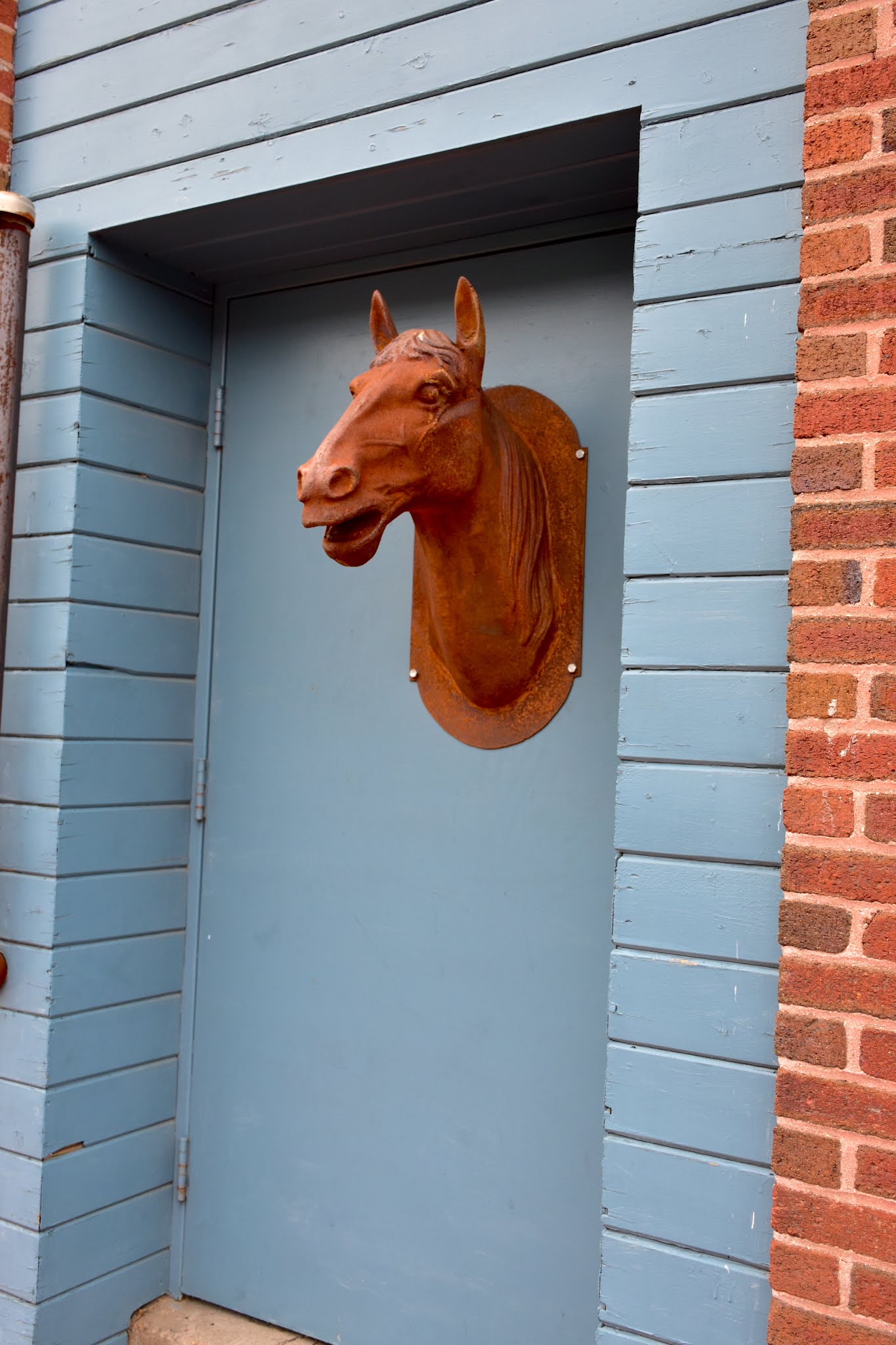
(One of two horse heads flanking the front door of the theater. I'd love to know the story behind them.)

Next up is the Arizona building, which dates to 1922.
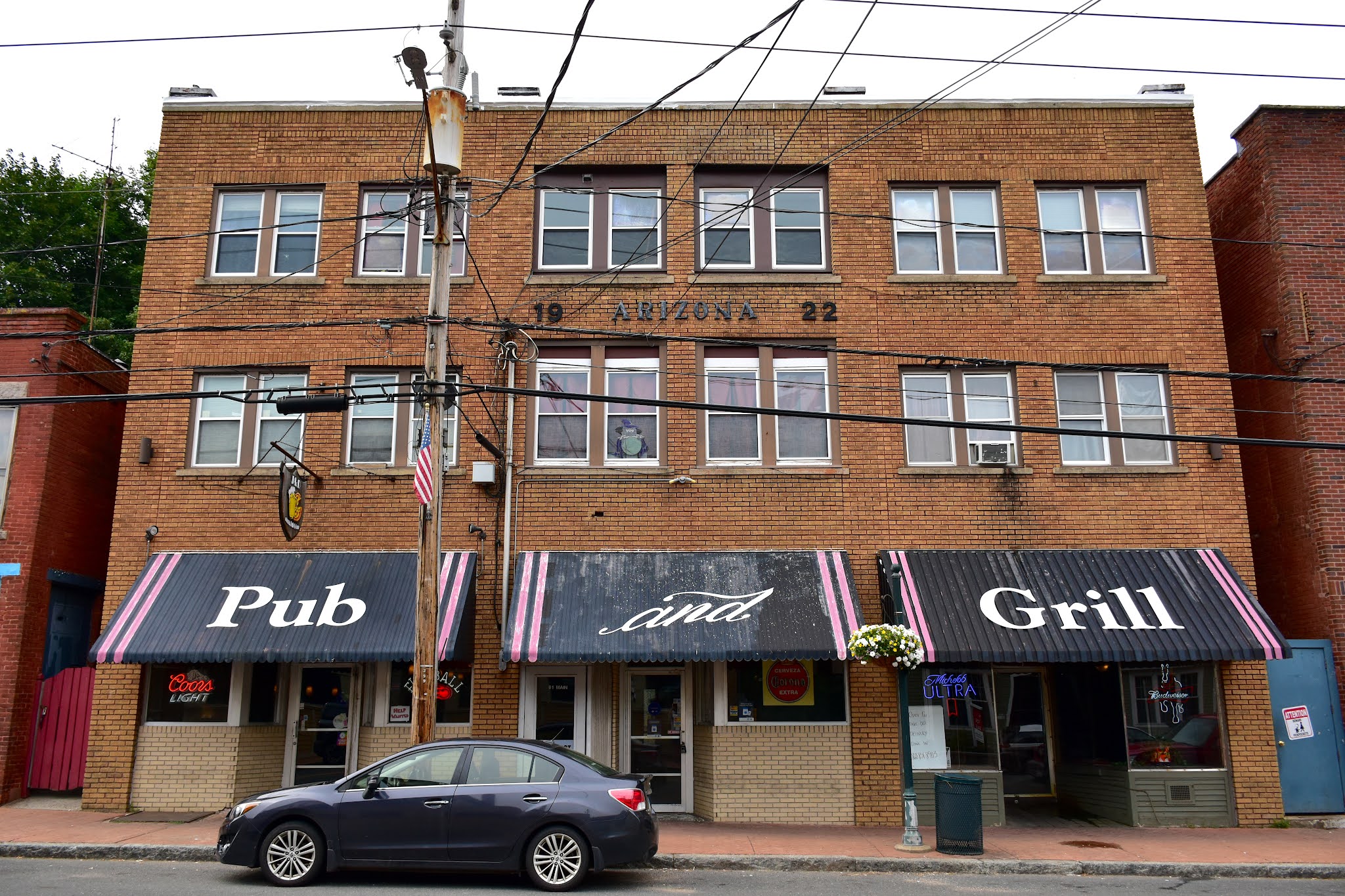
Now home to J&D Pizza, Pub & Grill, this building was once the home of the aforementioned Arizona Restaurant. To get a sense of that eatery, scroll down on this link.

The next building is small, but I love the cut of its jib.

Most recently (I think) the home of the Stafford Seamstress, this place is known as the L.H. Carvais Building. It dates to 1900. I couldn't find out anything about the Carvais clan.

The next place dates to 1933, and is home to the wonderfully named Blazing Saddles consignment shop and Laura Claman Equine Solutions.

Next door is an empty storefront...I think. I believe it was (or possibly is) home to Mocko's Propane Gas Service. The building dates to 1928.

Across Main Street, in what appears to be a long, narrow storage building (possibly formerly used by an appliance company), is a series of super-cool town-themed murals.

The one above shows, on the left, Hyde Park, location of the Civil War Monument mentioned previously, and Stafford Fairgrounds, also known as Stafford Springs Agricultural Park, where there was horse racing up until the end of World War II. This area is now known as the Stafford Motor Speedway. In my final Stafford Springs installment, I will write about the race track.

The mural above shows, on the left, the Baker Furniture Co. factory, as well as a streetcar; on the right people are shown fetching water from the aforementioned mineral spring. The furniture company was established in 1807, and closed in 2015.

Continuing east, on the south side of Main Street, I saw the obviously rejiggered building below.

Home to a Farmers Insurance agent, this building dates to 1900 (allegedly) and is owned by American Sleeve Bearing, an industrial company located on the other side of the train tracks from Main Street.

Next door to that odd building is the Bidorini Building, which dates to 1915 (here's why I always doubt the year "1900" when I see it in assessor's databases...this place is listed as being built in that year, but the building iteself says "1915" on it)

I'm assuming this was the former home of Bidorini Bakery & Grocery, references to which I found online. Currently occupying the space is the Stafford Cidery, home of Crazy Cock Cider. Cock-a-doodle-do!!

Next door at 58-64 Main Street is a pair of buildings also allegedly built in 1900.

To the right is #64; I'm not sure what's in that building. Like the Farmers Insurance building mentioned above, this place is owned by American Sleeve Bearing. On the left is #58, home to ESP Pottery. The store/gallery offers lessons. I dig the funky threshold, below.

The last building on this block is home to the Stafford Coffee Company and the Stafford Academy of Dance.

This place also dates to -- you guessed it -- 1900. Allegedly.

To wrap up this post, below are some photos taken of the backside of the last few buildings I wrote about. These shots were taken from a driveway leading to American Sleeve Bearing, looking across the railroad tracks.

That sign says, "FLAG OILER DO NOT SAND." A flag stop (or request stop or whistle stop) is a station at which trains will only stop if there are passengers or freight to pick up. I don't know anything about oiling or sanding flags that mark these stations.

This is the backside of the pottery store

I just love that little tableau above.

I'm a sucker for graffiti. As I mentioned above, I shot these on property owned by American Sleeve Bearing, a company that will come into play again for the final Stafford Springs post, coming soon.

Tuesday, June 30, 2020

Chinatown Redux

From Dave Brigham:

As I was taking photos in Chinatown in February 2019, I knew that I would need to return, as there was just too much to capture in one afternoon. I researched and then wrote about that adventure last year (see July 31, 2019, "Won't You Take Me to...Chinatown?"). In October of last year, I made a second trip through this fascinating Boston neighborhood.

My usual method of writing posts is to present things in logical order by themes (i.e., ghost signs followed by cool architectural details followed by plaques, etc.). Today I want to showcase backside elements in the order that I came across them on my walk.

In the July 2019 post, I covered the heart of Chinatown, from Kneeland Street to John Fitzgerald Surface Road, Essex Street to Washington Street and a lot in between. For my most recent jaunt, I decided to hit the fringes a bit.

The first thing that caught my eye was 18 Pine Street, above, in the southwest quadrant of the neighborhood. Not far from the Mass. Pike and Harrison Avenue, this small street was the original location for the Pine Street Inn, the largest homeless services provider in New England. I have no idea what this sign says, or whether it's for a current business or one that's long gone. I believe this property is mostly, or perhaps all, apartments.

Right down the street, I spotted a different type of ghost sign than I usually see, one that made me feel like I was in an "Our Gang" short film.

"You can't post no bills here, see?" I can imagine some grizzled, middle-aged guy with a scally cap saying to a group of young toughs. "I catch you postin' bills here, I'll show you the back of my hand!"

"POST NO BILLS" signs are still used by building landlords to let people know they can't slap up posters, but this one, located on an out-of-the-way side street seems like its heyday has gone by.

Across from the tiny ghost sign, at the corner of Pine Street and Harrison Avenue, is the Boston Chinese Evangelical Church.

The congregation was founded in 1961; this building dates to 1979.

Heading north on Harrison Ave., I walked past a handful of produce vendors.

City Produce (not pictured, as it's not much to look at), Lun Fat Produce (foreground) and New England Food Supply (middle of the photo) are small operations that, I'm guessing, supply restaurants in Chinatown. Beyond New England Food Supply is May's Cake House (yellow awning) and a place called Top Ten, which I believe is a convenience store.

Next I scooted down Johnny Court, which is about a hundred yards from end to end, and saw this sign for Leung Association, which I think is a realty agency, and something called N.E.U.S.A.

All of the townhouses on this little street date to 1915, per this Bay State Banner article about gentrification on Johnny Court, and Chinatown in general.

My next stop was along Tyler Street, still in the southwest part of the neighborhood. I love all the rinky-dink (I mean this in a good way) stores and businesses in Chinatown, such as Chinamerica Food Manufacture, Inc.

Located between Long Wave Hair Salon and the New England Chang Sheng Association, Chinamerica has been in business since 1993. Just up the street on the other side is the Chinese Consolidated Benevolent Association of New England, outside of which I just had to snap a picture of the famous philosopher, Confucius.

Established in 1923, the CCBA of New England serves as an umbrella organization for roughly three dozen family associations and community organizations, per its web site. The group's building is the former Quincy Elementary School.

Over on Hudson Street, which is along the eastern border of Chinatown, next to an on-ramp for the Mass. Pike, I took a picture that captures the biggest issue in Chinatown: the potential of the new to overwhelm the old.

I took this photo from a nice slice of green space that sits between two relatively new buildings, 88 Hudson and One Greenway. The buildings in the foreground date, like many in Chinatown, to the late 19th/early 20th century. They are human-scaled, with TV antennas and interesting juxtapositions of doors, windows and rooflines. Looming in the background is Tufts University's Friedman School of Nutrition Science, which is one of many shiny new toys replacing historic structures and forcing lower-income, long-time residents out of their homes.

For those who are able to remain in the neighborhood, the Soo Yuen Benevolent Association of New England on Harvard Street, below, surely offers needed services.

From this quiet area, I cut up Tyler Street and out to the very busy Kneeland Street. There I found Ming Kee Live Poultry.

If you're able, I suggest enlarging this photo and looking at the window above the air conditioner. Should I offer you a clue, so you'll figure it out? Maybe I just did.

From this spot I wandered along Tyler Street to Beach Street -- the heart of Chinatown, much of which I'd shot on my previous trip -- heading toward the Chinatown Gate. Why didn't I shoot this landmark? Good question. Seemed too obvious a target, I guess. Walking across the plaza near the gate, I saw a fake "Wanted" poster on a shuttered former restaurant.

Dynasty Restaurant, which specialized in dim sum, opened here in the late 1980s or perhaps 1990. I'm not sure when it closed, as I couldn't find much about it on the Internet. Previous tenants in this building, which dates to 1914, include wholesale dry goods company Sparrow-Chisholm, diaper manufacturer Pinfree Manufacturing and the Pacific Kimono Company.

Steps away I shot the back of 129-131 Kingston Street, below, which dates to 1889 and was occupied over the first several decades of its life by curtain, dry goods and decorative novelty companies, among others. It is now home to architecture/design firm DumontJanks and a branch of German architecture firm Behnisch Architekten.

I got a bit artsy when shooting the buildings across the street from the "MORF" graffiti.

The yellow vertical sign in the middle is for Moon Villa, although the horizontal sign says "New Moon Villa." The restaurant has been in business since 1991.

Built in 1912, 17-19 Edinboro Street, like many other buildings in this area, was occupied for many decades by companies in the textile, shoe and and dry goods businesses, including those manufacturing and dealing in underwear, bathrobes and sportswear. Also, Ho Toy Noodle Company.

Next door is Wah Lum Kung-Fu Athletic Association, below.

On the front of the "MORF" building I found this little history lesson about industrial sprinklers.

I wasn't paying enough attention to why this little display is here. I think there were others of this type along the entire building.

Around the corner, on Essex Street, I spied this cool door detail.

This entryway is between the former Chau Chow City Dim Sum Restaurant and a one-time market, both of which I wrote about in my previous Chinatown post. Built in 1907 for a men's furnishing company, the Simons Hatch and Witten Co., the building has popped up in redevelopment discussions, but nothing seems to be solid at this point.

Around the corner on Chauncy Street once stood Winmil Fabrics.

The full-service fabric store closed in 2016 after 47 years in business. Built in 1902, this property is known as the Frost Brothers Building, after a pair of siblings who were real estate developers. Tenants over the years included Wachusett Shirt Co. and Bowditch & Clapp millinery goods. All of this information on these buildings comes, of course, from my good friend MACRIS.

One street over, on Harrison Avenue Extension, I spied this cool detail on the back of the massive Washington Essex Building.

Down Essex Street, between Hong Lok House and Dunkin' Donuts, is this former entrance to the Chinatown subway.

On Harrison Avenue is the fantastic mural below, which is a tribute to See Sun Market, which is closed but was open recently enough that it still shows up on Google Maps street view.

Across the street was this fantastic pop-up park.

A little ways down Harrison Avenue, heading toward Kneeland Street, is this bold advertisement for Connecticut's Mohegan Sun Casino.

Located on the side of the Bao Bao Bakery building, the ad has been there for years, I believe. Or at least some variation of Mohegan Sun advertising has.

Accessible via the parking lot next to the bakery is the amazing mural below.

Located on the side of the China Gourmet restaurant on Tyler Street, "Tale of an Ancient Vase" was painted by Bryan Beyung, an artist based in Montreal whose work has been displayed in Vietnam, Haiti, Canada and Cambodia, per this Sampan article. Beyung's assistant, Amanda Hill, lives in Boston. I just love this work. I hope it stays there for years to come.

Turning around in the parking lot, I spied yet another work of art.

Painted on the side of the nondescript Trans-Pacific Travel building, behind used cars for sale, is a work featuring, as best I can tell, a dancing samurai with a GIGANTIC hand beckoning a parade dragon that is being steered by two purple beings, while one person mopes in a window and another seems to hide and a girl walks on stilts. An homage to a local celebration, perhaps?

Turning away from the Trans-Pacific Travel building, I was stunned and pleasantly surprised by the Winsor Dim Sum Cafe.

Built in 1928, the building at 10 Tyler Street "is the most elaborate example of traditional Chinese urban architecture in Boston and a landmark of mid-20th-century Chinatown development," per MACRIS. "The cast-stone and stucco facade follows traditional Chinese motifs developed in San Francisco Chinatown with a second-story celestial balcony capped by a curved tiled roof and an upper recessed loggia with Foo-Dog pole brackets and projecting tile cornice," says MACRIS. "The third-story facade is centered by a scalloped window in Neo-Spanish Style, perhaps adopted by architect [Ralph Harrington] Doane from his experience in the Philippines before the First World War." The building replaced a circa-1840 row house. There are probably other buildings in Chinatown that reflect traditional architecture from China, but I'm happy I spotted the one considered one of the best.

Two doors down is the Chinese Masonic Lodge.

Built in 1840, 4-6 Tyler Street were likely first inhabited by Irish immigrants, per MACRIS. In 1876, St. Paul's Episcopal Mission acquired the property and ran it until 1892. In 1915, the Chinese Free Masons acquired the building. One of the many reasons I love wandering aimlessly through Boston and its surrounding towns is to learn about things like the existence of Chinese Masons.

At the corner of Tyler and Beach streets, on the side of the Gourmet China House restaurant, is a plaque that takes one out of Chinatown and back into the darkest times in America, before delivering hope and wonder at the "Screw you!" that the universe sometimes delivers to evildoers.

"In 1761 at Griffin's Wharf, near this site, John Wheatley purchased eight year old African-American Phillis Wheatley (c. 1753-1784) to serve as a domestic slave," this plaque reads. "Only twelve years later, in 1773, Phillis Wheatley would become the first published African-American woman with her acclaimed book, Poems on Various Subjects, Religious and Moral." The marker is part of the Boston Women's Heritage Trail.

Back out on Kneeland Street, at the corner of Knapp Street, I just loved the mix of colors, textures, ages and sensibilities with these buildings, below.

The yellow building at the lower right is Boom Crispy Chicken. Across from that you have about the ugliest Dunkin' franchise you'll see. The Empire Garden sign above the "we're not just donuts anymore" shop advertises one of the most well-known eateries in Chinatown, which I'll get to in just a minute. I love the front facade of that building, as well as the rough-looking side profile. And the old brick building behind it has mystery about it. Those buildings both have textiles in their blood, I'm guessing. And then you have some newfangled tower looming over it all. That's Boston.

Across the way, along the alleyway known as Harvard Street, I shot the stained glass windows on the backside of Saint James the Greater. Built in 1873 for the Boston Catholic Archdiocese, the church began offering Masses in Chinese in the 1960s. The house of worship is now the primary parish for the neighborhood.

The first window I saw had a screen on it, which I suppose offers some protection for the glass, but it's not like the monsignor cranks these windows open to let in the cool breeze in the summertime.

Anyway, the other window I shot had no screen, and God what a world of difference in how good it looks.

The final stop on my second trek through Chinatown was the mammoth and extremely popular Empire Garden on Washington Street, a restaurant with quite a history, one that I wrote about almost two years ago. I'll recap and provide a link to that post, below the photo.

Built in 1903 as the Globe Theatre, the building was known over the years as the Center Theatre, EM Loews, The Pagoda and the Loews Globe Theatre. In its later years it was a burlesque and grindhouse theater, according to various online sources. The restaurant opened in 1995; check out this web site for photos of the fantastic dining room.

I wrote about the backside of this property, natch, back in May 2018 (see "Backside of the Globe"). The rear faces the above-mentioned Knapp Street, and is home to the Jia Ho grocery store. That business is located in the theater's former orchestra pit, while Empire Garden was the mezzanine.

Committing Myself to the City of Sin

From Dave Brigham: Lynn, Lynn the city of sin You never come out, the way you came in You ask for water, but they give you gin The gir...