Often times when I post photos on Instagram that are also featured on this blog, people will ask me how was the food at the diner, or did I down a cold one at a dive bar, etc. Almost always I reply, "I didn't go inside." And that was the case with all of the buildings in today's latest Worcester post - save one. And I didn't check it out on the day I was exploring, but shortly after.
I made a long list of Worcester destinations some time ago (see the bottom of this post for links to the previous eight installments in this ongoing series). I flagged the area just east of Salisbury Pond, just west of Interstate 290 and a bit northeast of Worcester Polytechnic Institute for one reason...which I'll get to shortly.
"The building was originally constructed as a three-story cotton mill in 1863 by the Washburn & Moen Manufacturing Company, which grew to become the world’s leading manufacturer of barbed wire and other wire products during the second half of the 19th century," according to MACRIS. "A fourth story was added to the building between 1888 and 1892."
Founded in 1831, the company manufactured barbed wire, telegraph wire, piano wire, crinoline wire (for hoop skirts!), wire nails and other products. The company became part of U.S. Steel in the early 20th century.
Several businesses occupy the massive space today, including Safeway Luxury Transportation, Medi Tresse Worcester, some law offices, The Fix Burger Bar and Fuel America coffee house.
I hope that sign lights up real purty at night time. If you walked or drove by that sign at the northern edge of the Washburn & Moen complex, you might take a quick look around and think, "Huh, cool sign. Too bad the diner's not around anymore." But you, thankfully, would be very wrong.
Walk east through the parking lot next to Safeway Luxury Transportation and the wonderful truth becomes more evident.
When I saw this compound on Google Street View many moons ago, I flipped out. Old signs, a diner, a big space built behind the diner - located in an industrial back parking lot. "What the hell is this place?" I wondered.
Ralph's Rock Diner is a singular food and entertainment destination, with a long history of feeding people's stomachs and souls. As you can see, this legendary joint started life as Chadwick Square Diner, and, according to MACRIS, may be the city's oldest existing diner. The Worcester Lunch Car Company built it in 1930; its production number is 660.
The eatery was originally located about a mile north on Grove Street. "During the 1960's and 1970's, the Chadwick Square Diner was operated by Ralph Dryden at another location, 1475 Main Street," according to MACRIS. "The diner returned to Grove Street, not far from its original site, in the late 1970's."
There is a medium-sized brick building extension of the diner, which I assume by the industrial look of it, is a former cotton mill structure. Ralph's web site says it has a "full bar and original lunch car vibes," so I assume the diner retains at least some of its 1930s charm. I also assume the diner was moved to this location with the precise idea of turning it into what it has become.
I made these photos on May 3 of this year, on my way back from a trip to Connecticut. As I was editing the photos from this jaunt, I looked up Ralph's Rock Diner online to see what it's all about. Checking the club's event calendar, I saw that on Friday, May 16, an artist named Arto Vaun was playing the club. I've been a fan of his for years, since seeing one of his bands play at a friend's party many years ago, so I decided I had to go.
I rallied my buddy who had hosted Vaun's band in the late '90s, and we drove out to Worcester on May 16. We didn't go into the diner, but instead straight to the bar at the back of the first floor. The place has a real roadhouse vibe, with pool tables, dim lighting, tattooed rockers hanging out, vintage movies playing on TVs above the bar.
My buddy Lee and I thoroughly enjoyed the wacky horror flick on the telly. I asked the bartender what is was.
"'Howling III,'" he replied. "The full title is 'Howling III: The Marsupials.'"
The three of us cracked up.
After one drink ('Gansett for me, inspired by the big sign on the exterior wall), we paid the cover charge and headed upstairs to the bar. I thought there were supposed to be four bands on the bill, and that Arto Vaun was playing second or third. But within about 15 minutes, he and his crew took to the stage and away we went.
(Arto Vaun, center, and his band.)
They sounded great, ripping through several new songs I didn't fully know, and many older ones that I did. The crowd at that point was pretty small -- a handful of older guys like Lee and me, and, I was happy to see, some younger, gothier folks. After the set, Lee called out to Arto, who was flabbergasted. "I saw you from the stage," he exclaimed. "And I said, 'Is that Lee?'"
The three of us chatted for a few minutes. Arto is a really nice guy in addition to being a talented singer, songwriter and guitarist.
Here's a taste of his music:
The interior of the bar, both upstairs and down, is a feast for the eyes.
I hope to get back to Ralph's, as it's a great venue. Maybe next time I'll try the food!
From Ralph's, I headed east to Prescott Street, and then north. I walked past several industrial properties. The first one that caught my eye was an older one-story brick buildling occupied by Harpers Payroll Services.
There's nothing particularly interesting about the building or the company. I just kinda liked the sign. The building dates to 1960, per the Worcester assessor.
The next building is a lot more, uh, interesting.
What I've dubbed the Silver Apple Building was built in 2005, according to the assessor's database. I'm not sure I believe that. Sometime between October 2017 and September 2019, per Google Street View, the building was renovated, going from a warehouse-style that looked like a barn and a house simultaneously, to its current incarnation, which gives one an industrial, space-age apple farm vibe.
It is occupied by an outfit called Workplace Resource, which, among other things, conducts office space planning and work station design and budgeting, per its web site.
Finally, a named building in a gritty part of the city, with a history tied to farming.
Located at 100 Prescott Street, this building, currently known as the Washburn Building, rose in 1874 and was leased at that point to the Ames Plow Company. The owner was Stephen Salisbury III, hence the "SS" carved into the plaque in the photo above. "The Ames Company continued manufacturing plows on Prescott Street until 1911 when this branch of the company was moved to South Pramingham, Mass.," according to MACRIS.
This is the fourth short post about my trip to New York City in October (the first one is here; the second one is here; the third one is here). You can't throw a rock in the Big Apple without hitting a famous restaurant, park, store, art gallery, person, movie setting or nightclub. As I was walking through the Bowery in Lower Manhattan, I stumbled across an example of the latter.
The Bowery Ballroom opened on Delancey Street in 1998, in a building that's nearly 100 years old. It is considered one of the best music clubs in the country, per Wikipedia. As with Webster Hall that was featured in my second NYC post, I'd heard of this place but haven't been there.
I became more interested in this well-known spot after looking up and seeing "TREE-MARK SHOES" chiseled into the facade.
Wikipedia says this store never opened, because its planned debut came just before the Wall Street crash of 1929. "It stood vacant until the end of World War II, when it housed a series of shops." Ephemeral New York, however, says Tree-Mark moved in after the big war and was there for the next 30 years.
Whatever.
When I think of the Bowery, which over decades of decline became shorthand for down-and-out, I think of the Bowery Boys, probably thanks to my Dad mentioning the fictional New York City characters from a series of movies made from 1946 to 1958. The Boys were successors to the East Side Kids, who were an imitation of the Dead End Kids.
Near the end of August I drove to New York City with my daughter and one of her friends. They wanted to check out New York University during the day, and go to a concert at night. While they did a self-guided audio tour of the NYU campus near Washington Square Park, I tagged along with my camera. After the tour, we got lunch and then walked around a bit more.
Here's some of what I saw.
I was quite charmed by these buildings on MacDougal Street, which is one of the most well-known addressess in Greenwich Village. On the right is #177, which was built in 1834; I'm assuming the building on the left rose around the same time. They abut 181 MacDougal Street, a 16-unit, full-service condominium that was under construction. That building was designed by Morris Adjmi Architects.
MacDougal Street is where Eleanor Roosevelt moved after the death of her husband, Franklin Delano Roosevelt. In the middle of last century, its cafes attracted artists such as Jackson Pollock, Beat Generation writers Jack Kerouac, William S. Burroughs and Allen Ginsberg, author James Baldwin and musicans including Bob Dylan, according to this article from Untapped New York and this one from Grandlife.
I will cover more of the street's highlights below.
I learned the name of this street during my college years, when I heard Dan Green's 1968 psychedelic song, "MacDougal Street Freak Out," on the radio:
At 126 East 13th Street, I stopped to admire one of the windows, and noticed a plaque mentioning Frank Stella.
The name rang a bell, although I had no clue why. Stella, who died earlier this year at age 87, was an influential and well-known artist known for his minimalist works. "Stella’s works are held in the collections of the Metropolitan Museum of Art in New York, the Kunstmuseum Basel, the Art Institute of Chicago, the National Gallery of Art in Washington, D.C., and the Tate Gallery in London, among others," according to this Artnet profile.
Stella, who in 2009 was awarded the National Medal of Arts by President Barack Obama, lived and worked in New York City for decades. The Beaux Arts building on East 13th Street, of which I wish I'd taken more photos, dates to 1904 and is "one of the last remaining buildings in New York City built to stage horse auctions," according to this Curbed New York article.
A short distance away, I walked past a place with a dark, yet heroic, history.
I didn't make images of the plaques on the exterior wall listing the 12 members of this firehouse who died on 9/11. I wanted to stop for a moment to reflect, but my daughter and her friend were walking well ahead of me and I didn't want to lag too far behind. This is the station for Ladder Company 3 on East 13th Street. During the horrible terrorist attacks in 2001, the company reported to the North Tower of the World Trade Center. "As the time of the attacks coincided with the morning tour change, both tours remained on duty, and the company arrived at the World Trade Center carrying more men than usual," according to Wikipedia. "Captain Patrick J. Brown and his men were last known to be on the 35th floor of the tower before the North Tower collapsed. Ladder Company 3 received some of the heaviest casualties of any fire company in the FDNY."
Heavy stuff.
At the intersection of East 13th Street and Broadway stands a knockout of a building.
Built in 1893-94, the Roosevelt Building stands out for its architecture, its engineering, its history and its connection to a storied-and-moneyed New York family.
"Prominently situated on the northwest corner of Broadway and East 13th Street, the Roosevelt Building is an outstanding example of the high-rise commercial development that occurred south of Union Square during the late-19th century using innovative new technology such as elevators, electricity, and metal framing," according to a New York City Landmarks Preservation Commission designation report from 2019.
"The striking transitional Romanesque Revival/Renaissance Revival-style, iron- and steel-frame building has a tripartite configuration that includes a two-story rusticated stone base with upper sections clad in Roman brick and elaborate terracotta ornamentation," the report continues. "A column topped with a copper cupola anchors the building’s southeast corner....Detailed examination of the building reveals layers of intertwining and overlapping terra cotta ornamentation clustered primarily on the pilaster capitals and in undulate bands along the intermediate cornices that project above the second, sixth, and eighth stories on both designed facades. Though much of the ornamentation is classically-inspired in form, it is enhanced with a multitude of references to ancient mythology – lions, humans wearing lion heads, dragon-like monsters, gods, and half-beings with the body of a beast or human and tails of a sea creature – set within a backdrop of wild, swirling foliage."
Damn - I want to hang off the side of this building on a window-washing scaffold!
As you may have guessed by the building's name, it was developed by the well-to-do Roosevelt clan, which at the time included two uncles of future president Teddy Roosevelt. "Architect Stephen D. Hatch designed the eight-story Roosevelt Building...for James A. Roosevelt and Robert Barnwell Roosevelt, who, together with other members of the Roosevelt family, formed the Broadway Improvement Company to oversee their real estate ventures. [They were] [h]eirs of the wealthy merchant Cornelius V.S. Roosevelt. CVS Roosevelt, as he was known, worked with his father as a hardware importer, and inherited a large sum upon the elder man's death in 1840.
In addition to garment-related businesses, the Roosevelt Building was home in its early years to the American Mutoscope and Biograph Company, which was later renamed the Biograph Company, according to the report. "It was the first company in the United States devoted entirely to film production and exhibition, and for two decades was one of the most prolific, releasing over 3000 short films and 12 feature films," according to Wikipedia. "During the height of silent film as a medium, Biograph was the most prominent U.S. film studio and one of the most respected and influential studios worldwide, only rivaled by Germany's UFA, Sweden's Svensk Filmindustri and France's Pathé. The company was home to pioneering director D. W. Griffith and such actors as Mary Pickford, Lillian Gish, and Lionel Barrymore."
OK, moving on. Along West 8th Street, amid all of the lovely late-19th and early-20th century homes and chic boutiques and restaurants, there is a bit of smut.
The Hustler Hollywood store sells lingerie, sex toys, party gifts and more. The chain operates dozens of outlets in cities ranging from Albuquerque to West Palm Beach.
At 414 6th Avenue, there is an apothecary that's been in business for 186 years.
C.O. Bigelow claims to be the oldest such store in America. And who am I to disagree?! When I saw the old painted sign for the store (seen below), I figured it was a ghost sign for a long-out-of-business store. But no.
"Vermont Physician Dr. Galen Hunter founded C.O. Bigelow, originally called The Village Apothecary Shoppe, located a few steps away from our current location at 102 Sixth Avenue," according to the shop's web site. "Part of our unique legacy has been the passing of ownership from employer to employee," the site continues. "Clarence Otis Bigelow, who worked alongside Dr. Hunter for years, purchased the store and renamed it C.O. Bigelow."
The store's soda fountain, which served famous people including the New York Dolls, John Belushi and the rest of the SNL cast, former mayor Ed Koch, filmmaker John Waters and lawyer William Kunstler, was shuttered in 1984.
The Ginsberg family, which acquired the apothecary in 1939, maintains ownership.
Nearby, at the corner of Greenwich Avenue and West 10th Street, we had a fantastic lunch at Rosemary's, an Italian restaurant that opened in 2012. It is the low, white building in the photo below.
After we ate, I spied another ghost sign along 6th Avenue, but my daughter and her friend were heading the opposite direction, so I made a long-distance shot.
The sign advertised a real estate company at 450 6th Avenue. The best part of the sign, which you unfortunately can't see here, is the old phone number: Algonquin 4-1817.
Heading south-southwest on 6th Avenue, I saw a nice old "time and temp" sign.
I'm guessing this was originally on a bank. I'm not sure whether this space is currently occupied.
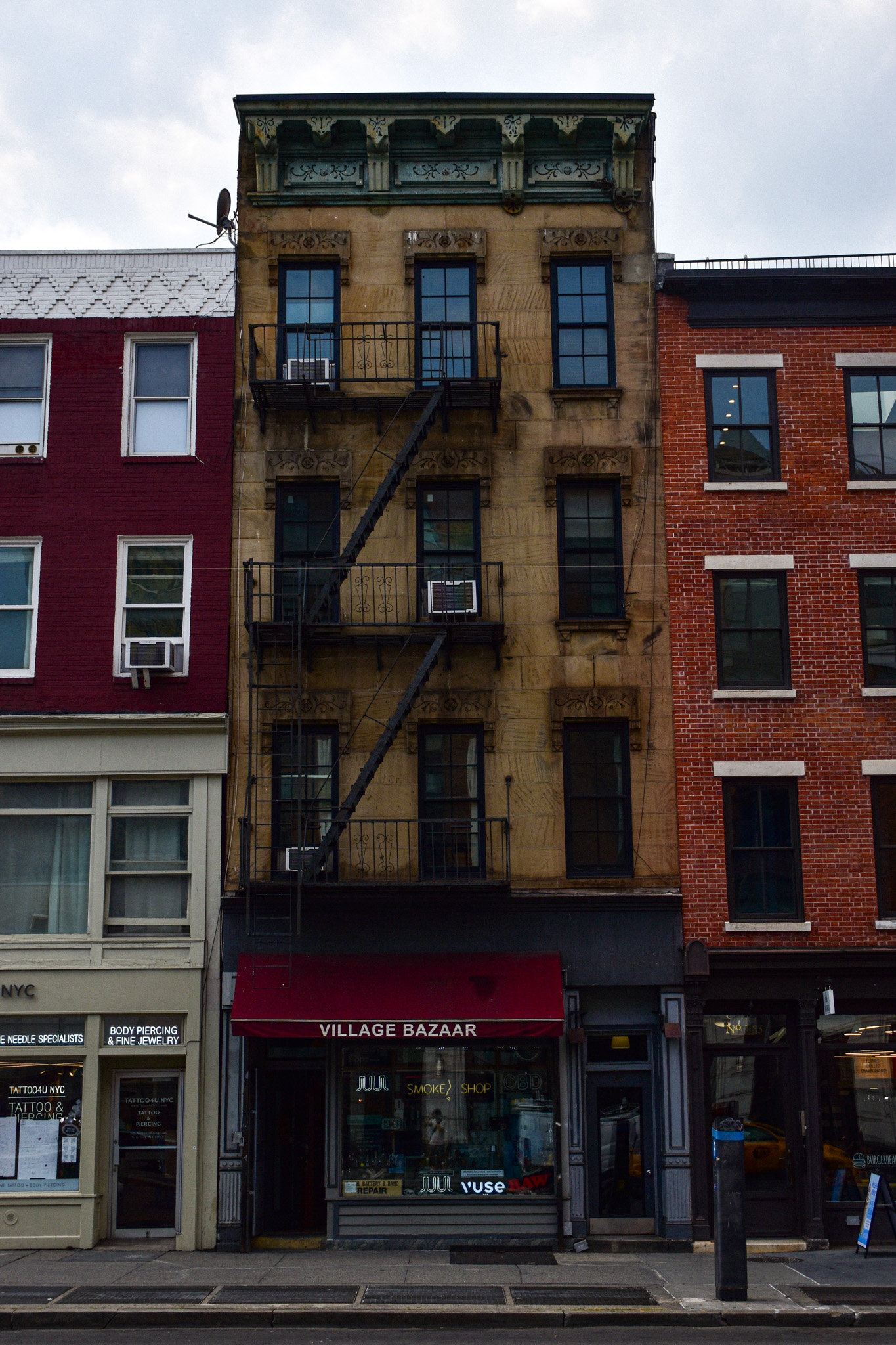
I liked the look of the building on 6th Avenue housing Village Bazaar, which offers (offered?) tattoos, piercings and smoking accessories.
At 251 Bleecker Street I saw a great decorative panel that unfortunately has been lightly defaced.
Bert Waggott was "a long-time Greenwich Village resident, graphic designer and professor of graphic design at Pratt Institute," according to this article of appreciation after his passing in July 2015. He was passionate about working on the aforementioned Winston Churchill Square garden.
We eventually wound up back on MacDougal Street, where I spied some nice signs.
In the foreground is Off the Wagon, which calls itself the "busiest, most popular bar in Greenwich Village." Next is Artichoke Basille's Pizza, which opened in 2008; and last, and unfortunately most difficult to see, is Minetta Tavern, which is a new incarnation of a joint that opened in 1937 and was "frequented by various layabouts and hangers-on including Ernest Hemingway, Ezra Pound, Eugene O'Neill, E. E. Cummings, Dylan Thomas, and Joe Gould, as well as by various writers, poets, and pugilists," per it web site. Honestly, I walked right past this place without even noticing it.
Last but not least is Cafe Wha? This place seemed like a place I should know, although I didn't know why.
A storied club with a chopped-up history, Cafe Wha? was opened in 1959 by Manny Roth, uncle of Van Halen singer David Lee Roth. The building at the corner of Minetta Lane was "a garage that used to be an old horse stable," per the club's web site. "You had to down steep stairs to reach the dark basement, which was bisected by a trough once used as a gutter for horse dung."
Between its opening and closure in 1968, the club hosted folk icon Bob Dylan, a young and unproven Bruce Springsteen, guitar god Jimi Hendrix, and comedians including Woody Allen, Lenny Bruce and Joan Rivers. From 1968 until 1987, the club was owned by Menachem "Manny" Dworman, who ran the place as Cafe Feenjon, per Wikipedia. "In 1987, the club was taken over by [Manny's son] Noam, who changed the room back to a rock music format, and changed the name back to Cafe Wha?
So, it turns out, a little more than a week ago, my daughter was accepted to NYU. I look forward to exploring more of Greenwich Village!
I have written about New York City before. Below are links to those posts:
The first place I lived when I moved to Boston in the fall of 1990 was an apartment in Brighton. During the three years my girlfriend (now wife) and I lived in that neighborhood, we frequented bars and clubs in neighboring Allston. I saw some great bands at Bunratty's, which eventually became the Melody Lounge and then Local 186 and then Wonder Bar and then empty. Another favorite hangout was the Kinvara Pub, where the soundtrack was heavily loaded with Irish/Scottish bands, from U2 and the Waterboys to Thin Lizzy and the Pogues.
In this first of four posts about Allston, I'll talk about those and other locations, and bands I saw there, as well as all sorts of other rock 'n' roll-type stuff I saw on my return to Allston Rock City.
I'm going to start at a more recently deceased club: Great Scott.
(Entrance to the former Great Scott, which had an awning over it.)
Opened in 1976 (replacing a joint called Brandy's), the club closed in May 2020 due to, you guessed it, coronavirus-induced economic hardship. Since that time, the owners have been working to resurrect Great Scott. There was an effort to relocate a few blocks away to the former Regina Pizzeria location in a former train depot, but that hasn't borne fruit. Here's hoping they succeed in these difficult times when COVID, redevelopment and a changing social scene are conspiring against them.
(Electrical box outside the former club, showing the aforementioned awning.)
Great Scott in its early days was a blues and folk club. From 2005 to 2020, however, this club on the corner of Commonwealth and Harvard avenues served up punk, indie and folk rock night after night after night. I saw bands including Giant Sand and the Neal Pollack Invasion here. My buddy Jay of Arlington, Mass.-based Clicky Clicky Blog used to host his annual shindig here, featuring loads of local bands, such as Speedy Ortiz, Guillermo Sexo and Soccer Mom.
The two best shows I saw at Great Scott were both in 2012: Japan's groundbreaking pop-punk band Shonen Knife, and U.K. indie rockers Johnny Foreigner (another great show put on by my buddy Jay).
(Shonen Knife at Great Scott in July 2012.)
(Johnny Foreigner at Great Scott in November 2012.)
(Cool mural on the back wall of the former Great Scott.)
(I peeked through these windows. The floors have been stripped out. Not sure what might go in here.)
Head north across the very busy four lanes of Commonwealth Avenue (as well as two sets of trolley tracks), and in short time you'll find yourself in front of a vacant space at 186 Harvard Ave., where I hung out on occasion alongside grungy rockers, leather-clad badasses, jocks, nerds and, once, a bunch of fake-British fops.
This, ladies and germs, is where Bunratty's (et al) once stood. 'Twas here that I saw bands such as Antietam, a band of Kentucky transplants who landed in Hoboken, New Jersey, in the early '80s (check out "War is (the health of the state)," the first song I ever heard by this band); Dinosaur Jr., an Amherst, Mass.-based band that proffers wonderfully sludgy slabs of rock (check out "The Lung"); and the Upper Crust, the aforementioned dandies, who sound like AC/DC and dress like French royalty circa 1782 (for your listening pleasure, "Let Them Eat Rock").
Let's face it, the odds of another rock club taking over 186 Harvard Avenue are lower than the chances of The Rat clawing its way back to its old dingy, dirty home in Kenmore Square now that Eastern Standard has shut its doors. In April 2021, the Boston Licensing Board granted the owners of the Wonder Bar the right to transfer a liquor license to a placed called Han at 186 Harvard Avenue. So in the near future, I assume, we'll see what's been going on behind the plywood.
(Wile E. Coyote hanging out on the plywood covering the old Bunratty's space.)
As for building itself, it's got a cool history. Erected in 1920, the building was originally a vaudeville theater, according to this great article at the Music Museum of New England web site. The site was a moviehouse for a short time, as well. In 1969, Dennis Mullins opened Bunratty's, named after an Irish castle that I visited in August 2018.
(Bunratty Castle)
"In it’s (sic) heyday, and for well over a decade, the venue hosted two to four bands a night: seven days a week; three hundred and sixty five days a year," the Music Museum article states. Like many rock clubs of that era, Bunratty's (known fondly as Bunz) could be more than a little scuzzy. But it was always a fun place to hang out. While reading that article, though, I learned that on one occasion it was a deadly place. "In August 1987, roller-skating doorman Abel Harris, a well liked kid, was murdered by an angry patron and Dennis sold the bar to his girlfriend and accountant Lorraine Curtis the next year; in 1988. The night Abel was shot the metal band Bang was playing and many people in the packed place thought the loud noise of the gun fire was a part of their show."
Holy smokes, I never heard about that. Anyway, in the ensuing decades the place changed hands and names and the music became tamer. I recall hearing people refer to Wonder Bar as a "fern bar." Wonder Bar closed in November 2020 due to, you guessed it, COVID-related shit.
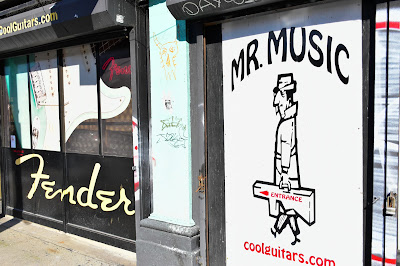
A little further into the maelstrom of Harvard Avenue is Mr. Music, which has been selling guitars, ukeleles, keyboards and other equipment for 58 years.
I have a vague memory of walking into Mr. Music many years ago, probably not long after I first moved to Boston. I was looking to buy a guitar. I don't recall whether I just browsed, or tried a few out. The primary image in my head is a German shepherd sitting quietly in the corner. I never felt threatened, but I definitely found it odd.
Watch this video for a peek inside this place, which seems pretty great.
Looming behind Mr. Music is the former Allston Storage Warehouse/Yellowbrick Storage, which dates to 1915.
This massive space is now home to Studio 52, which features both band rehearsal and artist spaces.
Below is Studio 52's former location on Everett Street in Allston. It sits on the edge of a major redevelopment project, so I'm guessing it will be torn down at some point.
Continuing northward on our Harvard Avenue rock 'n' roll trek, we come to the former home of Common Ground.
Opened in the mid-'90s, this bar and restaurant also featured bands and DJ's over the years. The place closed in 2019 after nearly a quarter-century in business. The space is now home to Kao BBQ.
I think I was only here once, in the mid- to late-'90s, to see a Boston band called the Push Stars. Somebody my wife knew was friends with a member of the band, I think. They scored a song on the soundtrack of "There's Something About Mary," and put out a few major-label records, but have been on hiatus for many years.
Near the northern terminus of Harvard Avenue is where the Kinvara Pub once stood. It's been home to The Draft Bar and Grill for quite a few years.
The building dates to 1928, according to the Boston assessor's office. The Kinvara was operated by the Briar Group, which runs several restaurants, including City Bar in Boston's Back Bay; Gather, in the Seaport; Hurricane's at the TD Garden; and Six String Grille & Stage at Patriot Place in Foxborough.
Two doors down from the Draft, tucked down an alleyway and located in the basement of a former firehouse, is a Boston institution: Looney Tunes.
(It's crazy how many signs this store has!)
Run by a guy named Pat for the last 40 years, Looney Tunes is one of several Boston-area record stores still kicking after decades in business (Nuggets, Stereo Jack's, In Your Ear). Originally located on Massachusetts Avenue, and then Boylston Street, the store has been in business since 1978. Pat acquired the shop in 1982, according to this 2017 Boston Hassle interview. Judging from the interview, and from what I've heard from friends who know him, Pat is quite the character. As to why he bought the store, he answered: "I am in no way suited for regular fucking employment. I cannot contain myself sufficient to be part of anything that will require me to contain myself. This is expansive. There is an infinite variety of music for one thing, and there’s nobody to tell me to shut up."
Across the street from Looney Tunes is O'Brien's Pub, which has been around a long time. I'm ashamed to admit I've only been there once or twice. Once again, I owe that to my buddy Jay who put on a show there. Among the acts I saw on stage that night was Elizabeth Colour Wheel. They rocked, even after the lead singer somehow suffered a cut to hear head and was bleeding.
My buddy Jay wrote a great piece about them at his late, lamented blog. Read it.
(Elizabeth Colour Wheel, live in the studio.)
Next door to O'Brien's is Stingray Body Art, which isn't a club or record store, but is obviously a place where local rockers go to get inked and pierced. A college buddy of mine who has played in a million Boston bands over the last quarter century used to work at Stingray, before setting out on his own, with Bird in Hand Tattoo.
Another of the few venues for live music still left in Allston Rock City is Brighton Music Hall.
Why isn't this small (capacity: 500) club called Allston Music Hall? I don't know. This place has been in business for about a decade. The last show I saw before the pandemic was here: Battles.
It went like this:
For 40 years prior to the opening of the club, this space was known as Harpers Ferry (likely named after the West Virginia town known best for the raid that John Brown conducted on its armory in 1859). The club was known for a long time as a blues and R&B spot. According to Wikipedia, the club hosted a yearly blues festival and a a Battle of the Blues Bands.
Other types of music thrived there as well. "Harpers Ferry had a reputation throughout the Boston area as being an important venue in the hardcore music scene," according to Wikipedia. "After the closure of The Rathskeller, a famous venue in Kenmore Square, many of the hardcore bands that called The Rat home moved to The Middle East in the Central Square scene in Cambridge...or to Harpers Ferry....The WBCN Rock & Roll Rumble was held at Harpers Ferry in 2007 and 2008....On March 17, 2007, Dropkick Murphys performed their [annual] St. Patrick's Day show at Harpers Ferry."
Harpers Ferry closed in 2010 in light of a dispute between the club and its landlord. Other bands I've seen here over the years, both at Brighton Music Hall and Harper's Ferry, inlcude X, the Scud Mountain Boys, Susan Tedeschi (before the Tedeschi Trucks Band) and Mr. Airplane Man.
What's the most rock 'n' roll place in Allston? Is it the Model Cafe? Or the Silhouette Cocktail Lounge?
Opened in 1932, when it catered to workers in local factories, as well as truck drivers going in and out of those plants, the Model is only a bar now, but it used to be a full-service restaurant, according to this Boston Eater article.
I've never been to the Model. Judging from the photo above, it seems that the cafe added basic food during the pandemic, when establishments that were straight-up bars had to close for quite a while. This is where rockers hang out when they're not rocking.
There used to be a cool neon sign above the doorway; I'm not sure what happened to it.
As for the Silhouette, it's considered one of the best dive bars in Boston.
If nothing else, this place wins the "best signs" contest. I've never been here either. From what I understand, the clientele is a mix of old-time locals and college students. Last October, the 79-year-old owner, Joseph Eliseo, announced his intention to sell the bar to a venture that's been buying up other dive bars in recent years.
The mural on the side and back of the cocktail lounge is called The Famous Joes (in honor of Eliseo, I presume), and was completed by the Mayor's Mural Crew in 2006. From left to right, Pesci, Frazier, Piscopo, Cook (I think) Perry and Bazooka.
That wraps up the stuff that's directly related to this neighborhood's Allston Rock City moniker. Let's move along to some other stuff.
Allston Billiards has been in this location along Cambridge Street, above a body shop, for several years.
I'm not sure if this is a private club. I like that it's here; there aren't many pool halls left in the area.
The liquor retailer was established in 1838 in Boston's Scollay Square. In 1938, the company was bought by John Corey who "grew the company from one retail location into a chain [of] retail stores," according to the Blanchards web site. "He also opened a distilled spirits plant and import division in the 1950’s located in Boston’s Historic South End." The company operates six retail stores in Greater Boston. Third- and fourth-generation Coreys continue to operate the business. Do those words look familiar? If you're a regular reader, they should. I wrote them about another Blanchards outlet, in Jamaica Plain (see January 22, 2022, "Jamaica Plain, Part I: Shopping & Snapping").
As for this Blanchards, I can give you some advice: If you're gonna be out and about in Allston late at night, don't park here. A million years ago, my girlfriend (now wife) and I parked here while out at the Kinvara, and when we returned to the lot, our car was gone. It had been towed to a lot somewhere south of Timbuktu. We had to take a cab to free our car. Pain in the ass, especially late on a long night.
I dig the sign advertising Kimchipapi Kitchen, which has been in business since 2018.
It's a Korean resaurant, but I'm not sure if the image is supposed to be Kim Jong-un or not. Owner Joon Son previously owned a sneaker shop, At the Buzzer, at this location. His mother, Ho Jeo Son, is a Boston restaurant veteran, having run Wuchon House in Somerville for years, according to Kimchipapi's web site.
Now for a sign of a different sort, for a much older business.
Arcand Sales & Service / Suspension Specialists, Inc. has been in business since 1908. At its founding, "we were primarily a blacksmith shop specializing in springs and suspensions on Carriages and Coaches. We worked on any transport vehicle, motorized or horse drawn," per the company's web site. It's still run by the Arcand family.
Lastly, the most well-known sign in Allston:
Located across North Beacon Street from The Model Cafe, Twin Donuts has been making donuts and coffee (and other foods) since 1959. I've found differing accounts about the age of this building -- 1920, says the Boston assessor's office, the 1800s, according to this profile on the Boston University web site. While the author of the BU article indicates the donut shop was "formerly occupied by the Odd Fellows Hall, a local movie theater," that's not correct. According to this Brighton Allston Historical Society article, the Odd Fellows Hall was located behind where Twin Donuts now stands, on a site where currently are situated a Dunkin' shop, a KFC restaurant and an auto service station. That information is borne out by these photos at a different location on the BAHS web site. Those pictures indicated previous tenants of 501 Cambridge Street include Commonwealth Lunch and Greene Druggist.
OK, that does it for the first installment about Allston. Make sure to check back soon for posts about houses of worship, ghost signs, apartment buildings and inns, a former train station, retail/restaurant space, murals, graffiti and much more. In the next post, I will talk at length about redevelopment, both projects that have already risen, and the many more yet to come.