From Dave Brigham:

La Salette Open Space in Bloomfield, Connecticut, checks many of my boxes:
Cool place to hike? Check.
Scenic views? Check.
Overgrown and somewhat dilapidated barns and outbuildings? Check.
Beautiful old stone house that you can't go in? Who put that on the list?!
History that includes farming, tin-making and a retreat for a Catholic group that named itself after a town in the French Alps where Blessed Mother Mary allegedly appeared to two children in 1846? Check-ity check!
I stumbled across this 140-acre property on Google Maps while searching for someplace close to my mother's house in Windsor to explore on a recent visit to the Nutmeg State. It was everything I'd hoped for, and more.
Let's start with that fantastic house that you can't enter (although that may change in the not-too-distant future).

Built of traprock in 1834, this place is known as the Oliver Filley House. "The floor plan is unusual, consisting of two intersecting wings," according to Wikipedia. "The primary living quarters were in the west wing. Filley's decision to build a stone house was partly motivated by the desire of his son, but he was also aware that a stone house was becoming a status symbol in the area. It would become the third stone house in Bloomfield, following a house built two year[s] earlier by David Grant, and one built a year earlier by Francis Gillette."


Oliver Filley, Jr., inherited a previous house and some land at age 12 upon the death of his father, Wikipedia continues. He acquired more land and added buildings during his ownership. Filley started a tinsmith business in 1806, and expanded that operation to Elizabeth, New Jersey. He built this house for his son, Jay.
To learn more about the house, the Filley family and the efforts to upgrade the property since the Town of Bloomfield took over the site, check out this document.
The Filley family owned the property only until 1849, when the estate of Oliver Filley, Jr., was settled. The site changed hands a few times over the next five years, with Samuel Pinney buying it in 1854, according to the Wintonbury Historical Society. In 1913, the Pinney family sold the property to the La Salette Missionaries, which operated a college in nearby Hartford. "The house and property was first used as a summer home or country villa for those La Salettes living in the Hartford House, a spot for excursions and picnics during the school year or vacation days," per the missionaries' web site. "The first general outing for the entire College to the new property was held on April 14, 1914 — and it created quite a stir and plenty of excitement in the town of Bloomfield. In 1916 the La Salettes broke ground for a $40,000, three-story brick building east of the Filley House. The 82-by-62-foot structure accommodated 50 students and was called the Novitiate of the College of La Salette."

When I told my sister, who lives in West Hartford, about my trip to this park, she recalled seeing what I believe what was the former La Salette dorm in prior years. The building is no longer standing. As you'll see below, the buildings that remainn on the site are in various states of dilapidation.
Eventually, the La Salette community turned their farming hobby into a self-sustaining business. "[B]y 1940 the farm was self-sufficient, and the novices were an integral part of this reality. In addition to farming, the La Salettes grew and sold produce, operated a dairy farm, raised livestock, slaughtered their own cattle and pigs. They were well-versed in plumbing, carpentry, electrical wiring, bricklaying and cabinet-making. They built their own swimming pool."
A swimming pool - I love it!
So just what the heck are novices? What is a novitiate?
A novice is a person who is in training, so to speak, to become a full-fledged member of a religious order (priest, nun, monk). A novitiate is both the building in which these trainees live, and the time during which the novices are on probation before taking their vows.
The missionaries closed this facility in the 1970s, due to dwindling enrollment in its novice classes. The group moved its novitiate to Altamont, New York. The La Salette organization, which is named for a "small hamlet" in the French Alps where in 1846 the Virgin Mary is alleged to have given her "message of reconciliation" to two young children, maintains a shrine in Attleboro, Massachusetts.
The La Salette organization eventually sold the farm. In 1992, the Town of Bloomfield purchased the site from Milton Levine (I'm not sure if Levine acquired the property from the La Salette folks). In 1993, the Town signed a 99-year lease for the house to the Wintonbury Historical Society, which has completed some renovations on the house.
Of all the buildings on the Bloomfield property, the house is by far in the best condition. But I was more intrigued by a small outbuilding along the main driveway.

I thought perhaps this was once a farm stand, or even a ticket booth for events held at the farm. But, as I learned from some Wintonbury Historical Society documents I found online, this little hut is a well house. I wasn't sure exactly what a well house is, so, crazy as this might seem, I searched on Google for more information. I came across the Into the Woods blog, which has since become a favorite. "A wellhouse was a common outbuilding in the days before electricity," according to the blog. "The well itself, with a windlass and bucket for drawing water, generally was near the wellhouse door."
Having grown up in a town -- Simsbury, which abuts Bloomfield -- that's still dotted with old tobacco barns, I have a certain affinity for these old farm structures (see this post, as well as this one, also this one, and this 'un here). So I was psyched to see some wonderfully decaying samples here.

(I wasn't expecting to see graffiti here.)

(Awfully tempting.)

(This was a workshop of some sort.)


(I'm proud that I knew this is an old corn crib.)


(It was like that when I got here.)
Could the pile of bricks below....

...have once been part of this ruin?

Perhaps. I just love this relic. A new storage area has been fitted into the old structure.

I'm guessing this is where supplies for the adjacent community garden are stored.

OK, let's get to the open space!
While I was certainly very interested in seeing the wonderful old stone house on this property, as well as the falling-down barns, I chose this site to explore because I needed a little fresh-air walkabout. I knew from a write-up at the excellent CTMQ blog ("Destroying the myth that there is nothing to do" in Connecticut) that La Salette offered views of downtown Hartford, as well as some nice paths through both active and former growing fields.

(The clouds obscured the Hartford view a bit.)

I enjoyed seeing Heublein Tower, which sits in Talcott Mountain State Park. As a kid, I climbed the mountain many times with my family. I also loved watching hang gliders soar above the ridge while I played baseball or football on the school field next to my house. I haven't climbed to the tower in probably 20 years.

The property connects to the Wintonbury Land Trust's Hawk Hill property, which I didn't check out. A nice older couple walking their dogs told me that's also a great site, and that it features at least one old barn.
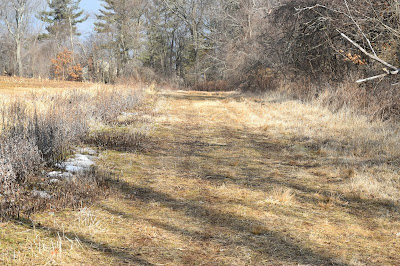

(A frozen pond at the bottom of a hill, near a housing development.)


(I'm not sure what this structure used to be. Perhaps another corn crib?)
The site is still actively farmed, which I was happy to see.

I'm guessing this is a corn field. I don't know who does the farming, what types of crops they work, or where the produce is sold. Perhaps at nearby Wade's Farm Fresh, which traces its roots back to a dairy farm established in 1919.
For more about Bloomfield, check out:
June 2, 2018, "Three Blessings and a Curse"
December 29, 2016, "What's Auers is Yours"


