Showing posts with label architectural detail. Show all posts

Saturday, February 19, 2022

New York City Flashback: Views from a Tour Bus

From Dave Brigham:

Recently this thought struck me like a runaway freight train: I visited New York City three times between 2010 and 2016 and I didn't post anything about my trips!!!

Granted, it's only in more recent years that I've become obsessive about chronicling places in Greater Boston and cities that I visit on vacation (Seattle, Chicago, Panama City). As well, I've gotten much better at editing my photos in that time. What that means is a) there aren't as many photos in this post as you might expect and b) those photos aren't always as good as I'd like them to be.

Anyway, I dug through my archives, found a bunch of useable photos, and decided to post whatever the blog equivalent of latergrams is. This is the last of four posts.

Links to the previous posts are at the bottom of this one.

I shot the photos in this post from a double-decker tour bus as we rode through Upper Manhattan and Harlem.

Let's start with one of the most well-known buildings in New York City.

Although I took this photo nearly six years ago, I had a good guess as to what this building is. But I turned to my Facebook experts to confirm my suspicions. This, as many of you already know, is The Dakota, which is best known as the place where John Lennon was murdered on December 8, 1980, by Mark David Chapman. The ex-Beatle and his wife, Yoko Ono, lived in the building. She still maintains an apartment there.

The Dakota, of course, is much more than just a famous murder scene. Built between 1880 and 1884 and designed by Henry Janeway Hardenbergh, the apartment building is located on the Upper West Side, across from Central Park. "Hardenbergh's architectural firm was commissioned to create the design for Edward Cabot Clark, head of the Singer Manufacturing Company," according to Wikipedia. "The building purportedly was named The Dakota because at the time of its construction, the area was sparsely inhabited and considered remote from the inhabited area of Manhattan, just as the Dakota Territory was considered remote. The earliest appearance of this story, however, was in a 1933 newspaper interview with The Dakota's long-time manager. Christopher Gray of The New York Times quoted the interaction thus: 'Probably it was called 'Dakota' because it was so far west and so far north.' Gray believed that the building's name stemmed from Clark's fondness for the names of the new western states and territories."

Other famous residents over the years include actress Lauren Bacall; Steely Dan co-founder Walter Becker; singer Roberta Flack; actor Boris Karloff; football coach/commentator John Madden; and financier Wilbur Ross. The building was added to the National Register of Historic Places in 1972.

Staying with the music and entertainment angle, the next spot is one of the most highly regarded theaters in the Big Apple.

Opened in 1913, the Apollo Theater "has played a major role in the emergence of jazz, swing, bebop, R&B, gospel, blues, and soul — all quintessentially American music genres," per its web site. In 1934, Leo Brecher and Frank Schiffman bought the theater from Sidney Cohen, shifting from burlesque to variety reviews. The owners focused their shows on the growing African-American population in Harlem. "Showtime at the Apollo," a TV show featuring singers, dancers, orchestras and comedians, debuted in 1955 and ran until 2008. Comedian and TV host Steve Harvey brought the show back in 2018. In 2020, the Apollo debuted a digital stage to showcase entertainment in the COVID era.

The next photo looks like a Hollywood backlot, but I don't know exactly where it is.

Thanks again to my Facebook friends who either live or once lived in Manhattan, I was able to identify the church below.

The Cathedral Church of Saint John the Divine is "the mother church of the Episcopal Diocese of New York and the Seat of its Bishop," according to its web site. Located at 1047 Amsterdam Avenue, the house of worship is "the largest Cathedral in the world, meaning a church that is also the seat of a Bishop," per its web site. "Measured by length or internal volume, it is one of the five largest church buildings in the world." As large as it is, the church, which rose in 1892, is unfinished. "Like the great Medieval cathedrals and churches of the world, St. John the Divine will continue to be constructed over many centuries. Currently, funding is directed to prioritize serving the community through our programming and social initiatives, and to maintaining the architectural integrity of the Cathedral."

I wish I'd gotten better pictures of this majestic cathedral.

I have no idea what or where the next building is, except that it's on the M72 bus line. I used Google Maps Street View to try and find it, but had no luck.

The next building, however, was easy to identify through a Google search.

This one-of-a-kind place is Masjid Malcolm Shabazz, a Sunni Muslim mosque. "Founded by Honorable Elijah Muhammad in 1956, by Nation of Islam Minister El Hajj Malik Shabazz known then as Malcolm X, Masjid Malcolm Shabazz located at 102 West 116th Street in Harlem began as Muhammad’s Temple of Islam #7," according to the mosque's web site. Malcolm X, who served time in prison before becoming a leading figure in the civil rights struggles of the 1960s, was minister here from the mosque's founding until 1965. Louis Farrakahn, a controversial figure in his own right, succeeded Malcolm X.

There are businesses on the ground floor, including a pharmacy and a barber shop. The site is also home to the Harlem Business Outreach Center.

Today this site features this distinctive building, a house of worship. Prior to that, though, the site had a less holy designation. "Before becoming a religious structure, the lot used to contain the Lenox Casino, a space which was often rented for meetings by the Socialist Party and used as a theatrical performance venue for a number of then-renowned artists," according to this article. "Built in 1905 and designed by Lorenz F. J. Weiher, the Lenox Casino was raided in 1912 for showing 'illegal films.'"

I'm unclear as to whether the casino became the mosque, or whether the mosque is a newer building. Either way, cool building and neat history.

I love the detail on the next building, but I don't know where it's located.

I've been able to identify (if it weren't already obvious) the location of the rest of the buildings/scenes. The first is the former Mickey Mantle's Restaurant.

Named for the former Yankee great and Baseball Hall of Famer, Mickey Mantle's was located on Central Park South for nearly a quarter century. The eatery closed in 2012, 17 years after Mantle passed away. I shot this photo in 2011; I initially thought we'd taken our tour-bus ride in 2016.

The next photo showcases another long-closed restaurant, located at 383 West 125th Street.

Look closely and you'll see the "Southern Fried Chicken" sign that advertised one of the specialties at soul-food place, M&G Diner. By the time I shot this photo, the Harlem eatery had been closed for a few years. But from 1964 to 2008, the diner served up homestyle cooking at reasonable prices. The building has since been revampted, with a clothing store in the former M&B space.

Next up is a view of the Park Avenue viaduct, which emerges from a tunnel to carry the Metro-North Railroad. This is the Park Avenue main line, which runs from Grand Central Station, under the city until this point, then across the Harlem River into the Bronx, where it splits into the Hudson Line and the Harlem Line.

Thanks to one of my college friends on Facebook, I learned that the cool details below are on the lower, older section of Hearst Tower. Unlike the river cruise I took in Chicago a few years back, I wasn't making notes on this jaunt....

"The Hearst Tower is...the world headquarters of media conglomerate Hearst Communications, housing many of its publications and communications companies," according to Wikipedia. "The Hearst Tower consists of two sections, with a total height of 597 feet...and 46 stories. The six lowest stories form the Hearst Magazine Building (also known as the International Magazine Building), designed by Joseph Urban and George B. Post & Sons, which was completed in 1928. Above it is the Hearst Tower addition, which was completed in 2006 and designed by Norman Foster."

One last building, before we get to the bare facts about one of the most well-known buskers in New York City.
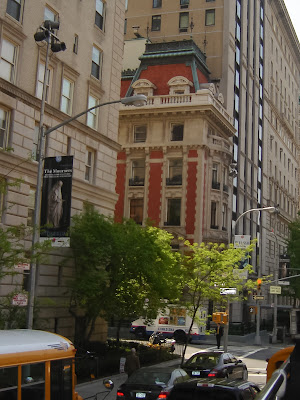
Once again, I have a Facebook college friend to thank for sending me on a Google Maps hunt, where I figured out that this is the Benjamin N. Duke House on Fifth Avenue. "The house was built speculatively by developers William W. Hall and Thomas M. Hall....Shortly after the mansion was completed in 1901, it was bought by Benjamin N. Duke, a tobacco, textile and energy industrialist and philanthropist, who was chairman of the American Tobacco Company at that time," according to Wikipedia. "Benjamin's brother, James, another tobacco entrepreneur, bought the house in 1907. He lived there until his own mansion...was completed in 1912.

"After James Duke relocated, the mansion became the residence of Benjamin Duke's son, Angier Buchanan Duke, until 1919, when his sister Mary Lillian Duke married A. J. Drexel Biddle Jr., and the couple moved in. Later, their daughter, Mary Semans, took over the residence. Members of the Duke family owned the mansion until 2006, when it was sold for US$40 million to Tamir Sapir, an American real estate mogul.

"The Mexican telecom magnate, Carlos Slim, at the time the richest person in the world, bought the mansion four years later in 2010 for US$44 million. Slim said in an interview with CNBC that he was planning on using the house as a place to stay when he was in New York for business meetings. In May 2015, he put the mansion up for sale at $80 million, nearly twice the amount he paid for it."

As far as I can tell, Slim still owns the house.

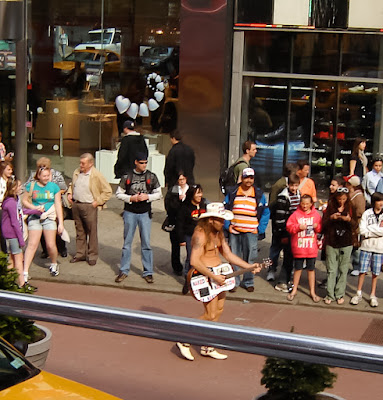
OK, time for the butt end of this post, of this entire series. Let's give a warm, backside round of applause to someone who could use the exposure: the one, the only Naked Cowboy!
Well, that wraps up my New York City flashback series. Hope you enjoyed it!

Here are the previous posts in this series:

"New York City Flashback: Views from the High Line"

New York City Flashback: Views While Strolling and Shopping

"New York City Flashback: The Transit Museum."

Saturday, September 25, 2021

Absolutely Nothing About the Kennedy Clan Here

From You Know Who:

This post about Hyannis, which is a village of the Town of Barnstable on Cape Cod, was supposed to have more photos. Due to a mental error, the likes of which I've never encountered before, I will have to take those other photos another time. Long story short: I accidentally bumped the settings dial on my camera without realizing it, resulting in several pictures being overexposed and not at all useful.

None of the pictures in this post, or in the Post of the Future, will feature any of the Kennedy clan, known for congregating in Hyannisport to play football, go sailing and flash their big, white teeth.

When I searched "Cape Cod" and "Jack Kerouac" on Google, the first thing that popped up was a mention of The 19th Hole in Hyannis.

I knew, having read Kerouac's On the Road a few times in the last 30 years, that he had mentioned Cape Cod. Turns out, that reference was simply Kerouac talking about how Route 6, at that time, traveled clear across the United States, and that it began on Cape Cod. He didn't actually get on Route 6 for a road trip until the roadway reached New York. Anyway, Kerouac did live on the Cape -- Hyannis to be exact -- for almost a year in 1966, three years before his death. He lived with his mother, and, apparently, was known to bend his elbow at The 19th Hole in downtown Hyannis. So that's why I took that picture.

You know me. When I visit a city or town, I don't go looking for the typical tourist fare. I seek out the oddball, the unusual, the hidden history, the faded memories. So that's what I did over the summer in Hyannis.

McLean's Barber Shop, which has been on the same spot since 1923, is right next door to the tavern. Maybe Kerouac got his haircut here....

The shop closed in 2018, following the deaths of both the son and grandson of the original owner. In 2019, however, according to this Barnstable Patriot article, Matthew and Amanda Kundel, operators of the Cape Cod Barber Shop, took over the business.

Check out the Cape Cod Times video about the shop, below:

Turning the corner from Barnstable Road to Main Street, I was struck immediately by the word MAYFLOWER and the date 1932 carved into the edifice of 334 Main Street.

Currently the home of an outlet of KKatie's Burger Bar, this storefront has a long history of housing restaurants, as well as some great murals that were covered for a long time, rediscovered, then hidden away again. Prior eateries include the Mayflower Restaurant, Priscilla Alden Room, John’s Loft, Sophie’s, Hooters (!) and, most recently, Tommy Doyle’s.

During renovations of the space in 2016, construction crews uncovered seven semi-circular paintings done on the horsehair plaster walls. Those works of art depicted "scenes of Hyannis and other villages of Barnstable as they appeared in the 1930s, including beach shacks, dunes, local harbors and windmills," according to this Cape Cod Times article.

The murals were painted in the 1930s by artist Vernon Coleman for the Works Progress Administration, which created jobs for artists during the Great Depression, according to the Times article. Coleman (1898-1978) painted more than 100 murals for the WPA, and founded the Cape Cod Art Club, which is now the Cape Cod Art Association, per Wikipedia. Although his paintings are cool and historic, alas, they couldn't be saved. They were bricked over. Make sure to click the link above and look at the photos.

Continuing east on Main Street, I came across the Federated Church of Hyannis.

Built in 1957, later than I'd figured, the sanctuary is the fifth church to be located on this site, per MACRIS. Baldwin Hall, below, is attached to the church, and dates to 1939.

A few doors down is the Igreja do Evangelho Quadrangular (Foursquare Gospel Church) of Hyannis, located in a storefront building that dates to 1910. Foursquare churches are evangelical Pentecostal Christian houses of worship. The denomination's name represents the four aspects of the Department of Christ: Savior, Baptizer with the Holy Spirit, Healer and Soon-coming King, according to Wikipedia, and had nothing to do with the playground game I loved as a kid.

The building at 296-98 Main Street is known historically as the Megathlin Drug Store, per MACRIS. In 1926, the store was sold to the Louis K. Liggett Co., which occupied the first floor and basement while the upper floors were rented as office space, according to MACRIS.

A few doors down is the circa-1905 Wilson's Grocery Store building.

Most recently home to the Baybridge Clubhouse, a community of support for individuals who are in recovery from mental illness, this place stuck out to me because of the poster slapped on the facade. It portrays John "Mad Jack" Percival, "a naval officer who served his country during the War of 1812, the Mexican-American War and "the campaign against West Indies pirates," according to Wikipedia. Perhaps the most amazing story from Mad Jack's life is his piloting the USS Constitution around the globe in 1844-45, as I mentioned in an October 2018 post about a small slice of Barnstable, Mass., which features Percival's gravestone.

Across Center Street from Mad Jack's poster is the headquarters of the Cape Cod Central Railroad.

Built in 1880 and since "altered beyond recognition," per MACRIS, the station was built as a private home. Really more of a commercial spot, with a store and ticket counter for scenic and dinner train rides as well as a small food mart, the building was situated behind a train depot, which was demolished in 1950. "The present building probably incorporates the [Baxter] House which stood on the site at the turn of the century," per MACRIS.

Across Main Street, on the corner of Pleasant Street, is a nice mural on the side of the Cash Block building.

Home to Bradford's Hardware since 1892 (!), the building once had a pool hall in the basement, per MACRIS. While that's apparently gone, there may still be two bowling lanes down there. As for the mural, it was painted in 2016 and is a gateway to the Sea Captains Row neighborhood, according to this Cape Cod Times article.

Located on Pleasant Street, which heads south from Main Street to the harbor, Sea Captains Row features homes from the 1800s. It was named one of Massachusetts' Most Endangered Historic Resources by Preservation Massachusetts in 2016. One of the few remaining seafarer homes along Pleasant Street is the Captain Allen Crowell House, below.

Built in 1852, this Greek Revival house is currently an inn, as best as I can tell. Capt. Crowell was born in 1821, and was one of the more well-known sea captains in Hyannis, according to MACRIS. "In 1847, Crowell, along with Capt. Rodney Baxter, carried supplies to Ireland during the dread potato famine," MACRIS indicates. "During his entire career, Capt. Crowell never was involved in a nautical accident, indeed a rarity in any era."

While the Cape is a huge tourist destination, it is still an active fishing and seafaring community, although nowhere near as busy as it was 200 years ago. In the 1800s, the area had nearly 700 sea captains that traveled the world, according to the Crowell House web site. "The various captains that lived on this street, interacted with historic events such as: The Revolutionary War, War of 1812, Civil War, and The Spanish American War," the web site continues.

There is a development being built across from the Crowell House called -- you guessed it -- Sea Captains Row. One-, two- and three-bedroom apartments will be available. Plans call for two artists-in-residence to live and work in two new studios located in the former Patriot Press building, seen below.

Built in 1840, this building is known historically as Freeman Tobey General Store, per MACRIS. Tobey ran the store until his death in 1863. Freeman Chase and E.G. Crowell then took over the business. In 1892, the successor to Chase and Crowell, Capt. Allen Baxter, sold the building to the Goss family, owner of several newspapers. The Hyannis Patriot was located here, as was its successor, the Barnstable Patriot.

A short distance away, overlooking a marina and steps from the Hyannis Ferry Terminal, is the Anchor In Hotel. The building dates to 1955; I'm not sure whether it has always been this hotel. I love the hotel's sign.

Back on the corner of Main and Ocean streets, I spied the cool sea-creature artwork below.

This building, which dates to 1935, has been emtpy for several years, as far as I can tell. Constructed as an A & P Grocery Store, it has housed a restaurant, a movie theater, an art museum and an art gallery, among other businesses I'm guessing. In 2008, the building was up for auction, but the sale was postponed because a co-owner had filed for bankruptcy. The foreclosing lender accused the owners of trying to "avoid paying a combined $44 million in debt by filing multiple bankruptcies and lawsuits," per the Cape Cod Times article linke in the prior sentence. The owners, in turn, claimed the lender had "tried to bully him...and other business owners across the Cape into ceding control of their projects and employing loan-to-own schemes and other fraudulent methods." The lender, of course, denied those claims.

In the ensuing years, the building, which has of course continued to decay, has changed hands four times, most recently for $100 in April 2019, according to the Barnstable assessor's office. I have no idea if this building will eventually be torn down. As for the murals on the side, I haven't been able to determine who made them. They are part of Arts Barnstable's Smile Spots project.

A few doors down heading southwest is the former Masonic Hall.

Dating to 1923, the old fraternal organization headquarters was in use until the 1960s, per MACRIS. This building was where the first movies in Hyannis were show, MACRIS reports. These days, the building is home to apartments, an art gallery, a bakery and other small businesses.

Continuing in that direction on Main Street, on the opposite side of the street I spied a cool architectural detail on the Puritan Cape Cod clothing store.

Built in 1925, this building is known as the Colonial Block. Among the original tenants, according to MACRIS, were the Telephone Exchange, a paint store and a restaurant. Later tenants included Woolworth's and the Cape and Vineyard Electric Company.

I may not have been able to deliver all the shots I wanted to, but at least I got the pink bus.

According to a 2014 Cape Cod Times article, the bus dates to 1966, and was supposed to be converted to a mobile repair lab for Nifty Nate's, the computer repair business in whose parking lot the bus sits today.

With any luck, I'll have more Hyannis shots sometime this fall.

Wednesday, September 2, 2020

Back At it

From The Masked Photographer:

After nearly five locked-down months, my son and I headed back out on the T one recent weekend. We wore masks, used hand sanitizer, obeyed the distancing rules in the subway cars, and avoided crowds (not that there really were any in Boston). I was happy to be in the familiar confines of the city, shooting a few photos. But I also felt like I was in a totally different place, one where crowds were low on a beautiful summer day, and where those who were out were sporting face coverings of all sorts. Comfortable and strange at the same time.

I wandered through Downtown Crossing and the Financial District, past buildings I've shot before for this blog. Still, I spied details I've missed in the past. Outside the doorway to the building at the corner of Winter and Tremont streets, directly across from the Park Street subway station, I spied some cool relief panels.

Known as the Thomas Building, the Richardson Romanesque property dates to 1887. It was designed by John A. Fox, the architect behind the Providence Opera House {since demolished), Lewiston Music Hall and Chelsea Academy of Music, per MACRIS. "The major original tenant was the George A. Sawyer & Co. men's clothing store, which had been located at the same address for many years prior to the construction of the...structure," per MACRIS. "G.A. Sawyer & Co. moved to a newer building at 129 Tremont Street in 1895-96. Turn-of-the-century photos show an ice cream soda shop on the ground floor and optician on the 2nd."

The dragon rising out of a crown is my favorite, although the eagle is pretty cool looking, too. I'm not sure what the third image is.

Steps away from the Thomas Building I spied the wonderful detail below.

In its current iteration, the Conrad-Chandler Building on Winter Street dates to 1925, "when the owners hired Harry Davidson & Son to remove the pitched roofs of earlier buildings on the site and construct a 'new limestone ashlar front' for Conrad's Department Store," per MACRIS.

The building has quite a history, which I suppose isn't unusual with older structures in Boston. "The new facade was the last of several major renovations which have changed the appearance of the building over the years," per MACRIS. "The curved rear wall, which faces Hamilton Pl, is the only surviving portion of the Greek Revival Central Congre­gational Church, built at #25-29 Winter St. in 1841. In 1865 the congregation moved to the Back Bay, merging with the First Presbyterian to form the Church of the Covenant on Newbury & Berkeley St.. Shortly thereafter, the church on Winter St was rebuilt into a 6-story granite French Second Empire mansard commercial building. The first tenant was Chandler & Co, which had been established in 1810 by Thomas Brewer and was popularly credited with selling the first "ready to wear" dress in Boston. Chandlers remained at this location until 1905, when the street became too congested for carriages to wait outside for customers and the store moved to the newly fashionable Tremont St, first to the Chickering Bldg (since demolished) and later to #149 and then #150 Tremont St. The next tenant was Conrad & Co., also a ladies dry goods and clothing firm."

The medallion in the photo above shows a child's head, although I could be convinced it's a young woman's profile.

Along Milk Street, I spied the plaque below.

Located on the side of 1 Federal Street, the plaque marks the location of the home of Robert Treat Paine, a signer of the Declaration of Independence. Paine, who was a lawyer and politician, served as the first attorney general of the Commonwealth and an associate justice of the Massachusetts Supreme Judicial Court. He died here May 14, 1814.

Not far away, in the Financial District, I spied a ghost sign of sorts along Pearl Street.

Located in 10 Post Office Square, the Cuban-inspired and quite opulent Mariel restaurant opened last fall. It's fancy, light-up sign covers an older mosaic-type sign for Commonwealth ?? Banking Association. Looking at both Google Maps and Bing street-level images, I saw that this sign was covered up prior to the restaurant's opening. So I like the fact that somebody discovered it and kept it. I just wish I could make out the second word on the sign. Online searches have proven fruitless.

Finally, a poor photo of an old sign painted on a window on one of the cool old Central Wharf buildings.

"Cobb's Photo Studio," the sign says. I have no idea if it once advertised an actual business, or if this is a fake produced for some other reason. This is located on the back of the building currently housing Central Wharf Co., a restaurant that is closed during the pandemic. Over the past 200 years, the building has been home to, among other businesses, Jose McIntyre's Mexican restaurant and the Central Wharf Tea Company.

Most of the several Central Wharf buildings facing Milk Street near the Rose Kennedy Greenway date to the early 19th century. Central Wharf No. 5 is the one we're concerned with. Designed by the ubiquitous 18th- and 19th-century architect Charles Bulfinch, the wharf building is included in the National Register Custom House District.

"Located at head of what was once Central Wharf, structure known as 'Jenny Building' is one of only 8 adjoining buildings which remain of original 54 building row extending to today's site of N.E. Aquarium," per MACRIS.

I would've loved to have walked around the Boston of 100 years ago.

Sunday, July 26, 2020

Man Wandering In Inman Square

From Dave Brigham:

I have no idea whether any of the places I shot for this post many, many months ago have gone out of business. I hope not.

I used to frequent Inman Square, which is mostly in Cambridge, Mass., but spills over into neighboring Somerville, primarily to eat at the S&S Deli, an award-winning eatery that's been around since 1919, and where I once saw Robert Reich, who served as Secretary of Labor under President Bill Clinton. On other occasions I shopped at a toy store, ate Brazilian barbecue and saw live music at the former Ryles Jazz Club (see September 28, 2019, "Waving Goodbye, With Jazz Hands").

I recently walked through as much of the square as I could given my time constraint. Here's what I found.

I was happy to see the S&S is still going strong. I miss going here, and to other breakfast/brunch places. My kids aren't eating-out-for-breakfast types, unfortunately. The restaurant's original matriarch, known as Ma Edelstein, used to greet customers in Yiddish, imploring them to “Es and es" (eat and eat), per the eatery's web site. This inspired the name of the restaurant; I'm not sure what it was called when Ma worked there. On the rear, outer wall of the restaurant, Ma still keeps an eye on things, even though she's gone to that great kitchen in the sky.

Another place I dined at a few times is the Brazilian BBQ joint, Midwest Grill.

I love the logo in this not-terribly-good photo. If you haven't had Brazilian BBQ, let me set the scene for you: most importantly, there is meat on swords. Waiters ceremoniously bring said swords of meat to each table, set down a small plate under the sword to catch blood, drippings, stray pieces of meat, and you indicate how much sausage, chicken, beef or pork loin you want them to shave off onto your plate. Each waiter has a different meat, and they make the rounds of your table as often as you like, or until you explode, a la Mr. Creosote.

You don't have to order the eat-until-you-pass-out sword-meat extravaganza, but I recommend it. As my buddy who took me and some fellow coworkers to Midwest Grill said, "Don't waste your time with the salad bar."

Those are the only two places I recall eating at back in the day. If I were young and kid-free today, I'd definitely go to Bukowski Tavern.

Named for foul-mouthed postal worker/poet and novelist Charles Bukowski, the tavern (there is also one in Boston, near a failed development that I wrote about a while back) has been around since 1998 and seems a pleasant enough place. And that's the problem. Bukowski was a dive bar guy, for sure, not one to be seen hanging out in hipster yuppie joints. I read a few of his books back in my 20s, and loved "Barfly," the movie based on his life and writings, starring Mickey Rourke and Faye Dunaway. The man was a misanthropic alcoholic who wrote down-and-dirty stories and poems. In my immediate post-college years, my friends and I would give out the "Chanaski Award," named for Bukowski's alter ego in "Barfly," to whichever one of us got the drunkest, or bled while partying, or did something disgustingly stupid.

I probably would only go to this bar once, although I like that on the bar's web site they promise "surly service." If you are able to, expand the photo above. You may be able to see the quote in neon that says, "Find what you love and let it kill you." It's a great quote, but while many people attribute it to Bukowski, it apparently wasn't something he wrote. Another reason to limit my visits.

Alright, that's way too many words about a place I've never been. Let's move on to some other watering holes.

Trina's Starlite Lounge -- what a great name, eh? -- opened in 2009. It's known for fried chicken and, as you can probably guess by the Miller High Life sign out front, hipsters. OK, I should lay off the tattooed, trucker-hat wearing crowd, right? The tavern, which is in Somerville, opened after the dissolution of longtime dive bar the Abbey Lounge, where I saw former Phantom Tollbooth bassist Gerard Smith play in some band.

The owners of Trina's also run Parlor Sports next door. The place has cool murals on the exterior that evidently change on a regular basis.

The Thirsty Scholar Pub opened in 1995, one of countless Irish bars inspired by public houses on the Emerald Isle. Seems like a pretty cool place; I hope it doesn't fall victim to the trend that has seen many local Irish pubs close their doors in recent years.

Regular readers know I love social clubs, so let's cover a few.

Clube Desportivo Faialense (Faialense Sports Club) is a private Portuguese club that seems to be open to the public for meals and parties on occasion. Faial Island is located in the Azores, an autonomous region of Portugual.

The Portuguese American Civic League is located on Springfield Street, not too far off the main part of Inman Square. Cambridge and Somerville have quite a few Portuguese clubs like this, which makes sense, as East Cambridge had a sizable Portuguese community beginning in the late 19th century.

We've covered bars and social clubs; how about some restaurants and coffee shops?

Richards -- named for four generations of Cambridge natives with that first name -- opened last October along Cambridge Street, offering "Exceptional Food/ Art / Hip-Hop." The new eatery replaced Tupelo, a Southern restaurant that had occupied the space for nearly a decade. Tupelo shuttered due to difficulty finding staff, per this article. Several months ago I shot a picture, below, of Tupelo, which is the name of the town where Elvis Presley was born.

Puritan & Company on Cambridge Street serves modern American cuisine, per its web site, and has done so since 2012. I've never been to this restaurant, but I love it because of the sign and the story behind it. The eatery is named after a prior tenant in this space, Puritan Cake Company, which was in business from the 1930s to 1950, per the restaurant's web site.

I wanted to return to Inman Square to get a better shot of this place, and a few others, but I haven't ventured out much in recent months, for obvious reasons.

M'lor Caffe, also on Cambridge Street, serves coffee, baked goods and other breakfast and lunch items. I love the artwork on the exterior, below.

The 1369 Coffee House (exterior, below) in the heart of the square has been around since 1993. The building dates to 1894, and was home for five years in the 1980s to the 1369 Jazz Club.

The jazz joint was highly regarded, booking local and national acts. But a dispute with the landlord resulted in the club shutting down. A documentary, "A Place for Jazz," was filmed but from what I've read online, the film was never released. Below is a clip:

There's a cool mural on the side of the coffee shop.

Heading east from the 1369 Coffee Shop, I saw what is perhaps the major commercial showcase building in the square.

Home to Highland Fried, a chicken, BBQ and exotic Tiki drinks spot; Christina's Homemade Ice Cream (and the related Christina's Spice & Specialty Food); Quick Food Mart; and the All Star Sandwich Bar, the building at 1245-1273 Cambridge Street dates to 1884. Try as might, I haven't been able to find out any background/history on this place.

Moving on....

Howzabout we look at some other old buildings that, with any luck, the Internet will tell us about?

The Cambridge Auto Center across from Bukowski Tavern has closed since I took this photo. As you can see at the roofline, the building dates to 1914. That's all I've been able to find out. Man, I need to improve my batting average here!

We're in Somerville at this point, near the Thirsty Scholar. This is 108-118 Concord Street, which sits on the corner of Beacon Street. The building dates to 1900, per the Somerville assessing web site, but I'm guessing it's older. Anything white on this building, I believe, is after-market crap that ruined what seems like it was a nice brick apartment building.

Across Beacon Street sits a much nicer old apartment complex. With all the beautiful trees in front of this place, however, it's tough to get a very good picture.

Built in 1880, 28-36 Beacon is known as George Wyatt Apartment Row, according to my new best friend, MACRIS. Across the street is the former home of George Wyatt, who owned a brickyard in the area in the 19th century.

Home to Vasquez Barber Shop and Alegria Dental, among other businesses, 1052 Cambridge Street, below, is an oddball.

The story above the red line appears to have been added on after the original construction. The back part of the building (not pictured) has only four levels. I haven't been able to find out anything about its original or former uses.

On the other side of Cambridge Street, opposite Puritan & Co., I saw the boldly designed building below.

Built in 1849 (!), 1157 Cambridge Street is currently home to Cambridge Rug Co., which has been in business since 1964. I haven't found anything more to say about this building than that, which is a shame.

Maybe I'll have better luck with the building below, which is located at the nexus of the square, at the intersection of Hampshire, Cambridge and Springfield streets.

Great picture, eh? I took that picture because of the date "1874" chiseled into the building's facade. That's a long time ago. Let's see if there's any info on this beautiful brick behemoth.

Known as the Middlesex Bank Building, this Italianate-style hunk of architecture is home to, well, I'm not sure.

Let's get to some old signs, shall we?

Now home to coworking space IndustryLab at the corner of Hampshire and Norfolk streets, just a little outside of Inman Square, this place was home to Monk's Laundry at some point in the distant past. I haven't found out much about the company, but per the beautiful ghost sign I now they offered French cleaning, which is what dry cleaning was popularly known as, and dyeing services.

The former Automatic Cone warehouse across Cambridge Street from Vasquez Barber Shop and Alegria Dental has been vacant for years.

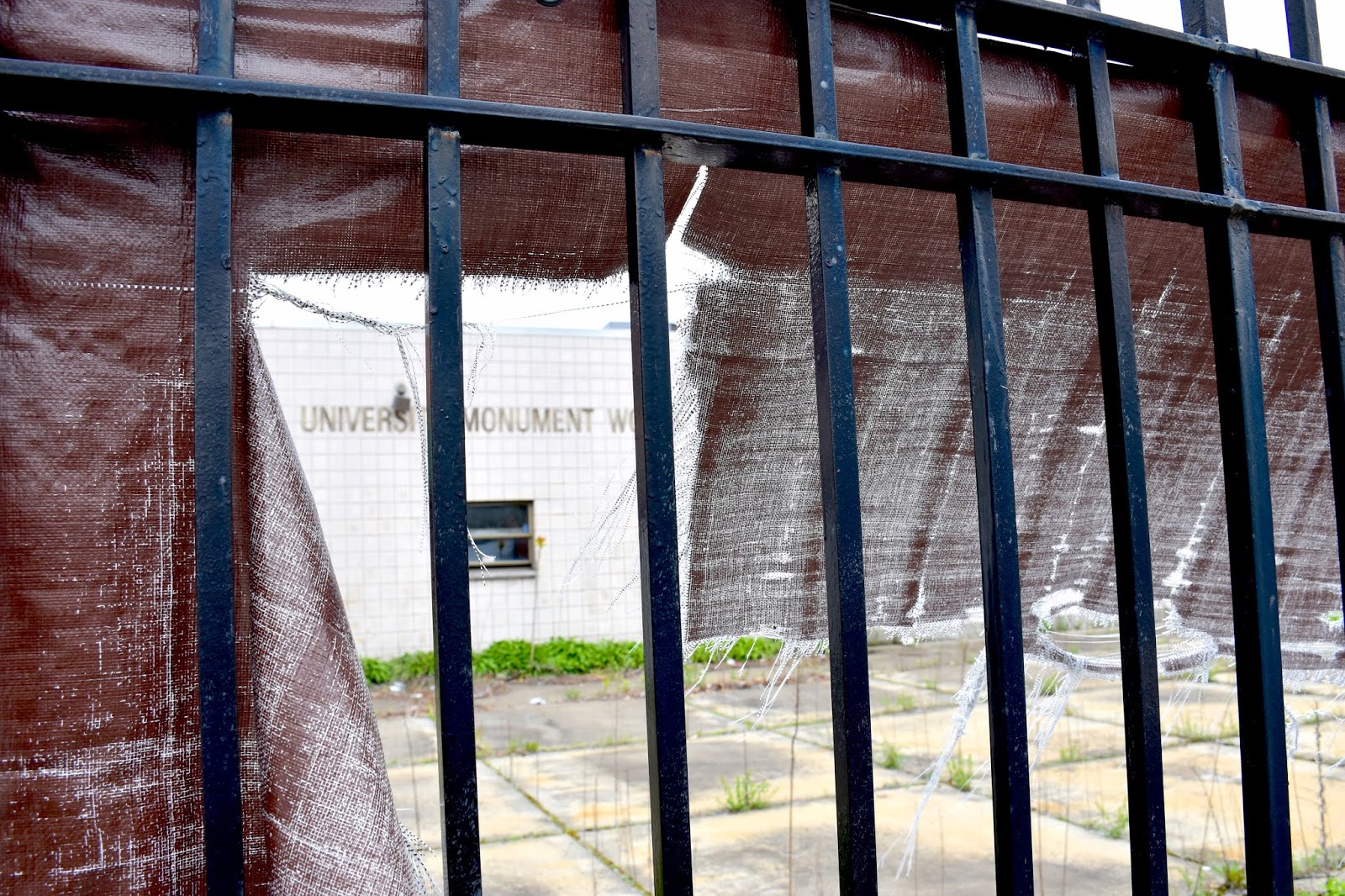
The University Monuments showroom at the corner of Cambridge Street and Webster Avenue has been abandoned for years, as well. A developer has proposed demolishing the warehouse and showroom buildings and putting up -- wait for it.... -- apartments on top of commercial space.

Founded in 1903 by Italian immigrant, James Denaro, Automatic Cone Company manufactured cake cones, and also invented and patented the Icy-Pi, per the web site for Por-Shun, a dairy distribution company that acquired the Cambridge company. As for University Monuments, I know it was in business a long time, but I haven't found out information about when it launched and when it closed up shop.

Not much to say about this sign, except I like how long it's obviously been telling people, "Piss off and get the hell away from our driveway!"

Now for a different type of mural than I've seen around the area before.

This is an ad for a five-night stint that British punk/folk singer-songwriter Frank Turner played at Boston's Royale club in late June and early July 2018. I took this picture in May 2019, and the ad was still there when I returned to Inman Square last fall. I've never seen an ad for a concert painted on a wall. I'm guessing there have been others in the Boston area, but I doubt they last very long.

Speaking of murals....

Painted by Ellary Eddy in 1980, and restored by the artist in 1999, this fantastic mural is a showcase of Inman Square. Located on the station for Engine Co. 5, the painting dominates the major intersection of Hampshire and Cambridge streets. You need to enlarge the photo to see George Washington and Ben Franklin, along with firefighters. For an explanation, read this Centers & Squares blog post. Below is the station.

I'm gonna wrap up with two churches, and a photo that I think is cool but that has no backside connection.

The First United Presbyterian Church is just up Cambridge Street from the firehouse, heading toward Harvard Square. Built in 1892, the church has always been occupied by the FUPC congregation, according to this history.

The Immanuel Seventh Day Adventist Church, below, dates to 1940, according to the City of Cambridge assessing department, but I'm guessing it's older.

As I was pointing my camera at the door, a teenage boy was exiting. I quickly dropped my camera, and he went back inside. I snapped a quick shot and moved on.

Finally, a cool window display at a travel agency along Cambridge Street.

For more recent posts about Cambridge, see June 23, 2020, "Walking Through the He(art) of Central Square" and April 3, 2020, "Walking Through a Waterless Port."

Checking Out Dudley Street in Roxbury...and a Historic, Pre-Civil War House

From Dave Brigham: As part of a series of quick-hit jaunts through Boston this spring, I checked out the outer reaches of Nubian Square, m...