Showing posts with label dive bar. Show all posts

Saturday, May 3, 2025

Kicking Around Downtown Everett

From Dave Brigham:

I take pride in coming up with clever headlines for my posts. I often rely on song titles or lyrics or other music-related terms ("Sneakin' Sally Through Boston's Alleys" came from a Robert Palmer song; "Things Are Poppin' in Windsor Locks" derived from two styles of street dancing). Other times I riff on the name of the town or city ("The Shire of Worcester, Part the Fifth,").

I came up empty while brainstorming about the downtown area of Everett, Mass., a city of nearly 50,000 residents just north of Boston. I tried to work something using former big-league baseball player Carl Everett, known by some as Jurassic Carl for his, shall we say, far out views on the world (denying the existence of dinosaurs, disputing that man has ever landed on the moon). In prior posts about the city, I had better luck (see September 30, 2023, "A Nutty Trip to See Some Signs in Everett" played off the Teddie Peanut Butter factory; May 4, 2019, "Roll the Dice: Encore!"; and June 25, 2013, "Roll the Dice") dealt with the city's casino. But those headlines had little to do with the city of Everett proper.

No matter. Lame headline aside, I've come up with another fantastic post (#906!) featuring a beautiful library, a gorgeous church, a nicely maintained armory and much more. Let's get to it!

The Palestine Masonic Lodge caught my eye first.

It looks practically brand new, all spiffed up and ready to greet the day. Often, when I see a Masonic building, it's closed up or in somewhat rough shape. Built in 1910 along Broadway, just south of the old high school, the lodge was erected to replace a previous building that burned down in a different location.

From MACRIS: "Like Masonic lodges across the country, the Palestine Lodge grew in membership in the first decades of the 20th century. In 1910, the lodge reported 465 members. By 1918 membership had grown to seven hundred and sixty-five and by 1926 the lodge had the third largest membership in the state with 1200 members. Interest in freemasonry and fraternal societies declined after 1930. This trend was evident at the Palestine Lodge, where membership declined to 825 by 1943. The Palestine Lodge continued to own and occupy the building at 536 Broadway until the early 1980s, when it was sold due to lack of funds to maintain the property. From the mid-1990s to 2019 the building was owned by the Islamic Association of Massachusetts."

The building sat vacant for a while before being redeveloped into apartments. "It houses 15 apartments consisting of a mix of studio, 1-bedroom, and 2-bedroom units. 3 units are designated as income-restricted and will be rented to households earning at or below 80% AMI (Area Median Income)," per this Maloney Real Estate listing.

Continuing north-northeast on Broadway, I liked the look of the sign outside McKinnon's Supermarket.

A five-store chain of stores in Massachusetts and New Hampshire, McKinnon's has been in business since the 1940s.

I continued all the way to Ferry Street, and then turned around. I didn't see much of note until I'd gone past the Masonic Lodge again and into the heart of Everett Square.

Dempsey's Breakfast & Lunch has been operated by the same family for years. I'm a little unclear on just how long the eatery has been in business. From the restaurant's web site: "From the original Donut Villa that opened in 1976 to Dempsey’s today, The Nentis Family has provided excellence in food service for over 39 years to Everett and the surrounding cities."

The MACRIS file on this building shows an old photo of Donut Villa. There are Donut Villa locations in Arlington, Cambridge and Malden. Their eatery in Newton didn't last very long. The building dates to 1940; previous tenants included Oliver's Stationery Store and S.K. Ames, which sold butter, cheese and eggs, per MACRIS.

Across the square from the diner is a rounded, two-story office building painted a distinctive shade of green.

The Everett Trust Company Building opened in 1919. The bank was establshed elsewhere in 1910. An addition on Chelsea Street, below, was built in 1921.

Now home to Iglesia Pentecostal Unida Hispana (United Hispanic Pentecostal Church), the addition was home to a post office for a number of years. Subsequent to that, the space was occupied by a Waldorf Restaurant, per MACRIS. I wrote about another old Waldorf Restaurant, this one located in Fall River, last September. Waldorf was a cafeteria-style restaurant popular in the middle part of last century in various locations across several states.

I continued east-southeast along Chelsea Street for a little bit until I saw a side-by-side clash of colors and histories.

On the right is Zeke's Pub, which I'll discuss in a minute. On the left is Super JC Market, which sells groceries and includes a pharmacy and a cafe.

The market is located in a circa-1925 building that was originally the Melanson Brothers Chevrolet dealership. A photo in the MACRIS file shows that this was also a BMW dealership in more recent years.

As for Zeke's, it has been slinging drinks since 1940, according to its sign.

This joint has a 3.8-star average on Yelp, based on four reviews.

A few steps further east brought me to the front of the Edward G. Connolly Center.

Like me, you may have guessed that this building's original purpose was as an armory. Built in 1902 in the English Revival style, the Everett Armory "was the home of Company B, 8th Regiment Infantry, Massachusetts Volunteer Militia," according to MACRIS. "In its early years the company provided assistance after the Chelsea Fire of 1908 and during the Lawrence Mills labor strike of 1912. The Armory building was taken over by the State in 1910 and was completely renovated for use by the company."

The renovation included a rifle range and two bowling alleys in the basement. "The building was used for military activities through the Vietnam War era but was also the site for various community functions including banquets, exhibitions and social events including military balls," MACRIS continues. "The City of Everett received the building from the National Guard in the 1970s and it received additional renovations in 1989. In October 2006 the building was renamed the Edward G. Connolly Center in honor of longtime state representative and former mayor, Edward G. Connolly."

At this point, I doubled back to Everett Square.

On the left in the photo above is La Hacienda, a Mexican/Salvadoran restaurant located in a circa-1926 building that was originally home to a Kresge department store. I've written about Kresge stores before, in Waltham and New Bedford.

The middle building is the aforementioned Dempsey's Breakfast & Lunch. The third building, the old Everett Savings Bank, I will discuss below.

I headed south on Broadway and was stopped in my tracks by the Frederick E. Parlin Memorial Library.

The main part of the Richardsonian Romanesque library opened in 1894. The addition, seen in the two photos above, dates to 1912, and was designed by the same architect, John C. Spofford, and matches the design of the original building.

Next door is the Central Fire Station, which dates to 1908 and looks to be in fabulous shape.

Renovations were completed in 2020.

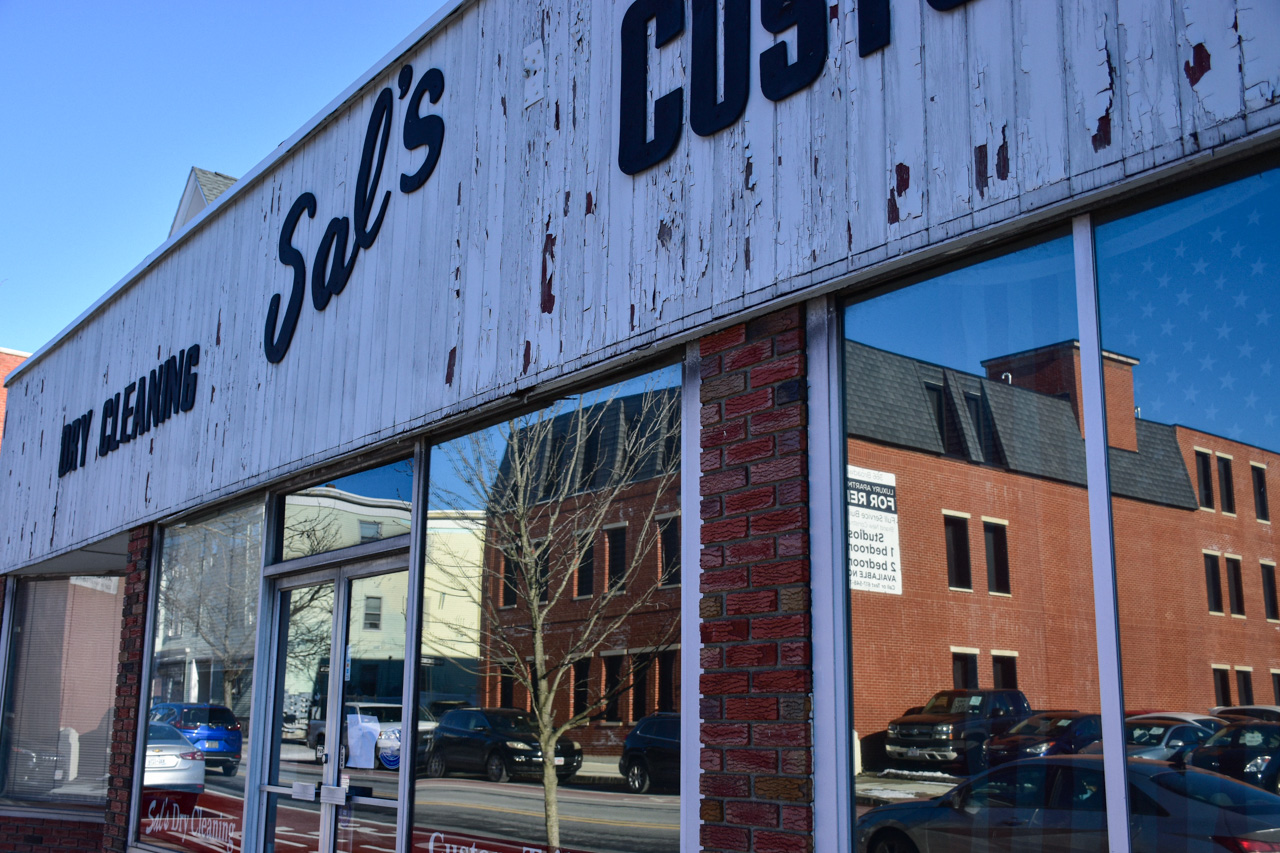
Just a little further south is the shuttered Sal's Dry Cleaning.
At this point, I turned around and headed back toward Everett Square. There, I spied two great old buildings abutting the previously mentioned Everett Trust Company Building.

Completed in 1896, the Evans Building was built by Alonzo Evans, who served as the city's first mayor and was the president of the Boston Five Cents Savings Bank, per MACRIS. "The Evans Building contained two stores on the ground story and offices above," MACRIS continues. "The third story, known as Arcanum Hall, was used as meeting space by various clubs and civic organizations and for special functions."

Current tentants include a deli, a smoke shop and an insurance agency.

Next door is the imposing and beautiful Arthur H. Whittier Building.

Built in 1900, the Renaissance Revival building was originally occupied by Arthur H. Whittier & Company, a grocery store. Subsequently, F.W. Woolworth opened a store on the first floor. Current tenants include a T-Mobile store, a Brazilian market and the Skyplex function hall.

From there I headed west on Norwood Street. On the side of Angelo's Touch Hairstyling, I found this amusing mural/ad.

Yes, artist Juleen Jones has turned Vito Corleone's threat against a Hollywood big shot in "The Godfather" into a tagline for a hair salon.

Across Norwood Street, I dug the sign for Taco El Paso.

At the intersection of Norwood Street and Broadway is another in a long line of buildings I've documented here with an "X" on it, which indicates to firefighters that the building is not safe to enter in case there's a conflagration.

Built in 1877, this Second Empire brick building holds a few important places in Everett's history. First, per the photo on the MACRIS file, the building once housed a Brigham's Ice Cream restaurant. Second, it was the first masonry block to be erected in Everett Square, according to MACRIS, and "is also the second oldest (sic) building in the square, pre-dated only by the First Congregational Church." I will discuss that church below.

MACRIS continues: "Originally known as the Whittier & Dearborn Building, the block was soon renamed the Library Building. The city's first public library, organized in 1878, was located here until the Parlin Library was constructed in 1894-95. The other tenant and later owner of note was the Odd Fellows Association, organized locally in 1875."

I hope someone can turn this place around, given its illustrious past.

Just north of the previously mentioned Dempsey's is a great little building, the former Everett Savings Bank.

Currently home to Regal Mexican Grill, this Classical Revival gem dates to 1885. Although built as office space, it was converted to use as a bank in 1889. Everett Savings remained in this location until 1930, per MACRIS, when it moved to a newer building that will be featured below. Since that time, a variety of small businesses and retailers have operated here.

A few buildings away is the gorgeous Everett First Congregational Church.

Now home to Igreja Universal, this Italianate stunner dates to 1852 and is oldest surviving structure in Everett Square, according to MACRIS. "The first Everett town meeting was held here on March 21, 1870. The church was incorporated in 1891 and a year later remodeled and rededicated."

The final stop on my downtown Everett tour was the newer Everett Savings Bank building. The sun was tough, so I apologize for the photo.

You can't tell from my photo, but this building is fairly impressive. "This sandstone building, designed in the Spanish Colonial Revival style (infrequently seen on the east coast (sic)) is one of the most distinguished in Everett Square," according to MACRIS. "The exterior walls are decorated with figured panels; multi-pane windows are outlined with rope molding and the arched heads terminate in panels filled with animal and foliate ornament. An arcaded frieze and Moorish cornice finish the major elevations."

Opened in 1930, the building is now home to the Pioneer Charter School...I think.

OK, that's all folks!

Saturday, October 5, 2024

Goin' ta Southie, Kehd

From Dave Brigham:

Last spring, I hung out with my buddy (and photography guru) Joe Viger in South Boston, a neighborhood I've visited plenty of times (see links at bottom of this post) while somehow missing a LOT. I'd mentioned in a public post on Facebook that I felt the need to see friends who I hadn't seen in a while; Joe replied that he'd been having the same thought. We had a great time catching up and making photos. Here's some of what we saw....

While zooming through South Boston on Google Maps looking for things to check out on our walk, I was instantly curious about the Whitey McGrail Monument located on an island of land surrounded by East 6th Street, Farragut Road and William J. Day Boulevard. I decided that needed to be our first destination. And boy was it a doozy!

It's gotta be tough to be "the other Whitey" in South Boston, aka Southie. For those who aren't familiar with the history of this Boston neighborhood, Whitey Bulger was a ruthless crime boss who was an FBI snitch and then went on the lam for 16 years after getting tipped off by his handler of an impending arrrest. He was eventually captured, found guilty of multiple crimes and beaten to death in prison in 2018 at the age of 89.

Robert "Whitey" McGrail, however, seems to have been up to the difficult task of moving in Bulger's shadow. McGrail "used to walk the boardwalk of Carson Beach, in his fancy outfit and greet one and all," according to this tribute web site. He owned a bar, Whitey's Place on West Broadway (now known as Croke Park, a place I will feature below) for years, before being gunned down there in 1985 at age 47, allegedly over a gambling debt, according to this Medium article. "No connection to Bulger was ever proved," the article indicates, "but that’s how things used to roll in Southie. Nobody said nothing. Not if they knew what was good for them."

Inscribed on the monument is a poem, which reads in part:

IT BROKE MY HEART TO SEE HIM GO

FOR THERE WILL NEVER BE ANOTHER YOU KNOW

THE "WHITEY STORIES" ! HEARD AS WE SAID GOOD BY (sic)

MAN, HE WAS ONE HELLUVA GUY

I'LL MISS THIS POLITICIAN, THIS BANKER,

PRANKSTER, AND LOVABLE HAM

HE MADE ME STAND TALL, HE MADE ME PROUD

HE MADE ME WHAT I AM

HE WAS SOUTHIE PRIDE, HE WAS WHITEY

The final line is: WHO AM I? I AM SOUTH BOSTON

The Southie of the two Whiteys, of organized crime and bloody gun battles, of the Irish-Catholic influence and blue-collar residents, has faded significantly in recent years. Like many Boston neighborhoods, Southie has gentrified, with expensive apartment and condo buildings rising in many locations, and high-end bars and restaurants catering to the newer residents.

My guess is that the bike below, spotted along N Street, belongs to a newer resident.

I don't know anything about this bike, other than it looks cool. Is it vintage? Is it a reproduction? Is it expensive? Does it ride well? Can you twirl your hipster mustache while carrying locally sourced hops for your home-brewed beer in one hand? I don't know.

On the same street, I saw a nice old architectural detail on a front door.

Joe and I walked through Medal of Honor Park on East Broadway, before heading west on that avenue. There's a lot of great architecture along here. I was quite taken by the double entryway below.

From East Broadway, we cut north along L Street. At the corner of L and East 1st streets, Joe and I each made a shot of some faded warnings stenciled onto the brick.

"POST NO BILLS" signs, to me, speak of times gone by, when folks would paste posters to brick walls for upcoming concerts or other events. "POLICE TAKE NOTICE." Do they really?

On the same corner, but opposite wall, of that building -- home to Commune Hair Boston -- is a ghost sign for Condit Electrical.

On K Street, on the exterior of Lifted Fitness, I had to make a photo of the homage to Lucky the Leprechaun, the Boston Celtics mascot.

I'd made photos in this part of Southie before, and I knew that Joe would love Ethel & Andy's, at the corner of K and East 1st streets.

Good to see some old school still left in the neighborhood, which is slated to change drastically when the redevelopment of a former Edison power station is completed.

On the corner of K and East 3rd streets is another nice slice of local flavor.

We got back onto East Broadway and headed west. I really like the 6 Twelve Convenience sign, and frankly, the name of the store, because it tells me everything I need to know.

Steps away, on Emerson Street, is Tom English's Cottage. Check out that Facebook page - it's very entertaining!

I'm not sure how long this place has been in business, but I'm assuming at least a few decades. For a sense of what it is/was like, check out this blog post.

We got back onto East Broadway and stopped at another place I'd made note of in advance: South Boston Candlepin.

These lanes have been been run by the same family for more than 20 years. I'm guessing this place has been around a lot longer than that.

Another place I had on my radar was the former Broadway Theater at 420 West Broadway, in the heart of New Southie, surrounded by bars and restaurants where Gen Zers and Millenials hang out. In the photo below, you can see (if you zoom in) a medallion with "BT" for Broadway Theater on it.

"Opened in 1920 as a vaudeville & movie house, the Broadway Theatre was designed by architects Clarence H. Blackall, Clapp and Whittemore," according to Cinema Treasures. "Following a fire, it was rebuilt in 1938 to the designs of architect Clarence Kivett. By 1957 it was operated by Daytz Theatre Enterprises Corp. By 2011 it was standing vacant & boarded up and was still the same in November 2020. By August 2022 it had been converted into 42 condominiums named The Mezz."

Continuing west-northwest on West Broadway, we came to the aforementioned Croke Park.

Named, I assume, for the Dublin, Ireland, home of the Gaelic Athletic Association, Croke Park is another holdout from Old Southie. In 2016, Esquire magazine named the joint one of the best bars in America.

Moving along to a place that is so money!

In business since 1932, Boston Cash Register provides, uh, cash registers and point of sale systems to business clients.

Our journey west ended at Al’s Liquors, which has a classic old-school sign.

But the real attraction for me is the Irish-American pride mural on the side of the building.

This mural has been here for years, and seems to get spruced up every once in a while. I recall when I first moved to the Boston area, my buddy Jim, who grew up in Somerville, drove me around Southie and I recall there being other murals similar to this one. This seems to be the sole survivor.

Heading east on West Broadway, I spotted two tile entryways, one for a current business, which I was very happy to see, and one for a long-gone operation. The first is for the Southie outlet of J.P. Licks, a great ice cream shop.

Founded in 1981 in Boston's Jamaica Plain (JP) neighborhood, the ice creamery has nine locations in and around Boston.

A little further up the boulevard, I made a photo of an old entryway, this one in front of a 7-Eleven shop.

Pober's was a department store that sold "high-end" clothing for kids, including Communion dresses, from what I've seen online. There was also a shop in Taunton, Mass., and possibly other towns and cities.

In between the tile entryway buildings sits the shuttered South Boston Chinese Restaurant.

Looking through Google Street View's chronology, I believe the eatery was in business from at least 2007 until 2021/2022. I'm intrigued by the green tilework underneath the sign, and would love to know what store or restaurant was here in years past.

The next sign, located in front of a shuttered small business on East Broadway, is almost too perfect.

I mean, come on! A sign that says "DeKay" with faded paint in front of an insurance and real estate office that's out of business? How could I resist making a phot of that!

I should probably do more of these types of strolls at night, so I can catch some lighted signs. I'm not sure the one shown below for Joseph's Bakery + Deli lights up anymore, as the place is (technically) out of business.

Located at 258 K Street, Joseph's was run by the Masciave family from 1967 until 2023, according to this Caught in Southie article. The deli part of the business closed for renovations in May 2021, but never reopened. The building was sold in 2023, but Annie Nikollo, who had operated the bakery side of the business since 2012, effectively moved the bakery to the corner of L Street and East Broadway, under the name Annie's Bakery & Cafe.

Directly across East 4th Street from the former bakery location is the Boston Fire Department's Engine 2/Ladder 19 house. Behind the main station is a hose-drying tower that caught my eye.

The station opened in 1932, according to the Boston Fire Historical Society. I believe the tower -- which I assumed was used for training -- was built at the same time.

Just to the east of the station is the original Engine 2 firehouse, which was built in 1857.

In 1857 the firehouse was occupied by Hand Engine Company 14, according to the Boston Fire Historical Society, before the reorganization of the Boston Fire Department in 1859. Engine Company 2 was organized in this station on September 17, 1860.

The building is now home to the Thomas J. Fitzgerald VFW Post 561.

In 1935-36, the Works Progress Administration, a "New Deal agency that employed millions of jobseekers (mostly men who were not formally educated) to carry out public works projects," according to Wikipedia, did some sort of work on the old station. I'm assuming the WPA worked to convert the firehouse to use by other organizations, such as the VFW post.

(WPA plaque on the front of the VFW hall.)

The final stop that Joe and I made was the L Street Bath House.

Located at the foot of L Street where it meets William J. Day Boulevard, the bath house was built in 1931, and is also known as the James Michael Curley Recreational Center. The brick and concrete Art Deco structure spans 1,000 feet in length, and is 44 feet deep. When it was built, it featured hot salt-water showers, hand ball courts and a solarium. You'll notice the MEN'S BATH HOUSE carved above the door. At its construction, there were sections for women and girls and one for boys. I'm not sure how the place is laid out these days.

The bath house is home base for the L Street Brownies, a swimming club known for its New Year's Day plunges in Dorchester Bay. "Organized in 1902, it is one of the oldest such clubs in the United States," per Wikipedia. Women were admitted to the club in 1915.

HEADLINE EXPLAINER: According to WBUR's guide to Boston slang, "kid" is a "term of endearment that doesn't only apply to children. For example, you might say: 'Nah, kid, I went to the store next door.' Can be used kind of like 'dude or 'this guy.' Those with a Boston accent will say it like 'kehd.'"

For more on South Boston, check out the links below:

August 27, 2020, "Circling Andrew Square"

January 25, 2020, "The Walk of Fame"

June 25, 2019, "Wool-d You Like to Join Me For a Walk?"

January 12, 2019, "Power Move in South Boston"

November 17, 2018, "Southie to Lose An Institution"

April 22, 2018, "Fort Point Channel - It's Electric!"

February 1, 2017, "Bon Voyage, Lady"

November 17, 2014, "Whitey Wuz Here"

Saturday, May 4, 2024

Seeking Out Hyde Park

From Dave Brigham:

In what seems another lifetime, I played in an over-40 men's baseball league. I played many games in Hyde Park, and enjoyed my drive through Cleary Square on my way to or from games. Recently I realized a years-long goal: I returned to that Boston neighborhood to make photos.

My first stop was a place I'd been to in more recent years, for my son's friend's birthday party, Ron's Gourmet Ice Cream and Bowling, in the heart of the square.

From the establishment's web site: "Ron Covitz is the patriarch of Ron’s Gourmet Ice Cream. The business was started as the Twentieth Century Bowling Alleys by Ron’s father, Julius. A family recreational facility, it housed 10 lanes of candlepin bowling and an 18-table pool hall....A 'foodie' before the term was popular, Ron knew he would not be happy making just average ice cream. He knew then as we know now that the best way to be successful is make it better and fresher than all of the competition."

It's a true family operation, with various members of the Covitz clan working there over the years.

Just south of Ron's along Hyde Park Ave., I couldn't resist making a photo of ODB Liquors.

"Why?" you may ask, if you aren't familiar with the Grammy-nominated, and possibly greatest rap collective of all time, Wu-Tang Clan. One of the Clan's members was Ol' Dirty Bastard, otherwise known as ODB. I'm not a Wu-Tang fan, but I do like the explicit "Shimmy Shimmy Ya" that ODB issued on his own.

As for the building housing ODB Liquors, it's known as the Thomas F. Fallon Block. Built in 1916, its tenants include retail stores on the ground floor, and small businesses located in office space above. Below are a few more retailers (and a possible ghost sign) located along the River Street-facing side of the block.

Back on Hyde Park Avenue, I found myself wanting to go back in time when the New England Baptist medical office building was in its prime.

The bones of this building seem solid, but it needs a refresh. I wonder if there was a clock in that empty circular spot.

Heading east on River Street, I liked the building housing Mr. G's Laundromat and Delicias Columbianas restaurant.

As with too many towns and cities I explore, I saw plenty of empty storefronts in Hyde Park....

...but I also saw two theaters, a storefront church and much more.

Located on Farimount Avenue, the Everett Square Theatre opened in 1915, hosting moving pictures, vaudeville shows and live music in its early years. "In 1933, Everett Square, where the theater was located, was renamed Logan Square, and the following year the theater was renamed the Fairmount Theatre," according to this article at After the Final Curtain (there are some great photos at that link as well). "By the mid-1940s the theater had discontinued the live performances and only showed motion pictures."

In the 1960s, the theater was renamed the Nu Pixie Cinema; in the 1980s the name was changed yet again, to Premiere Performances, as live acts returned to the space. Later on that decade, the old theater was used as an auction house before shuttering, according to After the Final Curtain.

In more recent years, Historic Boston, Inc. and Hyde Park Main Streets worked with the building's owner to re-create and install a new sign out front, and to restore the theater's foyer. In 2018, the owner was able to install a new roof.

I'm not sure of the status of further renovations. I hope someday that the Everett Square Theatre will reopen.

Adjacent to the old theater is a nice old building whose current tenant is the Bethesda Haitian Baptist Church.

As regular readers of this blog know, I have a thing for houses of worship, including ones located in non-traditional spaces. While things seemed pretty quiet at the Baptist church, I did hear music and preaching coming from other small churches along Fairmount Avenue and other locations during my expedition.

I was pleasantly surprised to see another theater marquee just two doors down from the Everett Square joint.

Riverside Theatre Works is located in the circa-1897 French's Opera House/Masonic Temple/Odd Fellows Hall. "French's block was originally constructed in 1897 but was ruined by fire 15 rronths after its opening," according to MACRIS. "Immediately rebuilt, the block was conpleted in 1899 and retained parts of the earlier facade. A more ambitious building than its predecessor, the 1899 block included an opera House (sic) with a 700 seat auditorium and, on the third floor, and odd fellows Hall (sic). In 1915, as the plaque on the building suggests, the interior of the block was renodelled for use as a masonic hall (sic)."

As for Riverside, it is a "rare community theater with a proscenium stage – and the only live theater venue in Hyde Park," per the troupe's web site. The 14,000 square foot facility "features a 156-seat opera house, a spacious dance studio and rehearsal space, a scene shop, a lounge, and several meeting and rehearsal rooms."

There's also a sweet ghost sign on the southeast-facing wall.

At the intersection of Fairmount Avenue and Davison Street there is a banner, installed by Hyde Park Main Streets, recognizing the 54th Regiment, the first military unit consisting of Black soldiers to be raised in the North during the Civil War.

From the Massachusetts Historical Society: "By the middle of February 1863, recruiting for the Fifty-fourth Massachusetts Regiment was underway. Newspaper advertisements and recruiting posters...encouraged Black men to enlist. Twenty-five men responded promptly, and by the end of the first week of enlistments seventy-two recruits were present at Camp Meigs in Readville (now Hyde Park), Massachusetts. However, more soldiers were needed and recruiters turned their attention to states throughout the North and South and into Canada to locate enough eligible Black men to fill the regiment. By 14 May 1863, the regiment was comprised of 1000 enlisted men, and a full complement of white officers."

I knew that the 54th Regiment was raised in Massachusetts, but I had no idea before wandering around Hyde Park that this neighborhood was the epicenter of that effort.

Laly's Market, which took over for Andrea Mini Market in recent years, is located in the Way Building, a circa-1903 Georgian Revival commercial block that rounds the corner from Fairmount Avenue to River Street.

Continuing northeast on River Street, I liked the sign for Kenney Cleaners, which looks like it's been there a while.

In the other end of the low-slung commercial block is Master McGrath's, an Irish bar.

From there I made my way west to the Hyde Park branch of the Boston Public Library. While both the old and new parts of the library are quite attractive, I was more interested in the slabs of stone parked in the north lawn.

This is a granite foundation stone from the former St. Catherine's School in Hyde Park. The foundation was built by Thomas Corrigan in 1895. The church was demolished in 1966.

Nearby are two architectural fragments from the cornice of the former Hyde Park Railroad Station, which was built in 1914 and torn down in 1964. One of them is pictured below.

Across the street from the library lawn is the former Hyde Park High School, which is being converted to studio, 1- and 2-bedroom rentals for the 62+, mixed-income, LGBTQ-friendly community.

Known as The Pryde (see what they did there?), the complex is a renovation partnership between Pennrose and LGBTQ Senior Housing, Inc.

As for the building, it was built in 1902 and was "originally known as the Hyde Park High School...[and] was constructed...as the first purpose-built public high school for the Town of Hyde Park, which was incorporated in 1868 and annexed to the City of Boston in 1912," according to MACRIS. "The 1902 building served as Hyde Park High School until 1929, when the Boston School Department completed construction of a new Hyde Park High School at 655 Metropolitan Avenue. From 1929 through 2015, the building was used as a public intermediate school known as the Rogers School."

Just around the corner, at the intersection of Everett Street and Central Avenue, is the Menino Arts Center, named after former longtime Boston Mayor Thomas Menino, who grew up in Hyde Park.

The building, which dates to 1899, is also home to George Robert White Trust, which owns the stadium in Boston's Franklin Park, about which I will post in the coming weeks.

In between the arts center and the library, across from the old high school, is a building that looks as though it could've been an academic administration building. On the day I visited, it was listed for sale. It's most recent tenant was New Beginnings Academy.

Along Harvard Avenue is the Cecil W. Fogg/Thomas J. Roberts Post #78 of the American Legion.

I ducked back down Everett Street, heading west, to check out a church located in a non-traditional space.

The somewhat ominous sounding Pentecostal Church of the Last Hour was in the middle of a service on the day I walked by. I could hear preaching and music. The congregation is located in an industrial building that several years ago was home to a dry cleaning service.

I doubled-back to Harvard Avenue, and saw two nice little buildings near the intersection with River Street.

Fan Fan Bakery is located in a late-19th century commercial building, and has been in business more than a decade. Prior tenants included Las Vegas Seafood Restaurant (!?!).

Across the street is a building and company that really intrigue me.

Built in 1924, this building is home to Klein Post Card Service, which sells calendars, logo apparel and Boston and Cape Cod souvenirs. In business since 1974, Klein is a family owned business. I thought this company was a relic of another age, but I'm happy to see it's still active.

Back on River Street, I spied a great mural on the side of New York Fried Chicken.

Featuring Mayor Menino and a cast of dozens, this artwork depicts, I believe, a Hyde Park parade from the 1990s.

Last but not least, a shuttered dive bar, located just north of our starting point, Ron's Gourment Ice Cream.

The Cottage Cafe closed in late 2017 after what I'm assuming was decades in business. The building dates to 1940.

Way Down Yonder in Pawtucket, Part I

From Dave Brigham: I apologize in advance for this, but I often feel the need to explain my headline choices: I'll admit that befo...