Located in a "four corners" area where Acton, Sudbury and Maynard meet with the southwest corner of Concord, Powder Mill Woods Conservation Area is a peaceful little oasis with an explosive past.
"The area has a 100-year history of gunpowder manufacture, the depressions in the landscape ideal for protecting individual buildings," according to the Town of Concord's Powder Mill Woods Trail Guide. "Trails follow 19th-century cart paths and narrow gauge railroad beds once used to move materials among separate buildings of the production process."
I knew from looking at the trail guide ahead of time that I'd stumble across the twisted rails shown below, but I still was pleasantly surprised.
"These narrow-gauge rails are relics of a railroad used by the American Powder Mills and other gunpowder manufacturing companies that once operated here," according to a sign posted next to this display of gnarled metal. "Horse-drawn rail-mounted carriages hauled materials on the railroad from as early as 1880 until at least 1913."
There are other small remnants spread throughout the woods.
As I strolled along, I was aware of fences and "No Trespassing" signs along the northern perimeter. That's because between the conservation area and Main Street, there is the Nuclear Metals, Inc., site. "The Nuclear Metals, Inc. site – also known as the Starmet Corporation site – is located on a 46-acre parcel in Concord, Massachusetts," according to this U.S. Environmental Protection Agency web site. "Nuclear Metals made depleted uranium products, primarily for armor-piercing ammunition. It also manufactured metal powders for medical applications, photocopiers, and specialty metal products such as beryllium tubing used in the aerospace industry. From 1958 to 1985, waste was discharged into an unlined holding basin. Facility operations contaminated soil and groundwater with hazardous chemicals. Following immediate actions to protect human health and the environment, the site’s long-term cleanup is ongoing."
I'm not sure what will become of the site once it has been cleaned up entirely.
I knew from the trail guide that there were ruins in the area, so I kept tromping until I found them.
Gunpowder production began on this site in 1835. "At its peak, production involved forty buildings scattered throughout the 400-acre area in Acton, Concord, Maynard, and Sudbury," according to the trail guide. "The mills produced 1,000 lbs. (450 kg) of gunpowder per day during the American Civil War."
"Ruins of these buildings and the roads between them can still be found in the land along Forest Ridge Road, both sides of Route 62, and in the Thoreau Club property. Remnants of a large concrete building can be seen beside the old roadbed that passes through the northeast corner of the Thoreau Club land."
Those concrete ruins are what I photographed here.
Nearby I checked out some cabins associated with the Thoreau Club's summer camp.
The club was founded in 1951 by Clifford and Dorothy Pulis. The camp "was the fulfillment of a dream to create a day camp where they could share their love of nature, the outdoors and their camping expertise," per the club's web site. "Incorporating their own wilderness camping experiences and a quote from Henry David Thoreau’s Walden, 'Every morning an opportunity to make life of equal simplicity with nature,' the...Pulis team created a unique camp environment that captured the feeling of the deep woods of Maine in rural Concord, MA."
Karl Malden (born Mladen George Sekulovich) was a legendary actor who starred on Broadway (Arthur Miller's "All My Sons," Tennessee Williams' "A Streetcar Named Desire") and in countless films ("On the Waterfront," "Baby Doll," "Birdman of Alcatraz"). I remember him best from "The Streets of San Francisco," a cop drama co-starring Michael Douglas that ran on ABC from 1972 to 1977.
The city of Malden, Mass., on the other hand, hasn't landed one stage, film or TV role since being incorporated in 1649. The small city located just a little north of Boston has, however, produced some famous folks: Tony/Oscar/Emmy winner Jack Albertson, whom I loved in "Chico and the Man"; Erle Stanley Gardner, author of the Perry Mason detective stories; musician Norman Greenbaum, about whom we'll learn more later; Edna May Oliver, who was nominated for Best Supporting Actress for 1939's "Drums Along the Mohawk"; and drummer David Robinson, who played in both the Modern Lovers and the Cars.
Ever since taking my son to Boda Borg, a "real-life questing" experience in downtown Malden several years ago, I've wanted to return to make photos. I recalled a main street with some cool old buildings. After a bit of research (An old diner!), last July I found time to explore. Below, you'll see and learn about what I found. You know how this works.
The first place I came across was one that made me say, out loud, to myself, not for the first time, "Oh, THAT used to be something!"
Currently home to a U-Haul Self Storage facility, this brick building along Eastern Avenue, near the intersection with Ferry Street, was originally Revere Knitting Mills.
From MACRIS: "The Revere Knitting Mills factory was built in 1921 with rear access to the Saugus Branch Railroad. In 1929 a rear addition was made to the original building along the railroad line. The Revere Mills suffered a serious fire in August 1938 and a strike in November 1938. After World War II the company moved to suburban Wakefield, closing operations in 1958."
The term "knitting mill" may sound quaint, as if a bunch of old ladies are rocking in sync in their chairs, nattering about the weather and slowly but surely completing scarves, hats and mittens. The reality was a bit different: low pay, long and grueling shifts, noisy and potentially dangerous machinery, children working without legal protection. Below is a video that gives you an idea of what it was like to work in a cotton mill in England in the 18th and 19th centuries.
I roamed quite a bit around downtown before I found my next photo target, but it was a damn good one.
This Classical Revival beauty was built in 1894 for Mrs. Edward L. Brown of Malden, according to MACRIS. It was "designed in 1894 by H.W. Hartwell & W.C. Richardson, noted Boston area architects, unrelated to H.H. Richardson," MACRIS continues. "The four story brick business block follows a standard plan for commercial buildings of the period with retail shops on the street floor and upper story offices, including a dining hall on the fourth floor."
"Sometime after 1930 the Malden Masonic Order relocated from the Yerxa (W.T. Grant) Building at 72-80 Pleasant Street to the Browne Building, renaming to the Malden Masonic Building," per MACRIS. "In 1972 a serious fire required substantial rebuilding of the Masonic facilities with a new entrance."
Nowadays, this building is known as the Residences at Malden Station, a pet-friendly apartment community with a 24-hour fitness center and two rooftop lounges.
Continuing east on Pleasant Street, I saw plenty of other nice buildings, starting with the old Malden Trust Company Bank.
Currently occupied by East Cambridge Savings Bank and Mixer eSports + Cafe (part of the Malden Gaming District, which includes Project: PUTT!, Rock Spot Climbing, Boda Borg [to be discussed below] and Station: Bistro & KTV), the Classical Revival Malden Trust building was completed in 1914. The building was acquired by Pioneer Bank in 1983, and by Eastern Bank in 1994, according to MACRIS.
Next door is Boda Borg, a questing entertainment business founded in Sweden in the mid-1990s, according to the company's web site. "Our Questing concept pioneered the Reality-Gaming business sector in an era of video games, reality television, and action movies," the web site continues. "People were drawn to a concept where they participate physically and mentally in exhilarating activities themselves. No movies! No video games! Just you and real-life Quests!"
My son and his friends had a blast here a few times back when he was in high school. Boda Borg took over the space formerly filled by Sparks Department Store, which had been in business for 94 years before closing in 2013.
Adjacent to Boda Borg is Super 99 Century, a discount store located in the former W.T. Grant Department Store space.
I've written a few times before about Grants, a department store chain founded by Malden native William T. Grant in 1906. Founded in Lynn, Mass., the chain grew to nearly 1,200 stores by the time its founder passed away in 1972 at age 96. Four years later, the company went out of business, "in part due to a failure to adapt to changing times [that] was probably accelerated by management's refusal until it was too late to eliminate the shareholder dividend," according to Wikipedia.
As for the Pleasant Street building, it was built in 1941 when Grants moved from its previous location in what is known as the Yerxa Block (located...somewhere in Malden), according to MACRIS. The Malden store closed in 1971.
Super 99's neighbor to the east is home to Zuru Zuru, a ramen restaurant, and The Downtown Paw, a doggy daycare facility. I've searched high and low online, but I haven't figured out any history for the building.
The place next door, on the other hand, was built in 1940 as an F.W. Woolworth store (aka Woolworth's).
Currently home to modern Asian restaurant All Seasons Table, this building was "named the 'most modern building in New England' when it opened in October 1940," per MACRIS, citing the Malden News. The Woolworth store closed in 1969.
Near the end of Pleasant Street, on the north side, is a little place named the Bychower Building.
I haven't found any information about this place, which is currently occupied by Gold & Diamonds, Etc.
Next door, close to the point where Pleasant and Main streets meet, is the Barrett Building, which has an interesting history and features a ghost sign.
(The Barrett Building, seen in the background.)
(Ghost sign for Black's Furniture on the side of the Barrett Building.)
From MACRIS: "Barrett's Building was completed and opened in March 1884 with a mix of craft-works, including a crockery shop and furniture factory on the upper floors, along with a meeting hall. Advertising signs for BLACK'S FURNITURE are still preserved on the side brick walls and match with directory listings and photographs to 1898-1900, possibly earlier to the original building as the oldest remaining commercial art in Malden Square."
Damn, those are some old ghost signs!
A meeting room on the third floor of the Panel Brick building was used for a time as a Red Men's Hall. Known officially as the Improved Order of Red Men, the fraternal organization "claims direct descent from the colonial era Sons of Liberty," per Wikipedia. Established in Baltimore in 1834, the Red Men held rituals and wore regalia "modeled after those assumed by men of the era to be used by Native Americans. Despite the name, the order was formed solely by, and for, white men," Wikipedia continues. The group lives on today, although not at this location.
Finally, in 1926 the Barrett Building's "middle bay was opened up at the ground floor level to become the entrance to the new Granada Theater which was built behind it," per MACRIS.
Around the corner, on Main Street, is the former home of another fraternal organization.
The Odd Fellows Temple, which has some impressively ornate details, dates to 1907.
Currently, the building is home to The Immigrant Learning Center, some law offices and other small businesses, I believe. Below is a ghost sign for a company called Insurance Express that was once located in the building.
On this exploration, I did a lot of walking without taking photos. Sometimes that happens on the backside. After checking out the IOOF temple, I doubled back along the other side of Pleasant Street, and then looped around to Exchange Street. In addition to some new apartment and office buildings, I found some cool public art and a ghost from the past.
"'Spirit in the Sky' is a mural painted...to honor Norman Greenbaun, who wrote the hit song 'Spirit in the Sky' and is from Malden....The mural was designed to be a vibrant piece of artwork for the City of Malden which fuels economic growth through Cultural Value, Educational Value, Historic Value and Community Engagement," according to a statement on the web site of artist Jesse Melanson. The giant mural is located on the rear of 110 Pleasant Street, facing Exchange Street.
At the rear of the former Woolworth's store, I spied an old sign for Woolworth Studios.
Surprisingly, I haven't found out any information about this part of the old department store chain's business. The current tenant for this space is the aforementioned Project: PUTT!
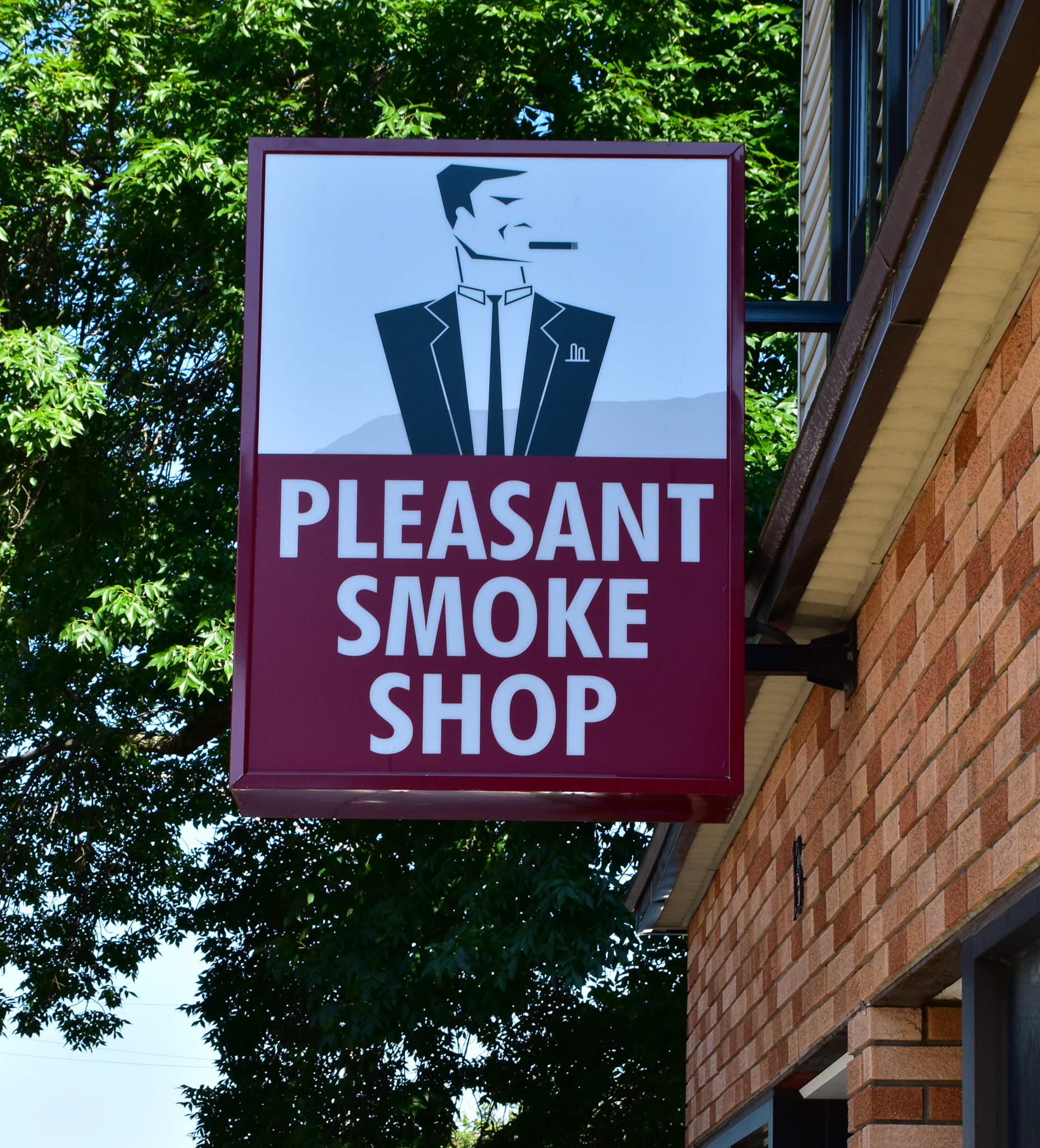
Along Irving Street, I spied a nice sign for Pleasant Smoke Shop, which has been selling cigars and accessories since 1982.
After a few minutes, I headed for the Northern Strand Community Trail, a bike path connecting Everett, Malden, Revere, Saugus and Lynn. I had no idea whether I would find some cool backside places, or whether I was putting undue strain on my bad feet and my sciatica for no reason. Over the years of exploring on behalf of this blog, I've found that old railroad rights-of-way that have been converted to community paths are pretty good places to poke along. Factories and warehouses that were once served by trains are often still standing witness to e-bikes, parents jogging with strollers, kids on bikes and middle-aged dudes with cameras limping along.
My gamble paid off once again, as I stumbled across the the top model train retailer in the USA.
Charles Ro Supply Company has been in business since 1972, offering "the largest selection and best pricing for all your model train & hobby needs," per its web site, which also claims the store is the world's largest dealer for Lionel Trains, a company owned in part by rocker Neil Young.
I visited the store twice many years ago when my son was young and totally into toy trains. My shopping trip was so many years ago, I thought Charles Ro was located in neighboring Everett, so I was pleasantly surprised to see the store and make a few photos.
I got off the multi-use path and headed north on Cross Street, as I was getting tired and needed to start working my way back toward my car. At the intersection of Cross and Salem streets, I saw a black awning with a faded sign for Salem Wood Cafe.
Shuttered in 2013 after what I'm assuming was at least a few decades in business, the restaurant received a good review from Boston's Hidden Restaurants, which described the joint as a "homey, well-worn working-class" eatery that offered good food in a no-nonsense location.
Further west along Salem Street I saw a one-story, four-bay retail building that has a Middle Eastern look to it because of the arched doorways and the red trim paint.
Known as the Zachary Zarsky Block, this Classical Revival building rose in 1925. Zarsky "was a pharmacist and business owner in Malden," according to MACRIS. "Zarsky was a native of Vilna, Russia. He began with ownership of the Red Cross Pharmacy in Gardner, Massachusetts. He came to Malden where he operated the Faulkner Pharmacy, also known as Zarsky’s Drug Store at 273 Salem Street....Zarsky acquired the land on which this building would be built in 1923 from Annie S. Towle....Original tenants included First National Stores, a grocery store, at 283, Roy Clough provisions at 285, Jacob Fitterman, tailor at 287, and Carmine DiMattia, barber at 289."
A little further along is a stunning apartment building: The Mount Vernon.
Located on the corner of Salem and Mount Vernon streets, this building was in the news more than two years ago, when the parapet at the roof line collapsed onto the sidewalk. Nobody was injured. As for the building, I haven't been able to find out when it was built. It looks to be in good shape now.
I followed Salem Street into Malden Square, near where I'd begun my adventure. I wanted to get a closer look at something I'd spied earlier in the day when I was making photos of the IOOF building.
There is a boomerang-shaped hole in the ground next to the brilliantly named Dentistry and Braces practice along Main Street, curving around to Ferry Street. As you can see, there are remnants of laths from the building that once stood on that semi-circular lot. I wanted to know what used to be there. I'm thankful that my old friend MACRIS and my newer friend Google Street View had some answers.
Known as The Auld-New Lounge, the building was built in 1912, remodeled in 1937 and 1974 and was considered by the MACRIS report author to be a "much-altered undistinguished commercial structure" that "may well be replaced," as of 1976. The building appears to have been torn down in late 2019 or early 2020. Below is a Google Street View photo of the building from November 2011:
As for what might fill the hole in the ground, I haven't been able to figure that out.
Heading south on Main Street, I absolutely had to make a photo of the building housing Kung Fu Tea, Thanh Danh tax services and Angel M Beauty Club.
Built in the Classical Revival style in 1902, 1-3 Pleasant Street wouldn't look out of place in a European village. Unfortunately, MACRIS doesn't have much to tell me about this place.
I continued south, across Centre Street, heading toward my car. I knew I had at least one building to shoot -- a recently revamped diner -- but another one caught my eye.
I'm used to seeing buildings with words carved into their facades, usually the name of a bank or a builder or a factory. This is the first time I've seen the name of a cleaning company: Golden Bell Cleaners. I wish I'd been more observant, as there is another business name carved into the south-facing facade: Boston Dye House, according to MACRIS.
"The Boston Dye House at 22-28 Eastern Avenue is dated 1927 by newspaper articles and archives blueprints," MACRIS indicates. "The present building is an addition to the original (1919) Boston Dye House building at 30-50 Eastern Avenue on a site occupied in 1912. The 1927 addition was constructed for the Golden Bell Cleaners, named after the founder Edward I. Golden, highlighted by gilded bells on the facade. The Boston Dye House building on Eastern Avenue remains a commercial landmark of Maiden Center, highlighted by gilded bells on the facade as signets of its identity."
After making the above photo, I crossed Main Street to get a better angle of the Breakfast Club, a diner that moved from Boston's Allston neighborhood due to redevelopment (see June 18, 2022, "I Love L.A.!").
Prior to the Breakfast Club, this was home to the Doo Wop Diner, from 1991 to April 2022. The eatery, so named because the owner's grandfather loved doo wop music, featured appropriately themed dishes such as The Chubby Cheddar, I Want to Hold Your Ham and Cheese and The Last Train to Belgian Waffles, according to this Neighborhood View article about the restaurant's closure.
Next, I made a photo of another neighborhood institution:
Doubling back toward my car, I ventured again down the bike path, which cuts just north of the Breakfast Club. I followed it just a short distance, to Ferry Street. I then walked west along Eastern Avenue and past a few old buildings, including a former auto repair business. As I crossed the street, I looked back and was fortunate enought to spot the ghost sign seen below.
Most recently home to The King of Auto Repair, this lot is being redeveloped. I'm not sure whether this building will be torn down or included in the new project.
Up until this month, on the rare occasions when I thought about Stafford Springs, Conn., I imagined the stock-car track there. That's it. But when I looked at Google Maps recently and realized that this village in the town of Stafford has 19th-century mills and commercial buildings of the same era, I knew I had to find out more.
Incorporated in 1719, Stafford initially was, like most towns in New England, a farming community. The Industrial Revolution brought mills to the town, especially to Stafford Springs, which sits astride the Willimantic River. By the mid-1800s, a railroad connected the town to the rest of New England, and a trolley ran to the aforementioned Rockville.
One of the mill complexes that still stands in this north-central Nutmeg State town rose in 1853 as the Converseville Company, according to this fantastic Hartford Courant article that I relied on heavily for this post.
(Now part of the American Woolen Company, the buildings in the above photos have been home to a variety of mill operations over the past 168 years.)
Located along Furnace Avenue in the heart of the village, the mill complex is still known to many as, and has signage for, the Warren Woolen Company.
"In 1879, [Parley] Converse sold the textile manufacturing company to brothers Daniel and Thomas Warren, who would rename it the Warren Woolen Company," according to the Courant article. "In 1890, it was acquired by J. M. Valentine and would continue to be operated by him and subsequent family members almost uninterrupted for the next 80 years. In 1978, the mill was acquired by Joseph Anderer and the name changed to Warren Corporation. The well-known Italian clothing company Loro Piana purchased the mill in 1988, but difficult economic times and competition from abroad forced the company to close its doors in the spring of 2014."
I'm amazed that these mills were in continuous operation from before the Civil War until the year that a robotic spacecraft landed on the Agilkia comet. And part of that time by an Italian clothing company! But the story doesn't end there.
In June 2014, "Jacob Long of American Woolen Company purchased the mill and reopened its doors once more," according to the Courant article. "The mill remains the only Connecticut firm which still manufactures woolen cloth using the entire process from raw wool to finished product."
That's pretty cool.
I also shot photos of another former mill downtown.
The former B.P. Cooley Mill faces River Road; its backside overlooks the railroad tracks. Now home to businesses including a town-run thrift shop, a dance studio, a book store and several artist studios, the old mill building dates to 1875. William Smith & Co. was the original occupant, according to this wonderful history from Preservation Connecticut. From the 1870s until the 1930s, the company was known as Smith and Cooley, manufacturing woolen products. Buildings were added over the decades. Benjamin P. Cooley acquired the company in 1936 and reorganized it as B.P. Cooley Co. There were other ownership changes until the wool company went out of business in 2002. In 2005, a town resident acquired the building from an outfit that had used the mill to reprocess wool for clients such as the baseball manufacturer, Rawlings, according to this Journal Inquirer article.
There's a cool mix of old details and funky new artistic ones around the complex.
That wraps up a few mills in Stafford Springs. Stay tuned for a future article about more of the downtown shops, parks, statues and more, as well a post about the nearby race track.