Showing posts with label record store. Show all posts

Saturday, March 14, 2026

Records, Wrecks + Religion

From Dave Brigham:

I used to love going to record stores and flipping through albums, EPs, 7-inches, cassette tapes and, as time wore on, CDs, hunting for punk, post-punk, New Wave, blues, classic rock, etc.

I still hit such shops once in a while, mainly looking for used country records, and always keep my eyes peeled for the stores when I'm out and about with my camera. I've featured images of record stores in plenty of blog posts, including in Gardner, Mass., Boston's Jamaica Plain neighborhood, Beverly, Mass., Worcester, Mass., Central Square in Cambridge, Mass., Ball Square in Somerville, Mass., Boston's Allston neighborhood, Natick, Mass., Belmont, Mass., and others that I didn't take the time to look up.

I recently decided I wanted to make photos of as many Boston-area record stores as I can. With that in mind, I headed to Mattapan, specifically the north-central part of the Boston neighborhood, along its commercial spine, Blue Hill Avenue. There, I found one that will be hard to beat, aesthetic-wise.

Founded in 1981, Taurus Records specializes in reggae, soca and Calypso in their mission to bring "the rich sounds of the Caribbean to their new community," per the store's web site. "Our store remains a hub for music lovers, where culture is celebrated and the beats of Jamaica live on. For us, it's more than just a business; it's a celebration of heritage, a community gathering space, and a tribute to the unifying power of music," the shop's owners, Sonia Barnett and Leroy Webb, profess on their web site.

Taurus also sells jewelry, apparel, car accessories, flags and other merchandise.

I walked around a bit, making sure to get a shot of the Mattapan Auto Body shop, which also houses All Star Motor Group.

I'm guessing the building dates to the 1920s or 1930s, and that the business has been around for a few decades at least. I really dig the signage.

The last place I checked out on my quick trip was the Lily of the Valley Baptist Church, at Blue Hill Avenue and Hosmer Street.

The church was founded in 1984, I believe. The building looks like it may have originally been a store or a warehouse.

For the other post I've written about Mattapan, see August 16, 2018, "The Lowdown on the High-Speed Line", about the quaint branch of Boston's rail system located about 1.5 miles south of the Baptist church, just on the Milton line.

Saturday, December 20, 2025

In the Valley of Belmont, Part III: Cushing Square

From Dave Brigham:

Named for the wealthy sea merchant and opium smuggler whose vast estate gave the town its name, Cushing Square is situated in Belmont's southern climes, bordering Watertown. For the purposes of this blog, I will stretch the boundaries of the retail district a bit to the north and east.

John Perkins Cushing was born in Boston in 1787. "When his mother died of smallpox, Cushing was raised by his uncle, slave and opium trader Thomas Handasyd Perkins," according to Wikipedia. "In 1803, at age 16, Cushing sailed for China to become clerk in his uncle's counting house," Wikipedia continues. "The head of the firm in China soon fell ill and died at sea. Thus, when Cushing arrived in China, he found himself Perkins & Company's sole agent, remaining there for nearly 30 years."

The firm imported and traded rice in China, and also engaged in money lending, Wikipedia continues. Perkins & Co. was also involved in fur trading, but when that business began to flag, the operation settled on the opium trade. In 1830, Cushing returned to Boston, where he married, raised a family and established Bellmont, a 200-acre estate.

He died in Belmont in 1862, three years after the town was established. His estate was located in the area where Payson Park is located.

OK, now that we've gotten the seedier business out of the way, let's learn more about the Greater Cushing Square area. This is the last of three posts about the commercial areas of Belmont (see December 6, 2025, "In the Valley of Belmont, Part II: Waverley Square," and November 22, 2025, "In the Valley of Belmont, Part I: The Center"). Links to other posts about the town are located at the bottom of this post.

This tour starts at the Payson Park Reservoir, which is located in the neighborhood just north and east of Cushing Square. "After Cushing’s death...Bellmont was sold to Samuel Payson, a textile manufacturer," according to this Town of Belmont document. In 1886 Payson sold the property to the Payson Park Land Company, which developed the residential streets.

I have a thing for gatehouses (see February 18, 2023, "The Loveliest Gatehouse,"; April 10, 2021, "I Seek Newton, Part X: Newton Centre (Section 3)," and scroll down for two examples; December 5, 2016, "I Seek Newton, Part VI: Chestnut Hill" and scroll most of the way down), so when I saw on Google Maps that there are a few at the large cistern owned by the City of Cambridge (WHAT?!), I had to check them out.

Bounded by Common Street to the west, Belmont Street to the south, Washington Street to the north and School Street to the east, the Payson Park neighborhood "underwent several stages of residential development between 1886 and 1930," according to MACRIS. It's a very pleasant area; its "historical significance rests in its current existence as an essentially intact example of early 20th century suburban development," MACRIS continues. "It reflects the impact on a large 19th century country estate of streetcar and automobile generated (sic) urban accessibility."

The reservoir was built between 1894 and 1898, after the City of Cambridge took the site by eminent domain, MACRIS indicates. "[I]t stands on the site of suspected Contact Period Indian activity," MACRIS explains. "In the 20th century the reservoir [was] the subject of several construction, water rights, and security controversies."

Cambridge still owns the 163-acre parcel. The reservoir holds 43 million gallons of drinkable water, and is located less than a mile from Cambridge's Fresh Pond Reservoir, as the crow flies. The two have a symbiotic relationship.

"Every day, between 12 and 16 million gallons of water is withdrawn from Fresh Pond, run through the plant and then pumped a half-mile uphill to an elevation of 176 feet at Payson Park, from which it flows by gravity to a central distribution point at the [Cambridge] Common, providing the water pressure needed for it to wind up ultimately in homes, schools and offices," according to this undated article from the Cambridge Water Department.

This isn't the only water reserve that Cambridge maintains outside its city boundary. The Cambridge Reservoir, also known as the Hobbs Brook Reservoir, is located just west of Route 128, straddling the towns of Lexington and Lincoln, and the city of Waltham. Cambridge also gets water from the Stony Brook Reservoir in Weston.

Anyway! Let's talk about those beautiful Romanesque gatehouses, which date to 1896.

Located at the top of a steep set of steps along Payson Road, these circular structures are really quite something. The details are magnificent, the design beautiful and the restoration applause-worthy. As you can imagine, they had fallen into disrepair over the generations, with MACRIS indicating in a 1982 report that they were "threatened by neglect," and that the main house had lost its pointed roof in 1967 and a "significant portion of its outer yellow brick wall facing."

Nowadays, when a utilitarian building of this sort is designed and built, it tends to be quite plain and boring. I understand that putting significant finances behind a structure that mainly exists to cover up infrastrcture isn't something that many public or private entities think makes sense. But I appreciate the efforts from the turn of last century.

Interested to learn more about the gatehouses, while also reading about someone's lunch of snow peapod noodles and her neighbor's concern about Dutch Elm disease? Then check out this blog post.

Below are two more images of the reservoir.

The Payson Park Land Company developed Bellmont and 15 acres of land for the Belmont School for Boys, a boarding school, according to Town of Belmont document. I'm unclear whether that school is the same as Belmont Hill School, which was founded in 1923. The school constructed a chapel in 1892. In 1930, the chapel was given to the town. It has served as the Benton Branch Library since then.

The quaint English Revival building "is of unique architectural style in the Benton neighborhood, particularly notable as being the only pre-1900 building in this portion of Belmont that has not been moved or inappropriately altered," MACRIS indicates.

OK, now that I've spent WAY more time on Payson Park than I'd originally intended, let's get to Cushing Square.

Perhaps the most notable building in the square is the Winters Block, a stately English Revival building located just to the southeast of the intersection of Common Street and Trapelo Road.

"Cushing Square developed in the early 20th century as a commercial center for the adjacent Payson Park residential neighborhood," according to this Town of Belmont document. "Both Trapelo Road and Common Street were important historically – Trapelo Road (originally North Street) was the road to Waverley and Common Street was the principal way from Watertown to Belmont Center. However it was the arrival of the West End Street Railway in 1891, offering streetcar service from Waverley to Boston via Cambridge, that made the area what it is today. At that time each road was widened to 75 feet to accommodate center tracks."

"In 1925 P.R. Winters opened Winters Hardware on the ground floor of a building he had built at 80-86 Trapelo Road," the document continues. "Four years later, a large addition was constructed to the east of the original building at 72-78 Trapelo Road. Like many residences being built in Belmont during the period, the Winters Block was designed in a Tudor Revival style with an exterior decorated by stucco, half-timbering and steeply-pitched gables projecting from the slate roof."

I love a nice clock. I also dig the fact that the original business is still here!

On the north side of Trapelo Road, a little to the east, is the Attacca School of Music, which is located in a former bank.

Named for a musical instruction used to indicate that the next section should follow without a pause (thanks Dictionary.com!), the school offers private programs in piano, violin, viola, guitar and cello.

As for the building, it was constructed as a branch office for the Harvard Trust Company in 1935. In ensuing years, Harvard Trust was swalloed up by Bay Bank, and this building served as a bank until 1993. It was then occupied by an insurance company, and perhaps other outfits, before the music school took over.

I continued east, to the intersection of Trapelo Road and Belmont Street. I wanted to take a look at the building where one of the last Brigham's Ice Cream shops in the world once stood. That location shut down in January 2012 after nearly 80 years in business. From there, I crossed the street and headed back toward the heart of Cushing Square, but as you'll see a bit further down this post, I ventured east by car later in my adventure.

Catercorner (one of my favorite words) from Winters Hardware is the Thomas A. Dewire building, which houses several small retail operations. I like the contrast of the building's name carved along the roofline with the much less permanent sign for #1 Food Mart.

Around the corner on Cushing Avenue is House of Lavash, which specializes in traditional Armenian flatbread.

I really like that sign.

There are numerous one-story retail buildings in the square. Along Common Street is a Colonial Revival strip that dates to 1931.

At 105-115 Trapelo Road is the Zebedee Cliff Block, which was built in the mid-1920s. It is one of many of what MACRIS calls "taxpayer blocks, which "provide shops and services for the area’s rapidly growing population."

Next, I stopped in to see my buddy who runs Want List Records out of the building at 113 Trapelo Road. It's a great shop!

At this point I got in my car and headed a mile east along Belmont Street to check out Belmont's southeast corner.

I've long been intrigued by buildings like this, which are tacked onto the front of houses and function as a small business. This one seems a bit more of a stand-alone than most, but it's still tucked right into the building on the left. Until 2013, this space was a hair salon. I believe it is now the location of Kataram Studios, a family-run photo and video service.

Steps away heading east is Lord's Dry Cleaners, which has a bright and awesome sign.

I followed Belmont Street until I hit the Cambridge line, and then turned back. I couldn't resist making a photo of the sign on the side of the Tennis & Squash Shop building.

This family business has been selling, repairing and restringing racquets for more than a century!

Just a bit west is Eastern Lamejun Bakers.

Established in 1942 by the Koundakjian family, and acquired by the Dervartanian family in 1984, the bakery calls itself "the premier Middle Eastern and Armenian bakery in the Greater Boston area." Belmont and Watertown have long had significant Armenian populations.

I don't believe Empire Alarm is still in business, but the company's sign is still working hard.

Just off the intersection with Belmont Street stands 11 Grove Street, home to the town's Knight of Columbus council, and Catholic Charitable Trust.

I assume this building has been altered greatly from a former residence. It is located in a triangular development that is hemmed in by Grove and Belmont streets, as well as Marion Road. "Marion Rd. is typical of the development in the Harvard Lawn section of Belmont," according to MACRIS, using a term for the neighborhood I hadn't heard before. I'm not sure of the origin, but I assume it relates to Harvard University somehow.

I wrapped up my tour of greater Cushing Square at a place that friends tell me is fantastic: Linda's Donuts.

This place has been around since the 1960s, I believe. When I posted a different photo on Facebook, one friend said, "That place is a classic," while another indicated that "These donuts are the best."

For an inside look into the business, check out this video.

Below are links to other posts about Belmont:

November 21, 2017, "Punk Farm?"

July 2, 2013, "Ped Xing"

May 28, 2013, "Small, But Useful"

November 25, 2012, "Crouching Barn, Hidden Mill"

Saturday, October 26, 2024

Digging Into Gardner

From Dave Brigham:

The first time I was in downtown Gardner, Mass., was in the mid-'80s when my car broke down. The night before, my friend Jim and I had seen R.E.M. in Boston and stayed at his family's home in Somerville, Mass. As we made our way north back to the campus of Keene State, my car conked out along Route 140.

We got a tow to a service station downtown and discovered, much to our excitement, that we could grab a bus nearby that would take us to Keene. A hippie dude who lived in our on-campus house was sleeping on this bus, which I found terribly amusing. I'm sure we spoke to him, but all these years later I can't recall where he was coming from. Probably a Dead show.

While I've passed through the small Worcester County city plenty of times since, heading up and back to Keene, I hadn't checked out downtown since the time my old Dodge Aspen fell ill. So on a recent trip back from jamming with the Slade Wiggins Band, I swung through Gardner to make some photos.

The first place I saw was O'Neil's Bicycle Shop on Main Street.

I love this sign! From what I can tell, O'Neil's has been in business for at least 44 years.

Right next door is the Blue Moon Diner, which looks amazing for 75 years old, don'tcha think?

Built by the Worcester Lunch Car Company in 1949 and originally located in Winchendon, Mass., and known as the Miss Toy Town Diner, the eatery has been in Gardner since 1954, according to Wikipedia. "A wood frame addition to the east provides space for the kitchen and additional table space."

"The diner, which has seen a succession of owners, was restored in 1984, and is the only diner in Gardner," according to Wikipedia. "The diner was used as a scene in the movie 'School Ties' featuring Brendan Fraser. In the movie the name of the diner was changed to Skip's Diner."

A few doors down, heading, north, I spied an old tile entryway for Gardner Appliance.

The store was in business from 1950 to 2000, I believe. The space is now occupied by Crown Fried Chicken.

Steps away is the Paramount Cafe, which has been in business for decades and is a no-nonsense joint from what I've seen of people's reviews online.

At the top of Main Street, where it meets Pleasant Street, are three buildings that once comprised the Goodnow-Pearson department store. I only shot a tile entrance, one of two.

Opened in 1899, Goodnow-Pearson over the years sold men's, women's and children's clothing; shoes; furniture; kitchen goods; and much more. The store closed in late 1987 or early 1988. "Through the 1990s, the Chinese restaurant Mythical China opened there before it was destroyed by a suspicious fire in 1999," according to this article from The Gardner News. "Ten years later in 2009, the building was revamped into the Greenwood Luxury Apartments. Once again, the block became a showpiece of downtown Gardner as it had been nearly a century earlier. In 2012, Patti Bergstrom moved The Velvet Goose from its spot on Parker Street to 24 Main St. after water damage forced her to move from her previous location." The Velvet Goose has been selling children's and women's clothing for nearly 40 years.

Standing in front of The Velvet Goose, you see two nice older buildings across the way on Pleasant Street.

Parker House of Pizza, on the right, is located in a building known historically as Davis' Brick Block, according to MACRIS. "The Davis Block, has the rectangular facade, corbelled roofline, patterned brick work, and labeled segmented arched window caps that are characteristic of much late 19th century commercial building," MACRIS indicates. "Built at a time when West Gardner Square was just being developed as a commercial area, the actual building is lower than it appears to be. The three-story facade hides a two-and-a-half-story gable front building behind it."

As you can see in my photo, at some point since the MACRIS write-up, the three-story facade was removed to reveal the building's true look.

On the left in the photo above is the First National Bank building, which was built in 1923. The bank was organized in 1864 and incorporated in 1865.

Rounding the bend onto Central Street, the old journalist in me had to stop and appreciate the Gardner News building.

Established in 1869, the Gardner News is a daily newspaper (save Sunday) serving northwest Worcester County. The building was completed in 1906, and was [d]esigned to resemble an old English printing shop," per MACRIS, and features "sixteen-inch brick walls and hard maple floors throughout."

A little further northeast, at the corner of Central and Pine streets, is the Carbone Block.

Currently home to the Montachusett Veterans Outreach Center, the building was built in 1900 by brothers Michael and Louis Carbone, who owned a confectionery store here, per MACRIS. "The upstairs consisted of the Grange Hall, Red Men's Hall, and the shop of Louis Sonese, clothier," MACRIS continues.

On the side of the Carbone Block is a nice ghost sign for Pillsbury's Best all-purpose flour.

I doubled back, crossed Pleasant Street and headed west down Parker Street. There I saw the Ryan Brothers Block.

Built in 1895 in what MACRIS calls a Utilitarian Victorian style, the Ryan Bros. building was originally occupied by the brothers' boot and shoe store, Robichaud and Mountain clothing store, and Gardner Hardware Company, per MACRIS. "The rear basement was used for the Ryan Brothers' undertaking rooms and the shop of a plumber. On the second floor were an ice cream parlor, club rooms, and the shops of a tailor, a milliner, and a dressmaker. The third floor was devoted to a large meeting hall and a lodge room, banquet hall, and kitchen."

Today, the storefronts on the ground floor appear to have been converted to apartments. I'm assuming there are apartments or offices in the upper floors.

Not far away is Lakin's, which has been selling children's fine apparel since 1935.

The store is located in what is known as the Robichaud Block, which rose in 1915. MACRIS calls its style Polychrome Classical. The building was originally used by Robichaud & Mountain Clothiers, Smith & Leavitt Jewelers and T.T. Greenwood and Son Furniture. By 1930, an outlet of the J.J. Newberry retail chain had taken over much of the space.

In the second photo, you'll see the word "WINCHESTER" in the tile entryway. Lakin's is located in the space previously occupied by the Winchester Specialty Shop, which sold women's clothing.

Continuing west, I dug the sign for Straightaway Records.

Across the street from the record store is Beauregard Liquors, which has a nice sign and appears to have been in business for quite some time. In between the two is a small island of land with both a statue honoring veterans of the Spanish-American War and a plaque memorializing those who lost their lives in the explosion of the USS Maine in Cuba in 1898, which led to the U.S. involvement in the war.

According to this article from The Gardner News, "the tablet and statue were both cast from metal recovered from that ill-fated ship."

In February of this year, I wrote about another tribute to the USS Maine, located in Woburn (see February 24, 2024, "Woo Woo! It's Woburn Time").

At Parker Street's intersection with Main and Pleasant stands the Garbose Building, which dates to 1883. I took a photo of the busted-up tile entryway.

The Colonial Revival building was originally known as the Garland Building, after the pharmacist who kept a store on the ground floor. In succeeding years, this place was known as the Ryan Building and the Liggett Building. The Garbose brothers -- Abe and Samuel -- ran a clothing store here.

I walked past the First National Bank building on Pleasant Street, and felt the need to make a photo of the Salem Coin Shop, which is located in the forrmer bank building.

I'm unsure whether Salem Coin is in business, as I can't find a listing online. There is a Gardner Coins and Cards listed in the city, and in the 2018 Google Street View image of this sign, it reads "Gardner Coin Shop."

Right next to the coin shop, I saw an old facade for a J.C. Penney department store, something I'd never spotted before on my various excursions.

To be honest, I forgot that J.C. Penney was still a going concern, seeing as how the chain filed for bankruptcy in May 2020 and closed hundreds of stores. But there are still 659 stores across the country.

The one in Gardner opened in 1925 or 1926, about two dozen years after the department store chain was founded.

From Wikipedia: "In 1898, [James Cash] Penney went to work for Thomas Callahan and Guy Johnson, who owned dry goods stores called Golden Rule stores in Colorado and Wyoming. In 1899, Callahan sent Penney to Evanston, Wyoming, to work with Johnson in another Golden Rule store. Callahan and Johnson asked Penney to join them in opening a new Golden Rule store.

"Using money from savings and a loan, Penney joined the partnership and moved with his wife and infant son to Kemmerer, Wyoming, to start his own store. Penney opened the store on April 14, 1902. He participated in the creation of two more stores and purchased full interest in all three locations when Callahan and Johnson dissolved their partnership in 1907. In 1909, Penney moved his company headquarters to Salt Lake City, Utah to be closer to banks and railroads. By 1912, Penney had 34 stores in the Rocky Mountain States. In 1913, all stores were consolidated under the J. C. Penney banner....In 1913, the company was incorporated under the new name, J. C. Penney Company....In 1914, the headquarters was moved to New York City to simplify buying, financing, and transportation of goods."

At its peak in 1973, the company operated 2,053 stores, living up to the motto seen on this facade, "A Nationwide Institution" (see photo below). The Gardner store was in business until sometime in the 1970s, per MACRIS.

My final stop was Brian's Bowlaway on Main Street.

(Bad side of the sign.)

(Good side of the sign.)

The bowling alley has been in operation under its current name since 1989, according to this 123 Main Street USA blog post (I love the idea behind this blog: "Actual businesses. Different cities. Same all-American address."). The kegling joint has been here since at least the 1970s, and probably much earlier.

That's all, folks!

Saturday, February 10, 2024

The Shire of Worcester, Part the Third

From Dave Brigham:

My tour of Worcester left off last time at the old Olympia Theatre on Pleasant Street, after featuring the so-called Junction District, a former manufacturing center that has been partially redeveloped, as well as some cool things along Main Street (see February 3, 2024, "The Shire of Worcester, Part the Second"). In the first part I covered the Canal District, the area around Polar Park and parts of Main Street (see January 27, 2024, "The Shire of Worcester, Part the First").

In this final installment covering my initial trip through Worcester, I will discuss a concert venue, several murals, an old hotel and its bar, a mall that's trying to hang on, a statue featuring a boy riding a turtle, and much more. In the future, I will showcase as much of Worcester as I can. I've already made one return trip, and have a few other plotted out.

Located at the corner of Main Street and Martin Luther King, Jr. Boulevard, The Palladium hosts concerts -- a lot of heavy metal, emo and rap acts -- as well as wrestling and other events.

Opened in 1928 as the Plymouth Theatre, the venue had a seating capacity of 3,200. The theater closed for several months in 1930, and when it reopened, it served largely as a movie house, according to MACRIS. It closed briefly in 1973, and then again in 1975. Renamed The Palladium, it began hosting live music around 1980.

Diagonally across Main Street from the theater is the Romanesque Revival property known historically as the Merchants and Farmers Insurance Company Building.

Formerly home to the Rehab nightclub and the Irish Times brewery and restaurant, 242-246 Main Street appears to be vacant. I searched online for "Court Park," but came up empty. I'm not sure if that's the name of a proposed business or residential complex.

The building rose in 1875, and was renovated in 1901, according to MACRIS. The renovation was completed by the Merchants & Farmers company, which moved its offices nearby. The first tenant after the rebuilding was Flint & Barker, a furniture store, according to MACRIS. As you can see below, a business called Coghlin's Furniture was located here at some point.

Back on the east side of Main Street, I had to make a photo of Joe's Albums, because I love record stores.

Located in Mechanics Hall, a gorgeous concert hall opened in 1857, the record shop sells new and used albums (there is also a store in Northampton). As for the hall, it is listed in the National Register of Historic Places, and has been judged by architectural historians as the nation's finest pre-Civil War concert hall, according to the venue's web site. The sun was difficult the day I passed by, so I didn't get a shot.

At the corner of Norwich and Mechanic streets, I spied a ghost sign hewn into the living rock (Spinal Tap, anyone?).

Currently occupied by the Massachusetts College of Pharmacy and Health Sciences (MCPHS), this solid, yellow-brick/granite/limestone building was built in 1895 for New England Telephone & Telegraph. "The first telephone exchange in Worcester was established in 1877 with one hundred subscribers," according to MACRIS. "By 1879, the number of subscribers had increased to 450, rising to 1,200 in 1895 and 9,289 in 1907. Between 1877 and 1886 the telephone exchange was located in Harrington Corner. After several changes of location, the Telephone Company moved into the Norwich Street building in 1895."

In 1896, NETT installed an "automatic signal multiple switchboard," MACRIS continues, the first of its type in the world. "[T]his switchboard automatically signalled the operator when a caller picked up a telephone and later, when the call was completed."

Across Mechanic Street, I spied what I at first assumed was another dead mall....

...but it turns out this retail patient seems ready to get off life support.

I didn't go through the open door, but I could tell that there were at least a few businesses in there. Google Maps indicates that Doho Cafe & Doughnut Bar is located here, as is Family Continuity, a private, non-profit mental health and social services agency. This Mass Live article from May 2019, about the sale of the mall, indicates that the mall's tenants included "small retail stores and churches." I don't know if there are still houses of worship here. The mall had by that point long been considered an eyesore, especially as more of downtown Worcester began to get spruced up.

Converted to a mall in the late 1970s, I believe, this building started out life around 1943 as a Woolworth's department store. "In 1941, [F.W. Woolworth & Co.] submitted plans to the state Department of Public Safety once again; this time for a new, three-story store block in a radical Art Deco style," according to MACRIS. "To achieve this plan, Woolworth purchased what was left of the old Crompton Block east of the Besse Building....Unlike the buildings it now occupied, the Crompton Block went entirely through the block to Mechanic Street; in fact, it even wrapped around the back of the Besse Building....The Besse Building and the Crompton Block were demolished to make way for the new store....No sooner had the new store opened than the downtown commercial and real estate economy went into decline. By 1956, the building was in the hands of the Irving Trust Co., although the store remained open for a number of years more. In 1970, F.W. Woolworth & Co. was listed in the house directory among a number of concessionaires, like Cole National Key Corp, J & M Farms Inc (deli), Speedcraft Shoe Service, and Radio Shack. Sometime between 1973 and 1975, the Woolworth store closed."

In August 2023, the City of Worcester granted alcohol, food and entertainment licenses to Odd By Nature, to operate a brewery called Odd By Worcester in the mall, according to the Worcester Telegram & Gazette. A few years ago, the mall's owner, Northeast Properties, issued a request for retail proposals, seeking supermarkets, gyms, restaurants and other potential tenants for the space.

On the building just north of the mall, I spied a ghost sign that was uncovered in 2018 after redevelopment work stripped away metal panels that had been added to the original facade of 401 Main Street.

Known historically as the Clark Block, this builiding dates to 1854. A quick bit of research determines that Kennedy's was a store of some sort, mentioned alongside Woolworth's, Newberry's and Grants by folks on sites sharing memories of Worcester.

From that spot on Pearl Street, I headed south past Worcester Common. I realized that I'd been in this area on my sole previous Backside trip to Woo-town. And as I suspected, the old movie theater I'd written about after that trip had long since been torn down (see June 1, 2012, "We'll Always Have Paris"). But in its place is a nice gathering place with a great work of art work overseeing things.

The Worcester Beer Garden & Taproom operates a patio and pavilion during warmer months, offering brews and other drinks, as well as cornhole, giant Jenga and other games, according to its web site. The outdoor entertainment site fills the space occupied by the Capitol Theatre, which was known in more recent years as the Paris Cinema.

Completed in 1928, the theater changed hands many times over the years and by 1970 was known as the Paris. On the side wall of the adjacent Ziggy Bombs sub shop is a mural by Damien Mitchell called "Paris of the '80s."

I assumed this was a reference to the demolished theater, but I did some research and found out that, to certain people, Worcester was for a time called "Paris of the '80s," with tongue firmly planted in cheek. "'Paris of the 80s' really had nothing at all to do with the Paris Cinema, nor was it ever the city’s official motto," Luka Raun posted on Medium back in 2018. "T-shirts with the phrase started to appear in 1979, and it was a poignant, wistful, ironic and self-deprecating joke. It was really very clever, and I don’t know whose brainchild it was. Worcester was downbeat. It was a rustbucket city, and had a perpetual inferiority complex in comparing itself to Boston. Of course, like everywhere, it had its bright and creative people, and it was from these people, and really only among these people, that the phrase circulated. It never got big, but it was a nice little amusement because it held out a little hope."

I don't know who Luka Raun is, but I know that a random guy sitting outside the Worcester Public Library gave me a hot tip about the next thing I made a photo of. As I walked by the library, I noticed a few somewhat strung-out folks chilling on a low concrete wall. One of them said to me, "Enjoy the game today," referring to the Worcester Red Sox, who play not far from the library.

"Thanks, but I'm not going to the game," I replied. "I'm just walking around taking photos."

"Oh, a tourist, eh?" he said with a chuckle. "Make sure you get a picture of Turtle Boy," he laughed. "The boy who's [having quite intimate relations with] a turtle!"

He pointed me back in the direction I'd come from, and there on the corner of Franklin and Church streets, fronting Worcester Common, I found Turtle Boy, and...oh boy.

Formally known as the Burnside Fountain / Boy with Turtle, this sculpture was begun in more innocent times, 1912 to be exact. It was started by Charles Harvey, who committed suicide in 1912 at the age of 42, before the sculpture was completed. According to this Telegram & Gazette article, "'Harvey was bitterly despondent about his work and so sensitive to the slightest criticism that any expression of adverse opinion caused him genuine suffering,' the artist's obituary in the Jan. 29, 1912, edition of The New York Times read."

Harvey was a student of Augustus Saint-Gaudens, an American known for works including the Robert Gould Shaw memorial on Boston Common. After Harvey's death, Sherry Edmundson Fry completed the work. Fry studied under Frederick MacMonnies, a one-time student of Saint-Gaudens'. Fry's works include fountains at the Toledo Museum of Art.

As you can imagine, the boy and his special friend have been the butt of jokes ever since it was installed, and even before. The sculpture was stolen at least once, and has been vandalized, dressed up and allowed to fester (I've seen photos online of a very green boy and turtle). "Over the years, Turtle Boy has been dressed with objects, including Mardi Gras beads, a knitted hat and scarf, and, during the pandemic, a face mask," the above article continues.

Money for the sculpture and fountain was donated by Harriet Burnside to honor her father, a prominent Worcester attorney, according to MACRIS.

OK, let's move on.

After a cursory examination of Worcester's most provocative statuary, I continued south down Salem Street. There, I spied a cool mural by an artist from Austin, Texas.

Jason Eatherly says on his web site that his "artwork is heavily influenced by abandoned structures, decay, and weathered environments." Sounds like my kinda guy. I often wonder, while making photos of cool murals like this around the Bay State, how does an artist from Texas (or Mexico or Florida or wherever) get hired to create something on the side of a building in Worcester (or Somerville or Chelsea or wherever)?

Heading southwest along Salem Street, I was impressed by the exterior of one of the buildings that make up The Grid, a redevelopment project from MG2 that includes apartments and retail.

I believe the building in that photo is the backside of 24 Portland Street, which opened in 1927 as the Bancroft Garage, according to MACRIS. "The Bancroft Garage, with a capacity of 1,000 cars, was hailed as the 'largest in this section of New England' when it opened in 1927. In recent years the Bancroft Garage [was] occupied by an automobile tire dealer."

At the corner of Salem and Myrtle streets is the singular Printers Building.

I'd shot this place the first time I cruised through Worcester, many years ago, so I was happy to stumble across it again. Home to many businesses and organizations, including the Southeast Asian Coalition of Central Mass., business incubator WorcLab and Arts Worcester, the Printers Building's main tenant is Davis Publications, as you can probably guess by the company's logo seemingly hovering above the building.

Founded in the early 20th century, Davis Publications had as its initial mission creating "a periodical that would help art teachers develop and use art curricula," according to the company's web site. In the late 1960s, the company began publishing textbooks, and in the following years expanded its educational resources with videos, CD-ROMs, DVDs and online programs.

As for the building, it was completed in 1922 when three printing companies -- Davis Publications, Commonwealth Press and J.S. Wesby and Son -- combined forces. "They believed it would be more efficient to have binders and printers in the same facility and product could shift between the floors," per the Davis web site. "The Printers Building was also one of only two buildings designed to withstand the weight of heavy presses."

Commonwealth Press and J.S. Wesby and Son went out of business late last century.

From the Printers Building, I walked south under the railroad tracks, then east along Lamartine Street until I came to a fantastic Red Sox-themed mural on the back of the PPG Paint Store.

"Legends of Fenway" was painted by Artifakt Studios, with the lead artist being Ryan Gardell and the assistants Audrey Tesserot, Tyler Wasson and Dwayne Glave, according to the art group's web site. That's Hall of Famer Pedro Martinez featured in my photo.

Around the corner on Harding Street, I admired yet another mural on the rear of Tom's International Deli.

Credit for the mural on the Tom's Instagram account is given only to "Ferdinand." As for the deli, it "was established by Thomas Haddad in 1969....Soon after his son John Haddad and his daughter Lisa Haddad joined the family business which they operated until 2006," according to the store's web site. "A Polish family from Boston purchased Tom’s Deli in 2006 and operated the business until 2008. In October 2008 Darek and Iwona purchased the business and kept it as a family operated business. In 2010 Tom’s relocated to 52 Millbury Street, which is about 500 yards for the original location. Since then we had a daughter, Lena, who one day will join the business."

I love stories like that!

At the corner of Carpenter and Millbury streets is McGovern's Package Store.

I haven't found out much about the store, but I'm guessing it's been there for quite a few years. I love the sign, and hope it lights up.

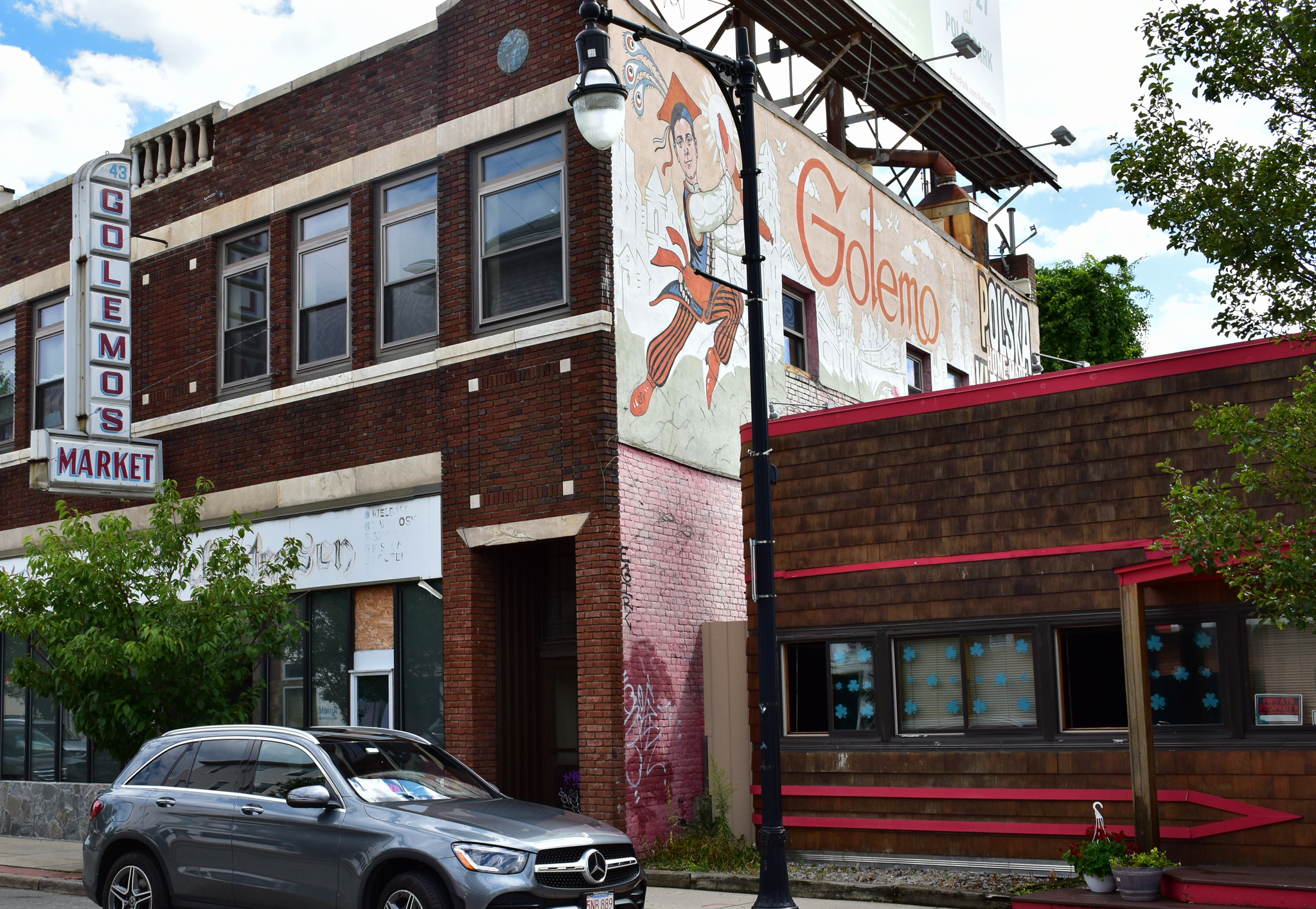
Heading north on Millbury Street, I soon found myself in front of Golemo's Market, a European market specializing in homemade kielbasa, pierogi, golabki, ham, kiszka and headcheese, according to its Facebook page. The company also operates a travel service and check-cashing business, all of it housed in a one-time theater.

"Built about 1918, this building originally contained a movie theatre, a lunchroom, and stores," according to MACRIS. "The building's major occupant was the movie theatre, known as the Rialto....[I]t opened in 1918, offering 1,250 red plush spring-cushioned seats and air conditioning. The substantial quality of the building and the large capacity and luxurious accommodations of the theatre itself were in contrast to most other neighborhood theatres in Worcester at that time."

I'm not sure when the Rialto (or perhaps a subsequent theater) went out of business. Nor have I found out much about the history of Golemo's, other than that it has served as a gathering place for Polish immigrants for decades.

At the head of Kelley Square, where Millbury and Vernon streets meet, is, appropriately enough, The Vernon, a residential hotel and bar about which MACRIS provides some fantastic historical details. I learned some great stuff from a few of my Instagram followers, as well as from various sources online.

I'm not sure whether this place is still an apartment hotel, or whether there are perhaps offices on the upper levels. MACRIS indicates The Vernon was completed in 1901 for owner Michael McGady, an American-born Irishman who worked in machine shops and as a store clerk before opening his own liquor business.

As for the bar, it was established in 1935 "by Francis and Beaven McGady, sons of the building's owner," MACRIS continues. "Named the Kelley Square Yacht Club, the bar's interior was remodelled to appear as a 'replica of the innards of the Mayflower.' The interior was decorated with original murals painted by Joseph Miron, Francis McGady, Walter Johnston and Alfred Kaplin [sic - it's Caplin] (better known as Al Capp, creator of 'Lil Abner') who were classmates at the Boston Art School."

Perhaps not all Backside readers are familiar with Al Capp, but I know the name because my father used to talk about "Lil' Abner," a comic strip that ran in newspapers from 1934 to 1977, when I was 12 years old.

As for the name of the bar, MACRIS quotes a 1971 Worcester Telegram article: "According to a 1971 article about the 'yacht club,' the bar was a major gathering place during the Great Depression for the inhabitants of the area's many three-deckers and tenements, serving as a sort of social club and 'to poke fun a t the millionaire's world; the Newport high society scene that didn't know a $20-a-week working man existed, never mind that he was often out of work at that.'"

I believe there is a main bar as you walk in the door, and then a Prohibition-era speakeasy in the basement of The Vernon. A quick search online led me to a blog post (since taken down) which provided details of a tour given by a bartender of the basement space. "We were led into a room referred to as The Ship Room or Worcester’s Yact Club," he indicates. "The room was erected to resemble the interior of a ship with booths and a stage for performers. The Ship Room has really become a hot venue for up-and-coming local bands. A far cry from when the place in its entirety was referred to as ‘a crack head hangout.’"

Because I was in Worcester on a Sunday morning, this place wasn't open, and I assumed it was out of business. I'm so happy to learn that it's still going, and that it used to be a music room (perhaps it still is). As for the speakeasy: "[The bartender] showed us where one of the entrances was; right through the women’s restroom! Hookers used to hang out there and offer sexual favors to the bar patrons. The going rate was just $5 up until recently (now not offered.) Yikes!! I do know Babe Ruth liked women and booze! It’s no wonder he spent some time here!"

Yep, Babe Ruth was known to hang out here. I just love that.

I checked the back of the building for ghost signs, and was pleasantly surprised to see an artist at work.

Once again, thanks to an Instagram follower, I learned that the artist is Eamon Gillen, who owns Crown of Thorns Tattoo.

I doubled back past Electric Haze, a hookah bar and live music venue at the corner of Millbury and Lamartine streets, to peep the cool mural.

The work is by Matt Gondek.

Along Harding Street I spied another great work of art, for The Dawg Alley, which may or may not still be in business.

The final stop on my first tour of Worcester is a mural along Harding Street memorializing a deli that stood at 126 Water Street for nearly 100 years.

As I mentioned in the first post in my Worcester series, this area of Worcester, especially along Water Street, was once a heavily Jewish neighborhood. Weintraub's Deli opened in 1920 in another location in Worcester, and moved to Water Street in 1940. In 2018, the deli's web site indicated that "[t]he building and business assets are being acquired by local developer Ed Murphy who is looking for an operator to lease the space and operate the business."

Alas, nobody took over the deli. The old Weintraub's space is currently occupied by Suzette Creperie & Cafe, which opened in August 2020.

I have more Worcester posts coming later this year. As of this publication, I have made a second trip to Woo-town. I hope to make others as well.

New Balance Draws a Red Line with Diner

From Dave Brigham: I can't be expected to know everything about the backside of America, nor of Massachusetts or even of Boston. But I...