Showing posts with label old buildings. Show all posts

Saturday, April 9, 2022

Jamming Through Allston, Part III: Buildings and Other Old Stuff

From Dave Brigham:

In the second part of this series about Allston, I talked quite a bit about current and future redevelopment in the Boston neighborhood known in prior decades as a home to gritty rock clubs and raucous student bars (see April 2, 2022, "Jamming Through Allston, Part II: The Future"). In the first post, I blabbed on and on about those clubs and other aspects of the village (see March 26, 2022, "Jamming Through Allston, Part I: Rock City"). In this installment, I will talk about retail and restaurant outlets, a historic former fire station and other old buildings, and a one-time railroad depot that has housed numerous bars and restaurants over the years, but that currently sits empty. Let's start there.

Allston Depot sits hard by the Massachusetts Turnpike and the railroad tracks that carry commuter, freight and Amtrak trains in and out of downtown Boston. Located on Franklin Street, across from the future home of the Allston Square development (which will comprise several buildings across from the depot on both Franklin and Cambridge streets), the depot was built in 1887 by the Boston & Albany Railroad. It was designed by Shepley, Rutan & Coolidge, the successor firm of famed architect Henry Hobson Richardson (Trinity Church, Boston; Marshall Field store in Chicago - since demolished; Thomas Crane Public Library, Quincy, Mass.; numerous train stations in and around Boston).

A designated Boston Landmark, the depot was taken out of service in the 1950's, according to a Boston Landmarks Commission report from 1997. "Yeoman-O'Connell acquired this abandoned property in 1956, operating their fence supply establishment from this location until the late 1960s," the report indicates. "The Arcand Automotive Repair Company purchased this former depot in 1969, initially intending to relocate their Allston business to this site. Instead, owner Eugene J. Arcand converted the building to restaurant use, opening the 'Allston Depot Steak House' in 1972." Eventually the restaurant, under the same ownership, changed its name to the Sports Depot. Its most recent use was as an outlet of local chain Regina Pizzeria.

(Sign on the door for the depot. It says "Circa 1884," so perhaps the station was begun that year, and not completed until 1887.)

While buildings all around the depot are slated for demolition or redevelopment, this place is safe. Last fall, reports surfaced that City Realty Group, which is spearheading the Allston Square project, was considering opening one-time Brighton dive bar Mary Ann's in this location (see April 19, 2019, "From Scary Ann's to Mary Jane's?"). A group affiliated with City Realty has been buying up dive bars in the area for the last several years, according to this Universal Hub article.

As I mentioned in the first Allston post, the folks who ran the Great Scott nightclub were also interested in the old Sports Depot site, but that deal fell through. Whatever ends up here, it will probably be a bit more upscale than what's been there before.

Another building that will abut the new Allston Square project is the old fire station on Harvard Avenue.

Built in 1891, per MACRIS, the old station is currently home to businesses including The Mindful Mutt, which offers doggy daycare, grooming and more; an outlet of the Out of the Blue art gallery; and Looney Tunes Records.

Alright, from here on down I'm throwing rhyme and reason out the window. I'm going to bounce all around the heart of Allston and talk about various buildings.

I was surprised that the beauty above doesn't show up in the MACRIS files. Located across Brighton Avenue from the current fire station, this place rose in 1899, according to the Boston assessor's database. I call it the DMOD building, after a company that was located there in the late '90s that provided secure digital media distribution software. I went to a meeting here with the company in my previous life as a writer for an online publication.

I love the look of Scissor Sound Hair Studio, which is located across from the old fire station.

I'm not proficient in foreign languages, but I believe the characters on the sign are Korean.

On Highgate Street I spied this nicely restored old building.

According to the sign on the facade, this place was built in 1896 and is known as Whitcomb Stables.

The building at 116-126 Harvard Avenue, below, is partially occupied. The space at the northern end is vacant; the southern portion is home to Korean Garden restaurant.

MACRIS calls this the McLaughlin Block, and says it dates to 1913. A LoopNet listing indicated the building was erected in 1930. I don't know who to trust. I dig the Spanish tile roof.

Just across an alleyway, at the corner of Harvard and Brighton avenues, is the E. Willard Frost Commercial Block, circa 1913.

I like the sign in the above photo, but unfortunately it's no longer 100% accurate. Yes, The Pike and L.A. (Lower Allston) are indeed in the directions indicated by the arrows. You'll still find Downtown by following the arrow, and I suppose The Burbs are indeed located in Hell. As for Patron's and Sunset (Patron's pool hall and the Sunset Grill & Tap), however, they vacated the Frost building years ago (see June 12, 2019, "The Sun Has Set On This Grill & Tap".

Current tenants include a Shibuyala Japanese skin care store, Stage Karaoke and Happy Lamb Hot Pot, a retaurant that has filled the old Sunset space.

I assume at least part of this building was once a bank, given the vault alarm hanging over one entrance. The building is somewhat down at the heels. I haven't found it in an online search for potential redevelopment, so I guess it's going to stay as-is for now.

One of the more mysterious buildings in Rock City is the Edison Light Company concrete block at the corner of Commonwealth Avenue and Linden Street.

MACRIS says the building dates to 1920, and that it's a garage. The Boston assessor's office gives a date of 1900, which is often a default that means, "We don't know/haven't done the research." Either way, I'd love to know what goes on in there, even if it's just loads of electrical equipment humming and buzzing.

With so many changes to the Allston landscape already in place, and on the way, photographer Edward Boches created the Postcards from Allston series for Allston Village Main Streets, in order to document "the character of a neighborhood." On the windows of the derelect building at the corner of Cambrdge Street and Emery Road, there are great promotional posters for this campaign.

The photo project features residents and businesspeople, as well as old buildings and street scenes. It's really cool.

Most recently home to Century Furniture and Boston Village Collision Specialists, this building is -- surprise! -- slated for redevelopment. "The current development plan proposes to construct a six-story building and a five-story building, one on each parcel," according to the plan from Anchor Line Partners. "As proposed, the buildings would total approximately 164,000 gsf and 2,400 sf of ground-floor retail space." The proposal features 166 apartment units, including 28 affordable; 88 studios, 54 one-beds and 18 two-beds five townhomes.

This project will also involve the demolition of a building on Rugg Road that most recently was home to Madhouse Motors.

Madhouse, which is now located in Boston's Roxbury neighborhood, "specializes in antique & vintage restorations, general maintenance, fabrication and custom builds" for motorcycles.

Along North Beacon Street is Yoma Burmese Cuisine, which offers a political statement in its window.

Along Harvard Avenue is the Gordon Building, which I find quietly impressive.

Built in 1926, this Colonial Revival building has some nice details (scroll pediments, inward-curving pilasters) that outshine the graffiti, in my mind. There's some nice original artwork on the front of The Pet Shop, as well as a groovy sign for Tresses d'Or Beauty Palace.

As I mentioned in the first post about Allston, I used to frequent this neighborhood when I first moved to Brighton with my girlfriend (now my wife). Until I started shooting photos and doing research for this series, I hadn't thought about the building below in quite a few years.

Located across from The Horse Allston tavern, this building dates to 1902 and is known as the Lincoln Block. It is home to Punjab Palace, Realr Skin Clinic, Friendship BBQ and other businesses. I recall going up to the second floor of this place back in the early '90s to buy vintage clothing, 'zines and maybe records. I wish I could remember any specific things I bought here. Thirty years later, I still shop for records and, once in a while, for vintage clothing. 'Zines, not so much.

Next door to the Lincoln Block is Linden Superette.

The convenience store is also part of the Lincoln Block. I don't know how long the store has been there, but guessing by the sign, I'd say a few decades at least. I love the word "superette." A few years ago, I wrote about the Brookline Superette.

The superette's nearest competitor is Night Star Convenience, which is located on Harvard Avenue.

Also home to Artful Edge Framing, the R.F. Whitehead Block dates to 1913.

The next building dates to 1910 and houses the Hanmaru Restaurant.

Located on Harvard Avenue, this place is one of many along this main thoroughfare that hasn't been well taken care off in recent years (decades?). You can see a bit of the finer details in the triangle above the eatery's sign. Perhaps with all of the new development in Allston, owners of buildings such as this one will be motivated to upgrade their facades.

I'm going to wrap up this post with a nice sign for a business that's been in Allston for more than a century.

Model Hardware has been selling hammers, nails and the like since 1916. The building dates to 1910.

That's it for funky old buildings and such in Allston Rock City. In the final part of this series, I will feature murals and graffiti galore.

Saturday, September 11, 2021

Stafford Springs, Part II: Other Than the Mills

From Dave Brigham:

I decided to explore Stafford Springs, Conn., because it's a mill town (see August 27, 2021, "Stafford Springs, Part I: The Mills"). I love shooting photos of old factories and mills, as I think is evident if you've spent more than two minutes reading this blog. But I also love the homes, municipal buildings, commercial architecture and churches that were built around these manufacturing facilities during their heydays. So in this post, I will look at those types of buildings in this village that serves as the downtown for the town of Stafford.

The first place that caught my eye -- and did so like no other commercial building in town -- was Full Sail Tattoo on East Main Street.

Established in 1994, the inking business appears to have run dry, unfortunately. This beautiful painted lady (not in the traditional sense of a Victorian home, but still...) dates to, well, I'm not sure. I found the year 1900 online, but I don't believe it. I'm guessing this place was erected at least 10 years prior.

Steps away is the Paradiso Building, which dates to 1930.

The building is home to Paradiso Insurance. It is located across from the American Woolen mill complex, so I'm guessing there may have been related offices here, or retail outfits, back in the day.

Just up Furnace Avenue is what I believe is the former home of the Stafford Springs Press newspaper.

The newspaper was in operation from 1883 to 1935. This building appears to be a private home, or apartments.

Next door to the old Press office is a little building that rivals the tattoo shop for ornate beauty.

Home to Orchardworks, a hand-carved magic wand maker (!), this gem dates to 1900 allegedly, but again, I believe it's older. The shop is run by what I assume is a husband-and-wife team. "Ed is an aerospace engineer by day, moonlighting in the workshop handling wand design, custom shaping work, and overseeing all of the woods and tools that we use. Janet works full time shaping, finishing, & delivering our wands to delighted customers all over the world," per the web site.

How enchanting!

Heading south on River Road, I spied Hyde Autoworks, located in what appears to be a nicely restored building.

The company, which specializes in "wild custom hot rod restorations," per its web site, has been in business since 1996. I like that they kept a few old automotive signs (photo below) on the outside of the building, which dates to 1930.

Doubling back toward the main drag, I walked past Shamrock Laundry, which is unfortunately out of business.

Then I looked west, up Highland Terrace, and saw the gorgeous church pictured below.

Grace Episcopal Church dates to 1876. I love the red clapboard, the bell tower, the fact that this house of worship is built into the hill. And right next to the church is an equally fantastic building.

The Stafford Historical Society building dates to 1885. It was built as the town library, and has also servede as a judge's office, office for a woolen company and the bottling house of the Stafford Mineral Waters Company, according to this post from the CTMQ blog.

Behind the historical society building is a mineral spring house, a remnant of a once wildly popular business offering allegedly curative waters, and the inspiration for the village's name.

The mineral spring -- thought by some to have therapeutic value due to the existence of minerals or other dissolved substances -- was discovered by the Nipmuck tribe that preceded European colonists. Among the colonists who availed themselves of the spring water was John Adams, who later in life, of course, went on to become the second president of the United States.

Naturally, businesses grew up around the spring. "In 1767 a direct stage route was established from Boston to Stafford Springs to capitalize on this budding resort’s popularity and make it more easily accessible," according to this Connecticut Explored article. "Through the early 1800s, visitors to the springs would stay at small hotels such as Child’s, Colburn’s, and the Green. In 1802, Dr. Samuel Willard bought the property and built the Stafford Springs House to accommodate patrons of the miracle water. His clientele grew as the springs’ reputation continued to spread, enabling Willard to expand the hotel."

The whole affair began to go downhill as the Saratoga Springs area in New York began to grow in the late 19th century. I'm not sure when Stafford Springs mineral water dried up as a business venture.

Moving on....

Beyond the mineral house is Hyde Park, where I saw the impressive memorial below.

The Warren Soldiers Monument was dedicated in 1924, and honors those who, like the sculpture's donor, Col. Charles Warren, fought in the U.S. Civil War. Warren was born and died in Stafford. He "had a distinguished military career that extended for the entire four years of," the Civil War, according to this web site. "He enlisted as a private in October 1861, soon became a sergeant, and rose through the ranks of commissioned officers as he served in a continuous series of campaigns. He led his regiment into Richmond in April 1865. After the war, Warren opened a general store in Stafford...and engaged in other successful business activities. He was president of the Stafford Savings Bank, built the Warren Block downtown, and gave to the town Warren Memorial Hall, which was dedicated January 31, 1924."

The sculptor was Frederick Ruckstull, who created many similar monuments around the country, including some Confederate memorials, according to Wikipedia.

At the intersection of River Road and Main Street sits the former Stafford Springs train station.

Built by the Central Vermont Railroad, the depot is currently home to the town's police department. I've been unable to find out what year this station was built. Trains are still active through the village, as the New England Central Railroad runs freight through here between East Alburgh, VT, and New London, CT.

Next to the train station, in a building that also features an ice cream shop, is Hairy Karry's Barber Shop.

Originally I thought this place was called "Hairy Harry's," which I liked. But I dig the actual name even more. I have a thing for funny/clever barbershop and salon names.

Across Main Street is the neat little green building housing Makuch & Company, CPA, and Willington Financial, two related businesses.

I believe this building dates to 1930.

There are so many neat old buildings in Stafford Springs, many of them nicely restored. I didn't shoot everything on Main Street, but just about. I'll run down the north side first and then the south. First up after the financial building (after a few that I found unworthy) is the building housing Rustology Antiques and Oddities.

This place looks great, sort of a Nutmeg State version of the American Pickers shop in Le Claire, Iowa. This place dates to 1908. Below is a peek through the front window.

Next door is the home of Ocean Asian Restaurant.

The CRCOG Tax Parcel web site indicates this building dates to 1900. The siding makes it look newer, but also not as attractive as the Rustology building.

Heading west, I came to a site unlike any I've seen in the several old mill towns I've explored over the years.

Located in what's called the Main Street Fruit Tree Trail, which is maintained by the Stafford Garden Club, this art-filled park sits in the remnants of buildings that collapsed some years ago, according to a friend who lives in town. The park contains several shrubs, trees and plants that produce edible fruits, berries and herbs. The public is encouraged to help themselves to a small sampling.

As for the murals, I've been unable to find out who painted them. There are several, and they are all bursting with color and life and imagination. Also located in the park is a bench dedicated to "Mamma" Teresa Andreoli (1926-2019), who lived in Stafford. "Main Street was her life," the inscription says. There is also a picture of the Arizona Restaurant, which I assume Mamma owned.

Continuing west, we come to a nice stretch of old commercial buildings. A plaque at the roofline of the building below says "1936."

This place is home to Smoker's Emporium. Look closely at the top of the building, and you'll see a peaked roof. The brick of the storefront is an add-on to a modest apartment house that is obviously older.

Next door is the Palace Theater, which dates to 1900.

The theater hosts concerts (James Montgomery Blues Band, Riders On the Storm [Doors Tribute]) and other events (fundraisers, weddings). It was founded as vaudeville theater, and began featuring movies by 1941, per Cinema Treasures. This place closed in 1960, but reopened at some point as a bar. I'm not sure how long it's been a live-music venue.

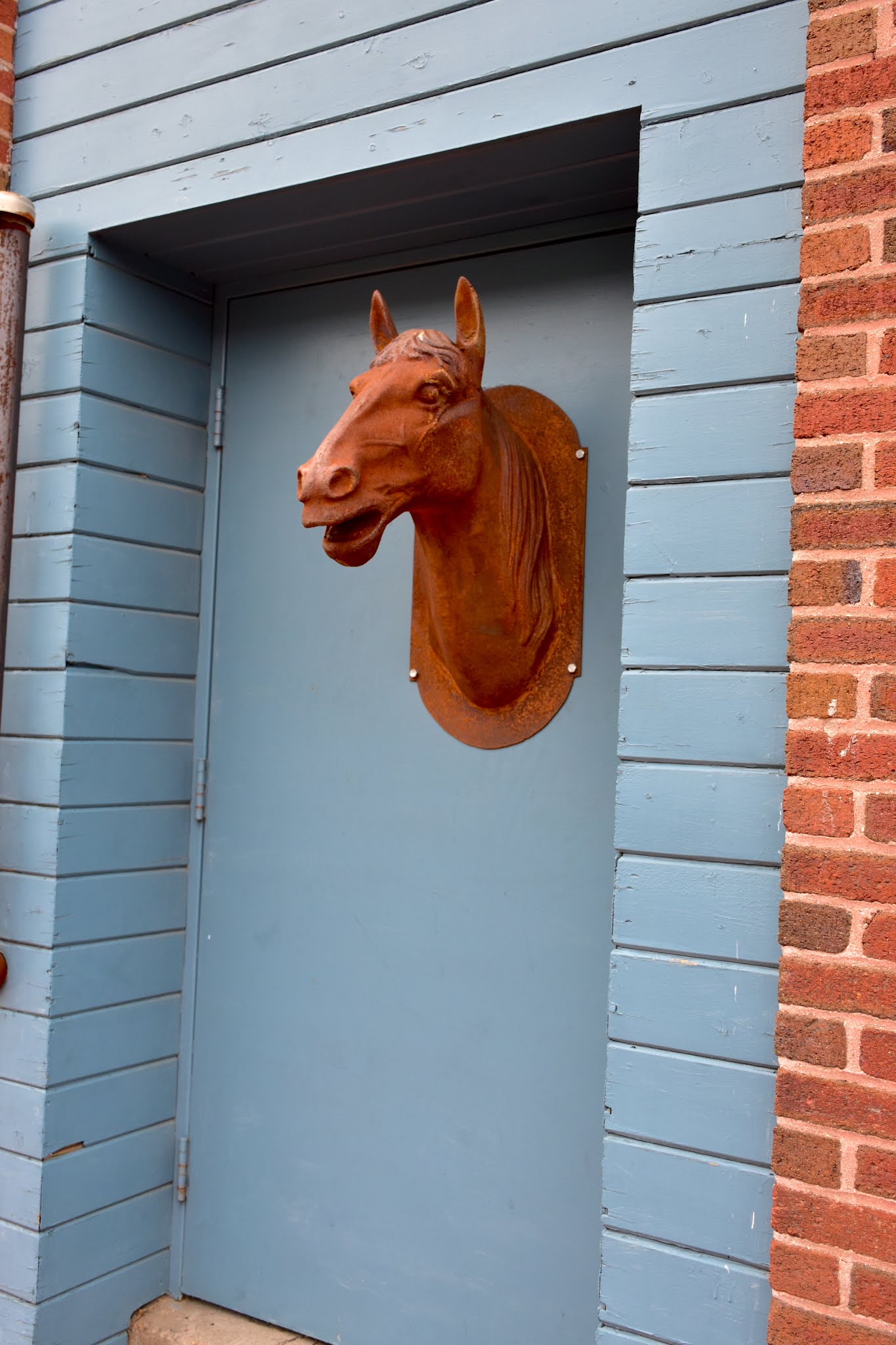
(One of two horse heads flanking the front door of the theater. I'd love to know the story behind them.)

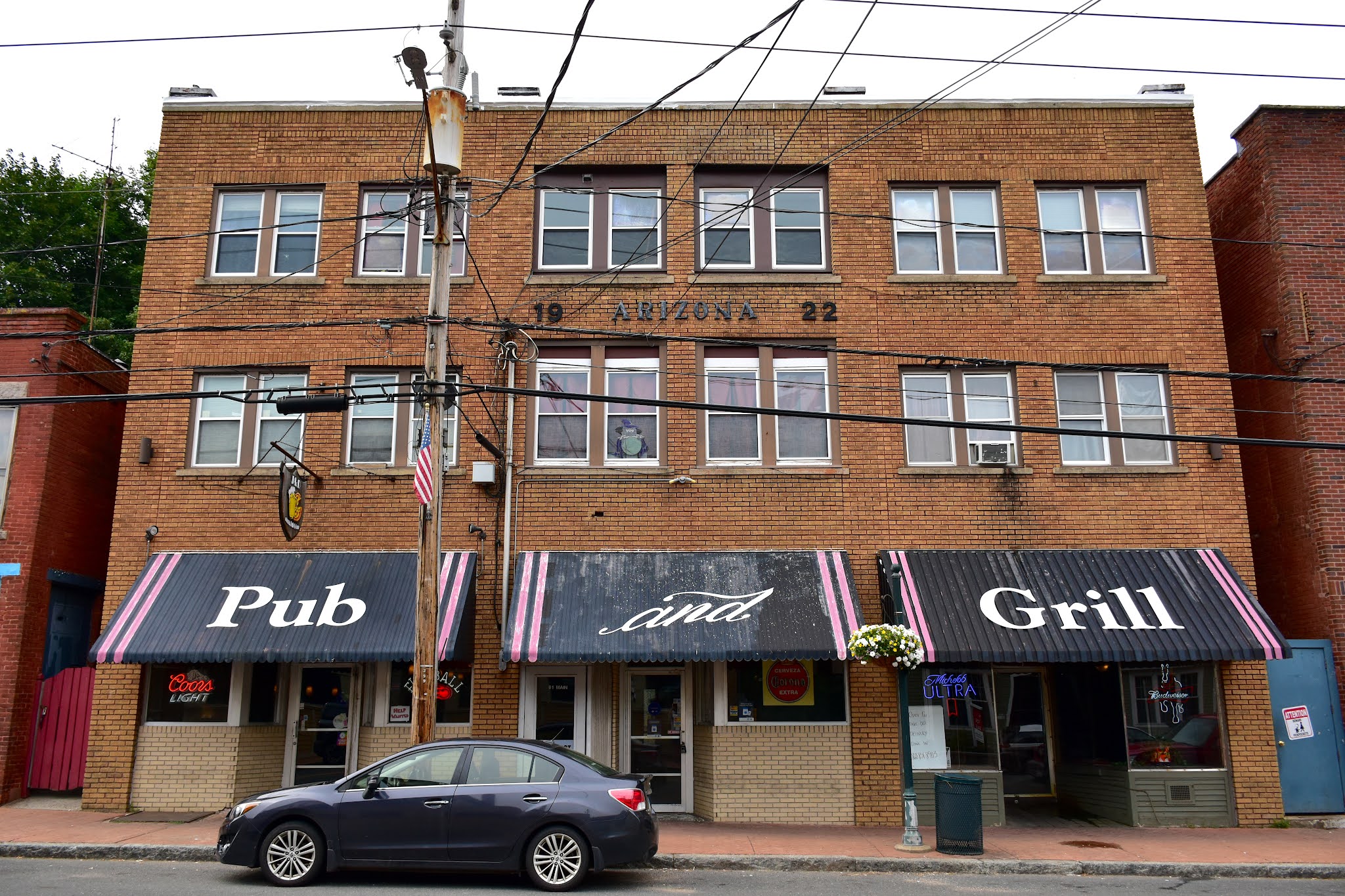
Next up is the Arizona building, which dates to 1922.

Now home to J&D Pizza, Pub & Grill, this building was once the home of the aforementioned Arizona Restaurant. To get a sense of that eatery, scroll down on this link.

The next building is small, but I love the cut of its jib.

Most recently (I think) the home of the Stafford Seamstress, this place is known as the L.H. Carvais Building. It dates to 1900. I couldn't find out anything about the Carvais clan.

The next place dates to 1933, and is home to the wonderfully named Blazing Saddles consignment shop and Laura Claman Equine Solutions.

Next door is an empty storefront...I think. I believe it was (or possibly is) home to Mocko's Propane Gas Service. The building dates to 1928.

Across Main Street, in what appears to be a long, narrow storage building (possibly formerly used by an appliance company), is a series of super-cool town-themed murals.

The one above shows, on the left, Hyde Park, location of the Civil War Monument mentioned previously, and Stafford Fairgrounds, also known as Stafford Springs Agricultural Park, where there was horse racing up until the end of World War II. This area is now known as the Stafford Motor Speedway. In my final Stafford Springs installment, I will write about the race track.

The mural above shows, on the left, the Baker Furniture Co. factory, as well as a streetcar; on the right people are shown fetching water from the aforementioned mineral spring. The furniture company was established in 1807, and closed in 2015.

Continuing east, on the south side of Main Street, I saw the obviously rejiggered building below.

Home to a Farmers Insurance agent, this building dates to 1900 (allegedly) and is owned by American Sleeve Bearing, an industrial company located on the other side of the train tracks from Main Street.

Next door to that odd building is the Bidorini Building, which dates to 1915 (here's why I always doubt the year "1900" when I see it in assessor's databases...this place is listed as being built in that year, but the building iteself says "1915" on it)

I'm assuming this was the former home of Bidorini Bakery & Grocery, references to which I found online. Currently occupying the space is the Stafford Cidery, home of Crazy Cock Cider. Cock-a-doodle-do!!

Next door at 58-64 Main Street is a pair of buildings also allegedly built in 1900.

To the right is #64; I'm not sure what's in that building. Like the Farmers Insurance building mentioned above, this place is owned by American Sleeve Bearing. On the left is #58, home to ESP Pottery. The store/gallery offers lessons. I dig the funky threshold, below.

The last building on this block is home to the Stafford Coffee Company and the Stafford Academy of Dance.

This place also dates to -- you guessed it -- 1900. Allegedly.

To wrap up this post, below are some photos taken of the backside of the last few buildings I wrote about. These shots were taken from a driveway leading to American Sleeve Bearing, looking across the railroad tracks.

That sign says, "FLAG OILER DO NOT SAND." A flag stop (or request stop or whistle stop) is a station at which trains will only stop if there are passengers or freight to pick up. I don't know anything about oiling or sanding flags that mark these stations.

This is the backside of the pottery store

I just love that little tableau above.

I'm a sucker for graffiti. As I mentioned above, I shot these on property owned by American Sleeve Bearing, a company that will come into play again for the final Stafford Springs post, coming soon.

Checking Out Dudley Street in Roxbury...and a Historic, Pre-Civil War House

From Dave Brigham: As part of a series of quick-hit jaunts through Boston this spring, I checked out the outer reaches of Nubian Square, m...