Showing posts with label ghost building. Show all posts

Saturday, January 13, 2024

Malden? Karl Malden?! No, the Other One

From Dave Brigham:

Karl Malden (born Mladen George Sekulovich) was a legendary actor who starred on Broadway (Arthur Miller's "All My Sons," Tennessee Williams' "A Streetcar Named Desire") and in countless films ("On the Waterfront," "Baby Doll," "Birdman of Alcatraz"). I remember him best from "The Streets of San Francisco," a cop drama co-starring Michael Douglas that ran on ABC from 1972 to 1977.

The city of Malden, Mass., on the other hand, hasn't landed one stage, film or TV role since being incorporated in 1649. The small city located just a little north of Boston has, however, produced some famous folks: Tony/Oscar/Emmy winner Jack Albertson, whom I loved in "Chico and the Man"; Erle Stanley Gardner, author of the Perry Mason detective stories; musician Norman Greenbaum, about whom we'll learn more later; Edna May Oliver, who was nominated for Best Supporting Actress for 1939's "Drums Along the Mohawk"; and drummer David Robinson, who played in both the Modern Lovers and the Cars.

Ever since taking my son to Boda Borg, a "real-life questing" experience in downtown Malden several years ago, I've wanted to return to make photos. I recalled a main street with some cool old buildings. After a bit of research (An old diner!), last July I found time to explore. Below, you'll see and learn about what I found. You know how this works.

The first place I came across was one that made me say, out loud, to myself, not for the first time, "Oh, THAT used to be something!"

Currently home to a U-Haul Self Storage facility, this brick building along Eastern Avenue, near the intersection with Ferry Street, was originally Revere Knitting Mills.

From MACRIS: "The Revere Knitting Mills factory was built in 1921 with rear access to the Saugus Branch Railroad. In 1929 a rear addition was made to the original building along the railroad line. The Revere Mills suffered a serious fire in August 1938 and a strike in November 1938. After World War II the company moved to suburban Wakefield, closing operations in 1958."

The term "knitting mill" may sound quaint, as if a bunch of old ladies are rocking in sync in their chairs, nattering about the weather and slowly but surely completing scarves, hats and mittens. The reality was a bit different: low pay, long and grueling shifts, noisy and potentially dangerous machinery, children working without legal protection. Below is a video that gives you an idea of what it was like to work in a cotton mill in England in the 18th and 19th centuries.

I roamed quite a bit around downtown before I found my next photo target, but it was a damn good one.

This Classical Revival beauty was built in 1894 for Mrs. Edward L. Brown of Malden, according to MACRIS. It was "designed in 1894 by H.W. Hartwell & W.C. Richardson, noted Boston area architects, unrelated to H.H. Richardson," MACRIS continues. "The four story brick business block follows a standard plan for commercial buildings of the period with retail shops on the street floor and upper story offices, including a dining hall on the fourth floor."

"Sometime after 1930 the Malden Masonic Order relocated from the Yerxa (W.T. Grant) Building at 72-80 Pleasant Street to the Browne Building, renaming to the Malden Masonic Building," per MACRIS. "In 1972 a serious fire required substantial rebuilding of the Masonic facilities with a new entrance."

Nowadays, this building is known as the Residences at Malden Station, a pet-friendly apartment community with a 24-hour fitness center and two rooftop lounges.

Continuing east on Pleasant Street, I saw plenty of other nice buildings, starting with the old Malden Trust Company Bank.

Currently occupied by East Cambridge Savings Bank and Mixer eSports + Cafe (part of the Malden Gaming District, which includes Project: PUTT!, Rock Spot Climbing, Boda Borg [to be discussed below] and Station: Bistro & KTV), the Classical Revival Malden Trust building was completed in 1914. The building was acquired by Pioneer Bank in 1983, and by Eastern Bank in 1994, according to MACRIS.

Next door is Boda Borg, a questing entertainment business founded in Sweden in the mid-1990s, according to the company's web site. "Our Questing concept pioneered the Reality-Gaming business sector in an era of video games, reality television, and action movies," the web site continues. "People were drawn to a concept where they participate physically and mentally in exhilarating activities themselves. No movies! No video games! Just you and real-life Quests!"

My son and his friends had a blast here a few times back when he was in high school. Boda Borg took over the space formerly filled by Sparks Department Store, which had been in business for 94 years before closing in 2013.

Adjacent to Boda Borg is Super 99 Century, a discount store located in the former W.T. Grant Department Store space.

I've written a few times before about Grants, a department store chain founded by Malden native William T. Grant in 1906. Founded in Lynn, Mass., the chain grew to nearly 1,200 stores by the time its founder passed away in 1972 at age 96. Four years later, the company went out of business, "in part due to a failure to adapt to changing times [that] was probably accelerated by management's refusal until it was too late to eliminate the shareholder dividend," according to Wikipedia.

As for the Pleasant Street building, it was built in 1941 when Grants moved from its previous location in what is known as the Yerxa Block (located...somewhere in Malden), according to MACRIS. The Malden store closed in 1971.

Super 99's neighbor to the east is home to Zuru Zuru, a ramen restaurant, and The Downtown Paw, a doggy daycare facility. I've searched high and low online, but I haven't figured out any history for the building.

The place next door, on the other hand, was built in 1940 as an F.W. Woolworth store (aka Woolworth's).

Currently home to modern Asian restaurant All Seasons Table, this building was "named the 'most modern building in New England' when it opened in October 1940," per MACRIS, citing the Malden News. The Woolworth store closed in 1969.

Near the end of Pleasant Street, on the north side, is a little place named the Bychower Building.

I haven't found any information about this place, which is currently occupied by Gold & Diamonds, Etc.

Next door, close to the point where Pleasant and Main streets meet, is the Barrett Building, which has an interesting history and features a ghost sign.

(The Barrett Building, seen in the background.)

(Ghost sign for Black's Furniture on the side of the Barrett Building.)

From MACRIS: "Barrett's Building was completed and opened in March 1884 with a mix of craft-works, including a crockery shop and furniture factory on the upper floors, along with a meeting hall. Advertising signs for BLACK'S FURNITURE are still preserved on the side brick walls and match with directory listings and photographs to 1898-1900, possibly earlier to the original building as the oldest remaining commercial art in Malden Square."

Damn, those are some old ghost signs!

A meeting room on the third floor of the Panel Brick building was used for a time as a Red Men's Hall. Known officially as the Improved Order of Red Men, the fraternal organization "claims direct descent from the colonial era Sons of Liberty," per Wikipedia. Established in Baltimore in 1834, the Red Men held rituals and wore regalia "modeled after those assumed by men of the era to be used by Native Americans. Despite the name, the order was formed solely by, and for, white men," Wikipedia continues. The group lives on today, although not at this location.

I wrote about another former Red Men's Hall on August 7, 2022, in part one of my profile of Natick Center.

Finally, in 1926 the Barrett Building's "middle bay was opened up at the ground floor level to become the entrance to the new Granada Theater which was built behind it," per MACRIS.

Around the corner, on Main Street, is the former home of another fraternal organization.

The Odd Fellows Temple, which has some impressively ornate details, dates to 1907.

Currently, the building is home to The Immigrant Learning Center, some law offices and other small businesses, I believe. Below is a ghost sign for a company called Insurance Express that was once located in the building.

On this exploration, I did a lot of walking without taking photos. Sometimes that happens on the backside. After checking out the IOOF temple, I doubled back along the other side of Pleasant Street, and then looped around to Exchange Street. In addition to some new apartment and office buildings, I found some cool public art and a ghost from the past.

"'Spirit in the Sky' is a mural painted...to honor Norman Greenbaun, who wrote the hit song 'Spirit in the Sky' and is from Malden....The mural was designed to be a vibrant piece of artwork for the City of Malden which fuels economic growth through Cultural Value, Educational Value, Historic Value and Community Engagement," according to a statement on the web site of artist Jesse Melanson. The giant mural is located on the rear of 110 Pleasant Street, facing Exchange Street.

At the rear of the former Woolworth's store, I spied an old sign for Woolworth Studios.

Surprisingly, I haven't found out any information about this part of the old department store chain's business. The current tenant for this space is the aforementioned Project: PUTT!

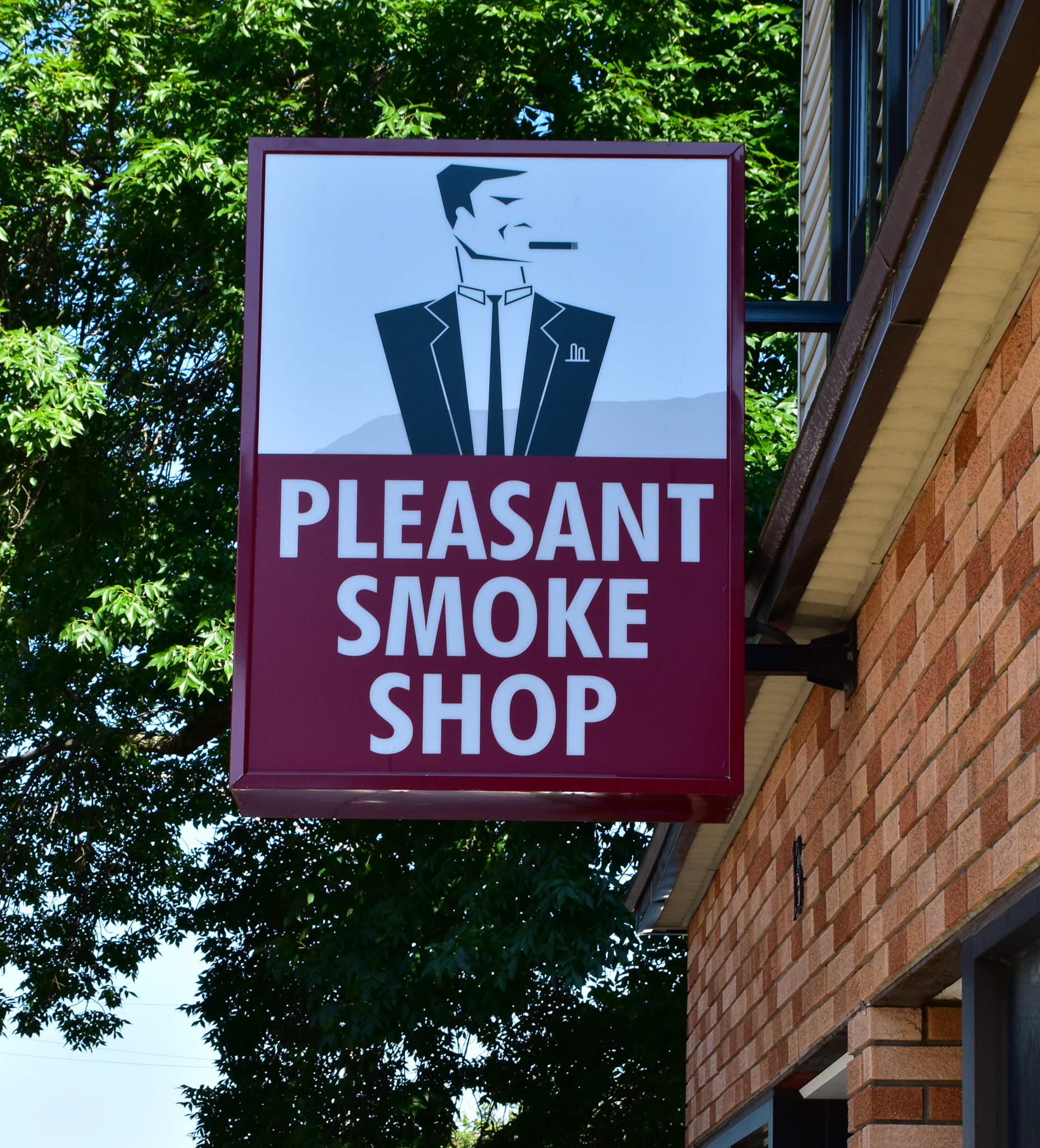
Along Irving Street, I spied a nice sign for Pleasant Smoke Shop, which has been selling cigars and accessories since 1982.
After a few minutes, I headed for the Northern Strand Community Trail, a bike path connecting Everett, Malden, Revere, Saugus and Lynn. I had no idea whether I would find some cool backside places, or whether I was putting undue strain on my bad feet and my sciatica for no reason. Over the years of exploring on behalf of this blog, I've found that old railroad rights-of-way that have been converted to community paths are pretty good places to poke along. Factories and warehouses that were once served by trains are often still standing witness to e-bikes, parents jogging with strollers, kids on bikes and middle-aged dudes with cameras limping along.

My gamble paid off once again, as I stumbled across the the top model train retailer in the USA.

Charles Ro Supply Company has been in business since 1972, offering "the largest selection and best pricing for all your model train & hobby needs," per its web site, which also claims the store is the world's largest dealer for Lionel Trains, a company owned in part by rocker Neil Young.

I visited the store twice many years ago when my son was young and totally into toy trains. My shopping trip was so many years ago, I thought Charles Ro was located in neighboring Everett, so I was pleasantly surprised to see the store and make a few photos.

I got off the multi-use path and headed north on Cross Street, as I was getting tired and needed to start working my way back toward my car. At the intersection of Cross and Salem streets, I saw a black awning with a faded sign for Salem Wood Cafe.

Shuttered in 2013 after what I'm assuming was at least a few decades in business, the restaurant received a good review from Boston's Hidden Restaurants, which described the joint as a "homey, well-worn working-class" eatery that offered good food in a no-nonsense location.

Further west along Salem Street I saw a one-story, four-bay retail building that has a Middle Eastern look to it because of the arched doorways and the red trim paint.

Known as the Zachary Zarsky Block, this Classical Revival building rose in 1925. Zarsky "was a pharmacist and business owner in Malden," according to MACRIS. "Zarsky was a native of Vilna, Russia. He began with ownership of the Red Cross Pharmacy in Gardner, Massachusetts. He came to Malden where he operated the Faulkner Pharmacy, also known as Zarsky’s Drug Store at 273 Salem Street....Zarsky acquired the land on which this building would be built in 1923 from Annie S. Towle....Original tenants included First National Stores, a grocery store, at 283, Roy Clough provisions at 285, Jacob Fitterman, tailor at 287, and Carmine DiMattia, barber at 289."

Tenants today include Casablanca Wireless and Bel Bebe, a beauty salon.

A little further along is a stunning apartment building: The Mount Vernon.

Located on the corner of Salem and Mount Vernon streets, this building was in the news more than two years ago, when the parapet at the roof line collapsed onto the sidewalk. Nobody was injured. As for the building, I haven't been able to find out when it was built. It looks to be in good shape now.

I followed Salem Street into Malden Square, near where I'd begun my adventure. I wanted to get a closer look at something I'd spied earlier in the day when I was making photos of the IOOF building.

There is a boomerang-shaped hole in the ground next to the brilliantly named Dentistry and Braces practice along Main Street, curving around to Ferry Street. As you can see, there are remnants of laths from the building that once stood on that semi-circular lot. I wanted to know what used to be there. I'm thankful that my old friend MACRIS and my newer friend Google Street View had some answers.

Known as The Auld-New Lounge, the building was built in 1912, remodeled in 1937 and 1974 and was considered by the MACRIS report author to be a "much-altered undistinguished commercial structure" that "may well be replaced," as of 1976. The building appears to have been torn down in late 2019 or early 2020. Below is a Google Street View photo of the building from November 2011:

As for what might fill the hole in the ground, I haven't been able to figure that out.

Heading south on Main Street, I absolutely had to make a photo of the building housing Kung Fu Tea, Thanh Danh tax services and Angel M Beauty Club.

Built in the Classical Revival style in 1902, 1-3 Pleasant Street wouldn't look out of place in a European village. Unfortunately, MACRIS doesn't have much to tell me about this place.

I continued south, across Centre Street, heading toward my car. I knew I had at least one building to shoot -- a recently revamped diner -- but another one caught my eye.

I'm used to seeing buildings with words carved into their facades, usually the name of a bank or a builder or a factory. This is the first time I've seen the name of a cleaning company: Golden Bell Cleaners. I wish I'd been more observant, as there is another business name carved into the south-facing facade: Boston Dye House, according to MACRIS.

"The Boston Dye House at 22-28 Eastern Avenue is dated 1927 by newspaper articles and archives blueprints," MACRIS indicates. "The present building is an addition to the original (1919) Boston Dye House building at 30-50 Eastern Avenue on a site occupied in 1912. The 1927 addition was constructed for the Golden Bell Cleaners, named after the founder Edward I. Golden, highlighted by gilded bells on the facade. The Boston Dye House building on Eastern Avenue remains a commercial landmark of Maiden Center, highlighted by gilded bells on the facade as signets of its identity."

After making the above photo, I crossed Main Street to get a better angle of the Breakfast Club, a diner that moved from Boston's Allston neighborhood due to redevelopment (see June 18, 2022, "I Love L.A.!").

Prior to the Breakfast Club, this was home to the Doo Wop Diner, from 1991 to April 2022. The eatery, so named because the owner's grandfather loved doo wop music, featured appropriately themed dishes such as The Chubby Cheddar, I Want to Hold Your Ham and Cheese and The Last Train to Belgian Waffles, according to this Neighborhood View article about the restaurant's closure.

Next, I made a photo of another neighborhood institution:

Jay's Pizza & Ice Cream opened in 2005, I believe.

Doubling back toward my car, I ventured again down the bike path, which cuts just north of the Breakfast Club. I followed it just a short distance, to Ferry Street. I then walked west along Eastern Avenue and past a few old buildings, including a former auto repair business. As I crossed the street, I looked back and was fortunate enought to spot the ghost sign seen below.

Most recently home to The King of Auto Repair, this lot is being redeveloped. I'm not sure whether this building will be torn down or included in the new project.

Thursday, January 30, 2020

Beacon Hill Randoms, Part III

From Dave "Fancy Boy" Brigham:

As promised, I am starting this third and final installment in my Beacon Hill series with a ghost building.

Located on the side of a Suffolk University residence hall, the outline of a 3 1/2-story brick building was quite stunning as I rounded Bowdoin Street onto Ashburton Place. I don't know when the building was torn down for a parking lot, but I'm glad that its ghost survives. In too many cases, these types of architectural shadows are all we have left of the once-vibrant, more human-scaled buildings in older cities like Boston.

As I mentioned in the first two posts -- Part II and Part I -- walking through Beacon Hill can be like walking through a movie set, with so many beautiful, historic, well-mainlined homes, quirky architectural details and narrow, cozy streets. In this wrap-up post, I will cover more of those same types of things. So let's get after it!

Let's check out some flesh-and-blood buildings of note, shall we?

Located on Beacon Street, across from the State House, the Claflin Building dates to 1873 and has architectural details that really stand out and are unlike any I've seen around the city. Architect William Preston renovated the building in 1884 for the Boston University School of Religious Education and Social Service, per Wikipedia. Here's a cool picture of the building from that era. Of interesting historical note: Alexander Graham Bell taught vocal physiology -- the mechanics of speech -- in this building, per the Boston University web site.

In what are called the spandrels of the Claflin Building are two terra-cotta portrait plaques: one of German painter and printmaker Albrecht Durer, who was born in 1471; and one of painter Anthony van Dyck, who was born in what is now Belgium in 1599.

(The Albrecht Durer portrait.)

(The Anthony van Dyck portrait.)

I have no idea why the university chose those two artists, but I think it's really cool that the plaques are still there.

On the other side of the State House, at the intersection of Derne and Hancock streets, I spied this unique building.

Built in 1876, this Egyptian Revival house is rare in Boston, according to a plaque on the front of the three-condo building. "The papyrus capitals on the entryway columns mark the style," per the plaque. Egyptian Revival is "attributed generally to the public awareness of ancient Egyptian monuments generated by Napoleon's conquest of Egypt and Admiral Nelson's defeat of the French Navy at the Battle of the Nile in 1798," per Wikipedia. Many theaters, temples and other buildings were built in this style around the world.

Just down the slope from the State House, along Park Street, sits the fabulous Union Club.

Founded in 1863, the Union Club was formed at the height of the Civil War to show members' stalwart support of the United States, per the club's history page. The club has been in this beautiful building -- the former homes of John Amory Lowell, a wealthy merchant with interests in mills, and businessman and politician Abbott Lawrence -- since six months after its founding. Famous members over the years include poet/essayist Ralph Waldo Emerson, Supreme Court Justice Dr. Oliver Wendell Holmes, Senator Henry Cabot Lodge and President Calvin Coolidge. The building dates to the 1830s, per Wikipedia.

Next door to the Union Club is The Paulist Center, below, which holds Catholic masses, feeds homeless people, offers religious classes and in recent years has "amplified its outreach to 18-39 year-olds by adding a staff person whose mission it is to specifically speak to this group," per the group's web site. The organization was founded by Isaac Heckler, who, before starting the Society of St. Paul the Apostle, lived at the Brook Farm Transcendentalist community outside Boston, and experimental Utopian community Fruitlands in Harvard, Mass.

Built in 1956, the Paulist Center includes an auditorium, a chapel, offices and a residence. The building is somewhat institutional-looking, which doesn't make it the most attractive place in the world, but in an area with municipal and state offices, it doesn't look out of place. But I wish it wasn't there. Reading the file for the building at the Massachusetts Cultural Resource Information System (MACRIS - one of my new favorite research tools), I learned that developers razed three historic structures so they could put up the Paulist Center: the former home of Boston Mayor Josiah Quincy, who developed Quincy Market and went on to become president of Harvard University; the home of distinguished surgeon John Collins Warren of Harvard Medical School; and the last of four circa-1804 houses designed by renowned architect Charles Bulfinch. I believe at some point the New England Women's Club was located on this site as well.

Oh well.

At the bottom of Park Street stands the Park Street Church.

(The steeple of Park Street Church, with the Millennium Tower in the background.)

Raised in 1810, the church was the tallest building in Boston until 1867, per the church's web site.

If you laid all the pages of the Holy Bible end to end from the Park Street Church heading due north, you might have enough to reach Church On the Hill, home of the Boston Society of the New Jerusalem (Swedenborgian), below.

As regular readers may recall, I am not at all a religious man, but I have a thing for churches. Here's your boilerplate description of the Boston Society of the New Jerusalem, from the church's web site: "The Swedenborgian Church is an open-minded, forward looking Christian church drawing its faith from the Bible as illuminated by the teachings of Emanuel Swedenborg."

OK, whatever. What I'm more concerned with here is that in the 1960s the congregation replaced a "beautiful Gothic Revival structure" with the rather boring church/apartment building amalgam you see in the above photo. I call that a damn shame.

Along Beacon Street, near the intersection with Charles Street, sits the King's Chapel Parish House.

Organized in 1686, King's Chapel, located at the corner of Tremont and School Streets, was New England's first Anglican congregation. The stone church was opened in 1754, replacing a wooden structure that rose there in 1689. The parish house, located a half-mile away, contains a chapel, offices, meeting rooms and the minister's residence. The brick town house was "built by two partners in the China Trade in the early 19th century," per the chapel's web site.

A little ways up Beacon Street is, believe it or not, the headquarters of the American Meteorological Society (AMS). The group -- 13,000+ members strong -- "is the nation’s premier scientific and professional organization promoting and disseminating information about the atmospheric, oceanic, and hydrologic sciences," per its web site.

I took this picture because of the rough-looking paint job on the portico. The wood has since been repainted. I had no idea what the building was, until I walked closer and read the sign on the door. And it wasn't until researching this post that I learned this building dates to 1806 (!) and was designed by local architectural icon Charles Bulfinch. Its original incarnation was as a house for Boston's third mayor, Harrison Gray Otis, per the AMS web site. From Otis's death in 1848 until the AMS purchased the building in 1958, there were three other owners.

Further on up Beacon Street, two blocks from the State House, is the Phillips-Winthrop House.

Yet another Charles Bulfinch construction, the house at One Walnut Street has been home to "some of Boston’s most prominent figures. John Phillips, first Mayor of Boston lived here and his son, famous abolitionist Wendell Phillips, was born here in November, 1811. Later occupants included Thomas Lindall Winthrop, Lieutenant Governor of Massachusetts from 1826 to 1832 and Thomas Dixon, Consul for the Netherlands. In 1939, the house was donated to the Judge Baker Foundation by Mrs. James Storrow. "In June of 1990, The Engineering Center Education Trust purchased the building and this affiliation of engineering and land surveying societies operates the Aldrich Center on the first floor," per the web site for the Aldrich Center. For a complete history of the building, read this Aldrich Center document.

On Chestnut Street, not far from Charles Street, is the Harvard Musical Association headquarters.

Founded in 1837, the association in 1852 erected the Boston Music Hall (now the Orpheum Theater) and formed the Harvard Musical Association Orchestra, which ultimately gave rise to the Boston Symphony, per the group's web site. The HMA's library and concert rooms are available to musicians for practicing and scholars for research. "The association maintains a longstanding tradition of commissioning new works, supporting local non-profit musical organizations, and giving prizes and awards to young performers," per the web site.

The association moved into the above building, the former Malcolm Greenough house, in 1892. "The main floor was dropped four feet in 1907, which required changing the main entrance to Chestnut Street...." per the web site. "With the proceeds of a generous bequest from Julia Marsh, widow of Charles Marsh (member Eben Jordan’s partner in the chain of Jordan Marsh stores), the Association renovated the upper floors in 1913. The third floor, with its warren of leased rooms, was removed and the resulting space conjoined to that of the second floor to create a highly-ornamented, double-height hall (designed by member architect Joseph Everett Chandler) thereafter known as the Marsh Room."

I never would have guessed all that goes on in there.

I would guess, however, that the 21st Amendment has seen all sorts of political shenanigans over the years, seeing as how it's located approximately three crooked politicians' lengths from the State House.

Named for the amendment to the U.S. Constitution that repealed the 18th Amendment, which banned alcohol nationwide, thereby bringing legal booze back into our lives, the bar "was originally designed in 1899 as Boston's most luxurious hotel complete with electricity, running water, a roof garden and the city's first 'passenger lift,'" per the saloon's web site. Over the years it was the men-only Bellevue Pub and the Golden Dome Pub, among others. I'm not sure how long it's been the 21st Amendment. Per the web site, it has long been "a hangout for some of the state's most colorful figures. A good part of the Commonwealth's business was transacted in the Bellevue's dark corners and John F. Kennedy was even rumored to write speeches by the fireplace in the back."

Once again on Beacon Street, not far from the State House, is the pair of buildings below.

On the left is 34 Beacon, which is owned by Northeastern University, and serves as the home of its president, Joseph Aoun. Built in 1825, it was owned for several decades by publisher Little, Brown & Co. It has 14 rooms and is assessed at more than $12 million.

In the middle is 33 Beacon (there are no buildings on the other side of the street here, just Boston Common, hence the odd and even numbering on the same side of the street), which is owned by the City of Boston and serves as a place for high-level meetings, functions and, on occasion, the residence of Boston mayors. The late Tom Menino lived here in 2013 while recovering from a long hospital stay. Known as the Parkman House, the building has a rich and occasionally sordid history.

From the Boston Globe article linked above:

"Parkman House was built on land originally owned by Governor John Hancock. Completed in 1825, the house was sold in 1853 to a widow and her two children who took ­re­fuge from unwanted attention.

"They were the family of Dr. George Parkman, a scion of one of Boston’s wealthiest clans. Parkman’s body was chopped into pieces in 1849 and hidden at Harvard Medical College by a chemistry professor. ­Parkman had been pressuring the professor to repay a debt, and some later blamed the doctor for bringing on his own death.

"Parkman’s wife and children lived in the mansion for the next half century. After the wife and daughter died, the doctor’s son, George F. Parkman, lived there as a ­recluse, standing in the parlor on the second floor, staring out at Boston Common.

“He would always see squirrels playing,” said Cecily Foster, a former city employee who was involved in renovation of the mansion in 1973 and 1997. “That became his entertainment, watching the squirrels. That’s who he related to, I guess.”

"George F. Parkman commissioned an ornate chandelier with squirrels cast in bronze that still hangs in the second-floor parlor, said Foster, who served as Mayor Kevin White’s personal assistant and as ­Menino’s director of special events and tourism.

"Parkman died in 1908 and bequeathed the mansion to the city, along with a $5 million trust for upkeep and improvement of nearby parks, a sum that would be the equivalent of almost $125 million today. The Parks Department used the mansion as its headquarters until White renovated the property in 1973."

(Plaque on the house in recognition of George Parkman's bequeathal to the city for maintenance of Boston Common and other parks.)

Attached to the Parkman House, on the right as you are facing the buildings, is 25 Beacon Street.

Built in 1926-27 by American Unitarian Association President Samuel Eliot, 25 Beacon was sold, along with two rear-adjacent properties, for more than $23 million in 2014 and is now condos. The Unitarian Universalist Association had a farewell party at the property at which several figures from the organization's history "came to life" in the form of actors in order to, among other things, express sympathy for the organization's leaders who faced criticism for selling the property.

A personal aside: My parents were Unitarian Universalists for decades, and after he retired from teaching, my father would come up from Connecticut to do some work at the U-U headquarters. I used to drop him off and pick him up in front of that cool trio of buildings above for the two or three days that he was in town. I believe he worked in the buildings behind 25 Beacon that were sold. I never asked him what the buildings were like on the inside. He passed away in 2014 so I may never find out.

The cool thing about Beacon Hill is that I could find out cool historical information about almost any random townhouse or former stable that I wanted to investigate.

Across Joy Street from the Northeastern president's house and the Parkman House, heading away from the State House, is The Tudor at 34 1/2 Beacon Street.

"Constructed 1886," it says on the left side. "Restored 1999" on the opposite side. It was built as an apartment hotel, and for much of the 20th century it housed both apartments and offices. In 1999, it was renovated and converted into 17 exclusive luxury condominiums, per a CL Properties web page.

Alright, let's get to some more plaques.

Located at 55 Beacon Street, this plaque honors William Hickling Prescott, who lived here from 1845 to 1859. "Historian of Spain, Mexico and Peru," the plaque reads. The lower plaque, translated from Spanish, reads: "The Peruvian Government and people in homage to the author of 'History of the Conquest of Peru,' written in Boston in 1846-47 in the first centenary of his death." Or something like that.

Since 1944, the house has been owned by The National Society of The Colonial Dames.

Also along Beacon Street is perhaps the Plaque of All Boston Plaques:

Reverend William Blaxton (aka Blackstone) was the first white settler of Boston, which in 1625 was a Native American settlement known as Shawmut. "[H]e arrived in Weymouth, Massachusetts in 1623 on the ship Katherine," per Wikipedia. While most of his shipmates returned to England in 1625, Blaxton headed north a bit and become Bostonian Number One. Man, that's a gutsy move. Seeing as how he was a man of the cloth, I'm guessing he talked about Jesus to the Native Americans.

The plaque marks the approximate spot along Beacon Street where his house stood.

When the Puritans arrived in nearby Charlestown in 1630 but had trouble finding potable water, Blaxton invited them to settle on his land in Boston. In return, the Puritans granted Blaxton 50 acres, but he sold it back to them. That land is now Boston Common, per Wikipedia. I'm not sure whether he paid the local natives anything for his land, or if he just squatted on it.

In 1635, Blaxton ditched Boston for Rhode Island, where once again he was the first white settler. He died in 1675.

Another well-known Bostonian -- this one a creative native son -- lived along Beacon Street.

John Singleton Copley -- namesake of the square that is home to the Boston Public Library's main branch -- is perhaps the most well-known painter of Colonial America. Born on Long Wharf in 1737, he lived on Beacon Hill before moving to England. He died in London in 1815. Here are some of his best-known works.

While Rev. Blaxton's plaque is the capo di tutti of Boston's countless historic markers, the next one on our little tour is certainly top five in importance to the city's colonial history.

"HERE STOOD THE RESIDENCE OF JOHN HANCOCK," the plaque starts out. Probably heard of that guy, eh? He started an insurance company or something, right? And he had that fancy signature?

No. And yes.

Seriously, though, Hancock was a major mover and shaker before, during and after the American Revolution. He inherited his uncle's importing/exporting business -- he'd moved in with his aunt and uncle after his father died -- and did well with that. He spent his money supporting the colonists against the British crown, and was charged with smuggling and had his boat seized in 1768. The charges were eventually dropped, per Wikipedia. "He served more than two years in the Continental Congress in Philadelphia, and he was the first to sign the Declaration of Independence in his position as president of Congress. He returned to Massachusetts and was elected governor of the Commonwealth, serving in that role for most of his remaining years. He used his influence to ensure that Massachusetts ratified the United States Constitution in 1788," see Wikipedia.

His house was located on the land where the State House now stands. The capitol rose on that property two years after Hancock's death.

From the highest high we go to, well, not the lowest low. But certainly down a few pegs on the name-recognition ladder (trust me, there is such a thing).

William Ellery Channing "was the foremost Unitarian preacher in the United States in the early nineteenth century," according to Wikipedia. As a former Unitarian/Universalist church school kid...this doesn't matter to me at all. Anyway, the house is on Mount Vernon Street.

The next stop on our exploration isn't a plaque, per se, but it's important.

"Corporal Max Hirshovitz was killed in action on July 23, 1918, in Trugny Wood," during World War I, per a commenter on this web page.

The final plaque on my agenda perhaps should have been the first thing in the initial post in this series....

"In 1634 the General Court caused a beacon to be placed on the top of this hill," the plaque starts. "In 1790 a brick and stone monument designed by Charles Bulfinch replaced the beacon but was removed in 1811 when the hill was cut down." A reproduction made of stone was erected in 1898 on the side lawn of the State House. It is pictured below.

There are several statues and memorials all around the State House.

Dedicated on September 11, 2007, the Massachusetts Firefighters Memorial is a 3,000-pound bronze statue created by Bob Shure. It is surrounded by a “Ring of Honor,” that is available to fire department and associations and families to honor deceased firefighters, per the organization's web site.

Nearby is the Massachusetts Law Enforcement Memorial.

The memorial, which is in the shape of a police badge, recognizes the more than 340 law enforcement officers who have lost their lives in the Commonwealth.

There are numerous statues of well-known politicians, military men and even a martyred Quaker all around the State House.

That guy up there, who stands along the southwest lawn of the capitol, is Henry Cabot Lodge. A member of a well-known Boston Brahmin clan, Lodge was a representative in the Mass. State House from 1880-82. He was a U.S. Representative from 1887-93 and a U.S. Senator from 1893-1924.

The next guy wasn't a Brahmin, but he and his Irish-American family had a little bit of money and talked just as oddly as their moneyed British-American counterparts.

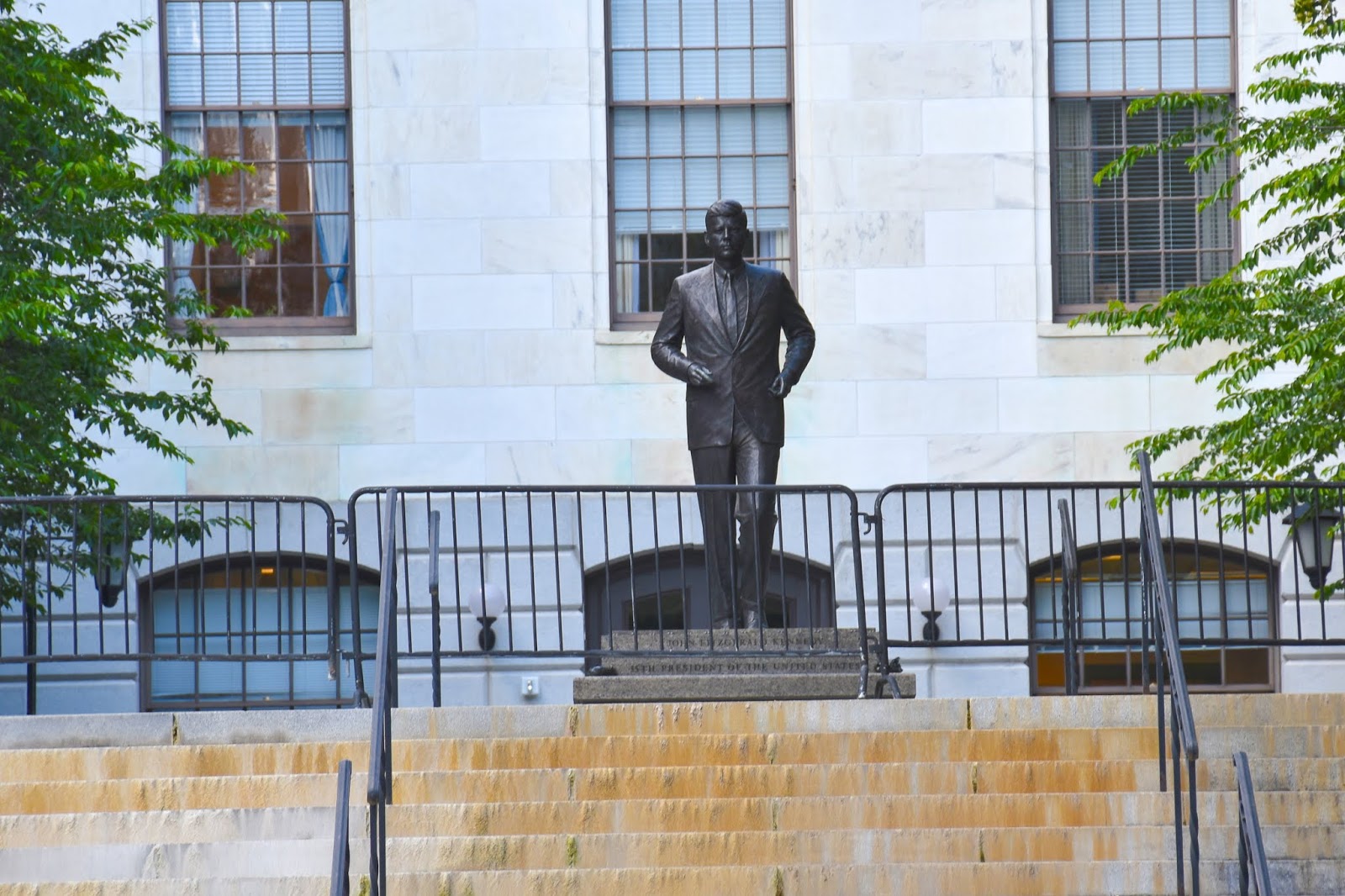
John F. Kennedy was the 35th president of the good ol' US of A. Prior to his election (and subsequent assassination), he was a U.S. Representative from 1947-53, and a U.S. Senator from 1953-1960. Look him up.

The next dude has controversy built into his name and his reputation.

That's Gen. Joseph Hooker up there on that steed, placed prominently near the front entrance to the State House. Born in Hadley, Mass., in 1814, Hooker served in the Seminole Wars and the Mexican–American War, per Wikipedia, before resigning from the Army. "At the start of the Civil War, he joined the Union side as a brigadier general, distinguishing himself at Williamsburg, Antietam and Fredericksburg, after which he was given command of the Army of the Potomac."

While Hooker certainly had some victories during the War Between the States, he is "chiefly remembered for his decisive defeat by Confederate General Robert E. Lee at the Battle of Chancellorsville in 1863," says Wikipedia. Perhaps he'd have won that battle if he'd cut back on his hard-drinking and skirt-chasing. Per Wikipedia: "his headquarters were known for parties and gambling."

In modern times, Hooker has become the subject of protest. In March 2018, the Boston media were filled with stories about a movement to change the name of the State House entrance near the above statue from "General Hooker Entrance" to, well, I'm not sure what. A state representative thought the name "Hooker," being another term for "prostitute," should be removed from the capitol building. She caught a lot of flack for that, but Peter Drummey, librarian at the Massachusetts Historical Society, told Boston magazine that there were rumors during the general's day that he consorted with, well, hookers.

I believe the name still appears above the entrance.

The final statue on my tour around the State House is of a woman who was hanged on Boston Common in 1660 because she refused to disavow her religious beliefs.

Mary Barrett Dyer was a badass. Born in England in 1611, she came to North America in the 1630's, after marrying William Dyer. She worked with well-known thorn-in-the-side-of-Puritan-fathers Anne Hutchinson to organize Bible study groups that went against the theocratic law of the Massachusetts Bay Colony, according to the Quakers in the World web site. Hutchinson and the Dyers were banished from the colony in 1638 for heresy. The Dyers first moved their sacrilegious selves to Rhode Island, and then to England.

There, Mary joined the Religious Society of Friends (Quakers). In 1657 she returned to Boston to protest the law banning Quakers. She was arrested and expelled; her husband, who was not a Quaker, was not pinched. There followed more arrests and banishment in Connecticut and Massachusetts, and a return to Rhode Island. In 1660 she traveled once again to Boston to defy the law, and was arrested, convicted and sentenced to hang. On June 1 of that year, she was executed by the colony.

I did a quick search to see when the anti-Quaker laws were repealed but didn't find anything. I'm assuming they're no longer on the books....

There are two more Beacon Hill statues I want to discuss, even though my pictures of them aren't that great.

This is Christopher Columbus, who stands at the north end of Louisburg Square. Why is the man who is credited with discovering America represented in stone in the most tony address on Beacon Hill? Who the hell knows....

The other statue, located at the south end of the square, is of Aristedes.

The Greek statesman, who was nicknamed "the Just," "is remembered for his generalship in the Persian War," per Wikipedia. "The ancient historian Herodotus cited him as 'the best and most honourable man in Athens,' and he received similarly reverent treatment in Plato's Socratic dialogues. The statues were placed in the square in 1850.

As for Louisburg (pronounced "Lewisberg") Square, below, in 2014 it was one of the most expensive residential neighborhoods in the country, per Wikipedia. I'm guessing it's still on that list six years later. Laid out in 1826 by the Mount Vernon Proprietors on pasture land owned by John Singleton Copley, the residential park's homes were constructed between 1833 to 1847. The townhouses sell for tens of millions of dollars. Among the well-to-do current residents are former Secretary of State John Kerry and his wife Teresa Heinz.

Still with me? This has been a looooooong journey, I know. We're almost done, though. Just a few architectural details and some cool storefront signs stand between you and a job well done.

I love the juxtaposition of the classic shell details on the casing around the exterior window along Beacon Street with the peeling paint and more modern white and yellow squares on the interior window.

Also along Beacon Street I spied the cool lantern below.

You can't swing a mink stole in Beacon Hill without hitting a unique architectural flourish.

This harp-looking decoration is on the outside of the aforementioned Harvard Musical Association, inside of which concerts are held for members only.

The next three photos were taken along Ridgeway Lane, which connects busy Cambridge Street near the Old West Church and the Otis House Museum, with Derne Street, which runs directly behind the State House. It's one of many narrow, picturesque alleys that dot Beacon Hill, and which are quite photogenic, although I imagine they can be a bit dicey in the dark. These lanes give one a sense of what Beacon Hill and the old West End looked like 100 years ago.

I've dubbed these the "oven windows." They're on the side of a building known as The Whitwell, where the penthouse apartment costs nearly $14 million. The building at 28-32 Derne Street (corner of Ridgeway Ln.) was formerly known as the Fenton Building, and was owned by Suffolk University until 2015.

Heading down Ridgeway toward Cambridge Street I was quite taken by this tall door/transom combination at the back of an apartment building that faces onto Temple Street.

I just love this doorway, one of so many on Beacon Hill about which I could say those words.

I'm gonna wrap up my Beacon Hill series with some cool storefronts and a bar along Charles Street.

The Sevens Ale House was established in 1933, the year Prohibition ended. I've never been there but from what I've read online it's a place for "just folks" amid all the highfalutin shops and restaurants in the neighborhood.

DeLuca's Market has operated under that name for decades, and while this place has been a grocery store since 1905, I believe it was originally under a different name.

Last, and certainly not least on my tour of Beacon Hill is Gary Drug Co., which was established in 1939.

The store sells medications, medical supplies, health and beauty products, gifts and more, and has been on Charles Street since 1972, when Herman Greenfield bought the business. The place, which is surrounded by antique stores, high-end clothing shops and pricey restaurants, features a window display that seems like something out of a small-town apothecary in the heartland.

These adorable horses are in the left side of the window, and they're pulling....

....a faux wagon advertising miracle hair grow, snake oils and other tonics to cure what ails ya.

As someone who wrote a (too long) short story years ago, which appeared in Movable Feasts: An Anthology, about just such a late-19th century operation, I really got a kick out of this.

Well, that wraps up Beacon Hill. I hope this and other deep dives into neighborhoods and towns inspire you to get out and explore a bit more of the backside of America.

Checking Out Dudley Street in Roxbury...and a Historic, Pre-Civil War House

From Dave Brigham: As part of a series of quick-hit jaunts through Boston this spring, I checked out the outer reaches of Nubian Square, m...