Showing posts with label historical marker. Show all posts

Saturday, February 24, 2024

Woo Woo! It's Woburn Time

From Dave Brigham:

Let's get this out of the way: Woburn is pronounded "Woo-burn," not "Whoa-burn."

Located about nine miles north of Boston, Woburn was settled by white folks in 1640, and originally included the present-day towns of Burlington and Winchester, and parts of Stoneham and Wilmington. At least some of the land was already populated by the Abenaki tribe, according to the Woburn Historical Society.

Near the end of last summer, I explored the small city's downtown, for no other reason than I wanted to write the headline you see above. Seriously, though, I knew next to nothing about Woburn, so off I went.

The first building of interest I spied was the imposing First Congregational church, which is badly in need of a paint job. I was fighting the sun, so my photos are a bit oddly angled and artsy.

Built in 1860, the Italianate-Romanesque building has, as is the case with just about any old building, some interesting quirks in its history. According to Wikipedia, the 196-foot steeple is the tallest wooden steeple in North America. And, according to MACRIS, "The...Church in order to accommodate the City built a side door leading to the City Common so that the City Council could meet in what is now called the Anne Murray Room (named after this lady, perhaps). An engine company of the Fire Department was housed temporarily in the sub-basement of the Church" at one time.

Additionally, the organ in the church (which may not still be there) dated to 1860 and was built by E.G. & G. Hook. That company, originally based in Boston, eventually built a factory in Weston, Mass., which I wrote about in my profile of that town's Kendal Green neighborhood (see June 23, 2017, "A Walk Through Weston's History").

Presenting a nice architectural contrast to the mega-spire is Woburn Bowladrome.

Located on Montvale Avenue within sight of the church, the bowling complex was established in 1940. Since its beginning in what was an old garage with eight candlepin lanes (with pin boys setting up the racks), the alley has grown to feature 40 candlepin lanes with automatic scoring, per its web site. I'm always happy to see places like this survive, because I've certainly come across plenty that have gone under.

(Rear of Woburn Bowladrome.)

From the bowling joint I curled back around to Winn Street and then to Main Street, where I saw two buildings that I can only describe as adorable.

On the left, at #400, is Mahoney's Barber Shop, which is listed on Google as being temporarily closed. The Woburn assessor's database lists this property's built date as 1979, but that's obviously incorrect. Nobody was erecting buildings with those types of windows and roofline details in the Me Decade. I'm guessing it dates to the late 19th century.

Next door is #406, which the database also indicates rose in 1979. Sigh...I'll never understand how assessor databases work. Where does that bad information come from? This is why I rely on MACRIS so much. That database tells me that #406 -- known alternately as the Col. John Wade Block and the College Block -- was built in 1810 (!).

Ah, so what's 169 years? Anyway, in this instance, MACRIS is only somewhat more useful to my purposes. Whoever wrote the report about this Federal-style building indicates it was built before 1848, and then wrote (c. 1810?), citing a 1904 article in the Woburn News. At least MACRIS got the correct century.

Directly north of #406 is another great old building.

Things only get more frustrating here. The database doesn't list this place at all, and a Zillow listing refers to what is evidently the favorite year of the Woburn assessor: 1979.

I give up.

Next in line is Andrea's Pizza, which has been slinging pies since 1977.

Along Campbell Street, I made a photo of Doughty & Sons, a family-owned heating/cooling/plumbing operation founded in 1980.

Did I make this photo because it made me think of Mike Doughty, one-time lead singer of Soul Coughing? Yes, I did. While I have only a mild interest in that band, I feel a connection to Mr. Doughty, because an acquaintance who is a massive fans of Doughty told me years ago that he couldn't get over how much I look like the singer. While my beard is nowhere near as impressive as Doughty's (check his web site; he's the one on the right on the main page), we share a similar glasses style and we're both bald. Anyway, below is Soul Coughing's big hit from many years ago.

Make sure you listen to music at Doughty's web site. Sounds pretty good to me.

I was excited to see the old Colonial Beacon Filling Station. I'd done a quick search on Flickr for old photos of Woburn, and this was the one thing I was hoping I'd run across.

My interest was piqued because of the unique golden dome on this place, but once I learned the back story via MACRIS, I became truly enamored with it. Built in the 1920s (MACRIS says 1925), the station, with its "[p]rominent columns, balustrade dome and lantern," was patterned after Boston's Massachusetts State House, according to MACRIS. The state house was designed by well-known architect Charles Bulfinch, who over the course of a career spanning the late 18th century into the early 19th designed dozens of buildings in Massachusetts, Maine, Connecticut, Washington, D.C., and elsewhere.

The Colonial Beacon station was one of dozens with the same design built in Massachusetts in the 1920s, according to this June 2019 Patch article. Of those many buildings, I believe perhaps only three remain, in Malden and Boston. There was one in Stoneham that was converted to an ice cream parlor, but it was torn down and replaced by condos.

According to MACRIS, Clifford Leonard, one of the owners of Beacon Oil Company, convinced his partners to build Colonial filling stations. "His reasoning was to market these stations as facsimiles of the Bulfinch State House in Boston. The State House served as the centerpiece of the 'Hub' of Boston, and Leonard wanted to have his gasoline station equated with this popular image."

The 2019 Patch article indicated that the Woburn Historical Commission voted to impose a one-year delay on demolition permits filed by the owner, a subsidiary of the Clancy Group. Four years later, the building still stands. I have been unable to determine if there is a plan to knock the building down, or to restore it.

I doubled back along Main Street, walking on the west side so as to shoot buildings on the east. How could I resist the former Woburn Masonic Hall?

Also known as the Bank Block, the Italianate beauty "is downtown Woburn’s oldest and best-preserved 19th century brick commercial block," according to MACRIS...."[T]he brick block is accented by granite trimmings including corner quoins, keystones above and pilaster caps flanking the arched windows, a string course above the second story openings and continuous window sills on the second and third stories."

At its construction in 1862, it was home to the Bank of Woburn. In 1871, a fourth story with a Mansard roof was added, to house two Masonic chapters in town, according to MACRIS. The bank continued to operate there. In 1921, the building was sold to the F.W. Woolworth Company, which put a large addition on the back. The Mansard roof was removed in 1947.

Across Main Street from the old Woolworth's, and next to Mahoney's Barber Shop, is the home of National Music, which has a pretty nice sign out front.

In business for more than four decades, the store specializes in concert and marching band instruments, as well as portable sound systems, per its web site.

I headed north on Park Street for a short time, saw a ghost sign, then headed back to the main square.

Currently home to Ani's Auto Body, this place was, at some point, known as Park Street Garage. The assessor's database says this building dates to 1959. Maybe that's right, but I'm dubious.

Over on Winn Street, parallel to Park Street, I found Capelo's Auto Service, which also sells used cars.

I like the plastic sign. I'm not sure how long the business has been here, or how old the building is.

Back in the main square, at the corner of Winn and Pleasant streets, is a beautiful old Classical Revival building.

Currently home to the Satsang Center Hindu Temple, this stately lady lost her steeple in a 1925 tornado, and it was never replaced. (Minor complaint about MACRIS. The organization's write-up mentions the tornado, but also twice says it was a hurricane - sheesh....) Built in 1840 as a Congregational Church, the building was taken over by the local Unitarian folks in 1863. "The last meeting of the Unitarian congregation was held in June 1990," according to MACRIS. "The church was sold to the City of Woburn in 1992 and to the Satsang Corporation, the present owner, the following year."

A few doors down, at the corner of Federal and Pleasant streets, is the impressive Woburn Five Cents Savings Bank building.

Now home to an urgent care facility, this granite and sandstone solid citizen rose in 1888, and was significantly altered in 1931. The bank completed a four-story building on this site in 1888, which it partially occupied. Other tenants over the years included a post office, a druggist, a YMCA, the St. Charles Catholic Total Abstinence Society, Post 161 of the Grand Army of the Republic and other social and patriotic organizations, according to MACRIS. There was a concert hall on the third floor at one point; that space was taken over by the Eastern Middlesex District Court beginning in 1915.

In 1930, the bank trustees met to discuss whether to construct a new building, or to rebuild the existing one. They decided on the latter option. "The Thomas M. James Company was retained as architects and the top two stories of the Victorian structure were removed," per MACRIS.

Across Pleasant Street from the Hindu temple and the old bank, on one corner of Woburn Common, is something the likes of which I've never seen before. Frankly, I'd never even heard of the item protected in a glass case and described in a plaque in front. It made for a nice final stop on my relatively short tour of Woburn.

That there is a ventilator cowl from the USS Maine, which was commissioned by the U.S. Navy in 1895, and sank three years later in Cuba's Havana Harbor. The sinking, and the subsequent sensationalized reports by journalists (especially in newspapers owned by William Randolph Hearst and Joseph Pulitzer), led indirectly to the Spanish-American War over Cuba. According to Wikipedia, the Maine had been sent from Key West, Florida to Havana, Cuba "to protect American interests during the Cuban War of Independence." Three weeks after her arrival, there was an explosion on board, which killed 268 sailors, rougnly three-quarters of the crew.

"In 1898, a U.S. Navy board of inquiry ruled that the ship had been sunk by an external explosion from a mine," per Wikipedia, with the Hearst and Pulitzer papers claiming the Spanish had done it. "However, some U.S. Navy officers disagreed with the board, suggesting that the ship's magazines had been ignited by a spontaneous fire in a coal bunker. The coal used in Maine was bituminous, which is known for releasing firedamp, a mixture of gases composed primarily of flammable methane that is prone to spontaneous explosions. An investigation by Admiral Hyman Rickover in 1974 agreed with the coal fire hypothesis."

Wreckage recovered from the bottom of the harbor was distributed to towns and cities across the United States. "America's small towns, flush with patriotic fervor, demanded relics of the waterlogged battlewagon to enshrine," according to Roadside America. "Some did better than others. Perhaps the greatest prize -- the captain's bathtub -- was snagged by Findlay, OH, but the other macabre booty was democratically scattered nationwide. Three ventilator cowls -- those horns that stick out of ship decks that people are always falling into or peeping out of in movies -- were dredged up. One was given to Woburn."

Now you -- and I -- know what the heck a ventilator cowl is.

Saturday, October 9, 2021

It's Hip to Be Coolidge Square

From Dave Brigham:

I know, I know. You weren't happy with my coverage of the West End of Watertown, Mass. (see October 2, 2021, "Making the Most of Watertown's West End"). It's not my fault that the largely residential area has a skinny backside. But I can offer plenty of what you're looking for in Watertown's Coolidge Square neighborhood, which has a cool diner, markets aplenty, a coffee shop/cafe, two historic graveyards and a bike path in the works.

Welcome to the final segment of my look at Watertown, which I started earlier this year.

Named for ancestors of President Calvin Coolidge, the square runs along Mount Auburn Street, roughly from School Street on the west to the border with Cambridge on the east, and extending southeast along Grove Street and south along Bigelow Avenue and points in between.

Let's start at the beginning, which is the end for us all.

The Old Burying Place, as the sign says, is the final resting place for ancestors of President Coolidge, as well as a predecessor in that office, James Garfield.

John and Mary Coolidge arrived from England to what is now the Cambridge/Watertown area, probably in 1630. The family owned many properties down through the years, including the land where the Coolidge School stands, just steps from the main drag through Coolidge Square, per this web site.

(Burial obelisk for Joseph Coolidge, killed in the Battle of Lexington, April 19, 1775. He was the only resident of Watertown to fall that day.)

(Other graves at the Old Burying Place.)

Watertown is also home to the more well-known Mount Auburn Cemetery, part of which is also in Cambridge (I feel like people assume the graveyard, in which are buried countless famous and wealthy Boston Brahmins and other folks, is largely in Cambridge, but a look at Google Maps disabuses us of that notion).

Mount Auburn is famous as the first rural, or garden, cemetery in the United States, per Wikipedia. "Dedicated in 1831 and set with classical monuments in a rolling landscaped terrain, it marked a distinct break with Colonial-era burying grounds and church-affiliated graveyards. The appearance of this type of landscape coincides with the rising popularity of the term 'cemetery,' derived from the Greek for 'a sleeping place,' instead of graveyard....The 174-acre cemetery is important both for its historical aspects and for its role as an arboretum. It is Watertown's largest contiguous open space and extends into Cambridge to the east."

I entered the cemetery along Grove Street, which heads southeast out of Coolidge Square.

(Holy Bible Patterson played college ball at Holy Cross, before going on to star for the New Orleans Saints. Or so I've heard.)

(Keen observers of the blog will notice that I used some of these photos in my post earlier this year about East Watertown.)

The burial ground is quite amazing. If you've never been there, do yourself a favor: drop whatever you're doing, and walk, bike, drive, catch a bus or hijack a truck to get there and take it all in. The grounds are stunning, the burial vaults and stones are gorgeous. There are birds and squirrels and quaint little walking paths and you'll quickly find yourself at peace. Also, if you enter along Mt. Auburn Street in Cambridge, keep your eyes peeled for the W.C. Canniff & Sons gravestone showroom, which I featured in the blog four years ago (see November 30, 2017, "Stone Cold Monuments").

Just northwest of the Grove Street section of the cemetery is the rather large industrial complex that has been the home to Newly Weds Foods since 1980.

The food ingredient supplier is a "global purveyor of customized breaders, batters, seasonings, and functional ingredients," according to its web site. Based in Chicago, Newly Weds has 17 North American manufacturing facilities, as well as several located elsewhere around the globe. The Watertown facility specializes in breading and battering, I believe. I've been unable to figure out what type of business was located in this plant prior to Newly Weds.

On the corner of Arlington Street (which merges with Grove by the Old Burying Place) and Mount Auburn Street is another large business complex.

Built in 1925 by Western Electric Company, this place was used to supply New England Telephone Co. with equipment and repair, per MACRIS. The building is the only one in Watertown "to be designed in the Moderne Style, which was popular between 1930's and 40's," per MACRIS. "The style stripped the surface of ornament, or kept it to a minimum...a strong geometry, and simplicity of line are evident, with building setbacks acting to give interest to the shape. The behemoth was built in the grounds of the former Coolidge Farm."

The complex is now home to Tufts Health Plan.

Between the old Western Electric buildings and Newly Weds Foods a multiuse path has been taking shape for quite some time.

The Watertown-Cambridge Greenway project was launched in June 2013 when the City of Cambridge and Mass. Department of Conservation and Recreation jointly purchased a former B&M Railroad line, the Watertown Branch, according to the Greenway's web site. The portion between School and Arlington streets in Watertown is complete, and fills up with walkers, runners and cyclists. The section (part of which is shown above) from Arlington to Mount Auburn Street in Cambridge is still under construction. By the time I publish this, this section of the path may be open.

(Taggers have been busy along the bike path.)

The path will take folks directly behind a local eating and drinking institution, Greg's Restaurant, which features a great sign out front.

The Diliberto family of Watertown started a market at this spot in 1932, per the eatery's web site. Soon after, the family turned it into a restaurant. Gregory Diliberto took over the restaurant in 1960; the fourth generation of the family runs it today. Rumor has it that former Massachusetts Gov. Bill Weld used to frequent this joint.

A short distance west of Greg's is a yellow-brick building with apartments above a handful of retail slots, one of which is occupied by Audio Pro (on their web site, however, they go by Audio Proz)

In business for more than three decades, Audio Pro offers "a wide range of products and services from consumer tape decks to professional studio processors, turntables to hard disk recorders, radios to mini-disc players," per its web site. Shop owner Vince Naeve is a music-maker; check out his Bandcamp page.

On the opposite side of Mount Auburn Street is the beautiful Sacred Heart Church.

Built in 1912 and designed by Charles Brigham, the church replaced a prior house of worship that burned down that same year. Its congregation in the late 19th century and well into the 20th was largely comprised of Irish immigrants drawn to Watertown for work in the stockyards, factories and mills. Sacred Heart forms half of the Watertown Catholic Collaborative, with the other half being St. Patrick's in Watertown Square, which I featured back in February in my second survey of the square.

Back on the south side of Mount Auburn Street is the home of the Baikar Association.

(I love the big windows and the funky awning above the front door.)

The association publishes The Armenian Mirror-Spectator, an English-language weekly paper that debuted in 1932. The building, which dates to 1963, is owned by the Tekeyan Cultural Association, part of a network of organizations around the globe dedicated to preserving "the Armenian Culture and Heritage in the Diaspora, and to promote cultural, spiritual and educational ties with the homeland, irrespective of political and ideological barriers."

Heading southwest from the Baikar building, into the heart of Coolidge Square, you'll find the old-school Mount Auburn Grill.

The restaurant and bar, which I believe dates to the 1970s, was evidently put up for sale last year. Shortly after a "For Sale" sign went up, though, it came down and the place reopened, according to a Facebook post I found. I'm not sure of the eatery's current status.

One place that's definitely in business is the Deluxe Town Diner.

Located on the corner of Mount Auburn Street and Bigelow Avenue, the diner is Coolidge Square's centerpiece, with its neon sign, cool glass-block windows, two-tone enamel siding and colorful umbrellas for outdoor seating. And the food! I haven't eaten there in a few years, but I've never been disappointed by anything at the Deluxe.

And the diner's story is as cool as the place itself: the diner is "actually an addition to an earlier diner on the site," per MACRIS. "When owner George Contros and his father decided to expand, they asked a local construction company to build this one on the site, although it looks factory-made. It illustrates the mid-1940's diner aesthetic, with aqua and cream porcelain enamel exterior, stainless steel, aluminum trim and roof, and glass blocks at the rounded ends. The neon signage & railroad car imagery is part of this 'look,'" MACRIS continues.

I believe the current diner's kitchen is the original diner, kinda like how Mike Mulligan's steam shovel became the furnace for the building they dug the basement for. Look it up, kids.

The Deluxe has been in business since 1947. The owners are Don and Daryl Levy, who formerly owned the Blue Diner (now the South Street Diner) in Boston's Leather District. I wrote a bit about that diner and featured some photos in a post about that neighborhood (see February 22, 2020, "Hell Bent for the Leather District").

(Even the backside of the diner looks cool.)

Across Bigelow Avenue, at the corner of Wells Avenue, is Whale of a Wash laundry and dry cleaning service.

I don't have anything to say about this place, other than I like the name and the sign. For some humorous -- and not so humourous -- reviews, check out Yelp.

Just a short distance south on Bigelow is Taxiarchae/Archangels Greek Orthodox Church.

Completed in 1950, the Byzantine-style church features a cornerstone inside of which are "the names of the 400 parishioners (as of 1950), a stone from the Acropolis and soil from Greece mixed with American soil to symbolize the spirit of democracy—the old and the new—together in a new land," per the church's web site. The parish dates to 1913.

Just up the street is St. Stephen's Armenian Apostolic Church.

As I've mentioned in previous Watertown posts (see links at the bottom of this post), the town has a significant Armenian population. This church was consecrated in 1957, nearly a quarter-century after the congregation formed, according to the church's web site. "St. Stephen’s Armenian Apostolic Church is located in the heart of the Armenian community in Watertown...the largest Armenian community on the east coast," the web site continues. "Its jurisdiction falls under the Eastern Prelacy of the Armenian Apostolic Church, and the Holy See of Cilicia."

On the western outskirts of Coolidge Square stands another Armenian church.

St. James Armenian Apostolic Church, which, along with its cultural center, stands at the intersection of Mount Auburn and School streets, dates to 1933. The parish traces its founding back to 1926, when "a door-to-door campaign by tireless volunteers accumulated a sufficient amount of money to make a down payment on a plot of land," per the church's web site.

Next door to the church, on the eastern flank, is a shuttered branch of the Watertown Library.

Built in 1900, the library has been closed since 2006, according to this Wicked Local article. In 2017, St. James Church bought the property from the town, and indicated it had no immediate plans for the space. One option mentioned in the Wicked Local article was tearing the building down and turning the space into a park. The branch was closed, along with another one on Orchard Street, once the main library was renovated.

On the old library's front lawn there is a historic marker, the likes of which are spread throughout the area.

"Through this place passed General Henry Knox in the winter of 1775-1776," the plaque reads. "To deliver to General George Washington at Cambridge the train of artillery from Fort Ticonderoga used to force the British Army to evacuate Boston. Erected by the Commonwealth of Massachusetts 1927." I wrote about a carbon copy of this plaque in neighboring Waltham, on April 20, 2016 in my post, "Washington Walked Here."

Two doors down from the old library is an abandoned service station.

The station dates to around 1940, according to the Watertown Assessor's Office. While cleaning up former gas stations can be expensive due to environmental issues, it's likely that at some point this site will be redeveloped for condos or offices.

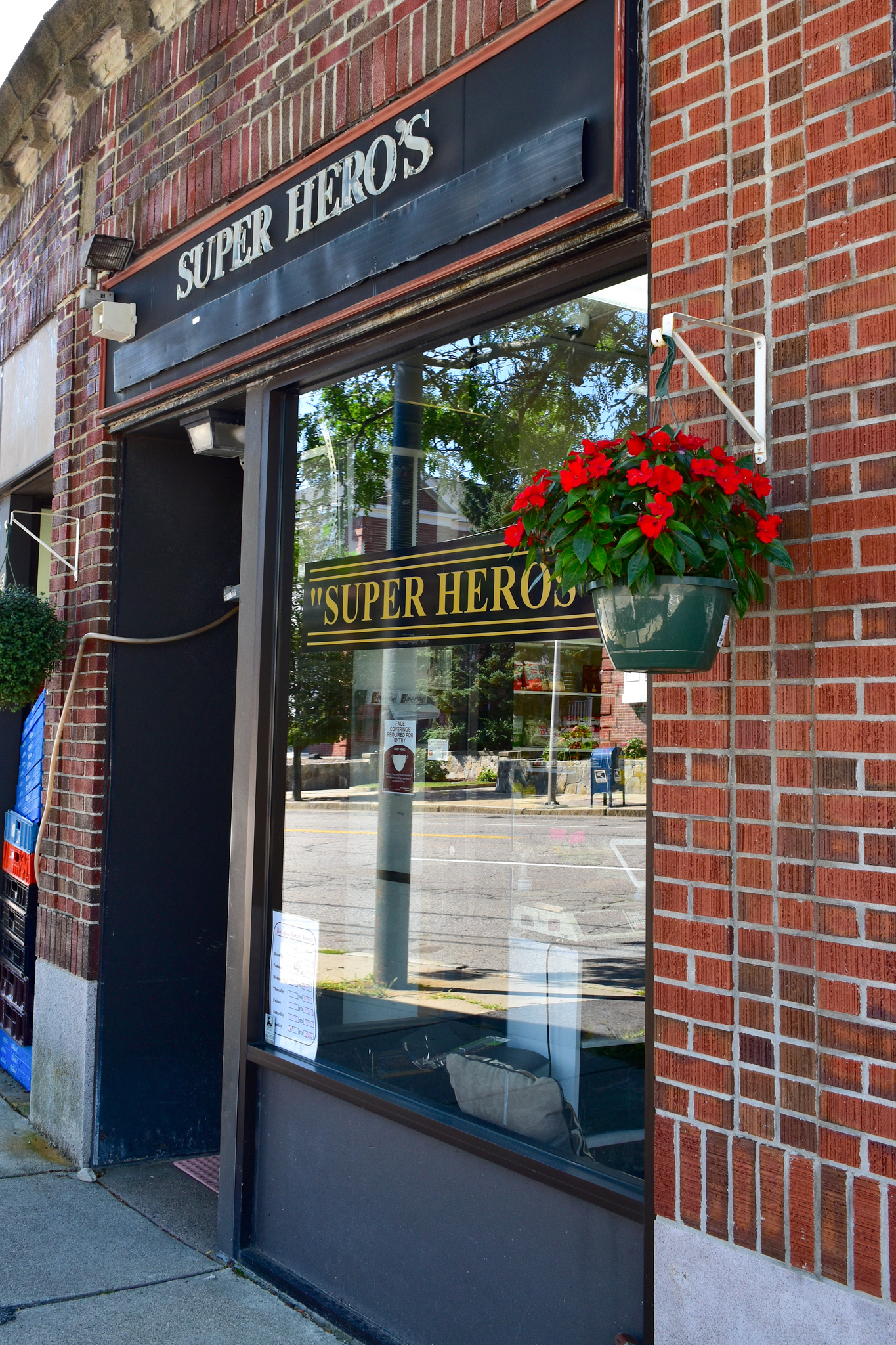
Across Boylston Street from the old service station is Roksana Market, aka Super Hero's.

I'm not sure, but this place may be owned by the same folks who own Roksana's Persian Food on Mount Auburn Street, closer to Watertown Square. I love the name Super Hero's, but wish they'd had someone paint a ripoff Marvel character or something on the window.

Continuing east along Mount Auburn Street, we come to the Cass School of Floral Design.

Established in 1981 by Faith Cass, the school teaches professionals and amateurs alike. The school, which is situated next to a retail florist operation, offers two certificate programs.

Heading further into the square, I found Uncommon Grounds, a cafe offering breakfast and lunch in a converted gas station.

Behind the trees that surround the sign were seated, that day, loads of people -- hipsters, families with small kids, older folks -- eating lunch on a beautiful day. I was drawn to the mural on the wall along the side of the property. The artwork was created in September 2015 by artist Gregg Bernstein and students from Watertown High School. "Called 'Seeds of Change,' it features fruit, vegetables, flowers and other items that can be found in markets and stores around Coolidge Square," according to the Watertown News article linked previously in this paragraph. The restaurant has been in business since 1998.

Across Melendy Avenue from the Uncommon Ground is Arax Market, one of several such establishments in the area.

Established in 1974, the market bills itself as an Armenian and International Specialty Store.

I'll wrap up this post with a place that is really not quite in Coolidge Square. But it's within walking distance, and I had to include it here, because when I shot this building earlier this year for my East Watertown post, I got a photo of an out-of-business eatery.

Located at the intersection of Crawford Street and Coolidge Hill Road (that name again!), What Da Chick calls itself a Thai Chicken Rice establishment. Slated to open in October, the restaurant succeeds Matilda's, a sandwich spot that had been in business for many years.

(I've love to know who painted this adorable mural.)

Well, that wraps up my series on Watertown, Mass., which debuted back in February. Here are links to my other posts about the town:

Watertown Square: Part I and Part II.

The Bemis neighborhood.

The former Watertown Arsenal.

East Watertown.

New Balance Draws a Red Line with Diner

From Dave Brigham: I can't be expected to know everything about the backside of America, nor of Massachusetts or even of Boston. But I...