I travel often from Connecticut to Pennsylvania to visit family and friends. I take Route 84 west to New York on most trips to avoid going through NYC. I have to cross the Newburgh Bridge in New York as I make my way down. I stopped in the town of Newburgh on one trip to get some gas, which sparked my interest in the town. I made a plan to stop there on a recent visit to see my father on Good Friday and I’m glad I stopped through.
I did a bit of research beforehand to get a lay of the land. I spotted a factory along the Hudson River so I figured it would be a good spot to start. The factory was once the site of The Newburgh Steam Mills on North Water St. The building was built in the mid 1800’s and brought a lot of business and employment to the area. The factory, which processed cotton, employed over 300 employees. As this was my first time in the area, I only took a few shots of the building from the street side, but I found out later that I could have walked behind the building also. (Next time!)
The building was bought and transformed into a lawnmower factory in the late 1800’s after the decline of cotton manufacturing. The Chadborn & Coldwell Manufacturing Company of Newburgh operated into the 1940’s before eventually merging with Toro brand lawnmowers. The building was once again sold and transformed into the Regal Bag Company. The company ran the business from the property for almost 73 years and sold it in 2024.
The building now contains businesses on the 5th and 6th floors. On the 6th floor, there is a company that makes backdrops for Broadway shows. The fifth floor has many spaces for artists and artist studios. Fun fact - the building is listed in Ripley’s Believe It or Not! as the only building that has its main entrance on the 6th floor.
After taking a few shots, I ventured closer to the marina to check out some sites along the Hudson River. There were other brick buildings that also looked to be former factories/businesses. Most of the buildings have been transformed into restaurants. The weather was nice for an early spring day, which brought a pretty good amount of people to the area. I’m sure that the area will be much busier with the weather getting warmer. I’ll have to go back later in the spring or summer to see.
My curiosity for something more “Backside” drew me even closer to the water. To my delight, I spotted a few old vessels docked along the shore. I don’t know what these vessels were used for or how long they were left there, but it lets us know there was some shipping activity along this part of the Hudson River.
Being so close to the shore gave me a great view of the town of Beacon across the river. The Newburgh-Beacon ferry can be taken from the marina back and forth across the Hudson River connecting Newburgh and Beacon, N.Y. The ferries only run on weekdays as a rush-hour service for commuters to NYC. Ferries are timed to connect at Beacon with Metro-North trains to and from Grand Central.
I will definitely be back to take more shots in this interesting town. My research of the town led me to the fact that Newburgh is in the top 10 of cities in the U.S. in violent crime. I will have to be careful when taking a trip further into the town. The town is in the process of revitalizing the area as it is reported that there is much blight like a lot of towns in the U.S. I’m anxious to view some of the old architecture and layout of downtown Newburgh. I will keep you all posted. Wish me luck!
Located at 94 Prince Street in New York City's SoHo neighborhood, Fanelli Cafe has been in business since 1847 (!). I knew nothing about this historic eatery when I walked by, trailing my wife and daughter as they window-shopped. I saw the sign, pointed my camera up because I liked the looks of it, made a photo and moved on.
This is the final post in my series of quick hits about a trip to NYC last fall. Links to the previous six are at the bottom of this post.
"Herman Gerken leased the wooden building at 94 Prince Street in 1847 and became the proprietor of a grocery on the site," per the cafe's web site. "In 1853 [John] Hance’s heirs, Edna Brown, Mary Sarles, and Sara McIntosh, sold the lots to Herman Gerken. In 1857 Gerken built the present day (sic) handsome five story (sic) brick building that still carries the 94 Prince Street address. This corner building was interconnected with his adjourning (sic) building at 135 Mercer Street by at least 1891."
To read the history of this property, starting with a Dutch farm in the 1640s to its status during Prohibition as a speakeasy, check out this page on the cafe's web site, which quotes from an article originally published by New York Art World.
This plaque is located outside a Guess store at 538 Broadway in New York City's SoHo district, marking the former location of a Fluxhouse artist cooperative live-work space. These are the kinds of things I make photos of while all around me people are window-shopping, taking selfies in front of a Brandy Melville store and generally not taking photos of things like this.
If, like me before October 13, 2024, you have no idea what a Fluxhouse is, let me tell you all about it...in the words of web sites that know what they're talking about. I made this photo because I was somewhat familiar with the Fluxus art movement. What did I know about it? Well, that the musician Beck's grandfather, Al Hansen was a member of the movement.
"Founded in 1960 by the Lithuanian/American artist George Maciunas, Fluxus began as a small but international network of artists and composers, and was characterised as a shared attitude rather than a movement," according to this article from London's Tate galleries. "Rooted in experimental music, it was named after a magazine which featured the work of musicians and artists centred around avant-garde composer John Cage."
"Drawn together by their disenchantment with the elitist attitudes that they perceived in the art world at the time, they looked to the Futurists and Dadaists for inspiration, especially focusing on the performance aspects of these movements," per this article from The Art Story. "The two most dominant forces, however, were Marcel Duchamp and John Cage, who championed the use of everyday objects and the element of chance in art, both of which became fundamental to Fluxus practices. Whilst Cage was part of the Fluxus movement, Duchamp was never directly involved."
"From 1966 to 1975, George Maciunas realized the social objectives of Fluxus towards a pragmatic and non-elitist conception of art in his work as an urban planner in the Fluxhouse Cooperatives," according to the George Maciunas Foundation web site. Over that decade, he livened the SoHo and Lower East Side neighborhoods by creating Fluxhouse cooperatives in 17 buildings.
This is the fifth in a series of short posts about my trip to New York City last fall. Links to the others are below:
This is the fourth short post about my trip to New York City in October (the first one is here; the second one is here; the third one is here). You can't throw a rock in the Big Apple without hitting a famous restaurant, park, store, art gallery, person, movie setting or nightclub. As I was walking through the Bowery in Lower Manhattan, I stumbled across an example of the latter.
The Bowery Ballroom opened on Delancey Street in 1998, in a building that's nearly 100 years old. It is considered one of the best music clubs in the country, per Wikipedia. As with Webster Hall that was featured in my second NYC post, I'd heard of this place but haven't been there.
I became more interested in this well-known spot after looking up and seeing "TREE-MARK SHOES" chiseled into the facade.
Wikipedia says this store never opened, because its planned debut came just before the Wall Street crash of 1929. "It stood vacant until the end of World War II, when it housed a series of shops." Ephemeral New York, however, says Tree-Mark moved in after the big war and was there for the next 30 years.
Whatever.
When I think of the Bowery, which over decades of decline became shorthand for down-and-out, I think of the Bowery Boys, probably thanks to my Dad mentioning the fictional New York City characters from a series of movies made from 1946 to 1958. The Boys were successors to the East Side Kids, who were an imitation of the Dead End Kids.
Located at 110 East 11th Street in Greenwich Village, the billiards joint (also a cafe and bar) was founded in 1989 by comedian David Brenner and brothers Greg and Ethan Hunt, per the joint's web site. I have fond memories of seeing Brenner on late-night talk shows and elsewhere on TV when I was a kid.
While the billiards place is 35 years old, evidently "this venue has a rich history that dates back to the charming Greenwich Village in 1940," according to this Billiard Bay article. I'm not sure if it was a pool hall back in those days, or what it was. I made the photo above because I dig the sign.
This building stands today, but a handful of buildngs of the same generation weren't so lucky, as they were torn down to make way for, ugh, the hotel where we stayed.
As I exited the Uber that my wife, daughter and I took from the train station, I said to myself, "Whoa! We're right across from Webster Hall!"
I'm not sure why I said this, as I have no connection nor much knowledge of the historic New York City concert venue. I think I first heard of Webster Hall back in the late '90s when I worked for an Internet company and we paid attention to bands webcasting live performances from there. Anyway, let's use my lack of familiarity about this place on East 11th Street to learn something.
"Webster Hall was built in 1886 by architect Charles Rentz in the Queen Anne style and topped with an elaborate mansard roof," according to Wikipedia. "Six years later in 1892, Rentz was hired to design an addition to the building, occupying the site of 125 East 11th Street and designed in the Renaissance Revival style using the same materials as the original building. Throughout the early twentieth century the building was plagued by fires, which occurred in 1902, 1911, 1930, 1938, and 1949. The original mansard roof was likely lost in one of these fires."
Damn, did they hire an arsonist act as part of the vaudeville nights? Yeesh.
A little more from Wikipedia: "The first decade or so of Webster Hall's existence saw it host countless labor union rallies, weddings, meetings, lectures, dances, military functions, concerts, fundraisers and other events, particularly those focused on the working-class and immigrant population of the surrounding Lower East Side neighborhood. Although it also hosted many high-society functions catering to the uppertens (new word for me - DB) of the city, the hall earned a reputation as a gathering place for leftist, socialist, Anarchist and labor union activity very early on."
Since 1992, the hall has been operated by the Ballinger brothers as a place for concerts and corporate events, and includes a recording studio. The night we stayed across the street, actor and comedian John Early, who I've never heard of, was on stage.
This is the second of several quick-hit posts about some of the things I saw during a brief visit to New York City in October. The first one is available here.
In mid-October my wife and I traveled with our daughter to take a tour of New York University. I had time the morning before our walkabout to check out the neighborhood, camera in hand. I headed south on 4th Avenue in Greenwich Village and within a short time found myself looking up at this amazing sign.
First, I'm happy to report that the clock inside the eighth note on the former Carl Fischer Music Building is accurate, although it appears some sort of renovation of the massive timepiece was going on. I'm also thrilled that when this music publisher's home was converted to condos, the developer kept the eye-grabbing sign. I mean, it's worth it to attract eyeballs and for giving directions, right?!
As for the building: "For over seventy-five years it housed the printery and a retail store for the Carl Fischer Music company," per this Off the Grid blog post from the Greenwich Village Society for Historic Preservation. "The company’s founder, Carl Fischer, was born in Germany and immigrated to New York in 1872. He opened a musical instrument store on East 4th Street between First and Second Avenues, and soon expanded into sheet music publishing. By 1880 the company expanded to a larger space on Cooper Square, but it wasn’t until 1922 that the building we see today was built."
The company is still in business today, albeit in a different location since 1999: Wall Street in Manhattan's Financial District. The company's "publications span multiple genres, ranging from concert music to jazz, classics, popular and choral works while representing the major instrumental groups, including woodwinds, strings, brass, percussion, voice, keyboard, and fretted instruments," per its web site. "Carl Fischer Music publications are available for purchase at over 2,000 retailers worldwide."
This is the first of several quick-hit posts about some of the things I saw during my brief visit to New York City.
My last post featured highlights from a walk I took through Greenwich Village, as I tagged along behind my daughter and her friend while they did a self-guided tour of New York University (see December 21, 2024, "A Peep at Greenwich Village"). Later that day we checked into a hotel in Brooklyn near the Barclays Center, where the girls went to a concert in the evening. While they were at the Childish Gambino show, I walked around the Park Slope neighborhood and made some photos, trying to beat the sunset.
The first thing that caught my eye was the rear of a Warby Parker store along Bergen Street.
The eyewear store, which fronts on Flatbush Avenue, opened in 2020.
Along Flatbush Avenue, I dug the sign for Antonio's Pizza, which has been in business for more than 50 years.
Across the avenue was a pair of buildings that caught my eye. Frankly, there were dozens of buildings like this that appealed to me, but I couldn't make photos of all of them.
On the right is a Dominican restaurant, El Gran Castillo de Jagua, which translates to the Great Castle of Jagua. Jagua is a fruit found in the jungles of South America; it has been used for body ornamentation and medicinal purposes by the indigenous people of the Amazon for centuries, according to the Internet.
On the left is Sharlene's Bar, which, according to its facade, features beer cocktails. "Opening in its current form in 2009, when borough native Sharlene Frank rechristened it, the space had previously been a watering hole named Mooney’s," according to this 2018 profile at Punch. "Before that, according to The New Yorker, it was 'a bar for as long as anyone can remember.'
"The jukebox is stocked with everything from The Kinks to At the Drive In, but the bartenders only turn it on when it’s really busy; before then, it’s usually a steady flow of bebop. That lack of pretension or gimmick is exactly what has made it the beloved second living room for an extended web of ambitious young people looking to mingle, hook up, swap stories about the sorry state of [the media] industry and hatch schemes to improve the lots of their comrades."
This joint has been here since 2005, after starting in New York's Tribeca neighborhood in 1991.
I passed the Barclays Center and then made my way over to a beautiful old subway head house.
I believe this place was built in 1908 from a design by the firm of Heins & LaFarge, as part of a much larger complex for an elevated train station. Eventually, the elevated line came down and the old head house fell into disrepair, according to this blog post.
"At some point, Arts for Transit took over the building, and today, it sits majestically and silently in the middle of the triangle formed by Flatbush, Fourth and Atlantic Aves," the blog post indicates. The nicely restored building "now serves as an artistic skylight for those folks waiting on the Brooklyn-bound local IRT tracks" underground.
I love that.
The sun was fading, while my appetite was growing, so I started making my way back to my hotel. I got a bit turned around, but after reorienting myself via Google Maps, I ended up in front of a hulking industrial building along Butler Street, just a few blocks from the Fairfield Inn.
This neighborhood is still somewhat industrial, but I could tell that there once had been a LOT more buildings that looked like this, filling up what are now empty lots or new condominiums. Thanks to the awesome Brownstoner web site, I learned everything I need to know about this abandoned complex.
Completed in 1914, this place was originally a publishing plant for R.G. Dun & Company, according to this blog post. The "Vaguely Renaissance/Gothic Revival early 20th century factory" was designed by the architectural firm of Renwick, Aspinwall & Tucker. The firm also designed buildings including the American Express Building at 65 Broadway in Manhattan; Grace Church Neighborhood House and the Provident Loan Society Buildings, both in Manhattan; and sanitarium additions to Seaview Hospital in Staten Island, and Dollar Savings Bank in the Bronx.
You can read the history of R.G. Dun & Company at the blog link. I'll tell you where the story ends, though: the firm merged with the John M. Bradstreet Company, forming Dun & Bradstreet, which provides commercial data, analytics, and insights for businesses.
There appears to have been a legal battle over this property, which as of early 2014 was slated for demolition to make way for a hotel, according to Brownstoner. More recently, a developer was awarded $36 million by a judge for...I'm not sure what, because the article is behind a paywall.
At the corner of Butler Street and 3rd Avenue there is a large mural advocating for drivers to watch out for pedestrians and those riding bicycles, with a big red stop sign painted that says "NOT ONE MORE DEATH." There are four kids portrayed, with names and birth and death dates next to three of them: Victor Flores 1992-2004; Juan Angel Estrada 1993-2004; and James Rice 2003-2007. The photo below depicts Rice.
Victor and Juan were hit and killed by a garbage truck at an intersection several blocks away, in February 2004, according to a news article that I don't feel the need to share. James was hit and killed by a car while in a crosswalk nearby, in 2007. Local teenagers painted the mural in 2007.
Before retiring to my hotel room, I did a loop around the property. Along Douglass Street, I saw a sign that I thought was perhaps a ghost, but alas it's for an active business: Marble, Onyx, Granite & Terrazzo.
Around the corner on Butler Street is a place that I'd noticed on Google Maps when I booked the hotel. I had to make an image of the Yellow Cab garage.
I will publish more quick-hit New York City posts in the near future.
Near the end of August I drove to New York City with my daughter and one of her friends. They wanted to check out New York University during the day, and go to a concert at night. While they did a self-guided audio tour of the NYU campus near Washington Square Park, I tagged along with my camera. After the tour, we got lunch and then walked around a bit more.
Here's some of what I saw.
I was quite charmed by these buildings on MacDougal Street, which is one of the most well-known addressess in Greenwich Village. On the right is #177, which was built in 1834; I'm assuming the building on the left rose around the same time. They abut 181 MacDougal Street, a 16-unit, full-service condominium that was under construction. That building was designed by Morris Adjmi Architects.
MacDougal Street is where Eleanor Roosevelt moved after the death of her husband, Franklin Delano Roosevelt. In the middle of last century, its cafes attracted artists such as Jackson Pollock, Beat Generation writers Jack Kerouac, William S. Burroughs and Allen Ginsberg, author James Baldwin and musicans including Bob Dylan, according to this article from Untapped New York and this one from Grandlife.
I will cover more of the street's highlights below.
I learned the name of this street during my college years, when I heard Dan Green's 1968 psychedelic song, "MacDougal Street Freak Out," on the radio:
At 126 East 13th Street, I stopped to admire one of the windows, and noticed a plaque mentioning Frank Stella.
The name rang a bell, although I had no clue why. Stella, who died earlier this year at age 87, was an influential and well-known artist known for his minimalist works. "Stella’s works are held in the collections of the Metropolitan Museum of Art in New York, the Kunstmuseum Basel, the Art Institute of Chicago, the National Gallery of Art in Washington, D.C., and the Tate Gallery in London, among others," according to this Artnet profile.
Stella, who in 2009 was awarded the National Medal of Arts by President Barack Obama, lived and worked in New York City for decades. The Beaux Arts building on East 13th Street, of which I wish I'd taken more photos, dates to 1904 and is "one of the last remaining buildings in New York City built to stage horse auctions," according to this Curbed New York article.
A short distance away, I walked past a place with a dark, yet heroic, history.
I didn't make images of the plaques on the exterior wall listing the 12 members of this firehouse who died on 9/11. I wanted to stop for a moment to reflect, but my daughter and her friend were walking well ahead of me and I didn't want to lag too far behind. This is the station for Ladder Company 3 on East 13th Street. During the horrible terrorist attacks in 2001, the company reported to the North Tower of the World Trade Center. "As the time of the attacks coincided with the morning tour change, both tours remained on duty, and the company arrived at the World Trade Center carrying more men than usual," according to Wikipedia. "Captain Patrick J. Brown and his men were last known to be on the 35th floor of the tower before the North Tower collapsed. Ladder Company 3 received some of the heaviest casualties of any fire company in the FDNY."
Heavy stuff.
At the intersection of East 13th Street and Broadway stands a knockout of a building.
Built in 1893-94, the Roosevelt Building stands out for its architecture, its engineering, its history and its connection to a storied-and-moneyed New York family.
"Prominently situated on the northwest corner of Broadway and East 13th Street, the Roosevelt Building is an outstanding example of the high-rise commercial development that occurred south of Union Square during the late-19th century using innovative new technology such as elevators, electricity, and metal framing," according to a New York City Landmarks Preservation Commission designation report from 2019.
"The striking transitional Romanesque Revival/Renaissance Revival-style, iron- and steel-frame building has a tripartite configuration that includes a two-story rusticated stone base with upper sections clad in Roman brick and elaborate terracotta ornamentation," the report continues. "A column topped with a copper cupola anchors the building’s southeast corner....Detailed examination of the building reveals layers of intertwining and overlapping terra cotta ornamentation clustered primarily on the pilaster capitals and in undulate bands along the intermediate cornices that project above the second, sixth, and eighth stories on both designed facades. Though much of the ornamentation is classically-inspired in form, it is enhanced with a multitude of references to ancient mythology – lions, humans wearing lion heads, dragon-like monsters, gods, and half-beings with the body of a beast or human and tails of a sea creature – set within a backdrop of wild, swirling foliage."
Damn - I want to hang off the side of this building on a window-washing scaffold!
As you may have guessed by the building's name, it was developed by the well-to-do Roosevelt clan, which at the time included two uncles of future president Teddy Roosevelt. "Architect Stephen D. Hatch designed the eight-story Roosevelt Building...for James A. Roosevelt and Robert Barnwell Roosevelt, who, together with other members of the Roosevelt family, formed the Broadway Improvement Company to oversee their real estate ventures. [They were] [h]eirs of the wealthy merchant Cornelius V.S. Roosevelt. CVS Roosevelt, as he was known, worked with his father as a hardware importer, and inherited a large sum upon the elder man's death in 1840.
In addition to garment-related businesses, the Roosevelt Building was home in its early years to the American Mutoscope and Biograph Company, which was later renamed the Biograph Company, according to the report. "It was the first company in the United States devoted entirely to film production and exhibition, and for two decades was one of the most prolific, releasing over 3000 short films and 12 feature films," according to Wikipedia. "During the height of silent film as a medium, Biograph was the most prominent U.S. film studio and one of the most respected and influential studios worldwide, only rivaled by Germany's UFA, Sweden's Svensk Filmindustri and France's Pathé. The company was home to pioneering director D. W. Griffith and such actors as Mary Pickford, Lillian Gish, and Lionel Barrymore."
OK, moving on. Along West 8th Street, amid all of the lovely late-19th and early-20th century homes and chic boutiques and restaurants, there is a bit of smut.
The Hustler Hollywood store sells lingerie, sex toys, party gifts and more. The chain operates dozens of outlets in cities ranging from Albuquerque to West Palm Beach.
At 414 6th Avenue, there is an apothecary that's been in business for 186 years.
C.O. Bigelow claims to be the oldest such store in America. And who am I to disagree?! When I saw the old painted sign for the store (seen below), I figured it was a ghost sign for a long-out-of-business store. But no.
"Vermont Physician Dr. Galen Hunter founded C.O. Bigelow, originally called The Village Apothecary Shoppe, located a few steps away from our current location at 102 Sixth Avenue," according to the shop's web site. "Part of our unique legacy has been the passing of ownership from employer to employee," the site continues. "Clarence Otis Bigelow, who worked alongside Dr. Hunter for years, purchased the store and renamed it C.O. Bigelow."
The store's soda fountain, which served famous people including the New York Dolls, John Belushi and the rest of the SNL cast, former mayor Ed Koch, filmmaker John Waters and lawyer William Kunstler, was shuttered in 1984.
The Ginsberg family, which acquired the apothecary in 1939, maintains ownership.
Nearby, at the corner of Greenwich Avenue and West 10th Street, we had a fantastic lunch at Rosemary's, an Italian restaurant that opened in 2012. It is the low, white building in the photo below.
After we ate, I spied another ghost sign along 6th Avenue, but my daughter and her friend were heading the opposite direction, so I made a long-distance shot.
The sign advertised a real estate company at 450 6th Avenue. The best part of the sign, which you unfortunately can't see here, is the old phone number: Algonquin 4-1817.
Heading south-southwest on 6th Avenue, I saw a nice old "time and temp" sign.
I'm guessing this was originally on a bank. I'm not sure whether this space is currently occupied.
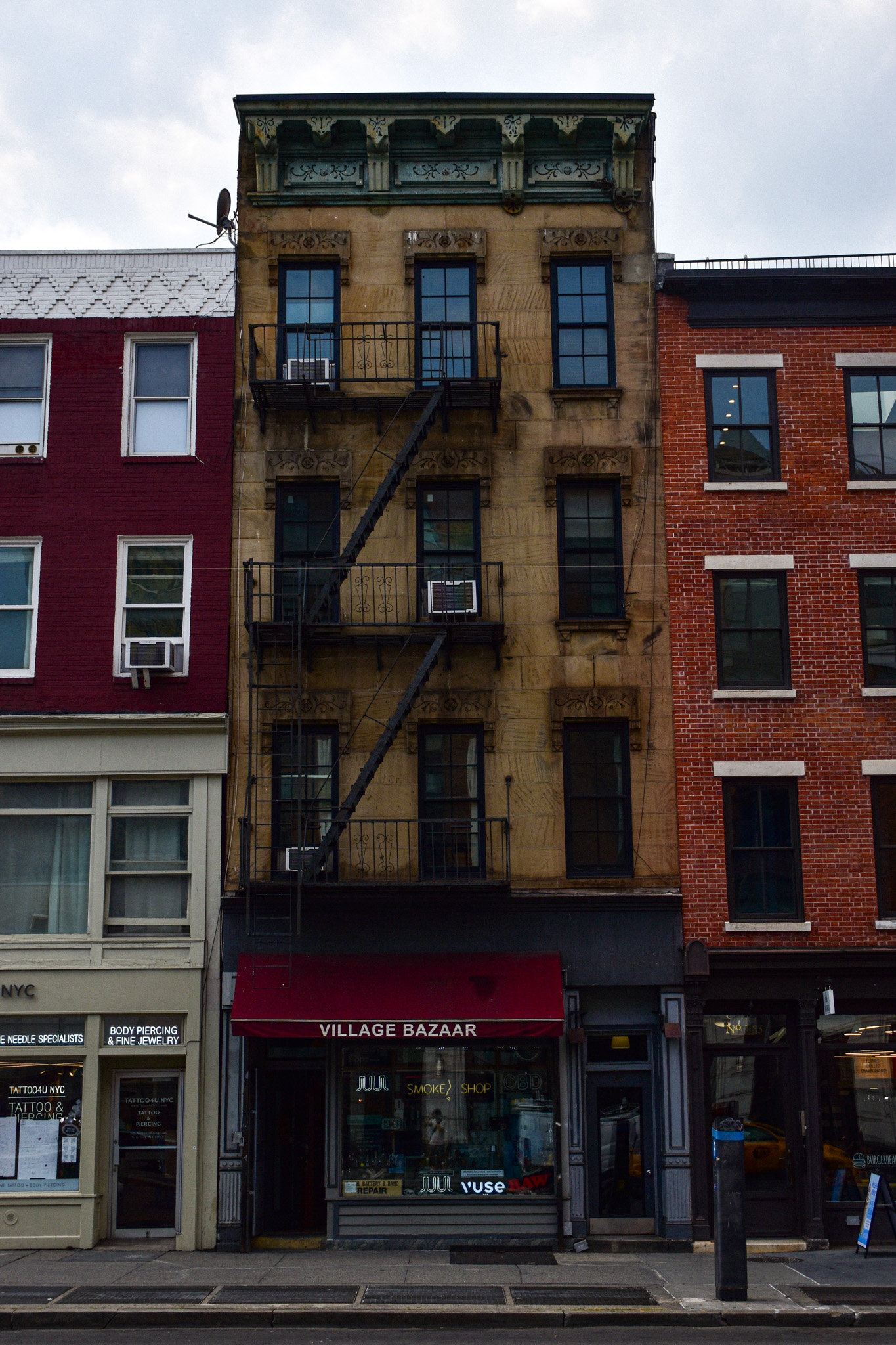
I liked the look of the building on 6th Avenue housing Village Bazaar, which offers (offered?) tattoos, piercings and smoking accessories.
At 251 Bleecker Street I saw a great decorative panel that unfortunately has been lightly defaced.
Bert Waggott was "a long-time Greenwich Village resident, graphic designer and professor of graphic design at Pratt Institute," according to this article of appreciation after his passing in July 2015. He was passionate about working on the aforementioned Winston Churchill Square garden.
We eventually wound up back on MacDougal Street, where I spied some nice signs.
In the foreground is Off the Wagon, which calls itself the "busiest, most popular bar in Greenwich Village." Next is Artichoke Basille's Pizza, which opened in 2008; and last, and unfortunately most difficult to see, is Minetta Tavern, which is a new incarnation of a joint that opened in 1937 and was "frequented by various layabouts and hangers-on including Ernest Hemingway, Ezra Pound, Eugene O'Neill, E. E. Cummings, Dylan Thomas, and Joe Gould, as well as by various writers, poets, and pugilists," per it web site. Honestly, I walked right past this place without even noticing it.
Last but not least is Cafe Wha? This place seemed like a place I should know, although I didn't know why.
A storied club with a chopped-up history, Cafe Wha? was opened in 1959 by Manny Roth, uncle of Van Halen singer David Lee Roth. The building at the corner of Minetta Lane was "a garage that used to be an old horse stable," per the club's web site. "You had to down steep stairs to reach the dark basement, which was bisected by a trough once used as a gutter for horse dung."
Between its opening and closure in 1968, the club hosted folk icon Bob Dylan, a young and unproven Bruce Springsteen, guitar god Jimi Hendrix, and comedians including Woody Allen, Lenny Bruce and Joan Rivers. From 1968 until 1987, the club was owned by Menachem "Manny" Dworman, who ran the place as Cafe Feenjon, per Wikipedia. "In 1987, the club was taken over by [Manny's son] Noam, who changed the room back to a rock music format, and changed the name back to Cafe Wha?
So, it turns out, a little more than a week ago, my daughter was accepted to NYU. I look forward to exploring more of Greenwich Village!
I have written about New York City before. Below are links to those posts:
Recently this thought struck me like a runaway freight train: I visited New York City three times between 2010 and 2016 and I didn't post anything about my trips!!!
Granted, it's only in more recent years that I've become obsessive about chronicling places in Greater Boston and cities that I visit on vacation (Seattle, Chicago, Panama City). As well, I've gotten much better at editing my photos in that time. What that means is a) there aren't as many photos in this post as you might expect and b) those photos aren't always as good as I'd like them to be.
Anyway, I dug through my archives, found a bunch of useable photos, and decided to post whatever the blog equivalent of latergrams is. This is the last of four posts.
Links to the previous posts are at the bottom of this one.
I shot the photos in this post from a double-decker tour bus as we rode through Upper Manhattan and Harlem.
Let's start with one of the most well-known buildings in New York City.
Although I took this photo nearly six years ago, I had a good guess as to what this building is. But I turned to my Facebook experts to confirm my suspicions. This, as many of you already know, is The Dakota, which is best known as the place where John Lennon was murdered on December 8, 1980, by Mark David Chapman. The ex-Beatle and his wife, Yoko Ono, lived in the building. She still maintains an apartment there.
The Dakota, of course, is much more than just a famous murder scene. Built between 1880 and 1884 and designed by Henry Janeway Hardenbergh, the apartment building is located on the Upper West Side, across from Central Park. "Hardenbergh's architectural firm was commissioned to create the design for Edward Cabot Clark, head of the Singer Manufacturing Company," according to Wikipedia. "The building purportedly was named The Dakota because at the time of its construction, the area was sparsely inhabited and considered remote from the inhabited area of Manhattan, just as the Dakota Territory was considered remote. The earliest appearance of this story, however, was in a 1933 newspaper interview with The Dakota's long-time manager. Christopher Gray of The New York Times quoted the interaction thus: 'Probably it was called 'Dakota' because it was so far west and so far north.' Gray believed that the building's name stemmed from Clark's fondness for the names of the new western states and territories."
Other famous residents over the years include actress Lauren Bacall; Steely Dan co-founder Walter Becker; singer Roberta Flack; actor Boris Karloff; football coach/commentator John Madden; and financier Wilbur Ross. The building was added to the National Register of Historic Places in 1972.
Staying with the music and entertainment angle, the next spot is one of the most highly regarded theaters in the Big Apple.
Opened in 1913, the Apollo Theater "has played a major role in the emergence of jazz, swing, bebop, R&B, gospel, blues, and soul — all quintessentially American music genres," per its web site. In 1934, Leo Brecher and Frank Schiffman bought the theater from Sidney Cohen, shifting from burlesque to variety reviews. The owners focused their shows on the growing African-American population in Harlem. "Showtime at the Apollo," a TV show featuring singers, dancers, orchestras and comedians, debuted in 1955 and ran until 2008. Comedian and TV host Steve Harvey brought the show back in 2018. In 2020, the Apollo debuted a digital stage to showcase entertainment in the COVID era.
The next photo looks like a Hollywood backlot, but I don't know exactly where it is.
Thanks again to my Facebook friends who either live or once lived in Manhattan, I was able to identify the church below.
The Cathedral Church of Saint John the Divine is "the mother church of the Episcopal Diocese of New York and the Seat of its Bishop," according to its web site. Located at 1047 Amsterdam Avenue, the house of worship is "the largest Cathedral in the world, meaning a church that is also the seat of a Bishop," per its web site. "Measured by length or internal volume, it is one of the five largest church buildings in the world." As large as it is, the church, which rose in 1892, is unfinished. "Like the great Medieval cathedrals and churches of the world, St. John the Divine will continue to be constructed over many centuries. Currently, funding is directed to prioritize serving the community through our programming and social initiatives, and to maintaining the architectural integrity of the Cathedral."
I wish I'd gotten better pictures of this majestic cathedral.
I have no idea what or where the next building is, except that it's on the M72 bus line. I used Google Maps Street View to try and find it, but had no luck.
The next building, however, was easy to identify through a Google search.
This one-of-a-kind place is Masjid Malcolm Shabazz, a Sunni Muslim mosque. "Founded by Honorable Elijah Muhammad in 1956, by Nation of Islam Minister El Hajj Malik Shabazz known then as Malcolm X, Masjid Malcolm Shabazz located at 102 West 116th Street in Harlem began as Muhammad’s Temple of Islam #7," according to the mosque's web site. Malcolm X, who served time in prison before becoming a leading figure in the civil rights struggles of the 1960s, was minister here from the mosque's founding until 1965. Louis Farrakahn, a controversial figure in his own right, succeeded Malcolm X.
There are businesses on the ground floor, including a pharmacy and a barber shop. The site is also home to the Harlem Business Outreach Center.
Today this site features this distinctive building, a house of worship. Prior to that, though, the site had a less holy designation. "Before becoming a religious structure, the lot used to contain the Lenox Casino, a space which was often rented for meetings by the Socialist Party and used as a theatrical performance venue for a number of then-renowned artists," according to this article. "Built in 1905 and designed by Lorenz F. J. Weiher, the Lenox Casino was raided in 1912 for showing 'illegal films.'"
I'm unclear as to whether the casino became the mosque, or whether the mosque is a newer building. Either way, cool building and neat history.
I love the detail on the next building, but I don't know where it's located.
I've been able to identify (if it weren't already obvious) the location of the rest of the buildings/scenes. The first is the former Mickey Mantle's Restaurant.
Named for the former Yankee great and Baseball Hall of Famer, Mickey Mantle's was located on Central Park South for nearly a quarter century. The eatery closed in 2012, 17 years after Mantle passed away. I shot this photo in 2011; I initially thought we'd taken our tour-bus ride in 2016.
The next photo showcases another long-closed restaurant, located at 383 West 125th Street.
Look closely and you'll see the "Southern Fried Chicken" sign that advertised one of the specialties at soul-food place, M&G Diner. By the time I shot this photo, the Harlem eatery had been closed for a few years. But from 1964 to 2008, the diner served up homestyle cooking at reasonable prices. The building has since been revampted, with a clothing store in the former M&B space.
Next up is a view of the Park Avenue viaduct, which emerges from a tunnel to carry the Metro-North Railroad. This is the Park Avenue main line, which runs from Grand Central Station, under the city until this point, then across the Harlem River into the Bronx, where it splits into the Hudson Line and the Harlem Line.
Thanks to one of my college friends on Facebook, I learned that the cool details below are on the lower, older section of Hearst Tower. Unlike the river cruise I took in Chicago a few years back, I wasn't making notes on this jaunt....
"The Hearst Tower is...the world headquarters of media conglomerate Hearst Communications, housing many of its publications and communications companies," according to Wikipedia. "The Hearst Tower consists of two sections, with a total height of 597 feet...and 46 stories. The six lowest stories form the Hearst Magazine Building (also known as the International Magazine Building), designed by Joseph Urban and George B. Post & Sons, which was completed in 1928. Above it is the Hearst Tower addition, which was completed in 2006 and designed by Norman Foster."
One last building, before we get to the bare facts about one of the most well-known buskers in New York City.
Once again, I have a Facebook college friend to thank for sending me on a Google Maps hunt, where I figured out that this is the Benjamin N. Duke House on Fifth Avenue. "The house was built speculatively by developers William W. Hall and Thomas M. Hall....Shortly after the mansion was completed in 1901, it was bought by Benjamin N. Duke, a tobacco, textile and energy industrialist and philanthropist, who was chairman of the American Tobacco Company at that time," according to Wikipedia. "Benjamin's brother, James, another tobacco entrepreneur, bought the house in 1907. He lived there until his own mansion...was completed in 1912.
"After James Duke relocated, the mansion became the residence of Benjamin Duke's son, Angier Buchanan Duke, until 1919, when his sister Mary Lillian Duke married A. J. Drexel Biddle Jr., and the couple moved in. Later, their daughter, Mary Semans, took over the residence. Members of the Duke family owned the mansion until 2006, when it was sold for US$40 million to Tamir Sapir, an American real estate mogul.
"The Mexican telecom magnate, Carlos Slim, at the time the richest person in the world, bought the mansion four years later in 2010 for US$44 million. Slim said in an interview with CNBC that he was planning on using the house as a place to stay when he was in New York for business meetings. In May 2015, he put the mansion up for sale at $80 million, nearly twice the amount he paid for it."
As far as I can tell, Slim still owns the house.
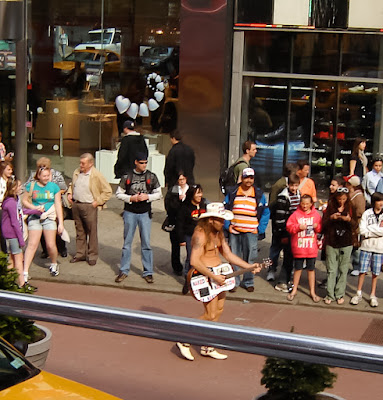
OK, time for the butt end of this post, of this entire series. Let's give a warm, backside round of applause to someone who could use the exposure: the one, the only Naked Cowboy!
Well, that wraps up my New York City flashback series. Hope you enjoyed it!