Showing posts with label former firehouse. Show all posts

Saturday, July 22, 2023

Going East to West in East Windsor

From Dave Brigham:

Located, as you might have guessed, east of Windsor, Connecticut, East Windsor is a small town that maintains a rural feel alongside suburban neighborhoods and relics of an industrial past. I visited there recently as part of my ongoing project to explore towns along the route between my home in Newton, Mass., and my mother's house in Windsor.

I started out in the southeast part of town, known as Windsorville, at a wonderful church.

The Windsorville United Methodist Church was built in 1877, replacing an earlier one from 1829 that burned down in 1876. There is a cemetery immediately to the east of the church. I was quite taken by this lovely house of worship.

I even love the storage shed!

From Windsorville, I made my way north-northwest to the Broad Brook village. As often happens when I go backsidin', I researched a few sites ahead of time, but it was the one I was clueless about that turned out to be the gem.

I knew about the Broad Brook Opera House at the corner of Main and Depot streets, but as I steered north on Main Street, I passed a place that had my eyes buggin' out of my head. I'll get to that site in a minute, but first the opera house.

Built 1892, "[t]he historic location has been home to various community groups and businesses throughout the century," according to its web site. "Originally founded by the Broad Brook Company, the tradition of being a family run establishment has stayed true through present day." In addition to live shows (Killer Queen Experience, a Queen tribute band; Reverend Horton Heat with the Delta Bombers; and the Ultimate Variety Show, featuring Vegas impersonators and impressionists), the facility is available to rent for private events.

There's a fantastic mural on the back.

In my research, I learned about a run-down mill across Main Street from the opera house.

Tucked behind a strip mall with a few restaurants and other small businesses, the remnants of the Broad Brook Mill are fenced off, although I'm sure folks get in there and party and spray paint and whatever. The property appears to be owned by Hamilton Standard Controls, according to the town's assessor, with some buildings dating as far back as 1850. That company was part of Hamilton Sundstrand, a Windsor Locks-based aerospace and industrial products company that merged with Goodrich Corp. in 2012 to form UTC Aerospace Systems. So who knows who the hell owns this mess.

These buildings, and possibly a few others, are what's left of the Broad Brook Company mill. To learn the history of this place, for the first time on this blog, I will be turning to the U.S. Environmental Protection Agency and its Superfund site for this property:

"The site was used for industry dating back to at least 1835 when a woolen mill was built by the Phelps Manufacturing Co., displacing earlier gristmills, sawmills, and a tannery. In 1849, the Broad Brook Co. bought the mill and continued manufacturing woolen products until 1951....To power the woolen mill, the [company] operated a coal gasification plant, which contaminated the site with PAHs as coal gasification byproducts. In 1954, United Aircraft Corp., now United Technologies Corp., bought the site property and owned it until 1977....From 1954 to 1967, United Technologies manufactured printed circuit boards....From 1968 to 1974, the company made boron filament at the site. From 1974 to 1977, there was a boron filament manufacturing operation at the site, operated by Composite Materials Corp., a subsidiary of Aluminum Company of America. Composite Technology Inc. continued manufacturing from 1977 to 1982.

"In 1977, United Technologies sold the property to Broad Brook Center, [which] leased building space to commercial and industrial users. In 1982, Broad Brook Center...conveyed the site property to James R. Testa and John Bartus, who in 1985, doing business as the partnership Broad Brook Center Associates, transferred title to the site property to Broad Brook Center Associates. In January 1986, the site property was sold to Connecticut Building Corporation. In May 1986, a fire destroyed many of the former mill buildings. In July 1986, Connecticut Building Corporation applied for a permit to develop 21 residential condominium units in the former mill building that had survived the fire. These residential condominiums were developed between 1990 and 1993."

I wonder what it was like living in condos on a former mill site that was almost certainly still quite polluted and contaminated. Well, however that experience was, it didn't last long. "In October 2004, Hamilton Sundstrand acquired this 21-unit mill building formerly used as residential condominiums as well as associated property from the Millbrook condominium association and individual unit owners. Residents no longer live on the property and the site is fenced."

The site seems to have been cleaned up in recent years. "In December 2003, EPA, the Connecticut Department of Environmental Protection (CT DEP), and Hamilton Sundstrand finalized agreements necessary to defer this site to the state. The state took the lead in the cleanup and EPA provided oversight. CT DEP ordered Hamilton Sundstrand to develop a cleanup plan and put it in place....In April 2021, the EPA withdrew the proposed rule to add the site to the National Priorities List."

What's next for this property? I imagine all remaining buildings will be torn down at some point. Broad Brook bisects this property, so I'm not sure how much of the land is buildable. Seems a good candidate for some open space with historical markers.

Immediately southeast of the old mill site, in the strip mall property, is an old brick building that I'm guessing was once part of the mill.

This building is currently home to Salon Rausch and James A. Houlberg accounting and tax services.

Just north of the mill site, along Main Street, are some nice older homes, including some brick ones, as well as some brick commercial properties.

Next to Broad Brook is 100 Main St., which dates to 1850. Currents tenants are Agonist Gallery and At the Dam Restaurant, which, based on photos online, looks to be a great little diner.

Next to the restaurant and gallery space is another circa-1850 brick building.

I found an old postcard online that I believe depicts the building above. The card is dated 1903 and indicates this building at that time was a hotel and general store. It is now home to the K. Simon Center for the Arts, although I'm not sure if it's currently open.

Due south on Main Street, located in a circa-1920 former bank, is Paul's Package Store.

Across the street is the site that that had me rubbing my eyes to make sure it was real.

The Broad Brook Garage was built in 1918. The small, red-tile-roofed building was where the gas attendant hung out (notice the pump underneath the sign). The main garage "housed at various times a Buick dealership, a Chevrolet dealership and a repair shop which also sold new and used cars," according to this Patch article from April 2021.

This property is like something out of a movie about small-town America in the 1950s, or a suburbex fever dream. If I ever stumble across old service stations, they tend to be fairly plain and simple, attesting to the no-bullshit work that got done there, or, in some cases, still gets done. Driving past this joint, I felt like I was a location scout for "American Pickers." This is the kind of spot that makes Mike Wolf slam on his brakes, turn around and go introduce himself to the proprietor.

If you watch "American Pickers," you know those folks love cars and petroliana. I saw a few old signs, and of course the Coca-Cola clock, and I'm guessing there may be some other gems inside these buildings.

I don't know how long the place has been out of business, but there is good news. When I posted shots of this place on Instagram, the owner of Stand Alone Customs commented: "Currently owned, loved and soon to be restored! The owner has been trying to restore the building slowly and keep it as a pillar of historical value. Discussions have been in place to restore and return the gas house into a functional area and possibly turn it into a coffee shop, hot dog stand, etc."

Man, that would just be fantastic.

From Broad Brook, I continued west to East Windsor's Warehouse Point village. Here again, I checked out sites I'd scouted out ahead of time on Google Maps, and stumbled across some nice surprises.

The main draw for me here, something I'd run across a few years ago while tooling around after exploring nearby Windsor Locks, was the old mill on Main Street.

The former Leonard Silk Company / Warehouse Point Silk Company buildings date to 1874 through 1884, according to this Preservation Connecticut article. "The four-story brick mill operated by the Leonard Silk Company was tragically destroyed by fire on December 16, 1874, however, the company quickly moved to rebuild and resume production," the article indicates. "In less than one month the firm had erected a new dye house and powerplant and had installed enough machinery to begin work. The majority of the existing red brick mill was completed in short order and the Leonard Silk Company was soon up to full capacity. Demand for the company’s products continued through the early 1880s and the two-story red brick block at the northern end of the plant was added to house a new office and stock room ca. 1884. In March 1893 the stockholders of the Leonard Silk Company voted to change the name of the firm to the Warehouse Point Silk Company."

Warehouse Point Silk prospered through World War I and the Great Depression, but its business slowed down and the operation closed up shop in 1944. After that, Montgomery Ward and Co., a mail-order and department store chain that went out of business in 2001, moved into the facility. Current tenants include Keystone Paper and Box Company, which was founded in 1944, and Trim Solutions, which since 2006 has manufactured vinyl siding, windows and doors.

A short distance away, on School Street, past the relatively modern police department building, is the town's social services building.

Built in 1874, this appears to be a former school, which would make sense given the street that it's on. The social services department provides social, emotional and economic assistance to East Windsor residents.

At the corner of School Street and Dean Avenue is a former firehouse.

Now a private home, this was once the home of Hose Company Number 1. The building dates to 1912.

Heading north to Bridge Street, I was pleasantly surprised to spy Mark's Tavern.

The assessor says this building dates to 1900, but the tavern's web site indicates it was built in the 1880s. I trust Mark.

Just a few doors down, heading back east, is a great old building that dates to 1850.

I'm assuming this was originally a private home. Tenants nowadays include The Vintage Shops, which comprises a group of independent antique and collectibles dealers. According to the group's web site, this building was previously a boarding house and a bar. Among the group is CBug's Records, Matt's Military, The Clock Man and Chipping with Charm.

Across Bridge Street from the vintage collaborative is a building that intrigues me.

Dated to 1850, 53 Bridge Street appears as though it might have been affiliated with the old mill complex. It is currently apartments, but its shape, and the fact that there are no windows at the close end, says to me "old warehouse."

A little bit south on Main Street I found two defunct businesses in one low brick building dating to 1920.

Danny's Radio & TV was evidently established in 1978. I like the hand-lettered sign. I'm not sure when the business went dark.

Around the back of this building is the former Wadsworth Press, which was founded in 1947.

I don't know when this place went out of business, either. The company's last Facebook post was made in September 2021.

Finally, in the southwest quadrant of East Windsor, as the clouds were rolling in, the winds kicking up and rain starting to fall, I found my final spot.
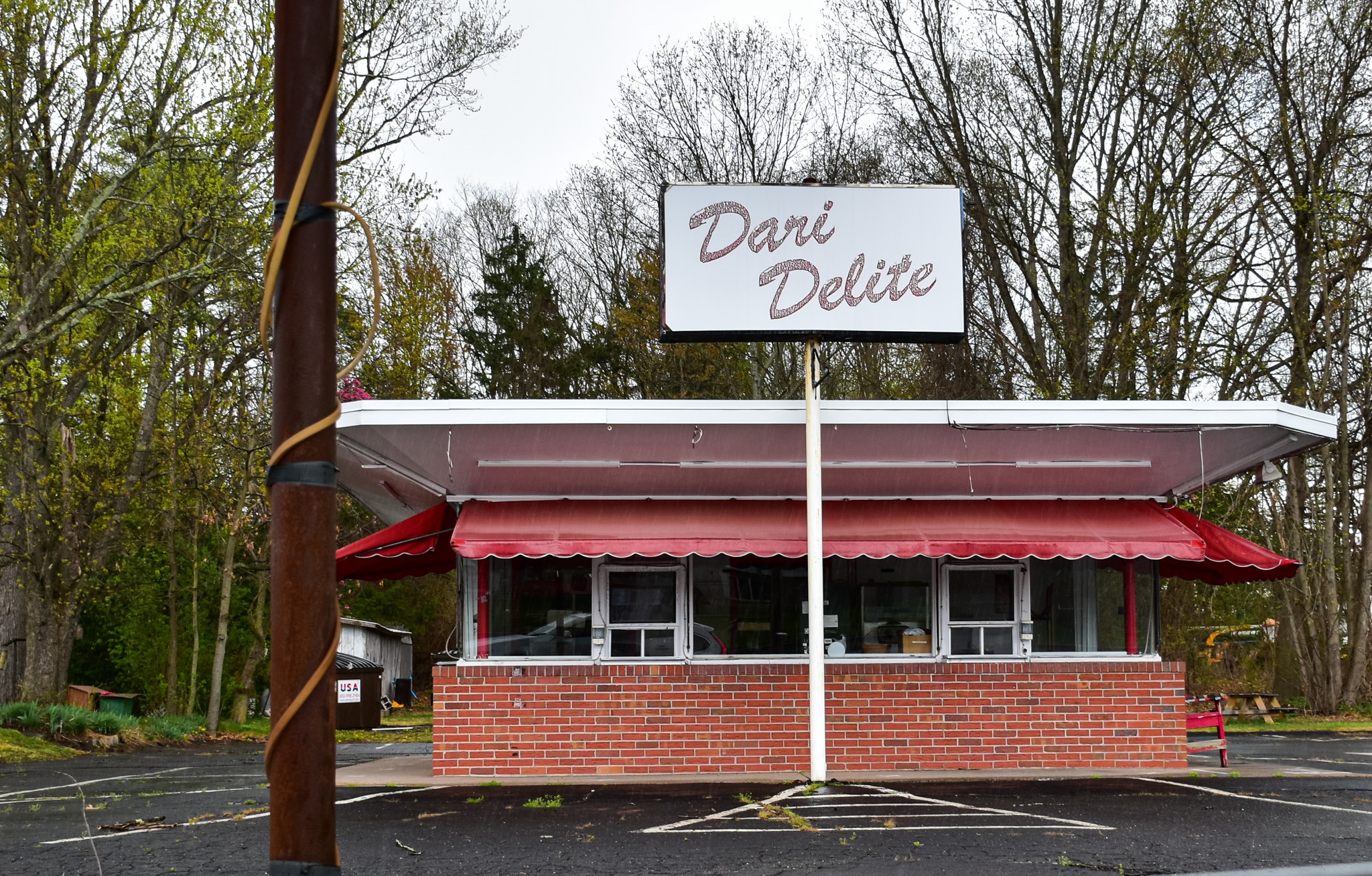
Located along Route 5 just shy of the South Windsor Line, Dari Delite is a great ice cream spot that unfortunately closed up last summer.

The shop opened in 1956. I hope somebody can find a way to reopen it.

I wanted to get closer and take more photos of the outside and inside, but the parking lot was roped off, I was parked on the side of very busy Route 5, and the skies were opening up. I had also hoped to make some photos of barns and other rural scenes in town, but the weather cut my trip short.

For more about this part of north-central Connecticut, see November 13, 2021, "Things Are Poppin' in Windsor Locks", and March 12, 2021, "Blowing Into Windsor".

Saturday, July 8, 2023

On Fire for the Brookline Arts Center

From Dave Brigham:

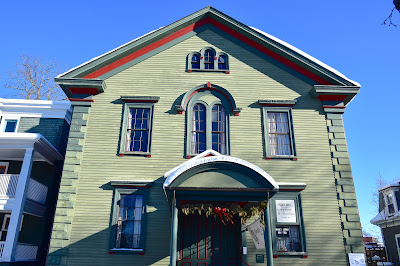
The Brookline Arts Center, a lovely Shingle Style building tucked behind a bustling commercial row in the extreme northeast corner of the city, was designed by a well-known architectural firm of the late-19th and early-20th centuries.

Peabody and Stearns, known as the architects behind dozens of buildings, including Matthews Hall at Harvard University, Boston's Exchange Building and Custom House Tower, and Worcester City Hall, designed this Brookline treasure in 1886 as a firehouse.

"A symmetrical, balanced design, it is quite unusual for a firehouse," according to MACRIS. "Its Shingle Style influence is evident in the use of large cross-gables, banded windows, curved walls at the attic window and the decorative patterns of shingles in the gable peaks and along the eaves. Originally there was an open arcaded porch along the right side."

It really is quite a handsome building, isn't it?

The fire station used chemical extinguishers, hence its historical name as the Chemical Engine House. The engine and horses were kept in the ground floor area, while the engine driver and his family lived upstairs, according to a plaque on the building.

There is a small park next door, which was formerly the site of the Longwood School. That facility was demolished in 1939. There is a small playground in the park, which features a cool piece of art using an old photo of the chemical engine.

As for the arts center, it offers classes (figure drawing, ceramics, printmaking), private lessons and function space. There is also a gallery here.

Saturday, January 22, 2022

Jamaica Plain, Part I: Shopping & Snapping

From Dave Brigham:

I did a fair amount of Christmas shopping at local businesses this season. For the first time ever, I combined that effort with a photo trek through the main retail district in Boston's Jamaica Plain neighborhood. Here's what I found.

Along South Street, just north of where it intersects with New Washington Street, I spied Arborway Auto Service.

I was struck by how neat and clean this place looks, with its immaculate brick front and gleaming sign, which was done by Josh Luke of Best Dressed Signs. You can really sense the pride in this business, which was founded in 1971.

Heading north along South Street, I was captivated as much by the outside of Botanica San Miguel....

...as by what they sell inside.

I'm not sure how long the store has been in business; I found a very positive review from 2010 on Yelp.

Next door is The Jeanie Johnston Pub and Grill, a joint named after what it calls "the legendary Irish famine ship" on its web site.

The ship was built in 1847 in Quebec. "The 408 ton cargo ship was purchased in Liverpool by John Donovan and Sons of Tralee, Co. Kerry," according to the Jeanie Johnston Educational Foundation web site. "As the famine gripped Ireland, the company ran a successful trade bringing emigrants from Ireland to North America and returning with timbers bound for the ports of Europe. She made her maiden emigrant voyage from Blennerville, Co. Kerry to Quebec on 24 April 1848, with 193 emigrants on board, as the effects of the Famine ravaged Ireland. Between 1848 and 1855, the Jeanie Johnston made 16 voyages to North America, sailing to Quebec, Baltimore, and New York."

As for the pub, it hosts open-mic and karaoke events, as well as trivia nights. None of those activities are happening these days, though. The building dates to 1910. I'm not sure what was in the space before the Jeanie Johnston.

A few doors down is Deep Thoughts record store.

Again, I'm not sure when this fantastic store opened, but based on the video below, it seems like the best kind of place for record lovers: stocked with more genres of music than you can imagine; jammed with buttons and books and art - a real orgy for the eyes.

STO 3: Deep Thoughts from Teen-Beat on Vimeo.

I've suggested to my wife's brother in law that he seek out a synergistic marketing deal for his Deep Thoughts Designs fishing gear.

Next up as we head north is Happy Market & Spirits.

The store looks great, but I was most interested in the Budweiser sign hanging outside.

Across the street is a Boston Housing Authority apartment complex. I like the fading mural on what appears to be a storage or maintenance annex.

I love how the artist incorporated the door of the building into this pastoral scene of a small house, a woman gathering fruit from trees, a river and gently rolling mountains in the background.

From South Street, I spied a cool building just a little ways down Carolina Avenue.

Established in 1894, Penshorn Roofing does slate work, asphalt shingles, copper fabrication, gutter work and more. I thought at first that this place was abandoned, but I was wrong.

Back on South Street, something about the signs for Peru Travel hit me just right.

The sign on the side of the building is hand painted and looks pretty old. The one on the front of the store has a fantastic image that makes travel seem glamorous. And the way the phone number is painted -- old-school, no area code -- speaks of a simpler time. By the way, notary services are also available here.

On the east side of South Street, just before it merges into Centre Street, is the Curtis Hall Community Center.

Built in 1868, this beautiful Second Empire building served as the West Roxbury Town Hall from that year until 1873, per MACRIS. From 1876 to 1908 it was the Jamaica Plain Library. Founded in 1630 as part of Roxbury, West Roxbury seceded from its parent town in 1851, per Wikipedia. West Roxbury, which included the neighborhoods of Jamaica Plain and Roslindale, was annexed by Boston in 1874.

A fire destroyed part of the building in 1908. In 1911, the JP library reopened. In more recent years, Curtis Hall (aka the Memorial Building) housed Jamaica Plain Little City Hall, per MACRIS. These days, the hall features a community room, a computer lab, a fitness center, an indoor pool, a senior center and a teen center.

This brings us to the triangular intersection of South, Centre and Eliot streets. Here is located the Loring Greenough House, just north of Curtis Hall. Built in 1760, the house since 2008 has served as a center for social, cultural, historical, and educational activities, per its web site. It is operated by the Jamaica Plain Tuesday Club, which was founded in 1924 as a ladies-only club and functioned that way until 1993. As you perhaps are figuring out, I didn't shoot any photos of the house, as I'm not really into well-preserved, museum-type places.

Of more interest to me in this intersection was the Civil War Monument.

Dedicated on September 14, 1871, this 27-foot-high memorial to West Roxbury's Civil War dead is one of the more impressive war statues I've seen in Greater Boston. W.W. Lummus -- who sounds like a Dr. Seuss character -- designed the entire monument; Joseph Sala sculpted the statue of the soldier that tops it off.

On the corner of Centre and Eliot streets, on the west-facing side of a one-story retail building, is the cool mural below.

Painted by the Mayor's Mural Crew (have I mentioned how much I love that the MMC is a thing?), the artwork features perhaps two dozen people across all ages and ethnicities and times, including the soldier from the Civil War monument.

Just up Eliot Street is the stunning Eliot Hall.

Home to the Footlight Club, which claims to be America’s oldest community theater, having produced performances every year since 1877, this Greek Revival/Italianate beauty was built in 1832. The theater group has used the building since 1878. At that time the hall was owned by First Parish Church, which is located across the street on property once owned by Rev. John Eliot, the so-called "Apostle of the Indians" (see December 18, 2021, "I Seek Newton, Part XI: Newton Corner (Section 2)" for more about Eliot and a memorial to him in Newton). According to the church's web site, Eliot is considered "a perpetrator of cultural genocide by indigenous scholars."

I'm not sure if the church owned the hall since its construction. Regardless, by 1889 the parish considered razing the building to "put the property to better use," according to the Jamaica Plain Historical Society's history of the building. "Friends of the Club formed a committee who sold 1000 shares of a trust in Eliot Hall and bought the hall for the Footlight Club. Major renovation was done to convert the hall into a true theater and on January 9, 1890 the Club's 50th production played in the new Eliot Hall," according to the JPHS.

The Footlight Club has undertaken some major renovations to the hall. In the photo below, notice the white/gray structures floating above the main building. I'm not sure when that addition was put on. I believe that's the main auditorium.

More recently, the troupe has undertaken accessibility upgrades. "The work will provide access to four levels of Eliot Hall – from the basement to the first and second floors and to the stage level – ensuring that both audience members and potential cast and crew can access all parts of the building," according to the group's web site. "Alongside the building will run an accessible ramp that leads to a new entrance, the elevator, and a staircase to all four levels of the club. An additional accessible restroom will be added on the second floor, as well as increased storage space in the basement and on the first floor."

Next on our tour, along Centre Street, is an outlet of a local liquor-store chain that was founded 40 years before the Footlight Club's members began to trod the boards.

(Cool sign.)

Blanchards Wine & Spirits was established in 1838 in Boston's Scollay Square. In 1938, the company was bought by John Corey who "grew the company from one retail location into a chain [of] retail stores," according to the Blanchards web site. "He also opened a distilled spirits plant and import division in the 1950’s located in Boston’s Historic South End." The company operates seven retail stores in Greater Boston. Third- and fourth-generation Coreys continue to operate the business.

Blanchards is located next to the Robert Seaver & Company Block, which was built in 1875.

This site was where a provisions store stood in the late 18th century, according to MACRIS. "After retiring from the teaching profession, [Joshua Seaver] bought an old store on or near the site....During the early 19th [century] the store was the first stop for the stage coach on its trip from Boston to Providence." Robert Seaver took over the store from 1833 to 1885, having a new building constructed in 1875. His sons eventually owned the business. I'm not sure when the store closed, or what may have been there prior to the current tenant, Robert T. Fowler & Sons Insurance.

When I saw Costello's Tavern, below, I thought not of the famous comedian Lou Costello, who with his partner Bud Abbott is best known for the "Who's On First?" skit, but rather of two men named Costello I knew just a little bit many, many years ago.

The first was my elementary school principal, who of course we only knew as "Mr. Costello." I think his first name was Paul. In my mind, he looked a bit like Ed Sullivan, with jet-black, slicked-back hair and a perpetually red face. I recall him as being mean, but I imagine he wasn't like that all the time. The second guy is named Mike Costello, and he lived in an apartment building that my girlfriend (now wife) resided in in the early '90s in Boston's Brighton neighborhood. This guy, who was maybe in his early 40s, was nice enough, but seemed to be complete and total lush. I would exchange pleasantries with him, but I felt a bit creeped out by him.

Anyway, Costello's Tavern has been around a long time, I'm sure. It closed temporarily during the pandemic, but reopened shortly after I snapped this picture. The new apartments rising above the bar were added in 2020. According to a commenter on an article at Universal Hub about the apartments, "The space above the former Redds and Tony's had upper floors as part of the original structure. In fact the space on the 2nd floor, historically, was the home of the first silent film house that was accompanied by piano."

Wow! Love that history. The floors were torn down after a fire.

Across Centre Street from the tavern is Galway House, which has been serving up food and drink to the locals since 1960.

There's a fantastic painting on the front door.

The artwork is by Chris Plunkett, depicting a streetcar of the type that used to roll by the front door of Galway House. In 1985, the MBTA temporarily halted trolley service in Jamaica Plain. My son, who is my in-house expert on the T, tells me that temporary order is still in place even though the tracks were torn out a decade ago.

A little further north is the Centre Building.

This building rose in 1920, according to the Boston assessor's office. Current tenants include Eastern Bank and Susanna, a clothing store established in 1982.

I've featured a few murals and front-door paintings in this post, but none of them can hold a candle to the next one.

This is just a detail of the amazing work on the side of Purple Cactus, a Southwestern restaurant. This masterpiece was painted in 2013 by the Mayor's Mural Crew and Heidi Schork, who is the director of the crew. Schork lives in JP and spent eight years living in Mexico. So it's no surprise that this mural has a Day of the Dead look about it. "The Mexican Mural Movement of the early and mid 20th century remains an important influence in [Schork's] mural work," according to the City of Boston web site. "Heidi has led countless mural, installation, and public art events in Boston and in Mexico."

Arguably the centerpiece of this shopping mecca is the original JP Lick's ice cream shop.

Located in a circa-1865 former fire station, JP Licks was founded in the neighborhood in 1981, according to its web site. "The shop immediately began to gain popularity and became a hit with local residents and area college students," the site crows. "Its eclectic look gave the store a distinctive atmosphere and my staff, mostly Mass College of Art students (who one customer good naturedly described in 1981, as a 'freak show of polite, tattooed, body pierced, gay and lesbian kids, and other assorted weirdos'), added to the shop’s unique environment."

The business operates nine stores in Greater Boston. As for the building, it once housed the Jamaica Plain Fire Engine Co. #28 and the JP Hook and Ladder Co. #10, per MACRIS. I'm not sure whether JP Licks moved here in 1981 or not, and when the fire station was shuttered.

Across Centre Street from JP Licks, on the side of Lebanese eatery Cafe Beirut, is another fantastic mural.

Painted by Bob White in 2004, this scene of kids hanging out and playing in a wooded area overlooking a lake and small town was the first completed by the Jamaica Plain Youth Mural Program, according to this 2008 article. "It was designed as a tool to teach the students to paint depth, shading, and contrast," the artist says in that article.

We conclude this tour with a shot of a former service station.

I don't know how long ago this place ran out of gas. Back in 2010, it was known as Mike's Service Station, and it was shut down for code violations, including operating without permits and having abandoned cars, a leaking oil tank and "illegal" propane heaters, according to the linked article. In October 2013, the Jamaica Plain Gazette ran an article indicating that the site was being targeted for redevelopment as a liquor store. At that time, the shop was known as El Rubio's Auto Repair Shop. That proposal fell through. Something will go here someday.

That wraps up my review of this area of Jamaica Plain. Stay tuned for the next installment, in which I venture further north along Centre Street and then east into the Hyde Square neighborhood.

Here are some other Jamaica Plain posts from years past:

January 26, 2018, "Jamaica Plain Has Plenty of Flair"

December 9, 2017, "Artist Thinks: 'I HAF to Fix That Smokestack'"

March 27, 2015, "Blessed Renovation"

Checking Out Dudley Street in Roxbury...and a Historic, Pre-Civil War House

From Dave Brigham: As part of a series of quick-hit jaunts through Boston this spring, I checked out the outer reaches of Nubian Square, m...