Showing posts with label former factory. Show all posts

Saturday, February 14, 2026

Committing Myself to the City of Sin

From Dave Brigham:

Lynn, Lynn the city of sin

You never come out, the way you came in

You ask for water, but they give you gin

The girls say no, yet they always give in

If you're not bad, they won’t let you in

It’s the damndest city I’ve ever lived in

Lynn, Lynn the city of sin

You never come out, the way you came in.

Thanks to the blog of a guy named Jason Stadtlander, I learned the lyrics to this poem, of which I'd only ever known the first line. I don't recall at what point after moving to the Boston area in 1990 that I first heard the North Shore city of Lynn referred to as the City of Sin. As with so many former mill towns and cities, I've had the eighth-largest city in the Bay State on my mind for quite a while.

After stumbling across an Instagram reel mentioning Bobby from Boston, a vintage clothing store at 545 Washington Street, I finally made a plan to check out that part of the city. And when I learned that there's a cool old diner right around the corner from the store, I moved that plan up on my Backside agenda.

While this was my first trip to downtown Lynn, I'd been to the city once before (see October 21, 2016, "Rockin' in the Dungeon," for a description of a quick visit to Lynn Woods with my kids).

"Settled by Europeans in 1629, Lynn is the 5th oldest colonial settlement in the Commonwealth," according to Wikipedia. "An early industrial center, Lynn was long colloquially referred to as the 'City of Sin,' owing to its historical reputation for crime and vice."

I started my tour in front of Zimman's, a Lynn mainstay that's been selling fabrics, furniture and furnishings since 1909.

Morris Zimman founded a dry goods shop at 6 River Street in Lynn, about a mile and a half west of the store's current location. "Morris, who was always searching for GREAT BARGAINS, purchased the entire contents of a sunken ship, and [sold] slightly soggy muslin on the sidewalk for 15 cents a yard," according to the Zimman's web site. In 1948, Morris's son, Barry, opened a department store elsewhere on Market Street, moving it to the present location nine years later.

The store is located in the former Goddard Bros. Department Store.

"The firm of Goddard Brothers was founded in 1899 by Franklin L. and Wallace I. Goddard of Boston," according to MACRIS, "who purchased a business from T. E. Parker." I'm not sure of the fate of the Goddard Bros. store.

Around the corner on Andrew Street, I had to make a photo of #58. I figured it was "something."

Sure enough. This is the Grand Army of the Republic Hall and Museum, which "was erected in 1885 with funds raised by local Civil War veterans as a memorial to the Union Army veterans of the Civil War," per the organization's web site. "It soon became the largest G.A.R. post in the country with 1,847 members. Post 5 held a position of prominence in the City of Lynn, the Commonwealth and the Nation for many years.

"Its crowning glory is the enormous 56′ x 46′ main hall on the third floor, which retains the original furnishings and has walls filled with photos of Civil War veterans. Six more rooms have memorabilia from the Revolutionary War through the Korean War."

The hall is currently under renovation, as you can see in my photo. "The structure is in urgent need of repair, and the first phase of that reconstruction has begun with the installation of an elevator, handicapped accessible bathrooms, and updates to the first floor storefronts," per the web site. "These changes make the building compliant with the Americans with Disability Act (ADA), and will enable broader use of the building and access to funding for further efforts.

"In addition, the Trustees of the GAR Hall and Museum are working on finding new uses for space in the building, building on the wishes of the Civil War Union veterans, who gifted the building to the city in a Home Rule Petition in 1919. To that end a community engagement program is also being launched to discover needs of Lynn veterans and nonprofit community organizations."

From there I headed north, and then east on Central Avenue. Cal's News caught my eye.

Opened in 1937, Cal’s News is the city’s oldest family-owned news retailer and tobacconist, according to this Item Live article
.

Steps away, across an empty lot, is a work of stunning beauty.

Located on the side of The Oxford Lynn apartment building, this mural of a rhino and other animals was painted by Miami-based artist Ernesto Maranje. As with many old industrial cities I've visited, Lynn features loads of such work, some of which is featured below.

Nearby along Washington Street is a lovely pastel work by a Los Angeles-based artist who goes by Free Humanity.

Around the corner in Central Square, the teenage boy inside me demanded I make a photo of buildings labeled R.A.W. and GAS.

Raw Art Works is a creative youth development organization rooted in art therapy, per its web site. Great Art Studio "was born with one intent: to develop and support the relationships between local creatives, business owners and their communities," according to its Internet home page.

I continued under the commuter train tracks that cut across the southern portion of the city, headed southwest on Union Street and suddenly I was standing in front of a rare gem of a diner.

The Capitol Diner is one of a select group of early metal diners to survive intact on its original site, according to MACRIS. "The Capitol Diner is a [J.G.] Brill [Co.] from 1928. This is believed to be the last operating Brill diner in the country," according to this Roadside Architecture post (scroll down). "It is listed on the National Register of Historic Places. The diner was originally known as the 'Miss Lynn Diner.' When it changed hands in 1938, it was renamed to refer to the Capitol Theatre across the street which is now gone."

Around the corner, under the train bridge across Washington Street, is a cool mural painted by artist Anna Dugan, who goes by Annadidathing. A detail from the work of art is featured in the image below.

The Guardians | Mga Tagapagtanggol "represents her Filipino culture and serves as an image of power, femininity, and protection," according to this statement at the Beyond Walls web site.

Based in Lynn, Beyond Walls "introduce[s] public art, curated experiences and outdoor museums into the fabric of our communities by partnering with local community members and experts to design, produce and manage collaborative projects and programs," per the non-profit group's web site. "We serve cities and towns where there are changes due to the loss of industry, shifts in population, or where there is underutilized infrastructure."

The group brought its Retrolit program, in which it restored and installed vintage neon signs, to the Bobby from Boston building I mentioned at the top of this post. That building is located just steps from the above mural, on Washington Street.

For Retrolit, Beyond Walls partnered with Dave and Lynn Waller, well-known local collectors (and conservators) of neon signs (for coverage of the Wallers, see April 22, 2023, "Walking Around Belt-Bottom," August 9, 2018, "Backside, Out in the Open" and March 22, 2010, "Gettin' My Kicks").

I believe both of the above signs were once located on local businesses. Lynn was once known as the Shoe Capital of the World, "with dozens of factories producing millions of pairs of shoes each year," according to this blog post.

Bobby from Boston is located in the Frederick E. Abbott Building, a nicely restored Romanesque Revival building dated to 1890. In the late 1890s, the Munsey Shank Company occupied this building, manufacturing shanks, which are long, thin pieces of material between the insole and outsole intended to support the foot and provide structure, according to Wikipedia.

Munsey was in business here until 1938. In 1940, according to MACRIS, the Prime Company rented the building. Prime was "a shoe sole equipment manufacturer, remaining in operation through 2001 as the last shoe manufacturer in Lynn," MACRIS continues.

I'd like to return to this place when the vintage clothing store is open, which is only on Sundays.

I continued southwest on Union Street. In front of the parking garage for the commuter rail station is a statue that seems somewhat forgotten to the world.

The site is slightly overgrown, and there is no plaque providing passers-by with information about the statue's name, or who the artist is, or why it's on this spot. The man is bald and striated, and appears naked. He's sitting on a stack of books, staring into the middle distance. Perhaps he is attempting to absorb knowledge through his tuchus?

I've searched on Google and can't find anything about this work of art. Maybe this forlorn guy knows Worcester's Turtle Boy.

Anyway...moving on.

The statue of the nude bookworm stands across from one of the imposing Harbor Loft apartment buildings.

Known as the Vamp Building, this massive structure -- the south facade extends 400 feet along Broad Street -- rose in 1903 as part of a complex built by a syndicate of investors known as the Lynn Realty Company (the edifice is known alternately as Lynn Realty Building #4).

"Following a disastrous fire of 1887 when a 30-acre area employing over 7,000 employees burned to the ground, there was a short flurry of rebuilding activity," MACRIS indicates. "This slowed considerably by 1891 and the next decade saw little construction in downtown Lynn. By 1900, the shoe industry had re-emerged as a significant economic engine and Lynn was once again in a leadership position in that industry. The Lynn Realty Company, headed by one Edward Strout, financed major construction in the fire-zone by financing and constructing several large manufacturing structures."

I'm not sure when this old factory was converted to residential use.

From there, I headed northeast on Broad Street, as I saw something in the distance I wanted to check out.

This place turned out to be a two-fer. Located in what is known as Bank Square, the former Hotel Edison is an Art Deco building that looks pretty good. "The Hotel Edison...site had served as a prominent intersection with a previous hotel located after the Lynn Fire of 1889," per MACRIS. "The present Hotel Edison was constructed in 1931 by the Lincoln Reality Trust and served as a retail complex with street shops along Broad and Exchange Street. It was among the first buildings in Lynn to be air conditioned in 1937 and was...remodeled for commercial space in 1988."

This building is also the headquarters of The Daily Item newspaper, which was founded in 1877.

Next I cut west on Exchange Street, where I saw the fabulous sign below.

Unfortunately, Charlie's Junction Deli closed in the fall of 2019. This "classic old breakfast and lunch spot" was in business for more than 20 years, according to this Boston Restaurant Talk post.

I absolutely love the Charlie's sign. I'm surprised it's still there.

Around the corner, on Spring Street, is yet another of the many great murals of Lynn.

Painted on the side of the Breed Estate Building -- one of the few survivors of Spring Street's rebuilding between 1890 and 1908, according to MACRIS -- this work by Argentinean Mariela Ajras was completed in partnership with Beyond Walls. I've dubbed this one the UFO mural.

I wandered around and found myself at the Silsbee Street underpass, where I saw this dcool guitar painted on a pillar.

One of many paintings under and around the commuter train tracks, this one was done by that famous artist known as I Can't Find Information On the Internet.

Silsbee Street to the east, and Exchange Street to the west, are the end points of the old Eastern Railroad Station Viaduct. This structure, which runs along Mount Vernon Street, features more nice murals, but I'd like to know what's behind the facades.

When it was built in 1913, "it served as the passenger platform for the adjacent 1895 station (non-extant) located on the west side," according to MACRIS. "The station was left at grade, but the waiting room was extended under the viaduct and steps to the platform were provided." At that time, trains were operated by the New York, New Haven and Hartford Railroad.

"Exterior stairs located at either end of the viaduct also service the platform which is sheltered by a flat-roofed concrete awning," MACRIS continues. "Space under the viaduct was utilized for the baggage room and shops on both the Central Square and Silsbee Street ends. Although the 1895 station has been demolished and many of the original/early storefronts have been removed or altered, the viaduct itself survives basically unaltered and in its original context."

Old photos show some of the viaduct's archways, seen in my photos above, open. I'd love it if this place could be opened up for retail/restaurants businesses at some point. The only indication of a former business here is the sign on a door for the National Fire Escape Association.

At 305 Union Street I spied a ghost sign of sorts for the old McLellan's department store.

I haven't been able to find out any history of this retailer.

At the corner of Washington and Oxford streets is A&S Pawn and Used Jewelry, which has been around for at least a quarter-century, from what I've been able to figure out.

I headed back toward my car, which I'd parked at the Lynn Marketplace mall along State Street, but then I decided to wander just a little bit more. Along the Lynnway, in front of the parking lot for Lynn Motor Sales, I spied this nice old clock.

A quick online search turned up a Facebook post in which somebody who had taken a photo of this clock asked for any background information. This guy said the names on each of the faces are "F.L. Conte" and "Chery Conte." I haven't found any information about the clock, the maker or the Contes.

Coincidentally, on the opposite side of the busy four-lane roadway is an old factory building with a clocktower.

My first thought when I saw this place was, "It looks like the Schrafft's building in Boston." The candy company building pre-dates this one by about 15 years and may have inspired the architect, Harold Field Kellogg. Kellogg's other local buildings include the Batterymarch Building in Boston; the Pierce-Arrow auto showroom (now a Star Market) in Boston's Packard Corner; and the Longwood Towers in Brookline, for which he was a consulting architect.

Built in 1922 as a shoe factory for Albert Creighton, this structure was seen as "a landmark of modern reinforced industrial design after the First World War," per MACRIS. "The corner clock tower highlights the Gothic profile of the Creighton-Champion Buildings along the Lynnway with vertical piered windows in the upper story, capped by a stepped copper roof with flagpole."

When Creighton's company cratered in 1928, the building "was purchased by the Consolidated Electric Company as the Champion Lamp Works, for light bulb manufacturing from secondary General Electric patents," MACRIS continues. "The Champion Works continued to expand with radio assembly by 1937 with a substantial addition to the original Creighton Building in 1948-1951....In 1969 the Champion works was acquired by International Telephone and Telegraph (ITT) and again in 1975 by North American Philips Company (Norelco) with renovations of the original Creighton Building during 1987-1988."

It is now known as the Clocktower Business Center; tenants include a driving school and a law office.

Back across the Lynnway, at the corner of Blossom Street, there is an Enterprise car rental facility. It's located in a building that was previously home to Ron Costa's Auto World.

From what I've deduced online, Costa started that business in 1995. By 2011 this space was occupied by another business. I love that little reminder sign.

I next walked north-northwest on Blossom, then swung east on Alley Street. I had spotted a smokestack, and I needed to get closer.

I really love that image for Traditional Breads, which was established in 1999, a year after the founder, Fitzroy Alexander, sold his previous company, Signature Breads, to Hazelwood Farms, which is owned by Pillsbury.

Around the corner on Pleasant Street, I fought the sun to get a picture of Pudgy's Towing & Auto Repair.

I love the color combination, the slogan, the lettering - everything about this place. Unfortunately, Pudgy's closed down, evidently right around the time that I made this photo. The place was in business for 57 years.

The last shot I made was of a giant mural above the Jamaica's Flavor restaurant.

This work is by Wellington Naberezny, a Brazilian-born artist who goes by SIPROS. According to this Beyond Walls bio, the artist "started in the graffiti world in 1997 and was known for his character 'Big Ears' which makes an analogy of children as his source of inspiration and reflection."

I bid you adieu, City of Sin. Hope to return soon!

Saturday, September 27, 2025

The Shire of Worcester, Part the Ninth

From Dave Brigham:

Often times when I post photos on Instagram that are also featured on this blog, people will ask me how was the food at the diner, or did I down a cold one at a dive bar, etc. Almost always I reply, "I didn't go inside." And that was the case with all of the buildings in today's latest Worcester post - save one. And I didn't check it out on the day I was exploring, but shortly after.

I made a long list of Worcester destinations some time ago (see the bottom of this post for links to the previous eight installments in this ongoing series). I flagged the area just east of Salisbury Pond, just west of Interstate 290 and a bit northeast of Worcester Polytechnic Institute for one reason...which I'll get to shortly.

The first site on this relatively short tour was the former Washburn & Moen cotton mill on Grove Street.

"The building was originally constructed as a three-story cotton mill in 1863 by the Washburn & Moen Manufacturing Company, which grew to become the world’s leading manufacturer of barbed wire and other wire products during the second half of the 19th century," according to MACRIS. "A fourth story was added to the building between 1888 and 1892."

Founded in 1831, the company manufactured barbed wire, telegraph wire, piano wire, crinoline wire (for hoop skirts!), wire nails and other products. The company became part of U.S. Steel in the early 20th century.

Several businesses occupy the massive space today, including Safeway Luxury Transportation, Medi Tresse Worcester, some law offices, The Fix Burger Bar and Fuel America coffee house.

OK, let's get to, as Homer Simpson would say, the working overtime part.

I hope that sign lights up real purty at night time. If you walked or drove by that sign at the northern edge of the Washburn & Moen complex, you might take a quick look around and think, "Huh, cool sign. Too bad the diner's not around anymore." But you, thankfully, would be very wrong.

Walk east through the parking lot next to Safeway Luxury Transportation and the wonderful truth becomes more evident.

When I saw this compound on Google Street View many moons ago, I flipped out. Old signs, a diner, a big space built behind the diner - located in an industrial back parking lot. "What the hell is this place?" I wondered.

Ralph's Rock Diner is a singular food and entertainment destination, with a long history of feeding people's stomachs and souls. As you can see, this legendary joint started life as Chadwick Square Diner, and, according to MACRIS, may be the city's oldest existing diner. The Worcester Lunch Car Company built it in 1930; its production number is 660.

The eatery was originally located about a mile north on Grove Street. "During the 1960's and 1970's, the Chadwick Square Diner was operated by Ralph Dryden at another location, 1475 Main Street," according to MACRIS. "The diner returned to Grove Street, not far from its original site, in the late 1970's."

There is a medium-sized brick building extension of the diner, which I assume by the industrial look of it, is a former cotton mill structure. Ralph's web site says it has a "full bar and original lunch car vibes," so I assume the diner retains at least some of its 1930s charm. I also assume the diner was moved to this location with the precise idea of turning it into what it has become.

I made these photos on May 3 of this year, on my way back from a trip to Connecticut. As I was editing the photos from this jaunt, I looked up Ralph's Rock Diner online to see what it's all about. Checking the club's event calendar, I saw that on Friday, May 16, an artist named Arto Vaun was playing the club. I've been a fan of his for years, since seeing one of his bands play at a friend's party many years ago, so I decided I had to go.

I rallied my buddy who had hosted Vaun's band in the late '90s, and we drove out to Worcester on May 16. We didn't go into the diner, but instead straight to the bar at the back of the first floor. The place has a real roadhouse vibe, with pool tables, dim lighting, tattooed rockers hanging out, vintage movies playing on TVs above the bar.

My buddy Lee and I thoroughly enjoyed the wacky horror flick on the telly. I asked the bartender what is was.

"'Howling III,'" he replied. "The full title is 'Howling III: The Marsupials.'"

The three of us cracked up.

After one drink ('Gansett for me, inspired by the big sign on the exterior wall), we paid the cover charge and headed upstairs to the bar. I thought there were supposed to be four bands on the bill, and that Arto Vaun was playing second or third. But within about 15 minutes, he and his crew took to the stage and away we went.

(Arto Vaun, center, and his band.)

They sounded great, ripping through several new songs I didn't fully know, and many older ones that I did. The crowd at that point was pretty small -- a handful of older guys like Lee and me, and, I was happy to see, some younger, gothier folks. After the set, Lee called out to Arto, who was flabbergasted. "I saw you from the stage," he exclaimed. "And I said, 'Is that Lee?'"

The three of us chatted for a few minutes. Arto is a really nice guy in addition to being a talented singer, songwriter and guitarist.

Here's a taste of his music:

The interior of the bar, both upstairs and down, is a feast for the eyes.

I hope to get back to Ralph's, as it's a great venue. Maybe next time I'll try the food!

From Ralph's, I headed east to Prescott Street, and then north. I walked past several industrial properties. The first one that caught my eye was an older one-story brick buildling occupied by Harpers Payroll Services.

There's nothing particularly interesting about the building or the company. I just kinda liked the sign. The building dates to 1960, per the Worcester assessor.

The next building is a lot more, uh, interesting.

What I've dubbed the Silver Apple Building was built in 2005, according to the assessor's database. I'm not sure I believe that. Sometime between October 2017 and September 2019, per Google Street View, the building was renovated, going from a warehouse-style that looked like a barn and a house simultaneously, to its current incarnation, which gives one an industrial, space-age apple farm vibe.

It is occupied by an outfit called Workplace Resource, which, among other things, conducts office space planning and work station design and budgeting, per its web site.

Finally, a named building in a gritty part of the city, with a history tied to farming.

Located at 100 Prescott Street, this building, currently known as the Washburn Building, rose in 1874 and was leased at that point to the Ames Plow Company. The owner was Stephen Salisbury III, hence the "SS" carved into the plaque in the photo above. "The Ames Company continued manufacturing plows on Prescott Street until 1911 when this branch of the company was moved to South Pramingham, Mass.," according to MACRIS.

Current tenants include Coghlin Electrical Contractors, Washburn-Garfield, a process piping specialist that is a division of the Collins Companies, and Waites Industrial, another subsidiary of that firm.

Below are links to the previous eight installments in this Worcester series.

August 2, 2025, "The Shire of Worcester, Part the Eighth"

July 19, 2025, "The Shire of Worcester, Part the Seventh"

July 5, 2025, "The Shire of Worcester, Part the Sixth"

November 16, 2024, "The Shire of Worcester, Part the Fifth"

April 13, 2024, "The Shire of Worcester, Part the Fourth"

February 10, 2024, "The Shire of Worcester, Part the Third"

February 3, 2024, "The Shire of Worcester, Part the Second"

January 27, 2024, "The Shire of Worcester, Part the First"

Saturday, April 6, 2024

Strolling Through Stoneham

From Dave Brigham:

I worked in Stoneham, Mass., in the mid-'90s, but I hadn't been through the small town north of Boston in quite a few years before my recent visits. Known best, perhaps, as the hometown of Nancy Kerrigan -- who once almost ran me over in her large SUV as I was innocently leaving work one day -- Stoneham was settled by colonists in 1634 and was originally part of Charlestown.

My first visit -- during which I walked along Main Street, between Elm and Summer streets, with a few side streets tossed in for good measure -- took place on Saturday, October 28, on what turned out to be the town's Halloween Stroll. The downtown area was mobbed by families strolling from business to business to get treats, celebrating on the town common with games, crafts and other activities, and otherwise having a blast getting into the spooky spirit.

As much fun as it was to see people living it up on a beautiful fall day, I felt uncomfortable trying to make photos of cool old buildings, signs and storefronts with kids swarming all around and parents wondering whether I was a perv. I managed to get plenty of shots, but felt the need to return on a quieter day.

Here's what I found, starting on the east side of Main Street, near the intersection with Montvale Avenue.

City Cycle, located in a circa-1880 building, has been in business for more than 60 years. A family-owned outfit, the store sells bikes of all sorts, along with accessories. In addition, City Cycle sells ski and snowboard equipment and accessories, and offers service and repair, to boot.

I love the shop's sign, especially the gnarly part at the top.

Next door, heading south, is Round's Hardware, which has been in business here for many years.

This old brick building has an interesting back story. According to MACRIS, it was built in 1883 as a roller skating rink. Two years later, the Town of Stoneham purchased the building and used it as an armory for Company H 6th Regiment of the Stoneham Light Infantry. The town's assessor says this building dates to 1913, so perhaps it underwent a renovation at that time. I'm not sure how long it has served as a retail store.

Cater-cornered from the old armory, on the west side of Main Street, on the corner of Montvale Avenue, is a wonderful clapboard retail/office building that dates to 1890, according to the assessor.

I figured MACRIS would have a write-up on this place, but I was wrong. Still, I found an important nugget of information with the indirect help of the database. MACRIS had info about a double house located next door to the building in question, which mentioned that it was located near the E.L. Patch Company complex (which I will talk about below). A Google search for the company led me to a 1903 map of this area indicating that at that time the beautiful building in my photo was the town's Red Men's Hall.

I've written about this organization a few times on the blog (see January 13, 2024, "Malden? Karl Malden? No, the Other One" and August 7, 2022, "A Nice Walk in Natick Center, Part I"). Here's the boilerplate, from Wikipedia: "The Improved Order of Red Men is a fraternal organization established in North America in 1834. It claims direct descent from the colonial era Sons of Liberty. Their rituals and regalia are modeled after those assumed by men of the era to be used by Native Americans. Despite the name, the order was formed solely by, and for, white men. This whites-only rule was part of their bylaws until 1974, when the all-white clause was eliminated. Their current position is that they are now open to people of all ethnic backgrounds."

The organization is still active in many states, and includes a women's auxiliary, The Degree of Pocahontas. The Stoneham council is now located on Franklin Street, seen below.

A few doors away, heading due south, is the Cleveland Building, the front-facing tenant of which is Pignone's Cafe, in business since 2007. Built in 1985, the rather non-descript, mixed-use building has historic value only to me and a handful of people I worked with in the mid- to late-'90s. This, you see, was the hallowed home of Digital Music Network, Inc., which did business as Webnoize.

I started working (well, volunteering) here in 1995, writing CD reviews and articles in the evenings after my day job as a proofreader at an accounting firm. In 1997, I quit that job and started full-time at Webnoize, although I was working for stock, not money, initially. The company developed an excellent reputation as one of the first online outlets covering the convergence of the music industry and the Internet. Before its demise in late 2001, Webnoize was covering the music, movie and gaming industries, producing highly regarded research into trends of entertainment online, and running conferences in L.A. and New York.

Eventually the company moved to better space outside Central Square in Cambridge (which I mention in my post from June 17, 2023, "Cambridgeport, Part I: MIT/Biotechs/Nuclear Reactor/and Maybe Death Rays"). In mid-November of 2001, things went to shit and everybody lost their jobs. That was the last "real" job I had.

Continuing south along Main Street, we come to #367, home to Curtain Time, which for more than 40 years has sold window coverings and interior decor in a circa-1910 building.

The other half of this address was most recently occupied by Smokey's Longhorn Cafe.

This building was approved for redevelopment in late 2022, with a plan calling for ground-floor retail space with nine apartments above.

I'm going to ping-pong my way along Main Street for a little bit. Across from Curtain Time is one of only a few survivors of mid-19th century Central Square, according to MACRIS.

Built around 1850, this Greek Revival building may have originally been a dry goods or other retail store, according to MACRIS. Current occupants are Stoneham Barber Shop and the Helaine Marie hair salon.

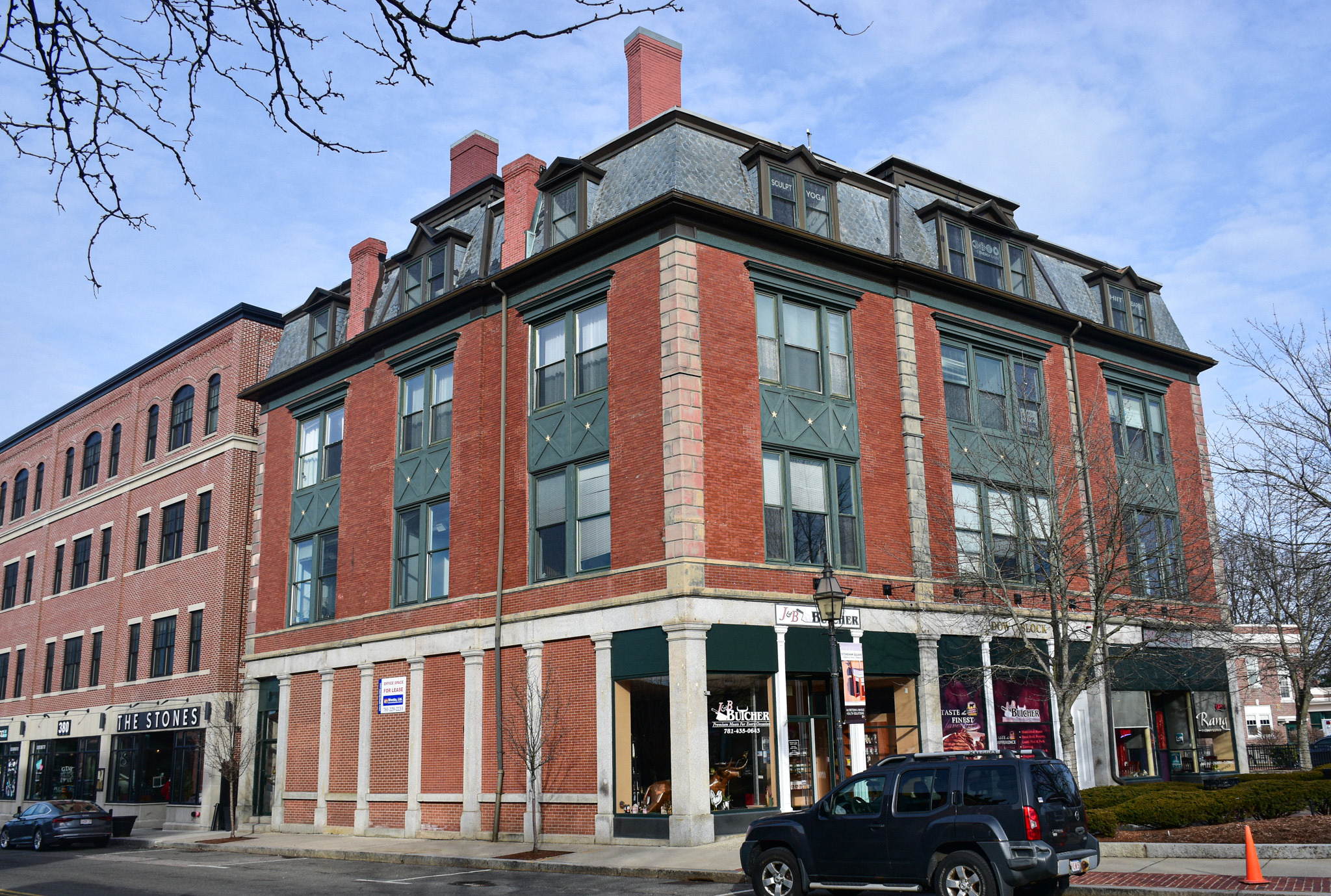
Looming next to this quaint little place is 380-82 Main Street, which dates to 1865 and is home to Ceramica Paint Studio and The Stones Common House & Kitchen. The building is seen in the photo below, at left.

The building in the foreground above is the Dow Block, a Second Empire beauty dating to 1864.

Located in the heart of Central Square, fronted nicely by the small but picturesque Buckley Park, the Dow Block "is the most important of the three major mid-late 19th century commercial blocks which define...Central Square; the others are the Chase Block and the Odd Fellows Building," per MACRIS. "The Dow Block achieves this stature through its early date, the quality and integrity of its Second Empire style design, and its key location at the intersection of Main and Central Streets."

In addition to store and office space at the time of its construction, the Dow also housed a post office and a public library. Tenants today include J&B Butcher, The Energy Barre and Rang Indian Bistro.

In a building just to the north of the Dow Block, along Centeral Street, I liked the facade and sign for A & K Jewelers, which was established in 1949.

The Chase Brothers Block is due west across Main Street from the Dow Block, and it, too, is an impressive slab of a building.

Built in 1874, this Italianate building is quite handsome. "It was built by local businessmen in the grocery business," according to MACRIS. "It has housed small shoe manufacturing concerns, banks, shops and offices." Today tenants include Firicano Boxing and Fitness Center and Serenity In the City, a salon and spa.

The third of the major mid-late 19th century buildings is the Odd Fellows Building, at the corner of Central and Franklin streets.

"The Odd Fellows Building [compares] favorably to the Chase and Dow Blocks, but [it is] unfortunately stuccoed-over," according to MACRIS. "[It] follows the mansard-roof tradition of other important local buildings of the period. The third-story dormers are the best conserved feature, each with a triangular pedimented lintel, and small brackets."

Stoneham's Odd Fellows "comprised several fraternal orders, including the Columbian Lodge, Columbian Encampment, Daughters of Rebekah, and Canton Fells," per MACRIS. "Many businesses have occupied the first level, including William Walker's Grocery and the Charles Currier Drugstore." The building, which dates to 1868, is currently home to Christine's Sweet Shoppe, Oro Salon & Spa and Gianna's Bridal & Boutique.

Across Central and Main streets from the Odd Fellows building, the Stoneham Theatre dates to 1917 and is today home to the Greater Boston Stage Company. In business since 2000, the not-for-profit GBSC produces around half a dozen shows each year ("Dial M for Murder" and "Guys and Dolls" are among this year's productions) and offers year-round training and performance opportunities to students in grades 1-12.

From MACRIS: "The Stoneham Theatre originally provided space for vadeville [sic] acts, lectures, and plays. One of the first attractions was 'Wanda's Trained Seals.'" Eventually, like most theaters, the Stoneham began showing silent films and, of course, talkies.

"The theatre was renovated to accomodate [sic] the technology of sound and to place a new screen at the front of the stage," MACRIS continues. "Vaudeville was not abandoned, but reserved for special holidays. Eventually, however, the cost of bringing performers to the Stoneham Theatre became prohibitive, and 'Amateur Nights' took the place of live acts."

(That is one helluva tile entryway!)

The yellow building next to the theater, shown below, is home to Evergreen Florists, which has been in business for more than four decades.

The building dates to 1870, and is known as the Dr. A. H. Cowdrey House and Office, per MACRIS. Next door is another old home that was converted to a business.

The Hill House also rose in 1870, and over the years has housed several restaurants and bakeries, including the Sidney Hill Store, according to MACRIS. The old home's most recent tenant was Melissa's Main Street Bistro, which is now closed.

Continuing south on the west side of Main Street, we come to the imposing Petrillo Building.

This building isn't old -- it rose in 2013 -- but the dedication plaque near the front entrance is a nice touch. The building is dedicated to Aquilino Petrillo, an Italian immigrant who founded Petrillo & Son Corp., a masonry, landscaping and site work company. Petrillo was a "devoted husband, father, brother, uncle, nonno and friend to many....He loved his craft and built things with pride."

At the corner of Maple and Main streets is a rather boring sign that I'm guessing used to be a lot cooler.

According to Google Street View, the sign has looked like this since at least 2007. The building housing DB Mart and Center Beverage dates to 1928, per the assessor's database. I'm guessing the arrow used to light up and perhaps once had the name of another business on it.

Across from the beverage center, there stands the largest relic of Stoneham's shoe manufacturing history.

You wouldn't guess to look at this place, which is known as the Residences at Stoneham Square, that it was once the hub of shoe manufacturing in Stoneham. "This was reputed to be one of the first shoe factories in the U.S. to employ steam power for labor-saving purposes," according to this National Register of Historic Places nomination form for Stoneham. The building dates to 1858, and was much more elaborate before being converted first to a furniture store (Love's) and then to condominiums.

I've come across a few "shoe towns" over my years of exploring in Massachusetts -- Hudson and Marlborough -- but had no idea before exploring Stoneham that it was also on this list.

"In 1837, Stoneham earned its reputation as a 'Shoe Town' when its workforce of 297 men and 180 women produced 380,000 pairs of shoes, the largest output in Middlesex County," according to this Stoneham Chamber of Commerce article. "Throughout the 19th century, Stoneham’s industrial base continued to expand. Hand labor in shoe factories was replaced by machinery in large establishments such as that of John Hill & Co....By 1850, more than half of the businesses in Stoneham were shoe making enterprises. Related businesses in the leather industry such as the Tidd Tannery, also flourished."

Below is a photo from MACRIS showing what the building looked like when was occupied by Love's Furniture.

Quite a difference, eh?

The building below, which is sited just south of the Residences at Stoneham Square, dates to around 1912, and I believe was also part of the old shoe factory.

This building is currently home to an office of Astound Broadband, and perhaps other businesses.

Continuing south along Main Street, I was charmed by the First Baptist Church at the corner of Hancock and Main streets.

MACRIS can tell you about it much better than I can (What else is new?): "Constructed in 1892, it is more complex in plan and massing than its predecessors and combines bricks and shingles in its construction. In general, the first story is brick, while the gabled areas and the tower are shingled. The main body of the church is rectangular with two cross gables facing east toward Main Street and a two-story tower projecting out between them. The gables contain arched, stained glass windows and decorative corbeled courses."

The First Baptist congregation built the Queen Anne-style church after having used a chapel on Common Street for more than two decades, per MACRIS.

I was sad to see that an ice cream joint I remembered from my days working in Stoneham, located diagonally across from the church, on the east side of Main Street, was long gone.

The condos in the photo above were completed in 2020. They stand on the site the Dairy Dome once occupied (here's a fan appreciation blog post). From 1980 to 2016, the Dairy Dome was an institution in Stoneham, serving up ice cream cones, Sundaes, frappes, you name it. As if that's not a cool enough history to this plot of land, the ice creamery was located in a former Colonial Beacon gas station.

(The Dairy Dome in its heyday, courtesy of Google Street View's wayback machine.)

I wrote about Colonial Beacon gas stations in my post about Woburn (see February 24, 2024, "Woo Woo! It's Woburn Time"). From MACRIS: "The Neo-classical Colonial Beacon gas station is a well preserved example of early 20th-century, automobile-related commercial architecture....These were designed as flagship stations for the company by the architectural firm of Coolidge and Carlson of Boston."

Other than the one in Woburn, only two others survive, one in Malden and the other in Boston, as of this writing.

As I wrote in my Woburn piece, "According to MACRIS, Clifford Leonard, one of the owners of Beacon Oil Company, convinced his partners to build Colonial filling stations. 'His reasoning was to market these stations as facsimiles of the Bulfinch State House in Boston. The State House served as the centerpiece of the 'Hub' of Boston, and Leonard wanted to have his gasoline station equated with this popular image.'"

Across Main Street from the old Dairy Dome site, I found a nice sign memorializing the old Stoneham Telephone Exchange, which once stood where now there are condos and a few businesses in a building that rose in 2019 and 2020.

Per the sign: "In 1915-16, New England Telephone & Telegraph constructed a building on this site to house telephone equipment and operators....At a 1937 Open House, it was reported that the telephone operators handled an average of 13,000 calls per day." A staff of nineteen women worked here at that point. By 1961 the site was handling 75-85,000 calls per day. In 1961, NETT built a new facility in Wakefield, and shuttered this building.

"The building was purchased by Stoneham Lodge 2211 B.P.O. Elks and used from 1962-2017, when they merged with the Woburn Lodge of Elks. It was razed in 2019."

My walk's southern point was Nutnapat Aroy Thai, an eatery with a great sign.

Built around 1925, this one-story, four-storefront building is known, according to MACRIS, as the Crown Cash Register Block. I haven't found much information about Crown Cash Register. Evidently the company was based in this building, and was a wholesale dealer in cash registers and related supplies. The company is registered to a private address in Stoneham.

Across Main Street, at the corner of Summer Street, is the tandem of Andrea's Pizza and Convenient Store. The building dates to 1962.

The local chain also has storefronts in Woburn, Winchester and North Reading.

On the side of the convenient store is a great Boston sports-themed mural.

The artist goes by Jet, and can be found online here.

After wrapping up this part of Main Street, I ventured off to several places east and north of Andrea's. After absorbing so much great late-19th- and early-20th-century architecture, I was happy to see something a little bit different.

Located at 15 Dale Court, the Boys & Girls Club of Stoneham & Wakefield has been serving youths and teens for more than 50 years. The lodge-style building dates to the early 1960s.

At the corner of Franklin and Pine streets is the old Boston and Maine Railroad depot.

Built in 1895, "This station replaced a gambrel-roofed frame structure...which was constructed when the Boston & Maine (then Boston & Lowell) tracks reached the Franklin Street depot in 1863, two years after the construction of the Farm Hill station," according to MACRIS. "Located adjacent to Central Square, the [1895] railroad station served to reinforce its position as Stoneham's commercial, institutional and industrial center."

After admiring the nicely restored depot, which is occupied by the Stoneham Municipal Employees Federal Credit Union, I glanced south down Pine Street, where something caught my eye.

The sign is missing an "I"; this is the Marconi Club (aka the Marconi Mutual Benefit Society). This is a private club that offers event space and makes charitable donations. I'm not sure whether it is named for Guglielmo Marconi, an Italian inventor and electrical engineer who is credited as being the inventor of radio.

West-northwest of the Marconi Club, along Franklin Street, I found a cool car inside the circa-1920 building at #41.

That's a Studebaker Lark VI inside of Dynasty Auto Tops & Upholstery, which moved from this location to Saugus, and has been in business for more than 30 years.

I was a little confused about seeing an H&R Block Income Tax sign above a door near the rear of the old upholstery shop.

On Pleasant Street, I spied the Old Burying Ground, which was established in 1726 and is on the National Register of Historic Places.

From MACRIS: "Inside the Old Burying Ground are nearly 500 head and foot stones arranged largely in rows of individual graves. The oldest markers are constructed of slate, and have been intricately carved by known artisans, including the Lamson shop (Charlestown), Isaac Newton Stone (Harvard), Isaac Fletcher (Lawrence), David Nichols (Lowell) and Bolduc & White (Lawrence). Images on the stones include winged skulls, winged cherubs, weeping willow branches, and draped pedestaled urns. Later markers (dating to the mid and late 19th century) are constructed of marble and display Victorian era imagery."

Steps aways from the cemetery is Pleasant Street Crossing, which I was pleasantly (see what I did there?) surprised by as I strolled along the Tri-Community Greenway where Pleasant and Spring streets meet.

Surprisingly, MACRIS hasn't written anything up about this place. According to this Facebook page for the property, Pleasant Street Crossing was originally a factory. "This 1850's landmark has been renovated into loft-style space with its exposed wood beams and duct work, original radius curve walls preserved and a nod towards its industrial past. High ceilings, and lots of natural lighting make these spaces a unique offering in this market."

This is commercial space, however, not residential. Tenants include Natural Food Exchange, Nouvelle Eglise Evangelique Du Mont Des Oliviers (New England Church of Mount Olives) and Boston Networks, among others.

I love the look of this place, but there is definitely work to be done, at least on the exterior.

A short distance away from the old factory, on William Street, is the Stoneham Historical Society, which is located in a cool old building with an interesting background.

From MACRIS: "This building was built by Oliver H. Marston to house packaging machinery invented by A.W. Souther. Souther, a machinist and inventor, devised a machine to fold the packages used for headache powders. The headache remedies were obtained from the Patch Pharmaceutical Company whose offices were on Fulton (later Montvale) Avenue. This building was probably one of the earliest reinforced concrete structures in Stoneham."

I will cover the Patch Company below.

The old packaging building dates to 1913, and was in more recent years used as the Spanish War Hall, according to the historical society's web site. Veterans of the Spanish-American War used the building as their quarters. They deeded the building to the historical society in 1958.

At the rear of the historical society's property is the Peter Doucette Ten-Footer Shoe Shop, aka the Museum of Shoe Industry.

"This 10 x 10-foot square building is a well preserved example of a kind of shop used by many shoemakers in the late 18th to mid 19th centuries," according to MACRIS. "In Stoneham during the 19th century there were many such shops scattered throughout the town. Usually, the owner-shoemaker worked alone or with family members. Materials could be stored in the 'attic.' Inside the shoe museum are found tools typical of the trade: shoe lasts, wooden forms, a shoe bench, lap stone, shoe hammer, awls, wooden pegs, skivers, edgers, pincers, a rolling machine and sewing machine."

Due west of the restored shoe shop, across Main Street and along Montvale Avenue, is the former E.L. Patch Company complex.

Once again, I was surprised to find the MACRIS cupboard entirely bare of any information about this former pharmaceutical manufacturing operation founded by Edgar L. Patch. I was thankful to find other online sources, such as this web site that has published an eight-page document, Patchwork, that the company published in 1938 in recognition of its 50-year anniversary. "In the early days a large number of crude drugs were ground," according to Patchwork. "Most of the pharmaceutical preparations then in vogue were manufactured. Along with these, chemicals and essential oils were sold."

Judging from a photo in Patchwork, the complex appears to have been larger than the buildings seen above, which are now apartments. The Stoneham Historical Society indicates that Patch "was a major employer of the town in the first half of the century." I'm not sure when the company went out businesses/moved/merged. To see photos of the company's products and read comments from people related to the Patch family, check out this web site.

Heading north on Main Street, past Round's Hardware and City Cycle, I found a two more sites of interest.

The H.P. Smith Monument Company building dates to 1963, while the firm has been in business since 1876.

I was bummed that Hago Harrington's Miniature Golf, which opened in 1952 along Main Street/Route 28, was no longer in business.

I didn't even know about this place on my initial visit, which took place just a few days after the course closed, according to Hago's Facebook page. By the time of my return in early February, the sign was gone and the small course looked pretty sad.

The owners sold off pieces of the course, likely including the sign. The Facebook page indicates that the decision to close was not their choice. One source online indicated that the Ford Motor Co. purchased the property. Stoneham Ford is right up the street. On the day I stopped by the old course, the adjacent parking lot was filled with new Ford pickups.

So who was the mini golf course's namesake? Leland "Hago" Harrington played hockey at Melrose High School and joined the United States American Hockey Association's Boston Unicorn at age 19. In 1925, he signed a contract with the Boston Bruins. He went on to play with many other teams, including the Montreal Canadiens, in his career. He passed away in 1959, just seven years after opening the business.

For a review of the course, complete with photos and short videos, check out this Mass Mini Golf page.

New Balance Draws a Red Line with Diner

From Dave Brigham: I can't be expected to know everything about the backside of America, nor of Massachusetts or even of Boston. But I...