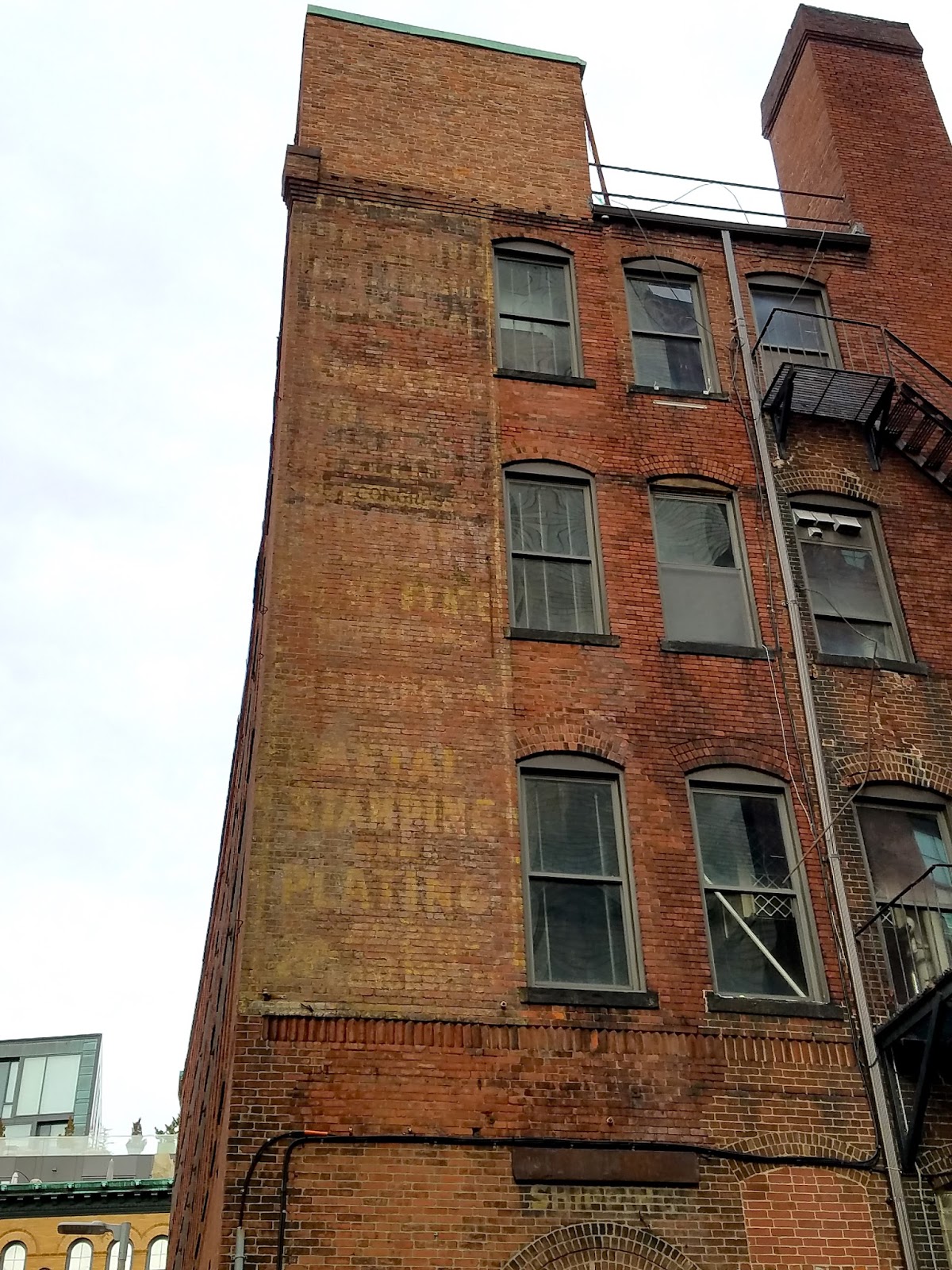
Friday, May 18, 2018

Rollin' On the River

From Dave Brigham:

Last month I visited Chicago with my family during school vacation week. In late April I posted about the backside elements I found in the Windy City (see April 28, 2018, "Toddling Around Chicago"); today's post is about the river tour we took that showcases the diverse and wonderful architecture in the city (and some backside stuff, of course). Astute blog readers will recall that my first post more than eight years ago talked about how my interest in the backside of America was inspired in part by a childhood canoe trip I took with my father down the Farmington River in my Connecticut hometown (see March 1, 2010, "Take Me to the River").

Run by the Chicago Architecture Foundation, the cruise runs about 90 minutes and goes along the Chicago River and briefly into Lake Michigan.

OK, let's get this first building out of the way.

This is Trump Tower Chicago, which our well-versed and perfectly charming docent told us is the most beautiful building in all of Chicago, perhaps the world. Actually, that's fake news. At 98 stories it is far shorter than President Donald J. Trump (R - Idiotville) wanted it to be 20 years ago. After the 9/11 attacks, however, he scaled back his vision of constructing the tallest building in the world.

The next buildings are incredibly different from Trump Tower and every other building we saw.

Marina City, a mixed-use residential/commercial building that was memorialized on Wilco's Yankee Hotel Foxtrot album -- was built in 1968 and includes a hotel, a House of Blues club and several restaurants. The lower third of each building comprises a spiral parking garage. Too cool.

Built in 1914, the Reid, Murdoch & Co. building has served over the years as offices, a grocery warehouse, home to Chicago's traffic courts and more. The penthouse is now occupied by The World of Whirlpool, the "international brand and product experience center" for the home appliance company. There is a restaurant called River Roast on the ground floor.

There are 37 moveable bridges on the Chicago River, and even more bridge houses. For more than a century, these houses were staffed 'round the clock by tenders, who opened and closed the bridges every day to allow boats and ships through, maintained the infrastructure and lived on site. Nowadays, the bridges are opened just a few dozen times a year, to "let recreational sailboats with soaring masts pass between their summer and winter berths," per this Chicago Tribune article.

I fell in love with several of the tender houses during our trip, and put the McCormick Bridgehouse & Chicago River Museum on my list of things to do. Alas, the museum was closed while we were in Chicago. For more words about and photos of the bridge tender houses, read this Untapped Cities article.

OK, let's get to my photos of the houses.

(This is the LaSalle Street house. Built in 1928, it is one of four at this bridge; most bridges only have two houses.)

(The Grand Avenue bridge house is my favorite. I didn't see any others of this style, and certainly not of this color. I can picture a hipster family living in here. The city rebuilt this house, along with some others, to restore it to its original wooden design, according to this book entry.)

(The Chicago Avenue bridge houses aren't the prettiest, and neither are these photos. Here's a better image of the second one. I find it interesting that they don't match. They are located on opposite sides of the river, and the bridge.)

(The Lake Street bridge house opened in 1916, and tends what was the world's first double-decked trunnion bascule bridge, according to this article. Trains cross the bridge's upper deck, and cars the lower.)

(The Roosevelt Road bridge was the turnaround point for our cruise. The bridge house was built in 1929, according to this web site, and rehabbed in 1994.)

(The Van Buren Street bridge house went up in 1956, the year the sixth iteration of the bridge was built, per this web site.)

(The Jackson Boulevard bridge opened in 1916, so I assume the house did as well.)

(The Adams Street -- aka Historic Route 66 -- tender house was built in 1927.)

(The raised bridge in the background is known alternately as the Carroll Avenue railroad bridge (more about Carroll Avenue here) and the Kinzie Street railroad bridge (read this). Owned by the Union Pacific railroad, the bridge is evidently lowered once a year to be inspected by a crew in a Hi-Rail truck.)

You can learn more about the dozens of Chicago River bridges at this link.

OK, enough bridges....

(One of my favorite buildings along the river cruise is Fulton House. Formerly a cold storage warehouse, it has four-foot-thick walls and was converted to residences in the late '70s.)

(When I visit New York City I'm always pleasantly surprised at the number of roof-top water towers still in place. I didn't see nearly as many in Chicago, but I was happy to see the Salvation Army one hanging on. The charity organization received a permit last year to repair the tank.)

(The Spirit of Progress statue in the middle of this photo sits atop the former Montgomery Ward headquarters. The Groupon building was a Montgomery Ward warehouse.)

(I really like this photo. The reflection, the mix of old and new, the river and the elevated train, the beautiful brick building that was built by renowned architect Daniel Burnham in 1922 as offices and warehouse space, and which was turned into condos called Randolph Place.)

(I took this photo mainly as a way to remind myself to ask my son, an aviation enthusiast as well as a train lover, if he wanted to visit the store at Boeing International Headquarters [He was topside and I was belowdecks with my daughter]. He didn't. But I learned while writing this that the building, which was erected in 1990, is the former world HQ of Morton Salt.)

(The mural is what caught my eye. It was painted by French duo Ella & Pitr, according to the Facebook page of Joseph Cacciatore & Co. Real Estate, on whose building the art is situated. Known as "The Native American Lost in Chicago...Dreamin'," the mural is one of two the artists have completed in Chicago. My daughter, with her young eyes, was able to tell me that the classic water tower on the roof read "Cacciatore." If not for her, I probably wouldn't have been able to determine much about this site.)

(I was surprised to see a barge on our cruise, but I shouldn't have been. Once this would have been a common sight.)

(The cruise turned around at the Union Power Station.)

(I know I missed a LOT of ghost signs in Chicago, even in the relatively small area of the city we visited. I spied this one, though, on the Paper Place Lofts building, which was built in 1915 and is the former home of the Chicago Paper Company.)

We cruised back toward our starting point, and then continued on toward Navy Pier, a shopping, eating and entertainment destination. I put this place on my pre-trip list of things to do, but it was just too damn cold to go out there.

(Maybe next time we'll make it to the Navy Pier's Ferris wheel, which made its debut during the 1893 Chicago World's Fair.)

(Not a bad view, eh?)

(The skyscraper in the middle of this photo, the one that looks like it has a vertical eye, is known as Aqua. A mix of retail, office, residential and hotel space, the 82-story building was erected in 2009. It's not old but I really like it.)

Finally, the LondonHouse Chicago hotel.

(I took this photo after the cruise, as we were hustling through the cold toward lunch at the Windy City's outpost of Elephant & Castle. Built in 1923 and originally known as the London Guarantee Building, LondonHouse is located on the site of the long-gone Fort Dearborn.)

I'm happy with the two posts I've done about Chicago, but wish I had more! With the Windy City stuff done, and warmer weather upon us here in New England, I plan to get back to my ongoing chronicle of my adopted hometown of Newton, Mass.

Friday, May 11, 2018

The More Things Change....

From Dave Brigham:

I spend a fair amount of time walking through Boston with my son. Some of the areas are new to me, others are places I've walked countless times in my nearly three decades of living in and around the city. There was a time, in what seems like a previous life, where I walked through Downtown Crossing, and past this building on Winter Street, on a regular basis for work. I went to a holiday party, or some such event, at the building next to this one. But that was all back before I paid attention to the architecture around me, and to ghost signs and named buildings and other hidden pieces of history.

40 Winter Street was built in 1866. The architect was Nathaniel J. Bradlee, who also designed, among other buildings, the Boston Young Men's Christian Union, Danvers State Hospital, the reception house at Mount Auburn Cemetery in Cambridge and the Jordan Marsh department store, which was demolished in 1975, according to Boston: A Historic Walking Tour by Anthony Sammarco. Notice the "B" and Roman numerals above the GameStop sign.

In its earlier years, the building was occupied by, among other businesses, Child's World, a periodical that I believe was also known as The American Sunday School Union; The Advocate of Peace; the American Congregational Association; Schonhof & Moellers bookstore; and a private classical school operated by George W.C. Noble.

So while it's a bit jarring to see the bold, modern, red-and-white GameStop sign on this Second French Empire-style building (thanks, Anthony Sammarco), the building's partial use as an entertainment destination for the younger set isn't completely out of step with its past use.

Saturday, May 5, 2018

Can Superior Nut Stand the Heat?

From Michael J. Squirrel:

Looking at the Superior Nut Company building, one might be forgiven for thinking the roasting outfit was, well, toasted. Started in 1929 in Somerville, Mass., Superior Nut has been at this location in East Cambridge, Mass., since 1979, per the company's web site. In previous drives and walks past the facility, I've enjoyed the aroma of roasting nuts. Lately, I haven't smelled anything, but I assume the company is still cranking out product. Its Facebook page is up to date.

Built in 1920, the manufacturing facility is located in a quickly evolving neighborhood. In recent years developers have built a Marriott hotel and very large apartment/condo buildings in the immediate area. Another development is under way across Monsignor O'Brien Highway (Rte. 28) from the nut company. Nearby, the massive Cambridge Crossing (formerly known as NorthPoint) multi-use project is in process, with several residential buildings completed and many more on the way. I wrote a little about this area back on October 27, 2017, in "Set Yourself Free on Prison Point."

There are a few lots north of Superior Nut that, on a recent walk-by, I noticed were either vacant or more than a bit rough around the edges, and surely ready to be redeveloped, including Lechmeres U-Do-It Car Wash, Boston Tropical Fish and Reptile and Sav-More Discount Liquors. A crack developer or two surely must have these sites on their radar. Since the nut company seems to be doing well, I'm guessing that it will stay put.

"Why is this area ripe for redevelopment?" you ask. Well, for one thing, Superior Nut is close to Somerville's Union Square, which in recent years has become quite the hipster zone, what with the restaurants and the bars and the breweries and mustache waxing.

Secondly, the neighborhood around Superior Nut will one day, God willing and the money don't dry up, be serviced by a long-planned, but much-delayed, extension of the Green Line trolley system. So developers are jumping on board now in expectation of growth along the new train line, which will connect Union Square and Medford with downtown Boston.

You know what to do. Stay tuned....

Saturday, April 28, 2018

Toddling Around Chicago

From Dave Brigham:

I recently visited Chicago on a family vacation and, despite the colder than normal temps, had a great time. I ate some great food (including deep dish and thin crust pizza, but I have to say, Chicago puts too much cheese on those pies. Must be the proximity to America's Dairyland), checked out some fantastic museums and, of course, had my head on a swivel while walking and riding the train through the Windy City.

The last time I was in Chicago Jerry Springer was on the cusp of national stardom. While at the fabulous Kingston Mines blues club with my then-girlfriend (now wife) and her college roommate in the summer of 1994, we saw the former mayor of Cincinnati who became one of the most famous trash TV hosts in the U.S. of A. Somebody approached the singer of the band and whispered something in his ear. Then this guy shouts out, "Ladies and gentlemen, we have Mr. Gary Springer in the crowd!"

Gary Springer.

The three of us turned around. I saw a geeky guy with glasses and blonde hair arm in arm with a floozy. Beth and her roommate were excited, as they actually had a clue who this guy was, unlike me. Well, the next day as I was flipping channels on the hotel TV, who should I spot doing his schtick but Jerry "Don't Call Me Gary From the Stage, Please" Springer.

The closest I came to celebrity spotting on my most recent trip was chatting in our hotel with a crew member of Food Network's "Diners, Drive-Ins and Dives," who told me that host Guy Fieri was in the area, but not in our hotel. They were shooting updates to previous episodes of the show, which I enjoy watching.

This post focuses on cool signs, art work and buildings I saw while walking or riding around Chicago. I will write separately about the architecture river tour we took while in the City of Big Shoulders.

In addition to food and architecture, Chicago is also known for its music scene, from power pop (Cheap Trick) to alt-rock (Smashing Pumpkins), punk rock (Naked Raygun) to blues (Buddy Guy). Nobody looms larger over the latter scene than the guy who loomed outside our hotel window.

That's Muddy Waters. Created two years ago by Brazilian artist Eduardo Kobra, the 10-story mural honors the man born McKinley Morganfield in 1915, and who basically created the Chicago blues sound. Take a listen:

Out another of our hotel windows was a great view of the Chicago Theatre. Built in 1921, the theater was originally known as the Balaban and Katz Chicago Theatre, and was one of many owned by the uncles of actor Bob Balaban.

(Chicago Theatre, where Bill Murray appeared during our stay, doing a literary reading with musical accompaniment.)

Located around the corner from the Chicago is the Oriental Theatre, which dates to 1926. Since 1997 it has been known as the Ford Center for the Performing Arts.

On our first full day in Chicago we took the L (not to be confused with "The R") to the Shedd Aquarium. Along the way I drooled over the ghost signs, murals, amazing architecture and restaurants.

(Located on the back of the South Loop Club bar and grill, the Make Your Own Luck mural was painted by the Brooklyn artistic duo known as ASVP.)

(The former Somerset Hotel was built in 1892-93, and was also known over the years as the Mayer Hotel and the Hotel Roosevelt, which makes its ghost sign a bit difficult to read. It is now apartments, and is located a stone's throw from Stan's Donuts, a place I really wanted to go to but I was the only one.)

After we returned from the aquarium I went on walkabout in our neighborhood. Here are some of the cool sites I saw.

Our hotel -- the Alise Chicago, a National Historic Landmark that was once an office building where Al Capone's dentist had his practice -- was just a block from the Jewelers Row District. The Jewelers Center has been around since 1921, and features more than 180 jewelers.

As hard as I try, I can't make out the ghost sign on this building. Maybe something to do with gold plating? Seems logical, given that it's in Jewelers Row. I've been unable to track down any useful information online. Frustrating. I welcome any and all forensic efforts from my readers.

This cool little detail, on the other hand, allowed me to find plenty of information about the Charles A. Stevens Building. Built in 1912, the 22-story structure once featured a basement and six stories occupied by Chas. A. Stevens and Bros., purveyors of women's clothing, including undergarments. Stores on the upper levels were reached by high-speed elevators.

I spotted this side entrance to the Palmer House Hilton having no clue about the place. The fire escape coming down to the top of the awning gave me the impression that this building was a little down at the heels. I snapped this picture and moved on. Two days later, however, my wife and I set out from the hotel to find a Frank Lloyd Wright-related building (about which more below) and walked past the main entrance to the Palmer. It was then that I realized this place was incredibly grand. This iteration of the hotel (the original burned during the Great Chicago Fire) opened in 1873 and now claims to be the nation's longest operating hotel.

Miller's Pub looks great, doesn't it? Open since 1935, this place, according to its web site, has played host to movie stars, pro athletes, Broadway actors and politicians. Regular people too, I suppose. Notice the FINE FOOD SPIRITS sign in the lower right corner of the photo.

Every where I looked, it seemed, I saw something to shoot. I spend a fair amount of time walking through various neighborhoods of Boston and simply don't see the quantity and quality of neon signs, ghost signs and awesome architecture as I did in my brief time in Chicago. Central Camera has been around since 1899, as the sign says. I think that's awesome.

In doing research ahead of my Chicago visit, I was excited to see on Google Maps that the origin point of Route 66 was just a few blocks from our hotel. I put this at the top of my list of things to take a picture of.

On a 1988 road trip with three buddies, I traveled a bit along and close to Route 66 in Oklahoma, Texas and New Mexico. The Mother Road, as it's known, is still a treasure trove of neon signs, funky restaurants, roadside attractions, motels and more, although obviously since the advent of superhighways the old road has suffered. For a nice history of Route 66, check out the National Historic Route 66 Federation web site.

In Boston there is a lot of new construction and I feel like the more recent history of the city is disappearing. In Chicago, however, I found a nice mix of new and old buildings. Like the Palmer House, Iwan Reis & Co. is the oldest outfit in its business: tobacco.

Founded in 1857, the company stocks more than 15,000 pipes, a large selection of tobaccos and operates an old school lounge with modern amenities.

One company that's not in business anymore is A. Sulka & Company. Founded in New York City in 1893, the haberdasher and shirt maker eventually expanded to London, Paris, Chicago and other locations. Well-heeled clients included Clark Gable and the Duke of Windsor. The company's last store, in the Big Apple, shuttered in 2002.

I shot this sign because I liked the idea of a highfalutin social club marking its alley so winos and roughnecks passing behind the building would know where they were (and, by extension, where they are not welcome). The University Club of Chicago was established in 1887 and occupies a beautiful building fronting Millennium Park. I took the shot below on a family walk on our last night in the city.

As you can tell from this post and many others I've written over the past eight years, I love architectural details.

So you know I was excited by these owls above the entrance to 8 West Monroe Street. Built in 1913, the building was once an office tower called the North American Building, but is now known as Metropolis Condominiums. I'm not sure of the significance of the owls.

As I mentioned, we had a lot of great food in Chicago. But we only had so much time, so we didn't get to eat at the Italian Village.

Opened in 1927, the Village is a third-generation venue that features three restaurants, each with its own chef. Based on these interior shots, the place looks amazing.

Just down the street from the Italian Village I found this very cool weather notification system attached to a circa-1906 building that over the years has been known as the Chicago Title & Trust Building, the Rector Building and the Bell Savings Building. The bell evidently changes color with the weather forecast: yellow for colder temperatures, red for warmer, and green for no change, per this web site. I can't tell if this is green, or if the bell is even working.

This unusual-looking building is the Chicago Loop Synagogue. Built in 1957, the synagogue was designed by Loebl, Schlossman and Bennett, firm founded in 1925 that is still in business. The outside isn't much to look at, but the interior is something else.

Just around the corner from my hotel, as I wrapped up my cold but very worthwhile backside stroll, the little kid numismatist inside of me got very excited.

That Buffalo nickel caught my eye. I have a few in the coin collection I started when I was in elementary school. I snapped a picture and regret now that I didn't step inside Harland J. Berk, Ltd..

I wrapped up my walkabout at the Chicago Temple, home to the First United Methodist Church. Built in 1924, the church is just the latest in a long line of houses of worship the congregation has used. The temple is actually a skyscraper with offices on the 5th to 21st floors, according to the church's web site. With a spire on top reaching 400 feet above street level, the Chicago Temple is considered the tallest church in the world. Here are some interior photos from Atlas Obscura.

In the courtyard outside the church are numerous stained glass windows. This one's inscription reads:

"THE REV. JESSE WALKER

PIONEER METHODIST CIRCUIT RIDER

ARRIVING AT FORT DEARBORN

JUNE 25, 1825"

My wife and I went on another short walk around the neighborhood, primarily to check out The Rookery, a circa-1888 building with an extremely impressive lobby.

The building was designed by Burnham and Root, one of the most well-known 19th century Chicago architectural firms, according to the Rookery web site. The interior, however, was redesigned by Frank Lloyd Wright in 1905. In the intervening years the building has undergone numerous renovations, one of which resulted in this unique method of showcasing architectural details.

Below is the exterior of the Rookery.

Just a short stroll away was The Berghoff, yet another storied Chicago restaurant. I had this on my list of potential places to eat, but I realized that my kids wouldn't go for their German fare.

Looming above the restaurant are these two buildings.

The Century Building (directly above the Berghoff sign, with remnants of a rather large ghost sign) and the Consumers Building (notice the ghost sign at the very top of the building to the right) will be jointly redeveloped under a plan unveiled by a developer last summer.

The final building I spotted on our quick jaunt is an odd one for sure.

Click on this photo to enlarge it. Let's take a look at it together. On the ground floor we have the Beef 'n Brandy restaurant and The Bar Below, which are sister establishments. Now let's move our eyes up to the second story. What is going on there? It looks like somebody transplanted the side of a small church onto the top of the Beef 'n Brandy. The third story looks like somebody cut out the dance floor from "Saturday Night Fever," tipped it 90 degrees, turned off the power and pasted it on top of the church wall. The top three floors look like they haven't been altered since the late 19th century.

What is up with this building?!?

After a little bit of searching online, here's what I found out: Known as the Waterman Building (it was built for pen company L.E. Waterman Co.), this seven-story edifice was designed by well-regarded Chicago architectural firm Holabird & Roche. Over the years, however, a parade of doofuses messed the circa-1919 building up. It "has been grotesquely obscured by three levels of facade paste-ons, including a faux New England front with clapboard and shutters," per this July 2006 Chicago Tribune article about the Loop's ugliest buildings. I believe at one point this building at 127 South State Street was the Chicago headquarters for the Red Star Line shipping company.

Last, but certainly not least, is this alley view of the side of the Chicago Theatre that I caught as my wife, kids and I were strolling to Millennium Park to see Cloud Gate (aka "The Bean"), as magnificent a place to hang out at sunset as there is in Chicago.

Come back soon for my write-up and tons of photos from our architecture river cruise.

Sunday, April 22, 2018

Fort Point Channel -- It's Electric!

From Dave Brigham:

This is Boston's Fort Point Channel, seen from a section of the Harborwalk that skirts behind the first Boston Wharf Company building you see as you cross Summer Street into South Boston. I walked here recently with my son, Owen. Whereas our trips on the subway into Boston used to involve staying mostly underground, in recent months we've explored areas of the city that are new to him, and in which I haven't taken photos before.

Boston Wharf Co. was incorporated in 1836, after which the company filled in the swampy area east of downtown and eventually constructed wharves and manufacturing and storage buildings for a variety of uses, including sugar and molasses, according to this blog post. Check out that post for photos of the pretty cool neon sign the company erected at the entrance to the district, which, before it was turned over to hipsters and tech-dorks was an artist enclave.

The sheer number of Boston Wharf Company buildings in this area is astounding.

(Boston Wharf Co. medallion. There are scads of these around the Fort Point Channel neighborhood.)

Our brief trek on the Harbor Walk led to this building.

This is one of two buildings that General Electric plans to renovate as part of it new global headquarters. The company, which broke ground in Boston last May after leaving its longtime Connecticut HQ, will also construct a new building, approximately on the site of the old Channel club, where I saw bands including the Butthole Surfers, Buffalo Tom and the Dead Milkmen back in the '80s and '90s.

In the photo above you see the ugly side of the Necco Court bridge, which GE originally planned to tear down. After neighbors -- many of them artists who flocked to the Fort Point Channel area decades ago -- complained to the city, GE agreed to preserve the pedestrian walkway. To see artist renderings of the bridge, historic photos of the area and read about the overall project, check this link out.

(The bridge, right, is on Necco Court, so named for the New England Confectionery Company (NECCO), maker of Necco Wafers, Sweetheart Conversation Hearts, Squirrel Nut Zippers, Mary Janes and Sky Bars. The company announced in March that it may shut down if it is unable to find a buyer.)

(I'm not sure whether this smaller bridge will be saved.)

I definitely want to return to Fort Point. Below are two random photos from the neighborhood.

(The backside of a building at the corner of A Street and Congress Street.)

(Located on the ground floor of the above building is Lucky's Lounge, which has a Rat Pack vibe. This entrance was locked.)

Sunday, April 15, 2018

Sitting On the Dock of the Bayside

From Dave Brigham:

Pay no attention to the fact that there's no man -- or woman, child or, well, building -- behind the Bayside Expo Center sign. OK, there is, but it's the Massachusetts Registry of Vital Records and Statistics, not the exhibition hall where folks used to go see car shows, comic book conventions and electronics industry trade shows.

I'm pretty sure I went to Bayside once in the 27 years since moving to the Boston area. I don't recall what the event was, but I guess that doesn't matter, does it? I walked by the sign recently on a jaunt with my son, Owen, to check out the Calf Pasture Pumping Station on the nearby campus of UMass Boston (see March 29, 2018, "Udderly Monstrous"). We'd been in this area a few years ago while out riding the subway, and as he hunted for Pokemon I checked out the ongoing demolition of the old expo center.

Built in the 1960's as a shopping mall (!!!), the expo center site is located in Boston's Dorchester neighborhood. The mall shuttered in the early '70s and the building sat vacant, I believe, until opening as an expo center in 1983.

Here's a picture of it in its heyday:

I stole this photo from here. Buy it if you like.

After suffering through a business slump brought on by the opening of the massive Boston Convention & Exhibition Center in South Boston and the continuing operations at the Hynes Convention Center, Bayside went into foreclosure in 2009. UMass Boston acquired the property -- 275,000 square feet of exhibition space and 20 acres of parking lots -- in early 2010. Since that time the school has worked hard to figure out a plan for the property.

A few years ago, when Boston was bidding for the 2024 Olympics, the city's plan called for an athletes village at the Bayside site. Then Boston withdrew its bid. In 2016 talk was that the New England Revolution -- the professional soccer team owned by New England Patriots boss Robert Kraft -- would build a stadium at the old Bayside site. That fell apart, too.

Last August, UMass Boston issued a request from developers. In it, the school conceptualized "a vision to transform the Bayside Property into a modern-day Harvard Square, New Balance/Boston Landing, Kenmore Square, MIT Volpe Center etc., projects; a mixed-use destination where a diverse community lives, learns and thrives, integrated with and complementary to the UMass Boston campus that optimizes its value and creates an oceanfront Boston neighborhood with academic, research, retail, residential, dining, entertainment and cultural uses, serving as a new gateway to UMass Boston and distinguish the University in the higher education marketplace as a unique, attractive urban university, all accomplished by leveraging public private partnerships that will facilitate a more rapid development of the Bayside."

Whew! That's a LOT of words. The university received 16 letters of intent from developers. In January, UMass announced plans to sell the site, which it acquired for $18.7 million out of foreclosure, for as much as $200 million. Financially strapped, the school would use the proceeds from a sale or longtime lease, to demolish a crumbling parking garage and for other capital improvements, per the Globe article.

Whatever happens at this site, it will significantly change an area of the city that has been underdeveloped for decades. Other projects in the surrounding area are in the works, or at least in the pipeline. Stay tuned....

Sunday, April 8, 2018

Tom Cruise Slept Here...Well, Maybe

T.C. Mapother V

I wonder if John Travolta, Leah Remini or Giovanni Ribisi ever set foot in this building?

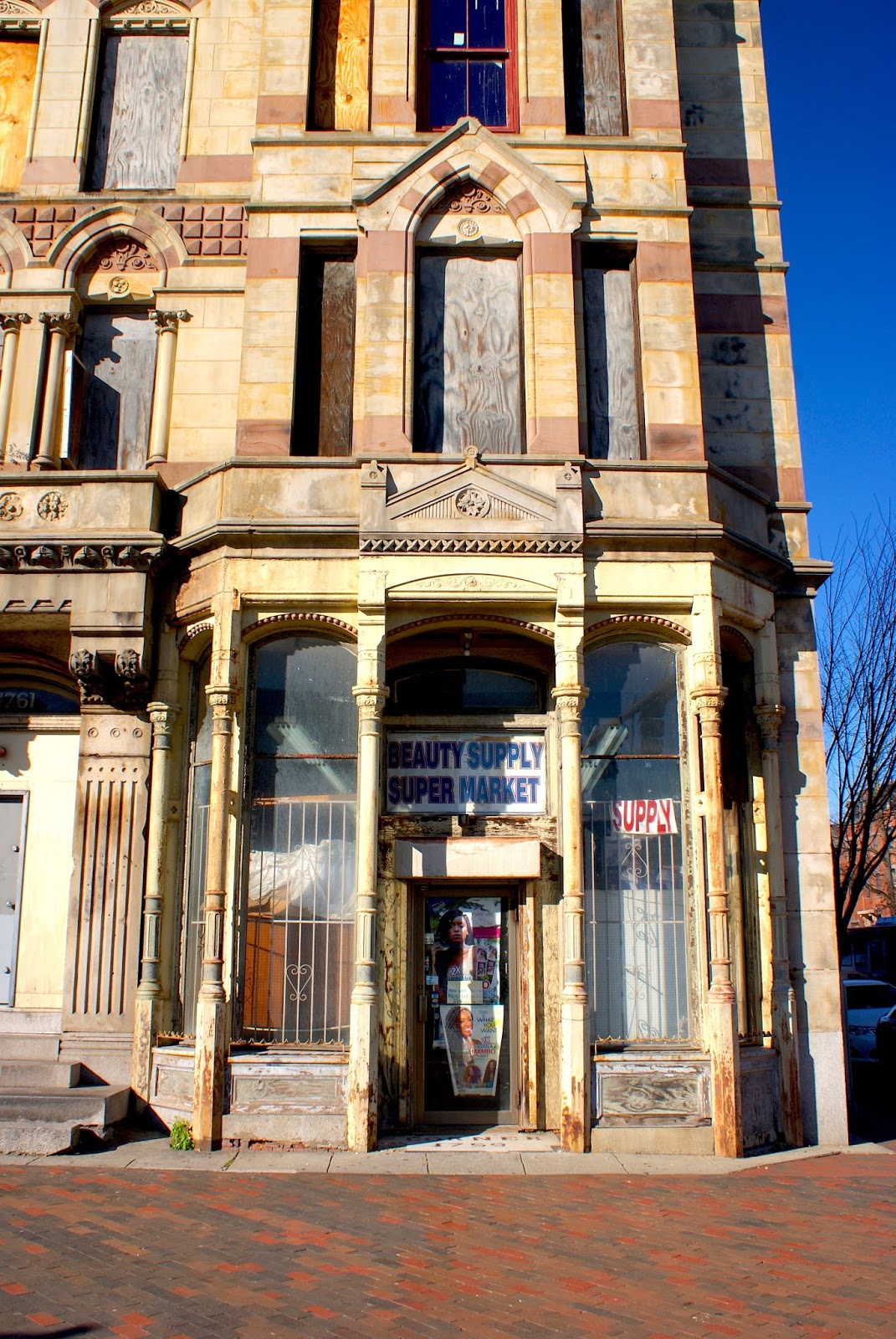
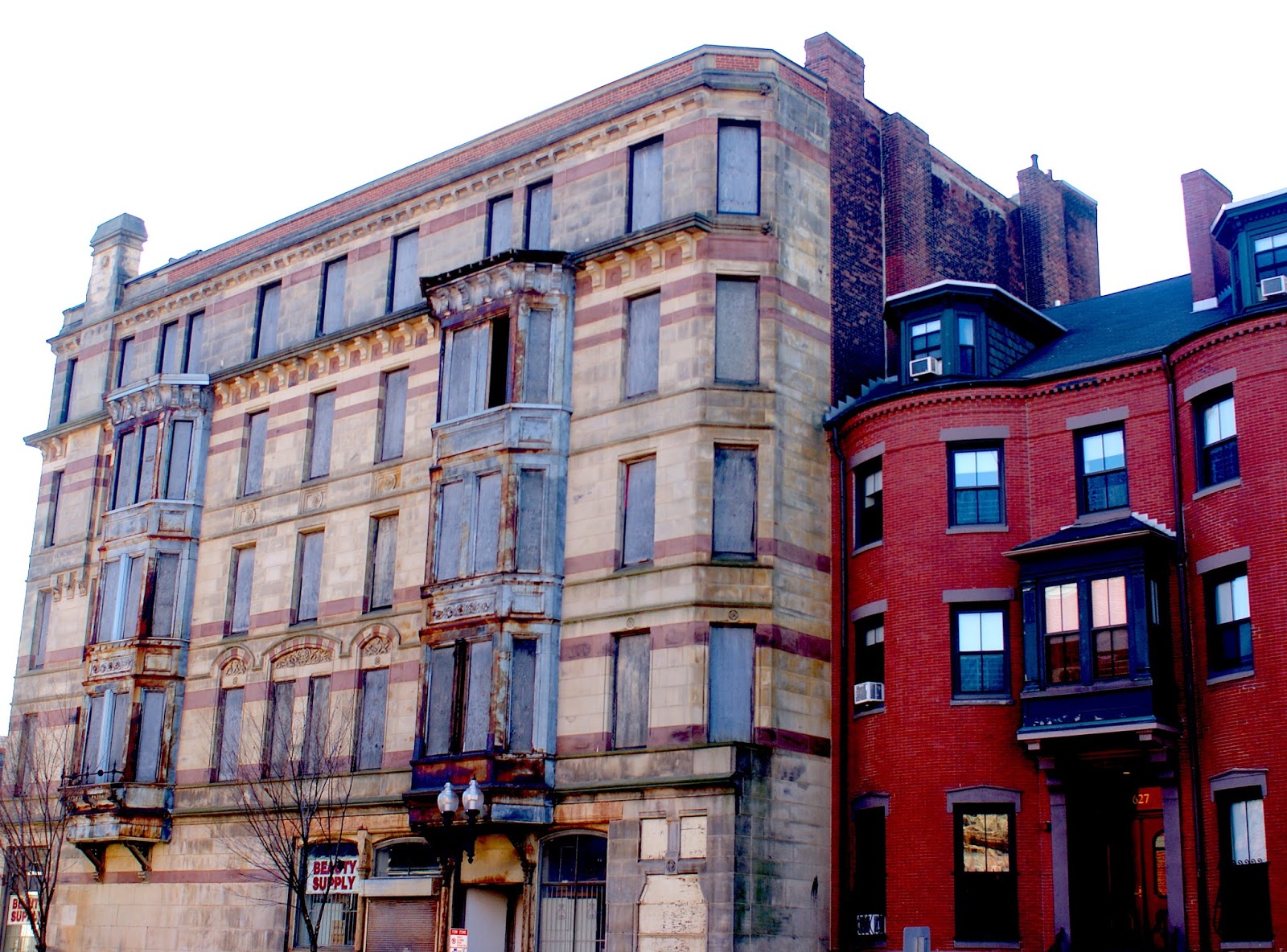
Located at the corner of Washington Street and Massachusetts Avenue in Boston's South End neighborhood, the former Hotel Alexandra was most recently owned by the Boston outpost of the Church of Scientology. When the religious group that's definitely not a cult purchased the building in 2008, it was with the intention of turning the circa-1875 Gothic structure into its New England headquarters. The House That L. Ron Hubbard Financed With His Crazy Crazy Books and Tape Recordings would have included a cafe, chapel and bookstore open to the public, according to this article.

The Folks Who Love Tom Cruise More Than They Love Themselves decided to sell the building, however, after failing to raise the millions needed to renovate the building, which has suffered multiple fires over the years. The Sons and Daughters of Xenu reached an agreement last summer to sell the building to Eric Hoagland, the son of CVS Pharmacy founder Ralph Hoagland.

Hoagland's Common Management Group plans to restore the property, but stated in the Boston Globe that the deal could take a year to close.

When The Worshipers and Captors of John Travolta acquired the former hotel in 2008, they also purchased an attached brownstone known as the Ivory Bean. Why was it called the Ivory Bean? Your guess is as good as mine, but let's agree that as far as building nicknames go, Ivory Bean is nowhere near as cool as the Darth Vader Building.

(You can see the outline of the demolished Ivory Bean building on the side of the former Hotel Alexandra.)

While the upper floors of the Building That David Miscavige Hoped to Use As Yet Another Place to Belittle and Assault His Underlings have been vacant for decades, the ground floor is home to a wig and beauty shop.

(The once-grand entrance of the five-story Hotel Alexandra -- which was an early Boston example of an apartment-hotel catering to the well-heeled -- just looks stupid now.)

(Close up, you can see, despite the rust and grime, the details that make this building stand out.)

Will the Son of CVS be the savior of Hotel Alexandra that the Father of Diabetics couldn't be? Let's hope so. As you can see in the photo below, the building obviously used to be quite stunning. And the buildings around it deserve to see the former hotel shine again. Stay tuned....

New Balance Draws a Red Line with Diner

From Dave Brigham: I can't be expected to know everything about the backside of America, nor of Massachusetts or even of Boston. But I...