From Dave Brigham:
I imagine you develop a thick skin if you grow up in a town whose name sounds like a curse word pronounced by Cindy Brady. Welcome, my friends and devoted followers, to Athol, Mass.!
Located in the northwest corner of Worcester County, not far from the New Hampshire border, Athol looks a little rough, as many old New England mill towns do. But Tool Town, as its been known for ages, has kept one major employer, the L.S. Starrett Company, and features plenty of old buildings that have been put to new uses.
I mentioned this town a few years back -- see October 15, 2022, "This Is Winchendon, Not Athol" -- but hadn't swung through until I made time on my way to Winchedon for a barbecue last summer.
I started my jaunt at the Starrett factory at the intersection of Main and Crescent streets.

At that corner, there is an old metal mileage sign that is really cool, despite the misspelled street name at the top.

Founded in 1880 in Athol, L.S. Starrett manufactures more than 5,000 variations of precision tools, gages, measuring instruments and saw blades for industrial, professional and consumer markets worldwide, per the company's web site.

The company's complex occupies more than 18 acres of property on both the east and west sides of Crescent Street, according to MACRIS. "The 3.5 acres...on the east side of Crescent Street is the most densely-developed portion of the...complex. It is occupied by numerous, interconnected, 3 1⁄2-story, flat-roofed, brick buildings unified by two, basic, design motifs," MACRIS continues.
The company employs approximately 1,800 people, with many of them working in Athol. Situated as it is along Millers River, the site has been prone to flooding over the years. At the rear of the building at the corner of Main and Crescent streets are two high-water marks from floods in 1936 and 1938, the latter of which was caused by a notorious hurricane that battered New England.

De rigeur for a 19th-century mill town, there are buildings that bear the Starrett name beyond the factory walls. "Designed by prominent Worcester architect, Edwin T. Chapin, Starrett Memorial Methodist Church, erected at a cost of more than $100,000, was dedicated on December 15, 1918 to the memory of Lydia Bartlett Starrett, wife of Laroy S. Starrett," founder of the tool manufacturer.

The house of worship was built on land that Starrett purchased on Island Street. He had two businesses moved, and one razed.
The Starrett Block, shown below, is located at 513-527 Main Street, within view of the church.

Completed in 1913, the block is an "expensively built, quite elaborate building," per MACRIS. "It is three stories plus a basement, made of yellow brick with limestone and granite front and sides and trimmings. Before the building was even completed, the top floor was already rented by the Masonic Orders. Other Original (sic) occupants were the Athol National Bank, Hamilton and Butterfield, and the Gardner L. Orton Dept. Store. After the bank crash of 1933, the bank quarters were taken over by the Bishop-Dodge Company and the Orton Dept. Store quarters were taken by Hames Photo Studio and Sears & Roebuck Co."
Tenants today include the Athol Credit Union and Lisa M. Carey, Certified Public Accountant.
Adjacent to the Starrett building, heading west along Main Street, is the Central Block. More than 20 years older than its neighbor, this circa-1891 building was reconstructed in 1916 after a fire. The only image I made of the block is the adorable sign below for Tintagels Gate - Flowerland, a florist shop.

The store was evidently named for Tintagel Castle, and perhaps more specifically, the gate that once guarded access to the peninsula in the British town of North Conwall where the medieval fortification still stands. That's not a piece of history I expected to stumble across while writing this post!
Between the Central Block and the Cooke Block (which I did not make an image of), stands a curious little yellow reminder of times gone by.

Currently occupied by the Athol Soap & Suds Laundromat, this small building is what remains of the Capitol Theatre, one of two movie houses along this stretch of Main Street. I assume this was the main lobby of the theater, which opened in 1930 and was (mostly) demolished, well, I haven't been able to find out when.
"The Capitol Theater was built by the Goldstein Brothers and was a Colonial Atmospheric theater," according to a comment at the Cinema Treasures page for the theater. According to Wikipedia, "[a]n atmospheric theatre is a type of movie palace design which was popular in the late 1920s. Atmospheric theatres were designed and decorated to evoke the feeling of a particular time and place for patrons, through the use of projectors, architectural elements and ornamentation that evoked a sense of being outdoors. This was intended to make the patron a more active participant in the setting."
I find that fascinating. In all of my years running this blog and stumbling across old theaters and researching and writing about them, I've never come across that term. Anyway, the Capitol's "auditorium had the twinkling stars, cloud machines, the recreation of a new England Town on the walls, etc....several articles in the Athol papers, at the time of the opening, state that a Water (sic) wheel was constructed in the auditorium," the Cinema Treasures commenter continues.
Well that's pretty crazy! Additionally, the theater's lobby and foyer "were designed to look like the interior of a covered bridge," the Capitol commenter indicates.
On the opposite side -- the northern side -- of Main Street just a little ways west is the Athol Second Unitarian Church.

Built in 1915 after a fire claimed a previous sanctuary three years earlier, the church has been known as First Church, Unitarian, since 1922, when two Athol congregations merged, according to the church's Facebook page. The church appeared vacant, or at least in transition, when I walked past. A photo on the Facebook page from May 13, 2025, indicates that the sanctuary had undergone a renovation of some sort.
The church was designed by the firm of Funk and Wilcox, a Boston architectural firm known for, among other works, several theaters in Greater Boston.
For a look inside, check out this Zillow listing.
On the other side of Main Street from the Unitarian church is the Delta Apartments building.

Not to be confused with the frat house in "Animal House," the Delta Apartments building rose in 1928 with tenants who, according to MACRIS, included the manager of a plumbling and heating business, and his wife; a shipping clerk at L.S. Starrett, and his wife; an assistant sales manager at Athol Manufacturing, and his wife; and a general storekeeper.
Abutting the Delta building is the second of two former movie houses in this stretch of Main Street.

Opened in 1930, the York Theater served as a cinema until 1961, according to MACRIS. Built in the Art Deco style, the York "helped transform downtown Athol from its Victorian appearance to a more modern streetscape," MACRIS continues. "Along with the Garbose Building [which I will discuss below] and the [adjacent] York Building, it is one of three, Art Deco buildings in this block of Main Street, all of which were designed by the same architect, Albert J. Smith of Worcester."
The building with white "X" on a red background in the photo above is the entrance to the theater lobby, which was 96-feet deep (!!), according to MACRIS, leading to the auditorium, which spanned 134 x 70 feet (show in the photo below, from the backside).

After the theater shut down, this large space took on many roles: 12-lane candlepin bowling alley, Athol District Court annex, a teen center and a bar/lounge. Most recently, as you can see in the image below, the old York was home to Lucky Lanes and Jolly Tavern. I'm not sure what the future holds for this historic place.

At the York Building next door, I was charmed by the handmade sign for Never Grow Up, which deals in video games, trading cards, CDs and DVDs, computers, gold/silver/coins and much more.

I love the name of this store, which has been in business for more than a decade, but I fear for its continued existence. Google indicates the shop is temporarily closed, and, once again, you can see the big "X" on the facade, which indicates the property is not safe for habitation.
As for the York Building, it rose in 1930. Early tenants, according to MACRIS, included the Great A&P Tea Company, Jacob Garbose’s shoe store and Angelo Carbone and Son, Confectioners. Great A&P Tea is known better as simply A&P, an erstwhile chain of grocery stores that operated from 1859 to 2015, when the outfit went bankrupt.
I continued west along Main Street. I was grabbed by the facade and storefronts of the Webb Block.

On the left, Athol-Orange Driving School. Sounds dirty.
On the right, TnT Co-op Mall. Not sure why you would name a place that sells antiques, collectables and vintage stuff after an explosive, but to each his or her own.
Oh, did you think I was talking about the gun shop?
Bear Arms has been in business for more than a decade. I'm a gun-control guy, but I understand that stores like this exist. I'm just not used to seeing them much.
Across the street is the rather amazing Pequoig Hotel.


First, let's discuss the name. Pequoig was the Native American name for the town that became Athol. It was the Squakeag name for Millers River, according to this history document at the town's web site.
Second, let's appreciate the architecture. especially the metal oriel windows projecting above the main entrance. If you are able, zoom in on the second photo above to gain an appreciation for the detail. How about the font for the hotel's name, and the bold numbers for the year, and the image of what I assume is a Native man carved into the metal!
Third, let's learn the history. One of two Athol buildings listed on the National Register of Historic Places, the Pequoig was constructed in 1895. "The Hotel (sic) contained living suites, single apartments, lodging rooms, banquet and meeting halls, and a dining room and tavern," at its opening, according to the Town of Athol document.
After sailing along for several decades, the hotel experienced a downturn, like the rest of Athol, after a Route 2 bypass was built that took away many of the traffic that had gone through town. By the late 1970s, there was talk of demolition, the town document indicates. Instead, in 1983, developers had renovated the place into senior housing.
Across the street is the aforementioned Garbose Building.

MACRIS indicates that this building may be the result of the "substantial/complete reconstruction of" an "earlier, 3-story, highly-ornate, red-brick, Second Empire style Starr Hall Building (a.k.a. Lee’s Block)." The Garbose brothers -- Jacob, Abraham and Samuel -- purchased the property in 1926 and constructed this building. They also constructed the York Building and York Theater.
Jacob Garbose operated a shoe-making and retail business. He was also co-owner of a toy manufacturing operation, which morphed into a furniture business. His brothers were clothiers in nearby Gardner. I mentioned their building in that city in a post from late 2024 (see October 26, 2024, "Digging Into Gardner").
The building's first floor is occupied by D'Ambrosio Eye Care.
From there, I headed north on Exchange Street for a few minutes.

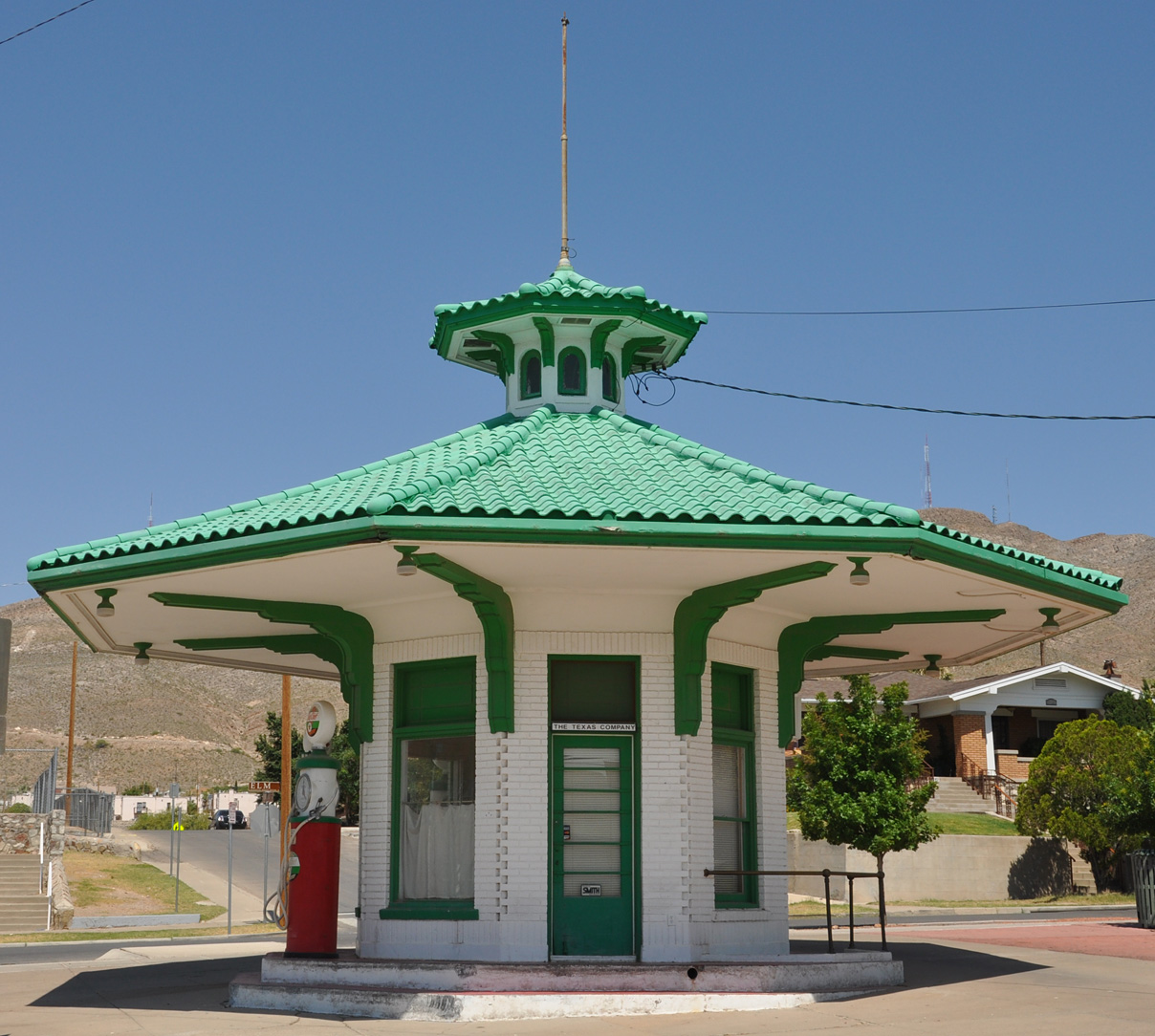
This former service station dates to 1955, according to the Athol assessor's database. I'm drawn to old gas stations, or filling stations, if you will. They have basic designs, but something about their blockiness just works for me. Stations of this vintage harken back to the days of massive American-made cars with big fins, white-wall tires and seating for 8-10 people.
I wish there were more stations with wacky designs and bold neon signs in New England, like you find elsewhere in the country, such as airplanes, shells and whatever you want to call this.
The coolest one I've come across is one of the handful of old Colonial Beacon Filling Stations still standing, which are designed to look the Massachusetts State House (see February 14, 2024, "Woo Woo! It's Woburn Time" and scroll down).
Athol’s Economic Development and Industrial Corporation has recommended that this station be torn down, and turned into green space, walkways and a parking area.
Across from this place is an old station of a different sort.

"Fire Station No. 1, erected in 1893, is the only surviving, nineteenth-century fire station in Athol," according to MACRIS. "At various times this station also housed town offices, the police station, jail and the district court."
I believe this building is used mostly for storage these days.
Back out on Main Street, I was obligated by the blog's bylaws to make a photo of the Masonic Temple.

Located in a circa-1913 former post office, the temple is home to the North Quabbin Lodge of Freemasons.
One of the places I'd seen on Google Maps Street View ahead of my visit was a nice old diner, shown in a Google image below:
I was disheartened to walk along Main Street and find out that the former eatery is unrecognizable after some extremely misguided renovation work.

I'm not sure of the status of this place. Despite loathing this exterior design, I still hope it opens and that the food is classic diner fare.
Across on the north side of Main Street is the former Ernest Fredette Automobile Showroom.

You can see Fredette's name carved into the facade, and that this place is currently being used to display cars by Wilson Steely Kustom Coachworks. I think this company may be out of business, unfortunately.

The furthest west I went on Main Street was just short of the Millers Rivers, to check out a nice old sign.

Athol Glass is no longer in business, but a business called Streamline Classics is now located in this space.
As I headed back toward the center of town, I spied through the yards of houses along Main Street some industrial buildings that I knew I had to check out. I cut up Freedom Street to Lumber Street and lo and behold....

This is the former Sawyer Tool Company mill warehouse, which dates to the late 1890s. It is the sole survivor from the tool company's property.

In the background of the image below, you can see the former Athol Silk Factory, which I obviously found less photogenic than the old warehouse.

"The brick factory was erected on the site of a former scythe mill between 1870 and 1887 by Thomas Goodspeed to carry out silk manufacture, including sewing silk, machine twist, buttonhole twist, embroidery silk and floss," according to MACRIS. "Thomas Goodspeed was succeeded before 1896 by Daniel E. Adams who operated the mill for 20 years as president of Adams Silk Company, Inc., which in 1891 employed 60 to 75 workers.
"The Corticell Silk Company of Florence purchased the firm’s assets in 1927 and removed the machinery. Modern textile machinery was installed by J. Warren Moulton & Son, Inc., which had relocated from North Rutland, Massachusetts. The firm did not succeed. After a period of vacancy, the mill was purchased by Gauthier & Beal (Mohawk Upholstering Company), which had been burned out of its previous location."
The old mill complex is occupied, but I'm not sure who the tenants are.
I made my way back to Main Street, and headed east and then south on Exchange Street. I went into the back lot of bankHometown -- a financial instititution I'd never heard of -- and made a photo of a small sign on the rear of the adjacent building.

"RESERVED PARKING FOR Blind Pig Violators Towed Away at Vehicle Owner's Expense," the sign says, with a likeness of a member of the swine family wearing dark sunglasses.
First, let me say I like the sign. The image is cute, and the message is clear and the punctuation is mostly correct. Second, I want to know what happened to this place, which Google tells me is a "temporarily closed" pub that shuttered abrupty in early 2018. "The Blind Pig was established in 2009, serving lunch and dinner fare. It was a popular hangout with locals," according to this Athol Daily News article.
The article continues: "General manager Sean Mahoney posted the following on the Blind Pig’s Facebook page: 'To all pig follower’s...Due to circumstances beyond my control, I have been forced to shut operations down effective immediately. I will update our status over the next few days. Thank you, Sean.'"
A "blind pig," by the way, is another name for a speakeasy. "Decades before the advent of Prohibition and the 20th century, 'blind pig' was used to describe an establishment where clients were brought in to see a curiosity," according to this post on the Kelley House Museum web site. "Clients had to pay a fee for the privilege of seeing a 'blind' or sometimes a 'striped' pig and after doing so were given a glass of spirits. This was a way around the direct sale of alcohol — folks were paying to see the 'blind pig.'"
Ah, American ingenuity!
As for the building, it's known historically as the Phoenix Block, and has been altered significantly since its construction in 1879, according to MACRIS. Over the decades, a number of commercial tenants have filled the space, from a Western Union telegraph office to a dry goods store, a watch repair and jewelry store to a tavern.
I strolled across the parking lot to get a better look at another industrial relic.


I absolutely love the second image. I can only imagine what dusty, rusty, nasty pieces of machinery are tucked away in there. This is the former C.M. Lee Shoe factory, which is also known as Woodland Casket Manufacturing Company complex.
Native son Charles M. Lee started making shoes in Athol in 1850, on his father's farm, according to MACRIS. Eventually he moved the company to Exchange Street, and by 1887 there were multiple buildings involved in the shoe-making process. An 1887 fire, however, resulted in the destruction of many of the buildings. After Lee's death in 1896, his son, W. Starr Lee, assumed control after a family battle, MACRIS indicates.
The first 20 years of the 20th century saw the company grow significantly, with between 700 and 800 employees. The company was liquidated in 1924. "The closing of the town's third largest employer (by then eclipsed by the L.E.Starrett Tool Co. and the Union Twist Drill Co.) was a blow too great for the town to take lying down," MACRIS continues. "The Board of Trade promptly organized the Athol Industrial Corporation which acquired the complex and machinery for $75,000. The AIC then set about to find a suitable tenant which would continue to employ the idled workers, leasing the buildings to a succession of shoe manufacturers (Marston and Tapley, Merit Shoe, Ansin Shoe Co., and finally Anweit Shoe Co.)."
In 1947, the McElwain Shoe Company of Nashua, NH, purchased the site. "After McElwain closed its doors in the late 1960s, the plant stood empty until bought by a local consortium of investors headed by Mr. Peter Gerry," MACRIS reports. "They in turn conveyed Building #2 to Plotkin Furniture Co. which owns the easterly mill building closest to Exchange Street, and Buildings #1, #3 and #4 to Woodland Products Corp., a casket manufacturer."
I believe the complex is currently vacant.
As I headed south on Exchange Street, the sign for George Vincent's Castle Light apartments brought a smile to my face.

So much attention went into making this sign: the crown, the coat of arms, the flowery flourishes, the fancy font. There appear to be a handful of apartments on the second floor, and retail/office space on the ground floor. I have searched for information about the building and about George Vincent, to no avail.
This building rose in 1920.
On the opposite side of Exchange Street is a sign that I simply couldn't ignore.

The Cardany Block dates to 1872, and was originally occupied by the Joseph B. Cardany Furniture Store. The store also sold crockery, and the space may have also been used for undertaking services, MACRIS indicates. There was a meeting hall on the third floor. Plotkin Furniture operated here from the 1920s until at least 2010, but it has been closed for many years.
Adjacent to the old furniture space is the Maroni Building, which is in terrible shape.

I don't know when this building was completed, what businesses it held, or when it began its decline.
In December 2022, the EDIC discussed a revitalization plan for Exchange Street and concluded that the Maroni Building should be razed. "[F]or our own revitalization of the downtown area that that’s one building that needs to be demolished," EDIC member Rebecca Bialecki said in this Athol Daily News article. "We’ve gotten multiple reports that there is nothing there worth saving, so I think that’s a priority."
The EDIC's revitalization plan recommends that the Plotkin building also come down, along with one other structure, to make way for a new mixed-use development.
I headed back to Main Street at this point. I was greeted by an older guy who asked what I was taking pictures of. When I told him I love all the old buildings, he pointed across the street and suggested I make an image of the old Athol Savings Bank.

Organized in 1867, the Athol Savings Bank moved into this building in 1928 upon its completion. The building was designed by J. Williams Beal, Sons, a Boston firm that designed dozens of schools, banks, municipal buildings, private homes, churches and others up into othe mid-1980s.
Continuing east, I made sure to make a photo of the YMCA building at the corner of Main and School streets. My dad was a lifelong member, volunteer, employee and teacher for the Y, so I always keep an eye out for the organization's buildings (see April 14, 2014, "Coincidence?").

The Athol YMCA building opened in 1911 on a site where a machine shop once stood, according to MACRIS. Our friend from the top of this post, Mr. Starrett, "demolished the shop, donated its site to the YMCA and made the largest contribution ($15,000) towards construction of the YMCA building," MACRIS continues.
I headed west on Traverse Street, which quickly becomes South Street, and checked out an old railroad station.


The Vermont and Massachusetts Railroad Company built a wood-frame depot here in 1850. That building "was relocated to the south side of the tracks and subsequently used as a dwelling, stable and storehouse before being lost to fire in 1935," according to MACRIS.
The brick depot was constructed in 1872-73, and included a restaurant. "Its operator, E. D. Brown and subsequently William E. Wood, lived in an apartment on the second floor," MACRIS continues. "Increased traffic necessitated a larger restaurant which extended off the west elevation. A frame kitchen was constructed on the northwest corner. A kitchen accident caused a fire on July 22, 1892 which destroyed the entire second floor.
"The depot was reconstructed as a one story building based on the surviving first floor. Passenger service ended in Athol in 1960. The depot has been utilized since by a number of occupants including a shoe shop in the 1960s, a youth center ca. 1970 and a lounge ca. 1974."
I'm not sure of its current use.
Last but not least, is the former Ledgard's warehouse on South Street.

I really love this image, too. I believe Ledgard's was a flooring business.


No comments:
Post a Comment