Wednesday, October 9, 2019

Another Taste of Fenway / South End

From Dave Brigham:

Hi, it's me again. Here with more photos and information about another corner of Boston. This time, the Fenway neighborhood...and a slice of the South End.

I've failed in my online searches to find out anything about this building on Hemenway Street near the Museum of Fine Arts. I believe it was built in 1910; it's currently apartments. The left and right sides of the building are fairly typical looking, but the strip down the middle tells a story that I haven't been able to decode. The plus signs (I don't think they're crosses) and evidence of a reworked front entrance tell me that something more grand than student housing used to be here. Was it church-owned? Or did it belong to a social club? I have no idea.

This is Matthews Arena, which perhaps I'd heard of before stumbling across it. Built in 1910, Matthews is the oldest arena still in use for hockey and the oldest multipurpose athletic building still in use in the world, per Wikipedia. It's the original home of the Boston Bruins and the Celtics. It's now home to Northeastern University 's hockey teams. Pretty dang cool.

I've really come to love the historic plaques of Boston. I stumble across them everywhere, honoring bigwigs such as Massachusetts Bay Colony Gov. John Winthrop and Gen. Henry Knox, and Joe Sixpacks like like Grant Gately. Located on the east-facing wall of Symphony Hall, this plaque for U.S. Navy Ensign Gately memorializes the heroic action he took to save the life of a fellow soldier by giving up his seat in a lifeboat when the U.S.S. Ticonderoga was sunk by a German submarine during World War I.

In the shadow of the Christian Science complex, on Clearway Street, I found two things that brought me great delight.

On the right, of course, is an amazing ghost sign, the biggest and most well-preserved I've seen in Boston (more about this in a second). I was almost more excited about the building on the left of the photo. Let's take a closer look, shall we?

"Why are you so excited about a convenience store?" I can hear you asking. I implore you to click on this photo and zoom in if you are able. Have you ever seen a corner store with such a well-organized window display? Such uniformity of product layout? I doubt it, unless you live in Anal Retentive Town. This innocent-looking storefront is the portal to Bodega, which has been selling shoes and apparel to street-wise hipsters for quite some time. I've heard about this place for years but had absolutely no idea where it was. But as soon as I saw this place, I knew exactly what it was.

No, I didn't go in...I'm not that cool.

Now, back to that ghost sign.

I walked down the very narrow driveway between Bodega and an apartment building to get this shot. I almost got run over as I was walking back out to the street. This advertisement is for Navin & Kelly Co., a clothing vendor once located somewhere in Boston. I thought that, given how amazing and large this sign is, that I would find more information about the retailer. No such luck.

I wish I had the power to summon forth from the Internet every bit of information I seek about random places like this, located at 2 Symphony Road. It's a grand old building. Just look at the fancy turret thing at the roofline! Also, I wish I knew more about proper architecture terms....Anyway, I'm guessing this was once a municipal building of some sort, possibly a fire house or police station. Obviously there once was a door wide enough for cars and trucks (or carriages) at lower right.

Now for a little dip into the part of the South End that borders the Fenway.

These beautiful doors and stained-glass windows are on the Columbus Avenue A.M.E. Zion Church. Built in 1888 as Temple Adath Israel, the house of worship was taken over by the Zion Church, which had begun as a congregation in 1838 and had meetinghouses in other locations in the city.

Across the street from the Zion Church is Newcastle Court, a complex of buildings in a U-shape with a nice courtyard.

Last, but certainly not least, is South End institution, Wally's Cafe & Jazz Club.

"Wally's Café is among the oldest family owned and operated jazz clubs in existence," per the club's web site. "It was founded in 1947 by Mr. Joseph L. Walcott. We feature live music 365 days a year."

For more about the Fenway, see March 27, 2019, "A Small Taste of the Fenway Neighborhood."

Sunday, October 6, 2019

Remembering a Foundational Moment

From Dave "Keene State Owls Rule!" Brigham:

Longtime readers of this blog will perhaps recall the inaugural post, nine-and-a-half years ago, in which I traced my curiosity about what I eventually dubbed "the backside of America" to a canoe trip I took with my father when I was about 12 years old (see March 1, 2010, "Take Me to the River"). I saw my hometown of Simsbury, Connecticut, from a new angle -- the rear -- as we paddled on the Farmington River. I was fascinated by the hindquarters of homes, stores, factories, churches, you name it, that I'd previously only seen from the road. The fronts of these residences and companies and houses of worship weren't necessarily beautiful, but they made good efforts because Simsbury is a well-to-do town. The backside of these places, on the other hand, was where I saw rusting cars, rotting porches, overgrown patios, dumpsters, hanging laundry, fallow farmland, etc.

The photo above represents another foundational moment for me in my quest to find the big, beautiful backside of America. We're looking at the Keene branch of the Fraternal Order of Eagles. The national organization calls its clubs "aeries," which I love. Keene's is #1413; like all the others, its mission is to raise money for "eight major charities, including kidney, heart, diabetes, cancer and spinal cord injury funds, a children's fund, memorial foundation and the Golden Eagle Fund," per the national web site.

Also, drinking.

When I was a senior at Keene State back in 1986/87, one night I went on what I dubbed a "back-lot tour" with two friends: Peter and Kristen. Peter played guitar, Kristen sang and I played bongos as we walked through downtown Keene and along the darker side streets populated with old mill buildings, train tracks and places like FOE Aerie 1413. As we rounded the corner from 93rd Street to Church Street and saw all these people hanging out front, with loud music leaking through the door, I was transfixed. "What IS this place?" I asked in wonder. I'd been at school for three years and been to my fair share of on-campus and off-campus parties, but I'd never seen a place like this where the locals partied.

I wrote about Keene's FOE chapter earlier this year. Not thinking I'd actually snap a photo of my own, I shared a Google Maps image (see Feburuary 26, 2019, "To All My Friends!"). Go ahead and read that post, as it covers much of the same material in this one, but with more colorful language.

Thursday, October 3, 2019

Seattle, Part V: Lower Queen Anne

From Dave Brigham:

This is the fifth, and final, post in my series about Seattle, a beautiful and fun city I visited with my wife and kids back in April. This series is by no means meant to be an exhaustive survey of the Emerald City. It just features a lot of the stuff I saw while annoying my family by taking so many pictures. For links to the four previous installments, see the bottom of this post.

My wife, kids and I stayed in a funky hotel near Seattle Center, home to the Space Needle, the Armory, the Chihuly Garden and Glass, a monorail station and more. We also ate dinner and walked around the Lower Queen Anne neighborhood, which is located slightly north and west of Seattle Center. Here's some of what I saw in each area.

Let's start with a few from Seattle Center:

The Seattle Center Armory has an amazing entrance. Built in 1939 as the Seattle Fields Artillery Armory, the massive building once held half-ton tanks and featured an indoor firing range. For the 1962 World's Fair the building was converted to a mall and food court. In 1985 a children's museum was added to the space. There is also a stage for free public performances.

This isn't the greatest view of Memorial Stadium, but it's the best one I could get. Taken from the Space Needle, this pictures shows the sports palace that was built in 1947 for high school football. During the aforementioned World's Fair, the stadium hosted the opening ceremonies. In the ensuing decades, Memorial Stadium was home to the Seattle Sounders of the North American Soccer League as well as another soccer franchise. Currently the stadium hosts Seattle School District high school football games and adult recreational leagues, and is the home field for the Seattle Cascades of the American Ultimate Disc League, per Wikipedia.

The Seattle Center Monorail was built specifically for the World's Fair. There are only two stations, but it's a nice ride from Seattle Center to a spot near the Pike Place Market I profiled in my first post in this series. The system was built by Alweg, a German transportation company.

Here's a close-up of the articulation between two monorail cars.

OK, let's move on to the Lower Queen Anne neighborhood.

As I often do when visiting a new place and staying in a hotel, I woke early on the first full day in Seattle to go on walkabout (I shouldn't use that term, as it has deep meaning to the Australian Aboriginal culture, but I just love the way it sounds).

Established in 1967 and located just a few blocks from our hotel, Big Mario's Pizza has three locations, including this one that features a cocktail lounge. As for the term "apizza," it means "the pizza" and seems to be used to describe New Haven-style pizza, which is a coal-fired, thin crust pie.

Open since 1973, Werner's Crash Shop is a body shop working on foreign and domestic vehicles. I love the saying at the bottom of this very cool sign.

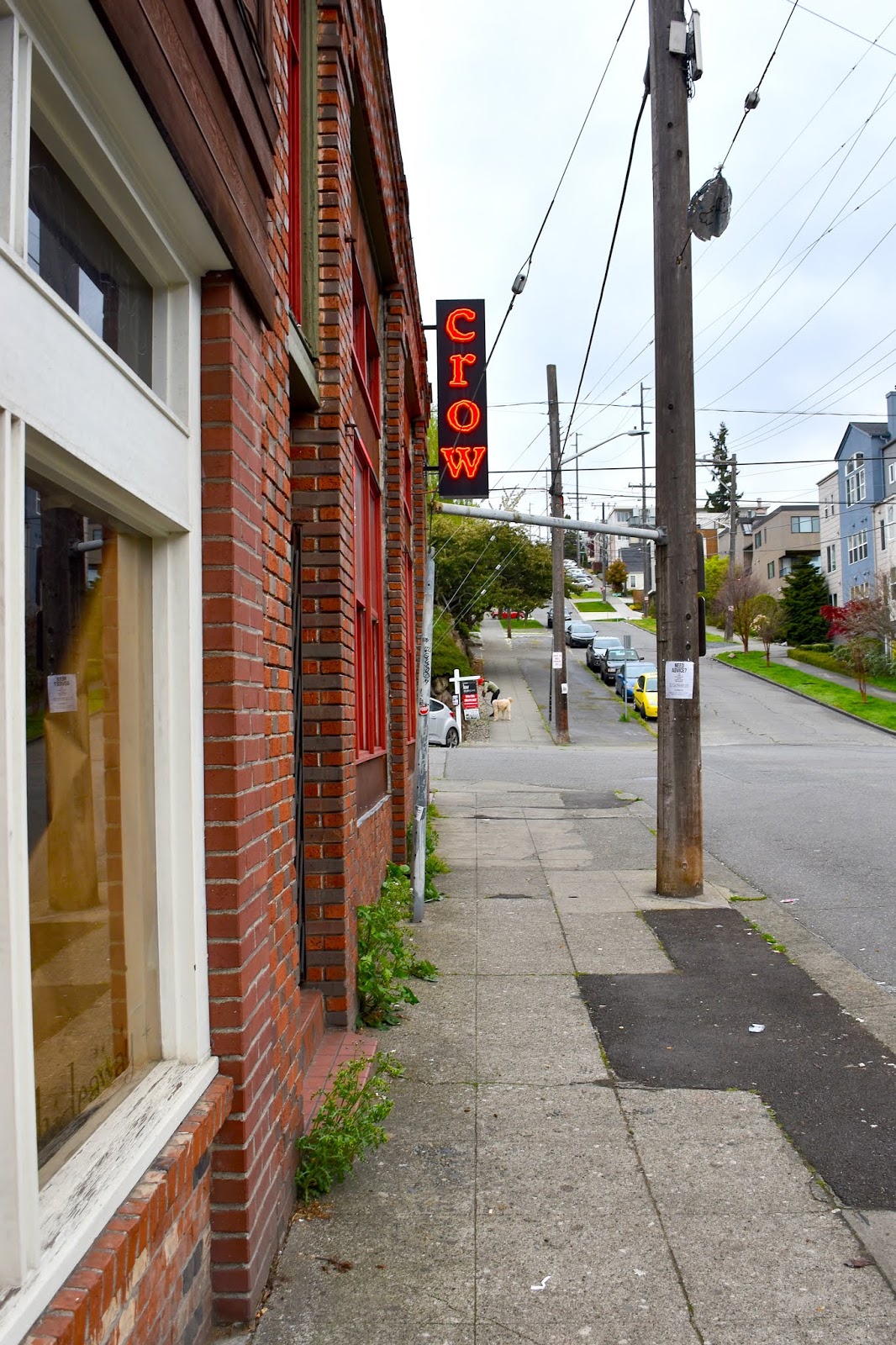
A short hop away I found another cool sign.

Two months after I shot this picture, Crow Restaurant & Bar closed after 15 years in business. I saw a crow around the corner while on my walk. There are those who believe crows portend bad events or an unlucky future. Just sayin'....

I suspect the house in the photo below may not be there any more.

The house in this photo, however, is a wonderful little oasis. Notice the black flamingos.

The photo below is boring, I know. But hang on just a second.

The Queen Anne Retirement Community is, I hope, a luxurious place with amazing amenities as it advertises. But my interest in this community is spelled out on the bottom of the sign: "Site of the Seattle Public Schools administrative center 1949-2002, and the Mercer Grammar School 1890-1940, on part of the Thomas Mercer donation land claim of 1852."

In 1852, Thomas Mercer traveled from Princeton, Illinois, to Seattle seeking a new life. Near the end of his six-month journey, his wife died, leaving Mercer's four daughters without a mother. Mercer opened a dairy and a delivery business and served as a probate judge. He died in 1898.

The final picture I took during that first morning's walk was of a very cool mural on the front of a restaurant.

This is Bahn Thai Restaurant, which gets great reviews on Yelp.

The rest of the photos I took on an evening stroll with my wife, while the kids trashed the hotel room.

"Alcoholics serving alcoholics since 1929," is emblazoned proudly across the splash page of the web site for the Mecca Cafe. That's a damn long time! Since my visit in April, the bar has changed hands in a somewhat controversial deal. I won't get into the details, but I'll post the linked headline to a story in The Stranger: "Mecca Cafe Owner Explains Why She Sold Historic Diner to Alleged Rapist David Meinert." Read it for yourself if you care to.

Just up the street from the Mecca is this fantastic-looking movie theater. Run by the Seattle International Film Festival, SIFF Cinema Uptown was born in 1926 as the single-screen Uptown Theatre. The cinema "received an Art Moderne style facelift in the 1940’s, including its present marquee," per Cinema Treasures. "In 1984, two additional screens were added in adjacent properties, each seating about 170. The original 500-seat auditorium remained intact. The building next door, that was previously a restaurant was torn down (keeping the original façade) with the building of Seattle’s first stadium seating auditoriums. The Uptown Cinemas screens first-run features, leaning towards art films."

I took this picture of The Kenneth Apartments for a good friend by that name. This lovely building was erected in 1925 and renovated in 1991. There are 24 studio and one-bedroom units.

This installment, and the series, ends with something completely different: two small vans, the likes of which I've never seen.

This is a Honda; I believe it's the Acty, a model that this owner needed to import from Japan. The SODO-MOTO stickers on the rear and side windows are for a dealership in the city's SoDo (South of the Dome) that imports and sells practical and collectible vehicles from the Land of the Rising Sun.

This is a Mitsubishi Delica, a van in production since 1968 but only available on limited import basis in the U.S.

For more backside cars, see: October 2, 2011, "Parking Lot Limbo," about an unregistered Cadillac that, eight years after I posted about it, still hasn't moved; and April 2, 2010, "Time Capsule Car," about a decomposing vehicle in the woods of Torrington, CT.

Here are the four previous installments in this series:

Part IV: Pioneer Square

Part III: Underground Tour

Part II: Discovery Park

Part I: Pike Place Market

Saturday, September 28, 2019

Waving Goodbye, With Jazz Hands

From Dave Brigham:

I only went to Ryles Jazz Club once, because jazz isn't really my thing. But I liked the fact that the joint, located in Inman Square in Cambridge, Mass., was there. I suppose it's attitudes like mine that, in part, resulted in the venerable nightclub and restaurant closing its doors in the summer of 2018.

Opened in 1977 by Jack Reilly, who had run the rock club Jacks in Harvard Square, Ryles hosted jazz legends such as Pat Metheny, as well as students from Boston's Berklee College of Music and everyone in between. In 1994, Reilly sold the club to the Mitchell family that has owned and operated the S&S Deli across the street for 100 years. I enjoyed many a meal at the S&S back in the '90s. I saw former Secretary of Labor Robert Reich there once. Exciting, eh?

The Mitchell family decided to close the club after nearly a quarter century of ownership in order to focus on the S&S, according to this Eater Boston article. "The Ryles building was put up for sale with a deed restriction 'that prohibits the new owner from opening a restaurant, bar, gourmet food store or music venue,'" per the Eater article. The Mitchell family may sell the Ryles name, so it's conceivable that another club using that moniker could open one day.

Reilly died three years ago at age 98.

So what's become of the building since I took these pictures a while back?

The property, which was built in 1862, is undergoing renovations to add eight residential units within two new floors above the commercial space, per this Bldup web page.

Keep your eyes peeled for a more comprehensive post about this area of Cambridge, known as Inman Square, in the near future.

Wednesday, September 25, 2019

Seattle, Part IV: Pioneer Square

From Dave "Proto Grunge Rocker" Brigham:

This is the fourth post in a five-part series about Seattle, a beautiful and fun city I visited with my wife and kids back in April. This series is by no means meant to be an exhaustive survey of the Emerald City. It just features a lot of the stuff I saw while annoying my family by taking so many pictures. For links to the three previous installments, see the bottom of this post.

I saw this ghost sign on a building abutting the parking garage where I put our rental car, and I knew our tour of Pioneer Square was going to be a good one. I had only a rough idea what to expect in the square, which dates to 1852 and calls itself "Seattle’s original neighborhood." There are some Native Americans who might disagree on that title. We went to the square for Bill Speidel's Underground Tour, which was cool, but we had time to kick around the historic district, so we did and boy am I glad.

The Bank of California sign above was a gigantic advertisement for the Seattle outpost of the financial institution that was the first commercial bank in the Western United States. In 1996, the Bank of California merged with Union Bank; in 2008 it became a wholly owned subsidiary of Mitsubishi UFJ Financial Group, per Wikipedia.

Alright, I'm gonna run through the Square more or less in the order my family and I did it before we went underground. You might want to go to the bathroom before starting on this journey; it's gonna be a long one.

This stunner is known as the Good Arts Building. Situated on the corner of First Avenue and Cherry Street, this place was completed in 1890 and was known as the Scheuerman Block, per the building's web site. "It has been the home to department stores, a two-story diner ('Good Eats,' from which our name derives), a cigar store, a jazz club, a boxing gym, brothels, speakeasies, and the original office of Washington Mutual Savings Bank," per the web site. "In the nineteen-seventies the basement housed the first gay and lesbian community center in Seattle, followed by the Skid Road Theatre....In 2015, Good Arts LLC purchased the building with the mission of preserving its artistic heritage and affordability to creative enterprises."

This totem pole is so cool, and the kind of thing I just don't ever get to photograph around New England. In addition to being a stunning work of art, the Tlingit Indian Totem Pole has an interesting back story. "The Totem Pole first appeared in 1899, after members of the Chamber of Commerce, vacationing in Alaska, stole it from Tlingit Indians," per the PioneerSquare.org web site.

Wow, I wasn't expecting that bit of racist history. How the hell did they travel with that thing? Boat? Train?

What happened next, oh great and wonderful Internet?

"The men gave the object to the city as a gift, but the tribe justly sued for its return and $20,000 in damages. The courts found the men guilty of theft, but fined them only $500 and allowed the city to retain ownership. In 1938, the pieces that remained after vandals set the Totem Pole on fire were sent back to Alaska, where Tlingit craftsmen graciously carved a reproduction."

Why am I not surprised that the Native Americans were bigger men than the idiots from Seattle's Chamber of Commerce?

(Detail of the totem pole.)

Steps away from the totem pole is a statue of Chief Seattle.

A Native American, Seattle (or Sealth) was born in 1786 and died in 1866. "While known as 'Chief Seattle, there were in fact no hereditary chiefs among the Puget Sound tribes," according to this biography. "From time to time leaders arose who distinguished themselves by their actions or particular skills, and were respected and followed." Seattle, per the biography, wanted the natives and the white settlers to live in peace and harmony. As such, he worked with David Maynard, who is considered one of the founders of what became Seattle, to realize that goal. Obviously, some Native Americans at the time rejected this accommodation; others went along. Chief Seattle's legacy is therefore a bit complicated.

"Though many people see this cooperation as a lesser of two evils, some individuals have a different opinion," per this post on Indians.org. "Some have criticized Chief Seattle claiming he was cowardly and it cost the tribe their land and their way of life. However, the other Native Americans who chose to fight for their lands eventually lost."

A few more steps away from Chief Seattle's statue and the totem pole is the Iron Pergola, which sounds like a heavy metal band or a medieval torture device but it's actually neither.

Erected in 1909 as a stop for the Yesler and James Street Cable Car Company, the fancy shelter was "the most lavish of its kind west of the Mississippi with ornamental iron columns, wrought iron ornamentation and a large underground restroom," per the PioneerSquare.org web site. It was restored in 1972 and today serves as a place for tourists to hang out, and for homeless people to gather, as you can in the above photo.

The Lippy Building went up in 1902, built for T.S. Lippy, who made a fortune in the Klondike gold rush. I'm guessing the mosaic entryway below had been touched up more than once in the ensuing 117 years.

Too bad this building wasn't named for Zippy the Pinhead's square brother, Lippy.

The State Hotel doesn't exist anymore at this spot along 1st Avenue South, but somebody was smart enough to save and restore this fantastic neon sign. Not sure the history of the hotel.

You may be starting to understand just how excited I was for Pioneer Square, what with the beautifully restored old buildings, the funky statues, the neon signs and the ghost signs. Well, when I saw the building below, I about crapped my pants.

I've shot ghost signs all around Greater Boston (and will even be featured in an upcoming Boston Globe article about these advertising relics), but I've never seen anything as amazing as the Buttnick Building. I thought I was looking at a movie set. I'd never seen ghost signs that were so easy to read, and that featured multiple commercial products: Buttnick Manufacturing, Driftwood Sportswear and Paul Bunyon (not sure why the spelling is different than the lumberjack of folklore) Outerwear. The building dates to 1908 for the Brunswick Balke Collendar Company, which made billiard equipment.

By this point in our walk, I was lagging well behind my wife and kids. Often I wasn't even on the same side of the street as them as they wandered along, chatting, looking at their phones, whatever. But there was no way I was going to miss the opportunity to snap photos of as many of these fabulous places as I could.

The J&M Cafe & Cardroom dates to 1889 as a hotel, and as a bar to 1892, when it served the men of the Gold Rush. The ceiling is tin and the bar-back is made of Austrian mahogany, per the web site.

Walking through Pioneer Square, I felt like I was on a movie set. No more so than when I saw the Bread of Life Mission building.

Founded in 1939, the mission has been in this building since 1942. The charity offers "a bed, food clothing, and a safe environment for those who are in need. Bread of Life reaches beyond the physical needs by offering an opportunity to make a life-changing decision to accept Jesus Christ. Bread of Life is interdenominational and is supported entirely by individuals, churches, businesses, and foundations that believe in giving hope to Seattle’s homeless."

Built as a hotel in 1890, the building was once home to a brothel; the name "Matilda Winehill" just under the cross at the top of building refers to a former madam or prostitute, according to the mission's web site.

Built as a warehouse between 1903 and 1905, the Schwabacher Hardware Building is now home to, among other businesses, Flora and Henri, which offers bespoke products for children, women and home, per its web site.

The red brick building was once home to the Seattle Quilt Manufacturing Company, which was founded in 1915. The company was bought and sold a few times over the decades, and I believe its brands are now dead.

The Washington Shoe Building was built 1892 as the Washington Iron Works Building. It was remodeled, with the addition of two floors, in 1912. I'm not sure if the ghost sign across the top reads "DAGG DURNEDEN" OR "DAGO DURNEDEN." I've seen both interpretations online. Whatever it was called, the company manufactured "green hood shirts," which I assume are the same as hooded sweatshirts.

When I saw this, I assumed this was where our underground tour would begin or end, but I was wrong. I'm sure this stairway leads to something cool.

This is the former Occidental Park station for the George Benson Waterfront Streetcar Line. To answer your questions: no, not that George Benson; the line operated from 1982 to 2005 using vintage streetcars.

Located in Occidental Square, this sculpture depicts Tsonqua, a mythical giant from Northwest Indian lore. Created by Duane Pasco, the statue was displayed at the Kiana Lodge restaurant until 1985, per this Waymarking web page. In 1985 restaurant owner Richard White donated the totem to the City of Seattle. Pasco refinished the totems and they were placed in Occidental Square in 1987.

Located on the back of the previously mentioned Buttnick Manufacturing Building is this ghost sign for local favorite Rainier Beer.

A city has really made it when it has not one, but two (and possibly more) Schwabacher buildings. This one dates to 1884 and is just down the street from the previously mentioned one.

Upon its opening in 1914, Smith Tower featured 540 offices, six retail stores, two telegraph offices, and a public telephone station in the building, in addition to a thirty-fifth-floor observatory, per the building's web site. Today, Smith Tower is home to the famous observatory, thirty-fifth-floor bar, Legends of Smith Tower exhibits, ground-floor retail store, special events space, and office leasing.

Merchants Cafe calls itself Seattle's oldest bar. Established in 1890, the saloon also for a time featured a brothel upstairs for the local loggers and Gold Rush maniacs heading to and from Alaska.

With Merchants Cafe, we completed our circle and were back in front of the Pioneer Building, where we would shortly do our underground tour. While we waited, I noticed this amazing building, which served as a nice backdrop for an oversize chess set.

Now home to Magic Mouse Toys, this stunner of a building rose in 1891 as the Mutual Life Building.

The amazing Barney McCoy sign I saw as we left the underground tour stopped me in my tracks.

Located in the former Elgin Hotel/Traveler's Hotel building (circa 1913), McCoy's was a pre-Prohibition bar, according to this account I found online. The bar offered lunch, cigars and Olympia beer "in cartons."

Continuing our way toward the waterfront, I spied this cool pair of neon signs.

The Pioneer Square Hotel (a Best Western facility) dates to 1914; it was formerly the Hotel Yesler. I'm not sure if the signs are vintage.

Last, but not least, is this impressive old heap.

At its construction in 1893, this power plant was owned by the Seattle Steam Heat & Power Company. "The company was granted a franchise to lay pipes under city streets to provide steam and hot water for various uses," per this web site. Since 2014 the facility has been owned by Enwave Seattle, which uses renewable biomass as its primary fuel, per the company's web site.

OK, so that's (most of) Pioneer Square. Make sure to come back for the fifth and final installment of this Seattle series, which will cover the Lower Queen Anne neighborhood where my family and I stayed during our visit.

Here are links to the previous three installments:

Part III: Underground Tour

Part II: Discovery Park

Part I: Pike Place Market

New Balance Draws a Red Line with Diner

From Dave Brigham: I can't be expected to know everything about the backside of America, nor of Massachusetts or even of Boston. But I...