Saturday, July 5, 2025

The Shire of Worcester, Part the Sixth

From Dave Brigham:

Benvenuti all'ultimo post su Worcester!

For this latest installment of my ongoing series about Woostah, Mass., I trekked through the eastside, the heart of the city's Italian-American community. I wasn't aware of that designation when I set out along Shrewsbury Street, but I figured it out quickly enough.

Located on Muskeego Street, just southeast of Shrewsbury St., near several industrial properties and large empty lots, the Biscee Club was founded as a mutual benefit society for the Italian-American population, as far as I can tell from the limited information I found online. Evidently it's no longer an active social club.

Around the corner on Shrewsbury Street is Franchi Brothers Auto Body, which has been in business since 1936.

I dig the signage, which looks like it's well taken care of.

I continued west along Shrewsbury Street, stopping at the entrance to Cristoforo Colombo Park. Of course, Cristoforo Colmbo is the Italian spelling of Christopher Columbus. Stone griffins flank each side of the main entrance to the park.

They're quite impressive. MACRIS says the artist was Charles McCann and that the sculptures date to 1874.

So, let's learn a bit about this neighborhood.

"New York has Little Italy. Boston has the North End. Worcester has Shrewsbury Street," states this September 2015 article at Pulse magazine's web site. "Shrewsbury Street became the home of Italian immigrants in the late 19th century and early 20th century," the article continues. "Today, roughly 13 percent of all residents in and around Shrewsbury Street are of Italian descent. The Italians brought their culture and love of food to Worcester and opened the fresh food markets that would eventually evolve into the swath of restaurants locals know and love."

While there are plenty of Italian sites along Shrewsbury Street, other Mediterranean countries are also represented.

Meze Estiatorio is a restaurant owned by "first generation Worcester natives serving what we know so well; authentic, unadulterated Greek food," per its web site. The mural may have been done by someone from Artifakt Studios, a collective that completed a painting inside the eatery.

I featured Artifakt in a previous Worcester post (see February 10, 2024, "The Shire of Worcester, Part the Third"). Also check out the other four installments that preceded this one: Part V, Part IV, Part II and Part I.

In the main entryway to 156 Shrewsbury Street, currently occupied by Root & Press, a cafe and bookstore outfit, I spied another hint of the neighborhood's past.

This space has been occupied by restaurants for many years. I suppose deMarco could have been an eatery or perhaps a market a long time ago.

A few doors down, on the north side, heading west, is the Parkway Diner.

I like the Red Sox font but I'm not crazy about the look of this place. Serving breakfast, lunch and drinks from the bar, the Parkway has been expanded a few times, I believe, since opening in the 1930s as a traditional Worcester Lunch Car Company diner. There is a more traditional-looking diner across Shrewsbury Street that I will discuss below.

At the major intersection of Shrewsbury and East Central streets stands Pampas Brazilian Steakhouse, which is located in the former D'Errico's Market building. I'm unsure whether D'Errico's runs its butcher shop, which opened in 1947, from another location.

On the side of 102-116 Shrewsbury Street -- aka the Zamarro Block -- I found an old sign that had me scouring the Internet, breaking out my magnifying glass and fine-tuning my photo-editing software.

The building, which was built in 1911, was "[i]mportant in the life of Worcester's Italian community throughout the first half of the 20th century," according to MACRIS. Constructed by Carmine Zamarro, who owned a bank on Shrewsbury St., this block housed businesses such as an Italian-language newspaper, several Italian doctors, a dry goods store, bakeries, a shoe shop, a restaurant and many more, MACRIS continues.

I tried my best to decipher the ghost sign but had no luck.

Near the western end of Shrewsbury Street, across from the railyards serving Union Station, is a fantastic old building, the likes of which I haven't seen in such great condition.

Currently home to Wormtown Brewery and Volturno Pizza, the former Worcester Buick Co. showroom looks amazing from the outside. I'm guessing the interior is no less fantastic.

Opened in 1922 from a design by architect Arthur Hunnewell Bowditch, whose notable projects include Boston's Paramount Theatre and Myles Standish Hall (now a Boston University dorm), the building served as a Buick and GMC dealership until 1961.

"The Worcester Buick building is Worcester's only unaltered example of the 'grand' automobile showroom," according to MACRIS. "The slightly earlier F. S. Howard Showroom (1918) on Main Street is little altered but not as elaborate or imposing as this. The 'grand' M. E. Tuller Showroom (1928-1929) on Park Avenue has been altered. Because of its excellent state of preservation and because its relative opulence recalls an era when the automobile was still a luxury, this building is important in the history of the automobile in Worcester."

I've mentioned Bowditch in posts about Boston's Downtown Crossing area (see April 12, 2020, "Crossing Through More of Boston's Downtown"), the Newton Corner neighborhood (see December 31, 2021, "I Seek Newton, Part XI: Newton Corner (Section 3)") and Brookline (see March 13, 2014, "What's in a Named Building? (Part 2)").

I have written about old car dealerships before. In the summer of 2018, Google Maps led me to an old Saab business once run by author Kurt Vonnegut (see October 24, 2018, "A Literary Icon, a Naval Celebrity & a Stern Warning About Micturation"). Earlier this year I mentioned a place that's currently home to a market in Everett, Mass., that was originally a Chevrolet dealership, followed up by a BMW showroom (see May 3, 2025, "Kicking Around Downtown Everett"). In 2024, I included a former Willy's dealership in my write-up about Somerville's Davis Square (see November 2, 2024, "It's Hip to Be Davis Square").

Next door to the old Buick dealership is another well-preserved old building.

I haven't found any background on this place. It is currently home to Carbonneau Bridal and Formalwear, as well as Keller Williams Realty.

At this point, I doubled back, heading east on Shrewsbury Street. At the intersection with East Worcester Street, I was impressed by a restaurant's large sign.

Via Italian Table says on its web site that it has been "acclaimed Worcester’s best Italian restaurant and most romantic restaurant in recent media polls." Along with other businesses, the eatery is located in a former Worcester public schools maintenance facility (!).

Built in 1905, the building is the gateway to a few other municipal buildngs I made photos of.

The Worcester Public Works building on East Worcester Street dates to 1920. It is located on the property of the former Pine Meadow Burial Ground, according to MACRIS.

Next door is the headquarters of the Worcester Sewer Department.

Built in 1932, the sewer department building, according to MACRIS, replaced a wood-frame structure belonging to Darling Brothers, which I'm assuming was a construction company.

Back out on Shrewsbury Street, I knew in advance that I needed to check out a few places, starting with Wonder Bar Pizza.

Opened in 1922, Wonder Bar was closed at some point in the last decade, I believe. But new owners brought it back to life. My photo doesn't do the sign justice. It is truly wunderbar!!

Continuing northeast, I arrived at the spot that was my inspiration for checking out this neighborhood: the Boulevard Diner.

Now THAT's a diner, right?!

Built by the Worcester Lunch Car Company some time between 1934 and 1936, the Boulevard is in the popular barrel-roof style that diner guru Richard Gutman has called "the VW Beetle of diners," according to MACRIS. "Additional distinguishing features seen here are the Art Deco neon roof cresting with illuminated central clock and the striped metal facade awning," MACRIS continues. "Both were probably added in the 1940's or 1950's. A brick structure was added at the rear sometime before 1957."

Claims have been made, but not substantiated, MACRIS adds, that the Boulevard is the oldest continuously operated diner in the United States.

Across Plum Street from the diner, I spied a nice old bank entryway.

Now occupied by an Italian restaurant named Piccolo's, 157 Shrewsbury Street dates to around 1890 and was originally home to a grocery store and apartments. MACRIS picks up the story: "About 1917 the store became the real estate office of Laraia and Ermilio. The principals in this firm were Gennaro Laraia and Pompeo Ermilio. Laraia, among the city's earliest Italian settlers, had come to Worcester from Italy in 1878. Ermilio was born in Anzi (Potenza), Italy. In 1900, he came to the United States, settling first in Philadelphia and coming to Worcester about 1915. Laraia, who had begun his real estate business about 1912, took Ermilio as his partner about 1917 when his daughter, Catherine, and Ermilio were married....About 1924, or perhaps earlier, the business was expanded to include banking services for the Italian community in the surrounding neighborhood."

So cool that the entryway has been preserved.

Across Shrewsbury Street, next to the Greek restaurant mentioned above, is the East Side Improvement Club.

I haven't found anything about this club online, as is often the case with these neighborhood joints. I'm guessing it was founded a long time ago to help out new immigrants from Italy.

Back on the south side of Shrewsbury Street, across from the entrance to the previously mentioned park, I spied a date of 1925 and a difficult to read name at #179.

Occupied by Invidium Salon / Hair by Eva, this place was originally occupied by Reliable Auto Radiator, per MACRIS. "By 1930 the Arthur S. Manzi Motor Co. was in business. By 1934 the building housed and (sic) auto repair business, trucking Co. (sic) and Arthur S. Manzi Funeral Home Inc. The Funeral Home eventually took over the entire building."

I was impressed by the entrance to 225 Shrewsbury Street, home to Mexicali Cantina Grill.

My photo doesn't give the feel of this place, which is a large rectangular building with fancy flourishes at the roofline, looking like it dates to the 1920 or 1930. I suspected it was once an auto dealership, and I was right.

Lawless Cadillac-Pontiac was located here from at least 1961 to 1979, from what I've found online. I'm not sure if the place was built as a dealership.

OK, I'm wrapping up this installment in my ongoing Worcester series with an underwhelming building, using the theory of leave the audience wanting more....

I made that photo of #252 because I am a sucker for coin dealers. Unfortunately, Rare Metals, which dealt in jewelry, diamonds, gold, silver and coins, appears to be out of business. Make sure to check for the seventh, eighth and ninth posts about Worcester, covering a biker bar with a Hollywood connection, a factory that makes spacesuits, great ghost signs, murals, a place called Smoke 'n' Munch, a diner-slash-live event venue and much more.

Saturday, June 21, 2025

Tool (Shed) Time

From Dave Brigham:

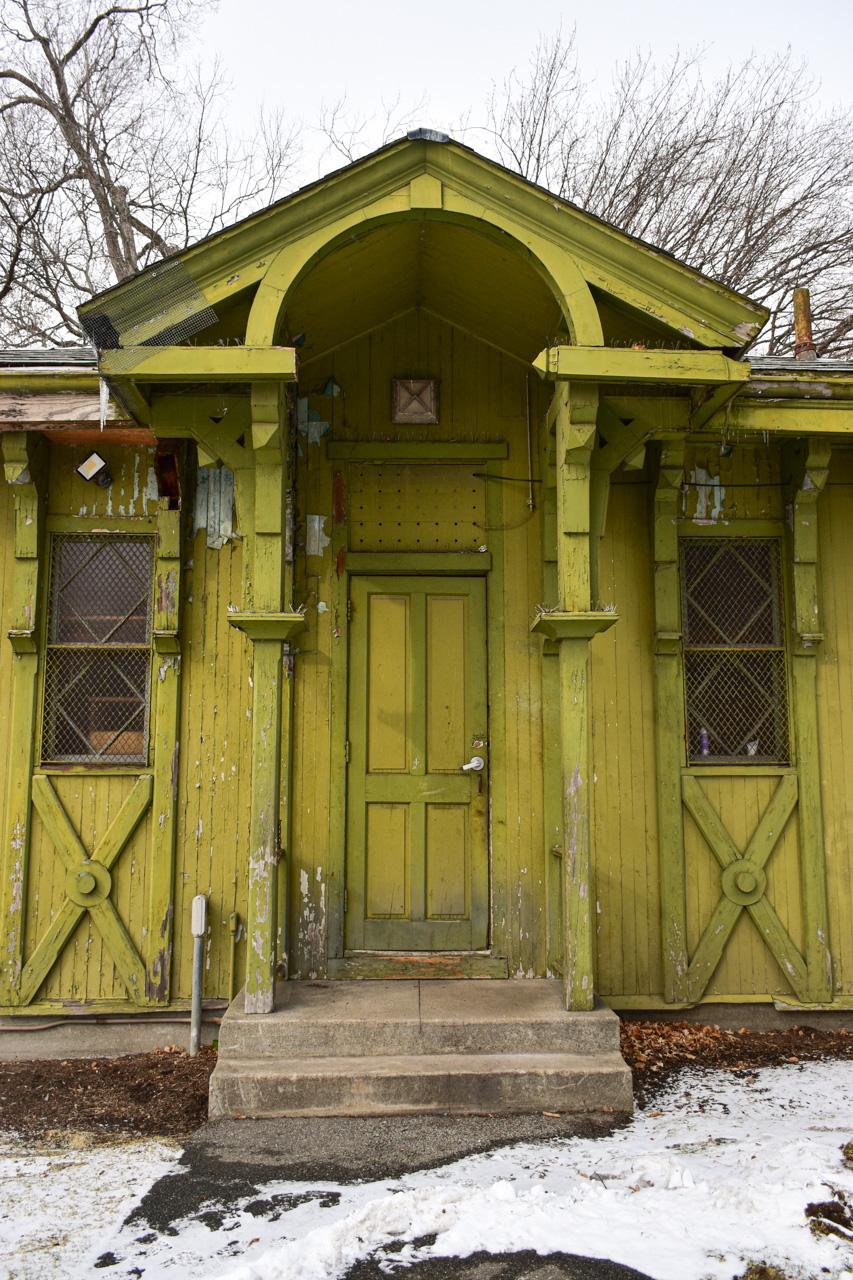
I haven't been to Boston's Public Garden -- the first botanical garden in America -- all that much over the years, but I'd say I'm fairly familiar with this beautiful space. Still, after a recent exploration of some of the city's public alleys (see June 7, 2025, "In Which I Am an Alley Cat"), I strolled through the garden and truly noticed the tool house for the first time.

The tool house was built in 1946, replacing a women’s comfort station that stood there previously, according to this 2023 article in the Boston Sun. Architecturally, the 642-square-foot structure is reminiscent of the Victorian “stick style” bathroom it replaced, according to this 2023 article by the Beacon Hill Times.

Currently, the tool house is used by the Public Garden's facilities staff, as well as by operators of the Swan Boat ride in the adjacent lagoon.

There have been discussions in city government about renovating and expanding the quaint little building.

"Restoration of the tool house will include replacing its worn slate roof in kind and replacing deteriorating wood elements, including windows, wood cladding, and decorative wood trim – all of which are original to the building’s 1946 construction, said Bentson," the Boston Sun reported two years ago.

Architectural firm Utile is working with the Boston Public Facilities Department and the Boston Parks and Recreation Department on the project. "This expansion aims to provide much needed space for equipment storage and operations while carefully adapting to the various constraints of the site, including its adjacency to rare specimen trees," according to Utile's web site, where you can see renderings of the proposed work. "The new structure reinterprets the existing building’s Victorian façade elements in a modern and subdued language, allowing its newly-restored historic neighbor to remain the primary feature."

I'm not sure the status of the project.

Here's your headline explainer:

Yes, that's Pamela Anderson alongside Tim Allen and Richard Karn.

For another post about the Public Garden, and the adjacent Boston Common, see December 14, 2019, "Of Rugged Sports and Moorish Samaritans," about a memorial plaque and a statue.

Saturday, June 7, 2025

In Which I Am an Alley Cat

From Dave Brigham:

Nearly 40 years ago I went on what was essentially the first Backside of American expedition. A senior at New Hampshire's Keene State College, I walked around the downtown one night with two friends, singing, playing music, bantering, emgaging with strangers, checking out the back lots of the town (see October 6, 2019, "Remembering a Foundational Moment").

Since that time, I've had a fascination with the hidden parts of small towns and big cities, the places where the rats and riff-raff go. For quite a few years, I've wanted to explore the public alleys of Boston. Last fall, I did my first proper adventure in the city's Back Bay neighborhood (see February 1, 2025, "Sneakin' Sally Through Boston's Alleys"). Earlier this year, I returned to the Back Bay for another foray.

I started at the eastern end of Public Alley 421, which is off Arlington Street, directly across from the Public Garden. It runs between Marlborough and Beacon streets. As I mentioned in the first alley dispatch, the Back Bay is a fairly posh area. Even the parking spaces are architecturally wonderful.

I crossed Berkeley Street and into Public Alley 420. Where that alley meets Clarendon Street, I was inspired by a steam release.

The exhaust was coming from Hale House, a residential home for senior citizens located in a building named for Edwart Everett Hale, a Boston author, historian and minister. "Hale House was once the home of the historian and writer Henry Adams, grandson of President John Quincy Adams," per the Hale House web site. "In 1896, the Massachusetts Audubon Society was founded by Bostonians Harriet Lawrence Hemenway and her cousin Minna B. Hall, in the parlor of the house."

Continuing along, I was in Public Alley 419 when I spied the rear of 237 Beacon Street. Something about the hand-written house number just looked good to me.

I was also quite taken by the tall, skinny building facing onto Marlborough Street.

In Alley #418, I found a nice little scene asking for neighborly etiquette.

I hear Emily Post was big into the whole No Dumping movement.

I don't traverse back alleys looking for great architecture, although sometimes I do find some. What I tend to look for is little scenes that you wouldn't necessarily expect to find in a neighborhood like the Back Bay.

Obviously there is renovation afoot. But that white "X" on a red background essentially cautions first responders it's not safe to enter. I see that sign all over the place, usually on long-abandoned properties.

Why is there a lawnmower?

In Alley #417, I saw the first of two basketball hoops. This one is pretty sweet.

Great architecture, no. But cool details - yes.

And more etiquette lessons.

OK, great architecture, too.

I love this little building. I believe it was brought into the world in 1919, whereas the main buliding it sits behind rose in 1888. It's a tiny house for the post-World War I generation.

The scene below could be the cover for Urban Slacker Design weekly.

The photo below makes me wonder whether some tenant along this public alley descends the fire escape ladder to illegally dispose of rubbish.

Eventually I crossed Massachusetts Avenue and into Public Alley #908. I'm not sure why the system goes from #414 to #908. I saw another basketball hoop.

And then the back entrance to 531 Beacon Street.

The apartment building features studios, 1- and 2-bedroom units, with rents starting at $2,300 a month.

At this point, the alley makes a sharp curve to the south and toward Marlborough Street. I found the mix of buildings at this point quite pleasant.

I walked east on Marlborough Street for a minute before ducking into Public Alley #905. There, I saw a scene reminiscent of the old-timey days....and of the second photo in this post.

And then an odd little door.

At first I assumed this was another old coal-delivery entry point. But then I realized that this door used to be bigger before it was partially bricked up. I crossed back over Mass. Ave. and into Public Alley #429. I don't remember which alley I was in when I saw the industrial yellow locker featured below. This was the second set of lockers I've seen on my back-alley wanderings.

Whereas the locker was neat and secure, the barrels below look gross and dangerous. Perfect for a back alley!

I continued on through Public Alleys 428-423, enjoying seeing other folks using the alleys, and appreciating the relative peace and quiet. Not much caught my eye until the gorgeous fire escape seen below.

At the entrance to Public Alley #422, I made a photo of the gated entrance to the First Lutheran Church of Boston.

The congregation traces its history to 1839. The building dates to 1959.

My final shot was of a lovely old brick and sandstone home directly across the alley from the church.

Known as the Samuel Hooper House, this Commonwealth Avenue residence rose in 1861, from a design by Arthur Gilman and Gridley J.F. Bryant. "The house itself is one of the most elegant examples of the Second Empire style in Boston, with octagonal bays projecting up into the mansard roof," according to this Society of Architectural Historians write-up.

Gilman "advocated filling in the Back Bay district, urging this plan for years before his views were carried out by the state," according to Wikipedia. "Here Gridley James Fox Bryant was his colleague. Commonwealth Avenue, now one of the finest streets in the world, is due almost entirely to his persistent efforts, along with Frederick Law Olmsted. Gilman designed the H. H. Hunnewell house (1851) in Wellesley (then West Needham) and, with Bryant, the Old City Hall in Boston (1862–65).

That's a wrap on public alleys for now. I will explore more later this year for sure.

Saturday, May 24, 2025

Lower South Roxbury End

From Dave Brigham:

Wouldn't it be funny if neighborhood boundaries, and city and town borders, existed in the three-dimensional world, rather than just on maps and in people's minds? Imagine walking on the Massachusetts Avenue bridge from Boston to Cambridge, across the Charles River, and half-way along you have to duck under a rope or pass through a door or step over a raised line of bricks to gain entry to the People's Republic.

Sometimes I feel this type of marker would be helpful when I'm out exploring. But what, ultimately, does it matter whether I'm making photos in Boston's South End neighborhood, or its Lower Roxbury area? I faced this same issue many years ago when walking along the Somerville/Cambridge line (see March 16, 2019, "Where Am I? Somertown? Charlesville?").

After walking through Boston's Nubian Square (see March 4, 2025, "Nubian Square: New Name, Old Buildings"), I continued north into more of Roxbury and then the South End. After checking out the murals honoring Martin Luther King, Jr., and his wife, Coretta Scott King, featured at the end of the Nubian Square post, I continued past Ramsay Park.

On the side of Pizza Talia, I saw a great mural painted by artist Alex Cook in 2009.

Called "She Sees More Than The World Will Show Her," the mural features a woman standing in a kitchen, staring out a window at a galaxy of stars. Cook has painted hundreds of murals all over the world. I've featured him a few times on the blog: September 21, 2024, "Franklin Park is Ruin-ed" and August 10, 2021, "A Lovely Walk Through Roslindale Village."

A few doors down is the Roxbury Men's Club, which the Internet tells me is permanently closed.

I bet this was a fun place to hang out back in the day.

Next door is the Shawmut Community Church of God.

On the opposite side of Shawmut Avenue, across from the Eritrean Community Center, is a storefront church.

Iglesias de Dios Pentecostal is located in the J.B. Prescod Building. Regular readers of the blog know I have an interest in these types of houses of worship. While I'm not religious, I respect this type of effort to carve out places for congregation.

I continued on for a short time, enjoying the brownstone apartment buildings and street-level activity of the neighborhood. At the corner of Worcester and Washington streets, I spied a classic old sign.

Andy's Cleaners was located in this beautiful brick building for many years. I made a photo of the sign because I'm guessing it won't be around much longer. The cleaning business was located in what's known as the Pope Block, which was "built by James E. Potter in 1884 from designs provided by Frederick A. Pope for George A. Pope," per MACRIS. "A member of the family for whom the Pope's Hill area of Dorchester is named, Boston Directories indicate that Frederick A. Pope was active as an architect from the early 1870s until the mid 1890s....Frederick A. Pope designed numerous residences in the Back Bay, including" many on Newbury Street and Marlborough Street.

I headed southwest along Washington Street, where I was inspired to make a photo of the gorgeous Smith Block.

"The Smith Block is a rare surviving Boston example of a mansard-roofed commercial block," according to MACRIS. "Numerous examples of this building type were destroyed in the Great Boston Fire o 1872...After this fire, the mansard roof was less widely utilized in residential as well as commercial construction. Over time, examples of this building type have disappeared as the result of demolition and neglect. The Smith Block ranks among Washington Street's most architecturally significant properties by virtue of its prominent siting and intact form and elements, if not its original brownstone facing. After many years of precarious existence as a vacant building, the Smith Block [was] adapted for reuse as an antiques cooperative."

Built in 1866 for Stephen Smith, a leading Boston dealer of office furniture, this block "was evidently intended as a satellite store of a business whose main office was located at 51 and 53 Cornhill, Boston," per MACRIS. Today it is occupied by Yunnan Kitchen, as well as several condos.

I knew that Mike's City Diner was in this area, but I wasn't inspired to make a photo.

Not far away stands one of the most photographed buildings in the South End, a former beauty that has sat unloved and neglected for many years.

I refer to this High Victorian slab as Tom Cruise's Place. Located on the corner of Washington Street and Massachusetts Avenue, the former Hotel Alexandra was built in 1875 and for a time several years ago was owned by the Church of Scientology (see April 8, 2018, "Tom Cruise Slept Here...Well, Maybe"). The cult hoped to make this historic property its New England headquarters.

"That project proved expensive, and ultimately the Scientologists put the property back on the market for sale in late 2014," per this Boston Globe article from April 2025. "It spent nearly five years on the market, and at least one sale agreement fell through before [developer Tom] Calus and [business partner Jas] Bhogal spent $11 million to buy the site in 2019."

That Globe article indicates that Calus and Bhogal in April filed a revised redevelopment plan with the city "that calls for restoring the historic Alexandra and building a five-story expansion on the vacant lot next door. The 68-room hotel would include retail or restaurant on the ground floor."

Here's wishing them all the luck in the world.

Next to Tom Cruise's Place, heading southwest on Washington Street, back in the direction of Nubian Square, is the very handsome Chester Block.

Built in 1857, this Italianate building mixes residential and retail uses. Completing a loop, I ended up admiring the gorgeous Church of St. Augustine and St. Martin on Lenox Street, just around the corner from the Shawmut Community Church of God mentioned above.

The combined congregations trace their respective histories to the late 19th century. "What is now the Church of St. Augustine and St. Martin began as two different missions of the Society of St. John the Evangelist," per the church's web site. "St. Martin’s Mission had its beginnings in the home of Sarah Jackson at 17 Westminster Street in the South End in 1899. The congregation soon outgrew Mrs. Jackson’s living room and moved first to a storefront on Camden Street and then to a small chapel on Lenox Street. In the West End, Church of St. Augustine was formally organized. In 1886 a building was purchased on Anderson Street and 1892 a new church was built on Phillips Street."

The web site continues: "In 1908 the Society of St. John the Evangelist purchased the land next to St. Martin’s Chapel on Lenox Street and began construction of the present building. Later that year St. Augustine’s Church in the West End was closed and many of its furnishing were incorporated into the new building. Father Field was the first pastor of the combined community. On St. Martin’s Day, November 11, 1908 the Church of St. Augustine and St. Martin was formally opened with a ten-day preaching mission led by a black priest, The Rev. John A. Williams, Rector of St. Phillips Church in Omaha, Nebraska."

A long fly ball away from the beautiful house of worship with the bright red doors is Jim Rice Field at Ramsay Park. The field was being upgraded back in January when I happened by.

The baseball field is named for Jim Rice, the Hall of Fame left-fielder who played for the Red Sox for 16 seasons in the 1970s and 1980s. The field was named in his honor due to his involvement with Major League Baseball's Reviving Baseball in Inner Cities (RBI) program, per Wikipedia.

Jim Rice Field was the last stop on this journey. But in May 2024 I had done some exploring nearby, with the intention of one day adding more material for a post. So below are several spots I checked out on the adventure.

On Whittier Street, which sits across Tremont Street from the Boston Police headquarters, and which dead-ends at Madison Park High School's football field, sits a relic from times gone by.

The old Health Unit of the George Robert White Fund is likely to be redeveloped before too long, much like its neighbor properties across Whittier Street, which include several new apartment buildings. The GRW Fund was established in 1922 to fund "works of public utility for residents of Boston, to hold and manage the facilities constructed by the Fund and oversee its investments," according to the City of Boston web site. Its namesake was a pharmaceutical executive who lived most of his life in Boston.

White is also the namesake of the stadium in Boston's Franklin Park that has been the subject of quite a bit of controversy as it undergoes a massive redevelopment. I wrote about the stadium in May 2024.

The Health Fund building sits just south of a lot labeled on Google Maps as "Embrace Center Project Site." Embrace Boston is the organization behind the The Embrace, a memorial on Boston Common to Martin Luther King, Jr., and Coretta Scott King. The group plans to develop the project site with a 31,000-square-foot community center offering performance, gallery and work spaces.

Heading east-northeast on Tremont Street, I passed many great old buildings. The one that caught my eye the most was at #1023.

This Classical Revival beauty, which is located in the Lower Roxbury Historic District, dates to 1894, and features decorative friezes and cornices covered with pressed metal, per MACRIS.

At Tremont and Cabot streets is an interesting mix of four buildings cheek by jowl.

Separated from Tremont Street by a small cobblestone parking lot and street, these buildings read this way to me, left to right: either new construction or completely renovated apartment building; a probably late-19th century Mansard building with a barber shop that may or may not be endorsed by Major League Baseball; a 19th-century apartment building that may have been a firehouse at one point, judging by the large opening in the middle of the ground floor; and another great residential structure that may have been the inspiration for the newer building.

Steps away is a legendary joint.

In business since 1935, Slade's Bar & Grill calls itself the "Soul of Boston." Here's the bullet list for this restaurant/nightclub's history:

  • Original owner Renner Slade may have been a bootlegger.
  • Boston Celtics legend Bill Russell once owned this place.
  • Malcolm X was a server.
  • It was listed in "The Negro Motorist Green Book."
  • Famous patrons over the years include Martin Luther King, Jr., Ted Kennedy and Muhammad Ali.

I'd heard of this place, and would have made a photo for sure, even if I wasn't in a musical outfit called the Slade Wiggins Band.

I considered turning around at this point, but I looked up ahead and saw a massive mural that I had to capture.

Located at the corner of Camden and Tremont streets, "Breathe Life" is a fantastic work by Rob “ProBlak” Gibbs, who I also featured in my Nubian Square post. Gibbs grew up in Roxbury and is a co-founder of Artists for Humanity, an arts non-profit that hires and teaches creative skills to youth.

Directly across Tremont Street from "Breathe Life" is, well, perfection.

The Chickering and Sons Piano Factory (aka the Spencer Repeating Rifle Co. building) is a five-story brick behemoth that fills nearly a full city block between Northampton and Camden streets. Built in 1853, this Italianate stunner was a year later called the second-largest building in the country following the U.S. Capitol.

At the time of the factory's opening, the Chickering company was the largest piano manufacturer in the United States, according to Wikipedia. From 1860 to 1868, the Spencer Rifle outfit was also located here, making weaponry for the U.S. Army and sportsmen, Wikipedia indicates.

In 1972, the building was converted to artist studios. Today known as the Piano Craft Guild, the building has been modernized with amenities including an indoor pool and a fitness center. I'm unclear on whether there are still artist spaces here.

I meandered the side streets between Tremont Street and Columbus Avenue for a while. There are loads of great buildings here, but the light was tough. For some reason -- well, I know the reason and I'll explain below -- I made a photo of the Stanhope Garage at 277 Northampton Street.

Built in 1916, according to the Boston assessor's office, it located a two-minute walk from the apartment building where Martin Luther King, Jr. and Coretta Scott King first lived after their 1953 wedding.

So what was the reason I made that photo above?

I was a fan of the TV show "Taxi," which aired for five seasons in the late '70s and early '80s. Whenever I see a garage like the one above, I think of the garage where the show mostly took place, and imagine that Louie DePalma is in there yelling at his drivers.

The last thing I saw on this journey was the most surprising. It required some detective work to figure out just what I was looking at.

This is the rear of 8 Coventry St / 1035-1039 Tremont Street. Using my photo editing software to manipulate the contrast and light, I was able to read the words "THE WORLD'S BREAKFAST" at the top. Doing a quick online search of that phrase, I discovered that the American Cereal Company used that slogan beginning in 1902 for its Quaker Oats cereal. Once I learned that, I looked at the image again and was able to make out the outline of the Quaker Oats "mascot" underneath.

Pretty cool find, I must say.

New Balance Draws a Red Line with Diner

From Dave Brigham: I can't be expected to know everything about the backside of America, nor of Massachusetts or even of Boston. But I...