From Dave Brigham:
My parents moved from Weatogue, Connecticut, where I grew up, to nearby Windsor many years ago. In the 11 years since I've run this blog, I've only posted a few things about Windsor, which was the first English settlement in the Nutmeg State (see February 27, 2020, "Shoot It If You Got It," September 20, 2017, "One-Stop Barnstorming Tour" and April 3, 2014, "Beat Hotel").
Recently, I arrived in town early for a day trip to visit my mom, so I ambled around the downtown. Here's what I found, in the order that I found it. Much of the information contained herein comes from the excellent Tour Windsor web site set up by the Windsor Chamber of Commerce, the Windsor Historical Society and First Town Downtown.

The former freight house built on Mechanic Street by the New Haven, Hartford & Springfield Railroad Company dates to around 1870. "Wide double doors could be slid open to allow carts laden with crates and parcels to be wheeled directly from the trains and into the building where the items were sorted for distribution," per the Tour Windsor web site. By the middle of last century, the building had fallen into disrepair as railroad use waned. In 1988, the Town of Windsor renovated and refurbished the old freight house. In 2007, the Windsor Art Center moved into the building.

Across Mechanic Street is the building, below, which dates to 1930.

There's nothing of particular interest about this place, not on the surface anyway. It may have been related to a nearby apartment complex in a former industrial space. Now, wouldn't it be great if I had pictures of those buildings? Yes, yes it would. But for some reason I didn't shoot First Town Square, which features a building that dates to 1852. Over the decades the factory was home to businesses including Eddy Electic Co., Sequassen Woolen Co., General Electric and cigarette maker P. Lorillard Co. Maybe I'll shoot First Town Square some other time.
Anyway, moving on....how about a historic train station?!

Completed in 1870, the Windsor Train Station was renovated in the 1980s and looks amazing. It is used by the Windsor Art Center, but also serves as an Amtrak stop on the line between Springfield and New Haven.
Next door to the train station is a building with a cool history, but unfortunately no present.

This is 25 Central Street. That fancy green - portico? - hasn't always been there. Check the Google Maps picture below. I'm not sure what to make of this architectural change.
As you can tell by the ICE CREAM sign painted on the wall, this place used to sell food. It was a bakery called Get Baked. I only went there a few times, but the muffins were great. My sister, who used to work around the corner from this place, raved about it. It closed two years ago.
In the back of the building was Central Street Antiques. I don't know when the business was founded, or when it moved (or went out of business). Not sure if there's anything inside the building; the only indication that the store used to be here is the partial sign on the back of the building.
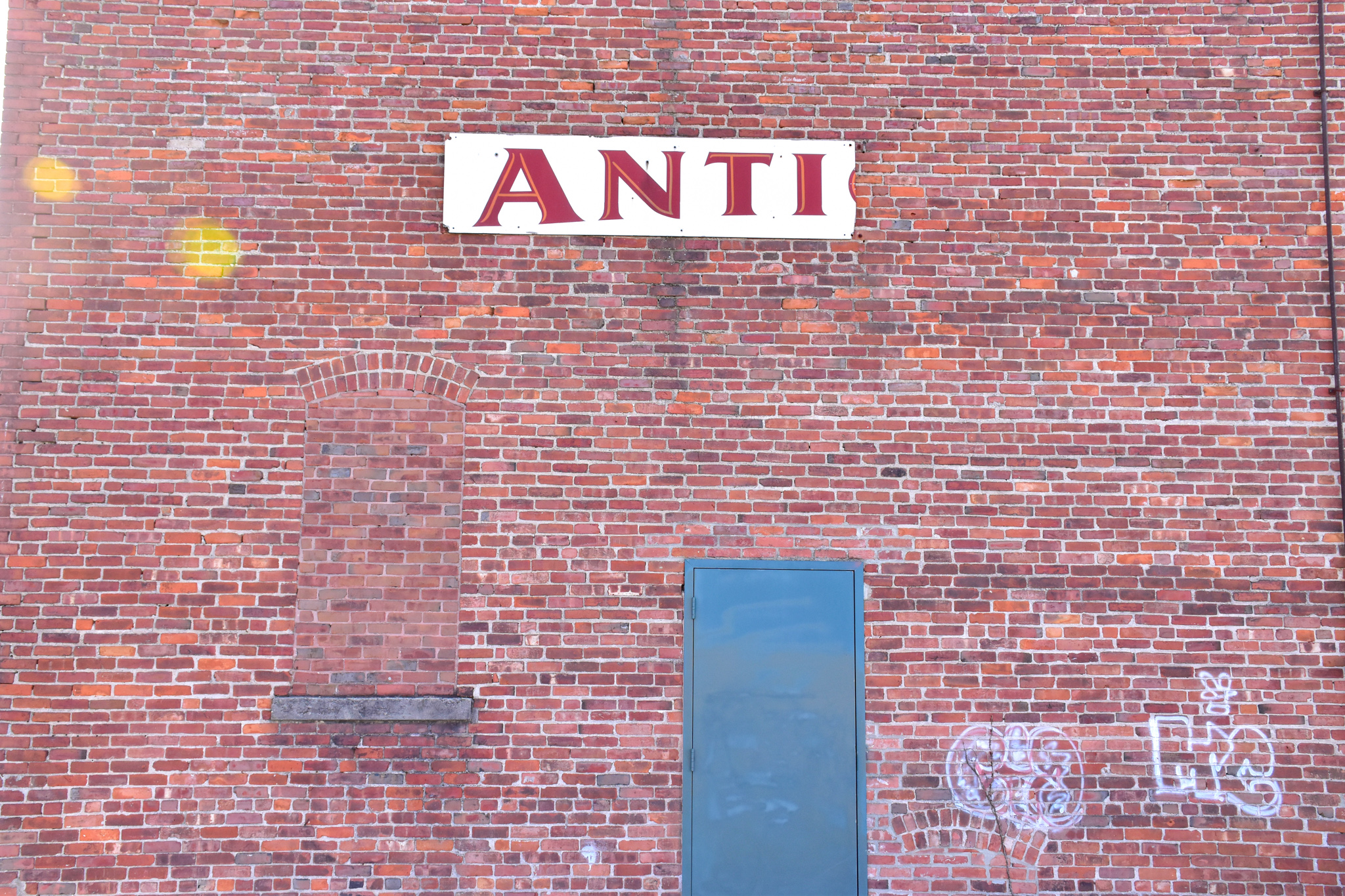
Now for the history, per the Tour Windsor web site. "In 1922, Arthur W. Lovell built the Lovell Building that housed the Tunxis Theater. The structure replaced the Best Manufacturing Company that had operated on the site until a fire in 1919. The theater opened on December 9, 1922 showing 'Smilin" Through' with Norma Talmage and other silent motion pictures. Renovations in the 1930s allowed for patrons to hear 'talkies' with sound throughout. The theater changed hands, management, and names many times. Eventually, Central Street Antiques purchased the property and held auctions in the large space."
I never would have guessed this place started life as a theater.
Looking west from the rear of the old Tunxis Theater building, I spied the backside of 181 Broad Street, below.

I don't have anything to say about the back of this building, but stick around: I took a picture of the front, too!
Over on the corner of Union Street and Palisado Ave. is the former Train Wreck Tap Room.

This place closed some time during the last year, surely a victim of the pandemic shutdown. The building dates to 1945, according to one online source. When my parents first moved to Windsor, a whole bunch of us (my wife and kids, my sister, my parents, my brother and his family) would pile into the restaurant that was there for a while, The Whistle Stop. The food was really good and so was the beer selection.
In more recent years, when we go out to eat we stop into the Union Street Tavern, which is just down the street from the tap room.

This sturdy and handsome brick building was built in 1927. It served as the Windsor Fire Company’s headquarters until 1964. The Union Street Tavern restaurant opened in 2006, and features cool vintage fire and police department photos and memorabilia. With any luck, some time in the near future, my family and I will eat here again.
Across Union Street from the former Whistle Stop is a place with an interesting history.

Built in 1902 as a parish house for the First Church in Windsor, this building featured a kitchen, a reading room, a chapel and several parlors for church gatherings. In 1955, after building a new parish hall, the church sold the place to the Washington Lodge of Masons. In operation since 1825, the lodge continues to meet here.

In the side yard of James Selig Estate Jewelry & Antiques on Broad Street, I spied the pastoral scene below.

Sculpted by Phil Thulen, this is one of many "reclaimed critters" that the antique shop sells. Continuing south along Broad Street, I came to #181, the building with the whitewashed rear end I featured above.

Currently home to Family Pizzeria and Queen Nails, this building dates to 1935 and was the home of Snelgrove Florist for 80 years, according to this article from the Windsor Historical Society (scroll down to read about the florist and see a photo). Look closely and you'll see the ghost of the word "Florist." The photo in the article shows the full sign, as well as a neon FLORIST sign that the Snelgroves acquired at a trade show in Vegas (!).
On the west side of Broad Street is VFW Post 4740/Raymond B. McHugh Post.

Dedicated in 1941 as a post office, this classic brick goverrnment building held that position for 22 years. In 1965, the VFW Post opened, after spending the prior two decades in a local Greek Revival home at the foot of Stony Hill, per the Tour Windsor web site.

(Entrance to the VFW Post.)
Across Elm Street from the VFW hall is the Plaza Building, which dates to 1929.

If you guessed that this place was once a theater, you're right. "Over the years this building has housed numerous commercial ventures including a grocery store, movie theater, and Baskin-Robbins Ice Cream," per the Tour Windsor web site. In 2011, the building was acquired by the Sachdev family, which has been renovating it with plans to revive it as a theater, and to add a restaurant and convert second-floor apartments to office space.


(The rear addition dates to 1935.)
My inside source (my sister) tells me that the owners have hit some snags over the years of working on the Plaza, including the existence of an underground stream (!). There is a pond at Washington Park, a short distance west, that runs close to this building before draining on the east side of Broad Street, near the Loomis Chaffee School.
I'm not sure the status of the renovation, but the pandemic likely didn't help. Here's hoping good things start happening here soon.
Next to the VFW Post is the Windsor Trust Building.

Built in 1929, this bank was constructed from bricks saved from a private home that was razed on the site. It is now home to Windsor Federal Savings
Behind the bank, on Maple Street, is the Windsor Town House, which I featured in a stand-alone post that I linked to above.

I haven't found out anything about this place online. My source tells me this motel is likely home to a transient population. I'm guessing by the architectural style and the sign, that this place dates to the 1950s.

Across Maple Avenue from the Windsor Town House, tucked down a long driveway, is the building below. I think the best word to describe it is adorable.

Built in 1882, this brick Victorian gem was originally a fire station, the first in town, according to this post at an unidentifiable blog. Now home to Gottier Investments, it served as a firehouse until 1939.

(Side view of the Gottier Investments building.)
Across a small parking lot, on Broad Street, is the Mondovi Dental building, which has some great jazz-themed murals on the side.


(Billie Holiday painting.)

(Miles Davis painting.)

(Thelonius Monk painting.)
I don't know who the artist is, but I'm guessing these artworks were commissioned by Steve Lipman, Windsor's "Singing Dentist," who works in the building. Here's an interview and some music samples.
Next door to the dentist office is The Bean @226, a coffee shop located in a circa-1885 former post office.

In addition to the post office, this beautiful building has been home over the years to a drug store and many other businesses.
There are other buildings in the immediate downtown that are listed on Tour Windsor as historic, but I had limited time, and knew I wanted to check out some stuff along nearby Poquonock Avenue/Route 75. First up on that short list was the Windsor Music Centre.

In business since 1960, this place has got a cool vibe, with some neat artwork adorning the exterior.


A friend who grew up in Windsor told me that this place is (or was) run by the family of Al Anderson of NRBQ, a band founded in 1965 in Kentucky whose music spanned rockabilly, pop and jazz. The band's best-known song is probably "Ridin' In My Car."
Another cool one is "RC Cola and a Moon Pie."
As cool as the music shop is, the main event around the bend was quite a thrill to explore.

At first, I thought this complex at the corner of Poquonock Avenue and East Street was just a sort-of old retail building with some apartments or offices up top. And a convenience store with a cool plastic sign.

But once I saw the historic marker, I knew there was much more going on.

There's a sign on this building that says "BUILT 1640," which is, well, a little misleading, as I'll explain. In that year, Rev. John Warham established at this site what may have been the first grist mill in Connecticut, according to this Windsor Historical Society article. A succession of proprietors ran the mill for the next 150 or years. Col. James Loomis -- father of the five siblings who founded the Loomis Chaffee School -- ran the place for quite some time. Upon his death in 1862, Earl Simons bought the property and tore down the old mill, per the historical society article. "[I]t is said that he used some of the timbers to erect the earliest part of the building that currently stands on the site," the article continues. So the building is more than 150 years old, and parts of it are 380 years old. That's pretty cool.


By 1929, Farmers Grain & Supply Co. was in business here. From the 1940s into the '60s, Raymond Robbins operated Robbins Grain & Hardware in this location. After that, the Larsen family took over the business.


The Larsens' store is now closed. I'm not sure how long ago it went out of business, or whether something else will fill this space in the near future.
How about we wrap this up with a close-up of that awesome sign!


