Sunday, May 19, 2019

Marlborough Melange

From Dave Brigham:

I've explored a handful of former mill and factory towns in the eastern half of Massachusetts over the years: Waltham (again, and yet again); Hudson; Clinton; Maynard. Trust me, there will be others. The former shoe factory town of Marlborough, however, is more than just a place to stomp around for me. As I recently wrote about, some of my ancestors are buried in this little city about 30 miles west of Boston (see April 27, 2019, "On the Brigham Trail").

I spent a few hours spread across three visits checking out much of the downtown and other spots around Marlborough. I wish I could say I hit every important site in town, but I didn't. Let's check out what I found.

In the Old Common Cemetery where I found some of my ancestors, I also found this headstone, the likes of which I haven't seen in the countless cemeteries I've trod through over the years.

"FOUR PRAYING INDIANS WHO REST WITHIN THE ANCESTRAL PLANTING FIELD," reads the vertical marker. "FOUR NATIVE AMERICANS," reads the horizontal stone under what appear to be two peace pipes, "DIED 1665 DISTURBED 1951 REBURIED 1992." So-called "praying Indians" were those natives who were converted to Christianity. When the English began moving into what would become Marlborough it was inhabited by "a small defenseless band of natives of about fifty in number," per this history on the city's official web site, which details how the relationship between the colonists and the natives evolved from supposed harmony, through various battles and imprisonments, to death, disease and dispersal for the natives.

By the time of the Revolutionary War, the colonists were more concerned with fighting their British overlords than the scattered natives who were still in New England. None other than Founding Father Numero Uno, George Washington, passed through Marlborough in 1775 on his way to take over the Continental Army, according to local legend (I've written about this event before; see April 20, 2016, "Washington Walked Here," about Waltham). So the Marlborough Historical Society (I believe) erected a plaque along Route 20 in the southwest area of town, near Route 495:

A related event is memorialized in the center of Marlborough, in front of the former high school on Main Street. The plaque in the photo below tells us that Gen. Henry Knox passed this way in the winter of 1775-1776 to deliver to Gen. Washington "the train of artillery from Fort Ticonderoga used to force the British Army to evacuate Boston." I also wrote about this in the above-linked article about Washington's journey.)

OK, let's get busy checking out all sorts of great old buildings, churches, memorials, signs, retired ski slope machinery and much more.

Near the Knox plaque along Main Street stands Marlborough's impressive World War I monument.

(Erected in 1923, the memorial was sculpted by John G. Hardy, per this Waymarking post.)

According to the Waymarking post, the cross the doughboy is carrying is to mark a grave. So -- bad segue warning! -- let's move from crosses to churches.

This is a so-so picture of an incredible building. The First Baptist Church of Marlborough went up in 1887, 19 years after the congregation formed. Located at the intersection of Witherbee, Main and Mechanics streets, the Queen Ann-style church was designed by H.M. Francis, "who also worked on public libraries, commercial buildings and other churches," according to this Community Advocate article. I've never seen a church like this. I find it stunning, and I'd love to get inside. While the current congregation is small, the church rents space out to other worship groups.

Located on the opposite corner of Witherbee and Mechanic streets from the soaring, ornate Baptist church is the much more humble Marlborough Assembly of God, which serves the area's Hispanic community, which is about 13% of the city's population.

(I'm guessing this building, which is now a church, used to be a bank, as I spotted an old-school vault alarm box near the front door.)

I took pictures of a few more churches, but there are plenty of others, from traditional houses of worship to ones housed in former storefronts. Below is Holy Trinity Anglican Church, which for five years has congregated in the former St. Ann's Catholic Church.

According to the linked article above from the Community Advocate, this area of Marlborough, French Hill, "has a long history of ethnic diversity. It was named for the French-speaking Canadians who originally settled there centuries ago, and St. Ann's was established by Italian Catholics in the 1920s. The working-class neighborhood is now represented by a wide variety of cultures, including a large Latino population." The yellow building on the right is the church's community center.

The last church I want to feature is known as the Saints Anargyroi Greek Orthodox Church.

(The church community purchased this property in 1924, and erected this wonderful sanctuary in December 1925.)

As the quote from above indicates, Marlborough has long welcomed immigrants, like every mill and factory town in New England. The city became so well known for its shoe factories that its official seal was decorated with a factory, a shoe box, and a pair of boots when it was incorporated as a city in 1890, according to Wikipedia. According to this 2017 article in the Main Street Journal, Marlborough was once considered the second largest shoe manufacturing town in the world. My ancestor Samuel Brigham is credited by some with founding both the shoe making and tanning industries in Marlborough, around 1700. His operation was on a small scale, so others are given credit for starting shoe making on a larger scale in the 1800's.

At one time there were nearly 20 such factories, including the massive Boyd & Corey Shoe Factory, which, according to the above linked article, once "covered one and a half acres on Main Street, opposite the old fire station, which is the current home of the Vin Bin." Check out this link to see a photo of the Boyd & Corey factory. Further down in this post you will see a photo of that old fire station, but you won't see many of the old factories, which were largely torn down during urban renewal efforts last century. I wondered as I drove and walked through Marlborough just what had happened to these old factories, as I knew that shoes were a vital economic driver here. Now I know. I found one former shoe factory on my visits and former housing for plant workers. I also found a factory for which I haven't been able to pin down a history, but which I assume related to shoes or textiles.

In the photo above we see the former Wood-Willard Building, which dates to the 1890's. It is located next to the terminus of the Assabet River Trail, which stretches through Acton, Hudson, Maynard and Stow. The old factory complex is currently for sale. Below are some detail shots, if you're interested in purchasing this old joint.

Another former shoe shop not too far away from the Wood-Willard Building was converted to condos five years ago.

Below is a somewhat disappointing photo of the Frye Building, which dates to 1892. The sun was tough that afternoon, folks.

This building once housed workers for the Frye boot factory, which no longer stands. The company was founded in 1863 on Elm Street, which isn't far from this building. The Frye building eventually became a YMCA and then the Hotel Preston. It is now home to apartments.

Heading south on Route 85 out of downtown in the waning daylight I came across this building.

Known as the Design Pak Lofts, this apartment complex dates to 1922, according to a realtor promotional video I found online. This building is known historically as the Dennison Manufacturing Co. Paper Box Factory. It was owned by that company until 1969, per Wikipedia. After Dennison left, a subsidiary of Dennison, Design Pak, was based in the building. In 2007, the building was converted into apartments. The building was added to the National Register of Historic Places in 2008.

OK, I wanna get back to the main drag. As I mentioned above, the Boyd & Corey factory once loomed across from the former fire station and police court. Here's that municipal building, on the corner of Main and Bolton streets, now home to a wine and cheese store.

Working my way west on the same side of Main Street, I walked past a parking lot and a newer building before I saw this little beauty.

(Built in 1895, this place has been home to a package store called Pastille Liquors, and a convenience store called Pete's On the Main - which is now closed, I believe - among other businesses. There are apartments above the retail space.)

Continuing on, I came upon another grand building. Gotta love that late 19th century architecture!

(This is the Temple Building, circa 1880. A former hotel on upper floors was converted to apartments. Ronald Brigham, not a direct ancestor of mine but surely somehow related, once ran a bookstore at the right side of the building. He endowed the Brigham Trust, which annually awards funds to benefit the greater Marlborough community. The building has Second Empire styling, with a mansard roof that is punctured at the center of the main facade by a two-bay arched projecting with decorative brickwork. No, I'm not an architecture savant. I stole that from here.)

In one of the building's doorways I saw this small ghost sign.

(I think I can see the word "HOUSE" near the bottom.)

Right next to the Temple Building is the Warren Block, home to Welly's Restaurant, which looks really great.

(Again, I turn to Mapio: this "is a historic commercial block... built in 1891 for Winslow Warren, owner of the local railway express. The building was designed to house office spaces on most of the first and second floors, and facilities of the local YMCA, including a gymnasium and reading room. The building's facade features a distinctive basket-weave style of brickwork.)

On the outer, west-facing wall of Welly's I saw this little ghost sign.

(I think I can make out the words "WILL" and "ESTATE," so perhaps this was a law firm ad. Or it could be "REAL" and "ESTATE" and therefore a realtor ad.)

Across the street from Welly's is city hall.

(Completed in 1906, this beautiful Beaux Arts building replaced the smaller Marlborough Town House, which burned in 1902. According to a Massachusetts Historical Commission report, "a committee under Mayor Frederick Muldoon hired architects Francis R. Allen, Charles Collens, and J. Lawrence Berry...to construct a building worthy of Marlborough's recent status as a city. The film of Allen & Collens, which specialized in churches, is known best for the Gothic style work it produced under various partners from the 1890's through the first third of the twentieth century. Among its other buildings are the Riverside Church in New York City and the 1910 Andover Hall at Harvard.")

A little further down Main Street, back on the other side, is the former Peoples National Bank.

(Currently a Santander branch, the former Peoples National Bank building dates to the 1920s.)

Next door is this solid citizen, which has a familial connection to its neighbor.

(Now home to Amalia's Hair Studio, 187 Main Street dates to 1892, and was the first structure raised for Peoples National Bank.)

Directly across from the two former Peoples National Bank buildings is the Corey Building, as seen in the sun-blasted photo below.

(Built in 1865, the Corey Building appears significantly different than it did when it was erected. Originally there was a hotel up top and retail space below, but a fire damaged much of the building in 1898. It was rebuilt in 1900.)

There are plenty of buildings between the Corey and Peoples buildings and the head of Main Street where the amazing First Baptist Church stands, but I wasn't much interested in them. But when I saw the former Windsor House / Middleton Building / MacDonald Hotel, I was quite happy with this three-fer.

(#1. Great sign for the MacDonald Hotel, which I believe is still open. I assume it's a residential joint.)

(#2. Ghost sign for the former Windsor House, which, prior to the MacDonald, occupied the upper floors of this building from at least 1885 until the early years of the 20th century.)

(#3. Named building - the Middleton building. Dating to 1882 and built by leading shoe manufacturer John O'Connell, this is home to the MacDonald Hotel and former home to the Windsor House. O'Connell named it after the town in Ireland where he was born, according to this Massachusetts Historical Commission document, which is the source for much of my reporting in this post.)

Across Main Street from the Middleton building is this funky little place.

(Built in 1916, 7 Mechanic Street is home to a branch office of Marathon Staffing, a temp agency with office in eight states.)

Just a few blocks up Mechanic Street from this building is Lincoln Street, which is a main thoroughfare in the city's French Hill neighborhood, referenced above. Here are a few shots from that area.

(The Prospector is called "the Cheers of Marlborough" by one regular on TripAdvisor. The bar/restaurant has been open for more than 40 years.)

(I love this window.)

Located at the corner of Lincoln and Pleasant streets, this place has seen better days, but the beauty still shines through.

(People with a better sense of architecture than I have tell me this building appears to be from the 1840's. According to Zillow, there are nine bedrooms and seven bathrooms, which have been split among apartments. I'm guessing this place was built by a shoe manufacturing baron. Lalo's Mexican Restaurant is tacked on to the back of this house.)

For a closer look at the restaurant space, check out this video:

About a block away from this big old house is the Pleasant Street Fire Station, which was erected in 1895 and is quite impressive.

Heading east on Lincoln Street, I stopped in my tracks at this place.

(The former armory is privately owned but considered by many in Marlborough to be too significant historically to be demolished, which is something the owner has discussed with city officials. The property has been on and off the market over the past several years, and things have been tense. I don't know when the armory was built. It looks to be of similar vintage to one in Waltham that I wrote about a few years ago. That one dates to 1907, and has also been vacant for years as neighbors battle the developer that owns it [see October 20, 2015, "An Armory In Need of Some Amore"]).

Check out the robot-voiced realtor video below for more information, and photos of the inside of the armory:

Now for a few random shots taken near downtown, to be followed by two spots on the outskirts of the city.
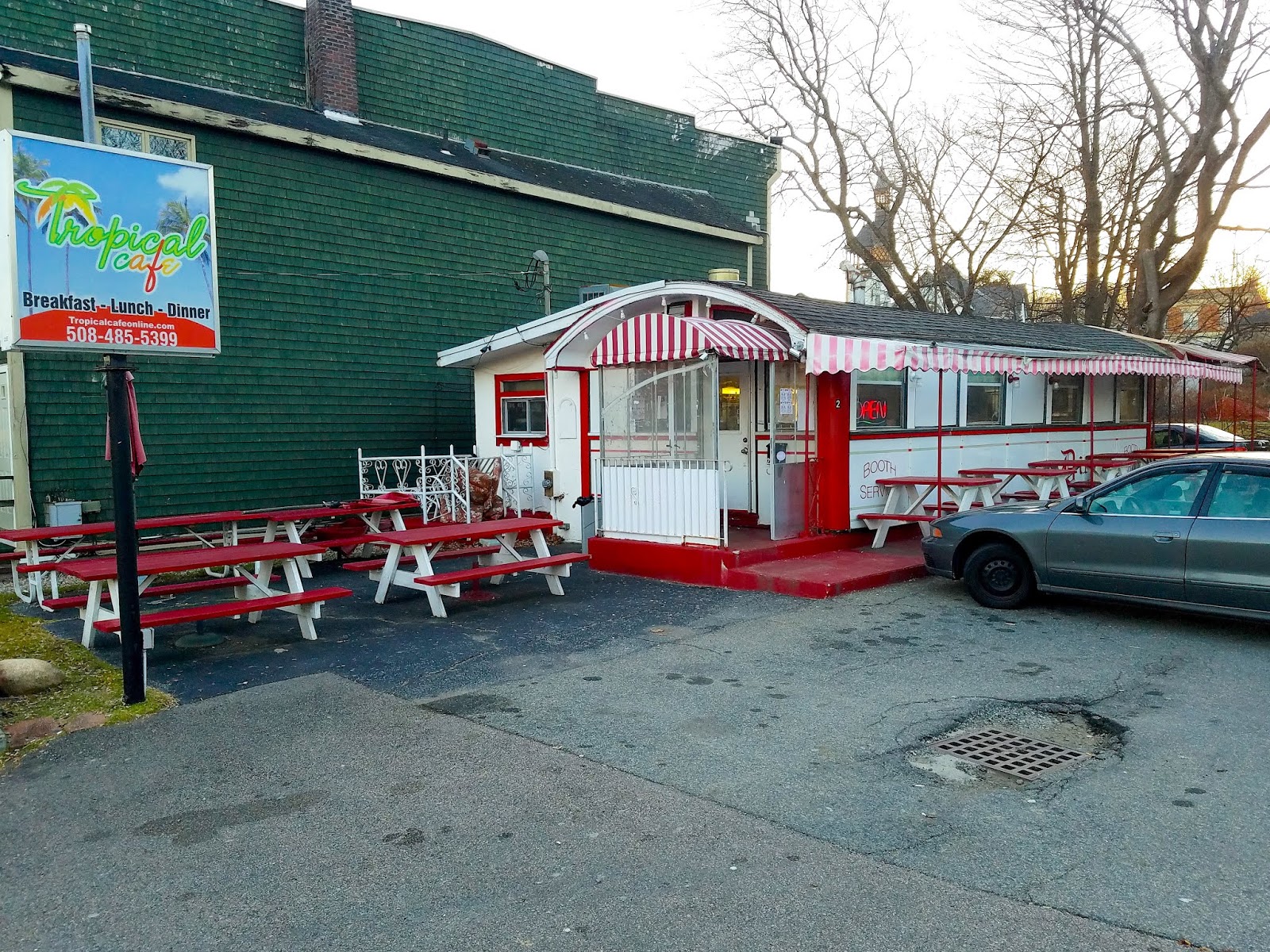
(The Tropical Cafe looks like a fun place. Located across Rawlins Street from the Old Common Cemetery, it features Brazilian food (meat skewers!) and live music. And possibly servers who don't speak English. The restaurant is located in Worcester Lunch Car Company No. 802 [built in 1947]. This place was formerly Nelly's Diner, and possibly other eateries.)

Located on East Main Street, the Route 20 Auto Shop has been closed for a while.

What will get built here? And when?

(I don't fish, but I love this sign, located on a cracked retaining wall next to a residential driveway.)

(Located on a side street a little west of downtown, this barn isn't historic, or probably even that old, but it caught my eye.)

OK, now to the outskirts. Like the other former small centers of industry I've explored in eastern Massachusetts in recent years, Marlborough has its leafy sections and open spaces. Marlboro Airport, opened in 1922 on the field of a dairy farm, recently closed. Up until that point, it was considered the oldest public airport in continuous use in Massachusetts, according to this Boston Globe article, which is accompanied by plenty of great photos, the kinds I would've taken if I didn't want to get busted for trespassing. Here are the two pictures I did snap:
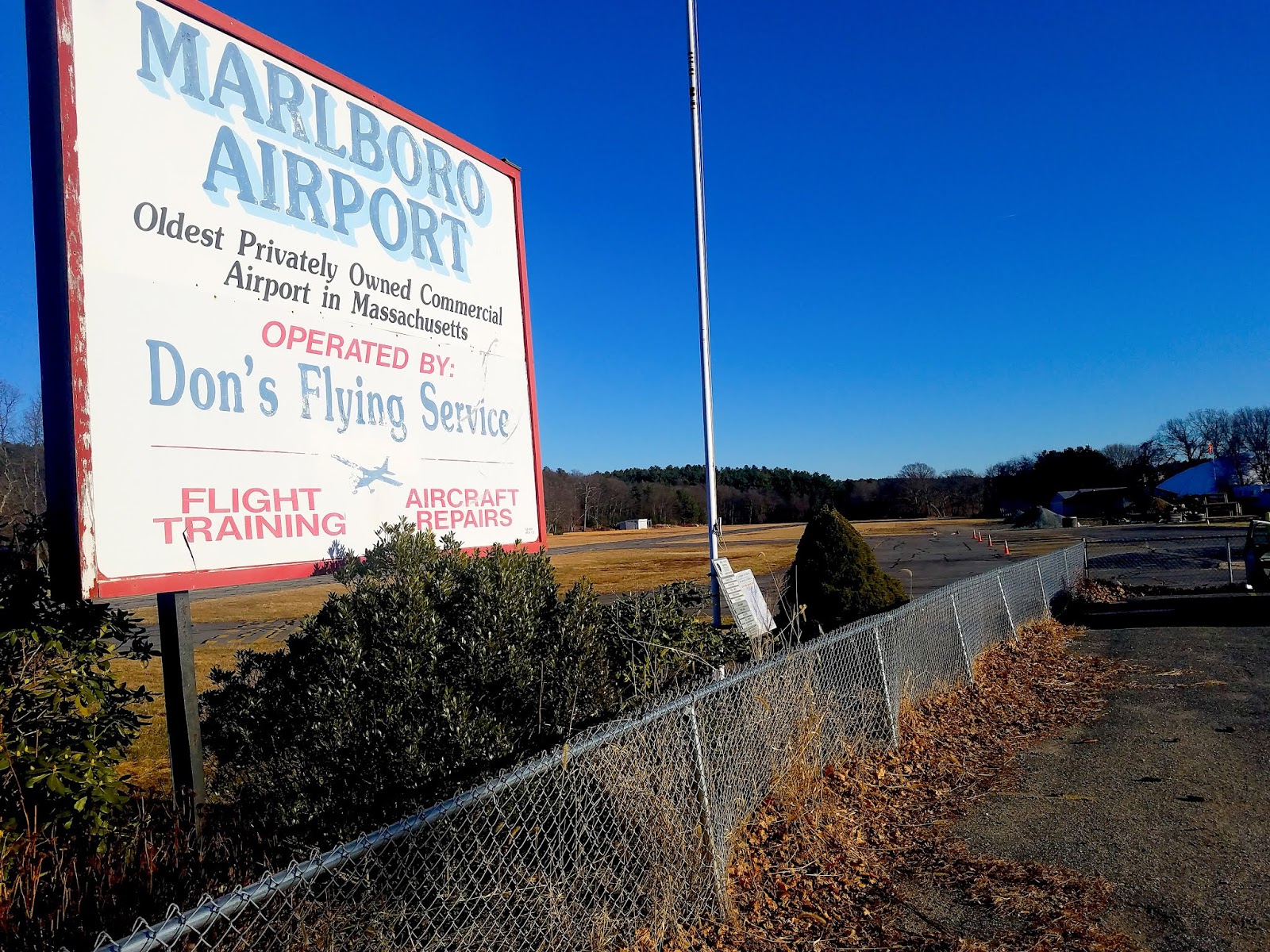
The place has been sold to a developer, who hopes to build residential units on the land. I'm not sure if those will consist of single-family homes, apartments or a mix.

Now on to the last part of my adventure in Marlborough, a place that is sure to NOT get redeveloped.

This is the Jericho Hill Recreation Area on...wait for it...Brigham Street! As you may have guessed, this used to be a ski hill. Opened in 1939, Jericho Hill ran until 1996, and may have been one of the first local ski hills to add snow-making, according to this post on the New England Lost Ski Areas Project web site. The slope featured a T-bar, rope tows, a lodge and a handful of trails serving all levels of skiers.

(Remnant of snow-making equipment, I believe.)

(Remnant of the T-bar system, I believe...I've never skied before.)

(A view down a side trail. There are nice walking paths in the woods both at the top and bottom of Jericho Hill.)

To see what else we've posted about former ski hills, see July 27, 2012, "Cat Rock, Part I," about an old slope in Weston, Mass.; and November 6, 2013, "It's All Downhill," about the former Prospect Hill ski area in Waltham, Mass.

So there you have it, a decent overview of Marlborough, but by no means an exhaustive look. For more information about these sites and many others in the city, check out this Massachusetts Historical Commission form, and this link, which is the full text of "Historical reminiscences of the early times in Marlborough, Massachusetts, and prominent events from 1860 to 1910 : including brief allusions to many individuals, and an account of the celebration of the two hundred and fiftieth anniversary of the incorporation of the town."

Friday, May 17, 2019

Will Old Sign Still Be On New Bridge?

From Dave Brigham:

After 118 years in service to Boston, the North Washington Street Bridge is being replaced. "The bridge has been considered structurally deficient since 2003," according to Wikipedia, "when the center two lanes were permanently closed." Built in 1900, the bridge once carried the Charlestown Elevated Railway, in addition to vehicle traffic.

The Commonwealth of Massachusetts last year began a five-year project to replace the bridge, which obviously will make traffic between Boston's Charlestown and North End neighborhoods potentially nightmarish until completion.

Here's a video showing the current bridge and its future replacement:

I wonder if the new bridge will still feature this sign:

"PATROLMAN CORNELIUS F. REGAN

KILLED IN THE LINE OF DUTY

JANUARY 13, 1898"

Boston has changed so much in recent years, with new buildings rising in just about every neighborhood, and an entirely new neighborhood sprouting in what is now called the Seaport District. Still, the city does a pretty good job of installing plaques marking historic sites, so I'm hopeful the powers-that-be will put this one back in place.

Tuesday, May 14, 2019

Ice Cream Works for Me

From Dave "Ice Cream Is In My Blood" Brigham:

I've ridden by this shop on Beacon Street in Brookline, Mass., many times in recent years, both in my car and on the trolley with my son. Most recently, it was an Emack & Bolio's outlet, selling ice cream, frozen yogurt and other yummy treats. The shop melted down in November 2017 due to increased rent, according to this Patch article. The ice creamery was launched in 1975 not too far away, in Brookline's Coolidge Corner, and still maintains other stores.

The Emack & Bolio's sign was taken down, revealing this old one for Ice Cream Works, a store that I can find little information about on the good ol' Internet. A branch in Newton closed more than a decade ago. I found a reference to the store (not sure if it's the Brookline outlet or another) in a 1991 newspaper article about an ice cream festival in Boston's Allston neighborhood. And a listing in a 1990 Waltham city directory.

The space is being converted to a veterinary office. I hope they serve Hello Kitty Ice Cream Cakes and Frosty Paws for dogs.

Friday, May 10, 2019

Feeling Downs In the Dump

From Dave Brigham:

That sign is enticing, isn't it?

"We're going to the track!"

Makes you feel like you're gonna be where the action is, an exciting place where Lady Luck will smile down on you and you'll pick the right horse and go home with a bulging wallet. Right?

No? Well, maybe 20 years ago you would've felt that way. Jump in the car with your favorite dudes or ladies, or maybe your No. 1 Philly or Favorite Guy, and cruise down to the East Boston/Revere line to throw down your bets, throw back a few drinks and throw up your hands in frustration after you lose that week's paycheck. But after nearly 85 years, Boston's Suffolk Downs race track is finally, really, honestly, going to close this summer. For good.

The track closed in 1990 and 1991, reopened for 12 years, and then closed again in 2014. The following year, however, the nags were up and running again, and the track also offered simulcasting from other tracks around the country. The latest closing, which everybody swears will be the actual final nail in the coffin, is slated for early this summer. HYM Investment Group has acquired the site and plans to redevelop it (see June 30, 2018, "Losing Bet at Suffolk Downs").

Having visited the track area in the post I linked to in the previous paragraph, I wanted to check out the horse barns at the northern end of the racing complex. Slated to be demolished this July, the 30 barns and stables played host to famous horses including Seabiscuit (if not these exact barns in 1936, perhaps their ancestors), Whirlaway and Dancer's Image. The race track also hosted concerts over the years, including the Beatles and Radiohead, who I saw here in 2001. I don't believe rock bands consorted with horses in the barns. But you never know.

I wish I could've hopped this fence and gotten into those poop-stankin' horse barns.

But I wouldn't want to mess with the Board of Stewards.

So long, Suffolk Downs. I eagerly await the next chapter at this site.

Tuesday, May 7, 2019

Is It Safe?

From Dave Brigham:

Such a nice building on a lovely day, no? The bluer-than-blue sky above, and reflected in the windows is just so nice, yes? Still, I am uneasy with the name etched into this building in Boston's Fenway neighborhood: The Forsyth Dental Infirmary for Children. Yes, I know it's just a place where doctors took care of kids' teeth. And I find it admirable that the infirmary was founded in 1914 by rich industrialists to focus on the "oral health needs of Boston’s disadvantaged children." But when I think of dental practices from a hundred years ago, practiced in an imposing facility, I just think of the potential for pain and horror and mishap.

This building is now home to the Barnett Institute for Chemical & Biological Analysis at Northeastern University.

Here's your headline explainer:

Saturday, May 4, 2019

Roll the Dice: Encore!

From Dave Brigham:

The folks at Wynn Resorts, after more than a year delay in their legal game of craps with the Commonwealth of Massachusetts, are gonna get that new pair of shoes after all. The Massachusetts Gaming Commission ruled earlier this week that the Las Vegas-based gambling juggernaut can retain its license to run the Encore Boston Harbor Casino, which has been under construction just over the Boston line in Everett for the last few years.

"The ruling follows a protracted investigation that began after the Wall Street Journal in January 2018 detailed sexual misconduct allegations against Steve Wynn, which he denied, and three days of hearings in early April," according to the Globe article linked above. Wynn Resorts was assessed a $35 million fine for the actions of executives who covered up sexual misconduct allegations against Wynn, who left the helm of the company in light of the controversy.

In 2011, the Massachusetts legislature voted to allow three casinos and a slots parlor to be built in the state. In 2014, voters rejected a casino repeal ballot measure. The slots parlor, Plainridge Park Casino, opened in Plainville in 2015. The MGM Springfield, a full-service casino and entertainment complex, opened last year.

Voters in the hardscrabble city of Everett, just across the Mystic River from Boston's Charlestown neighborhood, in 2013 approved a proposal by Wynn Resorts to build a casino in their midst. The gaming commission awarded the sole Boston-area casino license to Wynn in 2014. The other contenders were located in Milford, Mass., about 35 miles from Boston, and in East Boston/Revere at the now-defunct Suffolk Downs horse track (see June 30, 2018, "Losing Bet at Suffolk Downs").

I visited Everett in 2013 to take pictures of, and get a feel for, the neighborhood near the site of the proposed casino (see June 25 2013, "Roll the Dice"). What I found on that visit was a blue-collar neighborhood with plenty of gas/oil distribution sites, a massive power plant, small industry buildings, state and city government operations (Boston Water & Sewer, Mass. Water Resources Authority, MBTA bus yard), small restaurants and shops, houses and apartment buildings packed cheek-by-jowl, and rundown building and vacant lots.

Formerly a Monsanto Chemical facility, the site where the casino has risen needed a massive cleanup before construction could begin. The resort includes a 27-story hotel with 671 rooms and suites in a bronze glass tower, according to the resort's web site. The project will also include restaurants and lounges, as well as retail, spa and salon options, per the web site. Additionally, there will be a year-round public waterfront park. Encore Boston Harbor is slated to open in June.

Concurrent with building the casino complex, Wynn Resorts began buying up land across Broadway from its site, with an eye toward developing hotels, restaurants, retail sites and office buildings. Other buildings and sites in this area have been sold to other parties. Last fall I returned to the area to see what's changed since my 2013 visit and speculate what's likely to happen in the future.

As with my 2013 trip, I parked near this cool old building with a great ghost sign (which serves as the background photo on this blog):

The former Metropolitan Lithograph Publishing Company building is now home to a Hard Knocks martial arts studio, home and garden company Greene Installation, and other small businesses. It was recently acquired by United Properties, a Malden-based property management and development company. I haven't been able to determine if United Properties has made public its plans for this site.

Here are two other shots of this immediate area.

The top photo shows a warehouse that may or may not still belong to Kontron S & T Group, a German company in the embedded computing technology field. Whatever that means. The second photo shows some of an ExxonMobil oil tank farm, which is embroiled in a lawsuit. The Conservation Law Foundation sued ExxonMobil in 2016, alleging that the company endangers communities along the Mystic River by leaving its tank farm vulnerable to storms and rising seas (in May 2017, Wynn Resorts completed its removal of contaminated soil from its casino site and the abutting Mystic River).

Now let's look at two buildings that, back during my 2013 review, were in rough shape.

The top photo shows a former ExxonMobil office building at 30 Beacham Street. As you can see, it's in the midst of renovation. Developer United Properties last summer announced a plan to maintain some of this building and construct floors of luxury housing on top. To read about that project, check this link and scroll down to the article, "Exxon building buyer to propose luxury apartments on Bow Street." In my post from 2013, this building had several broken windows and a "for lease by owner" sign on it. This building, with its developer's commitment to façadism, will stand as a constant reminder of the odd marriage between a working-class neighborhood and a glitzy, high-stakes casino.

The bottom photo shows the side of one of Tigar Refrigeration's buildings, which dates to 1910, I believe. Situated across a side street from the former ExxonMobil property, Tigar appears to be out of business. This property looked largely the same back in 2013. There are several buildings here, and I'm guessing the cleanup and demolition costs will be considerable. I'm curious to see what happens here in the coming years.

(The back of the Tigar Refrigeration complex.)

Directly across Beacham Street from these two buildings is a parking lot filled with trucks, including these harbingers of summer. How long before this lot gets built up?

To get an idea of what type of changes are coming to this area, check out this apartment complex.

Located on the former site of a Charleston Chew factory, The Batch Yard is a 328-unit luxury apartment development located perhaps a quarter-mile from the casino complex, on the same side of Broadway/Route 99. The factory stood vacant for nearly three decades, according to The Batch Yard's web site, before being torn down in advance of redevelopment. The apartment complex opened in 2014. I imagine rents there will increase soon.

Here's a promotional video for The Batch Yard. Keep your eyes peeled for the massive Charleston Chew sign on the roof deck:

Here's a video by RSG Contracting of the former factory prior to demolition:

Directly across the street from The Batch Yard is the Timeless Ink tattoo parlor.

Located in the former Phyllis' Diner, the ink shop has been around since 2011, as far as I can determine. Will business spike at Timeless Ink with casino business? Or will the site fall victim to redevelopment? That's the question about nearly every property in the area.

Let's continue moving east along Broadway, toward Encore.

This is Perfect Grinding Auto Body. Again, I'm not sure if it's still open. If it is, it may not be for long.

Located two doors down from the auto body shop, Cha Cha Cha Taqueria might be open. Hard to tell with small shops like these with basic web sites and Facebook pages that aren't updated very often. Another eatery, Mike's Roast Beef, has remained open despite all manner of road and sidewalk construction in the area in advance of the casino's opening. I suspect this place will move out before too long.

Ciro's Auto Repair (below), which was located next to Mike's Roast Beef, has closed. In business for 38 years as of shutting this site in 2018, the auto body shop may move to a new location, per its Facebook page. In May 2018, this property and a vacant lot next door were acquired by Wynn Resorts for $4.25 million, per this web site. What will the gaming firm develop here? Retail? Offices? Hotel?

Below is the view from the former Ciro's parking lot, past the Honda dealership on the right, and the Fortune Garden Chinese restaurant on the left. That sleek, copper-colored building roughly in the middle of the picture is the casino. It looms over everything here, because everything here is human-scaled. For now....

Continuing down Broadway toward the casino we come across yet another business that's been uprooted.

After 57 years, Malden Auto Body moved from this location to, well, it makes sense: Malden. I believe the adjacent auto sales business has also closed. I don't know for sure who bought this property, but I'm willing to gamble that it was Wynn Resorts.

Here's a shot taken from Bow Street, behind Malden Auto Body, with the casino just across Broadway in the background.

Finally, I got right across from the Encore.

This is the view from Dexter Street, looking across Broadway at the casino. On the right is the Minichiello Brothers scrap metal company, which, as far as I can tell, is still in business here. I realize that most people who stay at the casino hotel won't take the time to look out their window, but I like the fact that when some of them do, they'll see this place.

Continuing southwest along Route 99, which turns from Broadway into Alford Street as you enter Boston's Charlestown neighborhood, I passed a massive power plant before getting to a bridge over the Mystic River.

The Mystic Generating Station, operated by Exelon Corp., dates to the early 20th century, and burns some petroleum, but mostly natural gas. Again, I get a kick out of this place, with it smoke stacks, industrial behemoth buildings, barb wire fencing and turbines looming over the $2 billion Encore casino. And did I mention the smell of gas and oil that hovers over this area?

In a recent column in the Globe, business writer Jon Chesto speculates that Exelon might sell the site someday, making it a "prime candidate for redevelopment." That's not impossible to imagine, I suppose, considering that a former power plant in South Boson is slated for a massive reworking over the next several years (see January 12, 2019, "Power Move in South Boston").

The Alford Street Bridge has this nice plaque, which informs gamblers and non-gamblers alike that Blessing of the Bay, one of the first ships built in America, launched near here on the Mystic River in 1631.

As I mentioned earlier, there is an ExxonMobil gas tank farm between the Encore and Admirals Hill in Chelsea, which features the Naval Hospital Historic District, and which can most likely be seen from the casino. I wrote about Admirals Hill several years ago (see September 16, 2013, "On the (Chelsea) Waterfront").

Wynn Resorts has been buying up land around the casino, as I said above, with a plan to spend approximately $90 million eventually. Surely hotels, retail shops, restaurants, office and residential buildings will rise in the neighborhood before too long. “As a prudent developer, we have a responsibility to invest in the overall success of our host community and play a meaningful role in what will be built around our $2.4 billion resort,” Robert DeSalvio, president of Wynn Boston Harbor, said in a statement quoted by the Boston Globe. “That means, in the short term, we will proceed with demolition and add landscaping to make the entry to our resort spectacular. In the long term, we will work closely with the city of Everett to bring even more vitality and prosperity” to the area.

The city has helped some residents find new homes, and it seems as if most of the businesses that sold to Wynn have relocated elsewhere in Everett, or in nearby towns.

There will still be pockets of the old Everett here and there, I'm sure. Will James E. Kilduff Corporation, a purveyor of "top quality produce," be able to hang on here?

I don't know exactly what the building in the background is. I believe it's part of the aforementioned power plant.

Now, to those properties Wynn is buying. One is at 51 Mystic Street, just up the road from the Kilduff produce company. According to this Boston Globe article from two years ago, Wynn paid $650,000 in June 2016 for this house, which was next to an auto collision center and across from an industrial building with a parking lot filled with trucks. The house was assessed at $311,000 that year.

Here's what the lot looks like now:

You can see the casino in the background. Wynn also purchased a warehouse on Mystic Street for $300,000, slightly less than twice its assessed value, and an adjacent parking lot and storage building for $5.65 million. The assessed value on that property was $737,200. At least some folks are making money off this casino!

40 Mystic Street was a multi-family house located next to another collision center. It sold for $975,000, more than $600,000 above its assessed value.

In the photo above, the yellow excavator in the background is roughly where 40 Mystic Street was. I shot this from the corner of Robin and Mystic streets, where the aforementioned industrial building with a parking lot filled with trucks once stood. I'm not sure whether Wynn also bought that property.

Wynn also vacuumed up a bunch of properties along Lynde Street and Bow Street. If I'd known about the Globe's article on Wynn's purchases, I would've taken pictures of each of them. As it turns out, though, I got a picture of a property along Lynde that abuts the casino operator's new properties.

Beautiful, isn't it? Who knows, maybe Wynn has purchased this lot by now. Yes, that's the Encore looming in the background.

Right across the street from this property is Logan Grate, which makes steel rolling doors, fire escapes, railings, fences and more.

Will this company still be here in a year?

While several houses in this area have been torn down, and others may yet be, I found one that I believe has been totally overhauled since my initial visit in 2013.

Above is a house I saw back then. I know the house was along a north-south road, and I'm fairly sure it was on Robin Street, which separates this neighborhood from a Sprague Energy fuel tank complex. On my return trip, I didn't see a house that looked like this. But I did see a rehabbed or newly built house on the corner of Lynde and Robin streets. Here's a Google image:

Realtor.com says this house was built in 2013. So somebody made the right choice to put this place up just in time to take advantage of increasing rents.

Another place that I shot back in 2013 was the G & T Lounge.

Located along Bow Street just a stone's throw from the casino, G & T was one of several properties along this street that Wynn acquired in September 2015 for just under $3 million. This dive bar was torn down and the site now awaits its fate as a lady-in-waiting for the Encore.

Another shop along Bow Street, Angelo's Barber Shop, was open when I visited last fall, but according to Yelp it has closed.

This spot is just one block off Broadway. My speculation? This place will be torn down or rehabbed in a major way, as will many locations like it in the neighborhood. Another such location on Bow Street is at No. 88.

Known as Bow Street Market, Los Compadres Market and Sanchez's Market at various times, this place also appeared to be closed when I visited. It's located next to a shuttered auto body shop, which means that, you guessed it, there will be bulldozers here soon.

With so many places already knocked down, on the wrecking-ball roster or with such fates hanging over their heads, what sort of places might survive and thrive in the new regime brought into the neighborhood by those fancy pants from Vegas?

Maybe a craft hard cider maker catering to hipsters? Well, that would be a good answer, except Artifact Cider Project moved out of this space a stone's throw from the aforementioned Tigar Refrigeration right around the time that I shot that lovely photo, unbeknownst to me. There is, however, a a brewery and tap room, Down the Road Beer, located in the same complex. Located a short distance from the former ExxonMobil office that's being redeveloped, and about a 10-minute walk from the casino, this place seems ideally suited to grow its business in the near future.

I don't know whether I'll ever visit the casino, but I will certainly visit this area again in the coming months to see how things are changing yet again. And to sample some beers.

To learn more than you could ever possibly need to know about this area -- known as the Lower Broadway District -- check out this urban renewal plan from four years ago.

Well, there you have it. Thanks for taking a gamble and reading this entire post!

Thursday, May 2, 2019

"Weird Steel Pasties"

From Dave "Three Percent Nordic" Brigham:

"Cold up there in that little skirt," one friend commented when I posted the photo below on Facebook a few months ago. "Brrr."

So who is this lady memorialized in Boston's Back Bay neighborhood, along the Commonwealth Mall?

Wait, is that a Viking ship at the front of the monument? That's no lady...that's Leif Erikson!

"With that mini skirt, chainmail, and Wagner brassiere, more like Leif Eriksdottir!" commented another friend on Facebook, using the feminine form of Iceland surnames. "Leif Erikson was a Viking," said a third. "Why is he wearing a dress and those weird steel pasties?"

Good question. Check this short blog post to see how another sculptor imagined Leif looked (he was born in 980 A.D. so there are no photos to work from....).

This statue seems out of place not only aesthetically but geographically. Born in Iceland, Erikson (also spelled Eriksson or Ericson) is credited by some as being the first European to reach the New World, nearly 500 years before Christopher Columbus. The crux of Leif Erikson’s fame is "the European discovery of the lands the Norse called VĂ­nland (‘Wine Land’), on the eastern shores of North America - a landmass which was of course already inhabited," according to this Ancient History Encyclopedia article. But Erikson and his crew didn't sail into Boston Harbor; they landed in modern-day Canada.

So why was a statue -- one that makes the bold Viking man look like a bold Viking lady, perhaps -- placed in one of Boston's toniest neighborhoods more than 130 years ago?

The extremely talented artist, Anne Whitney, dedicated this monument in 1887. Born in Watertown, Mass., in 1821, she was quite progressive for her time. "She made works that explored her liberal views regarding abolition, women's rights, and other socials issues," per Wikipedia. "Many prominent and historical men and women are depicted in her sculptures, like Harriet Beecher Stowe. She portrayed women who lived ground-breaking lives as suffragists, professional artists, and non-traditional positions for women at the time."

Whitney had what was called a "Boston marriage," a term "for a long-term relationship between upper-class, educated women, which was generally accepted within the community," says Wikipedia. Perhaps this is why she sculpted Erikson with feminine qualities? Not likely. Her works include plenty of other male figures, who look like men (check her Wikipedia profile, and scroll down to "Monuments"). Her Erikson sculpture was commissioned by Eben Horsford, a professor and scientist known for reformulating baking powder. He is also known, most important to our interests, as a leading proponent of Viking exploration of North America, including the Greater Boston area.

I took photos and wrote about the Norumbega Tower he had built in the late 19th century in Weston, Mass. (see January 5, 2012, "Norumbega Point," from back in the early days of the blog when I sucked at writing headlines). It is at this spot, according to Horsford, where was located Norumbega, a Viking fort and city. As Wikipedia says, Horsford's "work received little support from mainstream historians and archeologists at the time, and even less today."

Maybe Ms. Whitney was making a statement with a feminine-looking statue of such a renowned macho man? I don't know.

For more supposed Viking-related history in New England, check out this 2013 Boston Globe article, which expands on Horsford's beliefs and inspirations for his theories, and discusses a tower in Newport, Rhode Island.

New Balance Draws a Red Line with Diner

From Dave Brigham: I can't be expected to know everything about the backside of America, nor of Massachusetts or even of Boston. But I...