Showing posts with label paper mill. Show all posts

Wednesday, May 17, 2017

Anniversary Post #6: My Favorites from 2015

From Dave Brigham:

Welcome to the sixth installment in a series celebrating the 7th anniversary of the blog (for links to the prior five installments, see the bottom of this post). This post covers 2015.

I need to mention that Joe Viger has contributed some amazing photos and fantastic write-ups over the years, but I'll be linking to very few of them in this series. Why? Because Joe -- an amazing photographer who has served as a mentor of sorts to me in that regard, and a great friend I've known for nearly 30 years -- has changed the security settings on his Flickr account so that many of his photos that have run on this blog show up as broken links now. I will instead direct you to his wonderful online portfolio.

I take pride in this blog, as I'm sure you can imagine. I love exploring, taking photos, doing research and writing posts, as well as editing the work of others. One of the trickier elements of running this blog is writing headlines. I first learned this art during college, when I worked as news editor for my school paper. A good headline should be clear and concise and give the reader a general idea of the story. I follow those rules most of the time, but I also lean on my love of music and a good joke whenever possible.

Such was the case from the first highlighted story of 2015. "Maryland Mansion", from January 19, 2015, is the one and only story submitted by my brother, Steve Brigham. I hope I don't need to tell you the music joke that I made with that headline. Anyway, the post features some cool photos of a long-abandoned home near where my brother lives in the Old Line State.

(The pool of the abandoned Maryland mansion. Photo by Steve Brigham.)

"The Price of Gas" from February 7, 2015, is on this list for three reasons: it represents the first (and so far, only) use of a Google Maps capture on the blog; through online research I learned about the history of the Waltham Gas Light Company in this area; and my speculation in the post that improvements in the surrounding area seemed to be evidence that the lot in question would soon be developed has turned out to be true.

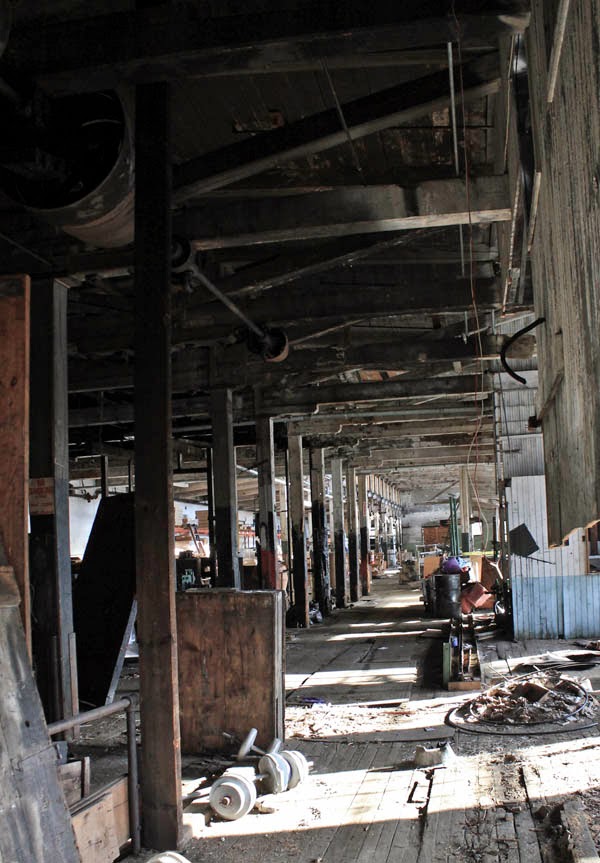
Just one week later, on February 14, 2015, in "Crumpled Paper Company," Heidi Waugaman-Page shared some amazing photos she took inside an old paper mill in Bellows Falls, Vermont.

(On the inside, looking out of the Robertson Paper Company. Photo by Heidi Waugaman-Page.)

Any time we can showcase states outside of the Northeast, I'm happy. So on March 9, 2015, when Kristen Smith shared some shots of Idaho and Wyoming in "Chewed Up, Spit Out," I was ecstatic. The backdrops for these photos are simply stunning.

The next post in March also took readers out of the Northeast. On March 17, 2015, in "Take Me Down to Panama City," I wrote about and shared photos from my family vacation in Panama City, Florida. I got up early a few mornings and cruised around taking photos of abandoned bars, motels and amusement parks. It was a lot of fun.

(Shuttered motel in Panama City Beach, Florida.)

On June 30, 2015, Mick Melvin posted about the former headquarters of the Colt firearms company in Hartford, Connecticut, in "Hartford Arming for New National Park."

(Former Colt armory headquarters. Photo by Mick Melvin.)

"Cavalier Attitude About Motels" from July 26, 2015, represents my favorite kind of post: the successful "find" after an aimless and frustrating drive.

The Internet is this blog's best friend. It's a rare case when I can't find at least a little bit of information about a small conservation area, long-abandoned building or repurposed mill complex. In "Bigelow's Little Office," from September 5, 2015, I was able to distinguish between two small former law offices in Weston, Massachusetts.

(The former Alpheus Bigelow, Jr., House, Weston, Mass.)

I love Mick Melvin's "Is That Paul Bunyan?" from October 16, 2015, because he found a true roadside American icon: the muffler man.

November 30, 2015's, "Walking Dead Tracks" reminds me of my childhood, when I spent countless hours meandering along the rarely used railbed in my hometown.

I encourage contributors to the blog to interpret "the backside" any way they wish, and to simply send me photos if they don't want to write any words. For the most part I like to conduct research and write a story to go with my pictures. Sometimes, however, I just let the photos do the talking. Such was the case with my December 9, 2015, post, "Scenes From An Old Shoe Town," about Hudson, Mass.

The final post of the year, from December 29, 2015, was the result of my slamming on the brakes and doubling back. "Gravity Can Lift You Up" features a cool old building with an interesting story.

Here are the links to the previous five installments of this series:

"Anniversary Post #5: My Favorites from 2014"

"Anniversary Post #4: My Favorites from 2013"

"Anniversary Post #3: My Favorites from 2012"

"Anniversary Post #2: My Favorites from 2011"

"Anniversary Post #1: My Favorites from 2010"

Stay tuned for my favorites from 2016, including a look at Clinton, Mass.; a fascinating journey through a former military training annex in the suburbs west of Boston; a skateboard park in Hartford, CT; the long-abandoned Medfield State Hospital; a Shaker cemetery; a junkyard in Somerville, Mass.; and a beautiful church in the woods of Maine.

Saturday, February 14, 2015

Crumpled Paper Company

From Heidi Waugaman-Page:

While on furlough in the summer of 2012 I landed a freelance design job for a small newspaper in Chester, Vermont. Every day I would drive by many factories, train stations and other buildings being consumed by nature and vandals in the run-down city of Bellows Falls. The town had obviously been a hub at one time with beautiful, large Victorians peeking through the trees. Today Bellow Falls has a drug and crime problem, so I didn't feel as brave as usual exploring by myself. So one weekend my husband and I took a drive up to start hitting some of the areas I had driven by while road exploring.

The Robertson Paper Company was my first stop. I explored around the building and took some outside shots before moving onto other buildings in the town. It looked pretty dangerous so I didn't attempt to go inside. There was a part of the building that looked like maybe homeless people were squatting in because there were some patio chairs out on part of the roof. So we decided to leave after that.

This part of the story ends here.

Bring it forward to fall 2014. My artist/photographer friend, Rick, and I had been talking about going on an adventure. I had been talking about getting back to Bellows Falls so he could check out all the great rust and decay of this worn-out city. We headed out on the coldest day and thought we would have enough time to hit many of the sites. Little did we know that we would spend the whole day just at the Robertson Paper Company Mill.

We arrived, parked and started exploring. Rick suggested that we get inside if possible. Then he noticed a woman looking out a window. We both figured it was homeless people in there. Then the door opened and a woman asked us not to park in front of the loading dock, due to deliveries. Rick and I looked at each other in disbelief that anyone would be delivering anything to an abandoned mill. I apologized and said we loved their building.

Her company was Robertson Printing Co. They had slowly lost more and more printing jobs overseas. They were only printing tissue paper for specific brands through the holidays. The town bought their property and because it was too expensive to move their equipment, so they were walking away.

I have learned to take chances, so I asked if there would be any way that we could come in to take pictures. The woman welcomed us to come in and explore but first gave us a stern WARNING: "Be careful, because the place is collapsing, and if you get hurt, you broke in and we don't know you." We were so thankful and giddy with excitement. She asked us to just check back in before we left so that they had a body count as to who was in the building and who left.

This is just a small taste of all the great finds we discovered. Enjoy.

Friday, February 22, 2013

Smokestack Lightnin': UPDATE

We recently received some new information about the old Curtis Paper Mill smokestack in Newark, Delaware, that Mick Melvin posted about in the fall of 2010 (see September 12, 2010, "Smokestack Lightnin'").

Backside fan David Huntley tells us that the stack, which since 2007 has been the sole remnant of the factory that stood there since the Industrial Revolution, is slated for demolition.

"There is a pre-demolition meeting scheduled in a couple of weeks to discuss HAZMAT removal and disposal," David said in an email. "I expect demolition to occur within the month if there are no weather or other impediments."

David was kind enough to send us a few close-up shots, in which you can see the stack's comprised condition.

Curtis Paper Mill Stack #1

(Curtis Paper Mill smokestack, Newark, Delaware)

Curtis Paper Mill Stack #2

(Curtis Paper Mill smokestack, Newark, Delaware)

Sunday, September 12, 2010

Smokestack Lightnin'

From Mick Melvin:

On a trip to Pennsylvania to visit my family, I took a side trip to Delaware to visit my best friend. As I drove on Route 72, I noticed a lone smokestack in a vacant lot in Newark. It got me thinking of its origins. On my way back to PA, I took some shots of the structure and noticed the name Curtis embedded on the smokestack. When I returned home, I went to the Internet to investigate and was quite surprised to find plenty of info on this site.

059

The smokestack is the only structure left from The Curtis Paper Mill. The complex was purchased by the Curtis brothers in 1848, although a mill had existed on the site since the late eighteenth century. The mill was also known as the Nonantum Mill, which refers to the Indian name for an area in Newton, Mass., where the Curtis brothers grew up (an area known colloquially as The Lake, and which is about a five-minute walk from my house -- ed.).

The James River Corp. later purchased the plant, but the mill closed in 1997. The plant was eventually demolished in December 2007, leaving the smokestack as the lone reminder of years past. An effort is under way to save the stack from demolition.

Sunday, June 20, 2010

The Truth Behind Beautiful Ruins

BMRY 1

From Joe Viger:

My father, Richard Viger, worked for the BMRY for over 40 years. The Berlin Mills Railway was the connection between Berlin, NH's pulp and paper mills and outside carriers like the Boston & Maine, Grand Trunk or Canadian National. Raw materials in and finished product out.

My dad wasn't an engineer as most folks assume when I mention he worked on the railroad. Rather he was a member of the train crew. Brakeman or conductor, sometimes yard master. He retired from the railroad as superintendent.

I remember being a kid when these new box cars became part of the railway. They were bright neon green with a big white logo and I would see them all the time when my dad would treat me to a quick ride on the train or take me to the railroad carshop to change the oil in our family's Buick. Today this boxcar sits on an unused track behind the old mill research building near the Northern Forest Heritage Park in Berlin, NH.

BMRY 2

When I was born, I was given a family name and joined the ranks of "Joe's" that included my uncle and my paternal and maternal grandfathers. My dad's father also worked for the BMRY. In the image below, my grandfather, Joe Viger, is on the right. Ernie Gagnon is on the left. Ernie was one of my dad's best friends and never walked into our house without a MARS bar for me.


These images are from a great website called Beyond Brown Paper. It features vintage photos of life surrounding the Berlin, NH, paper mills. As it turns out, you can find photos of both of my grandfathers on Beyond Brown Paper. Joseph Ruel, my mother's father, was a millwright at the Brown Company Paper Mill for many years. If you aren't familiar with the term millright, think MacGyver. Millwrights are more than mechanics or carpenters. They are craftsman who keep mills running by leveraging the skills of multiple trades to shape wood, steel and whatever else is needed to keep machines running.


Like most New England paper mills, the Berlin mills are mostly gone now. The Cascade mill is still standing and last I heard was running small batches of paper with imported pulp. Much of the Burgess Mill has been removed and included the demolition of the mill's smokestacks in the fall of 2007.

The town has paid a high price for the downfall of New England paper production. Berlin quickly became a favored location for prison development and there are both state and federal prison on the outskirts of town now. There is work being done to possibly redevelop the Burgess mill site as a BioMass Energy project. That is, burning wood to make electricity. This creates hope because when the mill closed it wasn't just the millworkers who took a hit. Folks felt it up and down the food chain of the paper industry: loggers, truck drivers, mechanics, oil and gas companies, chainsaw salespeople, safety equipment manufacturers, insurance folks... well, you get the picture. I remember reading that the economic impact even reached to Southern New England when the mill finally closed because of the nature of the industrial products supply chain.

While those of us who contribute to the Backside of America work hard to capture visual beauty in the decay and ruin of old factories, buildings and things, let's make sure we have good thoughts for towns like Berlin. They are full of hard-working folks living good lives. They aren't just working grunts, but often highly skilled and specialized craftsmen. Their work is more than a job and, in many cases, a legacy that is generations old.

Way Down Yonder in Pawtucket, Part I

From Dave Brigham: I apologize in advance for this, but I often feel the need to explain my headline choices: I'll admit that befo...