Showing posts with label former firehouse. Show all posts

Saturday, September 5, 2026

A Saturday Skulk Through Southie

From Dave Brigham:

I've covered South Boston quite a bit on this blog (see the bottom of this post for links) yet somehow I found more to check out this past April. The impetus for visiting this Boston neighborhood yet again was a ghost sign that I didn't know about the last time I was there.

I forget where I learned about this old sign for Bay State Brewery located on the side of The Distillery North apartments on East 2nd Street at the intersection with H Street. "The large brick factory building that sits between East 1st and 2nd Street in South Boston was first constructed in the 1860s as the Bay State Brewery and Malt House for the production of beer," according to the Distillery North web site. A man named Henry Souther started the brewing operation, having "purchased the land from the Sound Boston Association, seeing it as well located beside the water for the delivery of barley from Canada. At the time, the harbor came right up to the property edge...."

"It wasn’t long before the Bay State Brewery was sold to a railroad magnate and Congressman from New Hampshire named Frank Jones." I haven't learned when Jones took over the facility, but I'm assuming no later than the 1890s. That means the ghost sign is likely at least 125 years old, which is pretty cool.

Jones, who during his political career also served as mayor of Portsmouth, New Hampshire, started his brewing business in that small seacoast city. "The Frank Jones Brewery was one of the largest producers of ale in the United States of America," according to Wikipedia. "In 1896, Jones' Portsmouth brewery produced about 250,000 barrels a year."

Jones died in 1902, and the brewery complex was sold to the Felton family of Newton, Massachusetts, per the Distillery North web site. "The Feltons had arrived in the Massachusetts Bay Colony in 1640, already with a background in ale brewing. In Boston they took up rum distilling under the names of Crystal Spring Rum and Pilgrim Rum. After purchasing the Bay State Brewery, it took the Feltons a year to reconfigure the facility as a rum distillery, a process that involved the installation of two dozen 10,000-gallon fermenting vats."

The Felton distillery closed in 1982. "In 1984...Frederick Gordon...purchased the property with its skeletons of disused machinery, molasses streaked walls, and malodorous scents," the Distillery North site continues. "The rough neighborhood and the curious layout of the 100,000 square foot factory, with spaces ranging from shoebox to gymnasium-sized, was a curious real estate puzzle. It was artists who naturally gravitated toward the atypical labyrinth, and word got around."

Currently, the development features both work and living spaces for more than 100 artists and creative professionals. The on-site Distillery Gallery "features rotating exhibitions that highlight the diverse talents of both resident and guest artists," per the web site for the community.

Whew! That was a lot of information. I'm always happy when companies that redevelop old buildings provide the history of the site.

Since I've made photos a lot around Southie, I wandered quite a bit to find new subject matter. I ended up on Silver Street, which runs parallel to the main thoroughfare, West Broadway, between Dorchester and D streets. You know I love back alleys and narrow streets where I can see the true backside.

The first thing to catch my eye was the old rear entrance to the Gorin's department store.

When I made this photo, I felt sure I had made a complementary image of the old tile entryway to the store a few years back. But in reviewing my archives, I realized that the entryway was for Pober's, another old department store. Then I thought perhaps Gorin's had been located in the same building, before of after Pober's. But I checked out Google Street View and realized the stores were located in different buildings along West Broadway.

Anyway, Gorin's was a local chain that started in Woburn, Mass., in 1900. Early on, there were stores in Everett, South Boston, Watertown Square, Central Square in Cambridge and Somerville's Union Square, according to this Bouseblog post. By the 1950s, the chain had grown to employ more than 3,000 people in at least 20 stores. Gorin's "purchase of the Almy, Bigelow and Washburn department store chain added locations in Salem, Danvers and Beverly. Later acquisitions and mergers expanded the company to New Bedford, Mass, Manchester, N.H., Waterbury, Conn. and Rochester, N.Y.," per the blog.

"In 1984, the Gorin family sold their company, by this time 32-stores strong and re-branded as 'Almy’s,' to an investment group. The Gorin’s business had been struggling to make a profit since 1978. By 1985, the new owners had sold most of the Almy’s chain to the Stop & Shop Companies," Bouseblog indicates.

Continuing west-northwest on Silver Street, I crossed over E Street and found a little bit of country in the middle of the city.

Located next to a new apartment building and across the street from the rear of the old Bigelow School, this cute little farmhouse-style duplex was built in 1890, per the Boston assessor. I dig the civic pride demonstrated by the SOUTH BOSTON sign.

I looped around some more side streets until I found myself in front of Boris Pest Control, at the corner of West Seventh and E streets (not where these guys got their name).

I love that whoever created the company's sign paid homage to the Notre Dame Fighting Irish mascot by using a mouse with boxing gloves. Of course, Southie was once a MAJOR Irish-American stronghold. Boris Pest Control has been in business since 1967.

As I stood in front of the pest-fighting mouse, I looked diagonally across West Seventh and saw a subtly unusual home.

This Odd House, as I dubbed it, has just under 660 square feet of living area, with one bedroom and one bathroom. Built in 1900 (perhaps; you know I'm always dubious of that date), it has seemingly been altered a bit over the last 125+ years. Maybe it was once two stories?

I made my way to D Street, then headed south-southwest into a more industrial/commercial section of the neighborhood. Then I turned south on Dorchester Ave. (aka Dot Ave. I'd walked this area outside Andrew Square a few times over the years, so once again, I sought out the nooks I had passed over previously.

On Alger Street, I found my quarry.

The ghost sign at the top says INDUSTRIAL and perhaps CO. I haven't found out what business was/is here. I just love the combination of the weathered bricks with fading paint, the heavy (leaded?) glass windows, the vent, the two doors - so many squares and rectangles.

In a large empty lot across Alger Street, running along Dorchester Ave., stands (or perhaps by this point, stood) a decomissioned Red Line subway car.

Car No. 1643 will be used by the developers of the On the Dot mixed-use project to "enhance the activity space," according to something I read somewhere online. The car was previously located in a parking lot abutting Cannonball Cafe, just up the street.

The Red Line runs underneath this area of the city, with a stop at nearby Andrew Square. The 1600 series Red Line cars came into MBTA service in the late '60s and early '70s.

Some buildings for the On the Dot project are already completed, while others in the planned 21-acre development of life-science, retail, and residential buildings will rise in the future.

To the south of the old subway car/soon-to-be social hangout stands a bit of old-school Boston: Andrew Square Liquors.

The Internet says this business opened in the late '90s. I'm guessing it took the place of a similar operation. I have a thing for packies, as they often have old signs that make for decent photos. Google Street View shows me that Andrew Square Liquors up until four years ago had a cooler sign than the current Budweiser one hanging over the awning.

I doubled back along Dorchester Avenue, cut down Damrell Street, went north-northwest on Old Colony Avenue and then headed onto E Street. After winding my way around, I ended up in front of some stunningly beautiful row houses on F Street.

These gorgeous homes date to the late 19th century.

I trekked up to Dorchester Street (not Ave.) and walked around the lovely and historic St. Augustine's Chapel grounds.

Founded in 1818, the chapel is the Boston Archdiocese's oldest Catholic church. It is open to the public only on holy days. The cemetery is the oldest Catholic burial ground in New England. There is a nice shrine that backs up to Tudor Street; it's obviously also used as a shed. Poor Mary!

I headed northeast along Dorchester Street, popping down West Fourth Street to check out a former fire house.

Completed in 1869, the station housed Ladder 5 until 1917, when the company moved next door to the much larger Engine 1 headquarters, which also served as a municipal district court. The building was converted to condos in recent years.

I headed next to East Broadway, about ready to finish my trip. At the intersection with Emerson Street, I was quite taken by the building housing M&T Oil Company / Metro Energy, which has been in business since 1929.

Upon getting back to my car, I remembered one more spot I wanted to document.

The Galley Diner is located on P Street, just off of East 1st Street. Established in 1995, the diner serves up breakfast seven days a week, and lunch Monday through Friday. Notice the sign also mentions Rumpy's, which is evidently is a brand of roast beef served at the diner.

For more on South Boston, check out the links below:

October 5, 2024, "Goin' ta Southie, Kehd"

August 27, 2020, "Circling Andrew Square"

January 25, 2020, "The Walk of Fame"

June 25, 2019, "Wool-d You Like to Join Me For a Walk?"

January 12, 2019, "Power Move in South Boston"

November 17, 2018, "Southie to Lose An Institution"

April 22, 2018, "Fort Point Channel - It's Electric!"

February 1, 2017, "Bon Voyage, Lady"

November 17, 2014, "Whitey Wuz Here"

Saturday, August 22, 2026

Meandering in Milford

From Dave Brigham:

In April, I ventured to the Grafton Flea Market, searching for vintage wooden boxes I could use to showcase prints of my photos at arts and crafts events. I had no luck, but did procure three very cool crates not long after at Blue Collar Vintage Salvage, a great place in Leicester, Mass.***

Naturally, prior to my trek to Grafton, I scoped out a place to go backsidin'. That place turned out to be Milford, an old mill town with a population of just over 30,000 located in southeastern Worcester County, about 10 miles north of the Rhode Island border.

After parking in the center of town, along Main Street, I headed east and the first thing that caught my eye was the Milford Opera House.

Opened in 1881, this Victorian Gothic treasure has served many purposes down through the decades: a music hall, a theater, a racquetball club (!) and offices and shops, including a camera store that I will feature below that unfortunately is no longer in business.

I haven't found any information about the use of this place as a racquetball club, save for a few words from MACRIS, written in 1981: "[T]his lovely building is a racquetball club, where many Milfordians spend many happy hours. They can still enjoy the foyer that once part of the music hall, and many people enjoyed it in years gone by."

I passed several old buildings featuring small retailers, barber shops and churches, many catering to the growing Hispanic population (nearly 20% as of 2024). Then I spied a massive municipal building that was built in the middle of one of Milford's population explosions, as new industries took hold.

"The building is located in the center of the business district and is by far the most prominent building in the main street area," MACRIS reports. "The construction of the town hall out of wood and not granite makes it unique to the other town buildings. Milford's pink granite has played an important role nationally as a source of beautiful yet durable building medium. All of the other main public buildings are constructed out of Milford's granite, except for the town Hall (sic). This exception is important, for the building is a fine example of a wooden Italian Renaissance style."

The building rose in 1855. Five years later, "Milford pink granite was discovered, starting a long and successful quarrying industry in town," according to the town's 2025 Comprehensive Plan. "Milford saw the greatest growth in industry and population between 1830 and 1870," the plan indicates. "Between those four decades, the population increased from 1,360 to 9,000 people. Part of this population growth was fueled by the arrival of migrants from Ireland, who found work in the expanding boot and shoe industry as well as the emerging granite quarrying industry."

By the 1920s, the town had 16 quarries operating, with more immigrants arriving, many from Italy. "As the population increased and the town became wealthier, Milford saw a building boom. By the 1870s, the central village had become a distinct commercial district with multistory commercial brick building blocks and diverse establishments such as breweries, bakeries, and banks," the plan continues.

"The Great Depression led to the closure of several industrial businesses in Milford, including the Milford Iron Foundry, various shoe factories, and the quarries," according to the plan. "The population continued to grow, albeit slowly, between 1915 and 1940." During the 1980s, the town's Brazilian population grew.

Now that I've provided a history of the town's industrial and immigration growth, let's back to the buildings.

I doubled back on the opposite side of Main Street after seeing the town hall. I'd spied the old Rosenfeld Garage building as I walked east on Main Street, so I went back for a closer look.

This building on Spruce Street was home to the same business for at least 60 years, based on the "year constructed" date that MACRIS provides (1925), and the web site's 1986 write-up indicating that the garage was being run by the third generation of the family. Under renovation on the day I happened by, the building in more recent years was occupied by Gasco Auto Service, NAPA Auto Parts and Goodyear Tire Center. I'm not sure who the current tenant is.

Walking just a short distance west on Spruce Street, I looked up the hill and saw the magnificent Memorial Hall standing tall and proud along School Street.

Completed in 1884, this Richardsonian Romanesque beauty is currently home to the Milford Historical Museum, which has one of the finest displays of Civil War artifacts in the country, per the town's historical commission. "The large turret on the left of the building houses our large circular staircase made of our own Milford granite and each step is engraved with the name of a major battle of the Civil War and the name of its donner (sic)," according to MACRIS. "There are 23 steps. The large vestibule is made of oak and each side contains a marble plaque inscribed with the names of those who servered (sic)."

"The building was constructed in 1884 to serve multiple purposes: a free public library, meeting hall for the local Grand Army of the Republic (GAR) lodge, and most importantly, a memorial to honor the Civil War soldiers and sailors of Milford and nearby Hopedale," according to this Buildings of New England post.

Heading south-southwest on School Street, I found myself back at the old opera house. I was excited to see a sign on the Pine Street side of the building for a camera shop.

I was sad, however, to learn that about a month after I made this photo, Morin's Studio & Camera Shop closed up after more than 100 years in business.

Across Main Street from the opera house is one of several one-story commercial buildings located downtown.

When I found out on MACRIS that this building -- evidently two buildings stitched into one -- is known as the Blunt Block, I laughed to myself and thought of rap videos I've seen where crews are smoking blunts, aka a cigar that has been hollowed out and packed with weed.

(WARNING: This video is not safe for small pets or young children, nor for work, school or church.)

Then MACRIS tossed me this curious and, evidently, coincidental tidbit: "The earliest records that we have of this building show it being Milford's largest cigar manufactuer (sic)." The company was called Hale's Cigar Factory. The original owner was AJ Blunt, according to MACRIS. How's that for serendipity?

Current tenants include a convenience store, a karate studio and a church.

Further south, on the east side of Main Street, is one of several storefront churches I saw.

Milford Assembly of God is located in what appears to be a former bank, although I've been unable to confirm that. The house of worship, which I believe ministers to a Brazilian immigrant congregation, has been here since at least 2008, per my review of Google Street View.

I continued south on Main Street, then cut up Park Street, past Draper Memorial Park, which is located on land donated in the early years of last century by Susan Preston Draper. The small park features a statue -- fashioned by Lincoln Memorial sculptor Daniel Chester French -- of Gen. William Draper, Susan's husband. I did not make a photo of any of that.

I continued along Main Street, where the rear of an old fire station caught my eye.

I made an image of the front, located along South Main Street, a few minutes later.

"This firehouse was built in 1852 to house the new hook and ladder," according to MACRIS. "This company was call (sic) 'the Excelsior Hook and Ladder Company.'" As often happens when I'm researching my blog posts, I ran into conflicting information about the build date for the South Main Street Fire House. In this Patch article from December 2010, Deputy Fire Chief William Touhey said the station was built in the early 1900s.

""It was put in 'mothballs' around the year 2000," Touhey told Patch. "Then, when we rebuilt the Spruce Street station, it was reactivated until the construction was completed. When that was done, in 2003, the South Main Street station went into 'mothballs' again."

Regardless of when the fire house was erected, the property has sat largely unchanged since the town sold it in 2010. "Until the sale to [Jose] Ferreira, the building served as a storage center for the police and fire departments," the Patch article continues. " The sale was predicated on Ferreira's agreeing to convert the station to a multi-use building, with the bottom floor given over to commercial use, while the upper level would be turned into a housing unit. That plan was abandoned, however, as a result of neighborhood concerns. The major hurdle was the lack of available parking space for a commercial business."

The Patch article indicates that the property eventually was found to be deed-restricted to be only a single-family home. More than a decade and a half later, I'm not clear on whether there are any residents living here.

Across Main Street from the rear of the old fire station is an auto body shop with an eye-catching back entrance.

I'm unsure of the name of this joint; the town's assessor's database says the building dates to around 1900. Most of the cars in the shop's lot were modern; the two below, however, are gorgeous classic American cars.

(Mercury Comet, from the early- to mid-'60s.)

(Ford Ranchero from the early- to mid-'60s.)

At the corner of Main and Taylor streets sits this little building with sad red eyes.

For many years there was a business here called Cats II, which sold "specialty & promotional items," according to a sign that hung there that I saw on Google Street View. The sign below is from the side of the building.

K&S Painting was located here more recently, but I believe the business is no longer located here.

At this point, I turned back north on Main Street. One of the reasons I enjoy exploring old mill towns such as Milford is to see how these former centers of industrial strength are finding ways to grow and thrive after what may have been some lean times. A lot of the new energy in these towns comes from small businesses, many of them started by relatively new immigrants.

One type of business I've noticed in the towns and cities that I explore is tap rooms and affiliated operations. The Rail Trail Flatbread Company, sister to an outfit located in the town of Hudson, offers pizza, burgers and tacos, among other food, and also features 20 beer taps and additional options in cans and bottles. "[O]ur friends brew some really creative craft beers," the owners indicate on the web site.

Rail Trail is located in the Thayer Block, in a space previously occupied by Home National Bank of Milford and a branch of Rockland Trust Bank. This attractive building combines white brick with green marble from Vermont, according to MACRIS. The clock you can see at the right of the photo is "one of the remaining clocks made by the McClintock-Loomis Clock Company or successive company, O.B. McClintock Co., which specialized in sidewalk clocks for banking and financial institutions," according to this Buildings of New England post.

Next, I pointed myself east along Central Street, as I'd spied some old mill buildings.

The front (top) and rear (bottom) of what was originally known as Claflin and Thayer Shoe Factory. Built in 1871, this brick and fake stone (according to MACRIS) building in succeeding years was occupied by the Wilkinson Straw Hat Shop, the Rockingham Hotel and Stone's Furniture Store. In more recent years, as you can see in the second image, it was home to a Taylor Rental franchise.

I have a hard time imagining a former shoe factory being converted to a hotel, what with all the heavy machinery to be removed. MACRIS indicates at that time, the building had what is believed to be Milford's first elevator.

A short distance away is a related building, which, like the one above, dates to 1871.

MACRIS calls this one the Aaron Claflin Shoe Factory Building. Buildings of New England says Claflin and Thayer was "a leading boot and shoe manufacturer" in Milford, while MACRIS indicates this building is the only one on Central Street made from Milford granite, and one of the oldest along this old industrial strip.

The name Claflin and Thayer lives on in a clothing company started by the great-great-great granddaughter of the former boot company's founder. "My dad's great-great-grandfather started the original Claflin, Thayer & Co. in 1830 as a boot and shoe manufacturer in what is now Tribeca [in Manhattan, New York]," Liz Thayer tells a publication called Local Electric in this 2017 article.

While other sources online indicate the company was founded in the 1850s in Milford, I assume this is the same operation. Thayer continues: "The business was a family affair for over a hundred years until it closed down under my great-grandfather's management during the Great Depression. I think it's neat that I have fallen into the same work, so resurrecting the family name seemed like a given to me."

Claflin, Thayer & Co. sells outerwear and leather goods.

I mosied along, stopping to make a photo of the pleasant front of Nelly's Sandwich Shop.

The family-owned business has been making sandwiches and soups since 1997.

In the near distance, I could see what I thought was an old train station. It is indeed exactly that.

Now occupied by Countryside Discount Liquors, the old Milford Railroad Depot is located in a largely industrial area where the old railway right-of-way has been torn up. It was built in 1909 out of local granite, according to this Flickr post, which contradicts the above statement by MACRIS that the old shoe factory is the sole local granite survivor on this street.

The station was originally part of the Milford Branch of the Boston & Albany Railroad, according to this Waymarking post, which also pegs the built date to around 1890. Flip a coin.

"Passenger service remained on this line until 1959," the Waymarking article continues. "Penn Central, which eventually took control of the line, abandoned it in 1972."

My final stop in Milford was directly across my parking spot on Main Street.

The Gillon Block (aka the Ring and Welch Building) was built in 1888. The gorgeous Queen Anne building was erected by Patrick Gillon, who was a significant bottle manufacturer, according to MACRIS. Buildings of New England indicates that Gillon inherited his late-father’s distillery and bottling business.

Current tenants include a realtor and a mobile-phone store, but unfortunately not Manhattann's, which was a bar and restaurant whose sign is still on the building.

That's a wrap on Milford....

***I used those crates on May 31st at the Harvard Square MayFair, which marked the debut of Dave Brigham Photography in the public square. I was very happy to make a few sales and chat with many fairgoers. I will display my prints at other shows in the future, including at the Brighton Bazaar's New Digs: A Market for the Recently Moved at the Charles River Speedway in Brighton on September 5.

Saturday, July 22, 2023

Going East to West in East Windsor

From Dave Brigham:

Located, as you might have guessed, east of Windsor, Connecticut, East Windsor is a small town that maintains a rural feel alongside suburban neighborhoods and relics of an industrial past. I visited there recently as part of my ongoing project to explore towns along the route between my home in Newton, Mass., and my mother's house in Windsor.

I started out in the southeast part of town, known as Windsorville, at a wonderful church.

The Windsorville United Methodist Church was built in 1877, replacing an earlier one from 1829 that burned down in 1876. There is a cemetery immediately to the east of the church. I was quite taken by this lovely house of worship.

I even love the storage shed!

From Windsorville, I made my way north-northwest to the Broad Brook village. As often happens when I go backsidin', I researched a few sites ahead of time, but it was the one I was clueless about that turned out to be the gem.

I knew about the Broad Brook Opera House at the corner of Main and Depot streets, but as I steered north on Main Street, I passed a place that had my eyes buggin' out of my head. I'll get to that site in a minute, but first the opera house.

Built 1892, "[t]he historic location has been home to various community groups and businesses throughout the century," according to its web site. "Originally founded by the Broad Brook Company, the tradition of being a family run establishment has stayed true through present day." In addition to live shows (Killer Queen Experience, a Queen tribute band; Reverend Horton Heat with the Delta Bombers; and the Ultimate Variety Show, featuring Vegas impersonators and impressionists), the facility is available to rent for private events.

There's a fantastic mural on the back.

In my research, I learned about a run-down mill across Main Street from the opera house.

Tucked behind a strip mall with a few restaurants and other small businesses, the remnants of the Broad Brook Mill are fenced off, although I'm sure folks get in there and party and spray paint and whatever. The property appears to be owned by Hamilton Standard Controls, according to the town's assessor, with some buildings dating as far back as 1850. That company was part of Hamilton Sundstrand, a Windsor Locks-based aerospace and industrial products company that merged with Goodrich Corp. in 2012 to form UTC Aerospace Systems. So who knows who the hell owns this mess.

These buildings, and possibly a few others, are what's left of the Broad Brook Company mill. To learn the history of this place, for the first time on this blog, I will be turning to the U.S. Environmental Protection Agency and its Superfund site for this property:

"The site was used for industry dating back to at least 1835 when a woolen mill was built by the Phelps Manufacturing Co., displacing earlier gristmills, sawmills, and a tannery. In 1849, the Broad Brook Co. bought the mill and continued manufacturing woolen products until 1951....To power the woolen mill, the [company] operated a coal gasification plant, which contaminated the site with PAHs as coal gasification byproducts. In 1954, United Aircraft Corp., now United Technologies Corp., bought the site property and owned it until 1977....From 1954 to 1967, United Technologies manufactured printed circuit boards....From 1968 to 1974, the company made boron filament at the site. From 1974 to 1977, there was a boron filament manufacturing operation at the site, operated by Composite Materials Corp., a subsidiary of Aluminum Company of America. Composite Technology Inc. continued manufacturing from 1977 to 1982.

"In 1977, United Technologies sold the property to Broad Brook Center, [which] leased building space to commercial and industrial users. In 1982, Broad Brook Center...conveyed the site property to James R. Testa and John Bartus, who in 1985, doing business as the partnership Broad Brook Center Associates, transferred title to the site property to Broad Brook Center Associates. In January 1986, the site property was sold to Connecticut Building Corporation. In May 1986, a fire destroyed many of the former mill buildings. In July 1986, Connecticut Building Corporation applied for a permit to develop 21 residential condominium units in the former mill building that had survived the fire. These residential condominiums were developed between 1990 and 1993."

I wonder what it was like living in condos on a former mill site that was almost certainly still quite polluted and contaminated. Well, however that experience was, it didn't last long. "In October 2004, Hamilton Sundstrand acquired this 21-unit mill building formerly used as residential condominiums as well as associated property from the Millbrook condominium association and individual unit owners. Residents no longer live on the property and the site is fenced."

The site seems to have been cleaned up in recent years. "In December 2003, EPA, the Connecticut Department of Environmental Protection (CT DEP), and Hamilton Sundstrand finalized agreements necessary to defer this site to the state. The state took the lead in the cleanup and EPA provided oversight. CT DEP ordered Hamilton Sundstrand to develop a cleanup plan and put it in place....In April 2021, the EPA withdrew the proposed rule to add the site to the National Priorities List."

What's next for this property? I imagine all remaining buildings will be torn down at some point. Broad Brook bisects this property, so I'm not sure how much of the land is buildable. Seems a good candidate for some open space with historical markers.

Immediately southeast of the old mill site, in the strip mall property, is an old brick building that I'm guessing was once part of the mill.

This building is currently home to Salon Rausch and James A. Houlberg accounting and tax services.

Just north of the mill site, along Main Street, are some nice older homes, including some brick ones, as well as some brick commercial properties.

Next to Broad Brook is 100 Main St., which dates to 1850. Currents tenants are Agonist Gallery and At the Dam Restaurant, which, based on photos online, looks to be a great little diner.

Next to the restaurant and gallery space is another circa-1850 brick building.

I found an old postcard online that I believe depicts the building above. The card is dated 1903 and indicates this building at that time was a hotel and general store. It is now home to the K. Simon Center for the Arts, although I'm not sure if it's currently open.

Due south on Main Street, located in a circa-1920 former bank, is Paul's Package Store.

Across the street is the site that that had me rubbing my eyes to make sure it was real.

The Broad Brook Garage was built in 1918. The small, red-tile-roofed building was where the gas attendant hung out (notice the pump underneath the sign). The main garage "housed at various times a Buick dealership, a Chevrolet dealership and a repair shop which also sold new and used cars," according to this Patch article from April 2021.

This property is like something out of a movie about small-town America in the 1950s, or a suburbex fever dream. If I ever stumble across old service stations, they tend to be fairly plain and simple, attesting to the no-bullshit work that got done there, or, in some cases, still gets done. Driving past this joint, I felt like I was a location scout for "American Pickers." This is the kind of spot that makes Mike Wolf slam on his brakes, turn around and go introduce himself to the proprietor.

If you watch "American Pickers," you know those folks love cars and petroliana. I saw a few old signs, and of course the Coca-Cola clock, and I'm guessing there may be some other gems inside these buildings.

I don't know how long the place has been out of business, but there is good news. When I posted shots of this place on Instagram, the owner of Stand Alone Customs commented: "Currently owned, loved and soon to be restored! The owner has been trying to restore the building slowly and keep it as a pillar of historical value. Discussions have been in place to restore and return the gas house into a functional area and possibly turn it into a coffee shop, hot dog stand, etc."

Man, that would just be fantastic.

From Broad Brook, I continued west to East Windsor's Warehouse Point village. Here again, I checked out sites I'd scouted out ahead of time on Google Maps, and stumbled across some nice surprises.

The main draw for me here, something I'd run across a few years ago while tooling around after exploring nearby Windsor Locks, was the old mill on Main Street.

The former Leonard Silk Company / Warehouse Point Silk Company buildings date to 1874 through 1884, according to this Preservation Connecticut article. "The four-story brick mill operated by the Leonard Silk Company was tragically destroyed by fire on December 16, 1874, however, the company quickly moved to rebuild and resume production," the article indicates. "In less than one month the firm had erected a new dye house and powerplant and had installed enough machinery to begin work. The majority of the existing red brick mill was completed in short order and the Leonard Silk Company was soon up to full capacity. Demand for the company’s products continued through the early 1880s and the two-story red brick block at the northern end of the plant was added to house a new office and stock room ca. 1884. In March 1893 the stockholders of the Leonard Silk Company voted to change the name of the firm to the Warehouse Point Silk Company."

Warehouse Point Silk prospered through World War I and the Great Depression, but its business slowed down and the operation closed up shop in 1944. After that, Montgomery Ward and Co., a mail-order and department store chain that went out of business in 2001, moved into the facility. Current tenants include Keystone Paper and Box Company, which was founded in 1944, and Trim Solutions, which since 2006 has manufactured vinyl siding, windows and doors.

A short distance away, on School Street, past the relatively modern police department building, is the town's social services building.

Built in 1874, this appears to be a former school, which would make sense given the street that it's on. The social services department provides social, emotional and economic assistance to East Windsor residents.

At the corner of School Street and Dean Avenue is a former firehouse.

Now a private home, this was once the home of Hose Company Number 1. The building dates to 1912.

Heading north to Bridge Street, I was pleasantly surprised to spy Mark's Tavern.

The assessor says this building dates to 1900, but the tavern's web site indicates it was built in the 1880s. I trust Mark.

Just a few doors down, heading back east, is a great old building that dates to 1850.

I'm assuming this was originally a private home. Tenants nowadays include The Vintage Shops, which comprises a group of independent antique and collectibles dealers. According to the group's web site, this building was previously a boarding house and a bar. Among the group is CBug's Records, Matt's Military, The Clock Man and Chipping with Charm.

Across Bridge Street from the vintage collaborative is a building that intrigues me.

Dated to 1850, 53 Bridge Street appears as though it might have been affiliated with the old mill complex. It is currently apartments, but its shape, and the fact that there are no windows at the close end, says to me "old warehouse."

A little bit south on Main Street I found two defunct businesses in one low brick building dating to 1920.

Danny's Radio & TV was evidently established in 1978. I like the hand-lettered sign. I'm not sure when the business went dark.

Around the back of this building is the former Wadsworth Press, which was founded in 1947.

I don't know when this place went out of business, either. The company's last Facebook post was made in September 2021.

Finally, in the southwest quadrant of East Windsor, as the clouds were rolling in, the winds kicking up and rain starting to fall, I found my final spot.

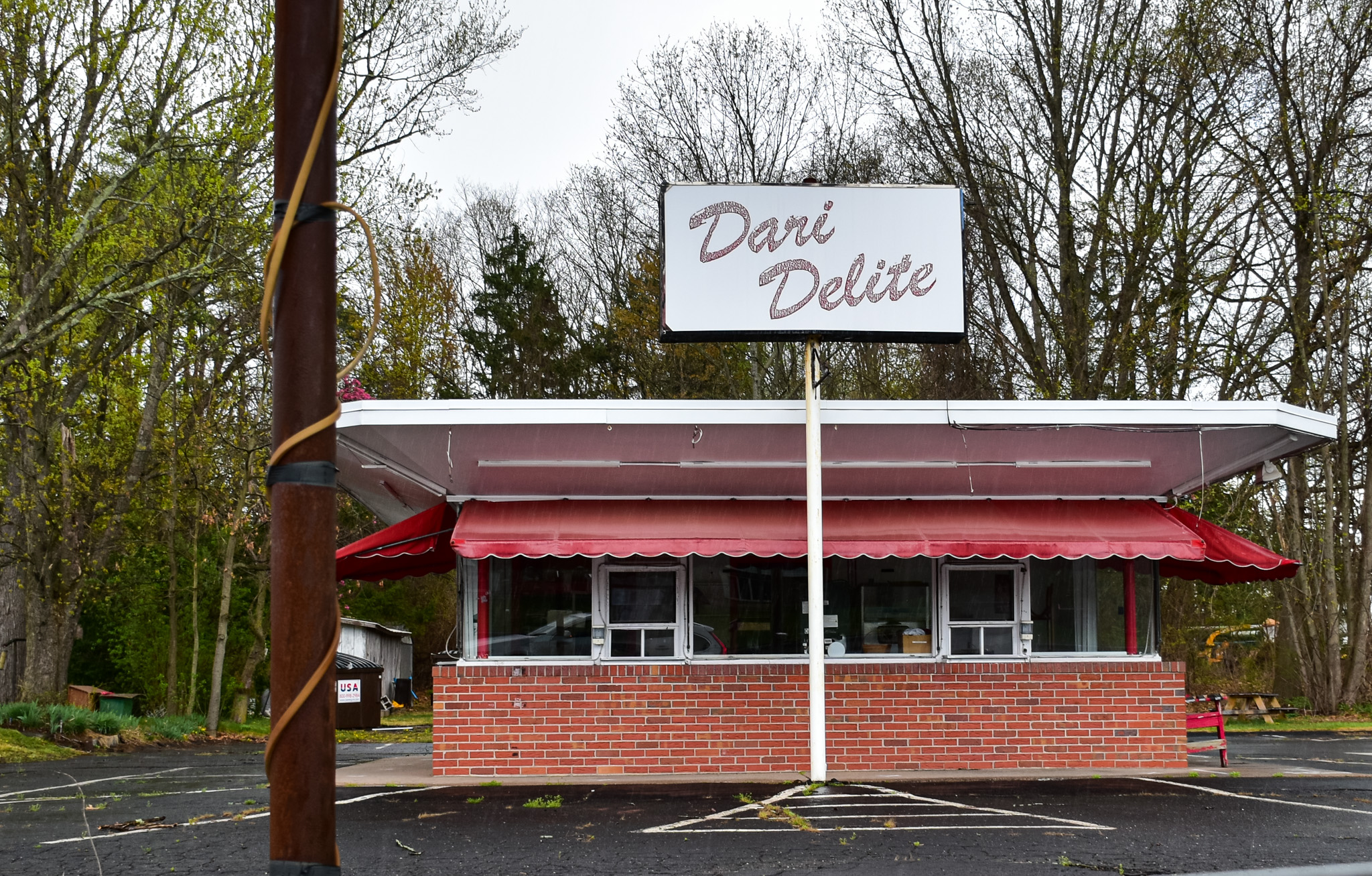
Located along Route 5 just shy of the South Windsor Line, Dari Delite is a great ice cream spot that unfortunately closed up last summer.

The shop opened in 1956. I hope somebody can find a way to reopen it.

I wanted to get closer and take more photos of the outside and inside, but the parking lot was roped off, I was parked on the side of very busy Route 5, and the skies were opening up. I had also hoped to make some photos of barns and other rural scenes in town, but the weather cut my trip short.

For more about this part of north-central Connecticut, see November 13, 2021, "Things Are Poppin' in Windsor Locks", and March 12, 2021, "Blowing Into Windsor".

Way Down Yonder in Pawtucket, Part I

From Dave Brigham: I apologize in advance for this, but I often feel the need to explain my headline choices: I'll admit that befo...