Showing posts with label rail trail. Show all posts

Saturday, June 1, 2024

Doing Time on the Reformatory Branch Trail

From Boxcar Willie:

Like a 19th-century murderer sent up the river to Concord for a long hitch, I've had the Reformatory Branch Railroad on my mind for quite some time.

OK, that's a terrible opening sentence, something worthy of the Bulwer-Lytton Fiction Contest, which challenges participants "to write an atrocious opening sentence to the worst novel never written." Still, my point stands: since my buddy Chris DeBarge, owner/operator of Bird in Hand Tattoo and a fellow explorer, mentioned the old railroad line in Bedford and Concord, Mass., many years ago, I've wanted to get there. And boy am I glad I did - I loved the trail and the history and the reformatory and found so much more than I'd expected.

Let's hop this freight!

I'm going to start not where I started, nor my point of completion, but rather somewhere in the middle.

The sun was setting on the former Billerica and Bedford Railroad Engine House as I wrapped up my hike along the old right-of-way for the Reformatory Branch, which I will get to shortly. I had no idea that this nicely restored building, the adjacent Boston and Maine Railroad engine and the Middlesex Central Railroad Passenger Depot were located in the heart of Bedford.

This area marks the northern terminus of the 10.1-mile Minuteman Bikeway, which also runs through Lexington, Arlington and Cambridge. The trail was built by the Commonwealth of Massachusetts on an inactive railway bed in the early 1990s. The old freight/engine house, which dates to 1877, now serves as an information center, museum and gift shop.

The train set on tracks right outside the engine house door is "Rail Diesel Car #6211, which was one of 110 purchased by the Boston & Maine Railroad from the Budd Company to be used for commuter and branch line service," per MACRIS. It is available to rent for meetings or special events.

As for the depot, it was restored in 2014, five years after the freight house was given the same treatment. Both buildings had been under private owneship for decades prior. The Stick Style building dates to 1874. I believe there are small businesses located here. The old depot has some great details.

OK, now let's get to where I started my adventure, at the eastern end of the Reformatory Branch Trail, which is located just south of the John Glenn Middle School, a short distance up Railroad Avenue from the old depot complex.

"The Reformatory Branch Trail was originally a railroad right of way of the Middlesex Central Railroad which opened in 1873 running from Lexington to Bedford and Concord," according to the Town of Concord's Reformatory Branch Trail Guide. "In 1879, the railroad was extended 2.5 miles west to Elm Street near the Concord Reformatory (now the Massachusetts Correctional Institution facility), with a connection to other rail lines at Concord Junction in West Concord. The railroad was taken over by the Boston and Maine Railroad in 1887. Passenger service was maintained by the B & M Railroad until 1926 and remaining freight service until 1962 when the entire branch was abandoned."

I saw some nice trail-side details on this portion of my hike.

(Old fire hydrant.)

(Old concrete signal posts.)

(Kinda spooky, kinda heavenly.)

The trail was pretty muddy at certain points, which was no surprise, given the wet winter we had.

I briefly considered a detour into the Mary Putnam Webber Wildlife Preserve, but I had limited daylight and wanted to get as far down the trail as I could.

I was pleasantly surprised to see a view through the trees open up to the Great Meadows National Wildlife Refuge.

The refuge is accessible by car via a road that crosses the trail.

I ventured on a little longer, eventually turning around at Great Meadows Road once I'd crossed into Concord. I wanted to get back to my car before dark. I hiked for nearly two hours in boots that aren't great for my bad feet. But I was happy. Little did I know that after my trek, I'd stumble across Depot Park and two beautifully restored buildings and train car that I wrote about at the top of this post.

I resolved to complete as much of the Concord portion of the trail as I could, and so not long after my initial adventure, I did just that. I started where the trail hits Lowell Road near The Concord Market, and worked my way east toward Great Meadows Road.

A short distance in, I spied this old hunk o' junk in the woods just off the trail.

A friend tells me this is a rotary sifter of some type, perhaps for sifting gravel from sand for making concrete aggregate.

I also saw another signal post, this one a victim of edaphoecotropism.

I took a side trip to Sleepy Hollow Cemetery. But again, I didn't want to tarry, as I was on a mission and needed to double back in order to complete it. Below are some shots of the side trails I took to and from the graveyard, which is where some of Concord's most eminent folks are buried.

Since the bridge that once carried the Reformatory-bound trains over the Sudbury River was washed out by the 1938 hurricane, I returned to my car behind the market, and made my way toward Egg Rock.

To access Egg Rock, which is where the Assabet and Sudbury rivers come together to form the Concord River, I had to park on Nashawtuc Road and walk down Squaw Sachem Trail (a private road) and take the narrow path between two houses (#50 and #80).

And that opened up to -- tada! -- the Reformatory Branch Trail.

I headed east toward the confluence until I could go no further. Below is a photo showing where the bridge used to be.

I turned back west, figuring the trail might be blocked or overgrown as it ran along the Assabet, behind some very nice houses. But I was wrong! So I trudged forward.

My original plan was to return to my car, drive to MCI Concord, where the Reformatory Branch once led, make a few photos and try, probably half-heartedly, to find the trail. But since the trail kept going, so did I. Eventually the trail curved south and I ended up on a quiet road near a relatively new housing development. I didn't feel like bushwacking at the curve point to see if the trail continued, so I headed out toward Elm Street.

At this point, once again, the sun was heading toward the horizon, and my dogs were barking. But I'd come all this way, walked way more than I'd anticipated, and was determined to make it to the prison.

On the west bank of the Assabet River, hard by Route 2, I spied what I guessed might be a remnant of the railroad right-of-way.

And just past that, I made a photo of a house along Route 2 that may at one point have been affiliated with the prison, which is located across the road.

And then, at last, I found myself standing in front of the Second Empire building that I'd driven past countless times over the last few decades, the place that looks like a Victorian mental hospital.
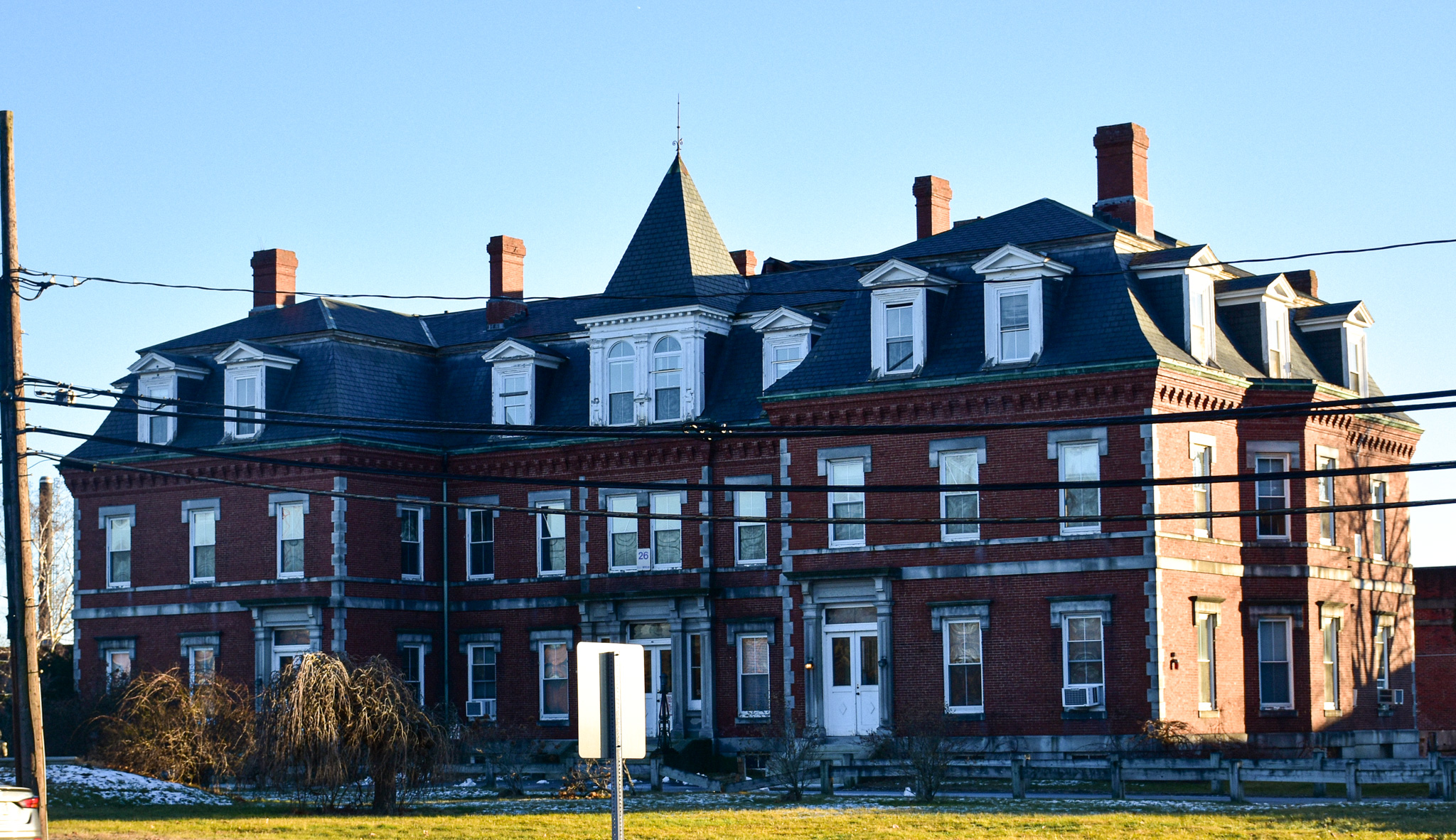
Known alternately as the Massachusetts State Prison Warden's House and the Concord Reformatory Warden's House, this brick building at the Concord Rotary was once a residence and offices for prison personnel. MACRIS has an interesting take: "By far the grandest building in West Concord, the Superintendents' House uses the power of the French-inspired Second Empire style to assert its authority over both the prison behind it and the area around it."

It was built in 1878 as the main entrance to what was then a new prison. Over the years, older buildings were torn down and new, less architectually significant ones went up. Once the prison opened, development in West Concord increased dramatically.

From MACRIS: "From the mid-1880's on, much of the building boom, and the social and organizational structure of West Concord as well, was guided by the residents of this building, both before and during their tenures as Reformatory Superintendent and Deputy-Superintendent. Most influential was Joseph Scott, who, with George Russell, developed the Riverside Park neighborhood northeast of the reformatory while Superintendent in the early 1890's. In 1896, with Loring Fowler, he formed the two major Concord Junction real estate syndicates of the later 1890's — the Concord Junction Land Co. and the West End Land Co."

With the announcement earlier this year that the state plans to close MCI Concord -- as the prison has been known for quite some time now -- this summer, this area of Concord is slated for more big changes. The prison has been operating at less than half capacity for some time.

There is no definite plan for the site yet, but the possibilities are tantalizing. "The potential for the prison site situated on the dreaded Route 2 Rotary is enormous," per the Boston Globe article linked above. "For starters it should spur discussion of a reconfiguration of one of the state’s most fearsome traffic circles. But beyond that, 'It’s perfect for housing,' state Senator Mike Barrett, whose district includes Concord, told the Globe editorial board. 'It’s walkable to West Concord [center]' and its train station. 'It could be a whole new neighborhood.'"

I imagine a mix of housing, retail and office space will spring up here eventually. And I certainly hope that the old warden's house will be saved and restored and turned into something useful for the community.

Saturday, June 11, 2022

Man Walking in Manchester...Again

From That Same Old Guy:

As I was on my way out of town after my first visit to Manchester, Connecticut (see May 27, 2022, "Man Walking in Manchester," April 30, 2022, "Mr. Paranoid Visits an Old Mill"), I noticed a building I hadn't seen on my way in. I said to myself, "Well, I'm gonna hafta come back." And so I did. I'll start off with that building, and cover a bunch of other stuff I checked out on my return.

The sign painted on the side -- "CCC FEED & FARM SUPPLIES" -- only hints at the history of this nicely maintained old brick building. The Central Connecticut Cooperative Farmers Association, which sold bulk seed and other supplies to local farms for nearly 80 years, acquired this building in 1977. The organization shuttered in 2016, due to tough economic conditions, including a decline in farms. The CCC also operated the adjacent grain silos, seen in the photo below.

The brick building dates to 1888, when it was erected by Bernard Apel, a German immigrant who came to the U.S. 14 years prior, according to this blog post. "And what sort of business did this man conduct here?" you might ask. "The basement contained the undertaking establishment and above it was his mercantile showroom, which he had expanded to include a wide variety of products, from carpets, wall paper and curtains, to crockery, lamps, clocks, stoves and pianos," according to that Historic Buildings of Connecticut blog post.

I think customers looking to buy home goods might have found it a bit odd, or even creepy, to be shopping above a funeral home. Perhaps not.

But wait, there's more. "The upper floors of the building housed a large community hall/theater called Apel’s Opera House." And that's why this building is known historically as Apel's Opera House. Unfortunately, the opera house was gutted by a fire in 1899. Apel rebuilt the theater, but "did not reconstruct the original audience gallery."

(I can make out the word "UNDERTAKING" on this ghost sign.)

Apel's Opera House hosted all sorts of events, from something called a Wizard Oil Concert and Specialty Company, to an exhibition of club swinging, a poultry exhibition with awards with 1000 hens and their cages, to a dance held by the St. Mary’s Temperance Society, according to the Manchester Historical Society. In 1899, for the first time, movies were shown at the hall.

Prior to the CCC buying the building, it was used by the Lewis Brothers as a tobacco warehouse, according to the historical society. The brothers continued to let clubs and churches use the hall for some years. It was later used by the Manchester Grain & Coal Co., Bracket & Shaw farm equipment, Allis Chalmers tractor parts and service, Yankee Aluminum salesroom, and Clay Furniture, per the historical society.

Today, this space is partially occupied by Beads East, a wholesaler of beading and embroidery supplies. I think it's still open.

A quick jog west along a set of abandoned railroad tracks takes you to Farrs Sporting Goods on Main Street.

Opened in 1955, the store continues to be operated by descendants of the founder, Jim Farr. Farr's store was originally called Manchester Surplus, and was a general store specializing in bicycles, camping, and household items, per the store's web site. "By 1970, the town of Manchester began a new project: the renovation of Main Street. As buildings were tore down and streets were repaved, Jim decided to take his business to the next level. In 1971, he opened 'Farrs Sporting Goods,' and the rest was history," the web site continues.

I love little slices of mid-century Americana charm like this. They are becoming increasingly rare in our Amazon World, so I shoot them when I see them, and hope for the best for their future.

From here, I walked south one block to Hilliard Street. I'd scoped out this area on Google Street View ahead of time. The complex at Hilliard and Main streets used to be...something. I haven't found out what.

(10 Hilliard St, top photo; 52 Main Street, bottom photo.)

The Hilliard Street building has a faded sign by the front door for Able Scale & Equipment. The town's assessor's database indicates this place was erected in 1888. The larger complex that extends west from Main Street is home to several businesses and organizations, including Manchester ROCS Boxing Club, the Knights of Columbus and Muvement, a fitness and nutrition program. The assessing department indicates this place dates to 1903.

A short walk to the west led me to a former cleaning product manufacturing facility that dates to the late 19th century.

Built in 1888, this beautiful brick building was once home to Bon Ami, a cleaning products company founded in 1886 in neighboring Glastonbury. Bon Ami's signature product "was created by Connecticut soapmaker John T. Robertson in 1886 as an alternative to the heavy scouring soap cakes made with hard translucent quartz," according to this UPI story from 1981. "Wanting a non-abrasive cleanser, he added feldspar -- a softer, chalky mineral -- to his soap."

This complex was home to Bon Ami until the early 1960s, I believe. The company's yellow-chick logo, which touts that Bon Ami's cleanser "Hasn't scratched yet!", is in elite company. "Only three corporate logos are older: the man on the Quaker Oats box, the Smith Brothers on the cough drop box, and the arm of Vulcan on the Arm and Hammer Baking Soda box," according to this Patch article.

The company is currently part of Faultless Brands, which is based in Kansas City, Missouri.

So what goes on here these days?

One of the brick warehouses is used by Sumitomo Bakelite Company, a Japanese plastics company that operates a facility elsewhere in Manchester.

Bakelite "was the first plastic made from synthetic components," according to Wikipedia. "...It was developed by the Belgian chemist Leo Baekeland in Yonkers, New York, in 1907....[and] patented on December 7, 1909. Because of its electrical nonconductivity and heat-resistant properties it became a great commercial success. It was used in electrical insulators, radio and telephone casings, and such diverse products as kitchenware, jewelry, pipe stems, children's toys, and firearms."

The old Bon Ami building is home to Time Machine Hobby, which specializes int toys of all sorts. There is also a bottle and can redemption center here, as well as a reupholstery company called Recovery Zone and a business called Kenyon Woodworking.

(Rear of the former Bon Ami complex.)

There is a wall along Electric Street, seen below. I'm not sure what it encloses. Google Maps shows a large empty space between the wall, where perhaps vehicles were once stored.

After checking out the old Bon Ami complex, I headed back east and picked up a short stretch of the Cheney Rail Trail.

(Old directional marker along the trail.)

(The rail trail veers off to the left. The tracks we're looking at here have been torn up in some spots.)

The rail trail "runs concurrently with part of the old South Manchester Railroad, built by the Cheney brothers in 1869," according to this Patch article. "The rail line was a 2.5-mile spur from the main Hartford, Providence, and Fishkill Railroad and it went to the Cheney silk mills, to bring passengers, silk goods and raw materials too the heart of Manchester's manufacturing sector."

I may check out the former Cheney mills on a future visit to Silk City.

My next stop was Friendship Tuscan Lodge #145 AF&AM on Golway Street, just a short distance away.

The organization was formed in April 2007 through the merger of Tuscan Lodge No. 126 A.F & A.M. and Friendship Lodge No. 145 A.F. & A.M., per the group's web site. The lodge is affiliated with the local Masonic Temple.

I love clubs like this that are dotted through the cities and towns that I visit. I also checked out the British American Club on Maple Street.

The club has been active since 1922. Based on the group's Facebook page, it seems to host private events, happy hours and local bands. After looking at the club's Facebook page, a British friend of mine commented, "Not seeing a lot of Britishness."

I'm going to finish up with two of the most impressive sights I came across in Manchester. The first is Orange Hall.

Located on East Center Street, just off the town's main drag, Orange Hall was built in 1902 as a meeting hall with commercial establishments at street level, according to this Living Places write-up on Manchester's Main Street Historic District. During the heyday of the Cheney mills in the first half of the 20th century, Orange Hall served as a meeting place for seven different fraternal organizations, some of ethnic origin, according to that article.

Nowadays, the hall's ground floor is occupied by Razor's Edge, a hair salon. The Steam Company, which sells e-cigs and vaping supplies, may still be in business. This gorgeous buildling also hosts events, including, as the sign below indicates, birithdays, showers, anniversary parties and stags. That latter one is such an old-fashioned term, making me wonder how old that little sign is.

Directly behind Orange Hall is the home of the Washington Social Club.

The club's Facebook page indicates the group has been in operation since 1823 (!). I'm not sure what goes on here. Six years ago, the club held a pipe band competition, per its FB page.

Finally, a curious, well-maintained, fenced-off ruin located in a quiet residential neighborhood.

The Pitkin Glass Works, located at the intersection of Parker and Putnam streets, was a big deal back in this nation's infancy. "In 1783, Connecticut's General Assembly granted Captain Richard Pitkin and his sons a 25-year monopoly on manufacturing glass, as recompense for their providing gun powder, at a loss, to the Connecticut militia, 1775-1781," according to the linked Manchester Historical Society web site. "The Pitkin Glass Works, the first successful glass factory in Connecticut, was built in Manchester (then the Orford Parish of East Hartford) on the Pitkin farm....Remaining in operation until about 1830, the factory produced demijohns for the West Indian trade, and bottles, flasks, inkwells and other small items, mostly in shades of green. These were considered to be the best color and design in the country. Rare today, Pitkin flasks have brought tens of thousands of dollars at auctions."

Nearly 100 years after it shuttered, the glassworks site was, I assume, in rough shape. "In 1928, Mr. And Mrs. Fred W. Pitkin and others of the Horace Pitkin family quit-claimed the property to the Orford Parish Chapter of the Daughters of the American Revolution," the above-linked article continues. "Finding the cost of maintenance a burden, a suggestion was made in 1977 that it be sold for commercial purposes. A group of interested citizens, led by Mr. Edson Bailey, protested this possibility, and formed a committee to preserve this historic site for the community.

"Pitkin Glass Works Inc. (the Corporation) was organized, with executive officers, and five representatives from the Orford Parish Chapter of the Daughters of the American Revolution; five representatives from the Manchester Historical Society, Inc.; and five representatives from the citizenry at large. Papers were filed for incorporation, and by-laws were drawn up. The site was approved for inclusion on the National Register of Historic Places."

Huzzah!

That's all, folks! I will probably explore more of Manchester at some point in the not-too-distant future, so stay tuned.

Way Down Yonder in Pawtucket, Part I

From Dave Brigham: I apologize in advance for this, but I often feel the need to explain my headline choices: I'll admit that befo...