In my series about Revere, Mass., I've covered commercial districts, diners, a former trailer park, areas under redevelopment and more (for links to previous posts, see the bottom of this one). Now it's time to discuss the most significant feature of this city just north of Boston.
For a not insignificant portion of the world, Revere = the beach. And rightfully so. The beach stretches for three miles along Massachusetts Bay, attracting thousands of sun worshippers, swimmers and people-watchers on any given summer day. The first public beach in the United States, Revere Beach was from the late 19th century through the middle of last century filled with dance halls, an amusement park, restaurants, roller skating rinks, bowling alleys, bars and more. It was a world-class entertainment destination.
While it's still a great place to visit with good food and entertainment and shopping nearby, it's just not what it used to be. I got depressed reading the history of the beach, realizing just how many cool old buildings and attractions had been demolished in the last 50 years or so.
In the late 19th century and for many years, people could access the beach by a narrow gauge railroad (nowadays the MBTA's Blue Line subway can get you there). "From all over New England, families would vacation at cottages, hotels or even in tents high up on Beachmont Hill," according to the history blog post linked above. "They came to enjoy the Coney Island of the East, Revere Beach. The Boulevard boasted rides, dance-halls, movie theaters, carousels, rollercoasters and all kinds of special attractions. Bluebeard’s Palace, Nautical Gardens, The Pit and the Himalaya were just a few. Hotels and restaurants lined the beach. The Pleasanton Hotel, The Strathmore, The Metropolitan and The Point of Pines Hotel were just four of the most noteworthy."
"The Hippodrome originally built in 1903, had a platform that displayed three Carousel horses abreast; it was later extended to showcase five abreast making it one of a kind. The organ music of the two Gavioli organs can still be heard with the memory of this majestic carousel which operated until May 1973. Wonderland Park, Revere Beach’s Mystic City by the Sea, was America’s foremost self-contained amusement park. Conceived in 1905, it opened in 1906. Some people believe it to be the inspiration behind the Disney theme parks of today. The similarities are striking."
Boy, do I wish I couldl've been in Revere a hundred years ago. Or even more recently while these places were out of business but still standing. According to Wikipedia, the amusements at Revere Beach had fallen out of my favor starting in the 1950s. The infamous Blizzard of '78 "destroyed many of the remaining structures, the sidewalks, and the sea wall." The beach was revitalized in the years after that, and today it is known best for its annual sand sculpting festival.
While the beach looks great, I was surprised by how few places to eat and hang out are located alongside. There are high-rise apartment buildings, a few places to eat, drink and be merry, and little to no trace of any of those historic places. If you want to learn more about the beach, read the article linked above, or check out Wikipedia and this article from The Prodigal's Chair blog.
Let me show you what I found.
Located at the corner of Shirley and Ocean avenues, within sight of the beach, BK's Bar and Grill seems to be a nuthin' fancy place where you can drink a few cold ones, watch the Sox or Celtics and have a decent meal. Up until February 2023, as you can see in the second photo above, Sissy Kelley was the boss. Her oldest son, Bobby, runs the joint now, according to her obituary.
I walked south along Revere Beach Boulevard for a few minutes, but, seeing nothing of interest, circled back to Nick's Place, which evidently specializes in chicken kabobs.
Right next door is Sammy's Patio, which features weekly karaoke, concerts, DJ/dance nights, private parties and live entertainment, per its Facebook page. Both Sammy's and Nicks have been located here for many years.
Continuing north along Revere Beach Boulevard, you come to Bill Ash's Lounge.
(Rear of Bill Ash's Lounge.)
This place seems like it's been here a long time.
Steps away is Twist & Shake, which has also been here for many years.
As you continue north, there is a nice tree-lined reservation between Revere Beach Boulevard and Ocean Avenue. And on the west side of Ocean Avenue, there are gigantic apartment buildings. Keep walking past the state police barracks, more apartment buildings, some houses and you finally come to another entertainment venue: La Maquina.
This is a dance club. That is all.
The final food destinations have similar names but very different menu options.
Kelly's Roast Beef has 14 locations across Massachusetts, New Hampshire and Florida, but this one is the original. "Before 1951, no one thought to eat thinly sliced, melt in your mouth roast beef in sandwich form," per the eatery's web site. "We did. Yep, we’re known as the inventor of the roast beef sandwich topped with American Cheese, mayonnaise, and James River BBQ Sauce, affectionately known as the three-way. Just ask anyone from Boston’s North Shore, where we’ve been a staple for over 70 years."
A little further north on Revere Beach Boulevard is Kell's Kreme, which specializes in soft serve ice cream, sundaes, frappes and more.
This place is another local legend that's been around for years.
I'm going to wrap up this post talking about things that are actually on Revere Beach. The first is the Shirley Avenue Bath House.
OK, so I don't have anything to say about this building other than it provides an important function as a public bathroom. The building is from the 1930s, I'm guessing.
There are several pavilions located along the beach, as well as the Rep. William G. Reinstein bandstand.
The most fascinating things I saw during this trip were multiple speakers facing the beach, which I assume used to (maybe still do) pump music from the bandstand out to the beachgoers.
I've searched high and low online but haven't found out anything about these relics from times gone by. I absolutely love them.
Alright, that wraps up Revere. Here are the links to the previous posts:
Somehow I managed to escape chaperoning duties when each of my kids visited the tourist destination formerly known as Plimoth Plantation with their schools. Known since a 2020 name change as Plimoth Patuxet Museums, the site in Plymouth, Mass., includes a Patuxet homesite, a 17th century English village, a grist mill and the Mayflower II, a replica of the ship that brought European Pilgrims to these shores in 1620. According to Wikipedia, the Patuxet people "were a Native American band of the Wampanoag tribal confederation. They lived primarily in and around modern-day Plymouth, Massachusetts, and were among the first Native Americans encountered by European settlers in the region in the early 17th century."
While I'd driven through Plymouth on my way to and from Cape Cod, I'd never set foot in "America's Hometown." So last summer I decided to go on a pilgrimage of my own.
I'm guessing many, if not all, of my devoted worshipers, er, readers, are familiar with Plymouth and the Pilgrims. So I shant go into detail about the town's place in American history. I was mostly curious about the downtown area, so I started there, about one block from Plymouth Harbor. The main commercial drag is filled with touristy spots but thankfully many of those are located in historic buildings. But of course before too long I found myself within sight of the more obvious trappings of the place, so I had to pay them a bit of attention.
The first thing that caught my eye as I walked along Main Street was a former fire station that until recently was doing business as a restaurant with a rather silly name.
Built around 1895, the Plymouth Central Fire Station served that purpose until sometime in the 1970s, according to MACRIS. "[T]he town leased it for restaurant use. Careful attention was paid to preserve, restore and design around the interior mahogany paneling," MACRIS continues. For 28 years, until spring of this year, the old station was home to an outlet of Sam Diego's, a Mexican restaurant that also operates in Hyannis on Cape Cod. While the name of the restaurant is a bit goofy, I like that the owners went to a lot of trouble to create a myth about Sam Diego.
A house once located on this site was home to the Old Colony Club, a social club for gentlemen that is now located a short distance away on Court Street.
I really wanted to take a picture of the two gentlemen sitting on the side porch of the club, one of whom was wearing a top hat, which is a common sartorial choice with this gang, as evidenced by photos on its web site. Anyway, the Old Colony Club was founded in 1769 by "a group of seven young Plymouth men," evidently in an effort to avoid rubbing elbows with the type of gents who frequented taverns, according to the group's web site.
"In December of [1769] they decided to hold their annual meeting on the anniversary of the December 11, 1620, Landing (sic) on Plymouth Rock," per the group's web site. "This celebration, originally referred to as 'Old Colony Day' and later as 'Forefathers' Day,' was first observed on December 22, 1769. It should be noted that the use of the term 'Pilgrims' to refer to the Plymouth colonists had not yet come into use. They were still just the local 'forefathers' of the little community rather than the symbolic progenitors of the whole nation."
In addition to Forfathers Day, the club holds events for Independence Day and Thanksgiving. As for the building, it is known as the Nathaniel Morton Davis House, and was built in 1789.
Continuing west-northwest on Court Street, I came to a wonderful hand-carved sign on a storefront.
Located in a circa-1769 Greek Revival former residencee, the locksmith shop may be part of the adjacent Peggy's Pawn Shop. I'm not sure. As for building, it is known as Daniel Diman / Coomer Weston House and also the William Goodwin House. The building remained residential until the 1930s or 1940s when the ground floor was converted to retail space, according to MACRIS.
Located in a circa-1880 Greek Revival former residence, Shelly's is the first U.S. outpost of a business begun in England in 2007. As for the building, it is located on land originally granted to Myles Standish and later owned by Governor Bradford, according to MACRIS, as is the case for many of these properties, I believe.
Moseying on down the road, I came to the site of the first "Dame School" in America.
Currently occupied by a realtor's office, the Isaac Symes / Tabitha Plasket House dates to 1772. Plasket lived from 1743 to 1807, and was a school teacher. According to Wikipedia, a dame school was "a private school with a female teacher during the 17th, 18th and 19th centuries. The education provided by these schools ranged from basic to exceptional. The basic type of dame school was more common in New England, where basic literacy was expected of all classes."
The Symes / Plasket house dates to 1772. MACRIS indicates that "tradition states [Plasket] was the first woman school teacher in America."
On the opposite side of Court Street I spied a groovy sign for Artisan Pig, a restaurant offering wood-fired pizzas, sausages, craft beer and fine wines.
The building dates to 1875 and was remodeled in 1975, according to MACRIS.
A short walk away on the west side of Court Street is the former Armory of the Standish Guards (aka Plymouth National Guard Armory).
Now known as the Residences at the Armory, this English Revival building dates to 1906. The Standish Guards were Plymouth's first militia company.
From the armory, I headed down to the harbor. There I saw, you know, harbor stuff. Like trawlers (I think that's what the boats below are called).
As expected, I found plenty of funky restaurants on the waterfront. Below is The Shanty, which serves seafood and other touristy food, and below that is The Shanty Rose, a bar that offers karaoke and, you know, drinks.
The Plymouth assessor's office indicates that this building dates to 1930. Below is the nearby Lobster Hut, which has been around for more than 50 years.
This building rose in 1970, per the assessor. Next is Tavern on the Wharf, which has a boat on its roof.
This building dates to 1998.
Below is Ziggy's Ice Cream, which has been slinging frozen treats since 1957.
The building dates to 1965, according to MACRIS, and was built on the site of a former rope walk, which "is a long straight narrow lane, or a covered pathway, where long strands of material are laid before being twisted into rope," according to Wikipedia. "Due to the length of some ropewalks, workers may use bicycles to get from one end to the other. Many ropewalks were in the open air, while others were covered only by roofs."
In front of Soft as a Grape, I spied a funny anti-boiling t-shirt.
I continued east for a little bit, looked up and realized I was heading straight toward the Ultimate Tourist Spot: Mayflower II and Plymouth Rock. I honestly had no idea where these sites were when I set out on my trip. Part of me thought, "Oh, let's not go there. It's so obvious." The more decisive part countered with, "Sure, it's hokey, but these are important landmarks. Plus, if you tell people you explored Plymouth and decided to skip the main attractions, people will think you're a Commie."
Across from Pilgrim Memorial Park I was fascinated by the Pilgrim Mother Fountain and Statue.
The statue and fountain were gifts of the Daughters of the American Revolution in 1921 for Plymouth's tercentenary celebration. "For the Daughters of the American Revolution, 1920 meant honoring this time of female triumph and Plymouth’s 300th Anniversary Celebration with a nod to the Mayflower women, whose numbers were decimated that first winter in Pawtuxet," per the See Plymouth web site.
I crossed Water Street to the small portico on the edge of the harbor where stands Plymouth Rock.
I knew that the rock was less impressive than a visitor might expect, given its outsize place in American history. Still, it was cool to see it. I dug that people throw coins into the pit for good luck, when the tide comes up and water covers part or perhaps all of the rock. The well-known architectural firm of McKim Mead and White designed the portico, which rose in 1921.
Having satisfied my tourist obligations to see the alleged point where the Pilgrims stepped ashore in the winter of 1620, I headed back toward the shops along Water Street. The Pillory Pub jumped out at me (a pillory, according to Dictionary.com, is "a wooden framework erected on a post, with holes for securing the head and hands, formerly used to expose an offender to public derision.").
Opened in July 2012, the pub is run by the same family that operates the adjacent gift shop (which I will talk about below). The building dates to the 1890s and was used as a market, a warehouse and a restaurant prior to the opening of the pub, according to MACRIS.
At Fishmans Memorial Park facing the harbor, I took a few minutes to reflect on the history and beauty of Plymouth.
From there I headed west on Chilton Street and back to Court Street, where I continued my tour south-southeast. I like the sign for The Mea Thai Cuisine.
"Thai food by Thai wife," it says underneath "The Mea." The restaurant was established in 2021 in a building that dates to 1781 and was originally a house. From MACRIS: "The house here was built after 1781 and as common in that section of Town, was divided into two houses in 1785. The present structure reflects many remodelling and altering changes both in architecture and use through the years so that almost none of the original structure remains."
The other half of this property is occupied by the Galway Pub.
At the entrance to Maria's Tailoring & Alterations at 54 Court Street, under a small welcome mat, I spied an old tile entryway for a prior tenant.
This building, which has been altered greatly over the centuries, dates to 1710, according to MACRIS. "The two story building at 52-54 Court Street is a two-part commercial block with commercial occupancy on the first floor and residential space on the second and attic stories. This property is an altered example of the Colonial style of architecture. The building has a brick veneer on the front façade and vinyl siding on the other elevations. The building’s first floor fenestration has been replaced with modern updates throughout; however, the second and attic story windows appear to be the original two-over-two windows. The roof has been covered in asphalt shingles."
As for the residential and commercial history, MACRIS indicates that "[t]his lot was granted to Martha Waite in the early 1700s and was passed onto Eleazer Rogers who built the house. Rogers sold the property in 1721 to Thomas Phillips who sold it in 1723 to Anthony DeCosta whose widow lived here until 1765....Then in 1795 the property was divided between two owners and changed hands several times. William Morey purchased the southern half in 1812 and then the northern half in 1824 to become the sole owner of the property and lived here into the
1880s. The building remained residential through the early 1900s and by 1912 the ground floor was divided into three businesses: tailor, electrician, and variety store."
I haven't found anything about a store called Sugar Bowl, but I'm guessing it was a candy store dating back to the early- to mid-20th century.
On the opposite side of Court Street stands The Music Box, one part of a mini empire that includes the Guitar Pedal Shoppe (located in the same building) and a recording studio called Soaring Sounds next door.
As you've probably guessed, the building was originally a home, dating to the late 1790s. In the 1890s, the house was sold to the Methodist Episcopal Church, which maintained ownership until 1978, according to MACRIS. After that, the quaint property was owned by the
Beis Jacob Society, an organization formed in 1912 in order to raise funds to build a synagogue in Plymouth.
At the corner of Court and South Russell streets, how could I pass up a chance to make a photo of a place called Gunther Tooties?
Part of a local, six-store chain, Gunther Tooties specializes in bagels, and also offers coffee, salads and breakfast and lunch sandwiches. I'm not sure when the business was founded, but the current owner, Tony Chen, purchased the chain in 2006, according to the company's web site. The store should not be confused with Colorado-based eatery chain Gunther Toody's, which was named for a character on the early '60s sitcom, "Car 54, Where Are You?" So I suppose that means Gunther Tooties was, as well.
As for the building, located steps from Plymouth Town Hall, it was previously occupied by Forest Jewelers, a Jubilee restaurant and All Things Tea, according to MACRIS. As for the date it was built, well, the MACRIS reporter was evidently drunk when this file was recorded. At the top of the document available online, next to "Year Constructed," it says 1935. Further in the report, we learn that the "building at 20 Court Street appears to have been constructed between 1910 and 1925." And then a little deeper in, we are told, "According to Sanborn Maps the lot was previously occupied by a dwelling at least until 1927 and the current building was constructed by 1948."
Take your pick. I choose to believe sometime between 1910 and 1925.
I ventured a little further south along Court Street and found myself at the town square, looking up at two very impressive churches. I was fighting the sun that day, so only managed one half-decent photo, seen below.
In the foreground is the Mayflower Meetinghouse, which is operated by the National Pilgrim Memorial Meetinghouse Charitable Trust. Built in 1897 as the First Parish Church of Plymouth, this Romanesque Revival beauty is the fifth house of worship located on this site. It was designed by the Boston architectural firm of Hartwell, Richardson, and Driver and is one of the few examples of this style of architecture in Plymouth, according to MACRIS. That firm was "established in 1881, by Henry Walker Hartwell...and William Cummings Richardson....The firm contributed significantly to the current building stock and architecture of the greater Boston area," according to Wikipedia. "Many of its buildings are listed on the National Register of Historic Places."
According to the The Mayflower Society, First Parish Church donated the building in an effort to save it, and "upon the condition that funds be put in place to permanently maintain it, and that they be allowed to continue scheduling their services there." The Mayflower Society plans an immersive and multi-media museum experience at the site, according to its web site.
Currently affiliated with the United Church of Christ, the congregation was formed in 1801 after splitting off from the First Church, which eventually became Unitarian, according to MACRIS.
"The Church of the Pilgrimage was erected in the Greek Revival style in 1840 and extensively remodeled in the Colonial Revival style to the designs of prominent architect Joseph Everett Chandler," according to MACRIS. "Chandler was responsible for the building's monumental three-bay
frontispiece, as well as its belfry, tower, and octagonal cupola."
My final stop on this tour was "the only existing house in Plymouth where Pilgrims actually spent time."
The Jabez Howland House was built in 1667, with additions completed in 1750 and 1790, according to MACRIS. John Howland and his wife, Elizabeth Tilley, both Mayflower passengers, had four sons and six daughters. Jabez, their eighth child, and his wife Bethia lived in the house at 33 Sandwich Street until they moved to Bristol, Rhode Island, in 1680, according to the historic house's web site.
The house was occupied until 1912 when, through the efforts of Mrs. Nelson Titus, then secretary-treasurer, the house was bought by the Pilgrim John Howland Society, according to the web site.
Karl Malden (born Mladen George Sekulovich) was a legendary actor who starred on Broadway (Arthur Miller's "All My Sons," Tennessee Williams' "A Streetcar Named Desire") and in countless films ("On the Waterfront," "Baby Doll," "Birdman of Alcatraz"). I remember him best from "The Streets of San Francisco," a cop drama co-starring Michael Douglas that ran on ABC from 1972 to 1977.
The city of Malden, Mass., on the other hand, hasn't landed one stage, film or TV role since being incorporated in 1649. The small city located just a little north of Boston has, however, produced some famous folks: Tony/Oscar/Emmy winner Jack Albertson, whom I loved in "Chico and the Man"; Erle Stanley Gardner, author of the Perry Mason detective stories; musician Norman Greenbaum, about whom we'll learn more later; Edna May Oliver, who was nominated for Best Supporting Actress for 1939's "Drums Along the Mohawk"; and drummer David Robinson, who played in both the Modern Lovers and the Cars.
Ever since taking my son to Boda Borg, a "real-life questing" experience in downtown Malden several years ago, I've wanted to return to make photos. I recalled a main street with some cool old buildings. After a bit of research (An old diner!), last July I found time to explore. Below, you'll see and learn about what I found. You know how this works.
The first place I came across was one that made me say, out loud, to myself, not for the first time, "Oh, THAT used to be something!"
Currently home to a U-Haul Self Storage facility, this brick building along Eastern Avenue, near the intersection with Ferry Street, was originally Revere Knitting Mills.
From MACRIS: "The Revere Knitting Mills factory was built in 1921 with rear access to the Saugus Branch Railroad. In 1929 a rear addition was made to the original building along the railroad line. The Revere Mills suffered a serious fire in August 1938 and a strike in November 1938. After World War II the company moved to suburban Wakefield, closing operations in 1958."
The term "knitting mill" may sound quaint, as if a bunch of old ladies are rocking in sync in their chairs, nattering about the weather and slowly but surely completing scarves, hats and mittens. The reality was a bit different: low pay, long and grueling shifts, noisy and potentially dangerous machinery, children working without legal protection. Below is a video that gives you an idea of what it was like to work in a cotton mill in England in the 18th and 19th centuries.
I roamed quite a bit around downtown before I found my next photo target, but it was a damn good one.
This Classical Revival beauty was built in 1894 for Mrs. Edward L. Brown of Malden, according to MACRIS. It was "designed in 1894 by H.W. Hartwell & W.C. Richardson, noted Boston area architects, unrelated to H.H. Richardson," MACRIS continues. "The four story brick business block follows a standard plan for commercial buildings of the period with retail shops on the street floor and upper story offices, including a dining hall on the fourth floor."
"Sometime after 1930 the Malden Masonic Order relocated from the Yerxa (W.T. Grant) Building at 72-80 Pleasant Street to the Browne Building, renaming to the Malden Masonic Building," per MACRIS. "In 1972 a serious fire required substantial rebuilding of the Masonic facilities with a new entrance."
Nowadays, this building is known as the Residences at Malden Station, a pet-friendly apartment community with a 24-hour fitness center and two rooftop lounges.
Continuing east on Pleasant Street, I saw plenty of other nice buildings, starting with the old Malden Trust Company Bank.
Currently occupied by East Cambridge Savings Bank and Mixer eSports + Cafe (part of the Malden Gaming District, which includes Project: PUTT!, Rock Spot Climbing, Boda Borg [to be discussed below] and Station: Bistro & KTV), the Classical Revival Malden Trust building was completed in 1914. The building was acquired by Pioneer Bank in 1983, and by Eastern Bank in 1994, according to MACRIS.
Next door is Boda Borg, a questing entertainment business founded in Sweden in the mid-1990s, according to the company's web site. "Our Questing concept pioneered the Reality-Gaming business sector in an era of video games, reality television, and action movies," the web site continues. "People were drawn to a concept where they participate physically and mentally in exhilarating activities themselves. No movies! No video games! Just you and real-life Quests!"
My son and his friends had a blast here a few times back when he was in high school. Boda Borg took over the space formerly filled by Sparks Department Store, which had been in business for 94 years before closing in 2013.
Adjacent to Boda Borg is Super 99 Century, a discount store located in the former W.T. Grant Department Store space.
I've written a few times before about Grants, a department store chain founded by Malden native William T. Grant in 1906. Founded in Lynn, Mass., the chain grew to nearly 1,200 stores by the time its founder passed away in 1972 at age 96. Four years later, the company went out of business, "in part due to a failure to adapt to changing times [that] was probably accelerated by management's refusal until it was too late to eliminate the shareholder dividend," according to Wikipedia.
As for the Pleasant Street building, it was built in 1941 when Grants moved from its previous location in what is known as the Yerxa Block (located...somewhere in Malden), according to MACRIS. The Malden store closed in 1971.
Super 99's neighbor to the east is home to Zuru Zuru, a ramen restaurant, and The Downtown Paw, a doggy daycare facility. I've searched high and low online, but I haven't figured out any history for the building.
The place next door, on the other hand, was built in 1940 as an F.W. Woolworth store (aka Woolworth's).
Currently home to modern Asian restaurant All Seasons Table, this building was "named the 'most modern building in New England' when it opened in October 1940," per MACRIS, citing the Malden News. The Woolworth store closed in 1969.
Near the end of Pleasant Street, on the north side, is a little place named the Bychower Building.
I haven't found any information about this place, which is currently occupied by Gold & Diamonds, Etc.
Next door, close to the point where Pleasant and Main streets meet, is the Barrett Building, which has an interesting history and features a ghost sign.
(The Barrett Building, seen in the background.)
(Ghost sign for Black's Furniture on the side of the Barrett Building.)
From MACRIS: "Barrett's Building was completed and opened in March 1884 with a mix of craft-works, including a crockery shop and furniture factory on the upper floors, along with a meeting hall. Advertising signs for BLACK'S FURNITURE are still preserved on the side brick walls and match with directory listings and photographs to 1898-1900, possibly earlier to the original building as the oldest remaining commercial art in Malden Square."
Damn, those are some old ghost signs!
A meeting room on the third floor of the Panel Brick building was used for a time as a Red Men's Hall. Known officially as the Improved Order of Red Men, the fraternal organization "claims direct descent from the colonial era Sons of Liberty," per Wikipedia. Established in Baltimore in 1834, the Red Men held rituals and wore regalia "modeled after those assumed by men of the era to be used by Native Americans. Despite the name, the order was formed solely by, and for, white men," Wikipedia continues. The group lives on today, although not at this location.
Finally, in 1926 the Barrett Building's "middle bay was opened up at the ground floor level to become the entrance to the new Granada Theater which was built behind it," per MACRIS.
Around the corner, on Main Street, is the former home of another fraternal organization.
The Odd Fellows Temple, which has some impressively ornate details, dates to 1907.
Currently, the building is home to The Immigrant Learning Center, some law offices and other small businesses, I believe. Below is a ghost sign for a company called Insurance Express that was once located in the building.
On this exploration, I did a lot of walking without taking photos. Sometimes that happens on the backside. After checking out the IOOF temple, I doubled back along the other side of Pleasant Street, and then looped around to Exchange Street. In addition to some new apartment and office buildings, I found some cool public art and a ghost from the past.
"'Spirit in the Sky' is a mural painted...to honor Norman Greenbaun, who wrote the hit song 'Spirit in the Sky' and is from Malden....The mural was designed to be a vibrant piece of artwork for the City of Malden which fuels economic growth through Cultural Value, Educational Value, Historic Value and Community Engagement," according to a statement on the web site of artist Jesse Melanson. The giant mural is located on the rear of 110 Pleasant Street, facing Exchange Street.
At the rear of the former Woolworth's store, I spied an old sign for Woolworth Studios.
Surprisingly, I haven't found out any information about this part of the old department store chain's business. The current tenant for this space is the aforementioned Project: PUTT!
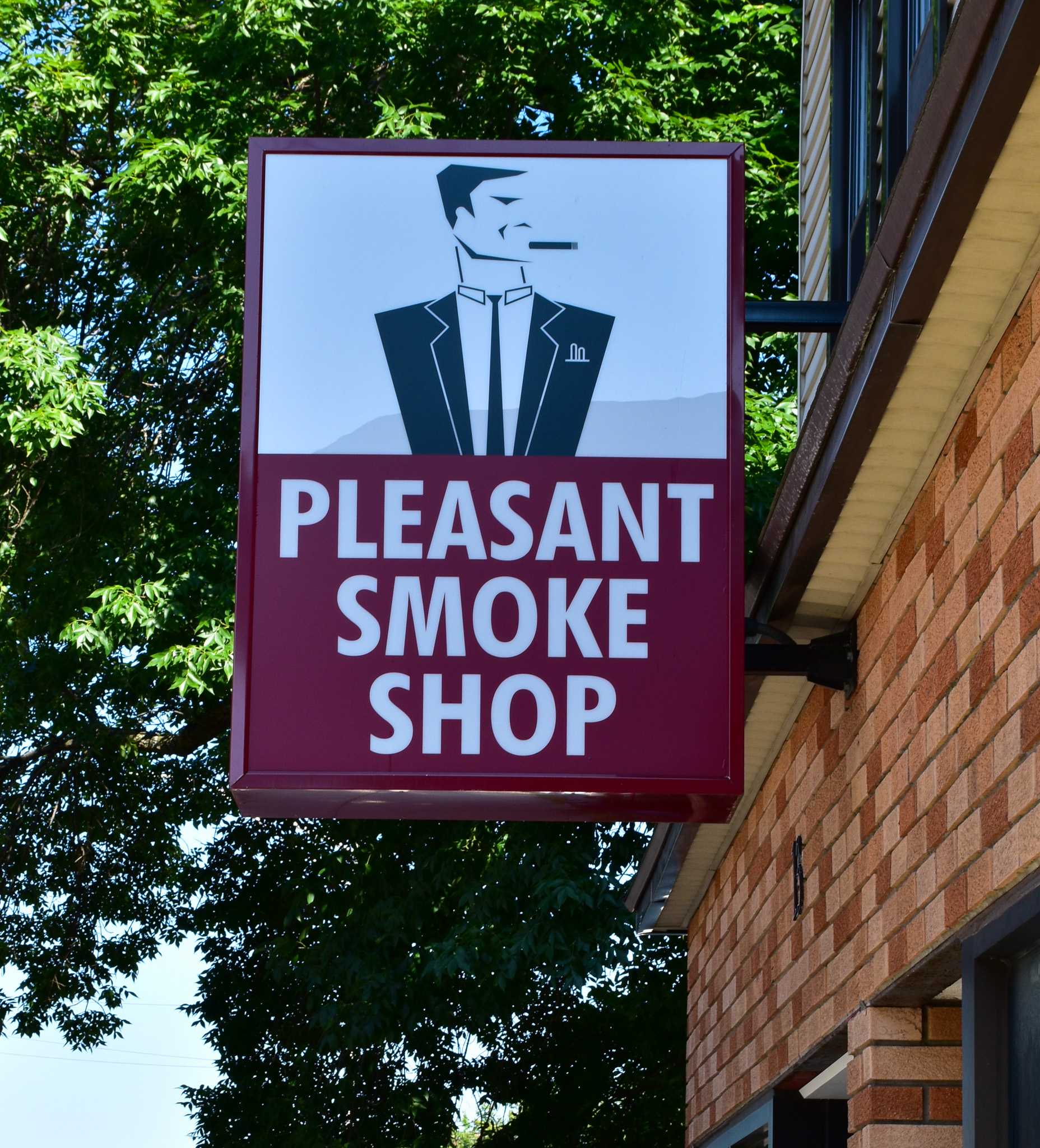
Along Irving Street, I spied a nice sign for Pleasant Smoke Shop, which has been selling cigars and accessories since 1982.
After a few minutes, I headed for the Northern Strand Community Trail, a bike path connecting Everett, Malden, Revere, Saugus and Lynn. I had no idea whether I would find some cool backside places, or whether I was putting undue strain on my bad feet and my sciatica for no reason. Over the years of exploring on behalf of this blog, I've found that old railroad rights-of-way that have been converted to community paths are pretty good places to poke along. Factories and warehouses that were once served by trains are often still standing witness to e-bikes, parents jogging with strollers, kids on bikes and middle-aged dudes with cameras limping along.
My gamble paid off once again, as I stumbled across the the top model train retailer in the USA.
Charles Ro Supply Company has been in business since 1972, offering "the largest selection and best pricing for all your model train & hobby needs," per its web site, which also claims the store is the world's largest dealer for Lionel Trains, a company owned in part by rocker Neil Young.
I visited the store twice many years ago when my son was young and totally into toy trains. My shopping trip was so many years ago, I thought Charles Ro was located in neighboring Everett, so I was pleasantly surprised to see the store and make a few photos.
I got off the multi-use path and headed north on Cross Street, as I was getting tired and needed to start working my way back toward my car. At the intersection of Cross and Salem streets, I saw a black awning with a faded sign for Salem Wood Cafe.
Shuttered in 2013 after what I'm assuming was at least a few decades in business, the restaurant received a good review from Boston's Hidden Restaurants, which described the joint as a "homey, well-worn working-class" eatery that offered good food in a no-nonsense location.
Further west along Salem Street I saw a one-story, four-bay retail building that has a Middle Eastern look to it because of the arched doorways and the red trim paint.
Known as the Zachary Zarsky Block, this Classical Revival building rose in 1925. Zarsky "was a pharmacist and business owner in Malden," according to MACRIS. "Zarsky was a native of Vilna, Russia. He began with ownership of the Red Cross Pharmacy in Gardner, Massachusetts. He came to Malden where he operated the Faulkner Pharmacy, also known as Zarsky’s Drug Store at 273 Salem Street....Zarsky acquired the land on which this building would be built in 1923 from Annie S. Towle....Original tenants included First National Stores, a grocery store, at 283, Roy Clough provisions at 285, Jacob Fitterman, tailor at 287, and Carmine DiMattia, barber at 289."
A little further along is a stunning apartment building: The Mount Vernon.
Located on the corner of Salem and Mount Vernon streets, this building was in the news more than two years ago, when the parapet at the roof line collapsed onto the sidewalk. Nobody was injured. As for the building, I haven't been able to find out when it was built. It looks to be in good shape now.
I followed Salem Street into Malden Square, near where I'd begun my adventure. I wanted to get a closer look at something I'd spied earlier in the day when I was making photos of the IOOF building.
There is a boomerang-shaped hole in the ground next to the brilliantly named Dentistry and Braces practice along Main Street, curving around to Ferry Street. As you can see, there are remnants of laths from the building that once stood on that semi-circular lot. I wanted to know what used to be there. I'm thankful that my old friend MACRIS and my newer friend Google Street View had some answers.
Known as The Auld-New Lounge, the building was built in 1912, remodeled in 1937 and 1974 and was considered by the MACRIS report author to be a "much-altered undistinguished commercial structure" that "may well be replaced," as of 1976. The building appears to have been torn down in late 2019 or early 2020. Below is a Google Street View photo of the building from November 2011:
As for what might fill the hole in the ground, I haven't been able to figure that out.
Heading south on Main Street, I absolutely had to make a photo of the building housing Kung Fu Tea, Thanh Danh tax services and Angel M Beauty Club.
Built in the Classical Revival style in 1902, 1-3 Pleasant Street wouldn't look out of place in a European village. Unfortunately, MACRIS doesn't have much to tell me about this place.
I continued south, across Centre Street, heading toward my car. I knew I had at least one building to shoot -- a recently revamped diner -- but another one caught my eye.
I'm used to seeing buildings with words carved into their facades, usually the name of a bank or a builder or a factory. This is the first time I've seen the name of a cleaning company: Golden Bell Cleaners. I wish I'd been more observant, as there is another business name carved into the south-facing facade: Boston Dye House, according to MACRIS.
"The Boston Dye House at 22-28 Eastern Avenue is dated 1927 by newspaper articles and archives blueprints," MACRIS indicates. "The present building is an addition to the original (1919) Boston Dye House building at 30-50 Eastern Avenue on a site occupied in 1912. The 1927 addition was constructed for the Golden Bell Cleaners, named after the founder Edward I. Golden, highlighted by gilded bells on the facade. The Boston Dye House building on Eastern Avenue remains a commercial landmark of Maiden Center, highlighted by gilded bells on the facade as signets of its identity."
After making the above photo, I crossed Main Street to get a better angle of the Breakfast Club, a diner that moved from Boston's Allston neighborhood due to redevelopment (see June 18, 2022, "I Love L.A.!").
Prior to the Breakfast Club, this was home to the Doo Wop Diner, from 1991 to April 2022. The eatery, so named because the owner's grandfather loved doo wop music, featured appropriately themed dishes such as The Chubby Cheddar, I Want to Hold Your Ham and Cheese and The Last Train to Belgian Waffles, according to this Neighborhood View article about the restaurant's closure.
Next, I made a photo of another neighborhood institution:
Doubling back toward my car, I ventured again down the bike path, which cuts just north of the Breakfast Club. I followed it just a short distance, to Ferry Street. I then walked west along Eastern Avenue and past a few old buildings, including a former auto repair business. As I crossed the street, I looked back and was fortunate enought to spot the ghost sign seen below.
Most recently home to The King of Auto Repair, this lot is being redeveloped. I'm not sure whether this building will be torn down or included in the new project.