From Dave Brigham:
In the first two installments of this series on West Newton, I discussed a major redevelopment project (see August 27, 2022, "I Seek Newton, Part XII: West Newton (Section 1: The Barn Redevelopment") and West Newton Square (see September 3, 2022, "I Seek Newton, Part XII: West Newton (Section 2: The Square)"). In this final post, I will cover a wide variety of sites spread across the village, from houses of worship to a conservation area to a statue to historic homes that have new purposes, and much more. For links to the previous posts in this years-long effort, see the bottom of this post.
Let's start with some West Newton sanctuaries; I'm not getting to all of them here, just the ones that caught my eye.

The Kingdom Hall of Jehovah's Witnesses on Washington Street near the intersection with Commonwealth Avenue, dates to 1958. I believe it was formerly a branch of Whitinsville Savings Bank, although I can't recall where I found that information.
On the appropriately named Temple Street is Temple Shalom, which was completed in 1956 for a congregation founded six years earlier.

Thanks to an attentive reader who pointed out my error in originally naming this as Temple Reyim, which is located on Washington Street, on the West Newton/Auburndale line. I took this photo many years ago and forgot to double-check just what it depicted.
Traveling back north into what is most assuredly West Newton, we come to a set of buildings that includes a church, a rectory, a former convent, a school and two other buildings.

Built in 1890 as St. Bernard Roman Catholic Church, this house of worship is known these days, after a consolidation, as Corpus Christi - St. Bernard Parish. Formerly sited on Ash Street in Auburndale, Corpus Christi was founded in 1922. As for St. Bernard, the congregation formed in 1866 and built a church at this location eight years later. Sadly, the church burned in 1889. This beautiful replacement rose less than a year later. The parishes joined in 2006.
On the opposite side of Prospect Street is the church's rectory, which dates to 1923.

Across Washington Street are two buildings built for the Catholic parish, but which are now used by a private school adjacent to the church.

On the left is a building known historically as Fuller House - Newton Catholic Club. The Second Empire building dates to 1875. Attached to the right is the circa-1909 former Newton Catholic Club Hall. These buildings are currently used by the Learning Prep School, which educates students in grades 5-12 "with complex profiles," per its web site. Below is Learning Prep's main building, which was originally the St. Bernard Parochial School.

(Learning Prep School.)
In addition to the former parochial school and the Catholic club buildings, Learning Prep leases the former St. Bernard convent.
Just around the corner from the St. Bernard/Learning Prep complex is the Myrtle Baptist Church - and a neighborhood that was torn apart in the 1960s by construction of the Massachusetts Turnpike extension.


Located on Curve Street in the heart of Newton's largest historically Black community, Myrtle Baptist was founded in 1874, when many of the 130 or so residents broke off from First Baptist Church (now Lincoln Park Baptist Church, which will be discussed below). The parishioners did so because they felt "the need to worship in their own tradition" and sought the "freedom to sit in the front of the church as well as in the rear," according to the church's web site. They separated “not with feelings of of unkindness toward [their] white brethren but simply for the best good of all concerned," the web site continues.
"The first church structure was built in 1875 on land given as a gift by D.C Sanger, a Deacon at Lincoln Park Baptist Church," per the church's web site. "On October 22, 1897, a fire destroyed the original church. Within a year, the church was rebuilt upon the same site as the original building. At that time, two beautiful stained glass windows, depicting 'Philip Baptizing the Ethiopian Eunuch' and 'The Ascension,' were installed."
The church continued to grow, despite another group breaking off to form a new congregation. In the 1950s, while he was a student at Boston University, Martin Luther King, Jr., preached at Myrtle Baptist. In the early 1960s, unfortunately, "many members of the church had their lives disrupted due to their homes being taken by eminent domain for the extension of the Massachusetts Turnpike. As a result, the church lost about half of its members due to relocation outside of the area."
The City of Newton fought the Pike's extension, as did property owners along the route in Boston. Obviously, their efforts were futile. Below is a wall separating this neighborhood from the turnpike.

The aforementioned Lincoln Baptist Church is located a short distance away, on the corner of Washington and Perkins streets.

Built in 1871, this Gothic Revival house of worship was named for an adjacent park that was also destroyed by the Mass. Pike extension. "The church, known originally as the First Baptist, was formally organized in 1853 at Newtonville," according to MACRIS. The congregation moved to West Newton in the 1860s. Lincoln Park was laid out during the Civil War and featured a tree-lined oval, according to MACRIS. "The congregation's name was formally changed to the Lincoln Park Baptist Church in 1906," according to MACRIS. "A split in the group occurred about this time over the acceptance of new members who had not been baptized by immersion. Reverend Edwin Shell, its pastor, was criticized by the Boston-area Baptist Conference for this practice, considered radical at the time, and the church lost several members over the dispute, which received considerable coverage in contemporary newspapers."
Of course, the church's membership shrank after the turnpike made accessing the sanctuary more difficult. Traffic flies by the church as folks head in and out of West Newton Square, and head onto the highway. Church leaders sought ways to increase their numbers over the years. "[O]ne of our options was to look for and embrace an emerging minority congregation in the vicinity to see if we could work something out with them," according to a post by George Waggoner (R.I.P.) on the church's web site. "As providence would have it, a young Chinese woman by the name of Jie Jiao, a theology student, made a call to Dr. Tony Pappas, who [was] the executive director of the American Baptist Churches of Massachusetts.
"Jie worked with new immigrants and converts, many with no church background, and they hadn’t come as Christians. At the time, they were gathering at a place that was originally a retirement home for missionaries, which over time, became a gathering place for foreign students as they went to school. Jie, along with her husband and son, lived there and hosted regular Bible studies for immigrants. When she called us, she said they were looking for a new space to call home."
And so today, Lincoln Park Baptist Church's congregation is largely (entirely?) comprised of worshipers of Asian descent.
Below is a photo of where Lincoln Park and its tree-lined oval once stood.

For more about what was lost in West Newton once the pike cleaved the village in half, check out this blog post.
Speaking of lost....
Newton, like countless other communities across time and space, buries its brooks. Below is a terrible shot of Cheesecake Brook, across Commonwealth Avenue from the fire station (I also featured a photo of the little waterway in the first West Newton post).

I live in Newtonville, and walk or drive by the Cheesecake just about every day as it makes it way north to the Charles River. But I had no idea of the brook's origin or course until researching this post, since, as I mentioned, much of the waterway lies underground. Thankfully, a Newton resident named Kathleen Maguire set out back in 2015 to learn about the brook, and wrote about it on the Village 14 blog. Here's the part of her essay most relevant to my pursuit: "Cheesecake Brook begins to the left of Brae Burn Country Club on Fuller Street and winds its way, mostly underground, through West Newton and Newtonville and ends at the corner of Bridge and California Streets in Nonantum where it flows into the Charles River."
When I read that, I thought, "The brook empties into the Charles River at the northern terminus of Albemarle Road, next to the bike path." But then I remembered that just to the east of the point where the brook does, indeed, dump into the river, you can hear water running underground, beneath manhole covers. I guess for some reason the Cheesecake was diverted in part to the Bridge and California street intersection.
As for the odd name of the waterway, Maguire tells readers that it is "a shortened version of 'Cheese and Cake' Brook. Early settlers picnicked beside the brook and enjoyed special treats of cheese and cake on Sundays."
While we're on the subject of waterways, let's talk about Dolan Pond Conservation Area.


Slated for development as housing lots at one point in the 1970s, the conservation area between Webster Street, Auburndale Avenue and Oak Avenue was acquired in 1979 by the City of Newton by eminent domain. "The move was strongly supported by a neighborhood group that was against its use for dumping and house lots — even today the lot lines can be found on the city’s maps," according to the Newton Conservators web site. "The area is named for Dolan Pond, which was originally part of the farm owned by Charles Dolan."
The area includes four small ponds, all of which were quite diminished by our current drought when I visited. "A biodiversity study in 2000 found 120 plant, animal, and insect varieties," per the Conservators web site. "Red maple swamp with netted chain fern, round-leaved sundew, swamp milkweed, poison sumac, and cotton grass abound. Birdwatchers have spotted over 130 species of birds near Dolan Pond."
I took only a short walk through here, but I'd like to return, as it is quite peaceful.


Let's switch gears from buried and dried-up waterways...to a cemetery.

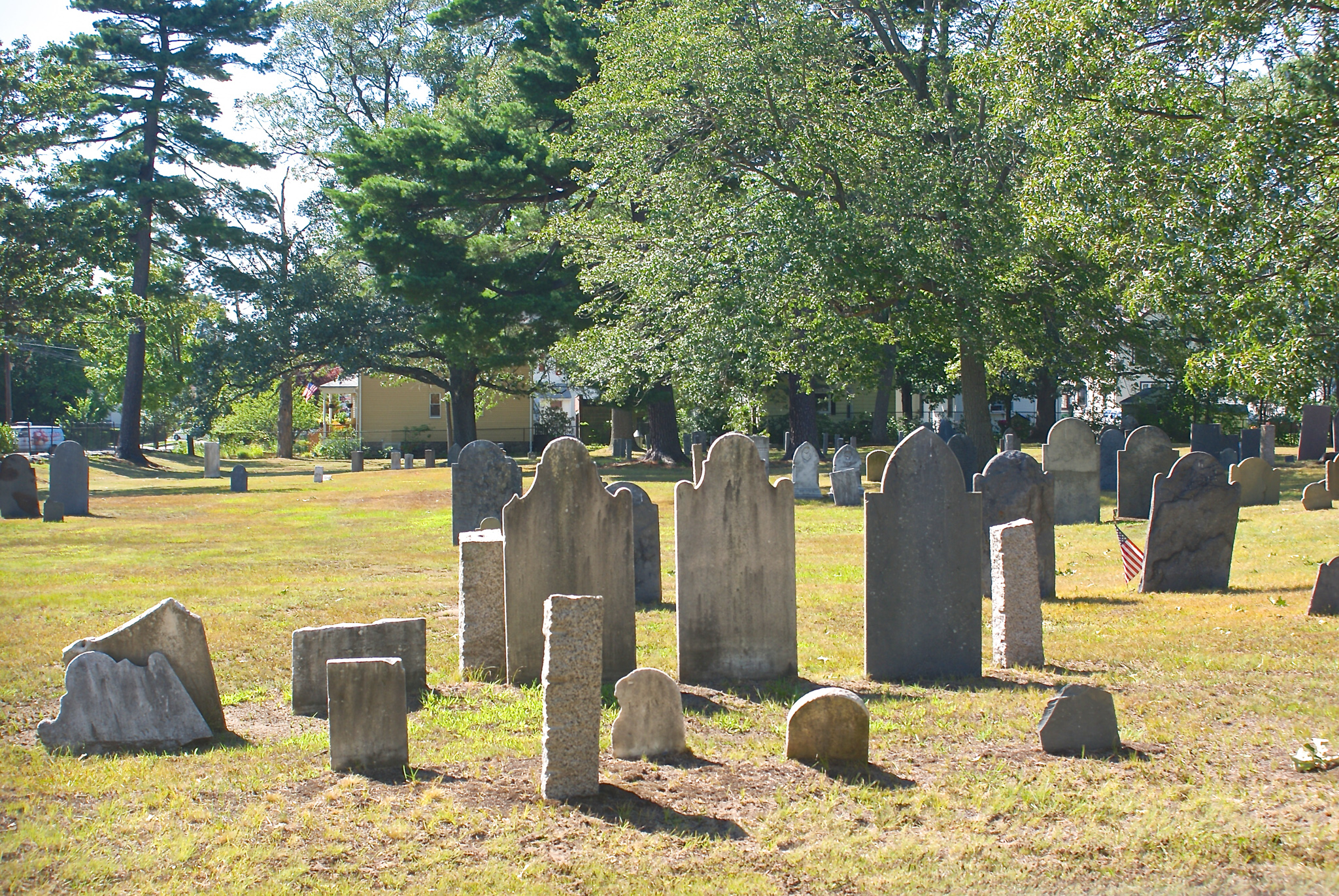
The West Parish Burying Ground, located at the corner of Cherry and River streets, was established in 1777, per Wikipedia, despite what the sign in the photo above indicates. Owned by the City of Newton, the graveyard was originally owned by the Second Church in Newton, which is located on Highland Street, just outside West Newton Square.

I haven't stopped by here in a few years, but I don't believe there is a way in to the boneyard, short of hopping the fence. But I could be wrong.
How about a statue of a different sort?

Located on a small triangle of land at the intersection of Highland and Chestnut streets on West Newton Hill, this sculpture is officially known as Child with Calla Lily Leaves, but is known more commonly as the Lambert Fountain. It was sculpted in 1903 by Anne Whitney, who was one of the rare successful, American female sculptors of the 19th century. Her best known statues include ones of Samuel Adams, Charles Sumner, William Lloyd Garrison, Harriet Beecher Stowe and Leif Erikson, the latter of which I photographed and wrote about in 2019 (see May 2, 2019, "'Weird Steel Pasties'").
"The first Child with Calla Lily Leaves appeared at the Chicago World's Fair in 1893 as one of the pieces on exhibit in the building of female architect, Sophia Hayden," according to MACRIS, citing information from a document filed with the Save Outdoor Sculptures! project. "This sculpture was donated to the City of Boston and was on view in Franklin Park until it was moved to the Children's Museum. From 1932 it was missing, never to be found. In the meantime, in 1903, following the death of her sister, Marianne Porter commissioned her close friend Anne Whitney to make a replica of the World's Fair sculpture in memory of Catherine Porter Lambert (1817-1900). The Lambert house was nearby at 128 Chestnut Street and Catherine Lambert had been one of the early residents of this part of Newton."
The statue was restored and rededicated in 1995.
A little ways south, on Berkeley Street, is The Neighborhood Club.
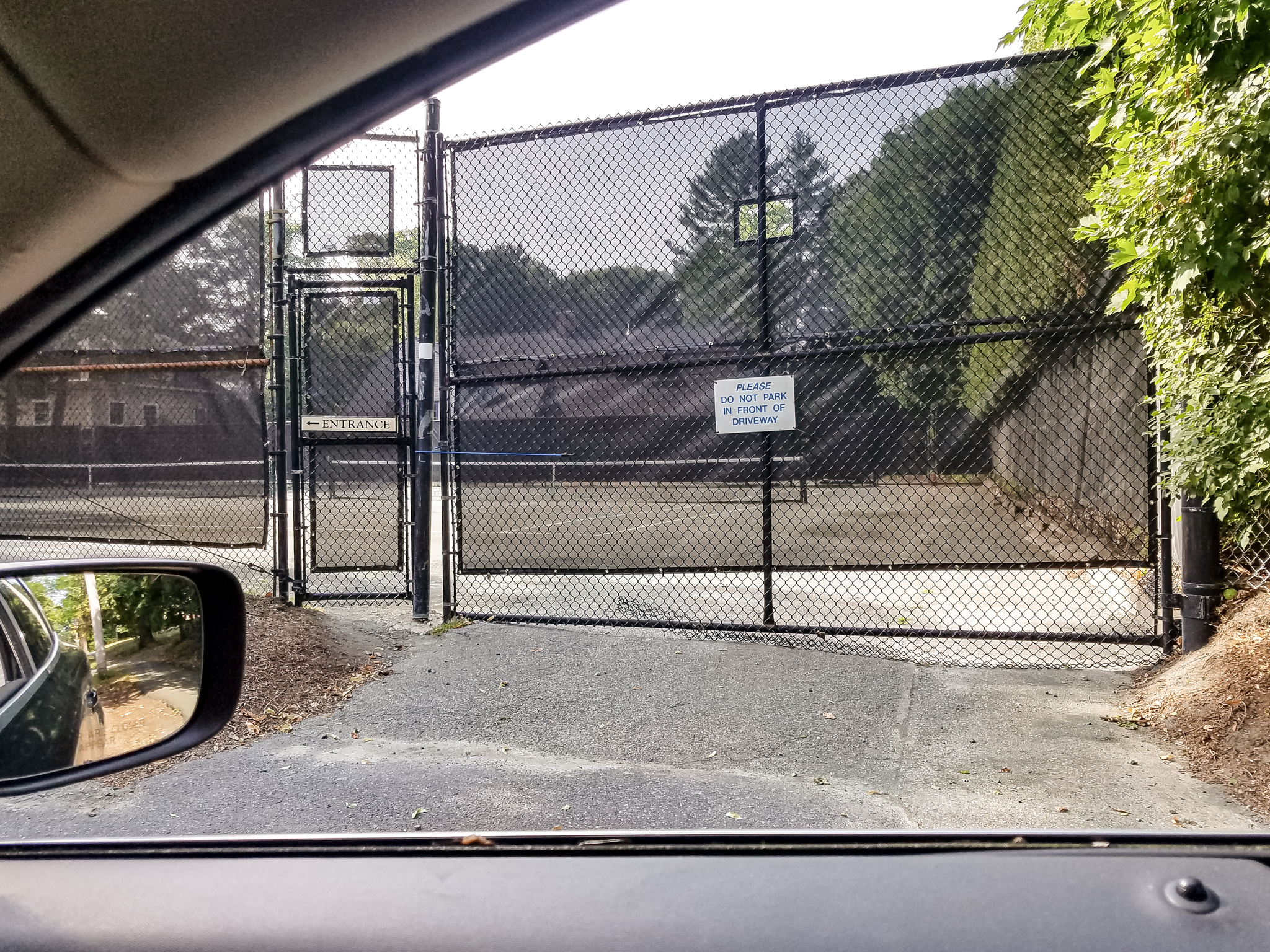
(It's difficult to get a shot of the clubhouse itself, so I just made a drive-by shot of the courts.)
The club was established in 1890 when five West Newton Hill men "all interested in the game of lawn tennis, held a meeting for the purpose of making plans to organize a club, to build tennis courts and a club house," per the club's web site. Each man recruited five men and thus was the club founded. Today, "Membership consists of 200 individuals and families within the West Newton zip code (02465)," per the web site.
I'm fascinated by social clubs of any sort, as regular blog readers likely know, from country clubs to neighborhood association (like Waban's Windsor Club) to fraternal organizations (Fraternal Order of Eagles, Masons) to groups based around shared ethnicity. As an introvert, I wouldn't want to join such a group, but I'm curious as to what goes on behind all of those closed doors.
Further south, as you head off the Hill and toward Commonwealth Avenue, is the All-Newton Music School.

Built in 1898 for Boston banker Henry B. Day and his wife, Julia, this "stone and shingle house is one of the most elaborate and grand of the late Colonial Revival houses to be built on West Newton Hill," per MACRIS. Day is the person who leased land to the organizers of The Neighborhood Club in 1890.
As for the music school, it provides lessons, classes and concerts to all ages. Founded in 1911 by Elizabeth Fyffe, a concert violinist, composer, and author of music instruction books, per the web site, "[t]he school was originally housed in a kindergarten school in West Newton, and developed a working relationship with Newton Public Schools." The school acquired this building in 1965.
Continuing with the West Newton school theme, below is a private home, which I don't usually feature, except in this case this lot is the former home of the Barnard School. I discovered this in the beginning stages of my "I Seek Newton" project, when I would obsessively scan the free Atlas maps available on the City of Newton web site.

Located on Shaw Street, between Winthrop and Washington streets, the Barnard School was built in 1884, according to this photo and information at Digital Commonwealth. I don't know when the school was torn down.
Back on the northern side of the Hill, along Chestnut Street, is the former Peirce School.

Opened in 1896, the school was named for Cyrus Peirce, "a noted educator" who "was instrumental in Horace Mann's experimental Normal school for teachers" in West Newton, per MACRIS. Born in neighboring Waltham in 1790, Peirce taught in Newton in 1807-1808, and again from 1844 to 1849 after long stints in Nantucket. In 1850, he became involved with Nathaniel Topliff Allen's school in West Newton, referenced in the first post in this West Newton series.
The old Peirce School shuttered as an educational institution in 1951, per Wikipedia. The building is now affordable housing. A newer Peirce School isn't far away, on Temple Street.
Along Waltham Street, near Newtonville, is the Fessenden School, which was established in 1903 by Frederick Fessenden and his wife, Emma Hart Fessenden, who had a plan to "start a small, pre-preparatory 'feeder' school for Phillips Exeter Academy," per the Fessenden web site.
Below is the school president's house.

"The Fessendens not only provided their young charges with academic instruction and athletic training, they also taught boys the basics of personal hygiene, good manners, and life skills," according to the web site. "Their approach was innovative -- an early version of 'whole child education' that proved extremely successful, and, in short order, the school added dormitories, classrooms, and playing fields to accommodate the growing numbers of students. Frederick led the school to prominence in the independent school world for 33 years, turning the reins over to his son, Hart, in 1935."
"Graduates include statesmen, business leaders, and philanthropists such as Howard Hughes, Senator Edward M. Kennedy, Governor William Scranton, and Secretary of State John Kerry."
As for the Second Empire house, it was built in 1874 for Andrew P. Conant, who was in the shoe business, per MACRIS. A family called Webster farmed the land, according to MACRIS, "and apple orchards climbed the hill."
Just north of the Fessenden School is the Scandinavian Living Center, a facility offering community-centered living and assisted living services, which I refer to as the Swedish Home for reasons that will become apparent below.

"In 1912, a nonprofit called the Swedish Charitable Society of Greater Boston was founded to provide a home for the aged, offer relief for the needy, and fundraise for charitable projects," per the SLC's web site. "The Society proudly opened the Swedish Home in 1917 on the same site where the Scandinavian Living Center now stands."
The facility extends well beyond the house shown in my photo above. Known as the Edwin Fleming House, the Queen Anne structure was built in 1870, although MACRIS indicates that "records at the City Engineering Department suggest that at least part of this house dates from 1859." Fleming was a bookbinder in Boston.
In this same neck of the woods, on the corner of North Gate Park and Adena Road is another one of those private houses that I claim to rarely feature.


Known as the Henry Gane House, this Second Empire home was built in 1865, per MACRIS, and is "one of Newton's most elaborate Mansard-style residences." I'll elaborate on the house in a moment, but first I want to relate the reason I made photos of it. My wife grew up in this area, and she and her family call this place the "Chinese Embassy" and the "Korean Consulate," so I assumed there was some connection with this old home and the Chinese or Korean diplomatic corps. Well, if there is, I haven't found it.
Anyway.
From MACRIS: "This residence, once surrounded by 16 acres of landscaped grounds and greenhouses, was constructed...at a location a few hundred feet from this site, at the southwest corner of Waltham and Derby streets....Gane was a well-known West Newton resident and a successful Boston merchant. Born in England, he came to the U.S. as a young man and started in the book binding trade, which he developed into a large business. Later he went into the mercantile line of book binders' supplies....On his retirement about twenty years before his death, he turned to the cultivation of flowers....
"His obituary continued: 'Mr. Gane made his name somewhat famous both here and abroad among chrysanthemum growers for his many seedlings which have taken prizes and which are recognized as among the choicest varities by florists.' After Gane's death in 1897, the land was subdivided. The house and two acres was bought by Alice M. Watkins, and much of the rest of the land was taken up by S. Edward Howard, instrumental in building the Northgate Club [which we'll get to next] and laying out Northgate Park. Henry Gane's house was moved to the corner of Northgate Park and Adena Road when the intersection was developed for house lots during World War I."
Lastly...the Northgate Club.
I believe the club was built in 1920, where South Gate and North Gate parks meet, just off Waltham Street, across from the Gane House. On the 1917 Atlas map for Newton, the site is listed as "Odd Fellows Building Association." There was an Odd Fellows Hall in West Newton Square; perhaps the organization owned this land and sold or leased it to the Northgate Club. Or perhaps Odd Fellows members started the club.
There were tennis courts behind the club, where two-family houses now stand. At some point, the Knights of Columbus took over the building. Houses were eventually built behind the club, resulting in the removal of the tennis courts. Several years ago, the Knights sold the building to developers and moved to a location in Newton's Nonantum neighborhood.
I made photos of the building in between the time the Knights sold the building and a developer turned it into condos. Below are the older shots.


Since the building was deemed historic, the developer renovated the building - and put a garage underneath - rather than tear it down. Below is what the place looks like now.

That wraps up West Newton! Stay tuned for the final installment in this series: Newtonville.
Below are the previous posts in this series:
December 31, 2021, "I Seek Newton, Part XI: Newton Corner (Section 3)"
December 18, 2021, "I Seek Newton, Part XI: Newton Corner (Section 2)"
December 11, 2021, "I Seek Newton, Part XI: Newton Corner (Section 1)"
April 10, 2021, "I Seek Newton, Part X: Newton Centre (Section 3)"
April 3, 2021, "I Seek Newton, Part X: Newton Centre (Section 2)"
March 27, 2021, "I Seek Newton, Part X: Newton Centre (Section 1)"
November 15, 2020, "I Seek Newton, Part IX: Nonantum (Section 3)"
October 29, 2020, "I Seek Newton, Part IX: Nonantum (Section 2)"
September 24, 2020, "I Seek Newton, Part IX: Nonantum (Section 1)"
March 14, 2018, "I Seek Newton, Part VIII: Upper Falls (Section 3)"
March 8, 2018, "I Seek Newton, Part VIII: Upper Falls (Section 2)"
March 1, 2018, "I Seek Newton, Part VIII: Upper Falls (Section 1)"
March 7, 2017, "I Seek Newton, Part VII: Thompsonville"
December 5, 2016, "I Seek Newton, Part VI: Chestnut Hill"
September 26, 2016, "I Seek Newton, Part V: Oak Hill"
June 3, 2016, "I Seek Newton, Part IV: Waban"
March 23, 2016, "I Seek Newton, Part III: Newton Highlands"
September 20, 2015, "I Seek Newton, Part II: Auburndale"
May 21, 2015, "I Seek Newton, Part I: Lower Falls"


