Showing posts with label train cars. Show all posts

Saturday, December 2, 2023

Webster: Founded by a Famous Industrialist, Named for a Well-Known Statesman

From Dave Brigham:

Thanks to a tip from a loyal reader of the blog, I recently checked out Webster, Mass., a former mill town located in south-central Worcester County along the Connecticut border. A town of just under 18,000 people, Webster was once home to numerous thriving factories, and is populated by many great old buildings from the late 19th and early 20th centuries.

From Wikipedia: "The area that is now Webster was the ancestral home of the Nipmuc people for thousands of years. It was first settled by Europeans in 1713 and was officially incorporated on March 6, 1832. The area forming the town had previously been divided among the town of Dudley, the town of Oxford and an unincorporated gore (an irregular parcel of land -- DB). The primary founder was the manufacturer Samuel Slater, who came to the area after his celebrated activities in Pawtucket, Rhode Island, and founded several textile mills, one of which was taken over by the Cranston Print Works in 1936. He named the town after his friend Daniel Webster."

Well, that's quite a nice gift from one friend to another.

I started my tour at the former Slater Woolen Mill, which is located off South Main Street, near the intersection with East Main Street. I hit a lot of sites in Webster, so strap in for a long post.

The building above was the spinning and carding mill, which was built in 1876, according to MACRIS. Carding is "a mechanical process that disentangles, cleans and intermixes fibres to produce a continuous web or sliver suitable for subsequent processing," according to Wikipedia.

These days I believe there are a few small manufacturing companies occupying the building shown above.

Known as the Father of the American Industrial Revolution, Samuel Slater was born in England and came to Rhode Island in 1789 at the age of 21. Long story, short: he caught on with a pair of industrialists in Pawtucket, Rhode Island, where he brought his knowledge of cotton spinning gathered as an apprentice in England. He eventually designed the first textile mills in America, was quite successful in his adventures in Lil Rhody, and moved to Webster to do more of the same.

Slater died in 1835, and his sons, George and Horatio, took over the business, according to An Architectural and Historical Survey of Webster, Massachusetts, issued by the town's historical commission in 1979. "The Slater Company continued to prosper throughout the 19th century," the report continues. "The sale of cloth for uniforms contributed in a large way to this prosperity. Since the days of the Civil War, the Slater Woolen Company's profits due to the sale of uniforms had been on the increase."

The mill was in operation until 1954, the final 31 years under the name American Woolen Co. Other businesses eventually moved into the property, but a fire in the late 1960s destroyed many of the buildings. Well, that's a bummer for the company, the town and urbex enthusiasts like me.

As for the spinning and carding mill, it "was built on the site of the old brick mill which had been built in 1824 and which was the nucleus of the manufacturing activities in the South Village," per MACRIS. "Designed by the prominent Worcester architectural firm, Eldridge Boyden and Sons, in 1876, the building has an ornamental clock tower as well as corbelled brickwork and crenellations."

Unfortunately, the clock was removed from the tower at some point in the last 40 years.

Workers at the mill in its later days would likely have eaten regularly at the nearby diner on South Main Street.
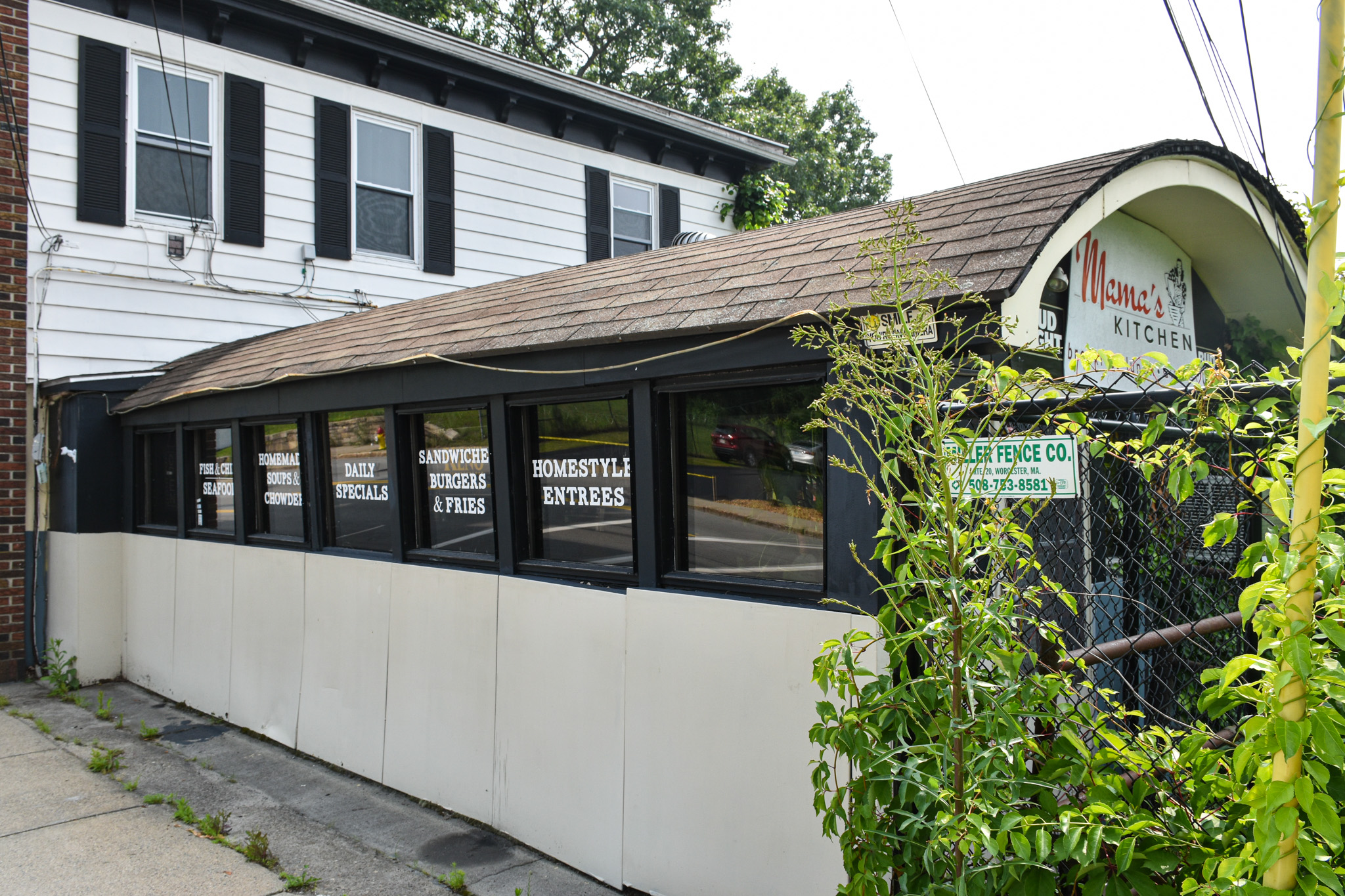
Known for years as Nap's Diner, this Worcester Lunch Car Company eatery is currently operating as Mama's Kitchen, and serves breakfast, lunch and dinner. The diner car was moved to this site "about 1941," per MACRIS, after the company redid the exterior. The diner was built as Worcester #682 and was originally located in Drury Square in Auburn. Nap's was in business until sometime this century.

A rear kitchen annex was built in the 1940s, MACRIS speculates. The brick building next door is part of the restaurant, and predates the diner at this location. Under that brick is a wooden structure that was originally a house.

A short distance south from the diner is Pete's Tire & Oil, which has been in business since 1988. Although the sign is newer, I really dig it.

Continuing south, I was happy to see Serenity Hall, as I'd stumbled across this odd-looking joint on Google Maps when doing some "presearch" before hitting Webster (I can't believe I've never thought to use that made-up word before).

This one is a real head-scratcher. On Google Maps Street View I was able to look back to 2007 - and this building looks the same, except the colors are a bit more muted. Back then, this space was occupied by a place called Closet Classics. Nowadays, at least part of it is home to Alcoholics Anonymous, and the building is known as Serenity Hall, after the AA prayer ("God, grant me the serenity to accept the things I cannot change / The courage to change the things I can / And the wisdom to know the difference").

I haven't been able to find any history of the building. I'd love to know what it looked like when it was built, and who decided to change it so drastically.

From the parking lot behind Serenity Hall, I made a shot of what I thought was a ghost sign in Webster. Turns out it's an active business, and it's actually located over the line in the town of Dudley.

Shield Packaging, which formulates and packages aerosol and liquids for household, automotive and industrial applications, has been in business since 1956. I believe the building was once part of the Slater/Anerican Woolen complex. MACRIS indicates it was built sometime between 1900 and 1905. There are a few other buildings featured below that may be remnants of the old mill as well.

I continued along South Main Street until it became Main Street, where I saw some livestock.

Installed a few years ago to promote the opening of Webster's Samuel Slater Experience museum, the sheep (I'm not sure how many are spread around town) are made of fiberglass and clear-coated for longevity. The one in the top photo features an ad for JV Mechanical Contractors (artist: Dave Laabs), while the other is sponsored by Bennett and Carol Smith (the artists are Jenny Gatzke and Gus McGarry).

The Samuel Slater Experience is located in the former Webster Armory, and focuses on textile manufacturing and the life and work of Samuel Slater. Based on the Experience's web site, the museum appears to mix tours through recreations of mills with videos produced with actors portraying Slater and other characters.

There is no shortage of homage to Slater in Webster. At the corner of Main and Davis streets there is a large mural on the side of a building featuring a nice rendering of downtown, as well as the visages of Daniel Webster and Samuel Slater.

(Samuel Slater)

This work was also done by Dave Laabs, owner of the Airbrush Shack in Thompson, Connecticut.

(Daniel Webster)

This brings me to downtown, which features a great collection of old buildings. First up is the Hall Block at 274 Main Street.

MACRIS provides scant detail, other than that this place was built in 1915. Charniak Insurance has been in business for 50 years. The brilliantly named Snack & Smoke, alas, is out of business (this store reminds me of an idea I hatched many years ago to launch a chain of Nap & Snack stores).

Next door is the Hall Block's fraternal twin.

This place also dates to 1915. Paradise Family Jewelers seems to have been in business until fairly recently, but when I happened by, the space had a FOR RENT sign up. Its neighbor is Iglesia Cristiana, a Spanish-language church.

At this point, I cut north down Tracy Court, which dead-ends at a closed-off bridge over the French River. On the other side, located in Dudley, I spied a former Webster Lens facility.

I haven't found out much about Webster Lens, other than that a Commonwealth of Massachusetts report covering the years 2004-2008 and the French River watershed specifies that this industrial property is/was a hazardous waste site. This property is close to the aforementioned Shield Packaging site, so may also be part of the former Slater mill operation. Below is another building that may have been part of Webster Lens.

Nearby is a nice old train trestle spanning the French River.

Back on Main Street, I continued to shoot buildings on the south side. Below is the Columbia Block, which dates to 1892, and has a connection to the Slater family.

From MACRIS: "In the Summer of 1891, Charles Lueth bought this property...and began digging a cellar on August 24. He planned an elegant hotel for the site with '30 rooms, wired and with steam heat and an elevator.' The walls were completed except for the front, the roof was on, and the name 'Elm House' (named for the great elm [sic] which had stood on the property) was cut in a stone on the front, when the work was stopped.

"On April 25, 1892, the unfinished building was purchased at auction by S. Slater and Sons. Shortly afterwards, the inscription 'Elm House' was changed to '1892.'....Frank Upham, a builder altered the plans and finished the work for Horatio N. Slater (grandson of Samuel Slater) at a cost of $25,000 to 30,000. Slater opened a dry goods and fancy goods store, The New York Store on March 19, 1893. The building also contained three upper floors, the top floor being an elegant hall, Columbian Hall."

Other tenants over the years have included the Webster Public Library, Woolworth's and Aubuchon's Hardware. Currently, at least part of the space is occupied by a mental health clinic.

The Columbia Block has a few ghost signs, which I was excited to see.

The Coca-Cola ad was retouched fairly recently. Racicot Brothers was located in a nearby block, which I will detail below.

At 174 Main Street is the Richard J. Murphy Building, which rose in 1939.

Businesses located here include FoodFit4U, which prepares gourmet meals for pickup or delivery, and Opening the Word, a peer recovery center.

I wandered west along Main Street and off in the distance, spied something that drew me in like ants to a picnic...but you'll have to wait to read about it, because it was over the border in Dudley, and will get its own post in the near future.

After chatting with some random guy about how hot it was (this was over the summer) and how he took a dip in some reservoir, I checked out some old train cars along Davis Street that I believe belong to the Providence and Worcester Railfan Club Museum in Webster.

(A boxcar from Seaview Railroad, which operates in Rhode Island.)

(A flatcar from the Milwaukee Road, officially known as the "Chicago, Milwaukee, St. Paul and Pacific Railroad...[which] was a Class I railroad that operated in the Midwest and Northwest of the United States from 1847 until 1986," per Wikipedia.)

(An adorable little rail car.)

(New Haven engine.)

Across from the train collection is 8 Davis Street, which was most recently home to the Beauty Bar and B. Kind Cafe. I don't believe either is in business here anymore.

I wish I'd seen two other buildings that used to stand along Davis Street: the City Hotel, which was built in 1897, and Edmunds Opera House, which rose in 1867. They were demolished at some point.

Nevertheless, I found plenty of great buildings as I headed back east on Main Street. Below is the Shumway Block, located along Main Street where the train tracks cross.

This Victorian Eclectic building replaced the Merchants Block, which was built in 1866 and burned down 20 years later.

Across Main Street is the Eddy Block, a High Victorian Gothic building that dates to 1878.

From MACRIS: "The L.R. Eddy Block...has been a commercial building since it was erected in 1878. It was built on the site of the Mechanic Block, which burned on September 30, 1876." Tenants over the past 145 years have included the post office, a men's clothing store, an insurance company and a smoke shop. Current tenants include Clippin' Tymes Barber Shop and Stave & Still, which offers handcrafted cocktails, modern fare and Southern hospitality, per its web site.

I took a quick detour down School Street to check out the building currently housing Sight Centre, a "one-stop family eye care" shop.

Built in the 1885-1887 range (MACRIS is a little unclear), the Bates Block (no, no that Bates) was initially a hardware store and sheet iron workshop. After A.J. Bates and Sons was sold, another hardware store occupied this space for many years. MACRIS references more recent tenants (from the late '70s), Barre's Toys and Plastecs Co., the latter of which evidently manufactured "sun powered novelties and toys" on the second floor.

Continuing back on Main Street, we next come to the English Revival Spaulding Block (on the left, below).

From MACRIS: "One of the oldest block buildings in the downtown section of Webster, the Spaulding block, was built by Cyrus Spaulding in 1866 to house his hardware business," which he'd taken over from his father. In addition to stores on the ground floor, the block was also home to the printing office of The Webster Times, as well as a Masonic Lodge and the Webster Sigel Lodge, a German-American fraternal organization. I believe the building is currently part of the neighboring Crown Supply business.

Bouncing back across to the south side of Main Street, I spied a sign that immediately grabbed my attention: JOSLIN HOUSE APARTMENTS circa 1844.

That date is somewhat misleading, as the brick building that now stands at 168 Main Street replaced the original wood-frame hotel that rose in 1844, and which was "[f]or many years one of the most well known and most frequented hotels in Webster," according to MACRIS. Originally called the Webster Temperance House, the hotel was operated by Nathan Joslin. "Details from early prints and postcards of the building show it to have many federal style features and set far back from the street," MACRIS indicates. "The building was enlarged and altered many times until by the late 19th century it looked radically different. A verandah and bandstand were added at sometime after 1850 with gatherings and band concerts held there fpr many years."

After changing hands several times, the building was eventually acquired by James Ryan in 1923. "During Mr. Ryan's ownership the hotel had its worst fire (October 1939) which leveled the entire wooden structure . The following year the hotel was rebuilt of brick by Emil Dupont, a local builder and this structure stands on the site today."

Back across to the other side of Main Street, to the Gilles Block.

Rebuilt in 1925 after a serious fire the year before, the Gilles Block has over the years been used as a jewelry store, a meat market and an optician's store, according to MACRIS. When I visited Webster, I assumed that Wine Studio 51 was in business (with a nice mural on the side of the building as an advertisement, seen below). But when I looked closer at the photo, I noticed the smaller sign indicating COMING SOON TO WEBSTER MA CALI-RITO'S BURRITO GRILL.

Cali-Rito's has two outlets in New Bedford, and one each in Worcester and Northborough. As for the wine bar, I'm not sure it ever opened. In June 2021, the "forthcoming" Wine Studio 51 was issued a $10,000 grant from the Town of Webster, along with a $10,000 refundable tax credit from the state, according to this Worcester Business Journal article.

Adjacent to the Gilles Block is the Tiffany Block, which features a great example of a storefront church, something I always keep an eye out for while backsidin'.

"Erected in 1926 by Luman H. Tiffany...The building was originally built to house the J.C. Penney Store with apartments on the upper floors," per MACRIS. "After the J.C. Penney store closed the street level was occuppied by the A.M. Kouri Company, a clothing store." In more recent years, this space was occupied by The Party Planner and Vee's Furniture and Mattresses. As you can see, the tenant nowadays is Iglesia Misionera Ciudad Santa, a Spanish-language church.

The major downtown Webster tenant is MAPFRE USA, which is located in the Racicot Block, whose rose in 1905.

The North American division of a Spanish multinational insurance carrier, MAPFRE USA is headquartered elsewhere in Webster but maintains a significant presence downtown. As for the Racicot Block, it was once the headquarters of a homegrown business empire that, according to MACRIS, for "many years remained one of the leading business firms in the town."

Racicot Brothers was founded in 1897. From MACRIS: "In the days when the horse was surpreme, the Racicot Bros. maintained a stable of 22 horses, and from Webster as a center, these horses, attached to the well-remembered 'Racicot Bros.' wagons radiated to the four points of the compass every day. Twenty-five men were employed, most of them on the road, selling tea, coffee and furniture in towns of three states [Massachusetts, Connecticut and Rhode Island]."

By 1901, the brothers, Alexander and Arthur, had acquired a furniture company and combined that venture with tea business, moving into a building across Main Street -- the one with ghost sign pictured above, I believe. Other businesses were located in the building, as was a hall for events. Eventually, younger family members joined the operation, and opened an undertaker business on site.

In 1927, a W.T. Grant store opened in the Racicot Block - how many times have I written about those former department stores?! At some point, Grant's moved elsewhere in town and The House of Bargains moved in, according to MACRIS.

Next on our survey of downtown Webster is the Larchar-Branch Block, which dates to 1912.

Currently home to Luk, Inc., a "not-for-profit social service agency...dedicated to improving the lives of youth and their families....[offering] a full spectrum of programs addressing mental health, trauma, addiction and substance abuse prevention, homelessness, and more," the L-B Block was within three years of its opening greatly enhanced by the addition of a theater.

From MACRIS: "In 1915 a 'modern theatre building' was built into the ground floor of the building and named the Steinberg Theatre after Henry Steinberg, who was one of the theatre's first owners as well as its first managers." MACRIS continues: "In 1954 the theatre, now known as the State Theatre, was closed for nearly one year for modernization, and reopened with cinemascope (sic) and vistavision (sic). This same theatre...was closed in 1967."

Next is the large and impressive Holden Block, which was built in 1921.

This place was quite a hub of activity in its heyday, with eight storefronts on the ground floor, pool tables and bowling alleys in the basement and a grand hall on the second floor. From, who else, MACRIS: "Surrounded by a gallery that had a seating capacity of 500,the floor space beneath provided room for 500 couples. A splendid dance floor was installed and a stage erected which was available for entertainment and later on, for motion pictures. This hall occupied the entire second floor of the building, which was 76 feet deep and had a frontage of 120 feet. Checkrooms, refreshment stands, smoking room, and everything for the convenience of patrons had been embodied in the hall."

It's hard to imagine now that in downtown Webster 100 years ago there were two (or perhaps more) theaters so close to each other. In more recent years the grand hall was occupied by a roller-skating rink.

Current tenants include Webster Asian Bodywork, Rob Roy Hair Salon and Liberty Tax.

The penultimate building along Main Street that I want to highlight is the Patenaude Block.

Currently home to Webster's Choice Barber Shop (New World Studios does not appear to be in business, at least not at this location), the building dates to, ahem, 1900 per the Webster assessor's office. That's all I've been able to find out about this place.

The last stop on this part of the tour presents the smallest building of the lot.

The Dugan Block rose in 1922 and was originally home to a drug store. That store was in business until at least the late 1970s, per MACRIS. The current tenant is Masis Staffing Solutions.

At this point, I veered off Main Street and headed east on Lake Street. There, I saw the Pastime Cafe.

Located on the ground floor of a residential building, the cafe appears to be past its time. I haven't been able to find out when it opened or when it closed.

Just up the street is Holy Trinity Parish.

Built in 1903, the Gothic Revival church was originally affiliated with the Polish National Catholic Church (and may still be). "The Polish National Catholic Church was established on March 14, 1897 in Scranton, Pennsylvania," according to Encyclopedia.com. "It came into existence as a result of the resentment of Polish Catholics to the lack of Polish-speaking clergy and disputes over legal, property, and other administrative issues. Its origins go back to the turn of the century when thousands of Poles arrived in the U.S. and, like most national groups, tended to settle among their own countrymen in Polish-speaking communities located in Massachusetts, Connecticut, New York, New Jersey, Pennsylvania, Ohio, Michigan, Illinois, and Wisconsin."

As I headed out of town, I stopped by Mohegan Bowl, just to see the sign.

I discovered this old bowling alley during my pre-trip online research. First opened in 1958, Mohegan came under new ownership in 2012, when "Ed & Kelli Kinsley relocated from Southern California" to renovate the place, according to the web site. I'm not sure whether the lanes were closed at some point before 2012. "Since the purchase, the center has undergone major renovations including 6 new ten pin lanes and 14 candlepin lanes, a state of the art game room, a pizza and appetizer menu, and an assortment of over 30 beers and wines, with 7 beers on tap. The most recent addition was a 5,000 sq ft laser tag facility."

Sounds pretty great.

To wrap up this post, I'm doing something that I don't think I've ever done. I'm going to offer brief write-ups of places that I had on my list to explore, but that I couldn't fit in due to a time constraint.

The TSKK Club is located at 21 Harris Street. Y'all know I love a good social club, but unfortunately, there are many zones in Webster where Google Street View isn't offered, so I can't provide a photo. As for the club, it was established in 1909 and is a Polish association whose acronym translates into English, roughly, as "The company of Saint Casimir the Prince." According to Wikipedia, "Casimir Jagiellon (...3 October 1458 – 4 March 1484) was a prince of the Kingdom of Poland and of the Grand Duchy of Lithuania."

The Polish-American Citizens Club (PACC) is also located on Harris St., in a no-Street View zone. From the club's web site: "The club formed originally in 1907 under the name of Polish Political Club and was incorporated the following year in 1908. its original purpose was to help Polish immigrants in the Webster-Dudley area find housing, work and engage in local politics and the community. In 1926 the decision was made and paperwork was filed to officially change the name of the club to...the Polish American Citizens Club. While most of its original mission remained the club took on a more social role acting as a gathering grounds for the established Polish community in the local area. It allowed members and the community to gather and discuss issues while also allowing members to have a sense of belonging. The current building that houses the P.A.C.C....was authorized and constructed was finished in 1956.

The Snow's Corner Horse Trough is located along Church Street, at the side of town hall. "The monument located on the Western (sic) side of the Webster Town Common is in actuality an old horse-watering trough, used many years ago before 'horse power' was invented," according to MACRIS. "It was taken from 'Snows Corner' on upper School Street in 1953 by the Webster-Dudley Garden Club and placed at its present location. It is a small reminder of the way things used to be in past years."

(The old horse trough.)

The Perryville Road Trolley Car Station is located at 7 Perryville Road, near the intersection with School Street, on the property of M&M Excavators. From MACRIS: "This unassuming brick structure was the cause of much excitement when it was built in 1898. On July 15th of that year the electric trolley car route, which had run from High and Main Streets to Beacon Park (an amusement park on Webster Lake), was extended to the top of School Street at its junction with Perryville Road. This building was the substation for the trolley car route."

(The old trolley car station.)

Trolley service in Webster ended in June 1927.

At 132 High St is the former Sigel Hall, also known as Congregation Sons of Israel Synagogue.

"Sigel Hall was built in 1875 to house the activities of Sigel Lodge, D.O.H., a benevolent order of german (sic) citizens (with lodges in eveyy state)," according to MACRIS. "More specifically , the organization was founded in New York City i n 1847 for the purpose of 'mutual support in sickness and death, and for the promotion of the interests of the german (sic) population of this country generally."

More from MACRIS: "In April 1919 the building and hall were sold to the Jewish community, who had been holding services in the hall for several years, by Charles Gerber, a trustee of the german (sic) society."

(Sigel Hall. Notice the Stars of David above top windows.)

I'm guessing the old lodge and synagogue is a residential building now.

Where North Main Street curves west to meet Cemetery Drive, there is an old train trestle.

The B and A Railroad Bridge was built around 1888 and spans the French River as well as active tracks of the Providence and Worcester Railroad. The bridge has evidently been modified and shortened over the years.

The final two sites are near the Price Chopper shopping plaza, close to I-395: the Slater Sunday School monument, and the Samuel S. Slater and Son Green Mill Bell Tower.

Across East Main Street/Route 16 from Price Chopper, the plaque above is situated close to where "it is believed Samuel Slater built the first Sunday School for workers' children in this area of Massachusetts," according to MACRIS. "The school itself was built about 1815."

Just west of that marker, at the intersection of East Main Street and Worcester Road, is the bell tower.

Again, from MACRIS: "The monument is a reconditioned bell tower built prior to 1870 which was used to summon workers to the mill, announce lunch and the end of the working day. It is the oldest remaining section of the Slater cotton mill in the East Village, and is near the site where Slater first erected mill structures in about 1812. The Slater family sold their manufactoring concerns in Webster in 1923."

So there you have Webster! Make sure to check back soon for my write-up about a factory just over the line in Dudley.

Saturday, June 24, 2023

Cambridgeport, Part II: Cool Art/Famous Auto Shop/Former Teeth Maker/Much More

From Dave Brigham:

Cambridgeport is bigger in person than it is on a map.

The camera adds 10 pounds to Cambridgeport.

CAUTION: Cambridgeport in the real world is bigger than it appears.

Yes, Cambridgeport, all of those restaurants, sidewalk art pieces, rowhouses, ghost signs, old churches, freight cars and shuttered gay bars DO make your backside look big.

OK, so I'm no stand-up comic. I'm just trying to get across the point that when I first considered exploring Cambridgeport -- located in the southeastern section of this notoriously liberal enclave -- I pictured walking it in a day and writing one post. I should've known better. I used to work in this area, for Chrissakes!

On my initial foray into Cambridgeport, I wrote about buildings owned or leased by the Massachusetts Institute of Technology, known around here, and pretty much everywhere, as MIT (see June 17, 2023, "Cambridgeport, Part I: MIT/Biotechs/Nuclear Reactor/and Maybe Death Rays"). That post included plenty of bio-tech and other science-y companies.

Today, I take on things on the south side of Cambridgeport that aren't connected to the egghead university. Things such as a historic park built by soldiers of the Continental Army; the former home of Myerson Tooth Corp.; the workplace of one-time radio sensations Click and Clack; some cool artist homes; some murals and mosaics; a historic church under renovation; a ghost sign; a breakfast joint in business since 1937; and much more!

Let's start in Paradise.

Or rather, outside it. Located at the corner of Albany Street and Massachusetts Avenue, across from MIT's nuclear reactor, this lovely orange-brick building dates to 1910, per the assessor's office. For many years, Paradise was a gay night club, a "porn covered" place, a "fog rolling, liquor slinging dive," according to this Gay Bars in Boston write-up. "They [had] an upstairs bar with go go boys, and a dance floor downstairs," the review continues. I wonder how many out-of-towners over the years confused this place with the Paradise Rock Club near Boston University, and showed up expecting to see an alt-rock or reggae show and found themselves in unfamiliar, but titillating, territory.

Cambridge's Paradise closed on September 15, 2018, its final bash featuring music by Cajjmere Ray, according to something I read online. I believe the space has been incorporated into the neighboring Novartis Institutes for BioMedical Research facility.

Less than a mile away, at a mini-rotary where Albany, Erie and Waverly streets come together, is a sign post honoring a local icon from Cambridge's past.

Henry Goldberg Square recognizes the founder of Cambridge Tire, which was located at 290 Albany Street, very close to this sign. The tire company's "roots [went] back to 1914 when the younger [Henry's father] started a scrap tire and battery business in New Jersey," according to this December 30, 1983, Christian Science Monitor article. The company became inactive in 2019, according to a listing at the Open Corporates web site.

Directly behind this sign, you can see part of 40 Erie Street, a large complex of several buildings that is home to companies including Intellia Therapeutics and Neon Therapeutics. And, as you can see in the photo below, this address is also where an outlet of Flour Bakery & Cafe is located.

Founded in 2000 in Boston's South End, Flour has four locations in that city and in Cambridge. As for the building...I haven't been able to find out anything. It looks old, but everything around is new and is listed as having been built within the last 25 years, according to the assessor.

A short jog away, continuing southwest along Waverly Street, is Fort Washington Park.

Squeezed between two large parking lots, Waverly Street and a lightly active set of railroad tracks, the small park "was built by soldiers of the Continental Army under the orders of George Washington in November 1775," according to Wikipedia. "It is the oldest surviving fortification from the American Revolutionary War and the only surviving fortification from the Siege of Boston."

Well, damn, if that doesn't blow your powdered wig off, nothing will.

(Sculpture of Revolutionary War soldiers created by Madeleine Lord.)

"The property was acquired by the City of Cambridge and restored in 1857, at which time three 18-pounder cannons from the old Fort Winthrop, located on Governor's Island, were installed, and an elaborate granite and iron fence was designed by architect John R. Hall to protect the site," Wikipedia indicates.

The park is lined with trees, and offers a nice oasis in a desert of high-tech and institutional buildings, parking lots and ongoing construction.

The railroad right-of-way I mentioned above (and in the first Cambridgeport post) is the Grand Junction Railroad, which connects the former Beacon Park Yard along the Massachusetts Turnpike in Allston to the MBTA's Fitchburg Line commuter rail tracks near North Station. The Grand Junction is "used by the MBTA to transfer southside commuter rail equipment to and from the MBTA Commuter Rail Maintenance Facility, and by Amtrak to transfer Downeaster equipment to and from Southampton Street Yard," according to Wikipedia. "Until 2018, CSX Transportation operated one daily freight to the New England Produce Center and scrap yards in Everett. The Barnum and Bailey Circus train often parked on the Grand Junction while the circus was in Boston."

(Freight cars along the Grand Junction.)

Around the corner from Fort Washington Park, at 625 Putnam Avenue, I spied the amazing work of art below.

"A HOUSE IS MADE OF WALLS AND BEAMS / A HOME IS BUILT WITH LOVE AND DREAMS," is the quote accompanying this fantastic mosaic work on a public housing project known as Putnam Green. The art depicts people of many ethnicities building, playing, riding bikes and spending time together. I haven't been able to figure out who made this mosaic.

At the southern outskirt of Cambridgeport, in the shadow of Memorial Drive as it flies over the traffic circle near the Boston University bridge, I spied a World War II monument.

The carved stone honors the men and women of Cambrideport who served their country "with dedication and devotion" during the battles in Europe and the Pacific.

I know I've made this point before, but the photos below will help prove it: when exploring the backside of America, it's crucial to keep your head on a swivel, and to approach buildings from more than one angle.

I walked past Cambridge Pizzeria on Brookline Street and barely paid attention. Nice little building, I thought. Later in my walk, as I was heading back to my car, I walked past the pizza joint from the east, and that nice little building all of a sudden became an amazing ghost sign!

I can read BORELLI and after that I think it says BROS. I'm not sure if this was a market or just a liquor store, but the retailer offered free delivery of beer and wine. I love stumbling across signs like this, especially ones that are so well preserved.

Prior to walking past the pizza place, I passed a mosaic laid into the sidewalk.

A short walk away from Cambridge Pizzeria, at the perimeter of Old Morse Park, there is display explaining that the work of art I'd just seen is part of the Public Art for Brookline Street Improvement Project. The project consists of several mosaics by artist and teacher Mike Mandel, representing local residents, companies that were once sited in the neighborhood, a former nightclub and more.

"Since the early '90s Mandel's work has worked extensively on public art projects transforming photographic imagery into large scale glass and ceramic tile mosaic murals," according to the second link above. "He has been awarded several NEA grants and a Fullbright Fellowship." He has also published several books.

See more of Mandel's public art projects here.

As for the mosaic shown above, it depicts Geneva Malenfant, a local community activist and former president of the Cambridge Civic Association. Malenfant, who passed away in 2009, was instrumental in realizing the development of the aforementioned Putnam Green affordable housing complex.

As I walked through this part of Cambridgeport, I kept my eyes peeled for more of the mosaics. I found a few others.

"Simplex Wire and Cable Company’s first Cambridge building was built in 1886, and more than a dozen followed before World War I," according to the City of Cambridge web site linked above. "The company was known for its fabrication of steel-wire products, such as bird cages and fire screens. In 1888 the company took over a former bakery at 112 Franklin Street, the first step in an eventual occupation of most of the surrounding blocks. Most of the buildings were razed in the 1970s."

"The Cambridgeport Community Garden, located at the vorner (sic) of Brookline and Emily Street, was started in 1974. At the outset the garden was a vacant lot strewn with trash and garbage. Over the years the community has added a water source, a shed and three composters."

"Bounded by Rockingham, Henry, Chestnut and Brookline Sts. Hastings Square oginated as a gift of land from Edmund Trowbridge Hastings to the City of Cambridge in 1857," per the City web site. "It is listed as part of the National Registory of Historic Places."

Four other mosaics have yet to be installed, one each for businesses New England Carbide, Strafel Shoe and Nabisco, as well as for Man ay, a nightclub known for alternative and goth music. The club was open from 1985 to 2005, when it was demolished in favor of apartments. Recently, the club reopened in a new space in Central Square.

There are three other works that I was unable to find, one each for Clark & Sons, a telescope maker, Morse School and Tom & Joe, the Hughes brothers who lived in Cambrideport. I came across two sections of sidewalk that looked as though they either had held mosaics that were removed, or may one day soon.

Across Allston Street from Old Morse Park is St. Augustine's African Orthodox Church, which is under restoration.

Located at 137 Allston Street, the church "was constructed in 1886 as St. Philip’s, a mission of St. Peter’s Episcopal Church in Central Square," according to this Final Landmark Designation Study Report from the City of Cambridge. "It was the first church to open in the Pine Grove neighborhood of Cambridgeport and was so popular that it had to be enlarged two years later. The building was sold in 1928 to the trustees of a new denomination, the African Orthodox Church."

"Through various fund-raising efforts and grants, the Church is moving forward with efforts to restore and update the building," the study report continues. "These efforts have been spearheaded by the Cambridgeport Neighborhood Association (CNA) and Black History in Action for Cambridgeport (BHAC). The CNA worked with the church’s trustees to publicize the building’s deteriorating condition and raise funds for the restoration project. The BHAC has taken up stewardship of the building with the goal of preserving the community service legacy of St. Augustine’s with programs focused on Black culture, arts, history, and education for all."

Such great news about a great project.

Parallel to Allston Street heading northeast is Hamilton Street, where I found some cool old buildings, as well as an unusual juxtaposition of architecural styles, the work home of a well-known radio duo and a few other great things.

I dig this eight-unit apartment building, which dates to 1890. The third-floor addition fits in well and the distressed-brick facade gives this updated place a lived-in look. The low industrial building just to the north of this place is home to shared-scooter company Superpedestrian. The 1930 Atlas map indicates that building was once home to Ohio Chemical & Manufacturing Company. Sure, the business name is fairly non-descript, but it leads into a discussion about how this area of Cambridgeport was once home to denture manufacturers and related companies.

Ohio Chemical, you see, manufactured dental equipment and supplies. And the building adjacent, at the corner of Hamilton and Brookline streets, was once home to Ideal Tooth Company, according to the Atlas map.

Built in. 1890, 90 Hamilton Street is still an office building, although I don't know what company is there. Ideal Tooth was founded in 1917 Boston by Dr. Simon Myerson, according to this article at Prosthodontics.org. The company soon moved to Cambridge, presumably this location. The company's first products were improved porcelain artificial teeth and facings, per the article. In 1937, Ideal Tooth developed the first multi-fired porcelain for denture teeth, according to the article.

In 1947, the company changed its name to Myerson Tooth Corporation. And that takes us across the street to 85 Hamilton, which became the new home to Myerson Tooth, lasting into this century. Check out this Flickr photo from 2007. I believe the company moved out of this building in the early '90s.

Now headquartered in Chicago, the company now known as just Myerson manufactures its removable prosthetics in the Caribbean nation of Trinidad and Tobago, according to its web site.

Evidently, Myerson wasn't the only dental company in the area. "Cambridge actually in this little area had a lot of tooth denture manufacturers in this little stretch that was Ideal Tooth and Myerson Tooth," according to James Rafferty, an attorney cited in a document that I will discuss further in a minute. "I often wonder if it had to do with the fact of all these candy factories up the street," he continued. Rafferty was referring to New England Confectionery Company (Necco), Cambridge Brands (a subsidiary of Tootsie Roll Industries), the James O. Welch Company and numerous other candy manufacturers that were located in Cambridge during the 19th and 20th centuries (see January 5, 2019, "There Was No Way-fer Necco to Carry On" and June 8, 2019, "UPDATE: Strolling Among the L7's in Kendall Square", which mentioned Cambridge Brands).

Only Cambridge Brands remains. As for denture makers, I'm not sure if there were others beyond Ideal/Myerson.

As for this building, which was built in 1938, it is now owned by Miltenyi Biotec, Inc., a global firm based in Bergisch Gladbach, Germany. The company, which provides products and services for biomedical research and cellular therapy, has facilities in Charlestown and Waltham, in addition to California, Maryland and more than a dozen countries in Europe and Asia.

In 2012, the company's representatives appeared before Cambridge's Board of Zoning Appeal (scroll down to page 130) seeking the green light to put two additions on the building: a rooftop pavilion for two small dwelling units, and a basement space. As for the apartments, they were planned to accommodate executives visiting Miltenyi. "They're not transient, but they are not -- it's not envisioned that they would be occupied full time," company attorney Rafferty indicated at the time.

The rooftop work, at least, was never done. When I visited this area, there didn't seem to be any occupation, but it seemed to me that some work was being done.

OK, we move from fixing grills on people's faces, to fixing grills on their cars. OK, that was a weak transition....

Located adjacent to the old tooth-making building, to the east, DeLeo's Auto Body has been in business since 1978. The building, which also houses another auto repair shop that is a bit more well-known, dates to 1925.

(I was quite taken by the rainbow of colors presented on City of Cambridge Solid Waste Collection stickers.)

Does the name Good News Garage ring a bell? If not, how about the names Click and Clack?

Click and Clack were brother Ray and Tom Magliozzi of the nationally syndicated National Public Radio "Car Talk" radio show, which ran from 1977 to 2012, and which lives on in web-site form. The brothers dispensed advice to callers with car problems, cracking up each other and their audience as they did so. I listened casually back in the '90s, and always enjoyed it, even though I knew nothing about cars.

Good News Garage is the auto-body shop the brothers founded decades ago. They got their start in the early '70s with a unique concept. "In 1973, Tom and Ray...started a do-it-yourself shop...called Hacker’s Haven," according to the Garage's web site. "These were the days of car DIY so we thought, let’s open a garage where folks could do their own work and we’ll rent them the space and tools. Was it the brilliant million dollar Swiss bank account-worthy idea that we promised our parents it would be? Not so much."

Although Tom died in 2014 at age 77, Ray still owns (and perhaps works at) the garage.

Looking northeast along Hamilton Street, across Brookline Street, I spied an architectural contrast that I needed to document.

The house, which includes a separate structure in the rear, dates to 1902, and contains condominiums. The tower looming in the background is Lyndon Baines Johnson Apartments, an affordable housing complex run by the Cambridge Housing Authority. Built in the early 1970s, it was overhauled about 10 years ago.

The LBJ also towers over 201 Brookline Street, a circa-1920 building that is now condos but started life as a garage.

Continuing northeast on Brookline Street, you'll come to Aetna Corp., with its nice sign and accurate time/temperature reading.

"For more than 90 years, Aetna Corp. has been installing lighting solutions, solving electrical issues, providing maintenance and upgrades and recommending cost-effective technologies to industrial, healthcare, retail, hospitality, educational, restaurant and property management sectors throughout the New England and Mid-Atlantic regions," according to its web site.

Across Aetna's small parking lot is a cool office space (or maybe residence?) that I suspect has an interesting past.

Dated by the assessor's office to 1899, this building shows up on the 1930 Atlas map as an unspecified commercial property. I believe that Single Speed Design may have designed this update, as that's the name that pops up on Google Maps.

Just a short hop away along Brookline Street, between Valentine and Decatur streets, is a former industrial complex that's been turned into apartments.

These buildings were once home to the George Dyer Co., which manufactured pistons and related products. The buildings were renovated in 1998.

Across the street from the northern end of the old Dyer property is the Moses Gulesian Building.

Currently the site of 24M Technologies, this yellow-brick beauty dates to the 1920s, and was used for a long time for car dealerships and repair shops. It sat vacant for many years before being redeveloped for office space.

Across Tudor Street from the Gulesian Building is the EMF Building, which has nothing to do with the British dance/alt rock band, but plenty to do with other bands as well as toys, electrical supplies and more.

"The EMF Building was built in 1920 as a factory for the National Company, a manufacturer of 'mechanical specialties'; initially these were toys and household items but later included mechanical components of radios," according to this 2019 Preliminary Landmark Decision Report about the property from the City of Cambridge. "The company soon focused on production of short-wave radio receivers. National and a related electronics company, Browning-Drake, occupied the Brookline Street factory until the late 1920s, when it was purchased by Devices Corp., a manufacturer of exercise machines that entered bankruptcy in 1934. Later in the decade it was occupied by a manufacturer of oil burners and heating oil tanks."

The report continues: "Abraham 'Uncle Abe' Katz...began EMF in Cambridge in 1928....Katz’s new retail store, EMF Electrical Supplies, expanded into home appliances after WWII...Katz initially used the building as a warehouse, but sales grew and in 1950 he retained Cambridge architect William L. Galvin to design an 8-foot-deep addition with plate glass windows for retail displays."

The black-on-orange signs that decorate the building today are original to the site's use as an EMF store. They obviously have been retouched, but I'm happy they were kept. Happy, however, isn't the word many local musicians would use for those signs or for anything to do with this complex of buildings.

"EMF continued in business until about 2005," the Landmark Decision Report continues. "William Desmond then leased the building from the Katz family for a ten-year period and it began to emerge as a place for art to be made and shared. Eventually, the interior was sectioned off into rooms that could be leased by artists of all sorts. Room rentals ranged between $450 and $650 a month; the cost was shared by sub-lessees, which kept the spaces accessible to emerging artists and musicians."

"The EMF Building offered rare, affordable studio space near Central Square, which has long been a regional art and music hub," the Report continues. "Many aspiring musicians collaborated on song projects, all the while gaining experience and fostering their own creativity and expression....While the EMF primarily housed musicians, visual artists often collaborated and showcased their work both on and inside the building. The spaces inside the storefront became pop-up art galleries."

In addition to musicians and artists, the EMF building housed a live-music venue called the Mix Hut. But all the good times started souring by 2014, I believe. Long story, short: artists petitioned the City of Cambridge for help in buying the building, but the city eventually declined. In 2018, artists and musicians had to clear out and the building was renovated and an addition was put on. In cities like Cambridge and Boston that are experiencing rapid growth in condos, hotels, life-science towers and more, former industrial spaces like the EMF building get snapped up by developers and artists and musicians too often get the boot (see March 19, 2022, "Developer to Give Legendary Jam Space a Hand," about the former Sound Museum in Brighton).

The old EMF building is currently home to Wistia, a video hosting and marketing company.

The mural on the building's north side was painted in 2014 by Caleb Neelon, whose work I have highlighted on the blog in the past.

The low building underneath the mural was built separately from the EMF structure, and was originally erected for the Metropolitan Ice Company.

I am going to skip over perhaps the most well-known Brookline Street address -- the Purple House -- until the end of this post. Near the northern terminus of Brookline Street, just before it hits Massachusetts Avenue, is a restaurant that's been in business since 1937.

Brookline Lunch offers both American and French Gourmet takeout, and serves breakfast and lunch. The two times I walked by here making photos for this blog, there was a line out the door. According to this Off the Beaten Path post, actor Casey Affleck once worked here. The building dates to *cough cough* 1900.

Around the corner from the restaurant, at 205-215 Green Street, is a nice set of brick rowhouses.

The buildings allegedly date to 1900.

I want to highlight a few outliers before wrapping this post up with some cool art-related stuff.

This is 533A Putnam Avenue. I really dig the light-blue design and the number on this building. A Google search didn't bring up too much, other than this address used to be or still is home to Thunder Sky Pictures, which specializes in video production, arts shows, events and artistic services. With canvases visible through the window, this space looks like it was or will be soon an art gallery. The building dates to 1910.

Out of all the buildings in Cambridgeport, from MIT's nuclear reactor to the old garages where death rays may be under construction, from the EMF building to the old tooth-making factory, none intrigues me as much as 162 Sidney Street.

LoopNet says this little building has two floors, each with an open floor plan, but that any tenant must rent the entire building. The Cambridge assessor dates it to 1940, but I'm dubious of that decade. It looks older.

Surrounded by warehouse-sized tech firms, sleek life-science office complexes and new-ish apartment buildings, this squat brick building is like an old man in a rumpled brown suit yakking into a rotary-dial phone while all the half-zip-fleece biotech nerds all around him are goosing up their dating profiles with ChatGPT.

The building is owned by Rotterdam Realty, as are the adjacent buildings. That company was founded in 1945, according to the Better Business Bureau. I haven't been able to find out what company, if any, occupies these buildings. A company called Maark, which I believe is a consultancy of some sort, occupied this building in recent years.

Who built this little place? What early tenants were here? Was it built before 1940? Why is it still standing? I have a lot of questions. I like to imagine that this place was used as a newspaper office at some point, with a fedora-wearing editor chain-smoking and pulling a bottle of whiskey out of his desk drawer more than a few times a day. Anyway....

This Sidney Street mystery is the Cambridgeport analog to Boston's sole surviving West End tenement, which I wrote about in 2014 (see "Last Building Standing").

Less than 500 feet east of this great old building is a cool sculpture spanning the Waverley Path. I'm not sure whether the multi-use path is spelled "Waverley," as is shown in city documents about the project, or "Waverly," as Google Maps has it. The latter would make sense, since there is Waverly Street that practically intersects the path.

However you spell it, the path connects Albany Street, at the point where the roadway intersects with Erie and Waverly streets, with Pacific Street where it meets Purrington Street. The path runs along the former right-of-way of a spur of the Grand Junction railroad, which I referenced above.

The sculpture, called "Quake," was created by DeWitt Godfrey, and installed in 2015. Godfrey's studio is located in Hamilton, New York. I really enjoyed his work called "Lincoln" at the DeCordova Museum in Lincoln, Mass., when I saw it a few years ago.

A short jog away from 162 Sidney Street, which I featured above, is an interesting house where artist Peter DeCamp Haines and poet/artist Sekyo Nam Haines live and, I believe, work.

Built in 1902, this house/studio is nestled into a nicely shaded lot that fits into a corner of a large biotech building that fronts on Sidney Street. I imagine the huge panel of windows above the garage door illuminates a nice studio space.

Finally, another artist's residence/studio/canvas, which is known as the Purple House.

Located at 37 Brookline Street, Peter Valentine's home and constantly evolving work of art is a three-family home built in 1907. "Beloved throughout Cambridge for his bountiful spirit and kindness, Peter literally colored the city's culture for nearly a half-century, not only by maintaining his home as a public art installation, but also by his presence around the city, appearing in homemade patchwork clothes of clashing hues, fabrics and patterns," per his obituary at Legacy.com.

Not only an artist, philosopher and local character, Valentine was a strong-willed opponent of The Man. "Some 30 years ago, when MIT was preparing to build University Park, plans called for demolishing the house Peter was living in," the obituary continues. "Peter refused to leave. He asked university administrators if they would order MIT scientists to abandon their research. His work, he told them, existed within the walls of the house where he had developed an electromagnetic psychic defense system; students included the author William Burroughs. Backed by the tenants' association, a decade later MIT relented, giving Peter the three story house, and moving it a block over."

Fight the power, indeed.

Valentine died last August, at age 80.

Earlier this year, the current owners of the house agreed to sell it to Just A Start, a nonprofit organization that plans to transform the property into a dozen affordable apartments.

Below are three videos: the first one a short documentary about Valentine; the second one comprised of video messages from the local community after Valentine's death; and the third one featuring Valentine explaining to the City Council why Central Square should be renamed Starlight Square.

For more about Cambridgeport-adjacent things, see June 23, 2020, "Walking Through the He(art) of Central Square."

Way Down Yonder in Pawtucket, Part I

From Dave Brigham: I apologize in advance for this, but I often feel the need to explain my headline choices: I'll admit that befo...