Showing posts with label historic buildings. Show all posts

Saturday, December 4, 2021

Ambling Through Arlington, Part II: The Heights

From Dave Brigham:

Arlington is a really great town, which I've known at a surface level for, oh, the past few decades of living in and around Boston. Recently, I walked along Massachusetts Avenue from the point where it enters the town from Cambridge, and on through Arlington Center, and gained a real appreciation for the history, the local businesses, the architecture and the public art (see November 20, 2021, "Ambling Through Arlington, Part I: The Center"). Today I present the second part of my journey along Mass. Ave., heading north out of the center and into Arlington Heights. I made two trips to this area to present as complete a picture as possible.

The Highland Hose House dates to 1928. It was renovated 10 years ago and looks amazing.

"The Highland Hose House is a brick structure built...in conscious imitation of several of Boston's 18th and early 19th century buildings," per MACRIS. "Its stepped gable ends and rounded windows are reminiscent of the Old State House, while its delicate cupola and gilded grasshopper weathervane imitate Faneuil Hall. Violet-paned windows copy those of Bulfinch townhouses along Boston Common.

"Interior woodwork by the Theodore Schwamb Company was that company's first commission after the firm converted its milling and cabinetry operation from the manufacture of piano cases to architectural woodworking," per MACRIS. We will learn about the Schwamb Company shortly.

But first: Jimmy's Steer House.

Around since the early 1970s (the building dates to 1965; not sure what was here prior), Jimmy's seems to be a solid old-school place that doesn't do anything fancy, but offers good food that keeps people coming back, based on what I've read online. I wanted there to be a giant steer out front or some other sexy signage or artwork. Maybe on the inside? Anyway...there is another Jimmy's in Saugus.

OK, now to the Schwamb complex.

The Theodore Schwamb Piano Manufacturing Company buildings date to, well, I'm not sure. There have been mills on this site - tucked behind Mirak Hyundai, at the point on Mass. Ave. where the road begins to curve to the northwest -- since the late 1700s.

"Gershom Cutter...probably erected a mill on this privilege for turning and grinding edge tools...previous to 1817," according to The Story of Arlington, as quoted in a MACRIS entry about the mill complex. "In 1848 Charles Schwamb came to this town and apprenticed himself to Paul F. Dodge. Later he went into business with Mr. Dodge." Eventually, four more Schwamb brothers joined the partnership; that business dissolved in 1862. In 1871, Theodore Schwamb purchased the mill and began manufacturing piano cases. The Theodore Schwamb Company was incorporated in 1897, and erected additional buildngs on the site. In the 1920s, the company switched from making piano cases, which had fallen out of favor, to manufacturing architectural woodwork, such as door frames and baseboards, according to The Story of Arlington.

I believe the buildings were abandoned for a time before the family that owns Mirak Hyundai and other auto dealerships took over ownership. Currently, the mill buildings are home to, among other companies, Falco & Associates, an estate planning operation; coworking outfit Workbar; and SunBug Solar. I will discuss another former Schwamb Mill, located not far away from this site, below.

(The stream running through the mill complex, and under some of the buildings, is called, not surprisingly, Mill Brook.)

At the intersection of Forest Street and Mass. Ave., we see the first of what will turn out to be many nice commercial buildings.

The Arlington assessor's office dates this building to 1922. I like the roofline details, and even the fact that the bricks are different colors. I want the Brite Whites Laundromat to have a better sign, but oh well. The other tenants are Amy's Salon and what appear to be siblings restaurants, Master Pies and Ginger Exchange.

Across Forest Street is what I believe is the former home of Swifty Printing. The company appears to be in business, but not at this address.

This place dates to around 1920. That double door tells me that perhaps this building was once a garage or carriage house. If anybody has a clue, please let me know.

Back on Mass. Ave., a short jog north, is Chapter 49 of the Disabled American Veterans.

The building dates to about 1920, per the assessor's office. The Internet indicates this outpost may have been permanently closed.

At the "Y" formed by the intersection of Mass. Ave. and Lowell Street is a small park that you might miss if you weren't, like I was, on foot with a camera in hand. The triangle of land memorializes events of April 19, 1775, the infamous day when the American Revolution effectively began.

"This park is dedicated by the people of Arlington to the memory of Colonial Minutemen and British soldiers who met here in the first great battle of the Revolutionary War," the plaque reads. The memorial is headlined, "THE FOOT OF THE ROCKS," which is apparently what this area was called back in the day. The battle took place as the British were retreating from the more well-known Lexington and Concord skirmishes of earlier in the day. "[E]leven men were killed in the house and yard during the skirmish, and bullet holes still show in the cellar way, parlor, and best room" of the home of Jason Russell, per this account from the Arlington Historical Society. "Two Redcoats were also killed here, making it the bloodiest fighting on the first day of the American Revolution, April 19, 1775."

There is a second memorial in this park.

This one honors Henry Wellington, "a commissioned officer of the War of 1812-14," and his wife, Eliza Teele, who made their home in the Foot of the Rocks neighborhood in 1819. The monument was erected by the Town of Arlington in 1907, paid for by Henry and Eliza's son, William Edward Wellington.

Continuing north on Mass. Ave., we find a simple commercial building.

Built around 1910, this quaint place is home to Custom Contracting. I imagine there have been loads of great businesses on this spot over the past 100+ years. Butcher shop? Grocer? Candy shop?

The next building is nothing great in and of itself. It dates to around 1953. But the history inside, and the story of a merger of friendly rivals, is worth saying a little about.

Back in September, R. W. Shattuck ACE Hardware, which was founded in 1857, announced it would purchase Wanamaker Hardware in Arlington Heights. The latter company was founded in 1923 by Chester and Marion Wanamaker. Their grandsons operated the business up until the sale.

As for the Shattuck store, "R. W. Shattuck founded the store and his grandson went into partnership with [current owner John] Wheatley's grandfather, John Wheatley Sr, who began working there in 1920," per the article linked above. “My dad [John Wheatley Jr.] started working with my grandfather in the '50s,” said Wheatley.

"The two stores have a friendly rivalry and are both known for staff who can answer questions from harried homeowners trying to fix a leaky faucet while offering tradespeople exactly what they want," the article continues. I love that continuity and commitment to the community.

I'm not going to lie to you: I thought the building below might be older than it looks, so I took a photo. Turns out, though, that this place - home to a Penzeys Spices store - was built in 1977.

Hey, at least I learned about Penzeys, a chain I'd never heard of before. Headquartered in Wauwatosa, Wisconsin, the company was founded in 1957. Bill Penzey, Jr., son of the founding couple, is not a Donald Trump fan, which makes me feel good about this company. "After the 2016 U.S. Presidential Election...Penzey...criticized Donald Trump and his supporters in an email to his customers. The store reported an increase in sales after the letter went out. In October 2019, the company spent over $100,000 in social media advertising calling for the impeachment of Donald Trump. Penzey's activism resulted in a Facebook boycott called 'Goodbye, Penzeys' with over 1,000 members."

Unfortunately, the company has shrunk in size in recent years, going from 67 retail locations in 2012 to 53 as of earlier this year.

Across the street, on the corner of Mass. Ave. and Davis Road, is a branch of Cambridge Savings Bank. The photo below isn't great; I was trying to showcase the cool roofline detail.

The building dates to 1930, and was originally home to the Arlington Five Cents Savings Bank.

One door down along the south side of Mass. Ave. is a mural in the window of the former Embassy Cleaners & Tailors.

I love the trend where cities and towns beautify empty storefronts or, in some cases, fill them with temporary pop-up shops. This artwork is courtesy of Arts Arlington.

The next two buildings represent the frustrations of Internet searching.

The one-story building in the top photo -- home to a Christian Science Reading Room, Bouvier Jewelers and Home Taste restaurant -- and the two-story abutting building in the bottom photo are listed by the Arlington assessor's office as being built in 1970. I'm no architecture expert, but even I can tell by looking at these buildings that they are much older than that. Hell, the Balich 5 & 10 store that was located in the two-story building until three years ago was founded in at least 1954, although I'm not sure it was originally in this location. The Balich family took over in 1972. That space is now occupied by The Heights Pub, which features an old Balich 5 & 10 sign inside (nice touch!).

The building's other tenants include a nail salon, hair salon, fitness studio and an eye doctor's office. If anyone knows more details about these buildings, I'd love to hear them.

Across Mass. Ave. from the old Balich building, on the corner of Park Avenue, is another mystery building, at least as far as the assessor's department is concerned.

There appear to be at least three distinct buildings along here, but the assessor's office lists them under "1309-1323 Mass. Ave." and indicates they were built "around 1900." On the ground floor of what appears to be a former house, is Yiassou Pizza & Gyro restaurant. Other tenants include a barber shop and a roofing company, with apartments above.

Across Park Avenue from that place is 1339 Mass. Ave., below.

Erected in 1901, this Colonial Revival style building has a complimentary partner across the street at 1334 Mass. Ave.

"These buildings display well-preserved Colonial Revival-style decorative detailing on their upper stories, although the storefronts have been modernized. Details include swags, garlands, corner pilasters, and a richly dentilated cornice," per MACRIS.

At the rear of 1334 is an Abbott's Frozen Custard store. That brand dates to 1902.

Heading further up Park Avenue, I spied some nice old brick buildings.

The Vittoria Dallin Public Library was built in 1938 as the first branch in town. It is now home to Arlington Community Media, Inc. (ACMI), which produces local programming.

Across the street are the Locke School Condos.

Built in 1899, the Locke School is listed on the National Register of Historic Places. It was converted to condominiums in 1984.

Next, I walked back down Park Avenue and across Mass. Ave. and spied this place.

Currently home to Crossfit Accolade, the building at 40 Park Ave. was formerly home to Sunshine Cleaners. The building dates to 1930.

I'd love to know what other businesses were here over the past 90 years.

Behind the Crossfit building is a large warehouse building with another fitness business, True Fitness, and other businesses.

This place dates to 1967, according to the assessor's office. Further down this post I will feature buildings at the other end of this industrial property, including one that holds the office/warehouse of a distribution company that's well known in the indie music world.

Across the street from the Crossfit outfit is the Arlington Coal & Lumber complex.

This building dates to 1875, and filled many roles prior to the coal company's founding in 1914. "At one time, it was an important civic center for the town. The second floor auditorium, Union Hall, was one of several such meeting facilities around town, and served many purposes," according to the company's web site. "It was the site of religious services while various Protestant denominations waited for their churches to be built; dancing classes and dramatic productions were held there; the Arlington Zouaves, a quasi-military marching society, met in the hall; and in 1885 it was even used for roller skating. The first floor, then and now, was used for commercial purposes, and the building once housed the Arlington Heights branch of the public library."

The Minuteman bike path, which runs through Cambridge, Arlington, Lexington and Bedford, skirts along the northern edge of the company's site.

A short jog away from the coal company complex is, well, I'm not exactly sure.

My first thought was that it's a former train station from which passengers boarded trains that ran on tracks located where the bike path is now. But after some research online, I found a photo of just such an old station, and it's situated much closer to the train tracks than the building in my photo above. I dug further and couldn't find much information. It's possible that this is a greatly changed former street car station. Either way, it's now owned by the MBTA and is used as a local bus terminal.

The final building on my first trek through Arlington Heights is home to an Oreck retail vacuum store.

Founded in 1963, Oreck "produces and sells vacuums, steam mops, floor machines, air purifiers and cleaning products for use in both hotels and homes throughout the U.S., Canada and parts of Europe," per its web site. As for the building, it dates to around 1900, and is owned by the Arlington Coal & Lumber Company.

Usually, if I visit a place more than once, I weave the narratives together. This time, for some reason, I decided to separate them. After my initial visit, while researching the Theodore Schwamb Co. buildings profiled above, I realized that they were distinct from the Old Schwamb Mill, which I'd learned about in my early research. Of course, before heading back to check out the Old Schwamb place, I had to look for other targets, and I found a few.

The Old Schwamb Mill is located on, of course, Mill Lane, just off Lowell Street, steps from the Foot of the Rocks monuments mentioned above.

Beautiful, right?! This historic site, which is owned and operated by the Schwamb Mill Preservation Trust Inc., maintains that it is the oldest continuously operating mill site in the United States. The mill has "a documented history of operation dating back to about 1684," per Wikipedia. "The current mill building, erected in 1861, is now a living history museum. The property was listed on the National Register of Historic Places in 1971."

(Mill Brook, which runs along the old place.)

After more than 100 years of operating the mill, the Schwamb family was ready to get out of the business. "The deaths of Clinton and Louis Schwamb, and the approaching retirement of Clinton’s son Elmer (the fourth generation to run the mill), prompted Elmer Schwamb and Louis’s widow to enter into a purchase and sale agreement with neighboring lumber terminal truckers to honor Clinton’s promise to the truckers to provide additional truck access to their property," according to the mill's history on the web site. "The plan of the truckers called for demolition of the three Mill buildings."

Enter Patricia Fitzmaurice.

"[Fitzmaurice] was particularly interested in the mill, for the Arlington Conservation Commission, of which she was an associate member, had discussed the mill and hoped to preserve it," the mill's web site continues. "Before the commission could move, however, the purchase and sale agreement had been signed. The mill, it seemed, was gone. Undaunted...Mrs. Fitzmaurice turned to Dr. Richard W. Hale, Jr., acting chairman of the Mass. Historical Commission...and to four of her colleagues in conservation for help.

"In an effort to save the Mill, the Schwamb Mill Preservation Trust Inc., a nonprofit charitable educational trust, was formed....The purpose of the Trust was, and is, to raise funds to preserve the Mill buildings, to maintain the production of oval frames, and to exhibit the Mill’s collections and traditions. This was apparently the first case of grassroots historic industrial preservation in America. On January 16, 1970, the Old Schwamb Mill was acquired by the Schwamb Mill Preservation Trust Inc. with contributed funds from two Boston foundations, a Cambridge bank, and several individual donors. The Trust appointed Patricia C. Fitzmaurice as Managing Trustee, a position which she held until her death in 2001."

The lumber terminal is long gone, replaced by an apartment complex.

Frame makers still use the mill for production. A small, nicely shaded park in front of the mill is named in memory of Patricia Fitzmaurice.

History of a much different, and less obvious sort, is located just north of the old mill, at 60 Lowell Street.

The building on the right is home to Forced Exposure, a music distributor with a catalog representing thousands of independent record labels and artists. Founded as a magazine focused on indie and punk music, as well as various counterculture movements, Forced Exposure was in print until 1993. Founders and editors included Byron Coley, Jimmie Johnson and Katy Goldman. "The list of contributors and interviewees," says Wikipedia, "reads like a who's who of underground music from the time: Steve Albini, Mission of Burma, Sonic Youth, Lydia Lunch, Chris D., Tesco Vee, et cetera."

(The entrance to Forced Exposure isn't marked, but I believe this is it.)

At the intersection of Lowell and Bow streets and Park Ave., is Peter Pan Superette.

I have no idea how long this place has been spreading the pixie dust.

Heading south along Mass. Ave., I had a few more destinations to check out. The first was an MWRA pumping station on Brattle Court.

Located behind an apartment complex and a self-storage facility, hard by the bikeway, is this circa-1907 Renaissance Revival-style building. The Town of Arlington abandoned its municipal water system in 1898 and joined the Metropolitan Water System. This nicely preserved place is still a functioning pump house.

On the way to check out the pumping station, I drove past a very nice house, one that looks like so many others in Arlington. But this one has a different history than most 18th and 19th century abodes in town.

Lovely, isn't it? Erected in 1790, 3-5 Brattle Street was built as the first Baptish Church in Arlington, per MACRIS. I don't know about you, but I never would have guessed that back story! I just happened to stumble across mention of this place online, otherwise I never would have sussed this out from a drive-by. "Of the four meetinghouses that were standing along Battle Road at the end of the 18th century, only this one survives," MACRIS continues. "Sold by the Baptists in 1828 upon the completion of their church at the site of the present First Baptist Church, the meetinghouse was converted into a private residence before 1880 and in 1913 was moved to the back of its original lot, 'five rods square,' and turned to face Brattle Street."

Last, but certainly not least, is the former Arlington Gas Light Company building on Grove Street, which is now used by the Town of Arlington's Public Works Department.

Built in 1914 for the eponymous business, this type of old municipal building is rare in suburbs around Boston. Although it's boarded up, the building seems to be in pretty good shape. There were formerly other buildings here, and I wish at least one of them was still on site. "It was built on the site of the Welch and Griffith saw factory (ca.1830), the first saw manufactory in the United States, after a 1913 fire," says MACRIS. "The gas light company used this complex of buildings to manufacture gas for light and fuel — it was Arlington's first such company and fulfilled an urgent need for the expanding community. The property at one time also held a large gas storage tank, built in 1923. On top of the tank was painted the legend 'ARLINGTON,' in yellow letters 20 feet high and 12 feet wide, and bisected by an arrow pointing north. This was New England's first marker for aerial navigation. In 1975, the tower, no longer in use, was torn down."

Dammit!!

OK, that wraps up Arlington, for now at least. Hope you enjoyed learning about this great town as much as I did!

Saturday, November 20, 2021

Ambling Through Arlington, Part I: The Center

From Dave Brigham:

Arlington is a mid-sized town with a fantastic downtown area filled with small shops, restaurants, theaters and Colonial-era homes. Located about six miles northwest of Boston, the town, like many in New England, has an industrial past. On two recent walks through Arlington Center, specifically along Massachusetts Avenue, I also found the town has a commitment to public art.

I can't tell you how many times I've driven (and walked) along some portion of what locals call Mass. Ave., from Boston's Back Bay, through Cambridge's Central and Harvard squares, Arlington and Lexington. Every once in a while, I think, "Man, how long is Mass. Ave.?" Well, I finally decided to find out.

The answer is...unclear. Starting in Boston's Dorchester neighborhood, Edward Everett Square to be exact, Mass. Ave. continues for roughly 16 miles into Lexington, where it enters Minuteman National Historical Park. "The road, by the same name, continues northwest and west, through many different cities and towns," according to Wikipedia. "It largely parallels or joins Route 2 and Route 2A, all the way into central Massachusetts, with a few gaps at towns that have different names for the central road." After Lexington, the avenue runs through Concord, Acton, Boxborough, Harvard and Lunenburg, where it finally seems to fizzle out.

Paul Revere also rode along this route, although it was known at the time as the Great Road.

I'll start my tour at the southeast end of Arlington, and work my way north and west along Mass. Ave. I made one long trek, and a shorter follow-up, but of course I surely didn't find everything worth finding.

The first building for us to consider is also the most mysterious.

It's just an unassuming brick building that's been partially painted white, you say. What's the big mystery?

It's the two-letter, triangular mosaic at the (somewhat unfriendly looking) front door. I want - no, NEED - to know what "A.N." stands for. Or, more likely, stood for.

This place, which dates to 1925, according to the town assessor's database, is a mix of residential and commercial. A search of 40 Massachusetts Avenue brings up a company called Sea Sciences, which designs and builds "cutting edge, field-usable tools that enable our customers to perform ecosystem monitoring and breakthrough research supporting better management of environmental issues in ocean and fresh waters," per its web site. Well, that certainly doesn't happen behind those doors.

I'm guessing this place was a social club of some sort way back when. If anybody knows, please let me know.

At 102 Mass. Ave. is Cambridge Typewriter.

Founded in 1968 by Ed Vanderwalle, the modest shop sells, rents and repairs typewriters. Tom Furrier took over the shop (which was originally located in Cambridge) in 1980, after having worked there as a technician. Furrier is somewhat of a local celebrity, having been featured on WCVB's "Chronicle" program and a video produced by two Emerson College students. The shop owner also ran his own blog, Life in a Typewriter Shop, for a while. Having grown up in a household with an old Royal typewriter, and having used a more modern one during college, this place speaks to me. Still, I have no desire to clickety-clack with typewriters anymore.

On the opposite side of the avenue is Minuteman Repair. Check out the soldier in the window.

Next up is #135-137, home of a HearUSA hearing center and Giles Wine & Spirits.

The building, which differs in looks from most along Mass. Ave., dates to around 1920.

Across the street is Za Pizza, which features a fantastic fox mural.

Artist James Weinberg painted this beauty. "The mural is a celebration of local wildlife, while the fox has become a veritable icon of the neighborhood by virtue of the Fox parade during Feast of the East, the Fox Library and its mini fox murals by Shun Yamaguchi, and Artbeat’s Follow the Fox summer art adventure," per this Arts Arlington post. The Fox Library murals are featured below.

There's another great mural on the side of Anthony's East Side Deli, at the corner of Mass. Ave. and Marathon Street.

The mural, which "celebrates the original meaning of 'marathon' in ancient Greece as well as its modern counterpart," was painted in 2014 by Lauren Hefferon and some of Arlington's fifth graders, according to the Arlington Public Art blog. I just love seeing more and more murals around Greater Boston, especially ones in which kids have helped realize the vision.

Below is the fox mural referenced above, on the Fox Library.

Across from the library is the former Arlington Five Cents Savings Bank.

Home for many years to Flora restaurant -- where I did a reading, along with other authors, from a story of mine that was published in Tales from the House Band, Vol. 2 nine years ago -- 190 Mass. Ave. was most recently where Adventure Pub laid its head. I believe the restaurant is closed, as there is no online presence. I guess maybe this place is empty now. Anyway, it was built in 1924.

Next on the tour is one of the gems of Arlington, the Capitol Theatre.

Built in 1925, the theater building also features restaurant and store space, as well as apartments. "It was originally part of the Albert Locatelli theater chain, which included the Ball Square and Central Square Theaters in Somerville," according to MACRIS. "Costing $500,000,the building contained 11 stores, 12 offices, a theater with a seating capacity of 1,700, and 15 apartments on the third floor. Publicity releases listed among the notable features the theater's organ, which the management claimed was 'the lagest of its kind in New England'....In its early years,it was also said to have 'the largest electric sign in New England' and 'a stage equipped to turn to vaudeville.'"

While it was originally a one-screen theater, over the decades the large space was divided into four smaller ones (the last film I saw here was "Avatar"). I'm not sure whether it has operated as a theater continuously for the last 96 years. Below is a banner ad on the north side of the building, above the Derby Farm flower shop.

There are some buildings that caught my eye as I headed north along Mass. Ave. from the theater, but not so much that I wanted to take pictures of them. One that I knew I had to explore a bit was a private home just south of the Walgreens Pharmacy.

I can honestly say that in all my years, I've never seen an enchanting, Greek young man posed seductively on a grape leaf hanging over someone's front doorway. I mean, what a statement piece! But I was actually more interested in what I'd seen behind the house when I had driven by a short time before.

This is the art studio of George Jovellas, who lives in the house (I presume; he's 92 years old). Jovellas has led quite an interesting life -- enlisted in the Army at age 17, went to Japan during World War II; he held jobs as a technical illustrator and a hairdresser, among others; and he's a painter. I'd love to see inside his studio. I also would like to know more about the panel truck parked behind the fence, as seen below.

That type of truck brings to mind the inimitable and irascible Reid Fleming, the world's toughest milkman.

Moving north along the western side of Mass. Ave., I saw a service station that may be the most well-decorated one I've ever seen.

(Arlington Service Station.)

Amid lots of older storefronts, newer apartment buildings and beautiful old homes, one historic building stands out: the former Wayside Inn.

"One of Arlington's few remaining pre-Revolutionary structures, this house was owned in the 18th century by the Cutter family, who were among the first settlers in the area, and in the early 19th century by the Whittemore family," per MACRIS. "In the 19th Century, it may have been used as a stagecoach stop or hotel, as its owner, Phillip Whittemore, also owned the Whittemore Hotel, which later-became Arlington House."

The house was built no later than 1750, according to MACRIS, but it wasn't known as The Wayside Inn until the 20th century. "...'Wayside Inn' did not appear in local documents until the early 20th century, by which time the building was a private dwelling. The Whittemore family sold the house to Ralph W. Shattuck, the hardware merchant. He lived here and maintained his store in an adjacent building during the late 19th century." Currently, the building is home to a few small businesses.

Next door, at 397 Mass. Ave., is a builing that's currently home to The Music Studios of Arlington Center and women's clothing store Helena's.

I took the photo because I thought I'd be able to figure out if the pattern above is evidence of a sign for an older business. I did find a photo on the Arlington Assessor's web site showing a store called Wild Women, but it shows the front of the building, so I'm not sure if there was a sign for that store in the spot shows in the photo above. The building dates to 1930.

Let's take a slight detour, to the corner of Broadway and Alton Street, where I made a photo I really like, below.

Located in this circa-1920 building are a handful of shops and businesses, including Alton Street Boxing & Fitness.

OK, back out to Mass. Ave., and the Fowle Block.

Built in 1896, the Fowle Block was named after Frederick Fowle, who operated a store of some sort here. Other early tenants were a furniture company, the Arlington Advocate newspaper and the Rose Bud Restaurant, per MACRIS. "Shattuck's Hardware Store, founded in 1857 and located originally in various locations across the avenue, moved into the Fowle Block in 1936," MACRIS continues.

Next door is the former Arlington Center Garage and Showroom, which has a cool history.

Built in 1909, this building, which looks nothing like any of its neighbors, and probably nothing like any building Arlington, was built as the first new car garage in town, per MACRIS. "Its construction included a reinforced concrete floor, then a great novelty in town, and a turntable and elevator to move automobiles between the main floor showroom and the service garage below. It was the showroom for the Mitchell car. Hollis M. Gott was the company's president and Warren A. Peirce, Jr. its treasurer; both were sons of distinguished Arlington families. Gott's father Charles had since 1873 maintained a wagon shop on the property."

I'd never heard of the Mitchell line of cars. The Mitchell & Lewis Company made wagons, so I'm guessing that Charles Gott sold that brand. In 1903, the Mitchell-Lewis Motor Company was spun off from the wagon operation. In 1910, the two businesses were combined, per Wikipedia, and made automobiles until 1923. This property is currently home to T.L. Nails & Spa, optician Ronald Riesz and the Z-Kai Learning Lab.

Next up is another great old theater.

Located on Medford Street, the Regent Theatre opened in 1916. "[T]he historic Regent Theatre remains true to its roots as a vibrant vaudeville house," according to the theater's web site. "An intimate 500-seat performing arts center with superior acoustics and comfortable seating, 'Arlington's Show Place of Entertainment' features live music concerts, theatre, dance events, family entertainment, comedy, film specials, and more." I was fortunate to see two plays put on by my son's school here, before the pandemic. It's a very warm and welcoming space - and it has a bar!

The next building has thrown me for a bit of a loop.

MACRIS says this place was built in 1950, but it looks older to me. The Arlington assessor's office says it dates to 1960, and lumps it together, address-wise, with the next building I will talk about. That building, known as the Finance Building, dates to 1920, per MACRIS. Anyway, the building in the photo above is currently home to Allure Hair Studio and Acitron, a Mexican restaurant.

So, let's move on to the Finance Building.

Currently home to a number of shops, including Wood & Strings, a music shop; the Portal Crystal Gallery & Wellness Space; gift shop Arlington Centered; and Indian restaurant Punjab, the Finance Building dates to 1920, as I mentioned above. The building continues slightly northeast down a pleasant, tree-lined walkway. Below is a nice detail from that section of the Finance Building.

Further down that path toward a large parking lot is a set of quaint storefronts along the side of an older apartment building. One of the small businesses located there is The Drawing Room, which serves as the gallery and work space for wedding photographer Connie Miller.

As for the building, it was developed by the same folks who erected the Finance Block. The Shingle Style apartment block rose in 1893, according to this National Register of Historic Places document for the Town of Arlington. It was built on the Old Squire Russell estate, according to the document.

On the north side of that shady walkway stands the Cyrus Dallin Art Museum.

(A lot going on here: at the left of the photo is an Arlington Housing Authority apartment building; to the right is the Dallin Museum; in the foreground is a preserved remnant of the former Lexington and West Cambridge Railroad. Whittemore Park, the site of the museum and old rail corridor, is currently in the midst of a revitalization.)

The museum, which celebrates "Utah-born sculptor, educator, and Indigenous rights activist [Cyrus Dallin] who lived and worked in Arlington, Massachusetts for over 40 years," is located in the Jefferson Cutter House. Cutter built the home in 1830; it is owned by the Town of Arlington, and was added to the National Register of Historic Places in 1992, per Wikipedia.

Across busy Mystic Street from the musuem, at an entrance to the Minuteman Bikeway, is Uncle Sam Plaza.

The statue in the background commemorates Samuel Wilson, who was born nearby and who, in a roundabout fashion, is given credit as the inspiration for the term Uncle Sam when referring to the United States government. "[A] popular legend is that the name 'Uncle Sam' was derived from Samuel Wilson, a meatpacker from Troy, New York, who supplied rations for American soldiers during the War of 1812," according to Wikipedia. "There was a requirement at the time for contractors to stamp their name and where the rations came from onto the food they were sending. Wilson's packages were labeled 'E.A.—U.S.' When someone asked what that stood for, a co-worker jokingly said, 'Elbert Anderson [the contractor] and Uncle Sam,' referring to Wilson, though the U.S. actually stood for 'United States.' Doubts have been raised as to the authenticity of this story, as the claim did not appear in print until 1842. Additionally, the earliest known mention definitely referring to the metaphorical Uncle Sam is from 1810, predating Wilson's contract with the government."

Anyway, makes for a nice story

Continuing on what becomes the north side of Mass. Ave. as it curves past Mystic Street, we come to one of my favorite buildings in this area.

The Associates Block dates to 1901, and was Arlington's first four-story building. I just love the color contrast and the roofline details. And of course, there is history at this site.

SITE OF THE GENERAL STORE OF THOMAS RUSSELL (1750). PLUNDERED DURING THE BRITISH RETREAT APRIL 19, 1775," the plaque on the side of the Associates Block reads.

As if the British plundering weren't bad enough, eventually Russell's store was demolished -- by Americans! -- to make room for a 1905 addition to the Associates Block, according to MACRIS. "The store...had been owned and operated by four generations of Thomas Russells for almost one-hundred-forty years as a general store and informal civic center."

At the corner of Mass. Ave. and Water Street stands a sign memorializing Captain Cooke's Mill Lane.

"THE ROAD TO CAPTAIN COOKE'S GRIST MILL. BUILT IN 1638. THE FIRST WATER MILL IN THIS VICINITY."

"Capt. George Cooke lived in what is now Arlington, Massachusetts, from 1635 to 1645," according to the Historical Marker Database. "Here he owned more than 500 acres and built his water-powered grist mill. After returning to England, he served as an officer in Oliver Cromwell’s army and died during a battle in Ireland in 1652."

Strange that someone would sail across the Atlantic, amass 500 acres, start a grist mill, live there for 10 years, and then turn around and herad back across the pond.

Continuing along Mass. Ave., we come to the Whittemore Block.

Home to several small businesses, including Camilla's Bridal Shop, Mamadou's Artisan Bakery & Cafe, Symmes Mini-Mart and Code Ninjas, this well-maintained, single-story retail block dates to 1920.

The Whittemore family was highly regarded back in Colonial times. "The Whittemores were active in business, state politics and local affairs for many years. William was known locally as 'Squire Whittemore.' He was a selectman of Cambridge from 1803-05, state representative from 1804-06 and state senator from 1820-21. His grandfather Samuel is memorialized in an inscription in the town center in front of the Cutter House. It records his feats during the Revolutionary War," according to the Town of Arlington's web site.

On my second trip through this area, I checked out the former Arlington Police Station on Central Street.

Built in 1927, the old station is home to numerous businesses, including Amaze Escape, which features one game, Escape from Death Row, in which participants start in actual jail cells. Pretty cool!

On the corner of Central Street and Mass. Ave. is a quaint building that was once home to a restaurant, but which is currently the ministry center for a neighboring church.

Built in 1930, this lovely building housed the Town Hall Restaurant at some point in its history. According to MACRIS, other businesses located here over the years included a barber shop. The affiliated house of worship is Highrock Church, part of the Evangelical Covenant Church. The church is currently renovating the former B&R Auto Center around the corner on Mill Street, which is located adjacent to another Highrock building.

The new space will feature a larger sanctuary, community space, meeting rooms, and a prayer chapel, according to the church.

Further down Mill Street, up until sometime earlier this century, there stood the Brigham's Ice Cream factory. I really wish I'd seen that place in person, both because of my last name (although I'm not related to the founders) and because I love their ice cream. Anyway, the factory was torn down and replaced with Brigham Square Apartments.

Anyway, getting back to our tour.

This is 24 Mill Street, home to R.W. Shattuck/Ace Hardware. It was built around 1926. Shattuck has been in business since 1857, but I'm not sure how long it's been at this location. Also along Mill Street is #22, below, which features an older part and a newer part, which combined are home to apartments and businesses.

Built in 1905, the older part was home to the Hack & Barge Company, according to this Arlington Historical Society web page. Hack is an old term for a cab or carriage; a barge, of course, is a water conveyance. I'm not sure whether the company was a manufacturing outfit, or a transportation business.

The next stop on this first tour of Arlington is the Jason Russell House.

"Jason Russell built this simple house in the 1740s, using re-salvaged materials from his grandparent’s older home," according to the home's web site. "...The furnishings in the house date from the 18th and 19th centuries, reflecting its long development. Many of the furnishings belonged to the Russell family who occupied the house until 1896. The Arlington Historical Society...acquired and restored the house in 1923. On October 9, 1974 the National Park Service and the Department of the Interrior approved the addition of this historic house to the National Register of Historic Places."

As you can tell by my not-so-great photo, I was more interested in the "Mini Me" house. This little architectual wonder is what the historical society calls a "donation house." Folks walking by can drop coins or bills into a slot on the top of the clear plastic casing.

"The model dwelling atop the pole is a replica of the Jason Russell House as it would have looked in 1775, when Russell and 11 others lost their lives at the hands of retreating British soldiers," per this Your Arlington web page. The small house was built by Clif Fonstad, "a retired MIT professor who has built other intriguing miniatures around Arlington, including the book house in Menotomy Rocks Park."

During my second trip, I recalled that I'd missed a Masonic Temple behind Town Hall, on Academy Street.

Built in 1923, the temple was designed by Charles Dunham. Our friends at MACRIS believe, rightfully so, that this Classical Revival beast isn't quite suited for the residential neighborhood in which it sits. "...Dunham...gave his clients a fairly representative example of a neo-classical English country house which would probably be better situated amidst a Capability Brown deerpark than in its somwhat awkward suburban setting. This building, in the context of the adjacent institutional buildings (Friends of the Drama, and Central School) provides an interesting interlude in an otherwise strictly residential neighborhood." MACRIS sent me to Google with the Capability Brown reference. Lancelot Brown, better known as Capability Brown, "is remembered as 'the last of the great English 18th-century artists to be accorded his due' and 'England's greatest gardener,'" per Wikipedia.

The Mystic Valley Lodge A.F. & A.M. still meets in this building.

Now to the other buildings that MACRIS mentions in its write-up of the temple.

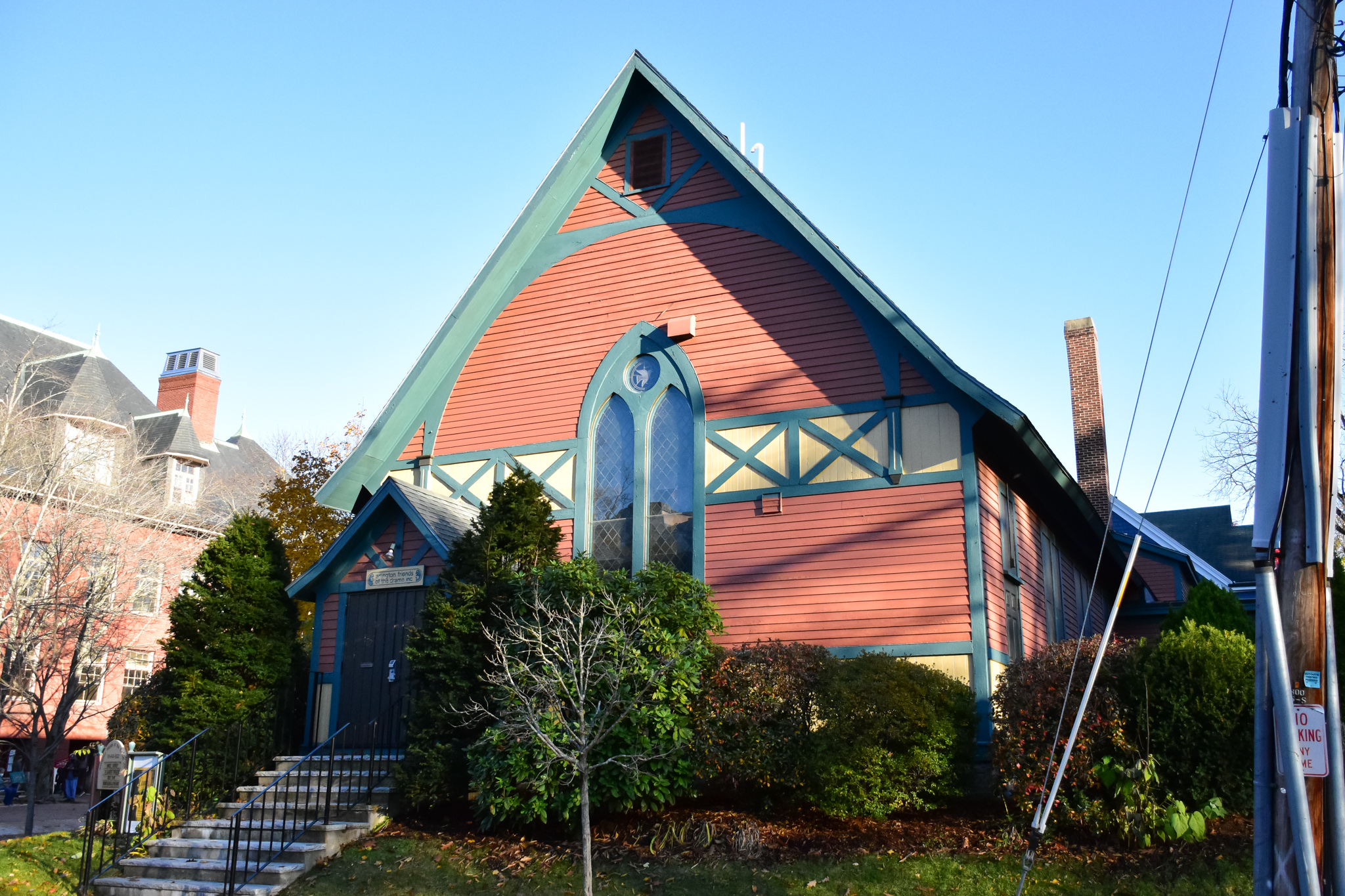
Arlington Friends of the Drama (aka AFD Theatre), which was founded in 1923, is located in the former St. John's Episcopal Church. Built in 1877, the building "is a handsome and well-preserved example of the Stick Style of ecclesiastical architecture," per MACRIS. "It has a rural air that echoes a preference for sermon over ceremony."

Finally, the former Central Junior High School, on the corner of Academy and Maple streets.

Now home to the Arlington Center for the Arts and the town's senior center, the former school rose in 1894. The building "is architecturally distinguished, and one of Arlington's handful of really monumental structures," according to MACRIS. "Its form was as much based on theories on public health as that of scholastic organization or architectural effect -- the outsized 'chimneys' are actually ventillation stacks. The building combines the proportions and gravity of Richardsonian Romanesque with Chateauesque dormers and symmetrical elevations, that foreshadow the Classical Revival."

I couldn't have said it better myself.

OK, there you have it! Make sure to check back for part two of my Arlington series, in which I will venture further north along Massachusetts Avenue.

Way Down Yonder in Pawtucket, Part I

From Dave Brigham: I apologize in advance for this, but I often feel the need to explain my headline choices: I'll admit that befo...