Showing posts with label mansion. Show all posts

Saturday, July 2, 2022

Wandering in Wellesley Square

From Dave Brigham:

I started my series about Wellesley, Mass., in the Wellesley Hills neighborhood, simply because it was closer to my home geographically than Wellesley Square, which is the "downtown" of this tony Boston suburb (see April 23, 2022, "A Wonderful Walk in Wellesley Hills").

Really, though, I should have kicked things off with Wellesley Square, if for no other reason than this: the Romanesque Revival town hall located on a small rise on the outskirts of the village is the most stunning, small-town municipal building I've ever seen.

(Wellesley Town Hall from the front.)

(Wellesley Town Hall from the rear.)

(Side entrance to what was originally the town library.)

For a palace like this to be located in a town of roughly 29,000 people, albeit a very wealthy little burg, is quite unexpcted. Built in 1882 from a design by Henry Sargent Hunnewell and George Russelll Shaw (of Shaw and Hunnewell), the town hall was erected on land donated by Hunnewell's father, Horatio Hollis Hunnewell, who made his fortune via railroads, banking, mining and real estate.

"As stated by the selectmen in their report of 1885, the town hall was erected on land belonging to Mr. Hunnewell, and it was built at his own expense," MACRIS reports. "He gave the land partly in recognition of the honor bestowed upon him in allowing him to name the town 'Wellesley' after the family name of Mrs. Hunnewell, the former Isabella Pratt Welles."

MACRIS continues: "This building can easily be considered the most striking and significant within the Community of Wellesley. It was apparently built under the influence of French architecture which the architects...had seen first hand on their extensive travels in Europe."

The steps at the old side entrance to the building are graced by the original bell that hung in the town hall.

(The bell was placed here on April 6, 1981 to commemorate Wellesley's centennial.)

The bell was cast by H.N. Hooper & Company, whose namesake had apprenticed with Paul Revere.

At the back of the town hall's lawn is a plaque about a historic tree located in Cambridge, Mass.

("THIS ELM WAS A CUTTING OF THE CAMBRIDGE WASHINGTON ELM," the plaque says.)

I don't know an Elm tree from a truffala tree, so I didn't even know which of the many trees on the town hall grounds this plaque referenced. Anyway, the Washington Elm on Cambridge Common lived approximately 210 years, dying in 1923, per Wikipedia. "Beginning as early as the 1830s, it became popular legend that 'under this tree Washington first took command of the American Army (supposedly the words of Henry Wadsworth Longfellow)," Wikipedia continues. "The publication of the fictional 'eye-witness' journal The Diary of Dorothy Dudley in 1876 furthered the legend. Although George Washington did take command of the army on 3 July 1775, there is no official documentation stating that this event took place under the tree."

Maybe he used a cutting from the tree to replenish his fake teeth....

Anyway.

Sticking to the fantastic municipal building theme:

The Central Street Fire Station, at the intersection of Central Street and Weston Road, was built in 1928 in the English Revival style. Made of granite and other stone, the station is set apart from most fire stations of that era, or any other, most of which are built of brick. MACRIS reports: "According to an article in the July 13, 1978 Wellesley Townsman, Wellesley wanted '...to build an edifice which did not look like a fire station, but would...add to the beauty of the town.'"

It certainly does that.

I will discuss a few more places of interest before moving on to the main retail district.

I wasn't expecting to find an outpost of one of the world's largest and oldest fraternal orders in Wellesley.

The Independent Order of Odd Fellows was established in the United States in 1806. "The exact date of the first founding of Odd Fellowship is lost in the fogs of antiquity," per the organization's web site. "Some historians trace its roots back to the Medieval Trade Guilds of the 12th and 13th Centuries. Others estimated that it existed before 1650. What is clear is that there were a number of Odd Fellow groups in England in the 1700s."

As for the group's unusual name: per the IOOF web site, a leading theory is "That common laboring men should associate themselves together and form a fraternity for social unity and fellowship and for mutual help was such a marked violation of the trends of the times (England in the 1700’s) that they became known as ‘peculiar’ or ‘odd,’ and hence they were derided as ‘Odd Fellows.’ Because of the appropriateness of the name, those engaged in forming these unions accepted it. When legally incorporated the title ‘Odd Fellows’ was adopted.”

As for this local branch, Sincerity Lodge #173, like others in the international organization, it promotes community service and supports local businesses. The building, located on Central Street, dates to 1875, per this article.

On the corner of Denton Road and Washington Street is St. Andrew's Episcopal Church.

This lovely building dates to 1894. That's all I can tell you, since, unlike most church web sites I've seen, the St. Andrew's one doesn't provide any history of the parish.

A short jog north on Washington Street lands us outside Washington House.

While the building -- a 1904 Colonial Revival house that is now condos -- looks like it could be quite posh, you wouldn't guess that by the sign hanging by the long driveway.

"Although built and used as a private home during the first 12 or l3 years its use took a dramatic turn when Wellesley College bought it in 1918 from the William Johnson's (sic), the second owners," per MACRIS. "The next 30 or so years it served as a freshman dormitory for Wellesley girls. It was named Washington House by the College who were establishing many of the houses in the area as dormitories and were naming them for identification. Time came when all students were housed on campus and Washington House was closed and remained idle for a time. Its life as a guest house began with the ownership of William White who purchased it in 1954. He transferred title to George C. McMichael in 1960."

OK, let's move on to the shopping area of Wellesley Square, which is home to more than 100 shops, restaurants and businesses, per the merchants association web site.

I started my tour of the shops with the flagship location of Dover Saddlery.

Founded in 1975 by by Jim and David Powers, former members of the USET Three-Day Event Team, the equestrian supply store has grown into quite the successful chain. There are 33 stores from coast to coast.

A few doors down from the horse hobbyist shop is the E.A. Davis & Company department store.

When I first spotted the cool sign, I assumed it was a relic from times gone by. Thankfully, I was. wrong. Founded in 1904 by Emma A. Davis, the store sells high-end fashions for men and women, as well as housewares such as furniture and window treatments. This past May, the company announced that another in a long line of local families will assume ownership. "It is with great excitement that we announce the E A Davis legacy will continue under the new stewardship of Brian and Becky Voelkel," the shop announced on its Facebook page. "The Voelkel Family has shopped at E A Davis since childhood."

Note of interest: HBO's recent series about Julia Child, "Julia," filmed at the store last year.

While I love all of the old retail buildings in Wellesley Square, my favorite shot of my tour is of a truly backside location.

Located on Spring Street, which is the closest thing to a back alley in this chic village, Auto Lab Alignment was founded in 1979, and specializes in German cars, such as the BMW 2002 you see in the photo. There were two guys working on a similar car outside the frame of that shot, along the street.

Around the corner on Cameron Street is Bellisario Rare Coin Gallery.

Established in 1965, the store is open by appointment only, according to its web site. While I never shop in coin stores, I hold a soft spot in my heart for them, since I used to casually collect coins, and still keep my eyes peeled for interesting money.

Back out on Washington Street is the Taylor Building, home to, among other businesses, Japanese restaurant Riceburg; Richard's of Wellesley, a hair salon; home furnishings boutique European Manor; Panoply Day Spa; and Lorraine dry cleaning.

Built in 1904, the building was erected by Charles N. Taylor for the Wellesley National Bank, where he was president, according to this Waymarking page. "The building also housed the Post Office until the present one was built in 1964," the entry continues.

Over on Crest Road, hard by the commuter train tracks, is a sprawling old building that's home to many businesses, including Faber Rug.

While I love the hand-painted sign, I'm confused by it. It looks as though it says "Faber's Rug" and perhaps covers up an older version of the sign, so the apostrophe and letters "r" and "s" are still showing. Anyway, this is the back entrance to the store, which was founded in 1954 in a different location in Wellesley. A few doors down is something called the Crest Road Mall.

The mall includes access to the rug store (I think), as well as Fast Frame picture framing, the Hagan Collection art gallery and Richard Tung massage therapy.

(Main entrance to Faber Rug on Central Street.)

A short walk west along Central Street gets you to the Central Block building, home to Lacrosse Unlimited, health food restaurant Cocobeet, the Wellesley Toy Shop and O'Neil Jewelers.

I haven't found any information about this building, but I'm guessing it dates to the 1920s or '30s.

Directly across the street is Clever Hand Gallery, which is located in a building with a surprising history.

An artisans collective around since 1973, the gallery is located in a significant building, as "it is the only building in Wellesley with an Art Deco facade," according to MACRIS. The site rose in 1923 as a shop selling auto batteries, tires and related items, operated by Robert Smith (no, not this guy), MACRIS continues. Just three years later, the building was leased to the Sat-ten Shop, which sold chocolate sauce the company manufactured elsewhere in Wellesley. The shop owners undertook extensive renovations, including "treatment of the front section [that] is a reproduction of a (sic) Italian court scene," according to an article published at the time by The Townsman, which is included in the MACRIS write-up.

(Random sidewalk art located elsewhere in Wellesley Square, which I assume is somehow related to Clever Hand.)

I'm going to wrap up with a sad story about what appears to be a cool store in a neat old building.

Cachet on Church Street, which sells clothing and housewares, is going out of business. "Time to say goodbye," the sign in the window indicates. "We have loved serving you and we will miss you." I don't know how long the store has been business, but I assume for quite some time. This building, like the similar one next door, was built in the early 1920s by Charles E. Holman, according to a marketing web site for the shops and eateries located here. It was Holman's sister-in-law, Emma A. Davis, who opened the E.A. Davis store mentioned above.

I love the architecture of these buildings, especially the leaded glass with lights behind it, as seen in the storefront for women's clothier Clementine below.

That's a wrap for Wellesley Square. Make sure to check back for another post about this lovely town, featuring some off-the-beaten-path landmarks.

Saturday, February 19, 2022

New York City Flashback: Views from a Tour Bus

From Dave Brigham:

Recently this thought struck me like a runaway freight train: I visited New York City three times between 2010 and 2016 and I didn't post anything about my trips!!!

Granted, it's only in more recent years that I've become obsessive about chronicling places in Greater Boston and cities that I visit on vacation (Seattle, Chicago, Panama City). As well, I've gotten much better at editing my photos in that time. What that means is a) there aren't as many photos in this post as you might expect and b) those photos aren't always as good as I'd like them to be.

Anyway, I dug through my archives, found a bunch of useable photos, and decided to post whatever the blog equivalent of latergrams is. This is the last of four posts.

Links to the previous posts are at the bottom of this one.

I shot the photos in this post from a double-decker tour bus as we rode through Upper Manhattan and Harlem.

Let's start with one of the most well-known buildings in New York City.

Although I took this photo nearly six years ago, I had a good guess as to what this building is. But I turned to my Facebook experts to confirm my suspicions. This, as many of you already know, is The Dakota, which is best known as the place where John Lennon was murdered on December 8, 1980, by Mark David Chapman. The ex-Beatle and his wife, Yoko Ono, lived in the building. She still maintains an apartment there.

The Dakota, of course, is much more than just a famous murder scene. Built between 1880 and 1884 and designed by Henry Janeway Hardenbergh, the apartment building is located on the Upper West Side, across from Central Park. "Hardenbergh's architectural firm was commissioned to create the design for Edward Cabot Clark, head of the Singer Manufacturing Company," according to Wikipedia. "The building purportedly was named The Dakota because at the time of its construction, the area was sparsely inhabited and considered remote from the inhabited area of Manhattan, just as the Dakota Territory was considered remote. The earliest appearance of this story, however, was in a 1933 newspaper interview with The Dakota's long-time manager. Christopher Gray of The New York Times quoted the interaction thus: 'Probably it was called 'Dakota' because it was so far west and so far north.' Gray believed that the building's name stemmed from Clark's fondness for the names of the new western states and territories."

Other famous residents over the years include actress Lauren Bacall; Steely Dan co-founder Walter Becker; singer Roberta Flack; actor Boris Karloff; football coach/commentator John Madden; and financier Wilbur Ross. The building was added to the National Register of Historic Places in 1972.

Staying with the music and entertainment angle, the next spot is one of the most highly regarded theaters in the Big Apple.

Opened in 1913, the Apollo Theater "has played a major role in the emergence of jazz, swing, bebop, R&B, gospel, blues, and soul — all quintessentially American music genres," per its web site. In 1934, Leo Brecher and Frank Schiffman bought the theater from Sidney Cohen, shifting from burlesque to variety reviews. The owners focused their shows on the growing African-American population in Harlem. "Showtime at the Apollo," a TV show featuring singers, dancers, orchestras and comedians, debuted in 1955 and ran until 2008. Comedian and TV host Steve Harvey brought the show back in 2018. In 2020, the Apollo debuted a digital stage to showcase entertainment in the COVID era.

The next photo looks like a Hollywood backlot, but I don't know exactly where it is.

Thanks again to my Facebook friends who either live or once lived in Manhattan, I was able to identify the church below.

The Cathedral Church of Saint John the Divine is "the mother church of the Episcopal Diocese of New York and the Seat of its Bishop," according to its web site. Located at 1047 Amsterdam Avenue, the house of worship is "the largest Cathedral in the world, meaning a church that is also the seat of a Bishop," per its web site. "Measured by length or internal volume, it is one of the five largest church buildings in the world." As large as it is, the church, which rose in 1892, is unfinished. "Like the great Medieval cathedrals and churches of the world, St. John the Divine will continue to be constructed over many centuries. Currently, funding is directed to prioritize serving the community through our programming and social initiatives, and to maintaining the architectural integrity of the Cathedral."

I wish I'd gotten better pictures of this majestic cathedral.

I have no idea what or where the next building is, except that it's on the M72 bus line. I used Google Maps Street View to try and find it, but had no luck.

The next building, however, was easy to identify through a Google search.

This one-of-a-kind place is Masjid Malcolm Shabazz, a Sunni Muslim mosque. "Founded by Honorable Elijah Muhammad in 1956, by Nation of Islam Minister El Hajj Malik Shabazz known then as Malcolm X, Masjid Malcolm Shabazz located at 102 West 116th Street in Harlem began as Muhammad’s Temple of Islam #7," according to the mosque's web site. Malcolm X, who served time in prison before becoming a leading figure in the civil rights struggles of the 1960s, was minister here from the mosque's founding until 1965. Louis Farrakahn, a controversial figure in his own right, succeeded Malcolm X.

There are businesses on the ground floor, including a pharmacy and a barber shop. The site is also home to the Harlem Business Outreach Center.

Today this site features this distinctive building, a house of worship. Prior to that, though, the site had a less holy designation. "Before becoming a religious structure, the lot used to contain the Lenox Casino, a space which was often rented for meetings by the Socialist Party and used as a theatrical performance venue for a number of then-renowned artists," according to this article. "Built in 1905 and designed by Lorenz F. J. Weiher, the Lenox Casino was raided in 1912 for showing 'illegal films.'"

I'm unclear as to whether the casino became the mosque, or whether the mosque is a newer building. Either way, cool building and neat history.

I love the detail on the next building, but I don't know where it's located.

I've been able to identify (if it weren't already obvious) the location of the rest of the buildings/scenes. The first is the former Mickey Mantle's Restaurant.

Named for the former Yankee great and Baseball Hall of Famer, Mickey Mantle's was located on Central Park South for nearly a quarter century. The eatery closed in 2012, 17 years after Mantle passed away. I shot this photo in 2011; I initially thought we'd taken our tour-bus ride in 2016.

The next photo showcases another long-closed restaurant, located at 383 West 125th Street.

Look closely and you'll see the "Southern Fried Chicken" sign that advertised one of the specialties at soul-food place, M&G Diner. By the time I shot this photo, the Harlem eatery had been closed for a few years. But from 1964 to 2008, the diner served up homestyle cooking at reasonable prices. The building has since been revampted, with a clothing store in the former M&B space.

Next up is a view of the Park Avenue viaduct, which emerges from a tunnel to carry the Metro-North Railroad. This is the Park Avenue main line, which runs from Grand Central Station, under the city until this point, then across the Harlem River into the Bronx, where it splits into the Hudson Line and the Harlem Line.

Thanks to one of my college friends on Facebook, I learned that the cool details below are on the lower, older section of Hearst Tower. Unlike the river cruise I took in Chicago a few years back, I wasn't making notes on this jaunt....

"The Hearst Tower is...the world headquarters of media conglomerate Hearst Communications, housing many of its publications and communications companies," according to Wikipedia. "The Hearst Tower consists of two sections, with a total height of 597 feet...and 46 stories. The six lowest stories form the Hearst Magazine Building (also known as the International Magazine Building), designed by Joseph Urban and George B. Post & Sons, which was completed in 1928. Above it is the Hearst Tower addition, which was completed in 2006 and designed by Norman Foster."

One last building, before we get to the bare facts about one of the most well-known buskers in New York City.

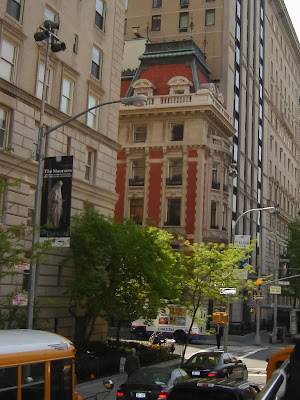
Once again, I have a Facebook college friend to thank for sending me on a Google Maps hunt, where I figured out that this is the Benjamin N. Duke House on Fifth Avenue. "The house was built speculatively by developers William W. Hall and Thomas M. Hall....Shortly after the mansion was completed in 1901, it was bought by Benjamin N. Duke, a tobacco, textile and energy industrialist and philanthropist, who was chairman of the American Tobacco Company at that time," according to Wikipedia. "Benjamin's brother, James, another tobacco entrepreneur, bought the house in 1907. He lived there until his own mansion...was completed in 1912.

"After James Duke relocated, the mansion became the residence of Benjamin Duke's son, Angier Buchanan Duke, until 1919, when his sister Mary Lillian Duke married A. J. Drexel Biddle Jr., and the couple moved in. Later, their daughter, Mary Semans, took over the residence. Members of the Duke family owned the mansion until 2006, when it was sold for US$40 million to Tamir Sapir, an American real estate mogul.

"The Mexican telecom magnate, Carlos Slim, at the time the richest person in the world, bought the mansion four years later in 2010 for US$44 million. Slim said in an interview with CNBC that he was planning on using the house as a place to stay when he was in New York for business meetings. In May 2015, he put the mansion up for sale at $80 million, nearly twice the amount he paid for it."

As far as I can tell, Slim still owns the house.

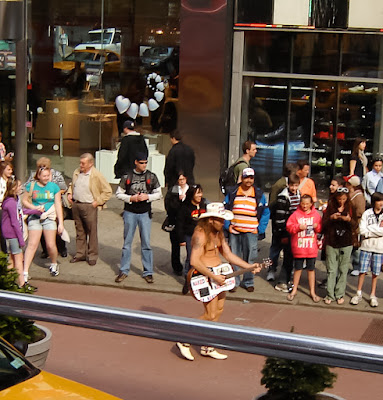
OK, time for the butt end of this post, of this entire series. Let's give a warm, backside round of applause to someone who could use the exposure: the one, the only Naked Cowboy!

Well, that wraps up my New York City flashback series. Hope you enjoyed it!

Here are the previous posts in this series:

"New York City Flashback: Views from the High Line"

New York City Flashback: Views While Strolling and Shopping

"New York City Flashback: The Transit Museum."

Monday, March 2, 2020

Tom Brady Slept Here

From Dave Brigham:

You like my new digs?

Located along Commonwealth Avenue in Boston's Back Bay, this place is just absolutely amazing. Known as the Burrage House, this mansion was built in 1899 as a private residence. Over the years, it was converted to doctors' offices, and then the Boston Evening Clinic, and then a nursing home, before being redeveloped as condos, according to a 1989 Boston Landmarks Commission report.

The 28-room mansion was built for lawyer and philanthropist Albert C. Burrage and his family, at a cost of $600,000, which is about $18.5 million in today's dollars. Per Wikipedia, Burrage was affiliated with several Boston-area gas light companies, was involved in copper mining and served on the Boston Transit Commission, which was responsible for building the city's subway system, the oldest in the United States.

The home remained in the Burrage clan until 1947, when the attorney's wife, Alice, died.

Tom Brady lived here many years ago, according to the Internet. Condos here have sold for in excess of $10 million.

Wednesday, November 13, 2019

A Tale of Brahmins, Terriers, Murder, Clever Inventions and, Perhaps, Tom Cruise

From Dave Brigham:

As impressive as this place is physically -- two-tone brickwork; beautiful details over the door, which is sturdy and yet welcoming; six well-appointed condominiums; an unbeatable location in Boston's Back Bay; views of the Charles River -- it's the building's history that makes it a one-of-a-kind gem.

This is the Hooper Mansion, a place with a history that touches on Brahmins, a city-defining dog breed, murder, amazing inventions and, just perhaps, Tom Cruise. WARNING: THIS POST IS GOING TO PLACES I NEVER IMAGINED WHEN I FIRST STARTED WRITING IT....

Converted to condos in 2016, the mansion was built in 1889 for Robert and Helen Hooper. Mr. H was the treasurer and president of the Constitution Wharf Company. Like many Brahmins of his day, Hooper had plenty of money and, I'm guessing, exquisite taste and manners. But history wouldn't remember him if it weren't for his dog.

From the web site of the Boston Terrier Club of America: "....Hooper, of Boston came into possession of a dog named Judge....Judge, commonly known as Hooper's Judge, was destined to be the ancestor of almost all the true modern Boston Terriers. He was a cross between an English Bulldog and a white English Terrier. He was a strongly built, high stationed dog of about thirty-two pounds weight. In color he was a dark brindle, with a white stripe in the face. His head was square and blocky, and he resembled the present Boston Terrier in that he had a nearly even mouth. Judge was bred to Burnett's Gyp (or Kate)....a white bitch, owned by Mr. Edward Burnett. She was of about twenty pounds weight, had a fine three-quarter tail, and was quite low stationed."

Hence the plaque by the front door that drew me in.

I wish I'd taken more pictures. To see exquisite shots of the exterior and interior, check out this Hacin + Associates web page.

I took these two pictures and moved along, happy to have learned some cool canine lore, but completely unaware of the deeper history of this place. It wasn't until I poked around online while writing this post that I learned about its "history worthy of a BBC miniseries," as my primary source puts it.

After the Hoopers, the next owner was inventor Mabel Slater. A widow when she resided in this palatial home, "Mrs. Slater is credited with developing both an ice-cooled refrigerator and a sleeping bag that doubled as a garment used by soldiers in World War I," per this fantastic account by Longleaf Lumber, an antique and reclaimed lumber mill that "recovered several trailer-loads of reclaimed wood" from the mansion before it's conversion to condos. Considered an eccentric and evidently a woman with a heart of gold, Mrs. Slater was known to leave a rear door of the mansion open so local poor folks could come in for food and shelter. This was a great idea...until it wasn't.

"In 1917, as reported by the Boston Globe, a violent intruder made his way in through this entrance, searching for Mrs. Slater. When butler Emile Knabe attempted to stop this intruder, he was shot and killed," per Longleaf's blog.

Wow, that's quite a bit of history! But wait, there's more....

From Longleaf: "In later years, Hooper Mansion has served as a dining club, a secretarial school, and most recently, until its sale in 2013, as the Church of Scientology’s regional base."

Whoa, whoa, whoa. What?!

I am OBSESSED with Scientology! I knew that the "church" had a Boston location (from 1975 to 2014, per a Boston Globe article I found online) but I had no idea where it was. I certainly didn't think I would stumble across it unknowingly. OK, let's get into this a little. Bear with me.

Dating back to seeing the 1976 miniseries "Helter Skelter," which debuted on CBS four days before I turned 11 years old, I have been more than a little intrigued by cults. The murder scenes were extremely bloody, as I recall, and the word "PIG" was scrawled on the walls in blood. When Charles Manson shows up in court with a swastika on his head and his zombie-eyed female followers shave their heads and start yelling in the courtroom, I was chilled to the bone.

I mean, check out this trailer! (I'm a little confused, as this clip shows a woman naked from the waist up, being hassled by cops. I'm sure that was edited out of the TV version.)

In addition to the Manson Family, over the years I've been fascinated by the Branch Davidians and David Koresh in Waco, Texas; Jim Jones and the People's Temple, who committed mass murder/suicide in the jungles of Guyana; the oddballs of Heaven's Gate, who also committed mass suicide while wearing matching tunics and Nikes; and the followers of Bhagwan Shree Rajneesh in Oregon. I find myself absolutely perplexed how seemingly normal people can become spellbound by charismatic leaders and do things that they probably never imagined they would, from killing people to committing suicide to, well, wearing matching tunics and Nikes.

Scientology fits right into this pattern. With their e-meters, which are basically lie detectors through which "auditors" interrogate members to find out their deepest secrets; belief in reincarnation; exorbitant fees for the massive number of classes members must take; the requirement to spend lavishly on the books of founder, science fiction writer-turned-religion-inventor L. Ron Hubbard, whom they mythologize to ridiculous extents (i.e., he cured himself of injuries suffered during World War II); and the existence of a ship where members are sometimes sent to live for indefinite periods while they are continuously monitored and berated, Scientologists are out-and-out crazy.

In order to learn more about just how insane this cult is, I religiously (pun intended) watched A&E's "Leah Remini: Scientology and the Aftermath," in which the former "The King of Queens" actress and one-time Scientologist explodes the myths about the cult and its demonic practices. In interviews with other former "church" members, Remini and co-host Mike Rinder expose the hypocrisy of the organization and question why Scientology remains tax-exempt and free from criminal investigation. Cult leader David Miscavige and others are accused by former members of using violence and intimidation to maintain an iron-fisted rule over followers.

Before Remini's show launched, I was riveted by Marc Headley's Blown for Good, in which he describes in almost excruciating detail his life at Scientology's "Gold Base" in California, and his harrowing escape after 15 years. Writing these words makes me realize I need to read more books like this. Although perhaps ones that are a bit more well-written.

So, anyway, whenever I come across something Scientology related, I pay attention.

That's why, a few years ago when I learned that a decrepit building in Boston's South End that I'd noticed before had once belonged to the Cult of Hubbard, I scoped it out (see April 8, 2018, "Tom Cruise Slept Here...Well, Maybe"). Somehow while researching that place, I didn't learn about the Hooper Mansion connection.

So, back to the home of Hooper's Judge.

The Church of Scientology, which, to be clear, is not a church, conducted New England-based business at this location for nearly 40 years. So just what the hell went on in this place for four decades? I have no idea, but I'm sure it involved heavy-handed brainwashing and extraction of hard-earned cash from people's wallets. I hope that every once in a while some famous Scientologists -- Tom Cruise, John Travolta, Beck, Jenna Elfman -- stopped by to dazzle the everyday jamokes with their diamond-encrusted e-meters.

The Massachusetts Scientology HQ is now in Quincy, just south of Boston. At that facility, they offer a Personal Efficiency Course, free Personality Tests and screenings of "The Story of Diabetics."

I now return you to your normal routine. Although I suspect you're going to do some more digging online into this bizarre and brutal organization....

Wednesday, May 24, 2017

The Land of Enchantment

From Dave Brigham:

I lived here 29 years ago. No, I wasn't homeless, although there was a Salvation Army shelter just up the street all those years ago. And no, I wasn't squatting in a tent on the property, at 314 Broadway SE in Albuquerque, New Mexico. There was a small house, with a few attached apartments, here three decades ago. I lived there with friends for three months, following a three-week road trip.

I've been writing a memoir covering the trip and my time spent in the Land of Enchantment. I decided a while back I would write the last chapter only after returning to the city. I tried to convince my wife and kids to take a family vacation in New Mexico, but they wouldn't go for it. Then I realized that the better idea was to hang out in Albuquerque with the guys who I traveled and lived with in 1988.

So in early May my college buddy Pete and I flew out of Boston and met our fellow road-tripper, my high school friend and Seattle resident Andy, in the Duke City. Primary on my agenda for our quick two-day visit was to check out a few old haunts. That's what this post is about. I will also write two other posts, one featuring shots I took on an early-morning walk through downtown Albuquerque, the other, photos of Native American and Spanish ruins in the desert north of the city.

I like the look of the Broadway Market Building, which was just a few blocks from our house. I don't have any idea if there was a market in this building 29 years ago. We never shopped at markets or grocery stores back then; we ate out once in a while, or bought ramen noodles, soup, bread, mayo, tuna, cereal and beer at places like the Circle K or 7-Eleven. We also bought more than our share of chili-and-cheese hot dogs at the latter joint. The building was converted to apartments at some point.

One place we ate is the Frontier Restaurant, an institution for students at the University of New Mexico. Located on Central Avenue (aka Route 66), the restaurant served as a hangout for Pete and me, as well as another guy on our trip, John. Andy left our road trip, which started in New England, part way through in order to return to Connecticut for a family party. He joined us in Albuquerque after we'd already been there for at least a month.

I have a thing for clever hair salon names, which started when I was living in Albuquerque. On the 1.5-mile walk from our rental house to the Frontier, I passed a place called Hairforce One, which to this day is my favorite salon name. I didn't see it on my return trip, but Hair We Are is a pretty good name, and I just love the colors and the artwork on their shop.

We didn't have a lot of money when we lived in the Duke City, but luckily drinks and cover charges were pretty low, so we managed to get out with some regularity to see local and national bands. We spent plenty of nights at the Fat Chance Saloon, which no longer exists. We asked the owner of a bar on Central Ave. where we were tipping a pint, "Where was the Fat Chance?" He told us it was in the space where Brickyard Pizza is now, so we popped in for a quick look.

There was a much closer bar that we also visited on occasion. El Madrid (or, as we gringoes called it, The El Madrid), was a short walk from our house, across a bridge over some railroad tracks. We drank cheap beer out of mismatched mugs -- Black Label beer, Mason jars, cartoon characters -- and watched local bands and performance artists.

(Pete in the doorway of El Madrid.)

The place has obviously been shuttered for a while. I was saddened but not completely shocked to see that the awesome Elvis mural on the outside of the bar has been defaced. That's just tragic. It was painted by Kenneth Wolverton.

Here's a photo of the full mural -- on each side of the front door, and above as well -- in all its glory.

I want this sign and light from outside El Madrid. Now, look in the background of this photo, to the right of the "BAR" sign. It's a turret.

And here's that turret from the front.

Built in 2006, this mansion belonged to the late local jewelry and antique seller Gertrude Zachary. Her store is located next to the house, in a neighborhood that various publications I found online refer to as "skid row," "a battlefield of failed homes [and] empty parking lots" and "a barren industrial neighborhood." Those terms may still apply somewhat, but when we walked through the 'hood we spied a brew pub, an artists' collective called Sanitary Tortilla Factory, several funky new apartment buildings and a Fast Signs franchise.

I'm not sure why this poster of Martin Luther King, Jr. and Coretta Scott King was plastered on this building, but I like it.

Just two blocks from the mansion and antique/jewelry store, you get a sense of why folks refer to this area as skid row. The building above until recently was the Albuquerque Rescue Mission. The mission changed its name to Steelbridge and houses nearly 100 men and women on a daily basis and offers "faith-based" programs. I spied at least one building with the Steelbridge name on it, and saw a handful of apparently homeless men lolling about nearby.

After walking through some of our old neighborhood in the midday sun, we drove up Central Ave. to the Route 66 Diner, where Pete worked when we lived there.

Pete had the Pile Up, a "pile of pan fried potatoes, chopped bacon, chopped green chile, two eggs any style, cheddar cheese & red or green chile sauce on top," per the restaurant's menu. I had the 66 Burger, topped with New Mexico Green Chile. Andy had 66 Chicken Fried Steak. They were all terrific.

The next installment in this mini-series will focus on photos I took early one morning in the downtown Albuquerque area.

Way Down Yonder in Pawtucket, Part I

From Dave Brigham: I apologize in advance for this, but I often feel the need to explain my headline choices: I'll admit that befo...