Saturday, April 28, 2018

Toddling Around Chicago

From Dave Brigham:

I recently visited Chicago on a family vacation and, despite the colder than normal temps, had a great time. I ate some great food (including deep dish and thin crust pizza, but I have to say, Chicago puts too much cheese on those pies. Must be the proximity to America's Dairyland), checked out some fantastic museums and, of course, had my head on a swivel while walking and riding the train through the Windy City.

The last time I was in Chicago Jerry Springer was on the cusp of national stardom. While at the fabulous Kingston Mines blues club with my then-girlfriend (now wife) and her college roommate in the summer of 1994, we saw the former mayor of Cincinnati who became one of the most famous trash TV hosts in the U.S. of A. Somebody approached the singer of the band and whispered something in his ear. Then this guy shouts out, "Ladies and gentlemen, we have Mr. Gary Springer in the crowd!"

Gary Springer.

The three of us turned around. I saw a geeky guy with glasses and blonde hair arm in arm with a floozy. Beth and her roommate were excited, as they actually had a clue who this guy was, unlike me. Well, the next day as I was flipping channels on the hotel TV, who should I spot doing his schtick but Jerry "Don't Call Me Gary From the Stage, Please" Springer.

The closest I came to celebrity spotting on my most recent trip was chatting in our hotel with a crew member of Food Network's "Diners, Drive-Ins and Dives," who told me that host Guy Fieri was in the area, but not in our hotel. They were shooting updates to previous episodes of the show, which I enjoy watching.

This post focuses on cool signs, art work and buildings I saw while walking or riding around Chicago. I will write separately about the architecture river tour we took while in the City of Big Shoulders.

In addition to food and architecture, Chicago is also known for its music scene, from power pop (Cheap Trick) to alt-rock (Smashing Pumpkins), punk rock (Naked Raygun) to blues (Buddy Guy). Nobody looms larger over the latter scene than the guy who loomed outside our hotel window.

That's Muddy Waters. Created two years ago by Brazilian artist Eduardo Kobra, the 10-story mural honors the man born McKinley Morganfield in 1915, and who basically created the Chicago blues sound. Take a listen:

Out another of our hotel windows was a great view of the Chicago Theatre. Built in 1921, the theater was originally known as the Balaban and Katz Chicago Theatre, and was one of many owned by the uncles of actor Bob Balaban.

(Chicago Theatre, where Bill Murray appeared during our stay, doing a literary reading with musical accompaniment.)

Located around the corner from the Chicago is the Oriental Theatre, which dates to 1926. Since 1997 it has been known as the Ford Center for the Performing Arts.

On our first full day in Chicago we took the L (not to be confused with "The R") to the Shedd Aquarium. Along the way I drooled over the ghost signs, murals, amazing architecture and restaurants.

(Located on the back of the South Loop Club bar and grill, the Make Your Own Luck mural was painted by the Brooklyn artistic duo known as ASVP.)

(The former Somerset Hotel was built in 1892-93, and was also known over the years as the Mayer Hotel and the Hotel Roosevelt, which makes its ghost sign a bit difficult to read. It is now apartments, and is located a stone's throw from Stan's Donuts, a place I really wanted to go to but I was the only one.)

After we returned from the aquarium I went on walkabout in our neighborhood. Here are some of the cool sites I saw.

Our hotel -- the Alise Chicago, a National Historic Landmark that was once an office building where Al Capone's dentist had his practice -- was just a block from the Jewelers Row District. The Jewelers Center has been around since 1921, and features more than 180 jewelers.

As hard as I try, I can't make out the ghost sign on this building. Maybe something to do with gold plating? Seems logical, given that it's in Jewelers Row. I've been unable to track down any useful information online. Frustrating. I welcome any and all forensic efforts from my readers.

This cool little detail, on the other hand, allowed me to find plenty of information about the Charles A. Stevens Building. Built in 1912, the 22-story structure once featured a basement and six stories occupied by Chas. A. Stevens and Bros., purveyors of women's clothing, including undergarments. Stores on the upper levels were reached by high-speed elevators.

I spotted this side entrance to the Palmer House Hilton having no clue about the place. The fire escape coming down to the top of the awning gave me the impression that this building was a little down at the heels. I snapped this picture and moved on. Two days later, however, my wife and I set out from the hotel to find a Frank Lloyd Wright-related building (about which more below) and walked past the main entrance to the Palmer. It was then that I realized this place was incredibly grand. This iteration of the hotel (the original burned during the Great Chicago Fire) opened in 1873 and now claims to be the nation's longest operating hotel.

Miller's Pub looks great, doesn't it? Open since 1935, this place, according to its web site, has played host to movie stars, pro athletes, Broadway actors and politicians. Regular people too, I suppose. Notice the FINE FOOD SPIRITS sign in the lower right corner of the photo.

Every where I looked, it seemed, I saw something to shoot. I spend a fair amount of time walking through various neighborhoods of Boston and simply don't see the quantity and quality of neon signs, ghost signs and awesome architecture as I did in my brief time in Chicago. Central Camera has been around since 1899, as the sign says. I think that's awesome.

In doing research ahead of my Chicago visit, I was excited to see on Google Maps that the origin point of Route 66 was just a few blocks from our hotel. I put this at the top of my list of things to take a picture of.

On a 1988 road trip with three buddies, I traveled a bit along and close to Route 66 in Oklahoma, Texas and New Mexico. The Mother Road, as it's known, is still a treasure trove of neon signs, funky restaurants, roadside attractions, motels and more, although obviously since the advent of superhighways the old road has suffered. For a nice history of Route 66, check out the National Historic Route 66 Federation web site.

In Boston there is a lot of new construction and I feel like the more recent history of the city is disappearing. In Chicago, however, I found a nice mix of new and old buildings. Like the Palmer House, Iwan Reis & Co. is the oldest outfit in its business: tobacco.

Founded in 1857, the company stocks more than 15,000 pipes, a large selection of tobaccos and operates an old school lounge with modern amenities.

One company that's not in business anymore is A. Sulka & Company. Founded in New York City in 1893, the haberdasher and shirt maker eventually expanded to London, Paris, Chicago and other locations. Well-heeled clients included Clark Gable and the Duke of Windsor. The company's last store, in the Big Apple, shuttered in 2002.

I shot this sign because I liked the idea of a highfalutin social club marking its alley so winos and roughnecks passing behind the building would know where they were (and, by extension, where they are not welcome). The University Club of Chicago was established in 1887 and occupies a beautiful building fronting Millennium Park. I took the shot below on a family walk on our last night in the city.

As you can tell from this post and many others I've written over the past eight years, I love architectural details.

So you know I was excited by these owls above the entrance to 8 West Monroe Street. Built in 1913, the building was once an office tower called the North American Building, but is now known as Metropolis Condominiums. I'm not sure of the significance of the owls.

As I mentioned, we had a lot of great food in Chicago. But we only had so much time, so we didn't get to eat at the Italian Village.

Opened in 1927, the Village is a third-generation venue that features three restaurants, each with its own chef. Based on these interior shots, the place looks amazing.

Just down the street from the Italian Village I found this very cool weather notification system attached to a circa-1906 building that over the years has been known as the Chicago Title & Trust Building, the Rector Building and the Bell Savings Building. The bell evidently changes color with the weather forecast: yellow for colder temperatures, red for warmer, and green for no change, per this web site. I can't tell if this is green, or if the bell is even working.

This unusual-looking building is the Chicago Loop Synagogue. Built in 1957, the synagogue was designed by Loebl, Schlossman and Bennett, firm founded in 1925 that is still in business. The outside isn't much to look at, but the interior is something else.

Just around the corner from my hotel, as I wrapped up my cold but very worthwhile backside stroll, the little kid numismatist inside of me got very excited.

That Buffalo nickel caught my eye. I have a few in the coin collection I started when I was in elementary school. I snapped a picture and regret now that I didn't step inside Harland J. Berk, Ltd..

I wrapped up my walkabout at the Chicago Temple, home to the First United Methodist Church. Built in 1924, the church is just the latest in a long line of houses of worship the congregation has used. The temple is actually a skyscraper with offices on the 5th to 21st floors, according to the church's web site. With a spire on top reaching 400 feet above street level, the Chicago Temple is considered the tallest church in the world. Here are some interior photos from Atlas Obscura.

In the courtyard outside the church are numerous stained glass windows. This one's inscription reads:

"THE REV. JESSE WALKER

PIONEER METHODIST CIRCUIT RIDER

ARRIVING AT FORT DEARBORN

JUNE 25, 1825"

My wife and I went on another short walk around the neighborhood, primarily to check out The Rookery, a circa-1888 building with an extremely impressive lobby.

The building was designed by Burnham and Root, one of the most well-known 19th century Chicago architectural firms, according to the Rookery web site. The interior, however, was redesigned by Frank Lloyd Wright in 1905. In the intervening years the building has undergone numerous renovations, one of which resulted in this unique method of showcasing architectural details.

Below is the exterior of the Rookery.

Just a short stroll away was The Berghoff, yet another storied Chicago restaurant. I had this on my list of potential places to eat, but I realized that my kids wouldn't go for their German fare.

Looming above the restaurant are these two buildings.

The Century Building (directly above the Berghoff sign, with remnants of a rather large ghost sign) and the Consumers Building (notice the ghost sign at the very top of the building to the right) will be jointly redeveloped under a plan unveiled by a developer last summer.

The final building I spotted on our quick jaunt is an odd one for sure.

Click on this photo to enlarge it. Let's take a look at it together. On the ground floor we have the Beef 'n Brandy restaurant and The Bar Below, which are sister establishments. Now let's move our eyes up to the second story. What is going on there? It looks like somebody transplanted the side of a small church onto the top of the Beef 'n Brandy. The third story looks like somebody cut out the dance floor from "Saturday Night Fever," tipped it 90 degrees, turned off the power and pasted it on top of the church wall. The top three floors look like they haven't been altered since the late 19th century.

What is up with this building?!?

After a little bit of searching online, here's what I found out: Known as the Waterman Building (it was built for pen company L.E. Waterman Co.), this seven-story edifice was designed by well-regarded Chicago architectural firm Holabird & Roche. Over the years, however, a parade of doofuses messed the circa-1919 building up. It "has been grotesquely obscured by three levels of facade paste-ons, including a faux New England front with clapboard and shutters," per this July 2006 Chicago Tribune article about the Loop's ugliest buildings. I believe at one point this building at 127 South State Street was the Chicago headquarters for the Red Star Line shipping company.

Last, but certainly not least, is this alley view of the side of the Chicago Theatre that I caught as my wife, kids and I were strolling to Millennium Park to see Cloud Gate (aka "The Bean"), as magnificent a place to hang out at sunset as there is in Chicago.

Come back soon for my write-up and tons of photos from our architecture river cruise.

Sunday, April 22, 2018

Fort Point Channel -- It's Electric!

From Dave Brigham:

This is Boston's Fort Point Channel, seen from a section of the Harborwalk that skirts behind the first Boston Wharf Company building you see as you cross Summer Street into South Boston. I walked here recently with my son, Owen. Whereas our trips on the subway into Boston used to involve staying mostly underground, in recent months we've explored areas of the city that are new to him, and in which I haven't taken photos before.

Boston Wharf Co. was incorporated in 1836, after which the company filled in the swampy area east of downtown and eventually constructed wharves and manufacturing and storage buildings for a variety of uses, including sugar and molasses, according to this blog post. Check out that post for photos of the pretty cool neon sign the company erected at the entrance to the district, which, before it was turned over to hipsters and tech-dorks was an artist enclave.

The sheer number of Boston Wharf Company buildings in this area is astounding.

(Boston Wharf Co. medallion. There are scads of these around the Fort Point Channel neighborhood.)

Our brief trek on the Harbor Walk led to this building.

This is one of two buildings that General Electric plans to renovate as part of it new global headquarters. The company, which broke ground in Boston last May after leaving its longtime Connecticut HQ, will also construct a new building, approximately on the site of the old Channel club, where I saw bands including the Butthole Surfers, Buffalo Tom and the Dead Milkmen back in the '80s and '90s.

In the photo above you see the ugly side of the Necco Court bridge, which GE originally planned to tear down. After neighbors -- many of them artists who flocked to the Fort Point Channel area decades ago -- complained to the city, GE agreed to preserve the pedestrian walkway. To see artist renderings of the bridge, historic photos of the area and read about the overall project, check this link out.

(The bridge, right, is on Necco Court, so named for the New England Confectionery Company (NECCO), maker of Necco Wafers, Sweetheart Conversation Hearts, Squirrel Nut Zippers, Mary Janes and Sky Bars. The company announced in March that it may shut down if it is unable to find a buyer.)

(I'm not sure whether this smaller bridge will be saved.)

I definitely want to return to Fort Point. Below are two random photos from the neighborhood.

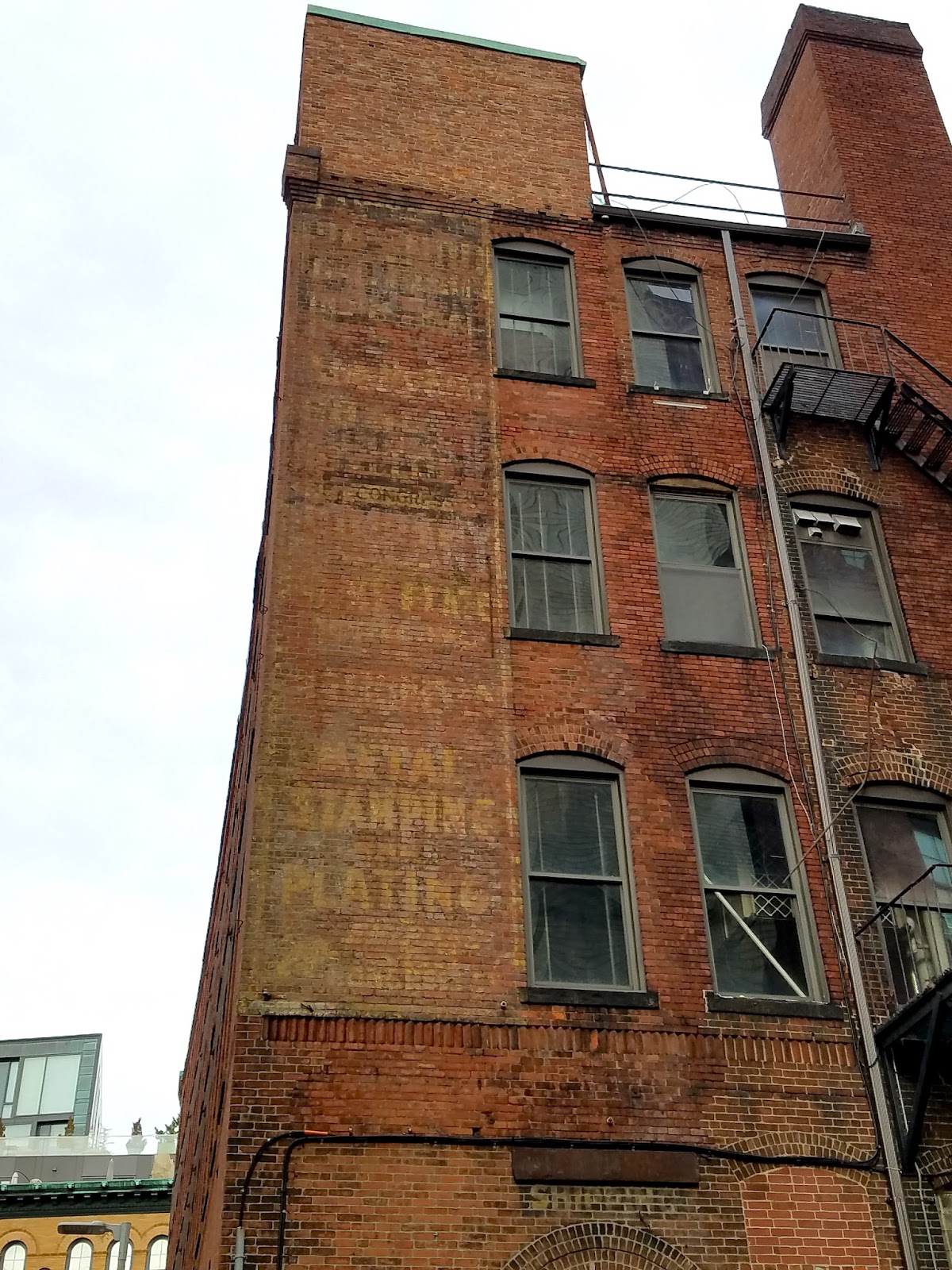
(The backside of a building at the corner of A Street and Congress Street.)

(Located on the ground floor of the above building is Lucky's Lounge, which has a Rat Pack vibe. This entrance was locked.)

Sunday, April 15, 2018

Sitting On the Dock of the Bayside

From Dave Brigham:

Pay no attention to the fact that there's no man -- or woman, child or, well, building -- behind the Bayside Expo Center sign. OK, there is, but it's the Massachusetts Registry of Vital Records and Statistics, not the exhibition hall where folks used to go see car shows, comic book conventions and electronics industry trade shows.

I'm pretty sure I went to Bayside once in the 27 years since moving to the Boston area. I don't recall what the event was, but I guess that doesn't matter, does it? I walked by the sign recently on a jaunt with my son, Owen, to check out the Calf Pasture Pumping Station on the nearby campus of UMass Boston (see March 29, 2018, "Udderly Monstrous"). We'd been in this area a few years ago while out riding the subway, and as he hunted for Pokemon I checked out the ongoing demolition of the old expo center.

Built in the 1960's as a shopping mall (!!!), the expo center site is located in Boston's Dorchester neighborhood. The mall shuttered in the early '70s and the building sat vacant, I believe, until opening as an expo center in 1983.

Here's a picture of it in its heyday:

I stole this photo from here. Buy it if you like.

After suffering through a business slump brought on by the opening of the massive Boston Convention & Exhibition Center in South Boston and the continuing operations at the Hynes Convention Center, Bayside went into foreclosure in 2009. UMass Boston acquired the property -- 275,000 square feet of exhibition space and 20 acres of parking lots -- in early 2010. Since that time the school has worked hard to figure out a plan for the property.

A few years ago, when Boston was bidding for the 2024 Olympics, the city's plan called for an athletes village at the Bayside site. Then Boston withdrew its bid. In 2016 talk was that the New England Revolution -- the professional soccer team owned by New England Patriots boss Robert Kraft -- would build a stadium at the old Bayside site. That fell apart, too.

Last August, UMass Boston issued a request from developers. In it, the school conceptualized "a vision to transform the Bayside Property into a modern-day Harvard Square, New Balance/Boston Landing, Kenmore Square, MIT Volpe Center etc., projects; a mixed-use destination where a diverse community lives, learns and thrives, integrated with and complementary to the UMass Boston campus that optimizes its value and creates an oceanfront Boston neighborhood with academic, research, retail, residential, dining, entertainment and cultural uses, serving as a new gateway to UMass Boston and distinguish the University in the higher education marketplace as a unique, attractive urban university, all accomplished by leveraging public private partnerships that will facilitate a more rapid development of the Bayside."

Whew! That's a LOT of words. The university received 16 letters of intent from developers. In January, UMass announced plans to sell the site, which it acquired for $18.7 million out of foreclosure, for as much as $200 million. Financially strapped, the school would use the proceeds from a sale or longtime lease, to demolish a crumbling parking garage and for other capital improvements, per the Globe article.

Whatever happens at this site, it will significantly change an area of the city that has been underdeveloped for decades. Other projects in the surrounding area are in the works, or at least in the pipeline. Stay tuned....

Sunday, April 8, 2018

Tom Cruise Slept Here...Well, Maybe

T.C. Mapother V

I wonder if John Travolta, Leah Remini or Giovanni Ribisi ever set foot in this building?

Located at the corner of Washington Street and Massachusetts Avenue in Boston's South End neighborhood, the former Hotel Alexandra was most recently owned by the Boston outpost of the Church of Scientology. When the religious group that's definitely not a cult purchased the building in 2008, it was with the intention of turning the circa-1875 Gothic structure into its New England headquarters. The House That L. Ron Hubbard Financed With His Crazy Crazy Books and Tape Recordings would have included a cafe, chapel and bookstore open to the public, according to this article.

The Folks Who Love Tom Cruise More Than They Love Themselves decided to sell the building, however, after failing to raise the millions needed to renovate the building, which has suffered multiple fires over the years. The Sons and Daughters of Xenu reached an agreement last summer to sell the building to Eric Hoagland, the son of CVS Pharmacy founder Ralph Hoagland.

Hoagland's Common Management Group plans to restore the property, but stated in the Boston Globe that the deal could take a year to close.

When The Worshipers and Captors of John Travolta acquired the former hotel in 2008, they also purchased an attached brownstone known as the Ivory Bean. Why was it called the Ivory Bean? Your guess is as good as mine, but let's agree that as far as building nicknames go, Ivory Bean is nowhere near as cool as the Darth Vader Building.

(You can see the outline of the demolished Ivory Bean building on the side of the former Hotel Alexandra.)

While the upper floors of the Building That David Miscavige Hoped to Use As Yet Another Place to Belittle and Assault His Underlings have been vacant for decades, the ground floor is home to a wig and beauty shop.

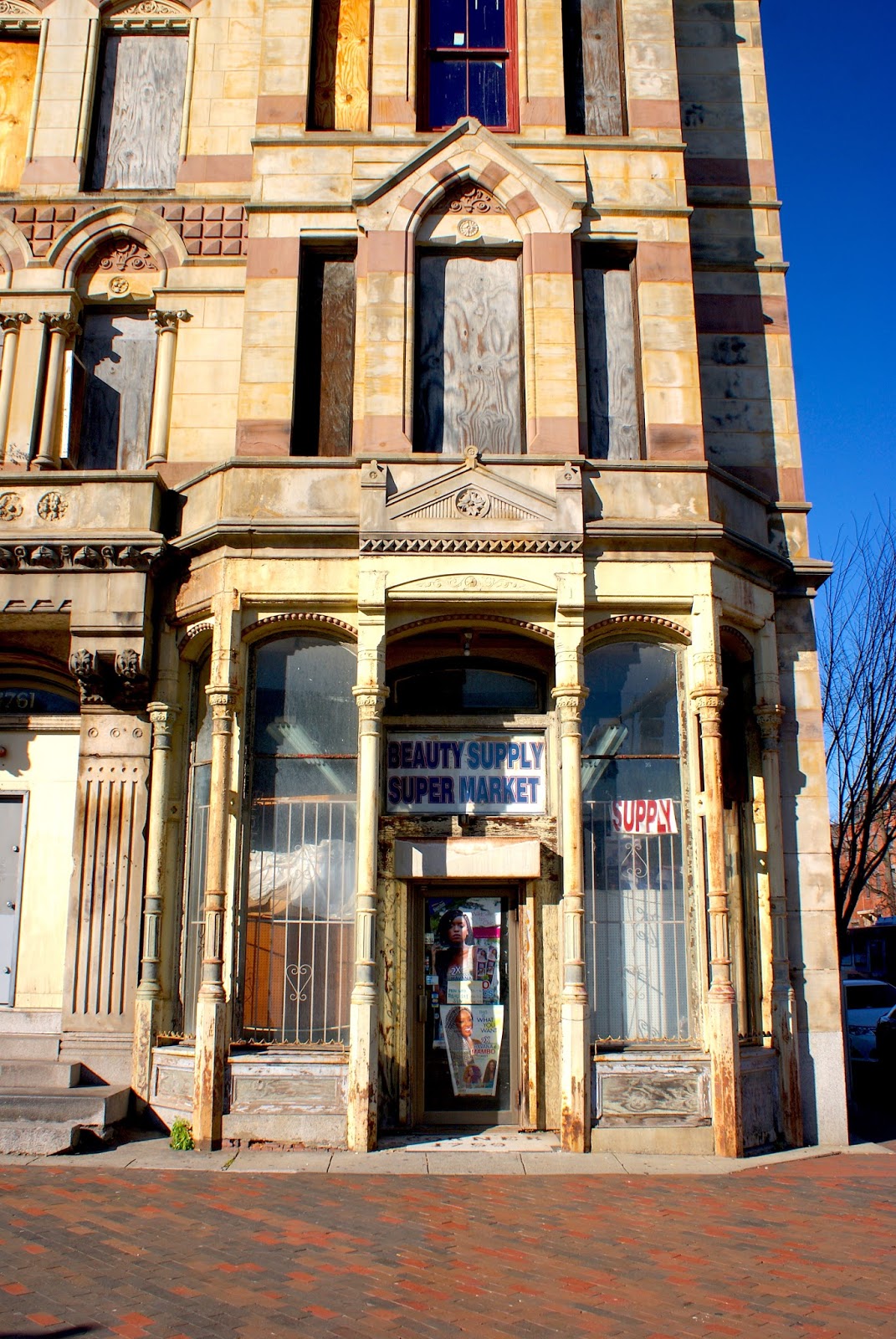
(The once-grand entrance of the five-story Hotel Alexandra -- which was an early Boston example of an apartment-hotel catering to the well-heeled -- just looks stupid now.)

(Close up, you can see, despite the rust and grime, the details that make this building stand out.)

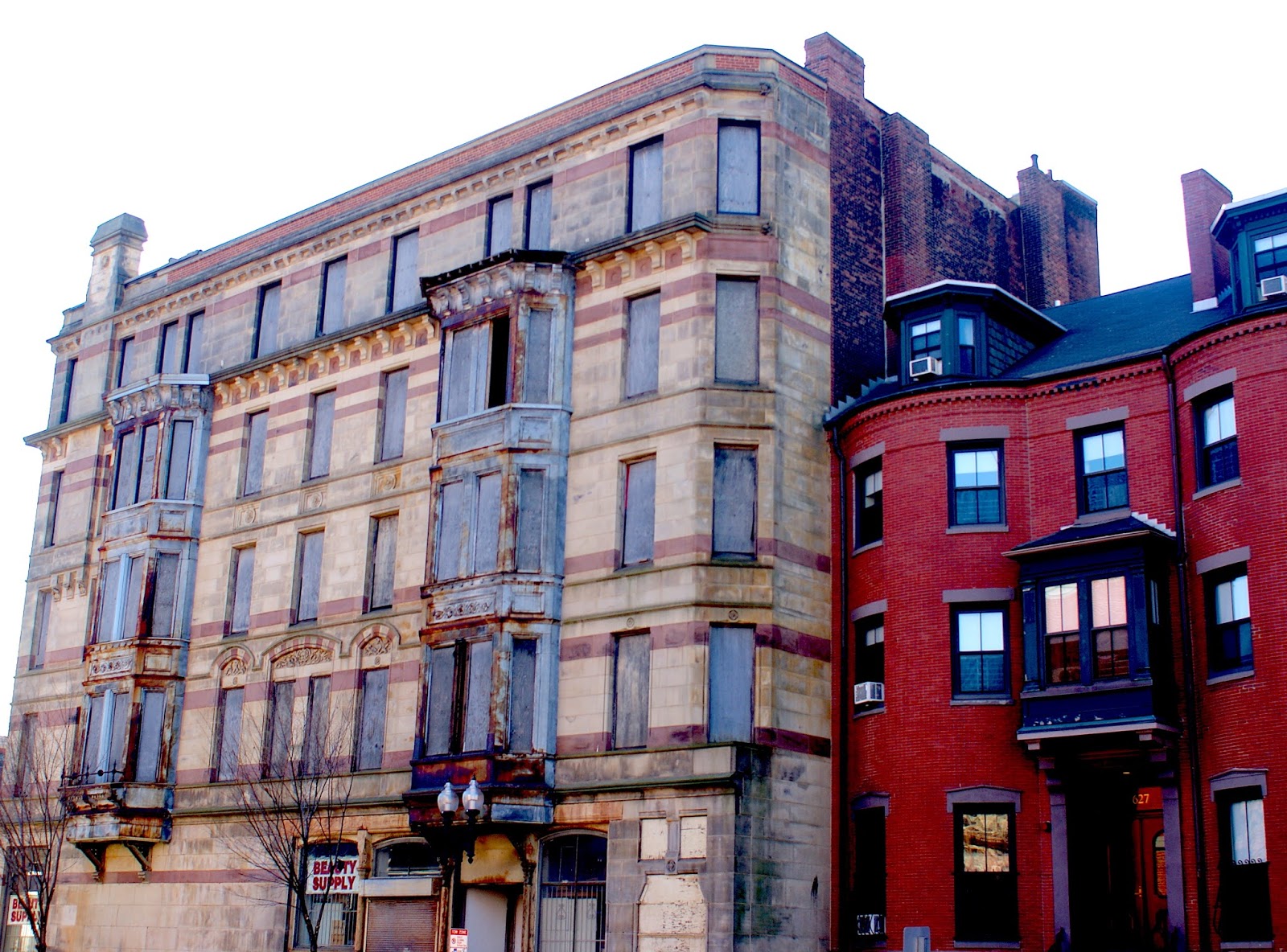
Will the Son of CVS be the savior of Hotel Alexandra that the Father of Diabetics couldn't be? Let's hope so. As you can see in the photo below, the building obviously used to be quite stunning. And the buildings around it deserve to see the former hotel shine again. Stay tuned....

Thursday, March 29, 2018

Udderly Monstrous

From Dave Brigham:

The wind was cold one recent day when I walked my son down a desolate strip of roadway toward this bleak mastodon of a building. He didn't want to go, which I understood. "They're locking you up for your own good," I told him, tears rolling down my cheeks. "You're too good. They want to toughen you up and get you ready for the Trumpocalypse."

OK, this is too morbid. This isn't a prison, and I wasn't turning my son over to The State in advance of a nuclear war.

But holy cow! Doesn't this place absolutely scream Victorian penal institution? Straight out of a Charles Dickens fever dream, or perhaps a late '70s Pink Floyd video?

The Calf Pasture Pumping Station -- the name tells you everything you need to know. But let's talk some more about it anyway. Located in Boston's windblown and perhaps-on-the-rise Columbia Point neighborhood, this incredible hulk was built in 1883 to help expel the city's waste out to Moon Island. The city closed the station in 1968 when the Massachusetts Water Resource Authority completed the Deer Island waste treatment facility (see February 27, 2015, "Digesting Deer Island," for a bit of history and some of my photos of the non-island.)

The Calf Pasture Pumping Station is so named because, well you know why, but let me tell you anyway: it was a calf grazing area for the residents of Dorchester for a few centuries. For decades after Boston built the pumping station, the city added fill to the original 14-acre peninsula, until the land mass was more than 350 acres, and featured Day Boulevard, Morrissey Boulevard and Columbus Park, according to this UMass Boston timeline of the facility, which now sits on the college's campus. For more information about the pumping station, read this and/or this. To learn more about Columbia Point and how the campus of UMass Boston was sited on a former dump, read this Boston Globe article.

For the past 50 years the granite complex -- which once included more buildings than the three currently standing -- has sat empty, haunted by the ghosts of so many lowing cows. For much of that time, I'm led to understand, there has been talk among city officials, college muckety-mucks and developers with slot-machine jackpots for eyes about what to do with this behemoth.

(One of the pumping station's satellite buildings. You can see a residence hall under construction in the background.)

So what's going to happen to this -- I hate to use the word -- eyesore?

UMass Boston acquired the pumping station from the Boston Water and Sewer Commission in 2012, after a dozen years of discussions and negotiations with the city, which didn't want to give up Calf Pasture because that would mean building a station elsewhere (the site was still used as occasional back-up. I'm unsure whether a new pumping station was built somewhere). Five years ago, the college posted an article, "Deciding the Future of the Calf Pasture Pumping Station," on its blog. Among the issues raised about the difficulty of renovating and repurposing the colossus: environmental remediation is required; a structural assessment needs to be done (and perhaps was); great financial resources are required to rehab the building, which has been nominated for the National Historic Register; and just what the hell do you do with a building that looks out of place amid the modern campus buildings, and brings to mind visions of sewage and rot and looks like a mental hospital or a prison for the mentally deranged?

Nobody seems to have any answers, at least none that are available online. After lying delinquent for so many years, the pumping station continues to deteriorate. My guess is that it will eventually be torn down, but since UMass Boston is a bit strapped for cash these days (look it up online), I imagine even that fate is several years off. As for the Columbia Point neighborhood, things are looking up. Sort of. UMass Boston is selling the land where the former Bayside Expo Center once stood (look for a future post about this), and I have to imagine that many of the parking lots in the area will get developed before too long. A Red Line subway stop is close by, as is the John F.Kennedy Presidential Library and Museum. Also, there is a plan afoot to turn the former Boston Globe HQ on nearby Morrissey Boulevard into a "tech-centric office space," according to this article.

(The backside of the backside.)

Stay tuned....

Thursday, March 22, 2018

WASP Wanderings and Wonderings

From D. Anathopolous Brigham III:

I have a bit of a WASP hang-up. I am a descendant of British settlers who landed in America in the 1630's, but who either squandered the family fortune or never had one to begin with. Thomas Brigham, my many-times-over great grandfather, once owned land that eventually was sold to Harvard University. But by the time that transaction occurred, my family no longer owned that property. I felt I should have dated Ethel Walker girls during high school, joined the Skull and Bones Club at Yale and been fitted for a personalized golf cart at The Country Club in Chestnut Hill.

I grew up among the preppie set in Simsbury, Conn., including one kid who once simultaneously wore more than two dozen alligator shirts and button-down Oxfords just for kicks. But although I share a last name with a guy who founded a well-known hospital in Boston, as well as a dude who started a locally famous Greater Boston ice cream/restaurant chain, I didn't fit into the espadrilles-and-penny-loafer crowd. My family didn't have money to throw away on scads of wide-wale pants and boat shoes.

Still, I love adopting a Thurston Howell III locked-jaw, old-money accent and pretend-shopping online at J. Peterman's web site. I dream of mahogany-paneled private libraries stained by decades of Three Nuns pipe smoke. My eyes light up when I read about any of the dwindling numbers of Boston Brahmin socialites (my favorite -- OK, the only one I know -- is Smoki Bacon. I know, sounds like a drag queen or porn star, but no.). I always wanted to eat at the famous Locke-Ober -- open for 137 years until 2012, host to JFK, business tycoons, politicians of all stripes, blue bloods galore, a place where gentlemen were required to wear jackets -- but never got to do so.

Now, what was my point? Oh yes, old boy! The cluster of pleasant-looking condominiums in the above photo. Built in 1900, the buildings are situated across the street from the Brimmer and May School in Newton, Mass. The school straddles Newton and Brookline in an area called Chestnut Hill that also includes part of Boston. There is a LOT of money in this special corner of the world. Business, sports, entertainment and political success stories abound, as do legacies of Chestnut Hill's WASP origins (see December 5, 2016, "I Seek Newton, Part VI: Chestnut Hill").

I first noticed the backside of the condo complex located along Middlesex Road on Green line trolley trips. Among the stately mansions and well-groomed private school properties, the buildings definitely look a bit out of place. Still, with their bright-white paint jobs, refined porches, circular driveway and elegant foliage, these edifices look like half-scale Southern plantation houses.

My first guess was that perhaps the buildings had once housed the well-to-do students of Brimmer. After quite a bit of searching online, I disabused myself of that surmise (listen to me talking like Charles Emerson Winchester III! -- RIP, David Ogden Stiers). The six buildings currently house at least 19 units. I suppose at one time there may have been fewer units, perhaps as low as six. In my mind, there were a few down-on-their-luck WASPs living here in the early 20th century, cousins to luxury whose trust funds were just a tad underfed, making do in shabby chic quarters just down the road from the Longwood Cricket Club, where perhaps they might cadge a drink once in a while.

For another, shorter entry about a WASP-y property in Dedham, Mass., check out September 9, 2010, "The Privilege Is All Mine."

OK, I'll let the fops from the Upper Crust have the last word.

Way Down Yonder in Pawtucket, Part I

From Dave Brigham: I apologize in advance for this, but I often feel the need to explain my headline choices: I'll admit that befo...